Training Symbol-Based Equalization for Quadrature Duobinary PDM-FTN Systems
A training symbol-based equalization algorithm is proposed for polarization de-multiplexing in quadrature duobinary (QDB) modulated polarization division multiplexedfaster-than-Nyquist (FTN) coherent optical systems. The proposed algorithm is based o…
Authors: S. Zhang, D. Chang, O. A. Dobre
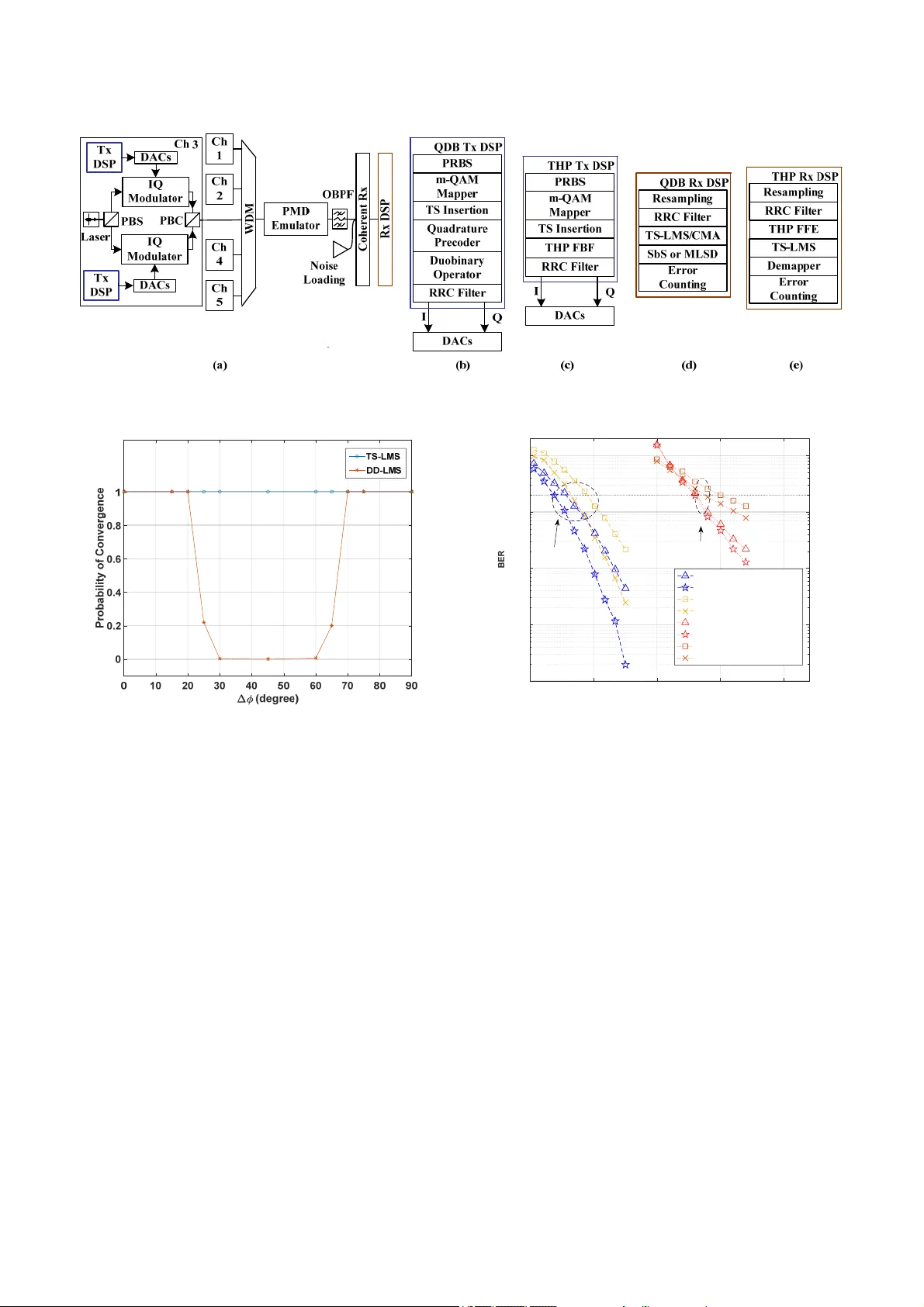
1 Abst ract —A training symbol-based eq ualization algorithm is proposed for polarization de -multiplexing in quadrature duobinary (QDB) modulated polarization division multiplexedfaster-than-Nyquist (FTN) coherent optical systems. The proposed algorithm is based on the least mean square algorithm, and multiple location candidates of a symbol are considered i n order to make use of the train ing symbols with QD B modulation.Results show that an excellent convergence performance is obtain ed using the p roposed algorithm under different polarization alignment scenarios. The optical signal-to-noise ratio required to attain a bit error rate of 2×10 -2 is reduced by 1.7 and 1.8 dB using th e proposed algorithm, compared to systems using the co ns tant modulus algorithm with differential coding for 4-ary quadrature amplitude modulation(4-QAM) and 16-QAM systems with symbol-by-symb ol detection, respecti vely.Furthermore, comparisons with the Tomlinson-Harashima precoding-based FTN systems il lustrate that QDB i s preferable when 4-QAM is util ized. Index Terms —coherent optical sy stems, faster-than-Nyquist, adaptive equalization. I. I NTRODUCTION ECENTLY ,the use of quadrature duobinary (QDB) modul atio n for polari zation division mult iplexed (PDM) faster-than-Nyquist (FTN) systems has b een proposed and investigated to increase the spectral efficiency in optical communicationnetworks [1-5]. In these studies, blind adaptive equalization techniques such as constant modulus algorith m (CMA) and multi-modulus algorithm (MMA) were applied to separate the polarization multiplexed signals. However, both the CMA and MMA may converge slowly, and suffer from the singularity problem where the equalizer recovers the same signal (or with so m e ti me shift) for both po larization outputs. Additionally, differential coding, which is employed wi th the CMA/MMA to handle the phase ambiguity problem,where the phase rotations of integer multiples o f π/2 from the or iginal symbol are not tracked, leads to performance penalty [6 ]. Another blind adaptive equalization technique, the phase-dependent decision-directed least-mean square (DD-LMS) algorithm, wasimplemented in [3], [5] f or the QDB This work was supported in part by the Atlantic Canada Opportun itie s Agency ( ACOA), in part by the Research and Develop ment Corpo rat ion (RDC). S. Zhang, D. Chang , O. Dobre, O. Omomukuyo, X . Lin and R. Venka tesan are with the Faculty of Engineering and Applied Science , Memori al University, St. John’s, NL, A1B 3X5, Cana da (e-mail: szhang13@mun.com) PDM 4-ary quadrature amplitude modulation (4-QAM) systems without the aid of differential coding. However, whenthe signal is highly distortedby the cha nnel, the DD-LMS algorithm also su ffers from the phase ambiguity problem, as well asthe convergence failure [7]. To avoi d these problems, it is desirable to use training symbol-based algorithms. Nevertheless, this i s not straightforward for the QDB modulated signals because each original training symbol has several possible candidate positions after the QDB o peration, as shown in the following section. In th is letter, we propose, for the f irst tim e to our kno wledge , a tr aining symbol-based least mean square ( TS-LMS) algorithm fortheQDB-PDM-FTN system s. It exhibits an excellent convergence performance and avoids the degradatio n ofthe sy stem performance introduced by differential codin g. A comparisonbetween the standalone D D-LMS algorithm and the proposed TS-LMS algorithmon their co nvergence under different polarization alignment conditions is conducted in simulation. Further more,thebit error r ate (BER)is measured as a f u n c t i o n o f t h e o p t i c a l s i g n a l - t o - n o i s e r a t i o ( O S N R ) o f t h e received signal using the TS-LMS algorith m and the CMA with differential cod ing in 4-QAM and 16-QA M systems.In addition, wecompare the QDB-PDM-FTN sy stems with the PDM-FTN schemes enabled b y Tom linson-Harashima precoding [8] (THP) f o r b o t h 4 - Q A M a n d 1 6 - Q A M s y s t e m s i n t e r m s o f B E R performance and their sensitivity to channel spacing variation . II. P RINCI PLE OF THE PROP OSED TS - LMS ALGORITHM In the QDB modulated systems, each quadrature (I/Q) branch of the incoming m -aryQAM ( m = 4 , 1 6 ) s y m b o l i s processed by the duobinaryoperator,in which the previous symbol delayed by one symbol period T is added to the current symbol. As illustrated in Fig. 1(a),before the duobinary operation, we implement a precoder with the inverse operati on, where the modulo- √ a d d e r i s u s e d t o c o n s t r a i n t h e s c o p e o f the output. Hence, the symbol-by-symbol (SbS) detection without error propagation can be applied, and the proposed TS-LMS algorithm becomes feasible. Note that the precoder will not degrade th e perform ance of the system [2], and a be tte r performance can be obtained by applying the duobinary operation at the trans mitter,as the processing of the transmission-added white noise is avoided. F ig s . 1 ( b ) a n d (c ) r es p ec t i ve l y s h o w t he c on s te l la t i on m ap s of 4-QAM and 16-QAM signals after the QDB operation. I t is worth noting that for bot h 4-QAM and 16-QAM signals, T rain ing Symbol-Based Equ alization for Quadrature Duobinary PDM-FTN Systems S. Zhang, D. Chang, O. A. Dobre, O. Omo mukuyo, X. Lin, and R. V enkatesan R 2 multiple points a mong the constellation points carry the same √ information bits, except for the center constellation po int at the o rigin. For example, the two hollow circle points in Fig. 2 (b) carry the bits “10”, and t he four hollow circle points in Fig. 2(c) carry the bits “0011”.In other words, the n -thoriginal QAM symbolis located on one of the multiple possible locations , ,…, , where p represents either the x o r y polarization, and t = 1, 2 , 4 for t he s y mbol s i n t he cen te r, on th e axis,and off the axis, respectively.This can be understood intuitively in the QDB operation pro cess, where the exactlocation of anoutgoi ng sy mbol is determined by the previous rando m data symbols. Convergence failures of the traditional TS-LMS algorithmcan occur in the polarization multiplexed QDB systems if the multiple possible locations of training symbols are not considered. We propose a TS-LMS algorith m that takes into account the multiple possible positions of the QDB modulated s ymbols. The proposed algorith m consists of two operation modes: the training mode and the tracking mode. At the beginning, the training mode makes use of the training sy mbols and the LMS algorithm is implemented to perform ada ptive e qualization. Then, it switches to the tracking mode, where the DD-LMS algorithm is used to keep track of the variation of the channel . N 1 training sy mbols are inserted at the beginning of the transmitted m -aryQAM symbols in order to achieve the pre-convergence at the receiver . Then, N 2 training symbols are inserted after ever y N b transmitted sy mbols to track thedynamic channel behaviors, such as the phase cycle s lip and transient polarization state change.When updating the butterfly-type adaptive equalizer in the trai ning mode, instead of using one fixed location, we choose the n -th training sy mbol’s location d p ( n ) between the t candidate positions by the following rule: ) ( ' ) ( ) ( ) ( min arg ) ( n i p p n S p p p e n E n S n d (1) where , ,…, , is the n -thtraining symbol’s corresponding received sy mbol in the polarization branch p at t he output of the butterfly-ty pe adaptive equalizer, and is the p -polarization branch’s carrier phase estimated by the pilot-assisted decision-aide d maximum-likelihood algorithm [9].To mitigate the pos sible phase cycle slip and enlarge the Euclidean distance, we generate the training sequence by randomly selecting training symbols a mong “01” and “10” for 4-QAM and “1100” and “0011” for 16-QAM, as shown by the hollow points in Figs. 1 (b) and (c), r espectively. It is noticeable that in the 16-QAM case there are other options for generating training symbols. Furthermore, the points on the in-phase (I) or quadrature (Q) axis, such as “0110” and “1001”, are not suitablebecause they cannot detect and correct the 180º phase cycle slips. III. S IMULATION S ETUP AND RESULTS To investigate the performance of the proposed algorith m, a system m odel, whose schematic is depicted in Fig. 2 (a) is buil t using VPI Tr ansmissionMaker. Five channels using the same scheme (QDB or THP) ar e simulated. The perfor mance is assessed on the central channel. The symbol r ate of each channel is 32 Gbaud. Unless otherwise mentioned, the channel spacing, ∆ f ,is 30 GHz, and the laser linewidth is 100 kHz.The optical signal ismodulated by two ideal IQ modulators. Polarization multiplexing is performed by a polarization bea m splitter (PBS) and a polarization beam c ombiner (PBC). The generation of the QDB and THP signals on each polarization branch are shown in Figs. 2 (b) and (c), respectively. For both schem es, N 1 , N 2 and N b are chosen to be 1000, 24 and 1000.Note that the selection rules of the tra ining symbols for THP sche me is explained in [10]. In the QDB scheme, the quadrature precoder and duobinary operator ar e implemented to process the symbols onI and Q branches separately. In the THP scheme, the signal is processed by the feedback filter (THP-FBF). The symbols are up-sampled by a factor of 2 and digitally shaped using the root raised-cosine (RRC) filter with a roll-off factor of 0.1 and a 3-dB bandwidth, Ω . Here, Ω is fixed to 32 GHz for the QDB scheme, whereas for the THP scheme, Ω is cho sen to give the best BER performance f or each value of the channel spacing [8]. When ∆ f is 30 GHz, the optimized Ω i s 28 GHz in the THP scheme. To simplif y the investigation, both chromatic dispersion and fiber nonlinear e ffects are neglected, and a first-order P MD emulator is employed to investigate the performance of the polarization de-multiplexing algorithms. The differential group delay ( DGD) value i s 50 ps.The worst polarization ali gnment condition is considered, where the state of polarization (SOP) ofthe input signal is offset from the principal axis of the DGD el ement by 45 degrees [11], unless otherwise mentioned.At the receiver, the central channel is Fig. 1. (a) Model of duobinary operation; Constellation maps o f 4-QAM;(b) and 1 6-QAM (c) signals with QDB (hollow p oints: selection of tr aining symbols). T Precoder Modulo adder m T Duobin ary operator 11 11 11 11 00 01 01 10 10 (a) (b) 1000 1001 1011 1010 1000 1001 10 11 0000 0001 0011 0010 0000 0001 00 11 0100 0101 0111 0100 0101 0111 1100 1101 1111 1100 1101 1111 0110 1110 1100 1101 1111 1100 1101 1111 1110 0100 0101 0111 0100 0101 0111 0110 0000 0001 0011 0010 0000 0001 00 11 (c) 3 selected by using a 0.4 nm optical band pass filter (OBPF) and then coherently detected by the combination o f a local laser with zero frequency offset to the transmitter laser of the cent ral channel, and a 90º optical hybrid. T he detected signal is t hen processed by the receiver DSP of QDB and THP, as shown in F i g s . 2 ( d ) a n d ( e ) , r e s p e c t i v e l y . F o r b o t h s c h e m e s , t h e T S - L M S algorithm is i mplemented by an 11-tap butterfly-type adaptive filter. In the QDB case, the pilot-assisted decision-aided(DA) maximum-likelihood(ML) algorithm is implemented wit h the equalizer to perform carrier phase recovery. It is worth noting that t he trainin g stage of the equalizer can be bypassed to ass ess the convergence o f the standalone D D-LMS. Wh en the CMA is used f or polarization de- multiplexing, the number of taps of th e equalizer is 11. Pr e- and post-filtering are implemented to enable the CMA for QDB modulated s ignals [ 12]. The α factorof the pre-filter [12] is optimized to be 0.7, which give s the best system performance. To sol ve the singularity problem, which was observed in si mulation, the CMA is modified according to [13]. T he carrier phase recovery is thenperformed using t he Viterbi-and-Viterbi (V- V) algorithm for the 4- QAM and blind phase search al gorithm [14] for the 16-QAM systems.Either S bS or the maximum -likelihood sequence detection ( MLSD) is used to recover the bits. In the THP case, the feedforward equalizer of THP (THP-FFE) is implemented before the adaptive filter. The parameters of THP, such as the modulo size an d the tap coefficients are optimized to obtain th e best BER performance for the given ∆ f [7 ]. The convergence performance of the TS-LMS algorithm is compared wit h the standalone DD-LMS algorithm under different polarization alignment scenarios. Fig. 3depicts the probability of convergence as a function of the input signal’s SOP offset from the principal axis of the DGD element (Δϕ) using both algorithms. 1000 trials are performed for each value of Δϕto obtain the results. As we can see from the figure, the TS-LMS algorithm always c onverges successfully, while the probability of convergence when using the standalone DD-LMS is less than 0.25% at an off set from 25 to 65 degrees. Moreover, the sys tem performance comparison between the TS-LMS algorithm andthe CMA with differential coding is conducted in simulation. To evaluate bo th systems when thereare cycle slips, the laser linew idth is increased to 1 MHz t o introduce higher phase noise.Fig. 4 shows the BER as a f u n c t i o n o f t h e O S N R f o r Q D B F T N 4 - Q A M a n d 1 6 - Q A M systems using both alg orithms . In simulations, cycle slips are observed when the blind phase estimation algorith ms are used with t he CMA, and the error bursts caused by the cycle slips ar e avoided by differential coding.On the other hand, no cycle slip Fig. 3. Probability of conver gence as a function of Δϕ. Fi g. 4 . B ER vs. OS NR fo r Q DB F TN sy st ems us in g th e C MA wi th di f ferential coding and TS-LMS algori thms, respectively. OSNR (dB) 10 15 20 25 30 10 -5 10 -4 10 -3 10 -2 10 -1 T S- L M S S b S ( 4 -Q AM ) TS-LMS MLSD (4-QA M) CMA SbS (4-QA M ) CMA MLS D ( 4-QA M) T S- L M S S b S ( 1 6- Q AM ) TS- LMS MLSD( 16-Q A M) CMA SbS (16-QAM) CMA MLS D(1 6- QA M) 4-QAM 16-QAM Fig. 2 . ( a) The schematic diagram of t he FTN system . (b) QDB transmitte r digital signal p rocessing (DSP) diagram. (c) THP trans mitter diagram. (d) QDB receiver DSP diagram. (e) THP receiver DSP diagram. (PBS: p olariz ation beam splitter, PB C: p o lar iza tio n be am com bi ner , OB P F: optical bandpass filte r, PRBS: pseudorando m bi t seque nce, RRC: root raised cos ine, DAC: digital- to -analog conve rt er, FBF: feedback filter; FFE: f eed forward equalizer. 4 is observed when the TS-LMS algorithm and the pilot-assis ted DA ML algorithm are used. From the results, we can see that the r e q u i r e d O S N R a t a B E R o f 2 × 1 0 -2 using the TS-LMS algorithm is 1.7 dB and 1.3 dB lower than using the CMA with differential coding for 4-QAM systems with SbS and MLSD, respectively. For 16-QAM systems, the BER performance is improved by 1.8 dB a nd 0.8 dB with SbS and MLSD, respectively. In F ig. 5 we illustrate the sy stem perfor mance of the QDB and THP systems. For 4-QAM,QDB with either SbS or MLSD outperforms THP by 0.5 dB and 2.4 dB at a BER of 2×10 -2 , respectively. On the other hand, the performance of QDB, ev en with ML SD,is 1 dB worse than THP at a BER of 2×10 -2 f o r 16-QAM. An explanation is r elated to the fact that the T HP operation m aintains the symmetric pro perty of the Gray mapping o f 16- QAM, whereas the QDB operation does not. Additionally, we i nvestigate th e relationship between the required OSNR for a BER of 2×10 -2 and ∆ f , as shown i n Fig . 6. For 4-QA M wi th QDB, ∆ f can be reduced to 23 GHz at anOSNR penalty of 1 dB with respect to a Nyquist system. ∆ f can be co mpressed to 28 GHzat 1 dB OSNR penalty for 16-QAM QDB systems. On the other hand, THP allows ∆ f t o be 27.5 GHz and 28 GHz for 4-QAM and 16 -QAM at an OSNR penalty of 1 dB, respectively. IV. C ONCLUSIONS A training symbol-based equalization algorithm has been derived for polarization de-multiplexing i n QDB PMD-FTN systems. Comparison with the standalone DD-LMS algorith m shows that the proposed TS-LMS algorithm c onverges well under differentpolarization alignment con ditions. The r equired OSNR is decreased by about 1.7dB and 1.3 dB using the TS-LMS algorithm for 4-QAM systems, and 1.8 dB and 0. 8 dB for 16-QAM systems with SbS and MLSD, respectively, compared to the conventional CMA with differential coding.Further investigati on on the co mparison with THP s h o w s t h a t Q D B i s p r e f e r a b l e f o r 4 - Q A M s y s t e m s a s i t p r o v i d e s an improved BER performance, whereas the opposite holds for 16-QAM systems. R EFER ENCES [1] J. Li etal ., “Enhanced digital coherent receiver for high spec tral-effici ency dual-polarization quadrature duobinary systems,” in Proc.Eur. Conf. Exhib. Opt. Commun ., Turin, I taly, Sep. 2010, P aper Th.10.A.3. [2] J. Li, E. Tipsuwannakul, T. Eriksson, M. K arlsson, and P. A. An derson, “Approaching Nyquist limit in WDM systems by low-complexity receiver-side duobinary sha ping,” I EEEJ.Lightw. Technol . vol. 30,pp. 1664-1676, Jun. 2012. [3] K. Igara shi, T. Tsuritani, and I. Morita, “Experimental study o n polybinary-pulse-shaped QAM signals for highly-spectral-efficie ncy super-Nyquist-WDM systems,” in Proc.Eur. C onf. Opt. Commun., Valencia , Spain, 20 15, Paper Mo.3.3. 6. [4] S. C hen, C. Xie, and J. Zhang, “Adaptive quadrature-polybinary detection in s uper-Nyquist WDM systems,” Optics Express , vol. 23, pp. 7933-7939, Mar. 2015. [5] K. Igarashi, T. Tsuritani, and I. Morita, “Polybinary shap ing f or high-spectral-efficient super-Nyquist WDM QAM signals,” IEEEJ.Lightw. Technol . vol. 34,pp. 1724-1731, Apr. 2016. [6] E. Ip and J. M. Kahn, “Feedforward carrier recovery for coheren t optical communications,” IEEEJ.Lightw. Technol . vol. 25,pp. 2675-2692, Sep. 2007. [7] X. Z ho u, J. Y u, M. Hu a ng , Y . S ha o, T . Wa ng, P. M agi ll, M. Cv ij e tic, L. Nelson, M. Birk, G. Zhang, S. Chen, H. Matthew, and S. Mishara, “Transmission of 32-Tb/s capacity over 580 km using RZ-shaped PDM-8QAM modulation format and cascaded multimodulus blind equalization algorithm,” IEEEJ.Lightw. Technol . vol. 28 ,pp. 456-465, Feb. 2010. [8] D. Chang, O. Omomukuyo, O. Dobre, R. Venkatesan, P. Gillard, an d C. Rumbolt, “Tomlinson-Harashima precoding with s oft detection f or faster than Nyquist DP-16QAM coherent optical system s,” in Proc. OFC 2015 , pp. 1-3, pa per Th3E.8. [9] S. Zhang, X. Li, P. Kam, C. Yu, and J. Chen, “Pilot-assisted decision-aided maximum-likelihood phase estimation in coherent op tical phase-modulated systems with nonlinear phase noi se,” IEEEPhoton. Technol. Lett., vol. 22, pp. 380– 382, Mar. 2010. [10] D. Chang, O. Omomukuyo, X. Lin, S. Zhang, O. Dobre, and R. Venkatesan, “Robust faster-than-Nyquist PDM-mQAM systems with Tomlinson-Harashima pr ecoding,” IEEEPhoton. Technol. Lett., vol. 28, pp. 2106–2109,Oct. 2016. [11] X. Zhou and C. Xie, “Enabling technologies for high spectral-ef ficiency coherent optical comm unication ne tworks,” 1 st. ed., New York, N Y, USA: Wiley, 2016, pp. 225. [12] J . L i , Z . T a o , H . Z h a n g , W . Y a n , T . H o s h i d a , a n d J . R a s m u s s e n , “Spectrally efficient quadrature duobinary coherent systems w it h symbol-rate digital signal processing,” IEEEJ.Lightw. Technol . vol. 29,pp. 1098-1104, Apr. 2011. [13] L . Li u , Z . T a o , W . Y a n , S . O d a , T . Ho s h i d a , a n d J . R a s m u s s e n , “ Initial tap setup o f constant modulus algorith m for po larization d e-multipl exing in optical coherent receive rs,” in Proc. OFC 2009 , pp. 1-3, pap er OMT2. [14] J. Li, L. Li, Z. T ao, T. Ho shida, an d J. Ra smussen, “Laser-linewdith- tolerant feed-forwa rd carrier phase estimator with reduc ed comple xity for QAM,” IEEEJ.Lightw. Technol . vol. 29,pp. 2358-2364, Aug. 2011. Fig. 6. Required OSNR for a BER of 2×10 -2 as a function of channel. Fig. 5. BER vs. OSNR of FTN sys tems with QDB and THP. OSNR (dB) 10 15 20 25 30 10 -3 10 -2 10 -1 QDB SbS (4-QAM) QDB MLSD (4-QAM) THP (4-QAM) QDB SbS (16-QAM) QDB MLSD (16-QAM) THP (16-QAM) 1ch Nyquist (4-QAM) 1ch Nyquist (16-QAM) 4-QAM 16-QAM
Original Paper
Loading high-quality paper...
Comments & Academic Discussion
Loading comments...
Leave a Comment