A characterization of two-dimensional rational singularities via Core of ideals
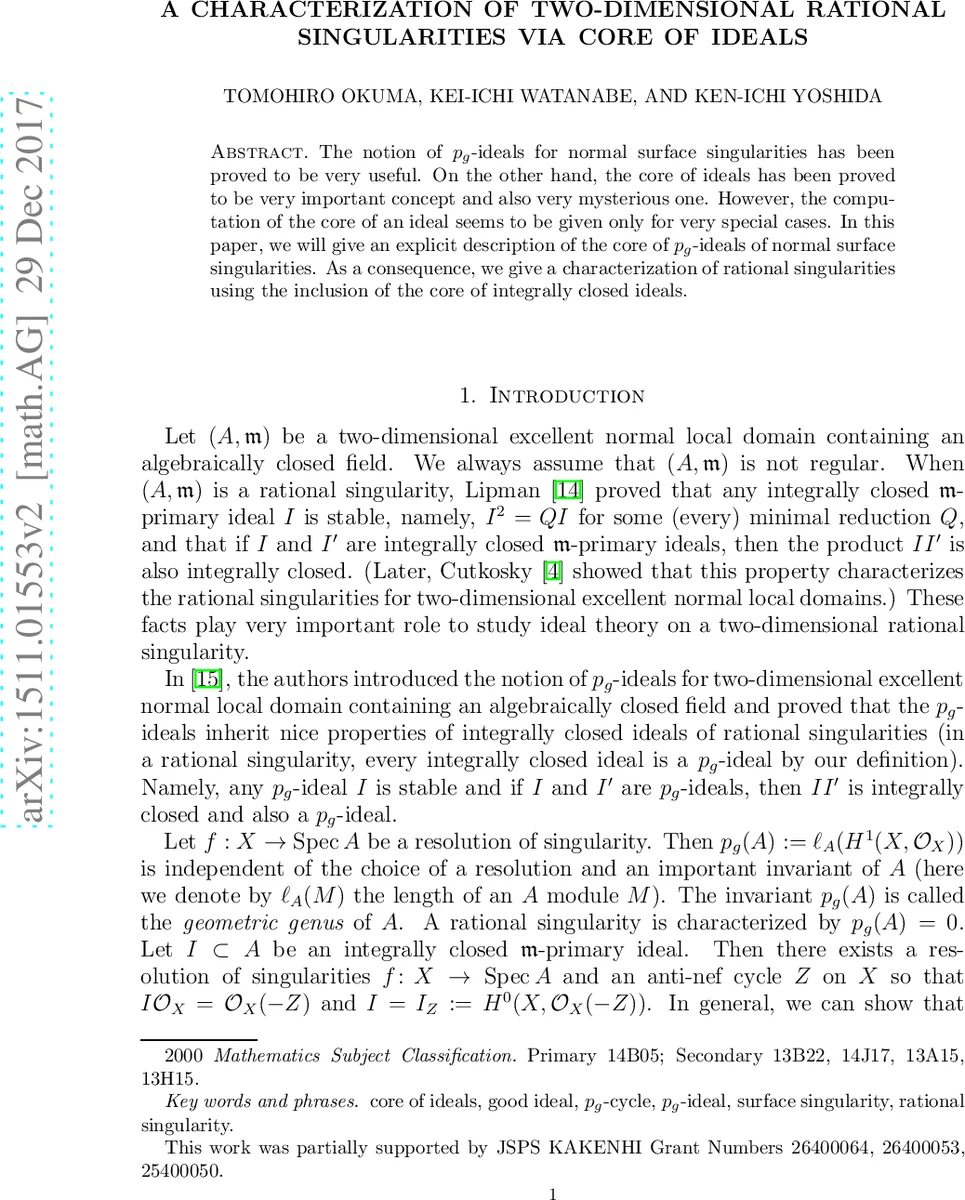
The notion of $p_g$-ideals for normal surface singularities has been proved to be very useful. On the other hand, the core of ideals has been proved to be very important concept and also very mysterious one. However, the computation of the core of an ideal seems to be given only for very special cases. In this paper, we will give an explicit description of the core of $p_g$-ideals of normal surface singularities. As a consequence, we give a characterization of rational singularities using the inclusion of the core of integrally closed ideals.
💡 Research Summary
The paper studies the interaction between two important concepts in the theory of two‑dimensional normal surface singularities: p_g‑ideals and the core of an ideal. Let (A, m) be a two‑dimensional excellent normal local domain over an algebraically closed field. The geometric genus p_g(A) is defined as the length ℓ_A(H¹(X, O_X)) for any resolution f : X→Spec A; p_g(A)=0 characterizes rational singularities.
An integrally closed m‑primary ideal I can be represented on a resolution X by an effective anti‑nef cycle Z with I = I_Z = H⁰(X, O_X(−Z)). The ideal I_Z is called a p_g‑ideal if h¹(O_X(−Z)) equals p_g(A). Such ideals enjoy many pleasant properties: they are stable (I²=QI for any minimal reduction Q), the product of two p_g‑ideals is again a p_g‑ideal, and they are integrally closed.
The core of an ideal, core(I), is the intersection of all its reductions; for m‑primary ideals the intersection of all minimal reductions suffices. The authors prove a precise description of the core for a p_g‑ideal. If I=I_Z is a p_g‑ideal and Q a minimal reduction, there exists an effective cycle Y≥0 on X such that
Q : I = I_{Z−Y} and core(I) = I_{2Z−Y}.
In the special case where A is rational (p_g(A)=0) and X₀ is the minimal resolution, Y can be taken to be the relative canonical divisor K_{X/X₀}, giving the simple formula core(I)=I_{2Z−K}. This explicit description is new and provides a practical algorithm for computing both Q : I and core(I) for any p_g‑ideal.
The central theorem (Theorem 3.2) establishes an equivalence:
- For every pair of integrally closed m‑primary ideals I′⊂I we have core(I′)⊂core(I).
- The ring A is a rational singularity.
The implication (2)⇒(1) follows because in a rational singularity every integrally closed ideal is a p_g‑ideal, and the authors show (Theorem 4.11) that the inclusion of cores is preserved for p_g‑ideals. Conversely, assuming (1) and that the characteristic of the residue field is not two, they construct a counterexample when p_g(A)>0: they take an integrally closed ideal I that is not a p_g‑ideal, show that I² is not contained in a minimal reduction Q, pick a general element f∈I with f²∈core(I), and then locate a p_g‑ideal I′⊂I containing f. Since I′ is stable, f²∈core(I′), but f²∉core(I), violating the inclusion. Hence (1) forces p_g(A)=0, i.e., A must be rational.
The paper also revisits the notion of a “good” ideal (stable and satisfying Q : I=I). It proves that every two‑dimensional excellent normal local domain admits a good p_g‑ideal, thereby guaranteeing the existence of good ideals beyond the Gorenstein case. Moreover, good ideals are precisely those p_g‑ideals for which core(I)=I².
In Section 5 the authors describe how to obtain the maximal p_g‑ideal contained in a given integrally closed ideal, and they illustrate the theory with explicit examples, such as the hypersurface A=k
Comments & Academic Discussion
Loading comments...
Leave a Comment