Modeling correlated bursts by the bursty-get-burstier mechanism
Temporal correlations of time series or event sequences in natural and social phenomena have been characterized by power-law decaying autocorrelation functions with decaying exponent $\gamma$. Such temporal correlations can be understood in terms of power-law distributed interevent times with exponent $\alpha$, and/or correlations between interevent times. The latter, often called correlated bursts, has recently been studied by measuring power-law distributed bursty trains with exponent $\beta$. A scaling relation between $\alpha$ and $\gamma$ has been established for the uncorrelated interevent times, while little is known about the effects of correlated interevent times on temporal correlations. In order to study these effects, we devise the bursty-get-burstier model for correlated bursts, by which one can tune the degree of correlations between interevent times, while keeping the same interevent time distribution. We numerically find that sufficiently strong correlations between interevent times could violate the scaling relation between $\alpha$ and $\gamma$ for the uncorrelated case. A non-trivial dependence of $\gamma$ on $\beta$ is also found for some range of $\alpha$. The implication of our results is discussed in terms of the hierarchical organization of bursty trains at various timescales.
💡 Research Summary
**
The paper investigates how temporal correlations in event sequences arise when interevent times are not independent but exhibit correlated bursts. In uncorrelated (renewal) processes, the well‑known scaling relation between the interevent‑time exponent α and the autocorrelation exponent γ (α + γ = 2 for 1 < α ≤ 2 and α − γ = 2 for 2 < α ≤ 3) holds. However, many natural and social systems display “bursty” behavior: short interevent intervals cluster together, forming bursts whose sizes follow a power‑law distribution PΔt(b) ∼ b^−β. This indicates correlations among interevent times, which the authors refer to as correlated bursts.
To explore the impact of such correlations, the authors introduce the “bursty‑get‑burstier” (BGB) model. The model takes as inputs the desired power‑law exponents α (for interevent times) and β (for burst sizes) and allows the degree of correlation to be tuned while keeping the same set of interevent times. The construction proceeds as follows:
- Generate a pool of interevent times T = {τ₁,…,τₙ} drawn independently from P(τ) ∼ τ^−α.
- Define hierarchical time windows Δtₗ = τ₀ q₀ s^l (l = 0,…,L) that partition T into level‑specific subsets Tₗ according to the magnitude of τ.
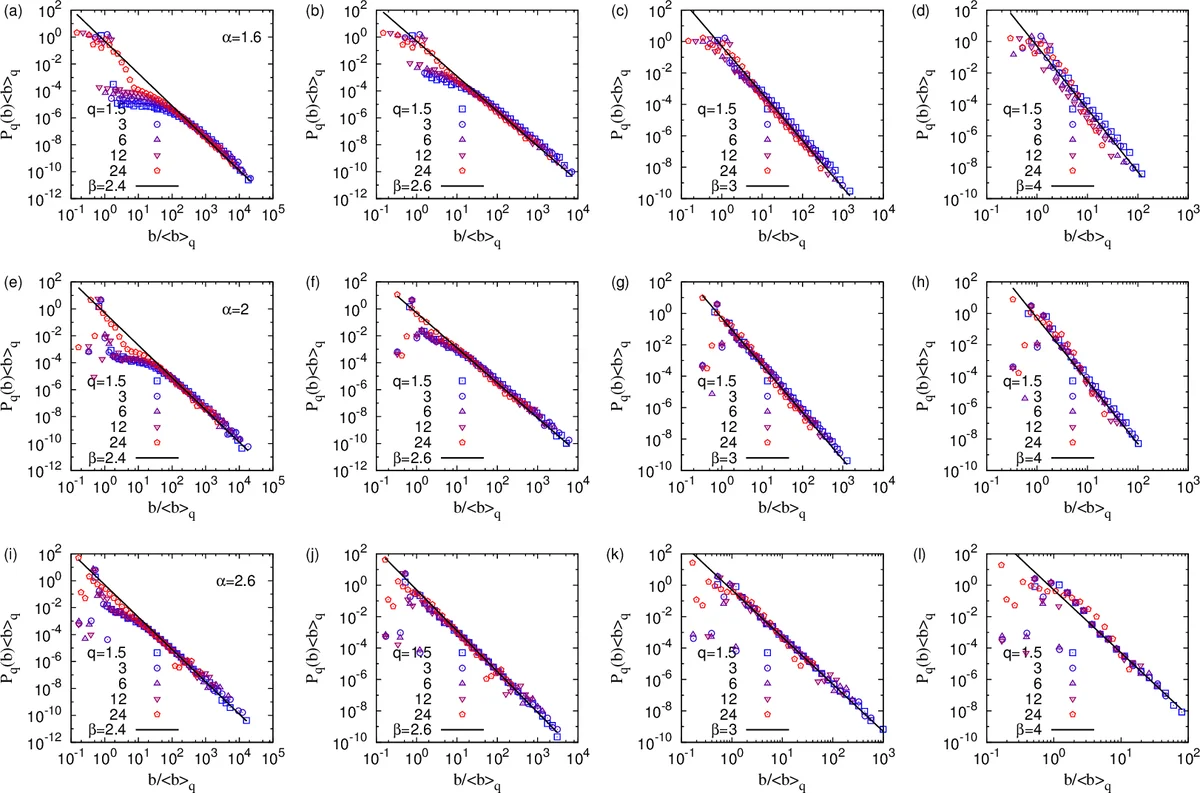
- Create burst size sets Bₗ for each level. At the lowest level (ℓ = 0) burst sizes b(0) are drawn from a power‑law distribution with exponent β. For higher levels, bursts are formed by merging several lower‑level bursts, enforcing the rule that larger bursts tend to merge with larger ones and smaller with smaller ones. This “bursty‑get‑burstier” rule ensures that the burst‑size distribution retains the same exponent β at every level.
- Reorder the interevent times according to the hierarchical burst structure. Starting from the highest level, bursts and the interevent times belonging to that level are interleaved in random order; each burst is then recursively replaced by its constituent lower‑level bursts and the corresponding interevent times. The final sequence contains exactly the original n interevent times but arranged so that the prescribed burst‑size statistics are realized.
The authors validate the BGB construction numerically, confirming that the burst‑size distributions at all levels follow the intended power law with exponent β. They then generate event sequences for various combinations of α (1.6, 2.0, 2.6) and β (≈2–3) and compute the autocorrelation function A(t_d). The key findings are:
- Violation of the α‑γ scaling: When β is small (i.e., bursts are large and strongly clustered), the measured γ deviates markedly from the theoretical values given by the uncorrelated scaling relation. Strong correlations among interevent times can thus break the α‑γ relationship.
- Non‑trivial γ‑β dependence: For a range of α, γ exhibits a non‑monotonic dependence on β. In particular, for intermediate β values the autocorrelation exponent γ reaches a minimum, indicating that the temporal memory is strongest when bursts are neither too small nor too large.
- Hierarchical organization: The BGB mechanism produces a multi‑scale hierarchy of bursts, mirroring empirical observations that bursty activity appears at many time scales (e.g., aftershocks in earthquakes, neuronal avalanches, human communication bursts). The preservation of the same β across levels suggests a self‑similar organization.
The paper concludes that the BGB model offers a flexible framework to study correlated bursts, extending beyond earlier two‑state Markov‑chain or self‑exciting point‑process models which could not independently control the correlation strength. The observed γ‑β relationship highlights that temporal correlations are not solely dictated by the heavy‑tailed interevent‑time distribution (α) but are significantly shaped by the way bursts cluster (β). Future work is suggested to fit the BGB model to empirical datasets, explore finite‑size and logarithmic corrections near α = 2, and investigate how the hierarchical burst structure influences dynamical processes such as spreading or synchronization on networks.
Comments & Academic Discussion
Loading comments...
Leave a Comment