Polar Coding for the Large Hadron Collider: Challenges in Code Concatenation
In this work, we present a concatenated repetition-polar coding scheme that is aimed at applications requiring highly unbalanced unequal bit-error protection, such as the Beam Interlock System of the Large Hadron Collider at CERN. Even though this co…
Authors: Alexios Balatsoukas-Stimming, Tomasz Podzorny, Jan Uythoven
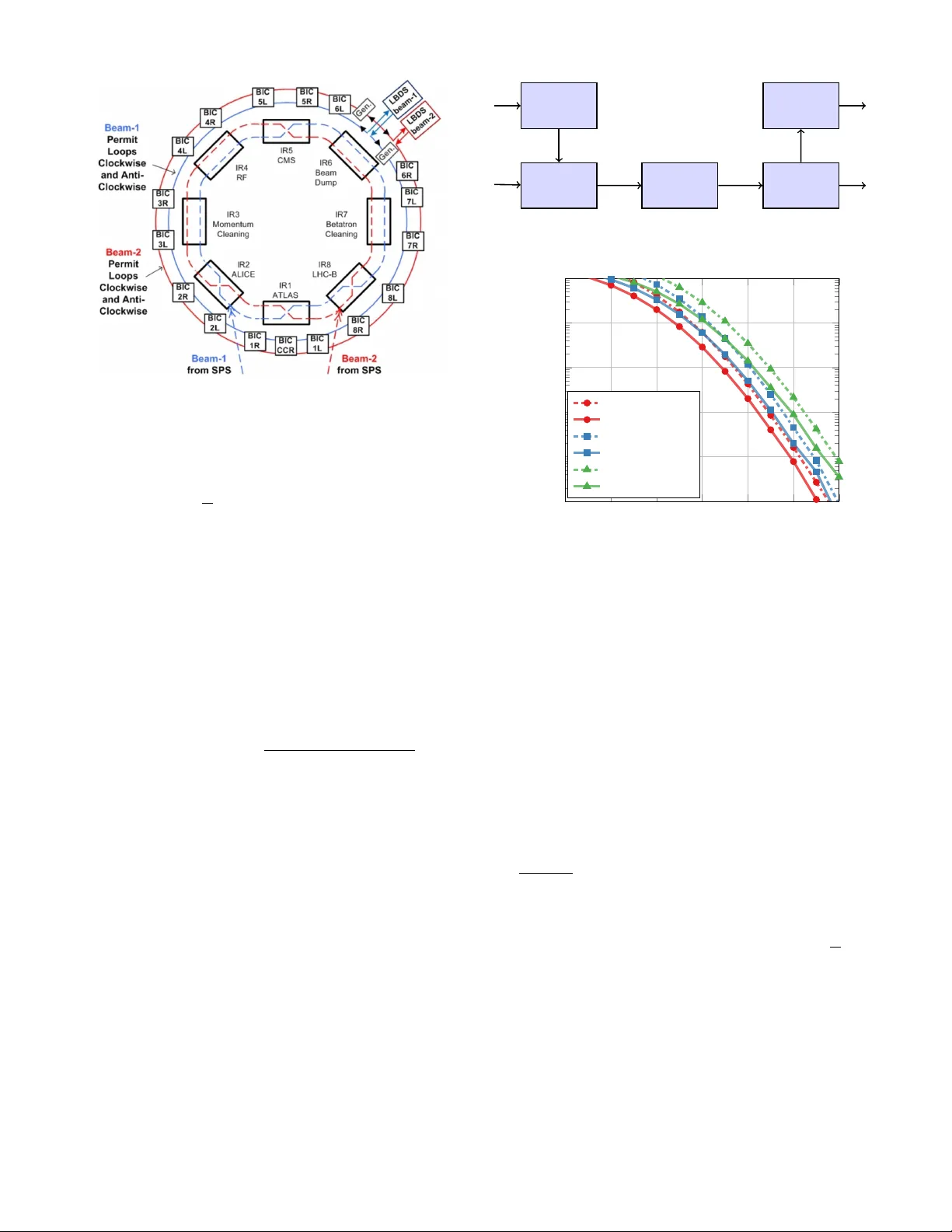
Polar Coding for the Lar ge Hadron Collider: Challenges in Code Concatenation Alexios Balatsoukas-Stimming, T omasz Podzorny , Jan Uythov en European Laboratory for Particle Physics (CERN), Genev a, Switzerland Abstract —In this work, we pr esent a concatenated repetition- polar coding scheme that is aimed at applications requiring highly unbalanced unequal bit-error protection, such as the Beam Interlock System of the Large Hadr on Collider at CERN. Even though this concatenation scheme is simple, it rev eals significant challenges that may be encountered when designing a concatenated scheme that uses a polar code as an inner code, such as error correlation and unusual decision log-lik elihood ratio distributions. W e explain and analyze these challenges and we propose two ways to over come them. I . I N T R O D U C T I O N The Large Hadron Collider (LHC) at the European Orga- nization for Nuclear Research (CERN) collides two counter- rotating proton beams with a total energy in the order of 400 MJ per proton beam. The combined beam energy is approximately equal to the kinetic energy of a Boeing 747- 8 landing at its maximum landing weight ( 312 , 072 kg) with a typical landing speed of 135 knots ( 70 m/s). In case of a failure in any critical part of the LHC, the stored beam energy has to be released (i.e. “dumped”) in a timely and controlled fashion in order to av oid damaging the accelerator . This is achiev ed by the Beam Interlock System (BIS) [1], [2], which broadcasts a single bit (called the “beam permit”), summarizing the information from various monitors, to a specialized beam dumping system. A new version of the BIS is currently under study and one of the possibilities that are being explored is to make the system more flexible by transmitting additional bits of information ov er the link that is used to transmit the beam permit, mainly for lo w- latency monitoring purposes. The error rate requirements for the v arious bits are very dif ferent; the beam permit bit must be highly protected against errors in order to av oid false beam dumps and, more crucially , missing a dump request, while the integrity of the monitoring data is less crucial. This kind of unequal error protection can be achie ved by using specialized error-correcting codes. Polar codes [3] are provably capacity-achieving channel codes with low complexity decoding algorithms. They are particularly attractive for our application as they do not exhibit error floors and they can be decoded very ef ficiently using successiv e cancellation (SC) decoding [3]. Unfortunately , at practically interesting blocklengths the error-correcting per- formance of polar codes is often inferior to that of other The authors thank the Hasler Foundation (www .haslerstiftung.ch) for fi- nancially supporting the presentation of this work at the 2017 Asilomar Conference on Signals, Systems, and Computers. modern channel coding schemes, such as low-density parity- check (LDPC) and T urbo codes. Attempts have been made to improve the error -correcting performance of polar codes by follo wing v arious directions, including modified code con- struction, modified decoding algorithms, as well as concate- nation of polar codes with other error-correcting codes. In the direction of concatenated codes, concatenations with both classical and modern error-correcting codes have been proposed. For example, the work of [4] considers the concate- nation of polar codes with very short repetition and Hamming codes, [5] examines the concatenation of polar codes with Reed-Solomon codes, and [6] considers the concatenation of polar codes with Bose–Chaudhuri–Hocquenghem and con vo- lutional codes. Finally , in the works of [7], [8], polar codes are concatenated with a cyclic redundancy check code in the context of modified decoding algorithms. On the other hand, [9], [10], [11] use a concatenation of polar codes with LDPC codes, while [12] presents a concatenation of polar codes with repeat-accumulate codes. I I . B AC K G RO U N D In this section, we provide background on the LHC BIS, as well as on the construction and decoding of polar codes. A. The Lar ge Hadron Collider Beam Interloc k System As can be seen in Fig. 1, the current BIS is a ring network that consists of 17 nodes, called beam interlock controllers (BICs), that are spread around the 27 kilometer circumference of the LHC and a generator node that generates and transmits a pre-defined frequency over dedicated optical fibers. In order to optimize the reliability and to minimize the propagation delay between any point of the ring network and the beam dumping system, there are in fact two distinct counter -directional optical ring networks. Each node passes this frequency on to its following node if and only if no operational faults have been detected and no beam dump has been requested by any of the equipment that is connected to the BIS. A loss of this frequency is detected by the beam dumping system, which then initiates the appropriate dumping procedure. In essence, the BIS uses digital frequency modulation in order to transmit a single bit of information, which is called the “beam permit. ” B. P olar Codes Polar codes are constructed by recursiv ely applying a channel combining transformation to a channel W , followed by channel splitting [3]. This results in N = 2 n synthetic Fig. 1. The Beam Interlock System of the Large Hadron Collider at CERN. channels, denoted by W i ( y N − 1 0 , u i − 1 0 | u i ) , i = 0 , . . . , N − 1 . The synthetic channels hav e varying le vels of reliability , which can be calculated using v arious methods [3], [13], [14]. A polar code of rate R , K N , 0 < K < N , is obtained by letting the K most reliable synthetic channels carry information bits, while freezing the input of the remaining channels to 0 . The set of non-frozen channel indices is denoted by A and the set of frozen channel indices is denoted by A c . The encoder generates a vector u N − 1 0 by setting u A c to 0 , while choosing u A freely . A codeword is obtained as x N − 1 0 = u N − 1 0 G N , where G N is the generator matrix [3]. The SC decoding algorithm [3] computes an estimate of u 0 , denoted by ˆ u 0 , based on the recei ved values y N − 1 0 . Subsequently , u 1 is estimated using ( y N − 1 0 , ˆ u 0 ) , etc. Let the log-likelihood ratio (LLR) for W i ( y N − 1 0 , ˆ u i − 1 0 | u i ) be L i ( y N − 1 0 , ˆ u i − 1 0 | u i ) , log W i ( y N − 1 0 , ˆ u i − 1 0 | u i = 0) W i ( y N − 1 0 , ˆ u i − 1 0 | u i = 1) ! . (1) In order to simplify notation, we will denote L i ( y N − 1 0 , ˆ u i − 1 0 | u i ) by L i in the sequel. SC decoding decisions are taken according to ˆ u i = 0 , L i ≥ 0 and i ∈ A , 1 , L i < 0 and i ∈ A , 0 , i ∈ A c . (2) The decision LLRs L i can be calculated efficiently through a computation graph with complexity O ( N log N ) [3]. I I I . B A S E L I N E C O N C AT E NA T E D R E P E T I T I O N - P O L A R S C H E M E Consider the case where we want to transmit K information bits per code word and one of these bits is significantly more critical than the remaining bits. More specifically , let b crit denote the critical bit and let b K − 2 0 denote the remaining K − 1 information bits. In the BIS of the LHC, b crit corresponds to the beam permit bit, while b K − 2 0 corresponds to other Repetition Encoder Polar Encoder b crit b K − 2 0 u A crit Channel x N − 1 0 Polar Decoder Soft Repetition Decoder y N − 1 0 L A crit ˆ b crit ˆ b K − 2 0 Fig. 2. Baseliune concatenated repetition-polar coding scheme. 0 1 2 3 4 5 6 10 − 6 10 − 5 10 − 4 10 − 3 10 − 2 10 − 1 E b / N 0 (dB) Bit Error Rate BER avg ( k rep = 1 ) BER crit ( k rep = 1 ) BER avg ( k rep = 5 ) BER crit ( k rep = 5 ) BER avg ( k rep = 11 ) BER crit ( k rep = 11 ) Fig. 3. Performance of an SC decoded polar code with blocklength N = 128 and information rate R inf = 1 / 2 concatenated with a k rep soft-decision repetition code. information (e.g., monitoring) that is less critical. In this section, we describe a baseline concatenated repetition-polar coding scheme that aims to solve the abov e problem and we ev aluate its performance. A. Concatenated Repetition-P olar Scheme In order to improve the reliability of the critical bit b crit , we use a concatenation scheme that first encodes b crit using a repetition code of length k rep and then encodes the resulting repetition code word along with b K − 2 0 using a polar code, as shown in Fig. 2. More specifically , we first construct a polar code of rate R = K − 1+ k rep N and we denote the subset of k rep most reliable non-frozen channels by A crit ⊂ A . Encoding is done by setting u A crit = b crit and u A non-crit = b K − 2 0 , where A non-crit = A\A crit , and then using a polar encoder to compute x N − 1 0 = u N − 1 0 G N . The effecti ve information rate of this scheme is R inf = K N . The codew ord x N − 1 0 is transmitted ov er the physical channel and a noisy version, denoted by y N − 1 0 , is receiv ed. At the recei ver , we first decode the polar code using SC de- coding and we then use the decision LLRs L A crit corresponding to the repetition code word to decode the repetition code using standard soft decoding as ˆ b crit = 0 , P i ∈A crit L i ≥ 0 , 1 , otherwise . (3) 0 7 15 23 31 39 47 55 63 0 7 15 23 31 39 47 55 63 Information Channel Index Information Channel Index 0 . 2 0 . 4 0 . 6 0 . 8 1 Fig. 4. Correlation matrix of the error vector e for a polar code with N = 128 and R = 0 . 5 at a design SNR of 0 dB. B. P erformance Evaluation In Fig. 3 we present the performance of the concatenated coding scheme described in the previous subsection for a polar code with N = 128 and R inf = 0 . 5 for various values of k rep . W e are interested in short polar codes due to the stringent latency requirements of the BIS. The simulations are performed for transmission over an A WGN channel using BPSK modulation and we denote the bit error rate (BER) of the critical bit b crit by BER crit and the a verage BER o ver both b crit and b N − 2 0 by BER avg . First, we observe that for k rep = 1 , BER crit is already slightly lower than BER avg since polar codes inherently have unequal error protection due to the varying reliabilities of the synthetic channels. W e also observe that, as k rep increases, BER avg also increases, which is expected since, in order to keep the same effecti ve information rate R inf for increasing k rep , the rate R of the underlying polar code has to be increased. Howe ver , we also observe that BER crit also increases with inreasing k rep . The latter observ ation is counter-intuiti ve and unfortunately goes in the opposite direction of what we would like to achiev e. Ho wev er, as we will show in the following section, the observed behavior can be explained and counteracted. I V . I S S U E S I N T H E B A S E L I N E C O N C A T E N A T E D S C H E M E In this section, we identify two reasons why the repetition code is inef fectiv e when concatenated with a polar code, namely the correlation between the errors in the decoded information bits in a polar code and the atypical distribution of the decision LLRs L i . A. Correlation Between the Decoded Information Bits It has been shown that, in the case of the binary erasure channel, the errors in the information bits that are decoded by the SC decoder become uncorrelated as the blocklength goes to − 300 − 200 − 100 0 100 200 300 10 − 5 10 − 4 10 − 3 10 − 2 10 − 1 10 0 D 120 values Probability − 300 − 200 − 100 0 100 200 300 D 128 values Fig. 5. Histograms of D 120 (left) and D 128 (right) for a polar code with N = 128 and R = 0 . 5 at a design SNR of 0 dB. infinity [15]. Howe ver , at short-to-moderate blocklengths, the errors are generally highly correlated. This correlation reduces the diversity order of the repetition code and renders it less effecti ve. In order to demonstrate this effect, let us define each element e i , i ∈ A , of the error vector e as e i = 0 , ˆ u i = u i , 1 , otherwise . (4) In Fig. 4, we sho w the correlation matrix of the error vector e for a polar code with N = 128 and R = 0 . 5 , which is obtained by running simulations at the design SNR of 0 dB, which translates to an Eb/N0 of 3 dB for R = 0 . 5 . W e observe that there exist se veral lar ge correlation coefficients, especially between error vector elements corresponding to synthetic channels that are close in terms of their index i . B. Distribution of the Decision LLRs Let us define D i as D i = L i , u i = 0 , − L i , otherwise , (5) so that D i ≥ 0 means that the decision for bit i was correct (i.e., e i = 0 ), and D i < 0 means that the decision for bit i was erroneous. In Fig. 5, we show histograms of D 120 and D 128 for a polar code with N = 128 and R inf = 0 . 5 , which is obtained by running simulations at the design SNR of 0 dB. Synthetic channel i = 128 is the most reliable channel, while synthetic channel i = 120 is the 5th most reliable channel, meaning that these two channels will belong to A crit for both k rep = 5 and k rep = 11 . W e use a logarithmic vertical axis for presentation clarity . W e observe that, in both cases, erroneous decisions are not caused by long tails in the distributions, b ut they actually come from erroneous LLR v alues that have very large magnitudes. These o verconfident erroneous decisions can cause significant problems in the context of a soft repetition decoder . For example, an erroneous value of L 128 = 250 when u 128 = 1 (equiv alently , D 128 = − 250 ) is very unlikely to be counter- acted by any correct value of L 120 , since from Fig. 5 we can see that correct values for L 120 are very tightly concentrated around a value of approximately 100 . 0 7 15 23 31 39 47 55 63 0 7 15 23 31 39 47 55 63 Information Channel Index Information Channel Index 0 . 2 0 . 4 0 . 6 0 . 8 1 Fig. 6. Correlation matrix of the error vector e for a systematic polar code with N = 128 and R = 0 . 5 at a design SNR of 0 dB. V . I M P R OV E D C O N C A T E N A T E D R E P E T I T I O N - P O L A R S C H E M E In this section, we explain our proposed improvements to the baseline concatenated repetition-polar scheme that alleviate the two problems identified above. More specifically , we describe a scheme that uses systematic polar coding and hard repetition decoding code that significantly improv es the error- correcting performance with respect to the baseline scheme. A. Error V ector Correlation W e note that the correlation problem has also been alluded to in other recent works [6], [11]. Ho wev er, the proposed solutions in these works rely on spreading the codeword bits for the outer code (in our case, the repetition code) over many codew ords of the inner code (in our case, the polar code). This approach can make the codew ord bits of the outer code completely uncorrelated, but it has a very high cost in terms of both the decoding latency and the memory required for codew ord b uffering. Our proposed solution, on the other hand, is to use sys- tematic polar coding [16], which has a very small overhead in terms of both latency and complexity . More specifically , in our simulations, we have observ ed that systematic polar coding, apart from slightly improving the average BER, also significantly reduces the pair -wise correlations of the elements of the error v ector e . This ef fect can be clearly seen when comparing Fig. 4 with Fig. 6, where we show the correlation matrix of the error vector e for a systematic polar code with N = 128 and R inf = 0 . 5 , which is obtained by running simulations at the design SNR of 0 dB. In Fig. 8, we observe that there is a significant gain of approximately 1 . 5 dB for BER crit when moving from a non- systematic polar code to a systematic polar code while the gain for BER avg is only approximately 0 . 25 dB, thus clearly 0 7 15 23 31 39 47 55 63 10 − 3 10 − 2 10 − 1 Channel index within A Bit Error Rate Non-Systematic Polar Code Systematic Polar Code Fig. 7. Per-channel information bit BER for a non-systematic and a systematic polar code with blocklength N = 128 and information rate R inf = 1 / 2 . demonstrating the decorrelating effect of systematic polar coding. B. LLR Distribution W e hav e shown that systematic polar coding largely al- leviates the error vector correlation problem. Howe ver , the LLR distribution problem remains e ven when systematic polar coding is used. 1 Moreov er , as sho wn in Fig. 7, when using systematic coding the BERs of the information channels are very similar . This means that the expected LLR magnitude E [ | L i | ] for channel i is not a good indicator for its reliability and soft repetition decoding is mismatched to the actual BER of each bit. One possible solution is to estimate E [ | L i | ] , i ∈ A , at some SNR using simulations, and to scale the decision LLRs as L i / E [ | L i | ] so that all LLRs used by the soft repetition decoder are on a similar scale. As can be observed in Fig. 8, where we estimated E [ | L i | ] at the polar code design SNR of 0 dB, using soft decoding with LLR scaling in conjuction with systematic polar coding provides a further SNR gain of slightly more than 0 . 5 dB with respect to the case where only systematic polar coding is used. Howe ver , as we demonstrated in Section IV -B, erroneous bit decisions almost always stem from completely wrong LLR values and the distribution of the decision LLR magnitudes is highly concentrated. This means that the actual decision LLR magnitude carries very little information about the reliability of the corresponding bit decision, e ven when scaling the LLRs as explained previously . For this reason, as we can observe in Fig. 8, hard decision decoding has practically the same performance as soft decision decoding in this particular scenario, while being significantly less complex to implement. 1 W e note that the distributions of D i for systematic polar coding can be obtained by performing a soft encoding step on the SC decoder decision LLRs L i . These distributions were not sho wn in Section IV -B due to space limitations, but they are practically identical to the distributions of D i for non-systematic polar coding. 0 1 2 3 4 5 6 10 − 6 10 − 5 10 − 4 10 − 3 10 − 2 10 − 1 E b / N 0 (dB) Bit Error Rate BER avg (baseline) BER crit (baseline) BER avg (systematic) BER crit (systematic) BER avg (syst. & scaled SD) BER crit (syst. & scaled SD) BER avg (syst. & HD) BER crit (syst. & HD) Fig. 8. Performance of a systematic polar code with blocklength N = 128 and information rate R inf = 1 / 2 concatenated with a k rep = 11 repetition code. C. Overall P erformance Evaluation In Fig. 9 we show the comparison that we showed for the baseline concatenated repetition-polar scheme in Fig. 3, but this time for the improv ed scheme. W e observe that, with the improv ed scheme, we ha ve successfully made BER crit decrease as k rep increases. At the same time, the degradation of BER avg as k rep is increased is also smaller than in the baseline scheme. V I . C O N C L U S I O N S In this work, we e xamined the concatenation of a repetition code with a polar code. More specifically , we showed that a baseline concatenated scheme that uses a non-systematic polar code and a soft repetition decoder performs particularly poorly . W e identified two major reasons that lead to this poor performance, namely the error vector correlation and the unusual decision LLR distributions, and we proposed an improv ed scheme that employs two ways to overcome these problems, namely using systematic polar coding and hard repetition decoding. Our simulation results show the improv ed scheme has an SNR gain of up to 2 dB for a k rep = 11 repetition code concatenated with polar code with N = 128 and R inf = 0 . 5 . While the examined concatenated scheme is quite specific, the identified problems also affect other concatenated schemes that use a polar code as an inner code. In particular , systematic polar coding is an effecti ve correlation-breaking approach that can be beneficial for any concatenated scheme. Moreover , because of the unusual decision LLR distributions that stem from the polarizing transformation that is used to construct the synthetic channels, low-complexity hard decision decoding may also be sufficient for other outer codes, especially as the blocklength is increased and the synthetic channels become more polarized. 0 1 2 3 4 5 6 10 − 6 10 − 5 10 − 4 10 − 3 10 − 2 10 − 1 E b / N 0 (dB) Bit Error Rate BER avg ( k rep = 1 ) BER crit ( k rep = 1 ) BER avg ( k rep = 5 ) BER crit ( k rep = 5 ) BER avg ( k rep = 11 ) BER crit ( k rep = 11 ) Fig. 9. Performance of a systematic polar code with blocklength N = 128 and information rate R inf = 1 / 2 concatenated with a k rep hard-decision repettition code. R E F E R E N C E S [1] B. T odd, “ A beam interlock system for CERN high energy accelerators, ” Ph.D. dissertation, Brunel Univ ersity , Nov . 2006. [2] R. Schmidt, R. Assmann, E. Carlier, B. Dehning, R. Denz, B. Goddard, E. B. Holzer , V . Kain, B. Puccio, B. T odd, J. Uythoven, J. W enninger , and M. Zerlauth, “Protection of the CERN large hadron collider, ” New Journal of Physics , vol. 8, Nov . 2006. [3] E. Arikan, “Channel polarization: A method for constructing capacity- achieving codes for symmetric binary-input memoryless channels, ” IEEE T rans. Inf. Theory , vol. 55, no. 7, pp. 3051–3073, July 2009. [4] M. Seidl and J. B. Huber , “Improving successiv e cancellation decoding of polar codes by usage of inner block codes, ” in Int. Symp. on T urbo Codes & Iterative Information Pr ocessing , Sep. 2010, pp. 103–106. [5] M. Bakshi, S. Jaggi, and M. Effros, “Concatenated polar codes, ” in IEEE Int. Symp. on Inf. Theory (ISIT) , Jun. 2010, pp. 918–922. [6] Y . W ang and K. R. Narayanan, “Concatenations of polar codes with outer BCH codes and conv olutional codes, ” in Annual Allerton Conf. on Communication, Control, and Computing , Sep. 2014, pp. 813–819. [7] I. T al and A. V ardy , “List decoding of polar codes, ” IEEE T rans. Inf. Theory , vol. 61, no. 5, pp. 2213–2226, May 2015. [8] O. Afisiadis, A. Balatsoukas-Stimming, and A. Burg, “ A low-complexity improved successive cancellation decoder for polar codes, ” in Asilomar Conf. on Signals, Systems and Computers , Nov . 2014, pp. 2116–2120. [9] J. Guo, M. Qin, A. G. i F ` abregas, and P . H. Sie gel, “Enhanced belief propagation decoding of polar codes through concatenation, ” in IEEE Int. Symp. on Inf. Theory (ISIT) , Jun. 2014, pp. 2987–2991. [10] Y . Zhang, A. Liu, C. Gong, G. Y ang, and S. Y ang, “Polar-LDPC concatenated coding for the A WGN wiretap channel, ” IEEE Comm. Letters , vol. 18, no. 10, pp. 1683–1686, Oct 2014. [11] Y . Meng, L. Li, and C. Zhang, “ A correlation-breaking interleaving of polar codes, ” ArXiv e-prints , Feb. 2017. [12] H. Y e and Z. Zhang, “Concatenations of systematic polar codes with inner repeat accumulate codes, ” in W ireless and Optical Comm. Conf. (WOCC) , May 2016, pp. 1–4. [13] R. Pedarsani, S. Hassani, I. T al, and E. T elatar, “On the construction of polar codes, ” in IEEE Int. Symp. on Inf. Theory (ISIT) , Aug. 2011, pp. 11–15. [14] I. T al and A. V ardy , “Ho w to construct polar codes, ” IEEE T rans. Inf. Theory , vol. 59, no. 10, pp. 6562–6582, Jul. 2013. [15] M. Bastani Parizi and E. T elatar, “On the correlation between polarized BECs, ” in IEEE Int. Symp. on Inf. Theory (ISIT) , Jul. 2013, pp. 784–788. [16] E. Arikan, “Systematic polar coding, ” IEEE Comm. Letters , vol. 15, no. 8, pp. 860–862, Aug. 2011.
Original Paper
Loading high-quality paper...
Comments & Academic Discussion
Loading comments...
Leave a Comment