Minimal Dominating Set problem studied by simulated annealing and cavity method: Analytics and population dynamics
The minimal dominating Set (MDS) problem is a prototypical hard combinatorial optimization problem. Two years ago we studied this problem by cavity method. Although we get the solution of a given graph, which gives very good estimation of minimal dominating size, but we don’t know whether we get the ground state solution and how many solutions exist in the ground state. For this purpose, last year we continue to develop the one step replica symmetry breaking (RSB) theory to find the ground state energy of the MDS problem. Finally we find that 1) The MDS problem solution space has both condensation transition and cluster transition on regular Random (RR) graph and we prove this by simulated annealing dynamical process. 2) We developed zero temperature Survey Propagation (SP) algorithm on ER graph to estimate the ground state energy and to get Survey Propagation Decimation (SPD) algorithm with good results same as BPD algorithm.
💡 Research Summary
The paper tackles the Minimum Dominating Set (MDS) problem, a classic NP‑complete combinatorial optimization task, by applying statistical‑physics techniques originally developed for spin‑glass systems. The authors first review the replica‑symmetric (RS) framework, where the partition function is expressed in terms of binary occupation variables c_i∈{0,1} for each vertex. Using belief‑propagation (BP) equations they compute node and edge free energies, from which the average free energy density, energy density, and entropy are derived. While RS provides accurate estimates of the typical size of a dominating set, it assumes a single large cluster of solutions and therefore cannot capture the detailed structure of the ground‑state landscape at low temperature.
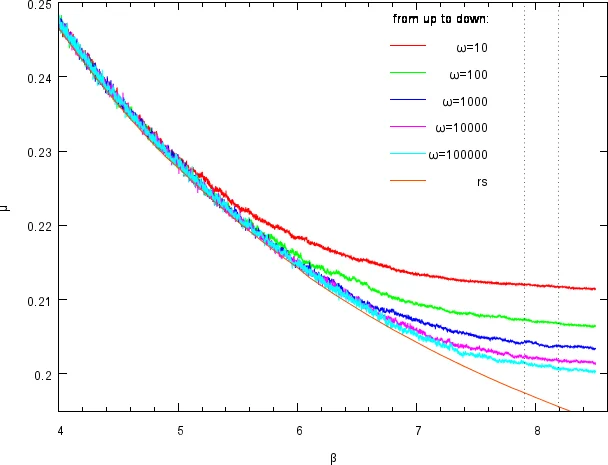
To overcome this limitation, the authors develop a one‑step replica‑symmetry‑breaking (1‑RSB) theory. They introduce a generalized partition function Ξ(y;β)=∑_α e^{‑yF_α}, where α indexes macroscopic solution clusters and y is a Parisi‑type parameter controlling the weighting of clusters. Setting y=β enables simultaneous investigation of clustering (dynamical) and condensation transitions. The 1‑RSB formalism splits cavity messages into an average message \bar p and a conditional distribution P, leading to new update rules (Eqs. 18‑20). Population dynamics is employed to evolve the distribution of messages numerically, allowing the computation of the complexity Σ(y)=y(⟨f⟩‑g). For regular random graphs with degree C=5 and C=6 the authors find a positive complexity region that disappears at β≈8.2, indicating a condensation transition, while a clustering transition occurs slightly earlier (β≈7.9). These results demonstrate that the solution space fragments into exponentially many clusters before a few dominant clusters take over.
The dynamical aspect is explored through simulated annealing. Starting from equilibrium at β=1, the inverse temperature is increased in steps of Δβ=0.001, with ω full‑spin sweep attempts at each β. Over 96 independent annealing runs the authors monitor the energy density. When the annealing schedule is sufficiently slow, the measured energy follows the RS prediction and approaches the ground‑state energy; a fast schedule leads to higher energies, reflecting trapping in metastable states. This empirical observation corroborates the theoretical prediction that the landscape becomes rugged near the clustering and condensation thresholds.
At zero temperature the authors construct a Survey Propagation (SP) algorithm, extending warning propagation to probabilistic “surveys” that encode the likelihood of a variable being forced to 0, forced to 1, or remaining unfixed (“*”). The SP equations are expressed in terms of the average and conditional messages derived earlier. Building on SP, they propose Survey Propagation Decimation (SPD): at each iteration the variable with the highest bias is fixed according to its survey, the graph is reduced, and SP is rerun on the residual subgraph. Experiments on Erdős–Rényi (ER) random graphs show that SPD achieves dominating sets of size comparable to those obtained by the state‑of‑the‑art Bayesian‑Propagation Decimation (BPD) algorithm, while being computationally cheaper.
In summary, the paper makes three principal contributions: (1) it reveals that the MDS solution space on regular random graphs exhibits both a clustering transition and a condensation transition, characterized by distinct inverse‑temperature thresholds; (2) it demonstrates that simulated annealing dynamics slow dramatically near these thresholds, providing a physical picture of algorithmic hardness; (3) it introduces a zero‑temperature SP/ SPD framework that efficiently finds near‑optimal dominating sets on random graphs. The work is primarily focused on ensemble‑average properties of random graphs; extending the analysis to structured real‑world networks (e.g., scale‑free or community‑rich graphs) and to finite‑size effects remains an open direction for future research.
Comments & Academic Discussion
Loading comments...
Leave a Comment