Crowd Counting Through Walls Using WiFi
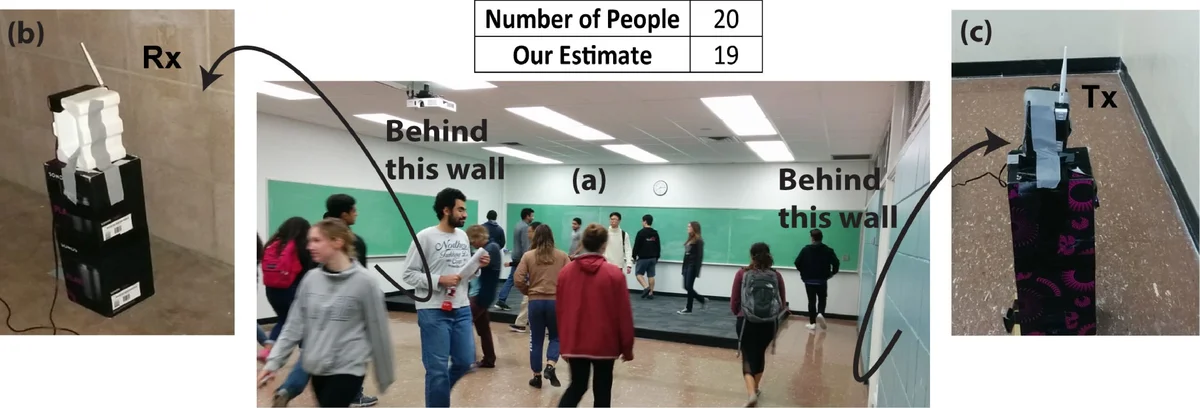
Counting the number of people inside a building, from outside and without entering the building, is crucial for many applications. In this paper, we are interested in counting the total number of people walking inside a building (or in general behind walls), using readily-deployable WiFi transceivers that are installed outside the building, and only based on WiFi RSSI measurements. The key observation of the paper is that the inter-event times, corresponding to the dip events of the received signal, are fairly robust to the attenuation through walls (for instance as compared to the exact dip values). We then propose a methodology that can extract the total number of people from the inter-event times. More specifically, we first show how to characterize the wireless received power measurements as a superposition of renewal-type processes. By borrowing theories from the renewal-process literature, we then show how the probability mass function of the inter-event times carries vital information on the number of people. We validate our framework with 44 experiments in five different areas on our campus (3 classrooms, a conference room, and a hallway), using only one WiFi transmitter and receiver installed outside of the building, and for up to and including 20 people. Our experiments further include areas with different wall materials, such as concrete, plaster, and wood, to validate the robustness of the proposed approach. Overall, our results show that our approach can estimate the total number of people behind the walls with a high accuracy while minimizing the need for prior calibrations.
💡 Research Summary
The paper addresses the problem of estimating the number of people inside a building without entering the premises, using only a single Wi‑Fi transmitter‑receiver pair placed outside the structure. Unlike prior work that relies on multiple devices, extensive calibration, or line‑of‑sight (LOS) measurements, the authors exploit the timing of RSSI “dip” events—moments when a person blocks or reflects the signal—rather than the amplitude of those dips. Their central observation is that the inter‑event times (the intervals between successive dips) are relatively robust to wall attenuation, making them a reliable feature for through‑wall crowd counting.
To model the phenomenon, the authors first describe a simple stochastic motion model for a single pedestrian: a discrete‑time Markov chain where heading direction changes with probability p and positions evolve with a constant speed v. When a pedestrian crosses the LOS link, an event is recorded. The sequence of event times {S_i} yields inter‑event intervals {T_i}. Under the assumed motion model, the inter‑event intervals are identically distributed, though not necessarily independent; the authors term this a “Renewal‑type” process. They derive the probability mass function (PMF) f(k) of T_i and relate it to the probability h(k) that an event occurs at time k and to the complementary cumulative distribution function (CCDF) of the intervals.
For N independent pedestrians, the overall process is modeled as a superposition of N Renewal‑type processes. The resulting inter‑event time distribution is a mixture whose parameters depend on N. By analytically expressing the PMF of the mixed process as a function of N, the authors construct a maximum‑likelihood estimator (MLE): given observed inter‑event times, they compute the likelihood for each candidate N and select the N that maximizes it. The computational load is modest because the candidate range is limited (up to 20 in their experiments).
The experimental campaign comprises 44 trials conducted in five distinct indoor spaces on a university campus: three classrooms, one conference room, and one hallway. These locations feature walls made of concrete, plaster, and wood, providing a diverse set of attenuation conditions. In each trial, 1–20 participants walk casually without any prescribed pattern while a standard Wi‑Fi link (2.4 GHz) records RSSI at 10 ms intervals. A dip detection algorithm flags any RSSI drop exceeding a fixed threshold (≈3 dB) as an event, and the inter‑event times are fed to the MLE.
Results show that the method achieves an average absolute error of less than 2 persons across all scenarios. For crowds of up to ten people, the estimator is within one person of the ground truth in more than 75 % of the trials; for larger crowds (up to twenty), the error remains within two persons for 100 % of the cases. Performance is slightly better with plaster and wood walls than with concrete, reflecting the higher attenuation of the latter, but the degradation is modest. Importantly, the approach works with a single Wi‑Fi link and requires only a brief, environment‑agnostic calibration (the detection threshold), contrasting sharply with prior methods that need multiple links, extensive training data, or line‑of‑sight access.
The authors acknowledge several limitations. The motion model assumes random, independent walks; coordinated or stationary groups could alter the inter‑event time statistics. The dip detection step is sensitive to noise and may need adaptive thresholds in low‑SNR environments. Finally, the study is limited to crowds of twenty; scaling to hundreds of occupants may cause event saturation, reducing the discriminative power of the inter‑event distribution.
Future work is suggested in three directions: (1) integrating channel state information (CSI) to capture richer multipath dynamics, (2) employing machine‑learning techniques to automatically detect dip events and possibly learn more complex statistical models, and (3) extending the framework to multiple links to improve robustness in highly congested or noisy settings.
In summary, the paper introduces a novel, low‑cost, privacy‑preserving technique for through‑wall crowd counting that leverages renewal‑theory concepts applied to Wi‑Fi RSSI timing. The method’s simplicity, minimal hardware requirements, and demonstrated accuracy make it a promising candidate for deployment in smart building management, security monitoring, and emergency response scenarios where non‑intrusive occupancy estimation is essential.
Comments & Academic Discussion
Loading comments...
Leave a Comment