Statistical Approaches for Initial Access in mmWave 5G Systems
mmWave communication systems overcome high attenuation by using multiple antennas at both the transmitter and the receiver to perform beamforming. Upon entrance of a user equipment (UE) into a cell a scanning procedure must be performed by the base s…
Authors: Hossein Soleimani, Ra`ul Parada, Stefano Tomasin
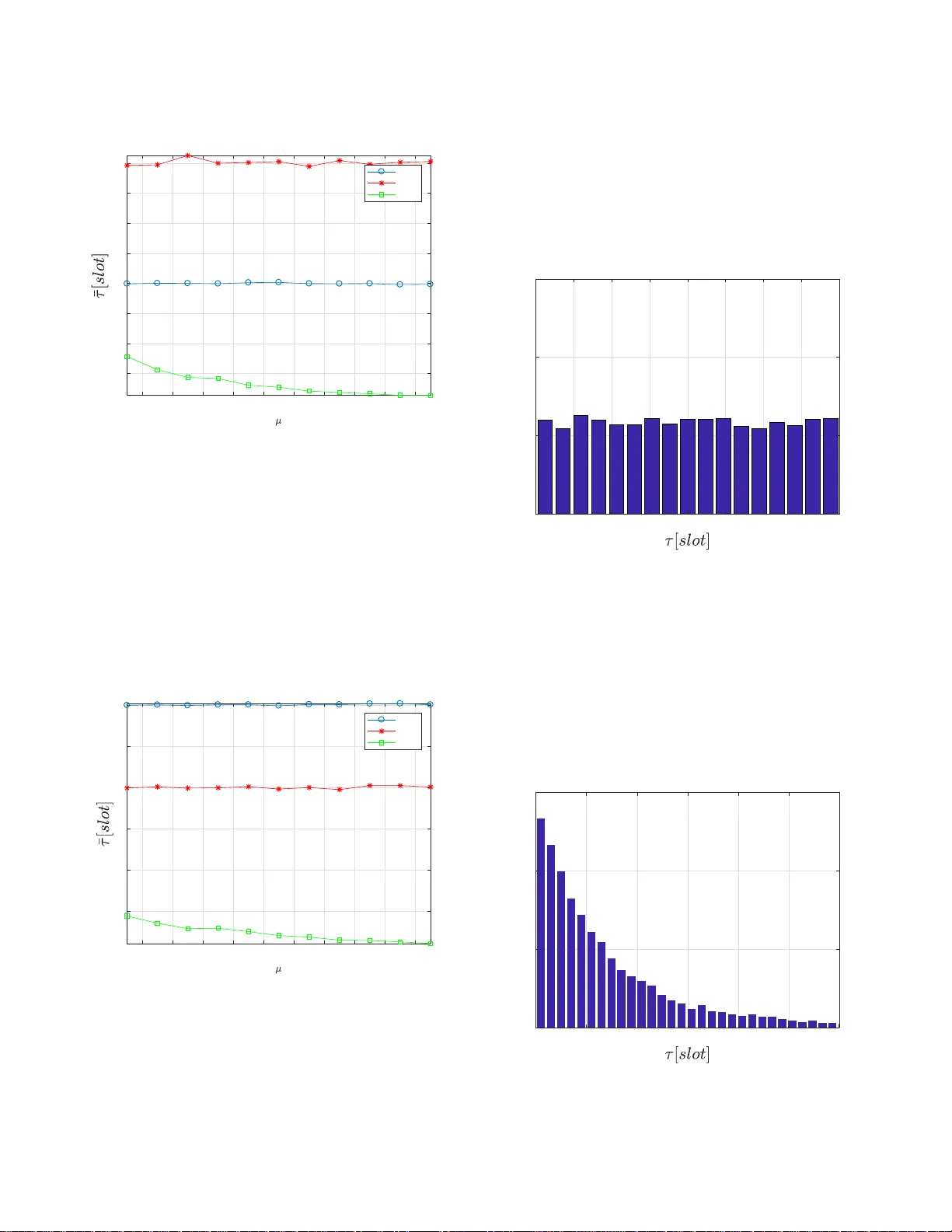
Statistic al Approaches f or I nitial Access in mmW a v e 5G Systems Hossein Soleimani, Ra ´ ul P a rada, Stef an o T omasin and Michele Zorzi Dep. of Information En gineering University of P adova, Italy { soleimani, rpar ada, tomasin, zo rzi } @dei.un ipd.it Abstract —mmW a ve communication sy stems ov ercome high attenuation by using multipl e antennas at both the transmitter and the recei ver to perform beamf orming. Up on entrance of a user equipment (UE) into a cell a scanning procedure must be performe d by the base station in order to fin d the UE, in what is known as i n itial access (IA) proce dure. In t his paper we start fr om the o bserv ation that UEs a re mor e likely to enter from some directions than from oth ers, as they typically move along streets, while other movements are impossible due to the presence o f obstacles. Mor eover , users are entering with a give n time statistics, for example d escrib ed by inter-arr iv al times. In this context we propose scanning strategies for IA that take into account the entrance statist i cs. In particular , we pro p ose two app roaches: a memory-less rand om i llumination ( MLRI) algorithm and a statistic and memo ry-based illu mination (SMBI) algorithm. The MLRI algorithm scans a random sector in each slot, based on the statistics of sector entrance, wi thout memory . The SM B I algorithm instead scans sectors in a deterministic sequence selected according t o the statistics of sector entrance and ti me of entrance, and taking into account the fact th at th e user has not yet been discov ered (thu s includ ing memory). W e assess the perfo rmance of the proposed methods in terms of a vera ge di scov ery time. Index T erms —mmW av e, 5G, Init i al Access, S tatistical, memory-less and memory-based algorithms. I . I N T RO D U C T I O N At the e n d of 201 6, the glob al mo bile d ata traffic was increasing by 7.2 exabytes p er month [ 1] and an incremen t up to 4 9 exabytes mo nthly is expected b y 202 1. Unfo rtunately , traditional microw av e cellular bands will not b e suitable to accommo date th is amou nt of data. Hen ce, there is a ne ed to study alternati ve technologies to deliver the constant incre ment of data y e arly . T h e millim e ter wa ve (a.k.a. mm W a ve) band from 30 to 300 GHz is a p romising space to allocate data. Howe ver, a drawback is th e hig h attenua tio n in non-line- of- sight (NLOS) scen a rios as the millimeter wav es are b locked by common o bstacles such as trees, buildings and h u man bodies. In a heterog eneous deploym ent, comm on macro b ase stations (MBS) fr om typical long-term ev olu tion (L TE) n etworks will be co mplemen ted by sma ll cells to provide the desired Gig a- bits spee d rate. Opposite to L TE MBS which typically transm it in an isotropic manner, mmW ave small b a se stations (SBS) must tra nsmit throu gh directiona l anten nas to increase the signal to noise ratio (SNR), covering a range o f u p to 2 00 This work has been support ed by the Resear ch Labora tory of Huawei Milan , Italia . meters. Similarly , th e user equipment (UE) will have multiple antennas an d will b e able to receive signals comin g from the SBS only if the UE’ s b eamform e r is directed towards the SBS. When a UE enters th e cell, neither the UE nor the SBS know where the other terminal is, therefo re they do not know wh ich beamfor mer must be u sed to co mmunicate . An in itial access (IA) procedur e m u st be started, in which the SBS seq uentially sends pilot p a ckets in various directions and in the me a n time the UE scan s the beam forming directions in o rder to rec eiv e them. Th e proced ure is completed whe n the SBS beamfor mer points to the UE and the UE beamfo rmer points to the SBS. Since the cell discovery time is an issue in mm W a ve networks, several appr oaches have been prop osed to minimize the time wh en a user is found by the SBS. Desai et al. [2] discussed these issues from the beamfor ming procedu re point of v iew . Jeong et al. [3] compared b o th o mnidirectio nal and dir e ctional search techniques. Ferran te et al. [4] stud ied the effects in terms of signal to interferen ce plu s noise ratio ( SINR) du ring the IA when the UE is in rotational motion. They c o mpared the performa n ce o f two alg o rithms, exhaustiv e and staged: the exhaustive algo rithm scans the whole 36 0-degree space in a sequ ential m anner while the staged appro a c h defines thinn er b eams into wider ones. Barati et al. [5] introdu ced the con cept of gen eralized likelihoo d ratio test (GLR T) where base station s pe r iodically transmit synchro n ization signa ls to establish commun ication. Capo n e et al. presented cell discovery schemes based on loc ation informa tio n [6]; in [ 7] th ey also introduce d a le a r ning ap- proach to reduce the d iscovery time b y taking into accoun t the p resence of ob stacles comm only fou n d in real scenarios (i.e., buildings). Qi and Nekovee [8] pro posed a coo rdinated initial scheme for standalo ne mmW a ve networks based on the power delay profile. Gio rdani et al. c o mpared different cell discovery schemes [9] to find the b est trade-off between delay an d coverag e . Th ey studied the perf ormance of state- of-the- a r t IA schemes such as exhaustiv e and iterative (a.k.a. staged). Further more, they included a context-inf ormation based schem e where glob al positionin g system (GPS) coor- dinates f rom the closest SBS are provided by the MBS to the UE. Th e UE also gets its GPS infor mation to steer th e beam to the closest small ba se station. Th is approach reduces the delay b ut in c reases the energy con sumption. Ab b as and Zorzi [10] stud ied the previously stated IA algo rithms in terms of energy consumption for beam f orming considering both a lo w power and a high power analog- to-digital converter . T hey also present in [11] an analo g b eamform ing receiver architectur e based on co ntext information at the user . An artificial neur al network (ANN) appro ach is p resented in [12] to incr e ase the positioning acc u racy . The r e are few works b ased on a geo- location d atabase [13], [14] where , by accumulating the UE position using GPS f or a mo r e ef ficient IA proced ure. Lu o et al. [15] propose a new a nd auxiliary transcei ver for IA which operates in a narrow subban d r educing the transmission leng th of beaco n and as a consequen ce th e beam alignment. Park et al. [16] estimate the user location fr om f ew mm W ave access points (AP) and optimize the beamwidth re quired by selecting the best AP to a given user . L i et al [17] analyze the tw o - stage beamfo rming appr oach ag ainst the exhausti ve sch eme resulting in an incre m ent of th e user-perceived th r oughp ut. W ei et al. [ 18] prop ose a hybrid IA schem e compo sed by a two-stage training wher e the SBS trains in the first stage and a reverse trainin g is p erform e d by the UE in the second stage. In [19] the Neld er Mead metho d is employed for fast and low complexity IA solutions. Parada and Zorzi p ropose a learning approa c h to reduce the delay in cell discovery procedu re [20] by prio ritizing those sectors with higher detectio n p robability using the historical UE’ s location infor mation. L i et al. [ 21] study different IA proto cols, including L TE, to find the optimal design to re d uce the cell discovery d elay w h ile obtaining the h ighest user-perceived downlink throu ghput. Habib et al. [22] propo se a hybrid algo r ithm comp aring it with both the exhaustiv e and th e iterative state-o f-the-ar t technique in terms of misdetectio n prob ability and discovery d elay . In this pap e r we start f rom the observation that UEs are more likely to enter fro m som e directions than other s. Th is is due to th e fact that u sers typically move along streets, while other movements are impossible due to th e presenc e of obstacles like buildings and walls. Note a lso th a t some streets are mo re trafficked th an others, further unbalan cing the probab ility that users enters from specific directio ns. Moreover , users are entering with a given time statistics, for examp le described by an inter-arriv al time between two users. The tim e statistics are also r elev ant for the cho ice of a beamfor ming scanning sequence by the SBS. In this context we adop t IA scanning strategies that take into acco unt the entrance statistics. I n particular, we pro pose two approa ches: a me m ory-less rand om illumination (M LRI) algorithm an d a statistic an d m emory- based illuminatio n (SMBI) algor ith m. The MLRI algorithm scans a random sector in each slot, based on the statistics of sector entrance , withou t memory . The SMBI algorith m instead scans sectors in a de te r ministic sequence selected a ccording to the statistics of sector en trance and time of entra n ce, and takin g into acc o unt the fact that the user has not yet b een discovered (thus including memory ). W e derive the optimal bea mformin g scannin g seq uence fo r bo th approa c h es that minimize the a verage discovery time. Then we assess the perfor m ance of the prop o sed methods in terms of discovery time. The remaind er of this p aper is o rgan ized as follows: Section II provides the system model and describ es the IA prob lem an d the average d iscovery time metric. The proposed algorithms are described in Sectio n III. Simulation experiments an d results are d escribed in Section IV. Fin ally , we con clude the paper in Section V. I I . S Y S T E M M O D E L W e consider a mm W ave cellular system and fo cus on the pr o blem of IA. Both base station (BS) and UEs are equippe d with m ultiple anten nas. T o this en d, we suppo se that the (sign al) space is divided into N sectors th a t can be separately illuminated by th e BS in order to discover new UEs. Secto r illumination is perf ormed by suitably choosin g beamfor mers that are ap plied to the tran smitted sig nal. In particular, the BS will be transmitting a packet kn own to all users, containing also th e in dex of the illuminated sectors, and the users attem pt to decode it cho osing in turn a suitab le beamfor mer to illuminate the d irection from which the signal is comin g. Sectors ar e non-overlappin g and com p letely cover the c e ll. Note that the case of overlapping sector s can be easily accom modated in o ur work, leadin g only to a more complicated mathema tical notation. W e indicate with p i the discrete probability de nsity function ( PDF) of the sector o f entrance of the generic u ser, i.e., p i is the prob ability th at user enters th e cell from sector i = 1 , . . . , N . T ime is divided into slots and the scanning procedu re by the BS is per formed by explo r ing sector b k in slot k u ntil the user is fou nd. W e also assume that within o ne slo t the user explores all the directions choosing multiple be a mformer s, so that when th e BS is illu minating the sector in which th e user is, the user is discovered and the IA pr ocedure fo r th at user is termin a te d . No te that we ign ore the effect of noise, chan n el fading and inter ference that co uld prevent the detection of the IA packet by the u ser , thus d elaying or pr ev e n ting the user discovery . Mor eover , we ignore false alar m events, i.e . , cases in which the u ser erroneo usly detects the IA packet (wh en it has not been transmitted or with the wr ong in dex of the illuminated sector) . All these features can b e achie ved with high p robab ility b y su itably cho osing a mo dulation an d co ding format fo r the IA packet. W e fur th er assume th a t the u ser remains in the sector from wh ich h e entered th e cell at least until it is discovered, i.e., the I A procedur e is faster than th e user movement within the cell. Lastly , we assume that at m o st one new user is present in the system, i.e., we neglect multiple entrance until th e fist u ser ha s been discovered. The time slot of entrance of the user is a random variable, with PDF w k , k = 0 , 1 , . . . , ∞ . W e denote with τ the discovery time, i. e., the number of slots that inter ven e b etween the entrance of the user into the cell and its d iscovery of the BS, i.e., the end of the IA p rocedu re. No te that τ is a random v ariable, depending on the explor ation sequ e nce o f the sectors b y the BS and the sector of entrance o f th e user . In particular, we look f or sector exploration strategies that minimize th e a verag e discovery time E [ τ ] . In particular, let z k,t be the p robability of d iscovering users in slot k , g iven that it entered in slot t , then the average discovery time is ¯ τ = E [ τ ] = ∞ X t =1 ∞ X k =1 ( k − t ) z k,t (1) I I I . I A A L G O R I T H M S In this section, we introdu ce two IA algorithm s: a mem ory- less rand om illumin ation (MLRI) algorith m an d a statistic and memor y-based illum in ation (SMBI) algorithm. The ML RI algorithm scans a ran d om sector at each slot, based on p i and without memory . The SMBI algorithm in stead scans sectors in a d eterministic sequence selected accordin g to the statistics p i and w k , and tak ing into acco unt the fact that user has n ot yet b een discovered (thus includin g m emory) . A. Memory-less Ra ndom Illumina tion A lgorithm The ML RI algorith m random ly chooses the sector to be illuminated at each slot using the PDF q i , i = 1 , . . . , N , to b e prop erly o ptimized. The algorithm does no t have a ny memory of th e illumin ated sectors, as e a ch ra ndom choic e is indepen d ent of the previous ones. In this case, the pro bability of discovering the user in slot k g i ven that it entered in slot t is z k,t = N X i =1 p i (1 − q i ) k − t q i . (2) The PDF q i that minimizes the av erage discovery time is obtained by solving the problem min { q i } E [ τ ] subject to N X i =1 q i = 1 q i ≥ 0 . (3) W e solve the pro blem using the Lagran gian function f ( { q i } , λ ) = k X t =1 w t ∞ X k = t N X i =1 p i (1 − q i ) k − t q i ( k − t )+ + λ N X i =1 q i − 1 ! , (4) where λ is the Lagr a nge multiplier, and with a simple change of variable we hav e f ( { q i } , λ ) = ∞ X k =0 N X i =1 p i (1 − q i ) k q i k + λ N X i =1 q i − 1 ! , (5 ) Computing the deriv ative o f the Lagrang ia n fun c tio n with respect to q i provides ∂ f ( { q i } , λ ) ∂ q i = − p 2 i q 2 i + λ = 0 , (6) and fro m the un itary-sum constraint we immediately h ave q k = p k . (7) Therefo re we rand omly select the sector b k to b e illuminated in slot k acco rding to the PDF of the sector of entran ce p i . For the ML RI algor ithm, the a verage discovery time is therefor e ¯ τ MLRI = N X i =1 p 2 i ∞ X k =1 k (1 − p i ) k = N X i =1 (1 − p i ) (8) B. Statistic and Memory-based Illumina tion Algorithm The MLRI a lg orithm does not have memory o f previously explored sectors, as b k are ind ependen tly g e nerated with a slot-in variant PDF . Instead, the SMBI alg orithm illuminates sector b k in slot k based both on the statistics o f users entrance ( p i and w k ) and o n the fact that the user has not yet been discovered in slot k . In or der to determ ine the optimal sequ ence of sector illumin ation b k that m in imizes the av erage discovery time, we resort to th e m a x imum-a- posteriori criterion, i.e., we maximize the probab ility of discovering the user given tha t we did not fin d it before. T o this end, define the set of explored sectors between slot t and slot k as S ( k , t ) = { i : ∃ t ≤ ℓ ≤ k : b ℓ = i } , (9) i.e., sector i is in S ( k , t ) if ther e exists at least on e slot between t and k in which sector i has been illumin ated. Now , g i ven that the u ser h as not ye t been d iscovered by slot k , and that the pr eviously explored sectors are b 1 , . . . , b k − 1 , the sector to be illuminated in slot k in order to minimize the average discovery time is the on e maximizing the pro bability of finding the u ser in slot k (given p rior assump tions). Th erefore, the probab ility of fin d ing the user in slot k illuminating sector ℓ is v k ( ℓ ) = k X t =1 w t p ( t ) ℓ P N i =1 p ( t ) i , (10) where we set to zero th e prob a bility th at the user is in sector ℓ if we did n ot find it in this sector a f ter it was entered, i.e., p ( t ) i = ( 0 i ∈ S ( k − 1 , t ) p i otherwise (11) The sector to be illum inated is then selected as b k = a rgmax ℓ v k ( ℓ ) , (12) and this ch oice ca n b e perfo rmed sequentially , from the first slot ( f or which b 1 is the secto r having th e maximu m probab ility p i ), to the next slots. The resulting sequence is a deterministic, therefore as lon g as th e statistics p i and w i do not change we will use sequence { b k } obtained from (1 2) to discover a ll users in the system. I V . N U M E R I C A L R E S U LT S W e now assess the p erform ance of the p roposed IA algo - rithms. W e assum e th at we have N = 17 secto rs. For com pari- son purpo ses we a lso consider th e exhausti ve-search algorithm (EA), that illum in ates sectors using a periodic sequ ence b k , where a period is a rando m p ermutation of the sector ind ices 1 , . . . , N . In this case the average discovery time is ¯ τ EA = ∞ X i =0 i i − 1 Y j =1 N − j − 1 N − j 1 N − i ≈ N 2 (13) The distrib ution p i depend s on the topolog y o f the cell, th e presence of do minant paths for the users du e for example to the p resence of streets and obstacles like building, together with user habits. This distribution can either obtained from the topo logy o f the cell and side info rmation on user b ehav- ior , or estimated by the BS, based on the IA pro c edure o f previous users. Here for d emonstration p urposes we con sider a equ ilateral triangular PDF p i with pa rameter L , i.e., p u = 4 L 2 u − [ N 2 − L 2 ] uǫ max { N 2 − L 2 , 1 } , [ N 2 ] 4 L 2 1 − [ N 2 − L 2 ] − u uǫ [ N 2 ] , min { N 2 + L 2 , N } 0 otherwise (14) where users n ev er enter fro m sectors ou tside the interval [ N / 2 − L / 2 , N/ 2 + L/ 2] and the prob ability in this in terval has an equilateral triangular shape. Fig. 1 shows some examp les of the d istribution p i for thr ee values of L . Th is allows to assess the p erforma nce o f th e pr o posed algorithms wh en the PDF o f entrance sector is mor e or less co ncentrated . For L g oing to infinity we obtain the u niform PDF , i.e. , p i = 1 N while for L = 0 we have tha t users only en ter from sector N / 2 . Also the the PDF w k of the user time of entrance, suitable models could be provided or w k can be estimated by observa- tions o f the BS. Here we consider an expon entially distributed inter-arriv al time between user entr ances, therefor e w k = e − µk 1 − e − µ , (15) where µ is the a verage inter-arri val time. The perfo rmance of the various schemes is assessed in te r ms of the average discovery time (1 ), for which we consider both the av e r age a nd the PDF . As alr eady stated, we ig nores the random effects o f th e channel an d th e false alarm s and missed detection pro bability of user discovery . 2 4 6 8 10 12 14 16 i 0 0.05 0.1 0.15 0.2 0.25 0.3 p i L=22 L=12 L=6 Fig. 1. Sector entrance distrib ution p i . 5 10 15 20 25 30 35 L 0 2 4 6 8 10 12 14 16 EA MLRI SMBI Fig. 2. A verage discov ery time as a function of L with µ = 0 . 1 . In Fig. 2 we first assess the av erage d iscovery time ¯ τ = E [ τ ] as a fu nction of th e parameter L of the PDF p i , fo r a fixed value of µ = 0 . 1 . A Monte-Carlo simulation h as been r un to obtain the re su lts for the various algorithm s. W e can observe how the exhaustive scheme (blu e-circle line) remains constant at 8 slots. The ML RI algorithm starts with a discovery time of 0 sinc e for L = 2 there is only one sector with pro bability one where the user could enter, th erefore also q N/ 2 = 1 . A similar observation ho lds f or the SMBI alg orithm that also shows a zero av er age discovery time. Then we o b serve that as L increases the average discovery time of both SMBI an d MLRI increases, as the distribution p i becomes more disp e r sed. Howe ver, while th e SMBI has the best pe r forman ce ac h ieving the minimum average discovery time, the MLRI algorithm requires even more time th an the exhau sti ve a p proach for L > 1 0 , as indeed with th e MLRI approac h it is possible that sectors a re explored mor e than on c e in N co nsecutive slots, thus being inefficient as p i tends to be u n iform. 0.2 0.4 0.6 0.8 1 1.2 1.4 1.6 1.8 2 5 6 7 8 9 10 11 12 EA MLRI SMBI Fig. 3. A verage discov ery as a function of µ for L = 14 . Fig.s 3 and 4 show th e average d iscovery time in the different value of µ for a large and small triangle window size of L = 14 and L = 8 , respectively . W e o bserve that the SMBI meth od has the lowest average discovery time, than ks to the exploitation of memory . As alread y observed , fo r small L ML RI ou tp erform s EA wh ile for h igh L EA o u tperfor ms MLRI. Moreover both M LRI an d E A show a con stant average with respect to µ while fo r SMBI the average discovery time decreases with µ . 0.2 0.4 0.6 0.8 1 1.2 1.4 1.6 1.8 2 3 4 5 6 7 8 EA MLRI SMBI Fig. 4. A verage discove ry as a functi on of µ for L = 8 . Lastly , Fig.s 5-7 sho w the PDF of th e discovery time for the various ap proach es, for µ = 0 . 1 and L = 10 . As we expect, the d ensity f unction f or EA is unifo rm over the set [0 , N − 1] as within N slots all sectors are explored. Both MLRI and SMBI methods instead exhibit a mo re co ncentrated PDF , in particular with the SMBI method being able to discover users within 1 0 slots w ith p robability very close to 1. Th e MLRI method shows instead a more dispersed PDF , as expected f r om the results on the a verage discovery time. 0 2 4 6 8 10 12 14 16 0 0.05 0.1 0.15 PDF Fig. 5. PDF of disco very time for EA algo rithm with L = 10 , µ = 0 . 1 . 0 5 10 15 20 25 30 0 0.05 0.1 0.15 PDF Fig. 6. PDF of discov ery time for ML RI alg orithm with L = 10 , µ = 0 . 1 . 0 1 2 3 4 5 6 7 8 9 10 0 0.02 0.04 0.06 0.08 0.1 0.12 0.14 PDF Fig. 7. PDF of disco very time for SMBI algor ithm with L = 10 , µ = 0 . 1 . V . C O N C L U S I O N S This p a per intro duced two novel alg o rithms to r educe the av erage discovery time for th e IA pr o cedure fo r mmW a ve massi ve MIMO systems. W e compared our propo sed sch emes with the E A and show that SMBI always outperform s EA. The simpler MLRI method instead ou tperfor ms EA on ly for concentr a ted PDF o f the entr ance sectors. Ind eed, we are able to exploit the statistics of user entran ce ( b oth time and sector of entrance): mo reover , the SMBI also exploits the memo ry of previously explored sectors, while the MLRI is a simp ler approa c h based o n th e statistics on the sector of entran ce. R E F E R E N C E S [1] Cisco Systems, “Cisc o V isual Network ing Index: Globa l Mobile Data Traf fic Foreca s t Update, 2016–2021 W hite Pape r , ” 2017, (Accessed August 2017) A v ailable at: http://www.cis co.com/c/en/us/s olutions/collateral/service- provider/visual- net working- index- vni/mobile- white- paper- c 1 1 - 5 2 0 8 6 2 . h t m l . [2] V . Desai, L. Krzymie n, P . Sartori, W . Xiao, A. Soong, and A. Alkhateeb, “Initi al Bea m forming for mmW ave Communication s, ” in P r oc. 48th Asilomar Confer ence on Signals, Systems and Computers , 2014, pp. 1926–1930. [3] C. Jeong, J. Park , and H. Y u, “R andom access in milli meter -wa ve beamforming cellula r netw orks: issues and approaches, ” IEEE Commu- nicati ons Magazine , vol. 53, no. 1, pp. 180–18 5, January 2015. [4] S. Ferrante, T . Deng, R. Pragada, and D. Cohen, “Mm W ave Initia l Cell Search Analysis under UE Rotati onal Motion, ” in 2015 IEEE Internati onal Confe rence on Ubiquit ous W ir eless Broadba nd (ICUWB) , 2015, pp. 1–7. [5] C. N. Barati, S. A. Hosseini, S. Rangan, P . Liu, T . Koraki s, S. S. P anwa r , and T . S. Rappaport , “Direc tional Cell Disco very in Millimete r W av e Cellul ar Netwo rks, ” IEE E T ransacti ons on W ir eless Communicat ions , vol. 14, no. 12, pp. 6664–6678, Dec 2015. [6] A. Capone, I. Filippini, and V . Scianca lepore, “Context Information for Fast Cell Discove ry in mm-wa ve 5G Netw orks, ” in Pr oceedings of the 21th Europe an W ir eless Confer ence , May 2015, pp. 1–6. [7] A. Capone, I. Filip pini, V . Scianca lepore, and D. T remolada, “Obstacle av oidance cel l discov ery using mm-wav es direc tiv e antenna s in 5G netw orks, ” in IEEE 26th Annual International Symposiu m on P ersonal, Indoor , and Mobile Radio Communicat ions (PIMRC) , Aug 2015, pp. 2349–2353. [8] Y . Qi and M. Neko vee , “Coordi nated Initial Access in Millimetre W av e Standalon e Networks, ” 2016 IEEE Confer ence on Computer Communicat ions W orkshops (INFOCOM WKSHPS) , pp. 59–64, 2016. [9] M. Giorda ni, M. Mezza villa, and M. Zorzi, “Initia l Access in 5G mmW av e Cellula r Networks, ” IE EE Communicat ions Magazine , v ol. 54, no. 11, pp. 40–47 , Nov ember 2016. [10] W . bin Abbas and M. Zorzi, “T o wards an Appropriate Beamforming Scheme for Initial Cell Discove ry in mmW 5G Cellular Networ ks, ” CoRR , vol. abs/1605.0, 2016. [Onli ne]. A vaila ble: https:/ /arxi v .org/abs/160 5.05088 [11] W . B. Abbas and M. Zorzi, “Conte xt inf ormation based initi al cell search for millimeter wav e 5G cellul ar networks, ” in 2016 Eur opean Confer ence on Networks and Communications (EuCNC) , June 2016, pp. 111–116. [12] X. Cui, T . A. Gulli ver , H. Song, and J . Li, “Rea l-Time Positi oning Based on Millimeter W a ve Device to Device Communications, ” IEEE Access , vol. 4, pp. 5520–5530, 2016. [13] I. Filippini, V . Scianca lepore, F . Dev oti, and A. Capon e, “Fast Cell Discov ery in mm-wav e 5G Networks with Conte xt Information , ” CoRR , vol. abs/170 5.07291, 2017. [Online]. A v ailab le: http:/ /arxi v .org/abs/17 05.07291 [14] F . Dev oti, I. Filip pini, and A. Capone, “Fac ing the Millimeter -W ave Cell Discov ery Chall enge in 5G Networks Wit h Context -A wareness, ” IEEE Access , v ol. 4, pp. 8019–8034, 2016. [15] J. Luo, N. V ucic, M. Castaneda, Y . L i, and W . Xu, “Initial Access Assisted by an Auxil iary T ranscei ver for Millimeter -W av e Networks, ” in WSA 2017; 21th International ITG W orkshop on Smart A ntennas , 2017, pp. 1–6. [16] E. Park, Y . Choi , and Y . Han, “Locatio n-based Initia l Access and Beam Adaptation for Millimeter W av e Systems, ” in IEEE W ir eless Communicat ions and Networking Confer ence , WCNC , 2017, pp. 1–6. [17] Y . Li, J. G. Andre ws, F . Baccelli , T . D. Novlan , and J. Zhang, “Per- formance Analysis of Millimeter -wav e Cellula r Networks with T wo- stage Beamforming Initial Access Protocol s, ” in Confere nce Record - Asilomar Confer ence on Signals, Systems and Computers , 2017, pp. 1171–1175. [18] L. W ei, Q. Li, and G. W u, “Exhausti ve, Iterati ve and Hybrid Initia l Access T echniques in mmW av e Communications, ” in IE EE W ire less Communicat ions and Networking Confer ence , WCNC , 2017, pp. 1–6. [19] M. Jasim and N. Ghani, “Fast beam disco very for mmwave cellular netw orks, ” in 201 7 IEEE 18th W ir eless and Micr owave T echnolo gy Confer ence (W AMICON) , April 2017, pp. 1–6. [20] R. Parada and M. Zorzi, “Cell disco very based on historica l user ’ s locat ion in m mW av e 5G, ” in Pr oc. Eur opean W irel ess 2017; 23th Eur opean W ir eless Confer ence , 2017, pp. 1–6. [21] Y . Li, J. G. Andre ws , F . Baccelli , T . D. No vlan, and J . Zhang, “Design and Analysi s of Initi al Acce ss in Mill imeter W av e Cellular Networ ks, ” IEEE T ransact ions on W ire less Communicati ons , v ol. PP , pp. 1–18, 2017. [22] S. Habib, S. A. Hassan, A. A. Nasir , and H. Mehrpouyan, “Mill imeter wa ve cell search for init ial access: Analysis, design, and implementa- tion, ” 13th International W ir eless Communications and Mobile Comput- ing Confere nce, IWCMC 2017 , pp. 922–927, 2017.
Original Paper
Loading high-quality paper...
Comments & Academic Discussion
Loading comments...
Leave a Comment