Inner products in integrable Richardson-Gaudin models
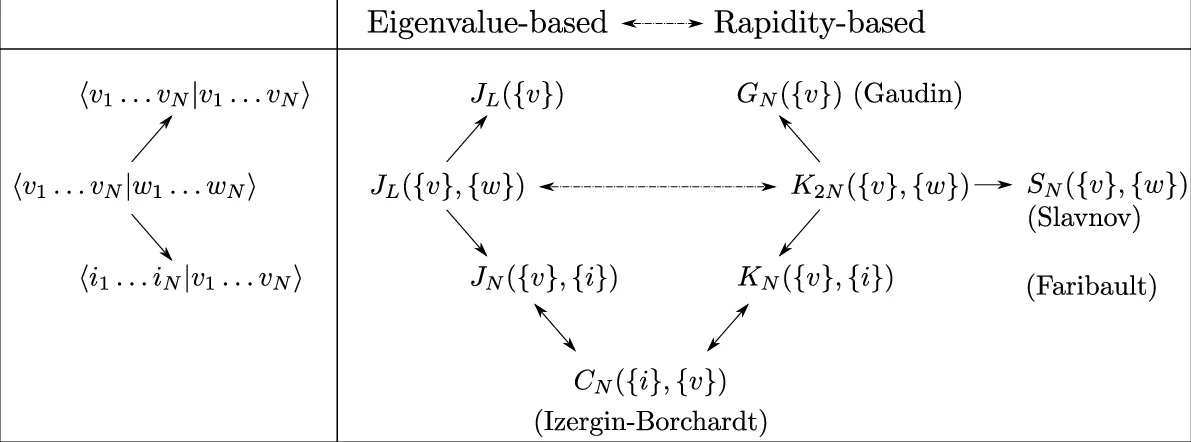
We present the inner products of eigenstates in integrable Richardson-Gaudin models from two different perspectives and derive two classes of Gaudin-like determinant expressions for such inner products. The requirement that one of the states is on-shell arises naturally by demanding that a state has a dual representation. By implicitly combining these different representations, inner products can be recast as domain wall boundary partition functions. The structure of all involved matrices in terms of Cauchy matrices is made explicit and used to show how one of the classes returns the Slavnov determinant formula. This framework provides a further connection between two different approaches for integrable models, one in which everything is expressed in terms of rapidities satisfying Bethe equations, and one in which everything is expressed in terms of the eigenvalues of conserved charges, satisfying quadratic equations.
💡 Research Summary
The paper investigates the inner products of Bethe states in integrable Richardson‑Gaudin (RG) models from two complementary viewpoints and derives two families of determinant formulas that generalize the well‑known Slavnov expression. Starting from the generalized Gaudin algebra (GGA), the authors construct the family of commuting operators S²(u) and define Bethe states |v₁…v_N⟩ = ∏ₐ S⁺(vₐ)|0⟩. When the rapidities {vₐ} satisfy the RG (Bethe) equations, the state is on‑shell; otherwise it is off‑shell.
A parallel “eigenvalue‑based” framework is introduced, where instead of rapidities one works with the set of conserved‑charge eigenvalues Λ_i = Σₐ 1/(ε_i – vₐ). These variables obey a closed set of quadratic equations that are free of the singularities present in the original Bethe equations. The two frameworks are linked by a differential equation for the polynomial P(z)=∏ₐ(z−vₐ), which can be derived from either set of equations.
The main technical results are two determinant representations for the overlap ⟨v|w⟩ between an on‑shell state (rapidities {vₐ}) and an arbitrary off‑shell state (rapidities {w_b}). The first representation is the classic Slavnov determinant: a ratio of products of differences multiplied by det S_N, where S_N is an N×N matrix built from the rapidities and the model inhomogeneities ε_i.
The second representation is expressed solely in terms of the eigenvalue variables. By exploiting the existence of a dual representation (a “dual state” built with lowering operators) the authors show that the overlap can be written as
⟨v|w⟩ = (−1)^N g^{2(L−2N)} det J_L({v},{w})
where J_L is an L×L matrix whose diagonal entries are 2g + Λ_i({v}) + Λ_i({w}) − ∑{k≠i}1/(ε_i−ε_k) and off‑diagonal entries are −1/(ε_i−ε_j). An equivalent 2N×2N matrix K{2N} is also constructed; its determinant reduces to the same expression via Sylvester’s determinant identity.
A crucial ingredient in the derivation is the explicit Cauchy‑matrix structure of all involved matrices. The authors present detailed identities for the inverse and determinants of Cauchy matrices, and they use these to transform the dual‑state overlap into a domain‑wall boundary partition function (DWPF). The DWPF is known to be given by the Izergin‑Borchardt determinant, which, after appropriate row/column operations, collapses to the Slavnov determinant. Thus the Slavnov formula emerges as a corollary of the more general eigenvalue‑based determinant.
The paper also extends the whole construction to the hyperbolic RG model, where the rational functions are replaced by hyperbolic trigonometric ones. The Cauchy‑like matrices persist, and the same J_L and K_{2N} determinants provide the inner products in that setting.
Overall, the work unifies the rapidity‑based and eigenvalue‑based descriptions of RG models, provides determinant formulas that are amenable to efficient numerical evaluation, and clarifies the role of dual states and DWPFs in the theory of integrable models. This framework is expected to simplify the calculation of correlation functions and matrix elements in large‑scale RG systems, where direct solution of the Bethe equations is often prohibitive.
Comments & Academic Discussion
Loading comments...
Leave a Comment