AI Buzzwords Explained: Multi-Agent Path Finding (MAPF)
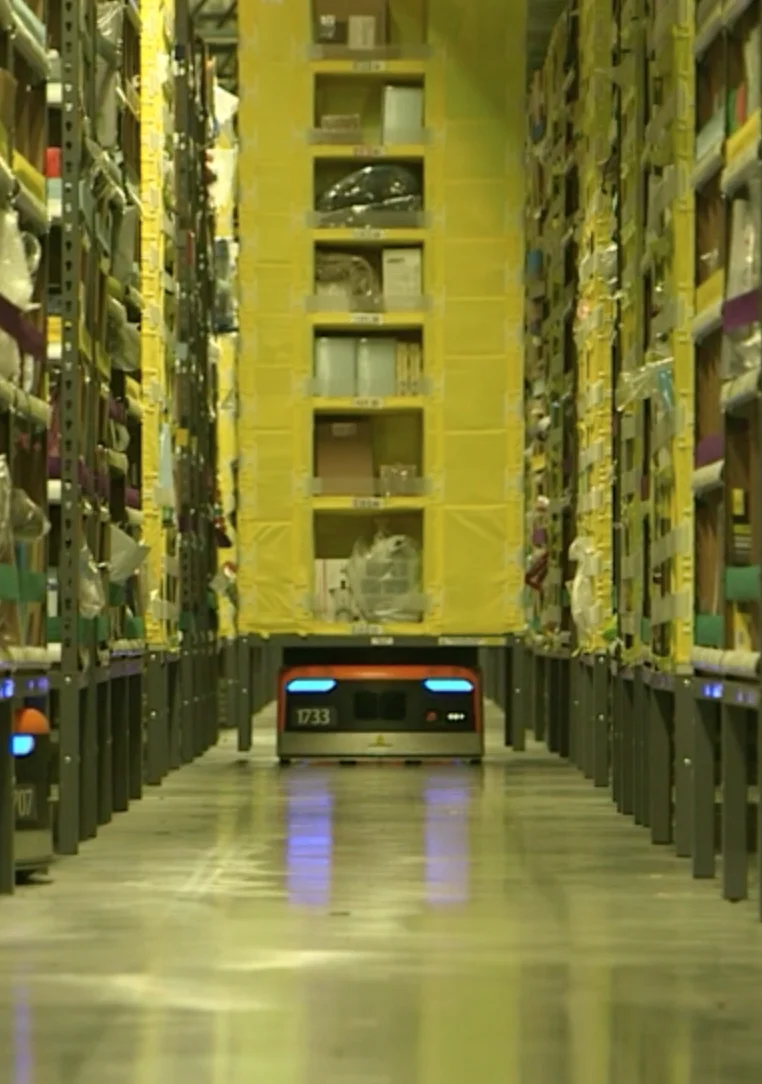
Explanation of the hot topic “multi-agent path finding”.
💡 Research Summary
The paper provides a comprehensive overview of Multi‑Agent Path Finding (MAPF) as it applies to modern warehouse robotics, using Amazon Robotics as a running example. In a typical fulfillment center, hundreds of autonomous robots shuttle inventory pods between storage locations and pick‑up stations through narrow aisles. The MAPF problem abstracts this setting as a discrete‑time graph where each of n robots has a start cell and a goal cell. At each time step a robot may either wait in its current cell or move to one of the four orthogonal neighboring cells, provided that no two robots occupy the same cell simultaneously and no two robots exchange cells in the same step. The most common objective is to minimize the makespan—the number of time steps until the last robot reaches its goal—although sum‑of‑cost (total arrival time) and other criteria are also studied.
The authors first discuss the computational complexity of MAPF. Finding an optimal makespan on a general graph is NP‑hard (Yu & LaValle, 2013c). A related variant where the set of goal cells is not fixed but any n free cells may serve as goals can be solved in polynomial time using network‑flow techniques, because the problem reduces to a maximum‑flow with unit capacities that automatically enforces collision‑free movement.
The paper then surveys the two dominant families of algorithms. Conflict‑Based Search (CBS) and its extensions (ICBS, ECBS, etc.) start by planning a shortest path for each robot independently. When a conflict (simultaneous occupation of a cell or a swap) is detected, the algorithm branches on two constraints—preventing one robot or the other from using the conflicting move—and recursively resolves the resulting sub‑problems. CBS maintains a constraint tree that allows reuse of previously solved sub‑problems, yielding optimal or bounded‑suboptimal solutions for moderate numbers of robots. However, as the number of conflicts grows, the tree can explode, limiting real‑time applicability.
The second family, Subdimensional Expansion (SDE), groups colliding robots into a low‑dimensional joint planning problem. The joint state space is the Cartesian product of the individual robots’ positions; by limiting the group size, the exponential blow‑up is kept manageable. Algorithms such as MAPP, Subdimensional Expansion, Push‑and‑Rotate, and their successors guarantee completeness and often produce high‑quality solutions in environments with narrow corridors where conflicts tend to involve only a few robots at a time.
Beyond these search‑based methods, the authors review approaches that translate MAPF into well‑studied optimization frameworks. SAT encodings turn collision constraints into Boolean formulas solved by modern SAT solvers; Integer Linear Programming (ILP) models use flow variables and linear collision‑avoidance constraints; Answer Set Programming (ASP) offers a declarative logic‑programming formulation. While these methods can provide provably optimal solutions, the number of variables grows with the product of robots and time horizon, making them challenging for large‑scale, low‑latency scenarios.
The paper also addresses practical deployment issues. Real robots have kinematic constraints (acceleration limits, turning radii) and sensor noise, which must be incorporated into the planning stage. The authors cite experimental results from simulations and from a testbed resembling an Amazon warehouse, where up to 100 robots were coordinated. State‑of‑the‑art MAPF solvers reduced makespan by roughly 10–30 % compared with naïve shortest‑path plans, but achieving sub‑10 ms planning times—required for continuous operation—remains an open challenge.
Finally, the authors outline recent community activities (AAAI 2012 MAPF workshop, IJCAI 2016 MAPF workshop) and emerging research directions: (1) online MAPF for dynamically arriving orders, (2) extensions that allow payload exchange or temporary re‑allocation of inventory pods, and (3) hybrid algorithms that combine the strengths of CBS, SDE, and SAT/ILP techniques to scale to thousands of robots while preserving real‑time guarantees. The conclusion emphasizes that MAPF sits at the intersection of theoretical computer science, AI planning, and robotics, and that future progress will hinge on tighter integration of algorithmic advances with the physical constraints of real warehouse fleets.
Comments & Academic Discussion
Loading comments...
Leave a Comment