A Spatial-Spectral Interference Model for Millimeter Wave 5G Applications
The potential of the millimeter wave (mmWave) band in meeting the ever growing demand for high data rate and capacity in emerging fifth generation (5G) wireless networks is well-established. Since mmWave systems are expected to use highly directional…
Authors: Solmaz Niknam, Balasubramaniam Natarajan, Hani Mehrpouyan
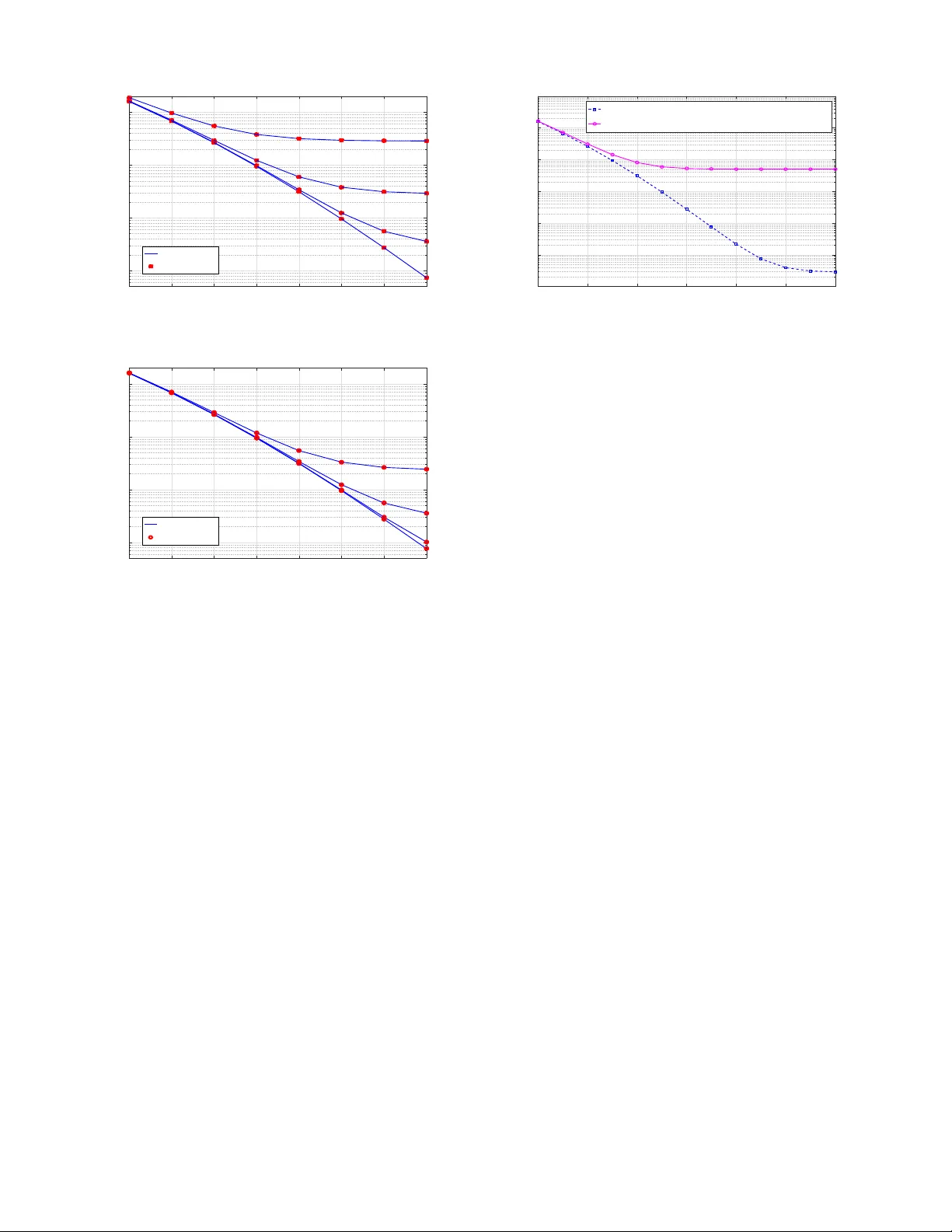
A Spatial-Spectral Interference Model for Millimeter W a v e 5G Applications Solmaz Niknam and Balasubramaniam Natarajan Department of Electrical and Computer Engineering Kansas State Univ ersity Manhattan, KS, 66506 USA Email: slmzniknam@ksu.edu; bala@ksu.edu Hani Mehrpouyan Department of Electrical and Computer Engineering Boise State Univ ersity Boise, ID, 83725 USA Email: hani.mehr@ieee.org Abstract —The potential of the millimeter wa ve (mmW a ve) band in meeting the ever growing demand for high data rate and capacity in emerging fifth generation (5G) wir eless networks is well-established. Since mmW a ve systems are expected to use highly dir ectional antennas with v ery focused beams to ov ercome sever e pathloss and shado wing in this band, the nature of signal propagation in mmW av e wireless networks may differ from current networks. One factor that is influenced by such propagation characteristics is the interference behavior , which is also impacted by simultaneous use of the unlicensed portion of the spectrum by multiple users. Ther efore, considering the propa- gation characteristics in the mmW a ve band, we pr opose a spatial- spectral interference model f or 5G mmW ave applications, in the presence of Poisson field of blockages and interferers operating in licensed and unlicensed mmW ave spectrum. Consequently , the av erage bit error rate of the network is calculated. Simulation is also carried out to verify the outcomes of the paper . I . I N T R O DU C T I O N One of the key enabling technologies of emerging fifth gen- eration (5G) wireless networks is the use of bandwidth in the millimeter-wave (mmW ave) frequencies, i.e, 30 – 300 GHz [1]. Howe ver , due to undesirable propagation characteristics of mmW av e signals such as sev ere pathloss, strong gaseous atten- uation, low diffraction around objects and large phase noise, this section of spectrum has been underutilized. Having large antenna arrays that coherently direct the beam energy will help ov ercome the hostile characteristics of mmW av e channels [2]. Howe ver , utilization of the highly directional beams changes many aspects of the wireless system design. Such directional links (that are susceptible to blockages by obstacles along with the distinct mmW a ve propagation characteristics), will considerably af fect the interference model. In fact, interference in the mmW av e band may exhibit an on-of f behavior [1]. As new applications and standards compete to e xploit open access frequencies, coexistence of licensed and unlicensed bands in 5G cellular networks is a critical consideration [3]. In addition, unlicensed frequencies provide a viable option for offloading traffic [1], [4]. With such mixed use of licensed and unlicensed bands, interference in the mmW av e band may hav e a more unpredictable behavior that needs to be taken into consideration. In general, users may be randomly distrib uted in space and could be using a random subset of frequency bands. There are multiple prior efforts that hav e focused on modeling the interference behavior . An uplink interference model for small cells of heterogeneous networks has been proposed in [5]. Howe ver , mmW ave specifications in modeling the interference, i.e., the effect of the highly directional links and considerable sensiti vity of mmW av e beams to blockages are not taken into account. An interference model for wearable mmW av e networks considering the effect of blockages has been suggested in [6]. Howe ver , the location of the interferers and the blockages are assumed to be deterministic. The authors in [7] have suggested an interference model for randomly distributed interferers, using a stochastic geometry based analysis. Howe ver , similar to [5] and [6], in [7], interferers are considered only in spatial domain. Such a consideration may not be adequate to model the interference in networks operating in both licensed and unlicensed frequency bands, due to the randomness in utilizing the frequencies by terminals that share the same spectrum. Authors in [8] hav e suggested a spectral-spatial model for interference analysis in networks considering the unlicensed frequency bands. Howe ver , the effect of the presence of the blockages in the en vironment is not taken into account in the model. In summary , current literature in interference modeling for 5G mmW a ve networks lacks the consideration for the propagation characteristics in the mmW a ve band, i.e., sev ere shadowing caused by highly directional links and the presence of blockages and simulta- neous use of both licensed and unlicensed spectrums in the mmW av e band. In this paper , we propose a spatial-spectral model for interference analysis in 5G mmW ave short-range wireless technologies while considering the impact of random number of blockages in the en vironment. Such technologies are a part of standards like IEEE 802.11 ad, wireless HD or short- range operating modes between devices for mmW av e 5G cellular systems, where communication links range from 1- 10 m [2]. W e deriv e the closed-form expression of the moment generation function (MGF) of the aggre gate interference to a victim receiv er , considering blockages in the en vironment. Then, we use this MGF to deri ve the bit error rate (BER) expression at the victim recei ver and validate it using Monte V i ct im R e c e i ver Inte rf e rer Bloc k a ge q c s c k q c s c k 2 t a n k q k q k k k k k k k k 2 2 2 2 5 5 3 3 1 1 Fig. 1: The impact of interferers on the victim receiv er in the presence of obstacles. Carlo simulations of the network. The remainder of this paper is org anized as follows. Sec- tion II describes the considered system model. In Section III, we calculate the closed-form expression of the MGF of the aggregated interference and perform the system ev aluation. Section IV and V present simulation results and the conclu- sion, respectiv ely . I I . S Y S T E M M O D E L W e consider a transmitter-recei ver pair in the presence of random number of interferers with the receiv er at the origin of I R 2 plane communicating with the transmitter ov er a desired communication link. The number of interferers follows a Poisson point process with parameter λ in the space-frequency domain [9]. W e also model the spatial distrib ution of blockages as a Poisson point process with parameter ρ [10]. Considering the large scale signal attenuation, specially in case of mmW ave signals that suffer greatly from gaseous attenuation and at- mospheric absorbtion, only interference within a limited area around the victim receiver is significant [5], [11]. A circular area of radius D around the victim receiver is assumed and the number of interferes inside the interfering circle is Poisson distributed with parameter λπ D 2 [12]. Moreo ver , in this network, we are primarily concerned with active interferers that are in the line-of-sight (LoS) of the victim receiv er . It is important to note that there could be other interferers that do not impact the victim receiver as their signals are blocked by obstacles. Similar to [6], we assume that there is no blockages in the desired communication link. The interferers and their distances to the victim recei ver are denoted by I k and ` k , for k = 1 , 2 , ..., U , respecti vely . For the k th individual interferer , we consider a radiation cone, denoted by S k , where the edges are determined by the beamwidth of the signal. From Fig. 1, it is e vident that for the k th interferer , the radiation cone area, A S k , is giv en by A S k = 2 ` k tan ( θ ) . ` k 2 = ` 2 k tan ( θ ) . (1) Similar to [6], [10] and [13], we assume that the beamwidth of mmW av e signals, 2 θ , is narrow enough that the signal from an interferer is blocked if at least one blockage is presented in the radiation cone of the giv en interferer . That is, the beamwidth, 2 θ , is such that the base of the radiation cone of the interferer is smaller than the dimension of the blockage. This considerable sensitivity to blockages results from the high directionality of mmW av e signals [1], [2]. F or instance, measurement results from [14], for a transmitter-recei ver pair separated by 5 m, indicate that an a verage sized body of depth of 0.28 m causes 30-40 dB power loss using directional antennas. Therefore, the probability of the k th interferer not being blocked, p k , is obtained by p k = e − ρA S k = e − ρ` 2 k tan( θ ) , (2) which is consistent with the 3GPP [15] and potential indoor 5G 3GPP-like models [16] as well, where the probability of ha ving LoS decreases e xponentially as the length of the link increases. Based on the above assumption and system configuration, the receiv ed signal at the victim receiv er, R ( t ) , is gi ven by R ( t ) = i 0 ( t ) + K X k =1 i k ( t ) + n ( t ) , (3) where K is the number of active interferers, i k ( t ) is the signal receiv ed from the k th interferer , i 0 ( t ) is the desired signal, and n ( t ) is the additiv e white Gaussian noise (A WGN) with zero mean and v ariance N 0 / 2 . The recei ved interference signal from the k th interferer , can be represented as [17] i k ( t ) = q q k h k ` − α k v k ( t ) e − j 2 πf k t + ψ k , (4) where v k ( t ) and q k are the baseband equiv alent and transmit- ted power of the k th interferer , respectively , α is the pathloss exponent, and h k is a Gamma distrib uted random variable that represents the squared fading gains of the Nakagami- m channel model (a generic model that can characterize different fading en vironments [17]). f k and ψ k denote the frequency and phase of the k th interferer , respecti vely , which are assumed to be random [9]. I I I . I N T E R F E R E N C E A NA LY S I S A N D S Y S T E M P E R F O R M A N C E In this section, the MGF of the accumulated interference is deriv ed and used to quantify the average BER at the victim receiv er . Using (3) and (4), the signal to interference and noise ratio (SINR) at the victim receiv er can be determined as SINR = q 0 h 0 ` − α 0 K P k =1 P I k + σ 2 n , (5) where, σ 2 n is the power of the additive noise bandlimited to the signal bandwidth [ − W 2 . W 2 ] . q 0 , h 0 , and ` 0 are the transmitted power , the squared channel fading gain, and the distance between desired transmitter and the receiv er , respectively . P I k is the ef fective receiv ed interference power from the k th interferer at the output of the matched filter which is obtained by P I k = q k h k ` − α k Z + W/ 2 − W/ 2 Φ( f − f k ) | H ( f ) | 2 d f . (6) Here, H ( f ) is the transfer function of the matched filter on the recei ver side, and Φ( f ) is the power spectral density of the baseband equi valent of the interferers’ signals. In order to ev aluate the performance of the network, we assume that given the distribution of f k , l k , and ψ k , the received interference signal at the output of the matched filter is a complex Gaus- sian distributed signal. This is a valid assumption as shown in [18]. Subsequently , we can relate the BER to SINR as BER= 1 2 erfc √ c SINR, where c is a constant that depends on modulation used [17]. In order to find the av erage BER, we in voke the result in [19], in which it is shown that the expected value of functions in the form of g ( x y + b ) can be written as E x " g x y + b # = g (0) + ∞ Z 0 g m (s) M y ( m s)e − s mb ds . (7) Here, x is a Gamma distributed random v ariable, M y ( m s) rep- resents the MGF of y in a Nakagami- m fading en vironment, b is an arbitrary constant, and g m (s) = − √ c π Γ( m + 1 2 ) Γ( m ) e − c s √ s 1 F 1 (1 − m ; 3 2 ; c s) , where 1 F 1 ( a ; b ; s) is the confluent hypergeometric function. In order to utilize (7) to find the av erage BER, (5) can be rewritten as SINR = h 0 1 q 0 ` − α 0 K P k =1 P I k + σ 2 n q 0 ` − α 0 , (8) where, h 0 is a Gamma distributed random variable and σ 2 n q 0 ` − α 0 is a constant. Therefore, using (7), the av erage BER can be written based on the MGF of the accumulated interference as E h 0 [ BER ] = 1 2 − √ c π Γ( m + 1 2 ) Γ( m ) Z ∞ 0 1 F 1 1 − m ; 3 2 ; c s √ s × M I ( m s) e − ( mb + c )s ds , (9) where M I (s) = E e s q 0 ` − α 0 K P k =1 q k h k ` − α k Ω( f k ) , (10) Ω( f k ) = Z + W/ 2 − W/ 2 Φ( f − f k ) | H ( f ) | 2 d f . (11) Since (10) is the MGF of sum of a random number of random v ariables, the distribution of the random variable K , i.e., the number of activ e interferers, is needed. Lemma 1. The number of active interferer s, K , within the cir cular ar ea of radius D (around the victim r eceiver) and the signal bandwidth W , is a P oisson random variable with parameter λπ W 1 − e − D 2 ρ tan θ ρ tan θ . Pr oof. Let K = X I 1 + X I 2 + ... + X I U , where X I k is the indicator that the k th interferer is not block ed with probability p k , gi ven by (2). In order to make the analysis tractable, we assume that the blockages af fect each link independently , i.e., the number of the blockages on dif ferent links are independent. The assumption of two links share no common blockages has negligible ef fect on accuracy [10]. Consequently , X I k can be modeled as an i.i.d Bernoulli distributed random variable with success probability p k and I k is assumed to take on Poisson distribution as presented in section II. Therefore, gi ven the distance ` k , the probability generating function (PGF) of X is obtained by 1 G X | ` k (z) = p k z + (1 − p k ) = e − ρ` 2 k tan( θ ) z + (1 − e − ρ` 2 k tan( θ ) ) . (12) In networks with Poisson field of interferers, the probability density function (PDF) of ` k , i.e., the distance of the k th interferer to the victim receiv er , is given by [9], P ( ` ) = 2 ` D 2 0 < ` < D 0 elsewhere . (13) Based on (13), we can av erage out ` in (12) leading to G X (z) = (1 − z) e − ρD 2 tan θ − 1 ρD 2 tan θ + 1 . (14) Subsequently , the PGF of K is giv en by G K (z) = E h z U P k =1 X I k i = X k ≥ 0 E z X k p ( U = k ) = G U ( G X ( z )) = e λπ W 1 − e − D 2 ρ tan θ ρ tan θ (z − 1) , (15) 1 The subscript of X I k is dropped for notational simplicity . M I ( s ) = exp ( λπ W 1 − e − D 2 ρ tan θ ρ tan θ 2 αW ∞ X n =0 ∞ X j =0 n Y i =0 ( i + j − 2 α ) κ ( j ) Γ ( n ) Γ ( j − 1) s q D α q 0 ` − α 0 j Γ ( j + m ) m j Γ ( m ) − 1 ) . (16) which is the PGF of a Poisson random variable with parameter λπ W 1 − e − D 2 ρ tan θ ρ tan θ . Theorem 1. The closed-form expr ession for the MGF of the accumulated interfer ence corr esponds to (16) . Pr oof. Similar to [8] and [6], for simplicity , homogeneous interferers are assumed, i.e., all interferers transmit at the same power . Therefore, gi ven the distribution of h , the MGF of the receiv ed signal from an arbitrary interferer, M I k | h (s) , is giv en by M I k | h (s) = E e s q 0 ` − α 0 q h` − α Ω( f ) | h = Z W 2 − W 2 Z D 0 e s q 0 ` − α 0 q h` − α Ω( f ) 2 ` D 2 . 1 W d ` d f = 2 D 2 W α − s q h q 0 ` − α 0 2 α × Z W 2 − W 2 Γ − 2 α , − s q h Ω ( f ) D α q 0 ` − α 0 Ω( f ) 2 α d f . (17) Here, f k is a random v ariable that is uniformly distributed ov er [ − W 2 W 2 ] which is a valid assumption in networks with Poisson field of interferers [9], and Γ ( a, x ) , R ∞ x t a − 1 e − t dt repre- sents the Incomplete Gamma function. Using the Laguerre polynomials expansion of the Incomplete Gamma function [20], (17) is simplified to M I k | h (s)= 2 αW ∞ X n =0 ∞ X j =0 n Y i =0 ( i + j − 2 α ) κ ( j ) Γ ( n ) Γ ( j − 1) s q h D α q 0 ` − α 0 j , (18) where κ ( j ) = R W/ 2 − W/ 2 Ω( f ) j d f . Based on the assumption of general Nakagami- m fading channel, h is a Gamma distributed random v ariable representing the squared fading gain of the channel. Therefore, the MGF of the interference from the k th interferer can be expressed as M I k (s) = 2 αW ∞ X n =0 ∞ X j =0 n Y i =0 ( i + j − 2 α ) κ ( j ) Γ ( n ) Γ ( j − 1) × s q D α q 0 ` − α 0 j Γ ( j + m ) m j Γ ( m ) . (19) Assuming i.i.d. interference signals, justified by the fact that the sources of the interference are independent from one another [9], we hav e M I ( s ) = E h e s K P k =1 I k i = X k ≥ 0 E e s I k k p ( K = k ) = G K ( M I k (s)) = e λπ W 1 − e − D 2 ρ tan θ ρ tan θ ( M I k (s) − 1 ) . (20) Substituting (19) in (20), the closed-form expression for the accumulated interference is determined as in (16). I V . S I M U L A T I O N R E S U LT S In this section, we present numerical results to e valuate the performance of the network based on the proposed interference model and v alidate the results with Monte Carlo simulation. A network region of an area of 100 m 2 is considered. The nor- malized distance between the desired transmitter and receiv er is set to 1 m. W e assume the pathloss e xponent, α , and the shape factor of Nakagami distribution, m , are set to 2.5 and 3, respectively . Here, similar to [6], the power of all interferers assumed to be the same and set to 0 dB. The beamwidth of the mmW a ve signals, i.e. 2 θ , is set to 20 degrees. An ideal raised cosine (RC) filter is assumed at the receiv er’ s side with roll-off factor of 0. In addition, we consider a raised cosine shaped power spectral density for the interfering signals, as well. It is worth mentioning that the proposed model is not limited to specific power spectral densities of the desired and interferers’ signals. In Fig. 2, BER versus SNR is shown for different values of λ . Here, the density of the number of blockages, ρ , is set to 10 − 4 . As expected, as the density of the number of interferers decreases, the performance of the system improves. For higher SNR values, the level of the error floor depends on the different λ values. Fig. 3 illustrates the performance of the system for different values of ρ , considering a fixed density of the number of interferers, i.e., λ =10 − 4 . As it is evident from Fig. 3, as the number of blockages increases, the probability of the interferers being blocked increases and consequently the performance of the network improves. Here, having higher blockage density in the network enhances the lev el of the error floor . This is an important result that indicates mmW av e signals sensitivity to blockages can be advantageous in densely deployed networks, where objects and users that serve as obstacles reduces the lev el of the interference. It is important to note that, in both Fig. 2 and 3, the simulated av erage BER plots aligns well with the theoretical result from the deriv ed interference model. Fig. 4 shows the BER versus SNR of the victim receiver with and without consideration of the blockages. As it is illustrated, when the presence of the obstacles is considered in the interference model, there is less SNR [dB] 8 9 10 11 12 13 14 15 BER 10 -6 10 -5 10 -4 10 -3 Theoretical Simulation λ =10 -3 λ =10 -2 λ =10 -4 λ =0 Fig. 2: Bit error rate versus SNR for different λ values, ρ =10 − 4 . SNR [dB] 8 9 10 11 12 13 14 15 BER 10 -6 10 -5 10 -4 10 -3 Theoretical Simulation ρ =10 -3 ρ =10 -4 ρ =10 -5 ρ =10 -2 Fig. 3: Bit error rate versus SNR for different ρ values, λ =10 − 4 . interference signal introduced to the desired communication link. Unlike traditional wireless environment, the sensitivity of directional mmW ave signals to the obstacles in the en viron- ment leads to a different interference profile that is effecti vely captured in the proposed model. V . C O N C L U S I O N A N D F U T U R E W O R K In this paper , we analyzed the performance of mmW ave communication networks in the presence of Poisson field of interferers and blockages. Due to the use of the unlicensed mmW av e frequency band, i.e. the 60 GHz band, user terminals that share the same spectrum in the network could introduce unpredictable interference to the desired communication links and possible interference could exist in both frequency and space. Considering randomness in the presence of interference in both spectral and spatial domains, we proposed a spatial- spectral model for interference in the network. In the proposed model, MGF of the accumulated interference was deriv ed and based on the closed-form expression of MGF , the average BER at the victim receiver was calculated. In future work, we consider heterogeneous interferers where each interferer transmits at dif ferent power le vel. In addition considering the mobility of the nodes would also be of particular interest. R E F E R E N C E S [1] J. G. Andrews et al. , “What will 5G be?” IEEE J . Sel. Ar eas Commun. , vol. 32, no. 6, pp. 1065–1082, Jun. 2014. SNR [dB] 8 10 12 14 16 18 20 BER 10 -8 10 -7 10 -6 10 -5 10 -4 10 -3 10 -2 With considering the effect of blockages Without considering the effect of blockages Fig. 4: Bit error rate versus SNR for λ =10 − 4 and ρ =10 − 2 . [2] T . S. Rappaport, R. W . Heath Jr , R. C. Daniels, and J. N. Murdock, Millimeter wave wireless communications . Pearson Education, 2014. [3] T . S. Rappaport et al. , “Millimeter wave mobile communications for 5G cellular: It will work!” IEEE Access , vol. 1, pp. 335–349, May 2013. [4] S. Niknam, A. A. Nasir , H. Mehrpouyan, and B. Natarajan, “ A multi- band OFDMA heterogeneous network for millimeter w ave 5G wireless applications, ” IEEE Access , vol. 5, pp. 5640–5648, Sep. 2016. [5] Y . Dong, Z. Chen, P . Fan, and K. B. Letaief, “Mobility-a ware uplink in- terference model for 5G heterogeneous networks, ” IEEE T rans. W ireless Commun. , vol. 15, no. 3, pp. 2231–2244, Mar . 2016. [6] K. V enugopal, M. C. V alenti, and R. W . Heath, “Interference in finite- sized highly dense millimeter wa ve networks, ” in Pr oc. of ITA , Feb . 2015, pp. 175–180. [7] R. W . Heath and M. K ountouris, “Modeling heterogeneous network interference, ” in Pr oc. of IT A , Feb. 2012, pp. 17–22. [8] Y . M. Shobowale and K. A. Hamdi, “ A unified model for interference analysis in unlicensed frequency bands, ” IEEE T rans. W ireless Commun. , vol. 8, no. 8, pp. 4004–4013, Aug. 2009. [9] M. Haenggi and R. Ganti, Interference in large wir eless networks . Now Publishers Inc, 2009. [10] T . Bai, R. V aze, and R. W . Heath, “ Analysis of blockage effects on urban cellular networks, ” IEEE T rans. W ireless Commun. , vol. 13, no. 9, pp. 5070–5083, Sep. 2014. [11] M. T aranetz and M. Rupp, “ A circular interference model for heteroge- neous cellular networks, ” IEEE T rans. W ireless Commun. , vol. 15, no. 2, pp. 1432–1444, Feb. 2016. [12] Z. Gong and M. Haenggi, “Interference and outage in mobile random networks: Expectation, distrib ution, and correlation, ” IEEE T rans. Mo- bile Comput. , vol. 13, no. 2, pp. 337–349, Feb. 2014. [13] A. K. Gupta, J. G. Andrews, and R. Heath, “Macro di versity in cellular networks with random blockages, ” arXiv preprint , 2017. [14] G. R. MacCartney Jr, S. Deng, S. Sun, and T . S. Rappaport, “Millimeter- wav e human blockage at 73 GHz with a simple double knife-edge diffraction model and extension for directional antennas, ” arXiv preprint arXiv:1607.00226 , 2016. [15] 3rd Generation Partnership Project, “Further advancements for e-utra physical layer aspects, ” Mar . 2010. [16] K. Haneda et al. , “Indoor 5G 3GPP-like channel models for office and shopping mall en vironments, ” arXiv preprint , 2016. [17] A. Goldsmith, W ireless communications . Cambridge univ ersity press, 2005. [18] T . H. Chan, S. Hranilovic, and F . R. Kschischang, “Capacity-achieving probability measure for conditionally Gaussian channels with bounded inputs, ” IEEE T rans. Inf. Theory , vol. 51, no. 6, pp. 2073–2088, Jun. 2005. [19] K. A. Hamdi, “ A useful technique for interference analysis in Nakagami fading, ” IEEE T rans. Commun. , v ol. 55, no. 6, pp. 1120–1124, Jun. 2007. [20] M. Abramowitz and I. A. Stegun, Handbook of mathematical functions: with formulas, gr aphs, and mathematical tables . Courier Corporation, 1954, vol. 55.
Original Paper
Loading high-quality paper...
Comments & Academic Discussion
Loading comments...
Leave a Comment