A Spatial-Spectral Interference Model for Dense Finite-Area 5G mmWave Networks
With the overcrowded sub-6 GHz bands, millimeter wave (mmWave) bands offer a promising alternative for the next generation wireless standard, i.e., 5G. However, the susceptibility of mmWave signals to severe pathloss and shadowing requires the use of…
Authors: Solmaz Niknam, Balasubramaniam Natarajan, Reza Barazideh
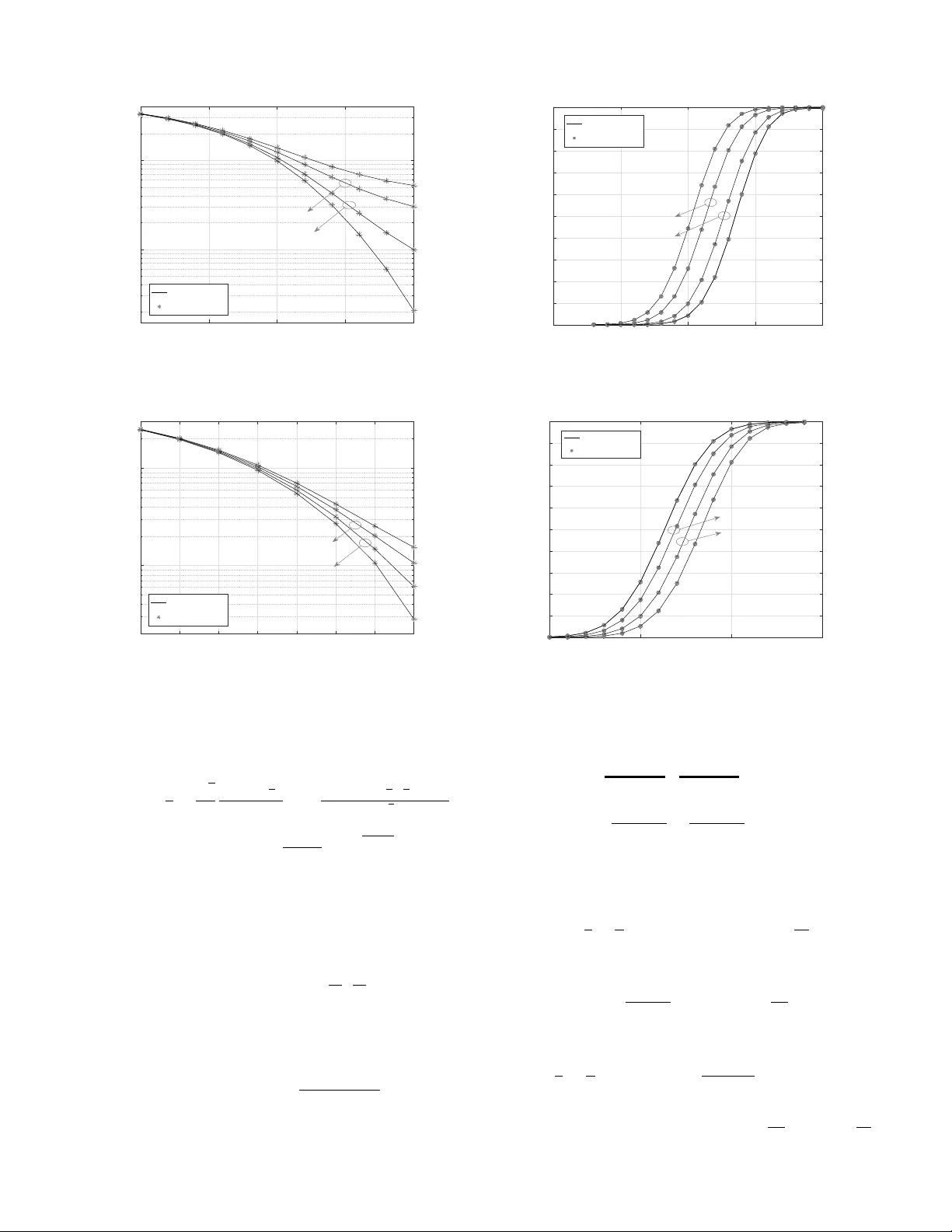
1 A Spatial-Spectral Interference Model for Dense Finite-Area 5G mmW a v e Networks Solmaz Niknam, Student Member , IEEE, Balasubramaniam Natarajan, Senior Member , IEEE, and Reza Barazideh, Student Member , IEEE. Abstract —With the overcr owded sub-6 GHz bands, millimeter wav e (mmW ave) bands offer a promising alternativ e for the next generation wireless standard, i.e., 5G. However , the susceptibility of mmW a ve signals to se vere pathloss and shadowing requir es the use of highly directional antennas to ov ercome such adverse char- acteristics. Building a network with directional beams changes the interference behavior , since, narro w beams are vulnerable to blockages. Such sensitivity to blockages causes uncertainty in the active interfering node locations. Configuration uncertainty may also manifest in the spectral domain while applying dynamic channel and frequency assignment to support 5G applications. In this paper , we first propose a blockage model considering mmW a ve specifications. Subsequently , using the proposed block- age model, we derive a spatial-spectral interfer ence model for dense finite-area 5G mmW ave networks. The proposed inter- ference model considers both spatial and spectral randomness in node configuration. Finally , the error performance of the network from an arbitrarily located user perspective is calculated in terms of bit error rate (BER) and outage probability metrics. The analytical results are validated via Monte-Carlo simulations. It is shown that considering mmW av e specifications and also randomness in both spectral and spatial node configurations leads to a noticeably different interference profile. Index T erms —Interference modeling, millimeter -wave band, blockage, 5G. I . I N T R O D U C T I O N T riggered by the popularity of smart devices, wireless traffic volume and device connectivity have been growing exponentially during recent years [1]. Next generation of wireless networks, i.e., 5G, is a promising solution to satisfy the increasing data demand through combination of key en- abling technologies such as ultra-densification (deployment of high density of access points (APs)) and utilization of lar ge amount of bandwidth in millimeter wav e (mmW av e) bands. Howe ver , mmW ave signals suffer from sev ere pathloss and strong gaseous attenuation due to oxygen molecules, water vapor , and rain drops in the atmosphere. Therefore, this section of spectrum has been under-utilized. Howe ver , ha ving large antenna arrays that coherently direct the beam energy will help ov ercome the hostile characteristics of mmW a ve channels. Utilization of the highly directional beams changes many aspects of the wireless system design. One of the main factor that is highly impacted is the interference behavior . In fact, directional links are highly susceptible to obstacles [2] and interference in such networks tends to demonstrate an on-off pattern as a result of the mo vement of the nodes [3]. In addition Authors are with the department of ECE, Kansas state university , Manhat- tan, KS (emails: { slmzniknam, bala, rezabarazideh } @ksu.edu). to the node mobility , the unplanned user-installed APs which causes uncertainty in spatial network configuration influences the interference models as interference power is highly de- pendent on the relativ e locations of the transmitters and receiv ers. Therefore, it is important to consider random spatial models of the network configuration to accurately model the interference [4]. In addition to the spatial distance between nodes, the distance between their allocated frequencies also affects the amount of accumulated interference in a multi-user en vironment due to possible partial band overlap and out-of- band radiation. Therefore, uncertainty in network configura- tion may be observed in the spectral domain impacting the interference model. Moreov er, with the notions of adaptive frequency selection and dynamic channel allocation strategies instead of static assignments [5], considering the uncertainty in spectral domain while modeling the accumulated interference provides a more accurate model. A precise interference model in turn impacts the design of interference coordination and management schemes. A. Related work There have been prior efforts on interference modeling considering random node distributions. Due to its analytical tractability , Poisson point process (PPP) is one of the popular random model assumed for node distribution [6]. A 2D-PPP has been suggested in [7] in order to consider the presence of interferers in both spectral and spatial domains in the interference model. Ho wever , an infinite-sized network area and an unlimited frequency band of operation are assumed in order to simplify the calculations. In addition, the effect of blockages and mmW a ve specifications such as high signal at- tenuation and beam directivity and are not taken into account. Therefore, it may not be applicable to 5G mmW ave networks. Assuming a PPP model, an interference model for finite-sized highly dense mmW a ve networks has been proposed in [8]. Howe ver , uncertainty in the configuration is only considered in the spatial domain. Moreover , Binomial point process (BPP) is a more appropriate choice for modeling finite-sized networks with a giv en number of APs [6]. Authors in [9] have recommended a mobility-aware uplink interference model for 5G networks with Binomial node distribution. Howe ver , only the interference from macro users to the small cell users is considered due to their higher po wer levels. Such an assump- tion may not be appropriate in a dense en vironment where the interference lev els from individual interferers become less distinguishable as they are located in close proximity . In fact, 2 V i c t i m R e c e i v e r I n t e r f e r i n g A P B l o c k a g e 5 3 1 2 t a n i i i R 2 Fig. 1: The impact of interfering APs on the victim receiver in the presence of obstacles. in dense networks, the variance of interference lev els from individual users decays with the node density [10]. In addition, mmW ave specifications and hence the sensitivity of the beams to the blockages in the environment is not taken into account in [9]. There hav e been sev eral prior works that model the effect of blockages [11]–[15]. Howe ver , in order to make the calculations tractable, [11]–[15] assume that the presence of one obstacle in the path between the transmitters and the receiv ers completely blocks the line-of-sight (LoS) link. Such an assumption may be justifiable in case of relativ ely long- distance links. Ho wever , in many practical applications such as indoor en vironments, outdoor small cells where coverage range is limited or e ven cases where terminals are equipped with larger number of antennas with wider beamwidths, more than one obstacle is needed to impact the power level, causing link blockage. Authors in [16] have suggested a blockage model, built with tools from stochastic geometry and rene wal processes, for mmW a ve cellular communications considering the receiv er dimension. Howe ver , the model in [16] is based on an unrealistic assumption of very large-sized receiver (i.e., receiv er dimension → ∞ ). B. Contributions In this paper, we propose a spatial-spectral interference model for dense finite area 5G mmW ave networks while considering realistic blockage effects. The important features of the proposed model can be summarized as follo ws: • In order to capture the effect of blockages properly , we first propose a blockage model that calculates the effecti ve number of the obstacles that results in complete link blockage. Then, we calculate the probability of the presence of that number of obstacles in the path from the interfering APs to the receiv er which is the probability of the complete blockage of the interference link. Therefore, unlike prior efforts that consider binary blockage effect , here we consider the partial blockage effect of e very single obstacle that intersects (partially or completely , depending on the blockage size) the signal beamwidth. • Binary effect of the blockages is the resultant of the assumption of 0 ◦ signal beamwidth which is not realistic. In fact, considering such an assumption, a single obstacle that occurs within a giv en area (depends on the size of the obstacles) close to the LoS link (assumed to be with 0 ◦ beamwidth) causes complete link blockage. Howe ver , considering non-zero signal beamwidth, there might be cases where a single obstacle creates partial signal blockage. Therefore, we consider non-zero signal beamwidth in order to model the effect of blockages and the interference behavior . • Using the proposed blockage model, we deri ve the mo- ment generating function (MGF) of the aggregated inter- ference power in a finite-sized mmW av e network while considering the configuration uncertainty of the nodes in the spectral domain as well as in spatial domain. Unlike prior works that consider configuration randomness only in spatial domain, we deriv e the spectral distance distri- bution and include the configuration randomness in the spectral domain, as well. Subsequently , using the proposed interference model, we ev al- uate the performance and reliability of the desired commu- nication link based on the av erage bit error rate (BER) and signal outage probability metrics. It is important to note that av erage BER and the outage probabilities are the two metrics that can be used in order to evaluate the network performance in fast and slow v arying spatial-spectral configuration scenario, respectiv ely . In fact, when the spatial-spectral configuration changes rapidly , it is meaningful to a verage the interference analysis o ver all possible realization of the spatial-spectral configurations motiv ating the use of the average BER metric. Howe ver , in the slow varying scenario, the configuration changes slowly and it is more reasonable to calculate the interference for the giv en configuration and utilize the outage probability metric. 3 T able I: S U M M ARY O F S Y ST E M M O DE L N OTA T I ON S Notation Description R Radius of the area N T otal number of interfering APs in the area of interest p Success probability of the BPP model (model of interfer - ing APs locations) ρ Parameter of the PPP model (model of blockages loca- tions) v 0 (resp. f 0 ) Location (resp. frequency) of the reference receiver v i (resp. f i ) Location (resp. frequency) of the i th interfering AP f s (resp. f e ) Minimum (resp. maximum) of the operational bandwidth d s (resp. d e ) Minimum (resp. maxi mum) of the radius of the blockages (modeled as circles) W Bandwidth of the desired signal 2 θ Signal beamwidth C. Organization The remainder of the paper is organized as follows. Sec- tion II and III describe the system model and the distribution of the number of APs considering the effect of the blockages, respectiv ely . In Section IV, we calculate the interference statistics and quantify the network performance based on BER and signal outage probability metrics. Finally , Section V highlights the numerical results and its validation using Monte- Carlo based system simulation. D. Notations E [ . ] and Pr ( . ) denote the expected value and probability measure of the argument, respectively . F X ( . ) , M X ( . ) and G X ( . ) are used for representing the cumulativ e density , mo- ment and probability generating functions of random variable x , respectively . erf ( . ) represents the error function. | . | and k . k are the absolute v alue and ` 2 -norm operators, respectiv ely . 1 F 1 ( a ; b ; c ) denotes the confluent hypergeometric function of the first kind. Γ( . ) represents the gamma function. Finally , min ( . ) and max ( . ) are used to denote the minimum and maximum v alues of the argument, respecti vely . I I . S Y S T E M M O D E L Fig. 1 represents the system model of interest in the present work. Here, we consider a reference pair of transmitter- receiv er communicating over a desired communication link in the presence of N number of interfering APs in a circular area with radius R and frequency range [ f s , f e ] . Interfering APs are distributed based on a BPP 1 in the space-frequency domain with success probability p . In other w ords, we consider a grid structure where the total N interfering APs are randomly located at space-frequency locations based on Binomial point process 2 . The overall recei ved interference signal is the sum of the recei ved signal from each element at random space- frequency location. W e also assume that the receiv er is at an arbitrary location v 0 ∈ B ( O ; R ) = x ∈ I R 2 k x k 2 < R transmitting signals with an arbitrary frequency f 0 ∈ [ f s , f e ] . There are also random number of random-sized blockages in 1 A popular model for finite-sized networks with a gi ven number of nodes [17]. 2 Reference transmitter-recei ver pair is not a part of the point process. the en vironment. Similar to [11], [13], [15], [18], we assume that blockages are PPP distributed with parameter ρ . For a quick reference, we provide the system model parameters in T able I. Due to the presence of the arbitrary blockages in the environment, the transmitted signal of interfering APs may be blocked and not all of the interfering APs contribute to the total recei ved interference signal. Therefore, we are primarily concerned with the interferers that are in the LoS link of the reference recei ver . In Section III, we provide the proposed blockage model and calculate the probability of each interfering APs being blocked. Subsequently , using the deriv ed probability of the blockage, we obtain the distribution of the number of active (non-blocked) interfering APs. I I I . B L O C K A G E M O D E L In order to calculate the probability of i th ∈ { 1 , 2 , ..., N } interfering AP being blocked, as sho wn in Fig. 1, we consider a radiation cone, denoted by C i , where the edges are determined by the beamwidth of the antenna ( 2 θ ). There are random num- ber of blockages, modeled as circles with uniformly distributed radius d in [ d s , d e ] , within the path from the interfering APs to the reference receiver . It is important to note that blockages can be at any distance from interfering APs. Therefore, we assume that r is uniformly distributed in [0 , ` i ] . Here, ` i is a random variable that represents the distances from the i th interfering AP to the reference receiver . Gi ven the BPP assumption for the locations of the interfering APs, the distribution of ` i is giv en by 3 [19] f L ( ` ) = 2 ` R 2 0 < ` ≤ R − k v 0 k 2 ` cos − 1 k v 0 k 2 − R 2 + ` 2 2 ` k v 0 k π R 2 R − k v 0 k < ` ≤ R + k v 0 k (1) T o calculate the blockage probability , we divide the distance r (distance from the interfering AP to the obstacles in its corre- sponding radiation cone) into two intervals, (1) r ≤ d tan( θ ) and (2) r > d tan( θ ) . In the former interval, only one obstacle blocks the radiation cone, while in the latter more than one blockage is needed to lose the LoS link from the interfering AP to the reference receiver . W e calculate the blockage probabilities in both cases (denoted as p b1 and p b2 , respectively) and average ov er all realizations of r . Since in the first interval, only one obstacle blocks the entire radiation cone, the probability of blockage is the probability of at least one Poisson-distributed blockage located in the upper triangle in Fig. 2 which is gi ven by p b1 | d = 1 − e − ρ d 2 tan( θ ) , (2) 3 W e drop the subscript i for notational simplicity . 4 and gi ven the uniform distribution of d , we have p b1 = d e Z d s 1 − e − ρ d 2 tan( θ ) 1 d e − d s d d = 1 − q π tan( θ ) ρ 2 ( d e − d s ) erf d e r ρ tan( θ ) − erf d s r ρ tan( θ ) ! . (3) In order to calculate the blockage probability in the second in- terval ( r > d tan( θ ) ), we borrow the concepts from point process projection along with results from queuing theory . As sho wn in Fig. 2, by projecting blockages onto the base of the radiation cone, each blockage in the radiation cone causes a shadow (blocked interv al) with length S = 2 d` i r on the base. Based on [20], the point process obtained by the projection of the points of a PPP from a random subset of a higher dimension onto a lower dimension subspace forms a PPP . Therefore, the number of the shadows of the blockages on the base follows a PPP . As shown in Fig. 2, the resulting blockages' shadows (gray lines on the base of the radiation cone) may overlap with one another . W e consider the ov erall overlapped shadow until the next upcoming non-blocked interval as a single resultant shadow (black lines on the base of the radiation cone) with length S res . It is worth mentioning that the number of the resultant shadows is a thinned version of the original PPP obtained from the projection of the blockages in the radiation cone onto its base. In order to calculate the the density of the thinned PPP and also the resultant shadows' length, S res , we model the overall projection process by an M/G/ ∞ queuing system 4 , in which the initiation and the length of the shadows corresponds to the customer arriv al (with poisson distribution) and their service times in the queue system, respecti vely . In fact, upon mapping the base of the radiation cone to the time duration [0 , 2 ` i tan( θ )] , we can model the initiation of the blockages' shadows (customers arriv als) as the Poisson point arriv als in that time duration. Furthermore, they are served immediately upon their arriv al (infinite servers in the system) for a time that follows a general distribution (shadow lengths). The assumption of infinite number of serv ers accounts for the overlapped service times (ov erlapped shado ws). By such correspondence, the interval [0 , 2 ` i tan( θ )] consists of alternate busy (partial blocked segment) and idle (non-block ed segment) periods in the queue system. Therefore, the average length and number of the resultant blocked intervals (busy periods of the queue system), denoted as E [ S res ] and N S res , is obtained via E [ S res ] = e ρ E [ S ] − 1 ρ , (4) and e − ρ E [ S ] (1 + 2 ρ` i tan ( θ )) ≤ N S res ≤ 1 + 2 ρ` i tan ( θ ) , (5) 4 M/G/ ∞ is a queuing system with Poisson arriv al of customers, infinite servers and general service time distribution. r 2 d S i i 2 d 2 ta n i ta n d Fig. 2: Effectiv e shadow of the blockages on the base of the radiation cone. respectiv ely [21], where E [ S ] is giv en by E [ S ] = E 2 d` r | d, r , ` = d e Z d s R + k v 0 k Z d tan( θ ) ` Z d tan( θ ) 2 d` r f D ( d ) f ( r, ` ) d d d r d `. (6) Here, f ( r, ` ) = f L ( ` ) f ( r | ` ) = f L ( ` ) 1 ` 0 ≤ r ≤ ` 0 otherwise . (7) Giv en the distribution of ` i in (1) and the fact that both upper and lower bounds of N S res are affine functions of ` i , we can apply Jensen's inequality . Therefore, the average number of the the resultant shadows can be bounded by e − ρ E [ S ] (1 + 2 ρ E [ ` ] tan ( θ )) ≤ N S res ≤ 1 + 2 ρ E [ ` ] tan ( θ ) . (8) In order to hav e a complete blockage of the base with av erage length 2 E [ ` ] tan ( θ ) , l 2 E [ ` ] tan( θ ) e ρ E [ S ] − 1 ρ m number of resultant shadows with average length E [ S res ] are needed. It is worth reiterating that the resultant equiv alent shadows do not overlap with one another . Therefore, following the fact that resultant shadows are Poisson distributed with density N S res , the prob- ability of having l 2 E [ ` ] tan( θ ) e ρ E [ S ] − 1 ρ m number of resultant shadows on the base of the radiation cone, i.e., the probability of each interfering AP being completely blocked is giv en by p b2 = N S eff 2 E [ ` ] tan( θ ) e ρ E [ S ] − 1 ρ e − N S eff 2 E [ ` ] tan( θ ) e ρ E [ S ] − 1 ρ ! . (9) 5 ρ (Density of blockage) 10 -3 10 -2 10 -1 10 0 10 1 p b (Blockage probability) 0 0.1 0.2 0.3 0.4 0.5 0.6 0.7 upper bound lower bound Fig. 3: Blockage probability vs. ρ v alues. Here, R = 20 m, v 0 = 10 m, d s = 0 . 2 m, d e = 0 . 8 m and θ = 20 ◦ . Consequently , the overall blockage probability of each inter - fering AP , in the av erage sense, is obtained by p b = Pr r ≤ E [ d ] tan( θ ) p b1 + Pr r > E [ d ] tan( θ ) p b2 = 1 E [ d ] tan( θ ) p b1 + 1 E [ ` ] − E [ d ] tan( θ ) p b2 . (10) Giv en the upper and lower bounds of the number of resultant shadows in (8), the blockage probability in (10) is shown for different network parameters in Fig. 3, 4 and 5. As we can see, the gap between the upper and lower bounds is small. It is worth mentioning that, in this blockage model, we assume the receiv er dimension spans the base of the radiation cone. As we can see in Fig. 3, the blockage probability increases with increasing density of the obstacles, as expected. By increasing the beamwidth, in one hand the chance of signals intersecting with more obstacles in the en vironment increases. On the other hand, since the beam is wider , e ven after partial blockage due to an obstacle, the signal can be partially received by the receiv er . Both effects are captured in the proposed blockage model by considering the blockage density and the beamwidth. Howe ver , as sho wn in Fig. 4, the overall ef fect is in a way that the probability of blockage decreases as the beam gets wider . Moreov er, by increasing the cell radius (which implies an increase in the average distance between the interfering APs and reference receiv er) the probability of blockage increases. This is due to the fact that, considering the beamwidth of the signal confined to the receiv er's dimension and increasing the av erage distance, the signal beamwidth becomes narrower with respect to the obstacles' dimension. Therefore, the chance of getting blocked and loosing the LoS link increases, which is consistent with the 3GPP [22] and potential 5G models [12]– [15], [23] as well, where the probability of having LoS decreases exponentially as the length of the link increases. Considering the blockage probability in (10), the distribu- tion of the total number of non-blocked interfering APs is calculated using the following lemma: θ ° (Beamwidth) 0 10 20 30 40 50 60 70 p b (Blockage probability) 0.04 0.06 0.08 0.1 0.12 0.14 0.16 0.18 upper bound lower bound Fig. 4: Blockage probability vs. θ values. Here, R = 20 m, v 0 = 10 m, d s = 0 . 2 m, d e = 0 . 8 m and ρ = 10 − 1 . R [m] (Radius of the area) 0 20 40 60 80 100 p b (Blockage probability) 0.2 0.3 0.4 0.5 0.6 0.7 0.8 upper bound lower bound Fig. 5: Blockage probability vs. R values. Here, v 0 = 5 m, d s = 0 . 2 m, d e = 0 . 8 m and ρ = 10 − 2 . Lemma 1. The total number of non-blocked interfering APs, denoted as K , is a Binomial random variable with success pr obability p (1 − p b ) . Pr oof. Let K = K 1 + K 2 + ... + K N , where K i is a Bernoulli random v ariable and equals 1 , if the i th interfering AP is not blocked, and 0 , otherwise. Therefore, the probability generating function (PGF) of K i is gi ven by G K i (z) = (1 − p b )z + p b . (11) Subsequently , we hav e G K (z) = E h z N P i =1 K i i = X k ≥ 0 E z K i k p ( N = k ) = G N ( G K i ( z )) = [(1 − p ) + p ((1 − p b )z + p b )] N = [1 − p (1 − p b ) + p (1 − p b ) z] N . (12) which is the PGF of a Binomial random v ariable with success probability p (1 − p b ) . Now , given the distrib ution of the number of acti ve inter- fering APs, in Section IV we deriv e the distribution of the aggregated interference power at the reference receiver . Using 6 the deriv ed distribution, we provide expressions for the error performance of the desired communication link in terms of av erage BER and outage probabilities. I V . I N T E R F E R E N C E S TA T I S T I C S A N D S Y S T E M P E R F O R M A N C E In this section, the MGF of the received aggregated inter- ference power at the reference receiv er is deri ved considering the configuration randomness of the interfering APs in both spectral and spatial domains. Gi ven the distribution of the activ e interfering APs, denoted as K in (12) the aggre gated interference po wer at an arbitrarily located reference receiv er is I agg = K X i =1 P I i (13) where, P I i is the ef fective received interference po wer from the i th interfering AP at the output of the matched filter which is obtained by [7] P I i = q i h i k ` i k − α Υ ( ω i ) . (14) Here, h i and k . k − α capture the Nakagami- m small scale fading and pathloss effects, respectively . ` i = v 0 − v i and ω i = f i − f 0 denote the spatial and spectral distance between the i th interfering AP (located at arbitrary spatial-spectral location { v i , f i } ) and the reference recei ver , respectiv ely . q i is the transmitted power of the i th interfering AP . Moreover , Υ ( ω i ) is defined as Υ( ω i ) = f 0 + W 2 Z f 0 − W 2 Φ ( f − f i ) | H ( f − f 0 ) | 2 d f , (15) where, H ( f − f 0 ) is the transfer function of the matched filter at the reference receiv er with arbitrary center frequency f 0 and bandwidth [ − W 2 , W 2 ] , and Φ( f − f i ) is the power spectral density of the baseband equiv alent of the i th interfering APs signals with frequency f i . Considering (14), as k ` i k − α captures the impact of spatial distances (and thereby random spatial configuration), Υ( ω i ) accounts for the effect of fre- quency separation (and thereby random spectral configuration) in the interference power . The distribution of the aggreg ated interference po wer is obtained using the following theorem: Theorem 1. The MGF of the aggr e gated interfer ence power at the arbitrarily located receiver , is given by M I agg (s) = 1 − p (1 − p b ) + p (1 − p b ) M P I i (s) N , (16) wher e M P I i (s) = ∞ X n =0 ( q s) n n ! m − n Γ ( n + m ) Γ ( m ) 2 γ n ( f s , f e ) κ n ( R, v 0 ) R 2 ( f e − f s ) . (17) Her e, M P I i (s) is the MGF of the i th interfering AP power , wher e γ n ( f s , f e ) = min( | ω e | , | ω s | ) Z 0 Υ( ω ) n d ω + max( | ω e | , | ω s | ) Z 0 Υ( ω ) n d ω , (18) κ n ( R, v 0 ) = R −k v 0 k Z 0 ` − nα +1 d ` + R + k v 0 k Z R −k v 0 k ` − nα +1 π cos − 1 k v 0 k 2 − R 2 + ` 2 2 ` k v 0 k ! d `. (19) and ω e = f e − f 0 , ω s = f s − f 0 . Pr oof. In order to calculate the MGF of the received aggre- gated interference power , we have M I agg (s) = E e s K P i =1 P I i = X k ≥ 0 E e s P I i k p ( K = k ) = G K M P I i (s) = 1 − p (1 − p b ) + p (1 − p b ) M P I i (s) N , (20) where, M P I i (s) is the MGF of the i th interfering AP power and calculated by 5 M P I i (s) = E h e s q h ` − α Υ( ω ) i = ∞ Z 0 R + k v 0 k Z 0 max( | ω e | , | ω s | ) Z 0 e s q h ` − α Υ( ω ) × f Ω ( ω ) f L ( ` ) f ( h ) d ω d ` d h. (21) Giv en the BPP assumption of the location of interferer in the space-frequency domain, the distributions of spectral dis- tance 6 is deri ved as f Ω ( ω ) = 2 f e − f s 0 < ω ≤ min ( | ω e | , | ω s | ) 1 f e − f s min ( | ω e | , | ω s | ) < ω ≤ max ( | ω s | , | ω s | ) (22) where, ω e = f e − f 0 and ω s = f s − f 0 . Ha ving the spatial and spectral distance distributions gi ven in (1) and (22), re- spectiv ely , Nakagami- m assumption of the small scale fading component, i.e., h , and using the polynomial expansion of the e xponential function, the integral in (21) reduces to that in (17). Subsequently , by substituting (17) in (20) the result in Theorem 1 is obtained. In order to evaluate the system performance using the deriv ed interference model in Theorem 1, we in voke the result in [24], in which using the MGF of the aggregated 5 W e drop the subscript i for notational simplicity . 6 Detailed deriv ation of the distribution can be found in the Appendix. 7 SNR [dB] -10 -5 0 5 10 BER 10 -2 10 -1 Theoretical Simulation N=100 N=200 N=300 N=50 Fig. 6: Bit error rate versus SNR for different N values, ρ =10 − 2 . SNR [dB] -6 -4 -2 0 2 4 6 8 BER 10 -2 10 -1 Theoretical Simulation ρ =1 ρ =0.1 ρ =0.001 ρ =10 Fig. 7: Bit error rate versus SNR for different ρ values, N =100 . interference power , the average BER is calculated by the following expression, BER av e = 1 2 − √ c π Γ( m + 1 2 ) Γ( m ) Z ∞ 0 1 F 1 ( m + 1 2 ; 3 2 ; − c s) √ s × M I agg − m q 0 ` − α 0 s e − mσ 2 n q 0 ` − α 0 s ds , (23) where, q 0 and ` 0 denote the po wer of the reference transmitter and the distance between the reference transmitter-receiv er pair . Moreov er, m is the shape factor of Nakagami distributed channel and c is a constant that depends on the modulation type. In addition, σ 2 n represents the power of the additiv e noise bandlimited to the signal bandwidth [ − W 2 , W 2 ] . The outage probability P outag e ( η ) is defined as the cumu- lativ e distribution function (CDF) of the signal-to-noise-plus- interference ratio (SINR) ev aluated at a threshold η which is P outag e = Pr ( SINR ≤ η ) = Pr q 0 h 0 ` − α 0 K P i =1 P I i + σ 2 n ≤ η ! . (24) In order to calculate the above probability we first rearrange SINR th [dB] -10 -5 0 5 10 Outage Probability 0 0.1 0.2 0.3 0.4 0.5 0.6 0.7 0.8 0.9 1 Theoretical Simulation N=200 N=100 N=50 N=300 Fig. 8: Outage probability versus SINR threshold for different N values, ρ =10 − 2 . SINR th [dB] -5 0 5 10 Outage Probability 0 0.1 0.2 0.3 0.4 0.5 0.6 0.7 0.8 0.9 1 Theoretical Simulation ρ =10 ρ =1 ρ =0.01 ρ =0.001 Fig. 9: Outage probability versus SINR threshold for different ρ values, N =150 . the ar gument in (24) and obtain the follo wing expression P outag e = Pr Λ z }| { − η U P i =1 P I i σ 2 n + q 0 h 0 ` − α 0 σ 2 n ≤ η ! = F Λ ( η ) , (25) where, F Λ denotes the CDF of random variable Λ . Now , using Gil-Pelaez in version formula F Λ ( λ ) = 1 2 − 1 π Z ∞ 0 Im M Λ ( j s) e − j s λ ds s , (26) and making the following substitution M Λ (s) = 1 − q 0 ` − α 0 s mσ 2 n − m M I agg − η σ 2 n s , (27) the outage probability can be simplified and written as follows P outag e = 1 2 − 1 π Z ∞ 0 Im ( 1 − j q 0 ` − α 0 s mσ 2 n − m × M I agg − j η σ 2 n s e − j s η ) ds s . (28) 8 V . N U M E R I C A L R E S U L T S In this section, we present numerical results to characterize the spatial-spectral interference model as a function of network parameters. A circular area of radius R = 25 is considered. The reference receiver is located at k v 0 k = 10 and f 0 = 62 GHz. Moreov er , f s and f s are set to 58 GHz and 64 GHz, respectiv ely . W e assume the pathloss e xponent, α , and the shape factor of Nakagami distribution, m , are set to 2.5 and 5, respectiv ely . Here, the transmitted power of all interfering APs are assumed to be the same and set to 30 dBm. The beamwidth of the mmW a ve signals, i.e., 2 θ , is set to 20 de grees. W e assume Gaussian PSD for interfering APs (it can be any PSD shape) and a raised-cosine (RC) matched filter at the reference receiv er side. It is worth mentioning that the proposed model is not limited to these assumptions on specific power spectral densities of the desired and interferers signals. In Fig. 6 and 7 , BER v ersus SNR is shown for dif ferent N and ρ v alues, respectiv ely . As expected, the performance of the system degrades as N increases. The same trend can be observed in Fig. 7 where by increasing the density of the blockages, larger number of interfering APs are blocked. Therefore, the accumulated interference signal decreases and results in a better performance. This is an important result that indicates mmW ave signals' sensitivity to blockages can be advantageous in densely deployed networks, where objects and users that serve as obstacles reduce the le vel of interference. In Fig. 8 and 9, the error performance of the desired commu- nication link is shown in terms of outage probability . Here, the performance decreases when there is lower number of active interfering APs (i.e., decreasing the density of blockages, ρ , and increasing total number of interfering APs, N ). It is important to note that in all Fig. 6, 7, 8 and 9, the simulated av erage BER and outage probability plots align well with the result from the theoretically deriv ed interference model. Moreov er, the performance of the desired communication link with and without consideration of the ef fect of the blockages sensitivity of the interfering links are illustrated in terms of both metrics, i.e., BER and outage probability , in Fig. 10 and 11, respectiv ely . As illustrated, unlike traditional interference model, where the impact of the blockages is not considered, directionality of mmW ave signals leads to a noticeably dif- ferent interference profile which is effecti vely captured by the proposed model. It is worth reiterating, the proposed model considers the uncertainty of the interfering node configuration in both spatial and spectral domains, simultaneously . V I . C O N C L U S I O N In this paper, we propose a spatial-spectral interference model for dense finite-area 5G mmW ave network considering the effect of blockages on mmW ave signals. The proposed model accounts for randomness in both spectral and spa- tial network configurations as well as blockage effects. The interference model builds off a new blockage model which captures the a verage number of obstacles that cause a complete link outage. Using numerical simulations, we validate the theoretical results and demonstrate how beam directionality SNR [dB] -6 -4 -2 0 2 4 6 8 BER 10 -4 10 -3 10 -2 10 -1 10 0 Without blockage With blockage Fig. 10: Bit error rate versus SNR for N = 200 . SINR th [dB] -5 0 5 10 Outage Probability 0 0.1 0.2 0.3 0.4 0.5 0.6 0.7 0.8 0.9 1 Without blockage With blockage Fig. 11: Outage probability versus SINR threshold for N = 300 . and randomness in node configuration impact the accumulated interference at arbitrary locations of a mmW a ve network. A P P E N D I X W e assume that the sequence of frequencies used by inter- fering APs, i.e., f i , are uncorrelated. Howe ver , the sequence of the frequency distance between the frequency of the victim receiv er , f 0 , and frequency of the i th interfering AP , f i , i.e., w i = f i − f 0 , are correlated due to the common factor f 0 . The conditional probability density function (PDF) of w i = f i − f 0 is gi ven by the following lemma: Lemma 2. The conditional PDF of w i = f i − f 0 given f 0 is f Ω ( ω ) = 2 f e − f s 0 < ω ≤ min ( | ω e | , | ω s | ) 1 f e − f s min ( | ω e | , | ω s | ) < ω ≤ max ( | ω e | , | ω s | ) (29) s f e f 0 f F r e q u e n c y a x i s i f Fig. 12: The frequency axis. 9 wher e ω e = f e − f 0 and ω s = f s − f 0 . W e dr op the subscript i for notational simplicity . Pr oof. Considering the frequency axis gi ven in Fig. 12, the frequency distance between the reference receiv er and an interfering AP is calculated, 1) When ω ≤ min ( | ω e | , | ω s | ) , the CDF of ω , i.e., F Ω ( ω ) , is the intersection of line segment 2 | ω | and | f e − f s | divided by | f e − f s | . 2) When min ( | ω e | , | ω s | ) < ω ≤ max ( | ω s | , | ω s | ) , the CDF is | min( | ω e | , | ω s | ) | + ω | f e − f s | . F Ω ( ω ) = ( 2 ω | f e − f s | 0 < ω ≤ min ( | ω e | , | ω s | ) | min( | ω e | , | ω s | ) | + ω | f e − f s | min ( | ω e | , | ω s | ) < ω ≤ max ( | ω e | , | ω s | ) (30) Subsequently , the PDF of the frequency distance is given by taking deri vati ve of the CDF with respect to ω . R E F E R E N C E S [1] N. Corporation, “T en key rules of 5G deployment, ” Nokia Networks white paper , 2015. [2] G. R. MacCartney , S. Deng, S. Sun, and T . S. Rappaport, “Millimeter- wav e human blockage at 73 GHz with a simple double knife-edge diffraction model and e xtension for directional antennas, ” in Pr oc. IEEE V eh. T ec h. Conf. , Sept 2016, pp. 1–6. [3] J. G. Andrews, S. Buzzi, W . Choi, S. V . Hanly , A. Lozano, A. C. K. Soong, and J. C. Zhang, “What will 5G be?” IEEE J . Sel. Ar eas Commun. , vol. 32, no. 6, June 2014. [4] J. G. Andrews, R. K. Ganti, M. Haenggi, N. Jindal, and S. W eber , “ A primer on spatial modeling and analysis in wireless networks, ” IEEE Commun. Mag. , vol. 48, no. 11, pp. 156–163, Nov . 2010. [5] E. Dahlman, G. Mildh, S. Parkv all, J. Peisa, J. Sachs, and Y . Sel ´ en, “5G radio access, ” Ericsson revie w , vol. 91, no. 6, pp. 42–48, 2014. [6] M. Haenggi, Stochastic Geometry for W ireless Networks . Cambridge, U.K: Cambridge Univ . Press, 2012. [7] Y . M. Shobowale and K. A. Hamdi, “ A unified model for interference analysis in unlicensed frequency bands, ” IEEE Tr ans. W ireless Commun. , vol. 8, no. 8, pp. 4004–4013, August 2009. [8] K. V enugopal, M. C. V alenti, and R. W . Heath, “Interference in finite- sized highly dense millimeter wa ve networks, ” in Inform. Theory and Applicat. W orkshop , Feb 2015, pp. 175–180. [9] Y . Dong, Z. Chen, P . Fan, and K. B. Letaief, “Mobility-aw are uplink in- terference model for 5G heterogeneous networks, ” IEEE Tr ans. W ir eless Commun. , vol. 15, no. 3, pp. 2231–2244, March 2016. [10] J. Liu, M. Sheng, L. Liu, and J. Li, “Interference management in ultra- dense networks: Challenges and approaches, ” IEEE Network , vol. PP , no. 99, pp. 1–8, Aug. 2017. [11] T . Bai, R. V aze, and R. W . Heath, “ Analysis of blockage ef fects on urban cellular networks, ” IEEE T rans. Wir eless Commun. , vol. 13, no. 9, pp. 5070–5083, Sept. 2014. [12] A. K. Gupta, J. G. Andrews, and R. W . Heath Jr , “Macro di- versity in cellular networks with random blockages, ” arXiv pr eprint arXiv:1701.02044 , 2017. [13] M. K. Muller, M. T aranetz, and M. Rupp, “ Analyzing wireless indoor communications by blockage models, ” IEEE Access , vol. 5, pp. 2172– 2186, 2017. [14] K. V enugopal, M. C. V alenti, and R. W . Heath, “Device-to-device millimeter wave communications: Interference, coverage, rate, and finite topologies, ” IEEE T rans. Wir eless Commun. , vol. 15, no. 9, pp. 6175– 6188, Sept. 2016. [15] A. Thornbur g, T . Bai, and R. W . Heath, “Performance analysis of outdoor mmwav e ad hoc networks, ” IEEE T r ans. Signal Process. , vol. 64, no. 15, pp. 4065–4079, 2016. [16] M. Gapeyenko, A. Samuylov , M. Gerasimenko, D. Moltchanov , S. Singh, E. Aryafar , S. p. Y eh, N. Himayat, S. Andreev , and Y . Kouch- eryavy , “ Analysis of human-body blockage in urban millimeter-wa ve cellular communications, ” in Pr oc. IEEE Int. Conf. Commun. , 2016, pp. 1–7. [17] M. Haenggi, Stochastic geometry for wireless networks . Cambridge Univ ersity Press, 2012. [18] K. V enugopal and R. W . Heath, “Millimeter wav e networked wearables in dense indoor environments, ” IEEE Access , vol. 4, pp. 1205–1221, 2016. [19] M. Afshang and H. S. Dhillon, “Fundamentals of modeling finite wireless networks using binomial point process, ” IEEE T rans. W ireless Commun. , vol. 16, no. 5, pp. 3355–3370, May 2017. [20] N. L. Garcia and T . G. Kurtz, “Spatial point processes and the projection method, ” in In and Out of Equilibrium 2 . Springer , 2008, pp. 271–298. [21] J. Filipe, M. A. M. Ferreira et al. , “Infinite servers queue systems busy period-a practical case on logistics problems solving, ” Appl. Math. Sci. , no. 25, pp. 1221–1228, 2015. [22] 3rd Generation Partnership Project, “Further adv ancements for E-UTRA physical layer aspects, ” Sophia Antipolis V albonne, France, TR 36.814, Mar . 2010. [23] K. Haneda et al. , “Indoor 5G 3GPP-like channel models for office and shopping mall en vironments, ” arXiv preprint , 2016. [24] S. Niknam, B. Natarajan, and H. Mehrpouyan, “ A spatial-spectral interference model for millimeter wav e 5G applications, ” in Pr oc. IEEE V eh. T ec h. Conf. , 2017.
Original Paper
Loading high-quality paper...
Comments & Academic Discussion
Loading comments...
Leave a Comment