Networks of Music Groups as Success Predictors
More than 4,600 non-academic music groups emerged in the USSR and post-Soviet independent nations in 1960–2015, performing in 275 genres. Some of the groups became legends and survived for decades, while others vanished and are known now only to select music history scholars. We built a network of the groups based on sharing at least one performer. We discovered that major network measures serve as reasonably accurate predictors of the groups’ success. The proposed network-based success exploration and prediction methods are transferable to other areas of arts and humanities that have medium- or long-term team-based collaborations.
💡 Research Summary
This paper presents a comprehensive network analysis study investigating whether the structural properties of collaboration networks can predict the success of creative teams, using non-academic music groups from the USSR and post-Soviet states (1960-2015) as a case study.
The researchers constructed a dataset of over 4,600 music groups by manually scraping information from Wikipedia pages in seven primary languages. A network was built where each node represents a music group, and an undirected edge connects two groups if they shared at least one performer (musician) throughout their history. This performer-sharing network exhibited a strong community structure (modularity of 0.76), largely divided by language and genre, with a giant connected component containing 80% of all groups.
Facing the challenge of quantifying success in a context with a lack of formal industry metrics like sales charts, the authors proposed two proxy measures for long-term popularity and success: 1) the combined visit frequency to a group’s Wikipedia pages across multiple years (2011, 2013, 2015), and 2) the maximum Google PageRank of those pages. These metrics are durable, hard to manipulate, and applicable across different eras and genres.
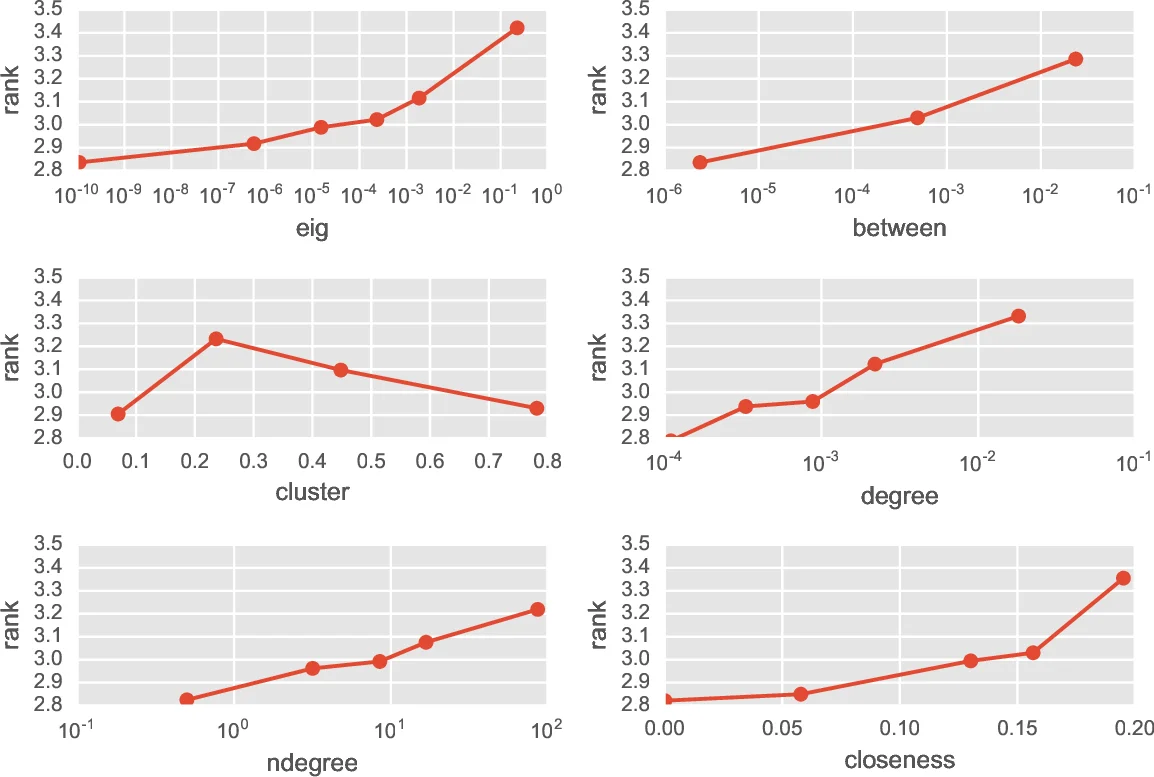
The analysis proceeded in two stages. First, an exploratory correlation analysis was conducted between six key network metrics—degree centrality, closeness centrality, betweenness centrality, eigenvector centrality, average neighbor degree, and clustering coefficient—and the success proxies. The results showed statistically significant positive correlations between most centrality measures (degree, closeness, betweenness, eigenvector) and both success measures, particularly with the logarithm of visit frequency. The clustering coefficient showed a non-linear (parabolic) relationship.
In the second, predictive stage, machine learning models (Random Forest classifiers) were trained to predict success categories based solely on the network metrics. Success was categorized as Google PageRank (0-10) and visit frequency (high vs. low, based on the median). To control for potential confounding factors, models were tested both with and without “group size” (number of members) as an additional feature. The results were compelling: using only network structure features, the model could predict whether a group’s visit frequency was above or below the median with 71.0% accuracy. For PageRank, allowing a prediction error of ±1, the accuracy reached 92.7%. Crucially, adding group size did not substantially improve the out-of-sample prediction scores, indicating that an artist’s position within the broader collaboration network is a more powerful predictor of long-term success than the size of the group itself.
The study concludes that network measures derived from shared performer relationships serve as robust predictors of a music group’s enduring success. The authors argue that this network-based framework for exploring and predicting success is transferable to other domains in the arts and humanities characterized by medium- to long-term team-based collaborations, such as scientific research teams or film production crews.
Comments & Academic Discussion
Loading comments...
Leave a Comment