Characterisation of bending mechanics in uncured laminated materials using a modified Dynamic Mechanical Analysis
Understanding the bending mechanics of uncured carbon fibre prepreg is vital for modelling forming processes and the formation of out-of-plane wrinkling defects. This paper presents a modification of standard Dynamic Mechanical Analysis (DMA) to characterise the viscoelastic bending mechanics of uncured carbon fibre prepreg using Timoshenko beam theory. By post-processing DMA results, the analysis provides temperature and rate-dependent values of inter and intra-ply shear stiffness for a carbon fibre laminate and each individual ply with experimental results for AS4/8552 presented. The new methodology provides a means to parametrise process models, and also gives an indication of optimal manufacturing conditions to enable defect-free forming and consolidation processes.
💡 Research Summary
This paper presents a novel experimental methodology to characterize the bending mechanics of uncured carbon fiber prepreg laminates, with a specific focus on quantifying the through-thickness shear stiffness that is critical for understanding and simulating forming processes. The authors address a key challenge in composite manufacturing: predicting and preventing out-of-plane wrinkling defects during the forming of laminates over curved tools. These defects are intimately linked to how individual plies bend and how they shear relative to one another, mechanisms governed by intra-ply and inter-ply shear stiffness, respectively.
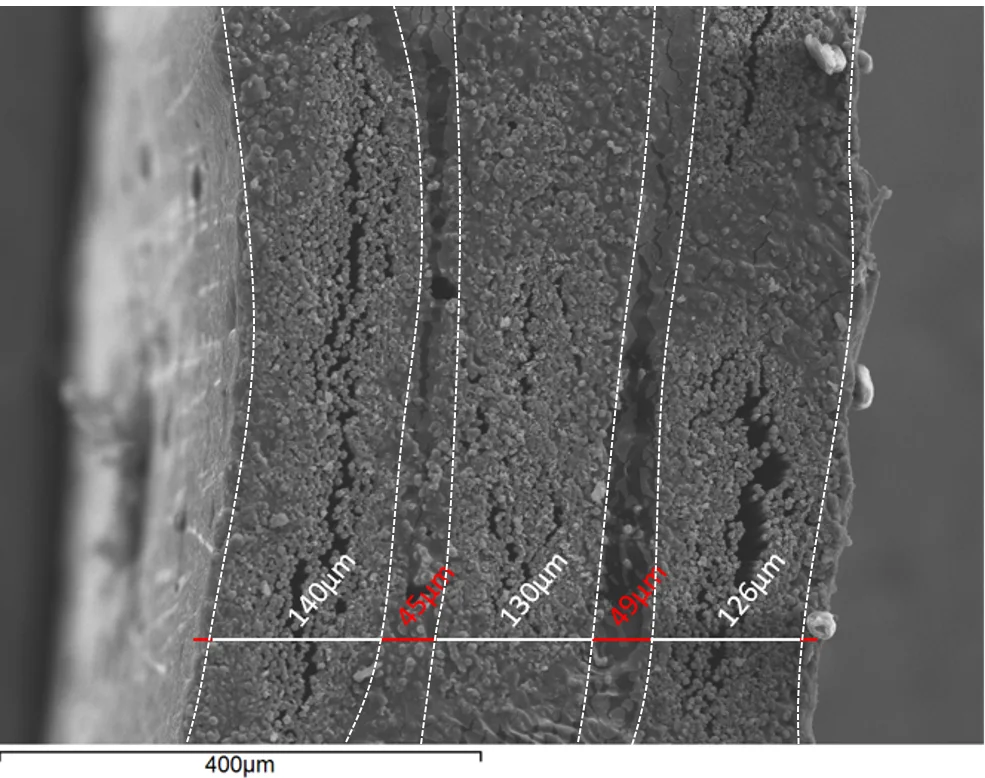
The core innovation lies in a modified application of standard Dynamic Mechanical Analysis (DMA). The researchers employ the single cantilever bending mode of a DMA but crucially reinterpret the results using Timoshenko beam theory instead of the simpler Euler-Bernoulli theory. Timoshenko theory accounts for shear deformation, which is significant in these relatively thick, compliant uncured prepregs. The methodology is a two-step process. First, DMA tests are conducted on a single ply sample. The standard DMA outputs (complex modulus) are post-processed using derived equations based on Timoshenko theory to extract the temperature and rate-dependent intra-ply shear storage modulus (G_ply) and loss modulus (η_ply). Second, the same DMA test is performed on multi-ply laminates (e.g., 2, 4, 8 plies) to obtain the effective shear moduli of the entire stack (G_lam, η_lam). By modeling the laminate as a series combination of stiff ply regions and compliant resin-rich interface regions, the inter-ply shear moduli (G_int, η_int) are then calculated by subtracting the known contribution of the plies from the total laminate response.
Experimental results for the AS4/8552 material system show a strong temperature dependence for all shear stiffness values, which fit well to a simple power-law heuristic model. As temperature increases from 30°C to 130°C, both intra-ply and inter-ply shear stiffness decrease significantly, confirming the resin-dominated viscoelastic behavior. The calculated inter-ply shear stiffness values show reasonable agreement with those from dedicated inter-ply shear tests found in literature, validating the approach. The paper concludes that this method provides a reliable, repeatable, and accessible way to generate crucial input parameters for process simulation software (e.g., ANIFORM). Furthermore, the data offers insights for process design, suggesting a need to balance low inter-ply shear (for good formability) with sufficient intra-ply shear stiffness (to resist ply buckling). Future work is directed towards refining the analysis for general laminates using Zigzag theory to better account for non-uniform shear distribution and incorporating the effect of applied pressure to better mimic industrial forming conditions.
Comments & Academic Discussion
Loading comments...
Leave a Comment