Spectral and Energy Efficiency of Superimposed Pilots in Uplink Massive MIMO
Next generation wireless networks aim at providing substantial improvements in spectral efficiency (SE) and energy efficiency (EE). Massive MIMO has been proved to be a viable technology to achieve these goals by spatially multiplexing several users …
Authors: Daniel Verenzuela, Emil Bj"ornson, Luca Sanguinetti
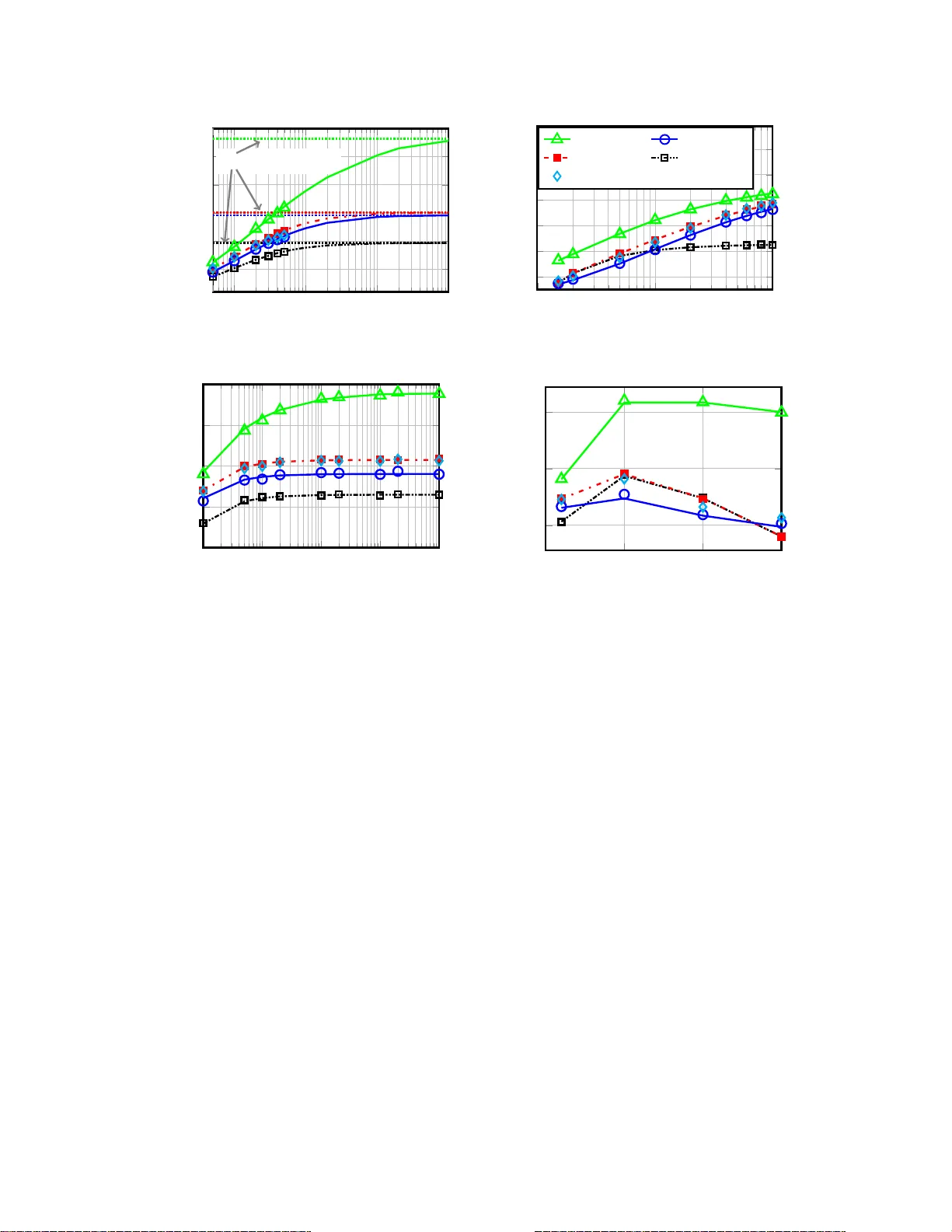
1 Spectral and Ener gy Ef ficienc y of Superimposed Pilots in Up link Massi v e MIMO Daniel V erenzuela, Student Member , IEEE, Em il Bj ¨ ornson, Member , IEEE, Luca Sanguinetti, Senior Member , IEEE. Abstract Next generation wireless networks aim at provid ing substantial improvements in spectral efficiency (SE) and energy efficiency (EE). Massive MIMO has been proved to be a viable techn ology to ac h iev e these goals b y spatially m ultiplexing several users using many base station (BS) antennas. A potential limitation of Massi ve MI MO in multicell systems is pilot contamin a tion, which arises in the channel estimation process from the interferen ce caused by reusing pilots in n eighbo ring cells. A stand ard method to reduce pilot contam ination, known as regular p ilot (RP), is to ad just the length of pilot sequ ences while transmitting data and pilot symb ols disjointly . An alternativ e method , called superimpo sed pilot (SP), sends a sup e rposition of pilot and data symb o ls. This allo ws to use lon ger pilots which, in turn, redu c es pilot co ntamination . W e consider th e u plink of a multicell M a ssive MIMO n etwork using maximu m ratio co mbining detection a nd co mpare RP and SP in term s of SE and EE. T o this e nd, we derive rigoro u s closed-fo rm achiev able ra tes with SP un d er a pr actical ra n dom BS d e p loyment. W e prove that the reduction of pilot con tamination with SP is outweighed by the addition al c o herent and non - coheren t interferen ce. Numerical results show that wh en bo th methods are optim ized, RP achieves com parable SE and EE to SP in practical scenar io s. D. V erenzu ela and E. Bj ¨ ornson are with the Department of Electrical Engineering (ISY), Link ¨ oping University , Link ¨ oping , SE-58183 Sweden (e-mail: daniel.verenzuela@liu.se; emil.bjornson@liu.se). L. Sanguinetti is wi th the Dipartimento di Ingeg neria dell’Informazione, Univ ersity of Pisa, Pisa, Italy , and with the Large Networks and System Group ( L ANEAS), CentraleSup ´ elec, Univ ersit ´ e Paris-Saclay , Gi f - sur-Yv ette, France (e-mail: luca.sanguinetti@unipi.it). This paper has recei ved funding from E L LIIT and the S w edish Foundation for Strategic Research (SFF ) . The work of L. Sanguinetti was supported in part by ERC Starting MORE under Grant 305123 . A preliminary version [1] of this work will be presented at IEEE GLOBECOM 2017. 2 I . I N T RO D U C T I O N The de velopment of cellular networks is lead by the conti nuous increase in mobile data traf fic [2]. The design of future cellul ar networks aims at handling 1000 × mo re d at a t raffic per unit area [3]. Meanwhile, the ener gy consumptio n of mobil e com m unication systems is of great econom ical and ecological concerns [4]. M as s iv e multiple-input mu l tiple-output (MIMO) i s consi d ered as one of t he most prom ising technolo gy to joi ntly improve spectral ef ficiency (SE) and energy ef ficiency (EE) [5]–[9]. The ke y idea of Mass ive MIMO is to util i ze a lar ge number of antennas (e.g., hundreds or thou sands) at t he base stat i ons (BSs) to communi cate coherently with sev eral (e.g., t ens or hundreds) user equipments (UEs ) by v i rtue of spatial multi plexing [10], [11]. The acqui sition of channel state i nformation (CSI) at the BS is essential in Massi ve MIMO. A t ime division d uplexing (TDD) system is usually proposed to a void the l ar ge over head of downlink channel training and feedback [11]. Uplink pilot sequences are transmi tted by the UEs and channel reciprocity is exploited at the BS to coherentl y detect data from UEs in the upli nk and precode data in the downlink. The time and frequency interval, over which th e channel can be considered t o remain s tatic and frequency flat, called the coherence block, has a limited size and, in turn, there is a finite num b er of orthogonal pilot sequences that are av ailable for channel estimation. Therefore, in mu l ticell systems the pilot sequences need to be reused across cells. This creates coherent interference, called pilot contaminati on, between UEs that share the same pilots, w h i ch reduces the q u ality of channel est i mates and af fects the SE. The p i lot contami nation has been widely in vestigated i n the literature. In [12]–[17], the same set of pilot sequences is assumed to be reused in al l the cells and pilot contam ination is mi tigated by exploiting spatial channel correlation [12]–[14 ] or d at a cov ariance matrices [15]–[17 ]. Another approach is to have longer pi l ot sequences than the n u mber of served UEs per cell to reduce the num ber of cells utilizing the same pi lot [9], [18]–[20]. This meth o d can effec tively reduce pilot contamination at the cost of an increased estimation overhead t hat, in turn, decreases the amo unt of data symbols transmitt ed p er coherence block. This tradeoff is studied in [19] under a hexagonal cell deployment and it turned out that a fraction between 5% and 40% of the coherence block should be u s ed for pilots . In all the aforementioned works, the transmissi on of pilot and data symbols is done separately within the coherence block t o reduce in terference in the channel estim at i on process. This method is known in the literature as regular pilot (RP) trans m ission. In [21]–[27], the authors explore 3 an alternativ e method that relies on the simultaneous transmission of pilot and data signals. This method is referred to as superimposed p i lot (SP) and allows to i ncrease the amoun t of samples that can be us ed for channel estimatio n and data t ransmission. By using SP , [21] propose an optimal coherent recei ver based on the V iterbi algo ri t hm. Linear channel esti m ation met h ods of finite impulse response channels for single-input singl e-out put (SISO) systems are considered in [22] wi th only knowledge of the first order statistics. In [23], th e authors compare SP and RP under Gauss-Markov flat f ading SISO channels und er a practical setup where channels change rapidly and UEs hav e low si g nal-to-noise ratios (SNR s). Th e results s how that SP provides better performance than RP in terms of uncoded b it-error -rate (B ER) and mean squared error (MSE) of channel estimates. Similar results h ave been found for stationary MIMO fa ding channels in [24]. In the aforementioned works [21]–[24], the authors focus on a single cell or sing le user scenario. Recently , [25]–[27] have shown that SP achie ves promi sing results in m ulticell M ass iv e MIMO syst em s. In particular , UEs transmit a linear comb ination of p i lot and data symbo ls within the whol e coherence block. This allows the use of lo n ger pilot sequences, which can thus be reused l ess frequently in th e network. Thi s allows to reduce pilot contamination, whi ch coul d, in principle, imp rove the SE. H owev er , sending pilo t and data signals sim ultaneously causes interference in the channel estimati on process from data sym bols. This degrades the estimati on quality and creates correlation between channel esti m ates and data. Moreover , the use of longer pilots increases the computational com p lexity of channel estim ation and data detection. This, in turn, consumes more power and m ay eventually reduce the EE of the network. In summary , the use of SP i n Massive MIMO systems i ntroduces new sources of interference and i ncreases the consumed p ower . All this may limit t h e practical gains of SP methods in terms of SE and EE. The aim of this paper is to eva luate the performance of SP in th e uplink of a mul ticell Massive MIMO system and make comparisons with RP . T o this end, we deri ve rigorou s clo s ed-form rate expressions with SP when using m aximum ratio com bining (MRC). Th is stands in contrast to prior works, [25], [27], which deal with approxim ate expressions of sig nal-to-interference-plus- noise ratios (SINRs) and mean s quare errors (MSEs). The analysis provided in thi s paper holds true for an y number of BS antennas (not just for a large number). These formulas provide valuable ins i ghts i n to identi fying all the interference sources, their impact on the SE and their relationship wi th the other s ystem parameters. The provided expressions are then us ed to perform the asymptotic analys i s (corresponding to the large n u mber of BS antennas regime) of the network, which allows to identify the conditions under whi ch either RP or SP provide greater 4 rates. Then, in order to properly study the ef fect asso ciated wit h intercell interference in a large practical network wi t h an irre gular BS deployment, we adopt t he stochasti c geometry framework dev eloped i n [8] wherein BSs are spati ally di stributed according to a homogeneous Poisson poin t process (PPP). W ithin thi s setti ng, we calculate closed-form lo wer bounds of the achiev able rates a veraged over the UEs’ sp atial distribution. Thi s provides po werful insights into the int erpl ay of system parameters withou t requiring t h e us e of heavy numerical simulations. Such lower boun ds are then u s ed to compute the EE of the network wit h both RP and SP taking into account th e power con s umed by transmissio n and circuitry . Numerical results are used to sho w that, when both m ethods are optim ized, RP provides comparable SE and E E t o SP in practical scenarios. The remainder of this paper is or ganized as follows. Sec tion II in t roduces the network model. In Section III , the channel estimati on process with RP and SP is detailed whereas th e achiev able rates with MRC are comp uted in Section IV. Section V presents detailed analytical comparis o ns between RP and SP . In Section VI, the av erage achiev able rates are first compu t ed for a random network deployment (based on stochast ic geom etry) and then used for com puting the EE. Section V II il l ustrates numerical results wh ile Section VIII conclud es our work. Notation: W e denote vectors by lower -case b old-face letters (e.g., x ) 1 and matrices by bold- face capit al letters (e.g., X ). 2 The operators E { · } and E { · | y } repre sent expected value and expected value conditioned o n a realization of the random variable y , 3 respectiv ely . The notat i on | · | represents the absol ute value and k · k denotes the Euclid ean norm. W e denote the transpose, conjugate transpose and conjugate operators as ( ·) T , (·) H and (· ) ∗ , respective ly . W e denote by I M the id ent ity matrix of size M × M and C N (· , ·) indicates a circularly symmetri c compl ex Gaussi an distribution. T o denot e the set of real and complex nu m bers we use R and C , respectiv ely , while ℜ(·) is the real part. Γ (· ) denotes the Gamma function. I I . N E T W O R K M O D E L W e consider the upl ink of a m ulticell Massive MIMO n et work where eac h BS has M antennas and serves K sing l e-antenna UEs. W e define Φ D the set containing all BSs, where D denotes the density of BSs per uni t area (measured in BS/km 2 ). Note t hat this definition does not require the BSs to be distributed in any sp ecific manner . Howe ver , a stochastic geom etry frame work 1 [ x ] j refers to the j t h element of x . 2 [ X ] j denotes the j t h column of X and [ X ] i j refers to the i t h ro w and j t h column element of X . 3 W e abuse the notation in conditional expectations by r eferr i ng to the random variable and i t s reali zati on with the same letter . 5 will be used l at er on i n Section VI to model the BS distribution. W i thout loss of generality , the following analysis is focused on an arbitrary BS, d eno t ed as BS 0 serving UEs i n cell 0 , and an arbitrary UE k in cell 0 , d eno t ed as UE 0 k . W e define Ψ D = Φ D \ { 0 } as the set containing all other BSs than BS 0 . W e consider a network with bandwi dth B W . The commu n i cation channels are modeled as bl o ck fading where each channel is considered to be constant over a coherence block of ti me duration T c and bandwid t h B c . 4 The total b andwidth is equally divided among all coherence blocks, which means that B W / B c is an int eger number , and each blo ck cont ains τ c = B c T c complex samples. W e ass ume uncorrelated Rayleigh fading channels since this is the first rig o ro u s capacity analysis with SP in a multicell s cenario. As done with RP , we believ e that it is hel p ful to first dev elop fundamental theory for uncorrelated channels and then to extend it to correlated channels. Therefore, this is left for future work. Moreover , since uncorrelated fading corresponds to the worst-case s cenario for pilot contamination and SP aims at mit igating this eff ect, this analysis giv es in s ights into the main benefits of SP . In addition, the achiev able rates under uncorrelated Rayleigh fading are clo s e to tho s e under practical m easured channels with non-line-of-sight and spatially distributed UEs [28]. W e denote b y h l l ′ i ∈ C M the channel between t he M antennas of BS l and UE l ′ i in which the s m all-scale fading (SSF) is modeled as h l l ′ i ∼ C N ( 0 , β l l ′ i I M ) ∀ l , l ′ ∈ Φ D and i ∈ { 1 , . . . , K } with β l l ′ i ≥ 0 being the large-scale fading (LSF) coeffi cient between BS l and UE l ′ i . W e assume that the dis tance between UEs and BSs is l arge enough to consider β l l ′ i to be the same for all BS antennas. Th e received s i gnal y 0 ∈ C M at BS 0 is y 0 = Õ l ′ ∈ Φ D K Õ i = 1 h 0 l ′ i x l ′ i + n 0 (1) where n 0 ∈ C M is th e noise v ector di stributed as n 0 ∼ C N ( 0 , σ 2 I M ) and x l ′ i represents the trans- mitted signal from UE l ′ i in one arbitrary sample of the coherence block. The transmi tted sign al can be used for data, pilots or a superposition of the two dependi n g on the employed method. W e analyze the two transmissio n m ethods illustrated in Fig. 1: RP , called tim e-multiplexed in [25], and SP . W ith RP , dat a and pilo t sym bols are transmit ted separately in each coherence block. Therefore, x l ′ i contains only one of the two in each s am ple of th e coherence block. W ith SP , pilot and data symbol s are transm i tted si multaneously during the whol e coherence block and thus x l ′ i contains a sup erpos ition of the two in each samp l e. 4 In an OFDM system, the coherence bandwidth B c includes sev eral subcarriers—see [11] for more details. 6 T c B c B c T c Data s y mbols Pilot Pilot + Data symb ols symbols RP: SP: Fig. 1: Transmission protocol wit h RP and SP methods. I I I . C H A N N E L E S T I M A T I O N T o estimate the channels , we us e standard linear mi nimum mean squared error (LMMSE) techniques [29] wi t h both RP and SP . A. Re gula r pilots W e consi d er a t ransmission prot o col where τ p out of the τ c samples i n each coherence blo ck are reserved for pilot sequences, which lea ves a fraction 1 − τ p / τ c of samples for data transmiss ion. W e consider a set of τ p orthogonal pilot sequences o f length τ p . Each BS allocates K ≤ τ p diffe rent pilot sequences to th e UEs s erved in its cell. W e denote as φ l ′ i ∈ C τ p , ∀ l ′ ∈ Φ D , i ∈ { 1 , . . . , K } the pilo t sequence assigned to UE l ′ i with | [ φ l ′ i ] j | = 1 , ∀ j ∈ { 1 , . . . , τ p } . T o identify the UEs in diffe rent cells that share the same pilot as UE 0 k (including UE 0 k ), we define the set P R P 0 k = { l ′ , i } : φ H 0 k φ l ′ i , 0 . UE 0 k transmits its pilot sequence φ T 0 k along with all other UEs in the network over τ p instances of (1). At BS 0 , this yields the receiv ed sig n al Z R P 0 k ∈ C M × τ p giv en by Z R P 0 k = Õ l ′ ∈ Φ D K Õ i = 1 √ q l ′ i h 0 l ′ i φ T l ′ i + ¯ N 0 (2) where q l ′ i is the transm ission p ower of the pi lot sym bols from UE l ′ i and ¯ N 0 is the noise m atrix with i.i.d. elements distributed as [ ¯ N 0 ] m j ∼ C N 0 , σ 2 ∀ m ∈ { 1 , . . . , M } , j ∈ { 1 , . . . , τ p } wi th σ 2 being the noise variance. By multi p l ying Z R P 0 k with φ ∗ 0 k / √ τ p , the receive d pilot sig n al is correlated wi th th e p i lot sequence corresponding to UE 0 k , which is equiv alent to despreading the recei ved signal. This operation y i elds z R P 0 k ∈ C M giv en by z R P 0 k = Z R P 0 k φ ∗ 0 k √ τ p = Õ { l ′ , i } ∈ P RP 0 k √ q l ′ i τ p h 0 l ′ i + ¯ n 0 (3) 7 where ¯ n 0 = ¯ N 0 φ ∗ 0 k / √ τ p is a noise vector di stributed as ¯ n 0 ∼ C N 0 , σ 2 I M . Notice that n o useful inform ation is lost in the despreading operation, given that any signal i n the orth o gonal complement of φ 0 k is ind epend ent o f z R P 0 k . T h erefore, z R P 0 k in (3) i s a sufficient st atistic for estimating t he channel h 00 k between BS 0 and UE 0 k . The mini m um mean squared error (MMSE) estimate o f h 00 k is given by t he n ext lemm a. Lemma 1. W ith RP , the MMSE estimate of h 00 k is ˆ h 00 k = ¯ γ R P 0 k √ q 0 k τ p z R P 0 k (4) with ¯ γ R P 0 k = q 0 k τ p β 00 k Í { l ′ , i } ∈ P RP 0 k q l ′ i τ p β 0 l ′ i + σ 2 (5) and has covariance matrix g iven b y E ˆ h 00 k ˆ h H 00 k = β 00 k ¯ γ R P 0 k I M . (6) Pr oo f: It follows from applying st andard LM MSE techniques [2 9 , Ch. 12 ] to the problem at h and. Since z R P 0 k contains a Gaussi an unknown signal p lus in d ependent Gaussian interference and noise, th e LMMSE estim ator coincides wi t h the true MM SE estimator . The parameter ¯ γ R P 0 k ∈ [ 0 , 1 ] indicates t he quality of channel estimates. Not ice that, as th e length τ p of the pilo t sequences increases, ¯ γ R P 0 k also increases since the noise term becom es l ess significant and the cardinali ty of P R P 0 k decreases with τ p . This means that, as τ p increases, the var iance of the channel est imates approaches the variance o f the true channels and estimati on errors vanish. Howe ver , i n practical appl ications τ p ≤ τ c . Since τ c is lim ited by t he physical properties of the channel, there will always be an estimati on error due to p ilot contami nation and noise. The key poi nt to not ice is that for scenarios w h ere τ c is mu ch l arger than K , the channel estimates with RP can be improved b y lettin g τ p be l ar ger than K . B. Superimposed pil ots W ith SP , all the τ c samples of t he coherence b lock are used for transmitti ng pilot and data symbols . W e consider τ c orthogonal pilot sequences of length τ c samples. E ach BS se- lects K ≤ τ c diffe rent pilots and assigns them to i ts UEs. W e d enote as ϕ l ′ i ∈ C τ c , ∀ l ′ ∈ Φ D , 8 i ∈ { 1 , . . . , K } the pilot sequence assigned to U E l ′ i with | [ ϕ l ′ i ] j | = 1 , ∀ j ∈ { 1 , . . . , τ c } . 5 The s et P S P 0 k = { l ′ , i } : ϕ H 0 k ϕ l ′ i , 0 contains t he indices of the UE s usin g the same pi lot as UE 0 k (including UE 0 k ). UE 0 k transmits a superposition of th e pi l ot sequence ϕ T 0 k and the data signal s T 0 k along wit h all other UEs in the network over τ c instances of (1). This yields an M × τ c recei ved signal at BS 0 giv en by Z S P 0 k = Õ l ′ ∈ Φ D K Õ i = 1 √ q l ′ i h 0 l ′ i ϕ T l ′ i + Õ l ′ ∈ Φ D K Õ i = 1 √ p l ′ i h 0 l ′ i s T l ′ i + N 0 (7) where p l ′ i and q l ′ i are the transmiss i on powers of the data and p i lot s y mbols, respectively , transmitted by UE l ′ i . The v ector s l ′ i ∈ C τ c contains the data symbols transm itted in th e wh ole coherence block. W e assum e the data symbol s to be i.i.d. as s l ′ i ∼ C N 0 , I τ c . The noise matrix i s defined as N 0 = n 01 , . . . , n 0 τ c with i.i.d. columns distributed as n 0 j ∼ C N 0 , σ 2 I M ∀ j ∈ { 1 , . . . , τ c } . By mult iplying Z S P 0 k with ϕ ∗ 0 k / √ τ c , w e obt ain z S P 0 k = Z S P 0 k ϕ ∗ 0 k √ τ c = Õ { l ′ , i } ∈ P SP 0 k √ q l ′ i τ c h 0 l ′ i + Õ l ′ ∈ Φ D K Õ i = 1 r p l ′ i τ c h 0 l ′ i s T l ′ i ϕ ∗ 0 k + τ c Õ j = 1 n 0 j [ ϕ 0 k ] ∗ j √ τ c (8) which is t hen used to compute the LM M SE est i mate the channel between BS 0 and UE 0 k . Lemma 2. W ith SP , the LMMSE estimate of the channel h 00 k is ˆ h 00 k = ¯ γ S P 0 k √ q 0 k τ c z 0 k (9) wher e ¯ γ S P 0 k = q 0 k τ c β 00 k Í { l ′ , i } ∈ P SP 0 k q l ′ i τ c β 0 l ′ i + Í l ′ ∈ Φ D Í K i = 1 p l ′ i β 0 l ′ i + σ 2 . (10) The covariance matrix of ˆ h 00 k is E ˆ h 00 k ˆ h H 00 k = ¯ γ S P 0 k β 00 k I M . (11) Pr oo f: It follows from applying stand ard LMMSE estimation techni ques [29, Ch. 12] t o the problem at hand . The parameter ¯ γ S P 0 k ∈ [ 0 , 1 ] indicates the quality of the channel estimat es. From (10), it follo ws that the interference caused by d ata s y mbols is τ c -times less influential than the pi l ot i nterference 5 Note that since t he modulus of each pilot symbol is one, the peak-to-av erage power ratio of the transmitted SP signal does not i ncrease when adding the pilot symbols. 9 from UEs that us e the same pilo t as UE 0 k . Moreover , as the leng t h τ c of the pilot s equ ences increases, ¯ γ S P 0 k approaches on e si nce the data interference and noise become less i n fluential and the cardinality o f P S P 0 k decreases with τ c . T h is means t h at the variance of the channel esti mates approaches t he variance of the true channels. Ho wev er , in practical applications τ c is limited and thus t h ere will always be an estim ation error due t o pilo t contami nation as well as interference from data sign als and nois e. Remark 1. The ke y differ ence between the channel estimates with RP and SP , ap art fr om the number obs ervat ions ( τ p with RP and τ c with SP), is the pr esence of e xtra interfer ence with SP due to the r eceived data symbols (see the thir d t erm i n the right-hand-si de of (8) ). This interfer ence not only r edu ces th e qua lity of the channel estimates but it al so: • Chan ges th e distribution of the channel estimates. The r eceived signal z S P 0 k in (8) is not Gaussian. Thus, t he LMMSE esti mate does not coincide with th e true MMSE estimate and the channel estimates ar e only uncor related to the channel estimation err ors b ut not independent, which s tands in contrast t o RP . • Cr eates corr elat i on between th e channel estimat es and r eceived d a ta symbol s fr om all UEs. These pheno m ena play a ke y role in the achievable rate analysis with SP an d cr eate e xtra interfering term s that cannot be obtained fr om the closed-form expr essions p ro vided in [11]. I V . A C H I E V A B L E R A T E S W I T H M R C T o ev aluate t he p erformance of the network, we deriv e er godic achie vable rates by appl ying standard lower bou n ding techniques on the capacity (e.g., [11]). Since we consider a fixed bandwidth, the SE is obtained simply by scaling the achie vable rates with 1 / B W . W e assume that MRC is employed for d at a detectio n. Particularly , the estimates of the data symb ols trans- mitted by UE 0 k are obtained at BS 0 by the inner product v H 00 k y 0 with v 00 k = υ 00 k ˆ h 00 k , where υ 00 k = 1 ¯ γ RP 0 k √ M β 00 k with RP and υ 00 k = 1 ¯ γ SP 0 k √ M β 00 k with SP . Th ese scali n g factors are selected to provide an equiv alent gain of M β 00 k for t h e desired signal with both methods. T o motivate the use of MRC, note that as M → ∞ , the di rectio n s of the channels h l l ′ i / k h l l ′ i k of different UEs become asymptot ically ortho g onal. This is kno wn as asymp totically fa vora ble propagation. The squared norm of th e channel scaled by 1 / M con ver ges to a determin i stic number , which is known as channel hardening. When consi d ering uncorrelated Rayleigh fading, these phenomena make the use of lin ear detection t echniques like MRC asymptot ically optimal 10 as M → ∞ [11]. In addition, the use of MRC has low complexity in the detection process and thereby low consum ed power . A. Random Pi lot allocati on The key advantage t hat SP has with respect to RP is the ability to use the whole coherence block for both channel estimation and data d etecti on. T o obt ain clear ins ights into the data rate performance with respect to the numb er of samples used o f channel estimati on, τ p (with RP) and τ c (with SP), we consider a random pilo t all ocation method with both RP and SP . In particular , we assume that each BS selects K , out of τ p (with RP) or τ c (with SP), dis t inct pilo t sequences uniformly at random in each coherence block and allocates them to its serv ed UEs . W e define χ R P l ′ i = φ H 0 k φ l ′ i τ p ∈ { 0 , 1 } and χ S P l ′ i = ϕ H 0 k ϕ l ′ i τ c ∈ { 0 , 1 } as bin ary random variables to i n dicate if UE l ′ i has the same pi lot as UE 0 k with RP and SP , respecti vely . Notice that BSs allocate pilots independently and that UE s within each cell have dif ferent pilots. This means th at for l ′ , 0 , Í K i = 1 χ R P l ′ i and Í K i = 1 χ S P l ′ i are Bernoulli dist ributed random variables with success probability K / τ p and K / τ c , respectively . Thus, the following results ho l d: E K Õ { l ′ , i } ∈ P RP 0 k \ { 0 , k } q l ′ i β 0 l ′ i = E ( Õ l ′ ∈ Ψ D K Õ i = 1 χ R P l ′ i q l ′ i β 0 l ′ i ) = Õ l ′ ∈ Ψ D K τ p 1 K K Õ i = 1 q l ′ i β 0 l ′ i ! (12) E K Õ { l ′ , i } ∈ P SP 0 k \ { 0 , k } q l ′ i β 0 l ′ i = E ( Õ l ′ ∈ Ψ D K Õ i = 1 χ S P l ′ i q l ′ i β 0 l ′ i ) = Õ l ′ ∈ Ψ D K τ c 1 K K Õ i = 1 q l ′ i β 0 l ′ i ! (13) which allow us to obt ain achie vable rate expressions t h at do no t depend o n the parti cular construction of the sets P R P 0 k and P S P 0 k . B. Re gula r pilots The received signal at BS 0 with RP , for an arbitrary data sym b ol j i n the coherence block, is y R P 0 j = K Õ i = 1 √ p 0 i h 00 i [ s 0 i ] j + Õ l ′ ∈ Ψ D K Õ i = 1 √ p l ′ i h 0 l ′ i [ s l ′ i ] j + n 0 j (14) where n 0 j is the noi se vector distributed as n 0 j ∼ C N 0 , σ 2 I M . T o d etect t he data sy m bol from UE 0 k , t he receiv ed signal y R P 0 j is combined wit h v 00 k to obt ai n [ ˆ s 0 k ] j = v H 00 k y R P 0 j = √ p 0 k E v H 00 k h 00 k [ s 0 k ] j + √ p 0 k v H 00 k h 00 k − E v H 00 k h 00 k [ s 0 k ] j + K Õ i , k √ p 0 i v H 00 k h 00 i [ s 0 i ] j + Õ l ′ ∈ Ψ D K Õ i = 1 √ p l ′ i v H 00 k h 0 l ′ i [ s l ′ i ] j + v H 00 k n 0 j . (15) 11 By treating the term √ p 0 k E v H 00 k h 00 k [ s 0 k ] j as the desired si gnal and the remaining on es in (15) as effec tive noise, we have an equiv alent SISO system w i th a deterministic channel and non-Gaussian ef fectiv e noise, which is un correlated with the dat a sy m bol [ s 0 k ] j . Moreover , th e individual t erms in the effecti ve noise (second to last terms in (15)) are also u n correlated due to the f act that the data symbols from dif ferent UEs hav e zero mean and are independent amo n g themselves and independent from the noise. In the next lemma, we provide an ergodic achiev able rate, i. e., a lower bound on th e capacity , of the system when usi n g RP . Lemma 3. An er god i c achievable rate for UE 0 k with RP and MRC detection is R R P 0 k = B W 1 − τ p τ c log 2 1 + SINR R P 0 k (16) wher e SINR R P 0 k is the effective SINR of UE 0 k given by SINR R P 0 k = p 0 k E v H 00 k h 00 k 2 Í l ′ ∈ Φ D K Í i = 1 p l ′ i E n v H 00 k h 0 l ′ i 2 o − E v H 00 k h 00 k 2 + E n v H 00 k n 0 2 o (17) = M p 0 k β 00 k M τ p Í l ′ ∈ Ψ D K Í i = 1 p l ′ i q l ′ i q 0 k β 2 0 l ′ i β 00 k + 1 γ RP 0 k Í l ′ ∈ Φ D K Í i = 1 p l ′ i β 0 l ′ i + σ 2 (18) and γ R P 0 k = E 1 ¯ γ R P 0 k − 1 = q 0 k τ p β 00 k q 0 k τ p β 00 k + Í l ′ ∈ Ψ D K Í i = 1 q l ′ i β 0 l ′ i + σ 2 . (19) The e xpectations in (17) ar e taken with r espect to the SSF an d the random pilot allo cat ion. Note that the ergodic achievable rate with effective SINR given by (17) holds for any s election of v 00 k and any channel d istribution. Pr oo f: It follows from standard lower bounds [11, Ch. 2] on th e capacity between t he transmitter and receiv er when on l y knowledge of the av erage ef fectiv e channel E v H 00 k h 00 k is used to obtain an equivalent SISO s ystem wit h a determin istic channel and non-Gaussi an ef fectiv e noise. The closed-form e xpression of the SINR follows the same approach as in [8], [20], [1 1 , Ch. 4] wh ere the independence between th e channel estimates and errors is used to compute the expectations in (17) in closed-form. In addit i on, the result in (12) is used t o calculate the expectations with respect to χ R P l ′ i . T o mitig ate th e effec t of pil ot contamin ation with RP , we can increase the pilot overhea d by selecting τ p > K . Th is im proves the qual i ty of channel estimates (see Section III-A) and 12 reduces the in terference from pilot contaminat i on (see first term i n t he denomin ator of (18)). This approach i s sim ple and provides good results when a pilot reuse factor is used [11]. Thus, it provides a suitabl e comparison reference when ev aluati ng the performance of SP . Th e selection of τ p is of paramount im portance in order to assess the performance of RP . Therefore, i n Section VII we p rovide numerical results when τ p is opt imized to maximize the data rates. This op t imization is done th rough an exhaustive search over the integer values of τ p ∈ [ K , τ c ] . C. Sup eri mposed pi l ots In the case of SP , the recei ved signal for an arbitrary data sym bol j in the coherence block, at BS 0 , is giv en by the j t h column of Z S P 0 k (see (7)). By combini ng the receiv ed signal [ Z S P 0 k ] j with v 00 k , an est i mate of the data symbol j transm itted by UE 0 k is o b tained as [ ˆ s 0 k ] j = v H 00 k Z S P 0 k j . T o compute an ergodic achiev able rate, we first isolate the term that contain s th e desired information . T o this end, we rewrite the d etecto r as v 00 k = υ 00 k ¯ γ S P 0 k h 00 k + ¯ v 00 k = 1 √ M β 00 k h 00 k + ¯ v 00 k (20) where ¯ v 00 k = υ 00 k ¯ γ S P 0 k √ q 0 k τ c © « Õ l ′ ∈ Ψ D K Õ i = 1 χ S P l ′ i √ q l ′ i τ c h 0 l ′ i + Õ l ′ ∈ Φ D K Õ i = 1 r p l ′ i τ c h 0 l ′ i s T l ′ i ϕ ∗ 0 k + τ c Õ j ′ = 1 n 0 j ′ [ ϕ 0 k ] ∗ j ′ √ τ c ª ® ¬ . (21) Next, we add and subtract q p 0 k M β 00 k E n k h 00 k k 2 o [ s 0 k ] j from the data est imate [ ˆ s 0 k ] j to obtain a desired signal with determinis tic effecti ve channel gain. This leads to [ ˆ s 0 k ] j = r p 0 k M β 00 k E n k h 00 k k 2 o [ s 0 k ] j + r p 0 k M β 00 k k h 00 k k 2 − E n k h 00 k k 2 o [ s 0 k ] j + √ p 0 k ¯ v H 00 k h 00 k [ s 0 k ] j + Õ l ′ ∈ Φ D K Õ i = 1 √ q l ′ i [ ϕ l ′ i ] j + ξ l ′ i √ p l ′ i [ s l ′ i ] j v H 00 k h 0 l ′ i + v H 00 k n 0 j | {z } = n eff . (22) The term n eff is defined in (22) for analytical tractability and accounts for the interference caused by pilot and data symbol s recei ved from all UEs (including self-interference from UE 0 k ) plus noise. For ease of not ation, we define ξ l ′ i = 0 for { l ′ , i } = { 0 , k } and ξ l ′ i = 1 otherwise. Notice that the first term in (22) i s uncorrelated with the remaining ones in (22) since th e data symbols h ave zero mean, are i n dependent and circularly sy m metric complex Gaussian. Thus, we hav e an equiv alent SISO sy stem with deterministic ef fecti ve channel and non-Gaussian ef fectiv e 13 noise for which we can obtain an achieva ble rate based on t he analysis in [11, Ch. 2]. This result is sum marized in the following theorem. Theor em 1. An er godic achievable rate for UE 0 k with SP and MRC detection is R S P 0 k = B W log 2 1 + SINR S P 0 k (23) wher e SINR S P 0 k is the effective SINR of UE 0 k given by SINR S P 0 k = p 0 k M β 00 k E n k h 00 k k 2 o 2 p 0 k M β 00 k E n k h 00 k k 4 o − E n k h 00 k k 2 o 2 + E n n eff − E { n eff } 2 o (24) = M p 0 k β 00 k , M τ c Õ l ′ ∈ Ψ D K Õ i = 1 p l ′ i + 1 − 1 τ c q l ′ i q l ′ i q 0 k β 2 0 l ′ i β 00 k + M τ c Õ l ′ ∈ Φ D K Õ i = 1 ( p l ′ i + q l ′ i ) p l ′ i q 0 k β 2 0 l ′ i β 00 k | {z } Coher ent interfer ence + 2 τ c p 0 k β 00 k + 2 τ 2 c Õ l ′ ∈ Ψ D K Õ i = 1 q l ′ i p l ′ i q 0 k β 2 0 l ′ i β 00 k + 1 τ 2 c Õ l ′ ∈ Φ D K Õ i = 1 p 2 l ′ i q 0 k β 2 0 l ′ i β 00 k + 1 γ S P 0 k Õ l ′ ∈ Φ D K Õ i = 1 ( q l ′ i + p l ′ i ) β 0 l ′ i + σ 2 ! | {z } Non-coher ent interfer ence a nd noise ! (25) wher e γ S P 0 k = E 1 ¯ γ S P 0 k − 1 = q 0 k τ c β 00 k q 0 k τ c β 00 k + Í l ′ ∈ Ψ D K Í i = 1 q l ′ i β 0 l ′ i + Í l ′ ∈ Φ D K Í i = 1 p l ′ i β 0 l ′ i + σ 2 . (26) The term n eff contains the last terms of the ef fective noise defined in (22) . The e xpectations in (24) a re taken with r espect to the SSF and the random pilot allocation. Pr oo f: It follows from taki n g the esti mate of [ ˆ s 0 k ] j in (22) and establ i shing an equi valent SISO system wi th a determ i nistic channel and uncorrelated non-Gaussian ef fectiv e nois e. Then, by applyi ng stand ard lower bounds on the capacity between th e t ransm itter and receiv er of the equiv alent SIS O s y stem, the ergodic achie va ble rate with effecti ve SINR sh own in (24) is deriv ed [11, Ch. 2]. The proof for obt aining the closed-form expression in (25) can be found in Appendix A . W ith SP , there is no pre-log fa ctor in (23) since t h e whol e coherence block is used for data transmissio n . The coherent gain (see the n umerator of (25)) scales with M and depends on the f actor γ S P 0 k (see (26)), which reflects the channel estimation qu al i ty . W e define the coherent 14 interference as the interference that adds constructively in th e detection process due to the correlation between the detectio n vector and the receive d signal. As a result, it s variance scales with M . W i th non-coherent interference, we refer to all the sou rces o f i nterference that are combined non-const ruct ively whose variance, in turn, does not s cale with M . There is coherent interference from pi lot contamin at i on and als o from pi l ot and data symbol s (see the first two terms in the denom inator of (25)) due to the correlation between chann el estimates and data symbols. Similarly , t here is non-coherent in terference from pilot sym bols, data symbol s and cross-correlation of the two (see the third and fourt h terms in the denominator of (25)). In the prior works [25 , Eq. (12)] and [27, Eq. (41)], approximate SINR expressions are provided with SP and MRC based on asymptot ic fa v orable propagati on and channel hardening (i.e., lim M →∞ h H 0 li h 0 l ′ i ′ M = 0 if { l , i } , { l ′ , i ′ } and lim M →∞ k h 0 li k 2 M = β 0 l i ). In contrast, the resul t in Theorem 1 does not rely on any asymp totic app roximation. T h is enables us to accurately analyze the system performance for any finit e M . By comp arin g [25, Eq. (12)] and [27, Eq. (41)] wit h (25), it is seen that (25) contains extra in terfering t erm s , which might greatly affect the syst em performance. Notice t hat since the pilot symbols are known to the BSs, they can be subtracted from n eff to reduce the interference and obtai n a b et t er est imate of data s ymbols [25 ]. T o obtain clear in s ights into the effect of the i nterference from pi lot symbols, suppos e the receiv ed pilot sy mbols can be p erfectly removed from n eff . Let ¯ n eff = √ p 0 k ¯ v H 00 k h 00 k [ s 0 k ] j + Õ l ′ ∈ Φ D K Õ i = 1 ξ l ′ i √ p l ′ i [ s l ′ i ] j v H 00 k h 0 l ′ i + v H 00 k n 0 j (27) be the resulting term without the eff ect of pil ot interference. Then, by replacing n eff with ¯ n eff in (24) allows to com puted an upper bound on t he ef fectiv e SINR with SP . This is s ummarized in the following corollary . Corollary 1. By re moving the r eceived pilot symbols perfectly from the data estimat es, the effec tive SINR with SP i s upper bou n ded as SINR S P 0 k ≤ SINR S P - U B 0 k wher e SINR S P - U B 0 k = M p 0 k β 00 k , M τ c Õ l ′ ∈ Ψ D K Õ i = 1 p l ′ i q l ′ i q 0 k β 2 0 l ′ i β 00 k + M τ c Õ l ′ ∈ Φ D K Õ i = 1 p 2 l ′ i q 0 k β 2 0 l ′ i β 00 k | {z } Coher ent interfer ence + 1 τ 2 c Õ l ′ ∈ Φ D K Õ i = 1 p 2 l ′ i q 0 k β 2 0 l ′ i β 00 k + 1 γ S P 0 k Õ l ′ ∈ Φ D K Õ i = 1 p l ′ i β 0 l ′ i + σ 2 ! | {z } Non-coher ent interfer ence a nd noise ! (28) 15 Pr oo f: It follows from replacing n eff with ¯ n eff in (24) and deriving the closed-form expression with t h e sam e approach as in App end ix A. By subtracting the receive d pilot sym bols perfectly from n eff , both the coherent and non- coherent i nterference are reduced and some of the cross t erms in the non-coherent interference vanish. This can increase the dat a rates provided that the proportion of power used for pilot symbols is not negligible. Howev er , in p ractice the pilot symbols cannot be perfectly remove d from data estimates because chann els are not perfectly known (see Section III-B). Alternativ ely , we can remov e the estimates of t h e receiv ed pil ot symbol s (i.e., Í l ′ ∈ Φ D Í K i = 1 √ q l ′ i [ ϕ l ′ i ] j v H 00 k ˆ h 0 l ′ i ) from n eff . This approach would int roduce a lar g e n umber of cross terms into variance of n eff since the channel estim ates are correlated with the recei ved data symbols of all UEs (see Remark 1), and a clo sed-form expression of the eff ective SINR would not p rovide clear insights into t he performance. The effe ct of removing the esti m ates of the recei ved pi lot symbols is ev aluated numerically i n Section VII. Notice that iterative decoding algorithms can be used to i m prove channel and data estimates. This is achie ved at the price of an i ncreased com p utational complexity with SP since the number of operations in each it eration grows linearly with M and τ c [25]. M o reove r , si m ilar approaches can also b e used with RP where the data estim ates can be used to improve the channel est imates and vice versa. As the first capacity analysis with SP , we focus on MRC detection and use the results with perfect pi lot s ubtraction (shown in Corollary 1) t o e valuate the possibl e gain s of more complex s i gnal processing schemes. T h e use of iterative decoding alg orithms is thus left for fut u re work. V . A N A L Y S I S O F AC H I E V A B L E R A T E S T o compare the rate expressions i n Lemma 3, Theorem 1 and Corollary 1, we characterize the terms in t he effecti ve SINR expressions (18) w i th RP and (25), (28) wit h SP , and analyze th ei r influence on the network performance. From T able I, we can see that by using the ful l coherence block for pil o ts in SP: i ) the esti mates improve when τ c increases; ii ) there is no penalty in the pre-log factor on the achiev able rate; and iii ) t he pilot contamination is reduced by a factor of 1 / τ c . Howev er , due to the high correlation between t h e recei ved signal [ Z S P 0 k ] j and t he channel estimate ˆ h 00 k , there are o ther interfering terms t hat are combined coherently or no n -coherentl y . By su b tracting perfectly the recei ved pilot symbols, t he coherent and non-coherent i nterference 16 T ABLE I: Achiev able rate comparison of RP and SP T erm RP Lemma 3 RP Theorem 2 SP Theorem 1 and Corollary 1 SP Theorem 2 Coherent gain : N u merator o f (18), (25), ( 28), ( 3 4), (3 6) an d ( 37). M p 0 k β 00 k M M p 0 k β 00 k M Pilot con tamination: coheren t in - terference from UEs using th e same pilo t a s UE 0 k M τ p Í l ′ ∈ Ψ D K Í i = 1 p l ′ i q l ′ i β 2 0 l ′ i q 0 k β 00 k M K τ p ( α − 1 ) No pilot subtra c tio n: M τ c Í l ′ ∈ Ψ D K Í i = 1 p l ′ i + 1 − 1 τ c q l ′ i q l ′ i q 0 k β 2 0 l ′ i β 00 k Perfect pilot subtr action: M τ c Í l ′ ∈ Ψ D K Í i = 1 p l ′ i q l ′ i q 0 k β 2 0 l ′ i β 00 k No pilot subtra c tio n: M K 1 − ∆ τ c τ c ( α − 1 ) Perfect p ilot subtraction: M K ( 1 − ∆ ) τ c ( α − 1 ) Additional co herent in terference No pilot subtra c tio n: M τ c Í l ′ ∈ Ψ D K Í i = 1 ( p l ′ i + q l ′ i ) p l ′ i q 0 k β 2 0 l ′ i β 00 k Perfect pilot subtr action: M τ c Í l ′ ∈ Ψ D K Í i = 1 p 2 l ′ i q 0 k β 2 0 l ′ i β 00 k No pilot subtra c tio n: M K ( 1 − ∆ ) α τ c ∆ ( α − 1 ) Perfect p ilot subtraction: M K ( 1 − ∆ ) 2 α τ c ∆ ( α − 1 ) Non-coh erent inte r ference Í l ′ ∈ Φ D K Í i = 1 p l ′ i β 0 l ′ i 1 γ RP 0 k K 2 τ p ( α − 1 ) + α K α − 2 · 1 + K τ p 2 α − 2 + σ 2 ρτ p 2 τ c a 0 k β 00 k + 2 τ 2 c Õ l ′ ∈ Ψ D K Õ i = 1 q l ′ i a l ′ i q 0 k β 2 0 l ′ i β 00 k | {z } Cross products pilots and data + 1 τ 2 c Í l ′ ∈ Φ D K Í i = 1 p 2 l ′ i q 0 k β 2 0 l ′ i β 00 k + Í l ′ ∈ Φ D K Í i = 1 ( b l ′ i + p l ′ i ) β 0 l ′ i 1 γ SP 0 k No p ilo t subtra ction: a l ′ i = p l ′ i , b l ′ i = q l ′ i Perfect p ilot sub traction: a l ′ i = b l ′ i = 0 2 a τ c 1 + K τ c ( α − 1 ) | {z } Cross products pilots and data + K ( 1 − ∆ ) 2 α τ 2 c ∆ ( α − 1 ) + K 2 b τ c ∆ ( α − 1 ) + K α b α − 2 1 + K τ c ∆ 2 ( α − 2 ) + ( 1 − ∆ ) + σ 2 ∆ ρτ c No pilot subtra c tio n: a = 1 − ∆ , b = 1 Perfect p ilot subtraction: a = 0 , b = 1 − ∆ 17 is reduced and se veral in terference terms from cross products between pilot and d ata symbols vanish. The relati ve st rengths of t h e interference terms depend on the network deployment setup . T o gain further insi ghts, we consid er the asymptot ic limit when M → ∞ . This shows the influence of the interference that combines coherently in the detection process. The asymp t otic limits are summ arized in the following corollary . Corollary 2. The achievable rates of UE 0 k with RP and SP when M → ∞ ar e given by R A - R P 0 k = 1 − τ p τ c B W log 2 © « 1 + p 0 k β 00 k 1 τ p Í l ′ ∈ Ψ D K Í i = 1 p l ′ i q l ′ i q 0 k β 2 0 l ′ i β 00 k ª ® ® ® ® ¬ (29) R A - S P 0 k = B W log 2 © « 1 + p 0 k β 00 k 1 τ c Í l ′ ∈ Ψ D K Í i = 1 p l ′ i + 1 − 1 τ c q l ′ i q l ′ i q 0 k β 2 0 l ′ i β 00 k + 1 τ c Í l ′ ∈ Φ D K Í i = 1 ( p l ′ i + q l ′ i ) p l ′ i q 0 k β 2 0 l ′ i β 00 k ª ® ® ® ® ® ¬ (30) ≤ B W log 2 © « 1 + p 0 k β 00 k 1 τ c Í l ′ ∈ Ψ D K Í i = 1 p l ′ i q l ′ i q 0 k β 2 0 l ′ i β 00 k + 1 τ c Í l ′ ∈ Φ D K Í i = 1 p 2 l ′ i q 0 k β 2 0 l ′ i β 00 k ª ® ® ® ® ¬ . (31) Pr oo f: It follows from takin g the lim it in t he expressions (18 ), (25) and (28). The above asympt o tic formulas can be used t o compare RP and SP . W e see that the scali n g factor 1 / τ p in the coherent pilot con tamination wit h RP (see the denomi nator of the fraction inside t h e logarithm in (29)) is l ar ger than 1 / τ c with SP (see the denominator of the fraction insi d e the logarithm in (30), (31)). Howe ver , with SP t here is another term with coh erent in terference that aff ects th e performance. If we compare th e results i n Corollary 2 with [25, Eq. (13)] and [27, Eq. (42)], the following two differences are observed. First, the p ilot contamination term with SP is ne glected i n [25 ], [27], which is a v alid ass u m ption only for scenarios wherein the total number of UEs in the entire network is lower th an τ c . Howe ver , thi s is not the case of practical networks w i th many cells, and t hus there will be pilot cont am ination also w i th SP . Secondly , in [25] the lengt h of the pil ot sig n als τ p with RP is assum ed not to change with the coherence block si ze. Ho wev er , this parameter can ind eed be optimized for a given size of t he coherence block. As a result, wit h RP the effect of pilot contam i nation changes with th e s ize of the coherence block as well and this could affect th e scenarios in which SP o utperforms RP , and vice versa. 18 T o compare the asymptoti c achiev able rates given by (29) and (30 ), (31), we define ζ = τ p / τ c as the ratio between the pi lot length with RP and th e si ze of the coherence block. The value of ζ that maxim i zes the achieva ble rate wit h RP is given as follows. Corollary 3. W ith RP , the asymptotic rate when M → ∞ is a concave functi o n of ζ and it s maximum is f ound at ζ max = 1 SIR R P 1 + SIR R P W (( 1 + SIR R P ) e ) − 1 ∈ ( 0 , 1 ) (32) for SIR R P > 0 wher e SIR R P = p 0 k β 00 k 1 τ c Í l ′ ∈ Ψ D K Í i = 1 p l ′ i q l ′ i q 0 k β 2 0 l ′ i β 00 k and W ( ·) denotes the Lambert W fu n ction 6 and e d enotes the bas e of the natural logarithm. Pr oo f: The corollary is proved in Appendix B. Notice that: i) R A - R P 0 k is a concave fun ction of ζ ∈ [ 0 , 1 ] that st arts ( ζ = 0 ) and ends ( ζ = 1 ) at zero and t hus it is not mo notonic; ii) R A - R P 0 k depends linearly and logarithmically on ζ . T o the best of our knowledge, i t is not possi ble to find in closed-form the soluti on to the inequality R A - R P 0 k ≤ R A - S P 0 k in t erms of ζ . Let R A - R P - M A X 0 k = max ζ ∈[ 0 , 1 ] { R A - R P 0 k } , then i f R A - S P 0 k > R A - R P - M A X 0 k the asympt otic achiev abl e rate with SP al ways outperforms RP . Ho we ver , if R A - S P 0 k < R A - R P - M A X 0 k there exists an int erv al around ζ max for which the asympt otic achiev abl e rate with RP i s better than SP . Since the inequality conditio n R A - S P 0 k > R A - R P 0 k depends on the power allocation and LSF coef ficients, we need to cons ider a particular network deployment setup to offer a m ore precise comparison between RP and SP . Th is is wh at we do in the next sections. V I . P E R F O R M A N C E C O M PA R I S O N U N D E R R A N D O M D E P L OY M E N T As sho wn i n Sections IV and V, it i s necessary to ha ve a particular network deployment setup to obtain further insights into the performance of SP and RP . T o model the irregularity and lar ge number of cells of practical networks, we u s e t h e st ochastic geom etry framework from [8], which has been shown t o accurately model real network deployments [31]. Here, the BSs are distributed according to a spatially homog eneous PPP , that i s Φ D is a homogeneous PPPs with density D [BS/km 2 ]. W it h out los s of generality , we refe r to BS 0 as a typical BS and to UE 0 k 6 The Lambert W function is defined as z = W ( z ) e W ( z ) for any z ∈ C . More details can be found in [30 ] . 19 as a typical UE. Particularly , they represent any BS and UE in the network by means of the translation in variance p roperty of the homogeneous PP P . The K UEs in each cell are ass umed to be uniformly dist ri buted with in t he V oronoi region around each BS. This m eans that t he distance b etw een UE l ′ i and BS l ′ , denot ed b y d l ′ l ′ i [km], i s dis t ributed as d l ′ l ′ i ∼ Ra y leigh 1 √ 2 π D . T o mo d el the LSF b et ween UE l ′ i and BS l , we d efine β l l ′ i = ω − 1 d − α l l ′ i where α is th e pathloss exponent and ω is the p athloss at a reference distance of 1 km. This p arameter also accounts for prop agat i on losses independent of t he distances (e.g., wall p enetrati on). In cellular networks, the transmissio n power of UEs n eeds t o be con t rolled in order to avoid that signals from UEs close to the BS overwhelm si g nals from UEs further a way . This is particularly important in Massiv e MIMO where l ow-re soluti on analog-to-di gital con verters are expected to be used [32], [33 ]. Thus, we assum e statisti cal channel i nv ersion power control where the transmission power of data symbols is computed as p l ′ i = ρ d / β l ′ l ′ i = ρ d ω d α l ′ l ′ i and of pilo t symbols as q l ′ i = ρ p / β l ′ l ′ i = ρ p ω d α l ′ l ′ i . The design parameters ρ d and ρ p are used to control the a verage t ransmit p ower for data and pilot sym bols, respecti vely . Moreover , we define ρ as t he total av erage transmis s ion power per sym b ol 7 such that ρ d = ρ p = ρ wi t h RP and ρ d + ρ p = ρ with SP . W e define t he proportion b et w een pi lot and data power with SP as ∆ ∈ [ 0 , 1 ] such that ρ p = ∆ ρ and ρ d = ( 1 − ∆ ) ρ . By introducing the aforementioned definitions of transmissio n po wers and LSF coef ficients, the achiev able rates wit h RP and SP can be computed in terms of the distances between UEs and BSs. T o get insights into the i nfluence of design parameters such as the number of BS antennas M , the number of UEs per BS K , l eng th of pilot sequences τ p with RP and system p arameters such as the size of the coherence b l ock τ c , we ev al u ate the performance for different realizations of the UE positions. In particular , we calculate an expected value of ¯ R R P 0 k and ¯ R S P 0 k with respect to the dis tances d l l ′ i ∀ l , l ′ ∈ Φ D and i ∈ { 1 , . . . , K } . Following the same approach as i n [8], a closed-form l ower bound on the achiev able rates can be computed as shown in the following theorem. Theor em 2. A lower bound on the average er god ic achievable rate of the typical UE 0 k with r espect to the UE positions when considerin g statistical channel in version power cont r ol is wit h 7 The av erage SNR per UE s is then given by SNR = ρ / σ 2 . 20 RP given by R R P = B W 1 − τ p τ c log 2 1 + SINR R P (33) SINR R P = M M K τ p ( α − 1 ) + K 2 τ p ( α − 1 ) + 1 + K τ p 2 α − 2 + σ 2 ρτ p α K α − 2 + σ 2 ρ (34) wher e ρ d = ρ p = ρ . W ith SP , i t is gi ven by R S P = B W log 2 1 + SINR S P (35) SINR S P = M ( 1 − ∆ ) , M K τ c ( α − 1 ) 1 − ∆ τ c + M K τ c ( 1 − ∆ ) α ∆ ( α − 1 ) | {z } Coher ent Interfer ence + 2 ( 1 − ∆ ) τ c 1 + K τ c ( α − 1 ) + K ( 1 − ∆ ) 2 α τ 2 c ∆ ( α − 1 ) + K 2 τ c ∆ ( α − 1 ) + 1 + K τ c ∆ 2 ( α − 2 ) + ( 1 − ∆ ) + σ 2 ∆ ρ τ c K α α − 2 + σ 2 ρ | {z } Non-coher ent Interfer ence a nd noise ! . (36) By su b tracting the pilot symbols perfectl y fr om the data est imates, an upper b o und on the ef fective SINR with SP is given by SINR S P ≤ SINR S P - U B wher e SINR S P - U B = M ( 1 − ∆ ) , M K ( 1 − ∆ ) τ c ( α − 1 ) + M K ( 1 − ∆ ) 2 α τ c ∆ ( α − 1 ) | {z } Coher ent Interfer ence + K ( 1 − ∆ ) 2 α τ 2 p ∆ ( α − 1 ) + K 2 ( 1 − ∆ ) τ p ∆ ( α − 1 ) + 1 + K τ c ∆ 2 ( α − 2 ) + ( 1 − ∆ ) + σ 2 ∆ ρ τ c K ( 1 − ∆ ) α α − 2 + σ 2 ρ | {z } Non-coher ent Interfer ence a nd noise ! . (37) F or both SP and RP , ρ i s the average t ransmission power per symbol. Pr oo f: It follows from applyi ng Jensen’ s inequali t y to the achiev able rate as E { l og 2 ( 1 + SINR 0 k )} ≥ log 2 ( 1 + 1 / E { SINR − 1 0 k }) where SINR 0 k represents the SINR of UE 0 k with either RP or SP . W e then compu te th e mom ents of SINR − 1 0 k . Notice that the expectation with respect to the distances results in an SINR expression independent o f th e UE index “ 0 , k ”. See Appendix C for details o n calculating E { SINR − 1 0 k } . The lower bound s on the achie vable rates wit h both RP and SP are increasing with M and decreasing wi th K , whi ch m eans t hat in order to serve more UEs with the same rates we n eed 21 to increase the n u mber of BS antennas. W ith RP , we can see that SINR R P increases with τ p . Howe ver , the pre-log factor 1 − τ p / τ c decreases with τ p . T h i s means that the rate R R P is a unimodal function of τ p which can be m aximized wit h bisection search algorithm s. This resul t is in line with Corollary 3. If τ c increases, then the pre-log factor 1 − τ p / τ c increases as well since τ p ∈ [ K , τ c ] . This means that, by optim i zing R R P with respect to τ p , the maximum rate with RP i n creases with τ c . With SP , t h e achiev able rate R S P also increases with τ c . Notice that th e clos ed-form expressions fou nd in Theorem 2 do not require heavy num erical simulatio n s and can give powerful insights into the d ata rates of practical network deployments. A. Ener gy Efficiency Modeling The clo sed-form achiev able rates provided above to measure the SE of th e network allow us to provide analytical expressions for t h e EE, measured in [bit/Joule], wi t h RP and SP . W e consider th e effec t of transmi ssion and circuit power consumption following the model found in [7]. W e define the EE as the ratio between t he a verage sum data rate per unit area and the a verage power consumptio n per un i t area. This yields EE = E Í K k = 1 R 0 k D P B S D = E { R 0 k } K P T X + C 0 + C 1 K + D 0 M + P L P + P C E + A E { R 0 k } K (38) where R 0 k is the achiev able rate defined in (16) with RP and (23) with SP , and P B S is the power consumption per BS, which accounts for the transmis sion po wer and circuit p ower consumption (see the denominator of t h e second equalit y of (38)). Recall that D is t h e density of BSs p er unit area in [BS/km 2 ]. No t e that E { R 0 k } can be replaced by its lower bou n d in Theorem 2. By using L emma 5 in Appendix D, the average transmissi o n power is computed as P T X = B W η K E { p 0 k } = B W η K ρω Γ ( α / 2 + 1 ) ( π D ) α / 2 (39) where η ∈ ( 0 , 1 ] denotes the effic iency of the power amplifier . The parameter C 0 accounts for fixed power con s umption (e.g., si t e cool ing), C 1 and D 0 are the po wer cons umed per transcei ver chain of th e U E and BS, respectively . The power consumption that depends on t he data rates (e.g., codi ng, decoding , backhaul , etc.) is enclosed by A . The power consumptio n for li near processing and channel estimati on is denoted by P L P and P C E , respectively . T o calculate P L P and P C E , we find a first-order approxim ation of the computational complexity (i.e., number of floating point operations per s econd (flops)), based on t he numb er of complex multipl i cations 22 T ABLE II: Simulation Parameters Parameter Symbol V alue Parameter Symbol V alue Pathloss expon ent α 3 . 76 Circuit po wer per activ e UE C 1 0 . 1 W Fixed propagation loss (1 km) ω 130 dB Circuit power per BS antenna D 0 0 . 1 W System bandwidth B W 20 MHz Power const. related to data rates A B W 2 . 3 × 10 − 2 W Power amplifi er efficienc y η 0.39 Computational ef ficiency L 12 . 8 [Gflops/W] Static po wer consumption C 0 10 W Noise power σ 2 B W 10 − 13 W in linear algebra operations, and t h en mult iply it by the computatio n al effi ciency of current microprocessors d enoted by L [flops/W]. Then, we hav e P L P + P C E = B W L M K with RP 2 B W L M K with SP . (40) The combined powe r consump t ion for li near processing and channel estimation is doubled by SP as com pared to RP . This o ccurs because wi th SP we est imate th e channel and detect the data for all symbols i n the coherence block, whereas with RP we only est i mate the channel in τ p symbols and detect the data in τ c − τ p symbols. Giv en that the computational efficiency o f modern microprocessors is continuo usly increasing, a f actor of two does not add a si gnificant weight into the total power consumption with SP when com pared to RP . Thu s, the d iff erence between RP and SP in terms of EE is go ing to be m ainly determi ned by the rate p erformance. Comparisons are made in the next section. V I I . N U M E R I C A L R E S U LT S Monte Carlo (MC) sim ulations are used to compare RP and SP , and to v alidate the theoretical results of Section s IV, V and VI. W e sim u late a homo geneous PPP with densi ty D = 100 [BS/km 2 ] in an squared area of side leng t h L S Q [km] wi th an ave rage of N a v = D L 2 S Q = 50 BSs. T o av oid edge ef fects, w e implement the w rap around techni que where we replicate the original square 8 times and place the copies around itself. T able II summarizes the simulation parameters which are based o n [7], [8] and references therein. W e e va luate t he performance of achiev able rates and EE with MRC for the fol lowing m ethods: • RP with pilot length equal to the number of us ers per BS, i.e., τ p = K ; • RP with optim al pilot length t o maximize R R P 0 k ; 23 Param. M = 10 0 M = 30 0 M = 50 0 τ p Opt. 39 42 4 4 ∆ no sub. 0.36 0.45 0.5 ∆ perf sub . 0.6 0.7 0.75 ∆ est. sub. 0.47 0.5 0.5 3 (a) Opti mized parameters for ρ = σ 2 / 4 (SNR = − 6 dB), K = 10 and τ c = 200 . 0 100 200 300 400 500 20 40 60 80 100 Number o f an tennas M A v g. rate per UE [Mb it/s] SP perf. sub . SP no sub . Approx. [25] Approx. [27] SP est. sub . (b) A chiev able rate per UE for ρ = σ 2 / 4 (SNR = − 6 dB), τ c = 200 and K = 10 . 10 1 10 2 10 3 0 10 20 30 40 50 Size of coher ence block τ c A v g. rate per UE [Mb it/s] (c) Achie v able rate per UE for ρ = σ 2 / 4 (SNR = − 6 dB), M = 100 and K = 10 . 10 − 1 10 0 10 1 10 2 10 3 10 20 30 40 50 A v g. SNR ρ / σ 2 A v g. rate per UE [Mb it/s] (d) Achiev able rate per UE for M = 100 , τ c = 200 and K = 10 . Fig. 2: Opt imized parameters and SP achie vable rates versus M , τ c and ρ / σ 2 . The soli d l ines correspond to the clo sed-form expressions in Theorem 1 and Corollary 1, the triangle and circle markers correspond to MC simulati ons ove r the SSF . All results are averaged over t he LSF . • SP as in Theorem 1 (denoted as “SP no su b . ”, i.e., no pi lot subtraction), Corollary 1 (deno t ed as “SP perf. sub. ”,i.e., perfect pilot subtraction) and Theorem 2; • SP when we subtract the esti mated recei ved pilot sym b ols from t h e data esti mate [ ˆ s 0 k ] j in (22), denoted as “SP est. sub . ” wh i ch s t ands for estim ated pilot subtraction; • SP wit h the approximated result s found in [25], [27] denoted as “ Approx. [25]” and “ Approx. [27]” respectively . Note that in all figures the proportio n ∆ bet ween pi l ot and data power with SP is optim ized to maximize t he data rates in each LSF realization . Fig. 2a s h ows a table wit h the av erage τ p and ∆ values that maximi ze the data rates. Th e optimal τ p cove rs approximately 20% of t he coherence block and it i ncreases with M to 24 counteract the effect of pilot contamination. W ith SP , the opti mal ∆ increases wit h the num ber of antennas; in line wi th the results from [25]. From the results wit h and without p ilot subtraction, we can see that the op timal ∆ seeks to balance the interference from pilo t sy m bols and the quality of channel estimation . The rest of the graphs i n Fig. 2 shows the a verage data rate per UE versus the numb er of ant enn as, s i ze of the coh erence blo ck, and av erage SNR. The MC results confirm the validity of t h e closed-form expressions found in Theorem 1 and Corollary 1. It can be seen that th ere is a lar ge gap between the results with no pilot subtraction and perfect pilot subt ractio n. Howe ver , the data rates with estimated pilot subt raction are closer to t h e data rates with n o pi lot subtraction, which is due t o t h e cross products that arise from th e correlation between channel est imates and data symbols . The appro x i mation [25] is found within t h e resul t s deriv ed in Theorem 1 and Coroll ary 1, whi ch make s it a goo d approxi m ation of the performance. Howe ver , since the im pact of noise is n eglected in [25], the approxim ation becomes l ess accurate in very lo w SNR scenarios. On the other hand, the approximati o n in [27] greatly underestim at es the performance wit h SP . Fig. 3 depicts the achiev able rates per UE versus the number of BS antennas, coherence b lock size, and av erage SNR alo ng with the sum rate per cell versus the number UEs per cell. In general, we can see that SP outperforms RP with τ p = K for m ost cases when τ c is long enough to reduce pilot contamination. O t herwise, the data rates with RP , in clu ding the results when τ p is optimized, provide comparable performance to that of SP with estimated pilot subt ractio n. When subtracting t h e pilot symbols perfectly , the data rates with SP provide the best performance, b ut it might be hard to achieve this in practice. In Fig. 3a, the asymptotic lim its found derived in Corollary 2 are s hown. W e can see that more than 10 4 BS antennas are needed to con ver ge to the limits and the relative di f ferences amon g the m eth ods vary between the finite M and M → ∞ . Fig. 4a d epi cts the cumulative dis tribution function (CDF) of the achiev able rates per UE for different realization s of LSF . W e can see th at the rate distribution does not show any large diffe rence betw een the diffe rent methods. Fig. 4b shows the strength of the interference sources with respect to the coherent gain (all terms are defined i n T able I). W e see that wi t h SP , there is a reduct i on of the pilot contamin at i on cont ri butions with respect t o RP . At t he same t ime, howe ver , addit i onal coherent int erference app ears from data transmiss i on and, i n the case of SP without pilo t s ubtraction, that is s ubstantial. It is important to not e that t h e overall impact of coherent int erference for M = 100 and K = 1 0 is lower t han t he impact of n o n-coherent interference with both RP and SP . This suggests that, in practical dense deployments, Massive 25 10 2 10 3 10 4 10 5 20 40 60 80 100 120 50 Asymptotic limits Number of an te n nas M A v g. r ate per UE [Mbit/s] (a) Achie v able rate per UE for ρ = σ 2 / 4 (SNR = − 6 dB), τ c = 200 and K = 10 . 10 1 10 2 10 3 10 20 30 40 50 60 Size of coher ence block τ c A v g. r ate per UE [Mbit/s] SP perf. sub . SP no sub . RP τ p opt. RP τ p = K SP est. sub . (b) Achie v able rate per UE for ρ = σ 2 / 4 (SNR = − 6 dB), M = 100 and K = 10 . 10 − 1 10 0 10 1 10 2 10 3 10 20 30 40 50 A v g. SNR ρ / σ 2 A v g. r ate per UE [Mbit/s] (c) Achiev able rate per UE for M = 100 , τ c = 200 and K = 10 . 0 50 100 150 200 400 600 Number o f UEs per cell K A v g. sum rate per cell [Mbit/s] (d) Achie vab le sum rate per cell f or ρ = σ 2 / 4 (SNR = − 6 dB), M = 100 and τ c = 200 . Fig. 3: Achiev able rates versus M , τ c , ρ / σ 2 and K . The lines correspond to the closed-form expressions i n Lemma 3, Theorem 1 and Corollary 1. The markers correspond t o MC simulati ons over the SSF . All results are averaged over t he LSF . MIMO systems may not be limi ted by coherent interference. Fig. 4c and Fig. 4d depict the EE in terms of the num ber of BS antennas and size of th e coherence bl o ck respecti vely . W e see that the closed-form lower bounds found in Th eorem 2 follow the same trend as the MC simu lations. In g eneral, we can see a simil ar trend as in previous results, SP outperforms RP when τ p = K , howe ver when we opt imize τ p we find that RP provides comparable EE than SP with esti mated pilot subtraction . The hig h est EE is found with SP when pilot symbols are s u b tracted perfectly . V I I I . C O N C L U S I O N S In this paper , we derived the first rigorous achiev able rate expression for a multicell Massive MIMO network with SP . W e analytically and numerically compared RP and SP in a practical 26 0 10 20 30 40 0 0 . 2 0 . 4 0 . 6 0 . 8 1 A v g. rate per UE [Mb it/s] CDF SP perf. sub . RP τ p opt. SP est. sub . SP no sub . RP τ p = K (a) Achiev able rate per UE for M = 100 , ρ = σ 2 / 4 (SNR = − 6 dB), τ c = 200 and K = 10 . Pilot Cont. Coh. N-coh. +noise 0 0 . 2 0 . 4 0 . 6 / Int. po wer/Coh. g ain RP τ p = K RP τ p opt. SP no sub . SP perf. sub . (b) Interference sources for M = 100 , ρ = σ 2 / 4 (SNR = − 6 dB), τ c = 200 and K = 10 . 40 80 120 160 200 4 6 8 10 12 20 Number o f antennas M EE [Mbit/Joule] (c) E E for ρ = σ 2 / 4 (SNR = − 6 dB), τ c = 200 and K = 10 . 40 80 120 160 200 0 2 4 6 8 10 20 Size of coher ence block τ c EE [M bit/Joule] SP perf. sub . SP no sub . RP τ p opt. RP τ p = K SP est. sub . (d) EE for ρ = σ 2 / 4 (S NR = − 6 dB), M = 100 and K = 10 . Fig. 4 : Achie vable rates CDF , interference sources receiv ed po wer over coherent gain, and E E versus M and τ c . In Figs. 4c and 4d the markers are based on the closed-form expressions in Lem m a 3, Theorem 1 and Corollary 1, av eraged over the LSF . Th e lines are based on the closed-form expressions in T h eorem 2. multicell deployment. By examining the contribution of different sou rces o f interference, we observed that SP is able to reduce pilot contaminatio n at the expense of incorporating further coherent and non-coherent interference that lim its the s y stem performance. The results showed that, by opti mizing the pilot length with RP , th e av erage SE and EE are comparable to SP when estimated pil o t sub t raction is used. On t h e other hand, when t h e pilot symb ols are subtracted perfectly with SP , the SE and EE are the highest , which indicates that there is room for improvement—iterativ e decoding algorithms m ight b e able to bridge this gap. When analyzing the large num ber of BS antennas regime, w e encount ered that asymptotic results do not con ve y accurate results t o gain insight s into the behavior of practical deployments. Moreover , it is 27 worth to stress that in practical depl oyment s the effect of coherent interference, such as pi l ot contamination, can be less influential than non-coherent inter-ce ll on the SE of UEs. The use of SP has th e potential to provide better performance by usin g other si g nal processing schemes like zero-forcing, multi cell M MSE decoding, or iterativ e decoding alg orithms. Howe ver , it is not clear whether the benefit of using s u ch schemes would compensate for t he increased computational com plexity . All this study is left for future work. A P P E N D I X A P R O O F O F T H E O R E M 1 Since the channels are circularly s ymmetric complex Gaussian random vectors, the chann el gain uncertainty t erm (i.e., the first t erm i n the denomi nator in (24)) can be comput ed as (e.g., [11, Appendix A]) E n k h 00 k k 4 o − E n k h 00 k k 2 o 2 M β 00 k = M ( M + 1 ) β 2 00 k − M 2 β 2 00 k M β 00 k = β 00 k . (41) T o calculate t he va riance of t he rest of the effecti ve noise, we first conditi o n on an arbitrary realization of χ S P l ′ i ∀ l ′ ∈ Φ D , i ∈ { 1 , . . . , K } and then com pute the expectation over χ S P l ′ i as V ar ( n eff ) = E n n eff − E { n eff } 2 o = E n E n n eff 2 χ S P l ′ i o o − E E n eff χ S P l ′ i 2 . (42) T o proceed further , the fol l owing lem m a is needed. Lemma 4. ( [11, Append i x A] ) Consider two ind ependent random vectors dist ributed as x ∼ C N 0 , σ 2 x I M and y ∼ C N 0 , σ 2 y I M , then we have the following re sults : E ( x + y ) H x = E n k x k 2 o = M σ 2 x (43) E n ( x + y ) H x 2 o = M ( M + 1 ) σ 4 x + M σ 2 x σ 2 y . (44) By appl y ing Lemma 4 and the result from (13) to (42), we h a ve that E E n eff χ S P l ′ i = s M q 0 k β 00 k E ( p 0 k β 00 k τ c [ φ 0 k ] j + Õ l ′ ∈ Φ D K Õ i = 1 χ S P l ′ i q l ′ i [ φ l ′ i ] j + ξ l ′ i p l ′ i τ c [ φ 0 k ] j β 0 l ′ i + σ 2 [ φ 0 k ] j τ c ! ) = s M q 0 k β 00 k q 0 k β 00 k + 1 τ c Õ l ′ ∈ Ψ D K Õ i = 1 q l ′ i β 0 l ′ i + 1 τ c Õ l ′ ∈ Φ D K Õ i = 1 p l ′ i β 0 l ′ i + σ 2 τ c ! [ φ 0 k ] j (45) 28 and E n E n n eff 2 χ S P l ′ i o o = E ( E p 0 k ¯ v H 00 k h 00 k [ s 0 k ] j 2 + v H 00 k n 0 j 2 + Õ l ′ ∈ Φ D K Õ i = 1 √ q l ′ i [ φ l ′ i ] j + ξ l ′ i √ p l ′ i [ s l ′ i ] j v H 00 k h 0 l ′ i 2 χ S P l ′ i + 2 ℜ E n v H 00 k n 0 j √ p 0 k h H 00 k ¯ v 00 k [ s 0 k ] ∗ j χ S P l ′ i o + 2 ℜ E ( v H 00 k n 0 j Õ l ′ ∈ Φ D K Õ i = 1 h H 0 l ′ i v 00 k √ q l ′ i [ φ l ′ i ] ∗ j + ξ l ′ i √ p l ′ i [ s l ′ i ] ∗ j χ S P l ′ i ) ! + 2 ℜ E ( √ p 0 k ¯ v H 00 k h 00 k [ s 0 k ] j Õ l ′ ∈ Φ D K Õ i = 1 h H 0 l ′ i v 00 k √ q l ′ i [ φ l ′ i ] ∗ j + ξ l ′ i √ p l ′ i [ s l ′ i ] ∗ j χ S P l ′ i ) ! ) = p 0 k β 00 k 1 γ S P 0 k − 1 + M τ c p 0 k q 0 k p 0 k β 00 k + ( M + 1 ) τ 2 c p 0 k q 0 k p 0 k β 00 k + σ 2 γ S P 0 k + M σ 4 τ 2 c q 0 k β 00 k + M q 0 k β 00 k © « q 0 k β 00 k + 1 τ c Õ l ′ ∈ Ψ D K Õ i = 1 q l ′ i β 0 l ′ i + Õ l ′ ∈ Φ D K Õ i = 1 ξ l ′ i p l ′ i τ c β 0 l ′ i ! 2 + 1 τ c 1 − 1 τ c Õ l ′ ∈ Ψ D K Õ i = 1 q 2 l ′ i β 2 0 l ′ i ª ® ¬ + M q 0 k β 00 k 1 τ c Õ l ′ ∈ Ψ D K Õ i = 1 p l ′ i q l ′ i β 2 0 l ′ i + 1 τ c Õ l ′ ∈ Φ D K Õ i = 1 ( q l ′ i + ξ l ′ i p l ′ i ) p l ′ i β 2 0 l ′ i ! + 1 τ c q 0 k β 00 k 2 τ c Õ l ′ ∈ Ψ D K Õ i = 1 p l ′ i q l ′ i β 2 0 l ′ i + 1 τ c Õ l ′ ∈ Φ D K Õ i = 1 ξ l ′ i p 2 l ′ i β 2 0 l ′ i ! + 1 γ S P 0 k Õ l ′ ∈ Φ D K Õ i = 1 ( q l ′ i + ξ l ′ i p l ′ i ) β 0 l ′ i ! + 2 M σ 2 τ 2 c p 0 k q 0 k + 2 M σ 2 τ c q 0 k β 00 k q 0 k β 00 k + 1 τ c Õ l ′ ∈ Ψ D K Õ i = 1 q l ′ i β 0 l ′ i + Õ l ′ ∈ Φ D K Õ i = 1 ξ l ′ i p l ′ i τ c β 0 l ′ i ! + 2 p 0 k β 00 k τ c + M τ c p 0 k q 0 k q 0 k β 00 k + 1 τ c Õ l ′ ∈ Ψ D K Õ i = 1 q l ′ i β 0 l ′ i + Õ l ′ ∈ Φ D K Õ i = 1 ξ l ′ i p l ′ i τ c β 0 l ′ i ! ! . (46) By com b ining (45) with (46), we hav e that V ar ( n eff ) = M q 0 k β 00 k 1 τ c Õ l ′ ∈ Ψ D K Õ i = 1 p l ′ i + 1 − 1 τ c q l ′ i q l ′ i β 2 0 l ′ i + 1 τ c Õ l ′ ∈ Φ D K Õ i = 1 ( q l ′ i + p l ′ i ) p l ′ i β 2 0 l ′ i ! + 1 τ c q 0 k β 00 k 2 τ c Õ l ′ ∈ Ψ D K Õ i = 1 p l ′ i q l ′ i β 2 0 l ′ i + 1 τ c Õ l ′ ∈ Φ D K Õ i = 1 p 2 l ′ i β 2 0 l ′ i ! − p 0 k β 00 k + 2 τ c p 0 k β 00 k + 1 γ S P 0 k Õ l ′ ∈ Φ D K Õ i = 1 ( q l ′ i + p l ′ i ) β 0 l ′ i + σ 2 ! (47) and by combi ning (24) and (26) with (41) and (47), the proof is complete. 29 A P P E N D I X B P R O O F O F C O RO L L A RY 3 By st udying the first and second deriv at ive of R R P - A 0 k with respect to ζ , we hav e ∂ R R P - A 0 k ( ζ ) ∂ ζ = − ln ( 1 + ζ SIR R P ) ln ( 2 ) + ( 1 − ζ ) SIR R P ln ( 2 ) ( 1 + ζ SIR R P ) B W (48) ∂ 2 R R P - A 0 k ( ζ ) ∂ ζ 2 = − ( 2 + ( 1 + ζ ) SIR R P ) SIR R P ln ( 2 ) ( 1 + ζ SIR R P ) 2 B W < 0 . (49) W e can see that R R P - A 0 k ( ζ ) i s a concave function and R R P - A 0 k ( 0 ) = R R P - A 0 k ( 1 ) = 0 . Th u s, consid erin g that SIR R P > 0 , the m aximum point of R R P - A 0 k ( ζ ) is obtained when its deriv ative i s zero and it is found at ζ max shown in (32). This concludes the proof. A P P E N D I X C P R O O F O F T H E O R E M 2 By introducing the d efinitions o f q l ′ i = p l ′ i = ρ / β l ′ l ′ i with RP , q l ′ i = ∆ ρ / β l ′ l ′ i and p l ′ i = ( 1 − ∆ ) ρ / β l ′ l ′ i with SP and, β l ′ l ′ i = ω − 1 d − α l ′ l ′ i , i nto (18), (25) and (28) we hav e SINR R P 0 k = M M τ p Í l ′ ∈ Ψ D K Í i = 1 d α l ′ l ′ i d α 0 l ′ i 2 + 1 + 1 τ p Í l ′ ∈ Ψ D K Í i = 1 d α l ′ l ′ i d α 0 l ′ i + σ 2 ρτ p K + Í l ′ ∈ Ψ D K Í i = 1 d α l ′ l ′ i d α 0 l ′ i + σ 2 ρ (50) SINR S P 0 k = M ( 1 − ∆ ) , M τ c 1 − ∆ τ c Õ l ′ ∈ Ψ D K Õ i = 1 d α l ′ l ′ i d α 0 l ′ i 2 + M τ c ( 1 − ∆ ) ∆ K + Õ l ′ ∈ Ψ D K Õ i = 1 d α l ′ l ′ i d α 0 l ′ i 2 ! + 2 τ c ( 1 − ∆ ) + 2 ( 1 − ∆ ) τ 2 c Õ l ′ ∈ Ψ D K Õ i = 1 d α l ′ l ′ i d α 0 l ′ i 2 + ( 1 − ∆ ) 2 τ 2 c ∆ K + Õ l ′ ∈ Ψ D K Õ i = 1 d α l ′ l ′ i d α 0 l ′ i 2 ! + 1 + 1 ∆ τ c Õ l ′ ∈ Ψ D K Õ i = 1 d α l ′ l ′ i d α 0 l ′ i + K ( 1 − ∆ ) ∆ τ c + σ 2 ∆ ρ τ c ! K + Õ l ′ ∈ Ψ D K Õ i = 1 d α l ′ l ′ i d α 0 l ′ i + σ 2 ρ ! ! (51) ≤ SINR S P - U B 0 k = M ( 1 − ∆ ) , M ( 1 − ∆ ) τ c Õ l ′ ∈ Ψ D K Õ i = 1 d α l ′ l ′ i d α 0 l ′ i 2 + M τ c ( 1 − ∆ ) 2 ∆ K + Õ l ′ ∈ Ψ D K Õ i = 1 d α l ′ l ′ i d α 0 l ′ i 2 ! + ( 1 − ∆ ) 2 τ 2 c ∆ K + Õ l ′ ∈ Ψ D K Õ i = 1 d α l ′ l ′ i d α 0 l ′ i 2 ! + 1 + 1 ∆ τ c Õ l ′ ∈ Ψ D K Õ i = 1 d α l ′ l ′ i d α 0 l ′ i + K ( 1 − ∆ ) ∆ τ c + σ 2 ∆ ρ τ c ! ( 1 − ∆ ) K + Õ l ′ ∈ Ψ D K Õ i = 1 d α l ′ l ′ i d α 0 l ′ i ! + σ 2 ρ ! ! (52) 30 The expected value of the first term i n SINR R P 0 k − 1 (first term in the denominat o r of (50)) with RP and the expected v alue of all terms except the last one in SINR S P 0 k − 1 and SINR S P - U B 0 k − 1 (in the deno minator of (51) and (52) respecti vely) with SP , are give n by applying (56) in Lemma 6 of Ap p endix D. For the second term in SINR R P 0 k − 1 with RP and the last term in SINR S P 0 k − 1 and SINR S P - U B 0 k − 1 with SP we can apply the fol lowing resul t E ( G + T Õ l ′ ∈ Ψ D K Õ i = 1 d α l ′ l ′ i d α 0 l ′ i ! B + J Õ l ′ ∈ Ψ D K Õ i = 1 d α l ′ l ′ i d α 0 l ′ i ! ) = GB + GJ K Õ i = 1 E ( Õ l ′ ∈ Ψ D d α l ′ l ′ i d α 0 l ′ i ) + BT K Õ i = 1 E ( Õ l ′ ∈ Ψ D d α l ′ l ′ i d α 0 l ′ i ) + JT K Õ i = 1 K Õ j = 1 E ( Õ l ′ ∈ Ψ D d α l ′ l ′ i d α 0 l ′ i ! Õ l ∈ Ψ D d α l l j d α 0 l j ! ) = GB + GJ 2 K α − 2 + BT 2 K α − 2 + JT K Õ i = 1 K Õ j = 1 © « E Õ l ′ ∈ Ψ D Õ l ∈ Ψ D \ { l ′ } d α l ′ l ′ i d α 0 l ′ i d α l l j d α 0 l j + E ( Õ l ′ ∈ Ψ D d α l ′ l ′ i d α 0 l ′ i d α l ′ l ′ j d α 0 l ′ j ) ª ® ¬ ≤ GB + G J 2 K α − 2 + BT 2 K α − 2 + JT K 2 2 α − 2 2 + 1 α − 1 ! (53) which foll ows from Lemma 6, in App end ix D. For the case of RP we hav e G = 1 + σ 2 ρτ p , T = 1 τ p , B = K + σ 2 ρ , J = 1 , (54) and by com bining (53) with (54) we obtain the last two terms in the denominator of SINR R P in (34). In t he case of SP we h a ve G = 1 + K ( 1 − ∆ ) ∆ τ c + σ 2 ∆ ρ τ c , T = 1 ∆ τ c , B = K + σ 2 ρ , J = 1 , (55) and by combining (53 ) wit h (55) the last two terms in the denomi nators of SINR S P in (36) are obtained. For the case of SP with perfec t pilot subtraction we have the same v alues as in (55) except for B = K ( 1 − ∆ ) + σ 2 ρ and J = 1 − ∆ . Then by com bining these values with (53) the last two terms in the denominator of SINR S P - U B in (37) are found . Thus, the proof is concluded. A P P E N D I X D R E S U LT S F RO M S T O C H A S T I C G E O M E T RY The following results from stochastic geometry are useful. Lemma 5. The d i stribution of the distance d l ′ l ′ i between a UEs and its serving BS for l ′ ∈ Φ D and i ∈ { 1 , . . . , K } , wher e Φ D is a homogeneous PPP with densit y D , is d l ′ l ′ i ∼ Rayleigh 1 √ 2 π D . Then we ha ve tha t E d α 00 k = Γ ( α / 2 + 1 ) ( π D ) α / 2 for α > − 2 . This r esu lt is a l so fou n d in [8]. 31 Lemma 6. F or κ ∈ { 1 , 2 } and d l l ′ i ∈ Ψ D being the distance bet ween BS l and UE l ′ i wher e Ψ D describes a th e set of BSs distri buted as a homogeneous PPP with density D, we have E ( Õ l ′ ∈ Ψ D d α l ′ l ′ i d α 0 l ′ i κ ) = 2 κ α − 2 ∀ i ∈ { 1 , . . . , K } (56) E Õ l ′ ∈ Ψ D Õ l ∈ Ψ D \ { l ′ } d α l ′ l ′ i d α 0 l ′ i d α l l j d α 0 l j = 2 α − 2 2 ∀ i , j ∈ { 1 , . . . , K } (57) E ( Õ l ′ ∈ Ψ D d α l ′ l ′ i d α 0 l ′ i d α l ′ l ′ j d α 0 l ′ j ) ≤ 1 α − 1 ∀ i , j ∈ { 1 , . . . , K } and i , j . (58) Pr oo f: It is found i n [8, Appendix B]. R E F E R E N C E S [1] D. V erenzuela, E . Bj ¨ ornson, and L. Sanguinetti, “Spectral efficiency of superimpo sed pilots in uplink massive mimo systems, ” in Accepted to P r oc. IEEE GLOBECOM , 2017. [2] Ci sco, “V isual networking index : Global mobile data traffic forecast update, 2014–2019, ” T ech. Rep., Feb . 2015. [3] D. Aziz, K. Kusume, O. Queseth, and et la. , “D8.4: Metis final project report, ” IC T -317669-METIS, T ech. Rep., 2015. [4] J. M. A. F ehske, G. F ettweis and G.Biczok, “The global footprint of mobile communications: The ecological and economic perspecti ve, ” IE EE T rans. Commun. , vol. 49, no. 8, pp. 55–62, 2011. [5] R. Baldemair , E. Dahlman, G. Fodor , G. Mildh, S . Parkva ll, Y . Selen, H. Tullber g, and K. Balachandran, “Evolving wireless communications: Addressing the challenges and expe ctations of the future, ” IEEE V eh. T echnol. Mag . , v ol. 8, no. 1, pp. 24–30, March 2013. [6] H. Q. Ngo, E. G. Larsson, and T . L . Marzetta, “Energy and spectral ef ficiency of v ery larg e multiuser MIMO systems, ” IEEE Tr ans. Commun. , vol. 61, no. 4, pp. 1436–1449, Apr . 2013. [7] E . Bj ¨ ornson, L. Sanguinetti, J. Hoyd is, and M. Debbah, “Optimal design of energ y-efficient multi-user MIMO systems: Is massi ve MIMO the answer?” IEEE Tr ans. W i r eless Commun. , vol. 14, no. 6, pp. 3059–3075, Jun. 2015. [8] E . Bj ¨ ornson , L. Sanguine tti, and M. K ountouris, “Deploy ing dense netwo rks for maximal energy efficienc y: Small cells meet massi ve MIMO, ” IEEE J. Sel. Are as Commun. , vol. 34, no. 4, pp. 832–847, Apr . 2016. [9] H. Y ang and T . L. Marzetta, “T otal energ y efficienc y of cellular large scale antenna system multiple access mobile networks, ” in Pr oc. IEEE Onli neGreen Comm , O ct 2013, pp. 27–32. [10] T . L. Marzetta, “Noncoope rativ e cellular wireless w i th unlimited numbers of base station antennas, ” IEE E T rans. W ir eless Commun. , vol. 9, no. 11, pp. 3590–3600 , 2010. [11] T . L. Marzetta, E. G. Larsson, H. Y ang, and H. Q. Ngo, Fundamentals of Massive MIMO . Cambridge Press, 2016. [12] H. Huh, G. Caire, H. C. Papad opoulos, and S. A. Ramprashad, “ Achiev ing ”massiv e MIMO” spectral ef fi ciency with a not-so-large number of antennas, ” IEEE T rans. W ir eless Commun. , vol. 11, no. 9, pp. 3226–3239, September 2012. [13] H. Y in, D. Gesbert, M. Filippou, and Y . Liu, “ A coordinated approach to channel estimation in l arge-scale multiple-antenna systems, ” IEEE J. Sel. Ar eas Commun. , vol. 31, no. 2, pp. 264–273, February 2013. [14] E. Bj ¨ ornson, J. H oydis, and L. Sanguinetti, “Massiv e MIMO has unlimited capacity , ” Su bmitted to IE EE Tr ans. W ireless Commun. , 2017. [Online]. A v ailable: http://arxiv .org/abs/1705.005 38 32 [15] J. V inogradov a, E. Bj ¨ ornson, and E. G. Larsson, “On the separability of signal and interference-plus-no ise subspaces in blind pilot decontamination, ” in Pro c. IEEE ICASSP , March 2016, pp. 3421–3425 . [16] H. Q. Ngo and E. G. Larsson, “EVD-based channel estimation in multicell multiuser MIMO systems with very large antenna arrays, ” in Pr oc. IEE E ICASSP , March 2012, pp. 3249–32 52. [17] R. R. M ¨ uller, L. Cottatellucci, and M. V ehkaper ¨ a, “Blind pilot decontamination , ” IEEE J. Sel. T opics Signal Pr ocess. , vol. 8, no. 5, pp. 773–78 6, Oct 2014. [18] Y . L i, Y .-H. Nam, B. L. Ng, and J. Zhang, “ A non-asy mptotic throughput for massiv e MIMO cellular uplink with pilot reuse, ” in Proc. IEEE GLOB ECOM , Dec 2012, pp. 4500–450 4. [19] E. Bj ¨ ornson, E. Larsson, and M. Debba h, “Massi ve MIMO for maximal spectral efficienc y: Ho w many users and pilots should be allocated?” IEEE T rans. W ir eless Commun. , vol. 15, no. 2, pp. 1293–13 08, 201 6. [20] R. Mochao urab, E. Bj ¨ ornso n, and M. Bengtsson, “ Adaptiv e pilot clustering in heterogeneous massi ve MIMO networks, ” IEEE Tr ans. W i r eless C ommun. , vol. 15, no. 8, pp. 5555–556 8, Aug 2016. [21] P . Hoeher and F . T ufvesson, “Channel estimati on wit h superimposed pilot sequence, ” in IEEE Proc. GLOBECOM , 1999, pp. 2162–2166. [22] G. T . Zhou, M. V iberg, and T . McKelv ey , “ A first-order statistical method for channel estimation, ” IEE E Signal Pro cess. Lett. , vol. 10, no. 3, pp. 57–60, March 2003. [23] M. Dong, L. T ong, and B. M. Sadler , “Optimal insertion of pilot symbols for t ransmissions over time-varying flat fading channels, ” IEEE T rans. Signal Process. , vol. 52, no. 5, pp. 1403–1418 , May 2004. [24] A. T . Asyhari and S. ten Bri nk, “Orthogonal or superimposed pilots? a rate-ef ficient channel estimation strat egy f or stationary MIMO fading channels, ” IE EE T rans. W ir eless Commun. , vol. 16, no. 5, pp. 2776–2789, May 2017. [25] K. Upadhya, S . A. V orobyov , and M. V ehkaper ¨ a, “Superimposed pilots are superior for mitigating pilot contamination in massi ve MIMO, ” IE E E T rans. Signal Process. , vol. 65, no. 11, pp. 2917–2932, June 2017. [26] K. Upadh ya, S. A. V orobyo v , and M. V ehkaper ¨ a, “Downlink performance of superimposed pilots in massiv e MIMO systems, ” Submitted to IEEE T rans. W ir eless Commun. , 2016. [Online]. A vailable: http://arxiv .org/abs/16 06.04476 [27] H. Zhang, S. Gao, D. Li, H. Chen, and L. Y ang, “On superimposed pilot for channel estimation in multicell multiuser MIMO uplink: Large system analysis, ” I E EE T rans. V eh. T echnol. , vol. 65, no. 3, pp. 1492–15 05, March 2016. [28] X. Gao, O. E dfors, F . Rusek, and F . Tufv esson, “Massiv e MIMO performance ev aluation based on measured propagation data, ” IEEE Tr ans. W ir eless Commun. , vol. 14, no. 7, pp. 3899–3911, July 2015. [29] S. M. Kay , F undamentals of Statistical Signal Pr ocessing: Esti mation Theory . Prentice Hall, 1993. [30] R. M. Corless, G. H. Gonnet, D. E. G. Hare, D. J. Jeffre y , and D. E. Knuth, “On the LambertW function, ” Adv . in Comput. Math. , vol. 5, no. 1, pp. 329–359, 1996. [31] W . Lu and M. Di Renzo, “S tochastic geometry modeling of cellular networks: Analysis, simulation and experimental v alidation, ” in P r oc. ACM MSW iM , 2015, pp. 179–188. [32] S. Jacobsson, G . Durisi, M. Coldrey , U. Gustavsson , and C. Studer, “Throughp ut analysis of massi ve MIMO uplink with lo w-resolution ADCs, ” CoRR , vol. abs/1602.01139, 2016. [Online]. A vailable: http:/ /arxiv .org/abs/1602 .01139 [33] C. Moll ´ en, J. Choi, E. G. Larsson, and R. W . H eath, “Uplink performance of wideband massiv e MIMO with one-bit ADCs, ” IEEE T rans. W i r eless Commun. , vol. 16, no. 1, pp. 87–100, Jan 2017.
Original Paper
Loading high-quality paper...
Comments & Academic Discussion
Loading comments...
Leave a Comment