Adaptive local surface refinement based on LR NURBS and its application to contact
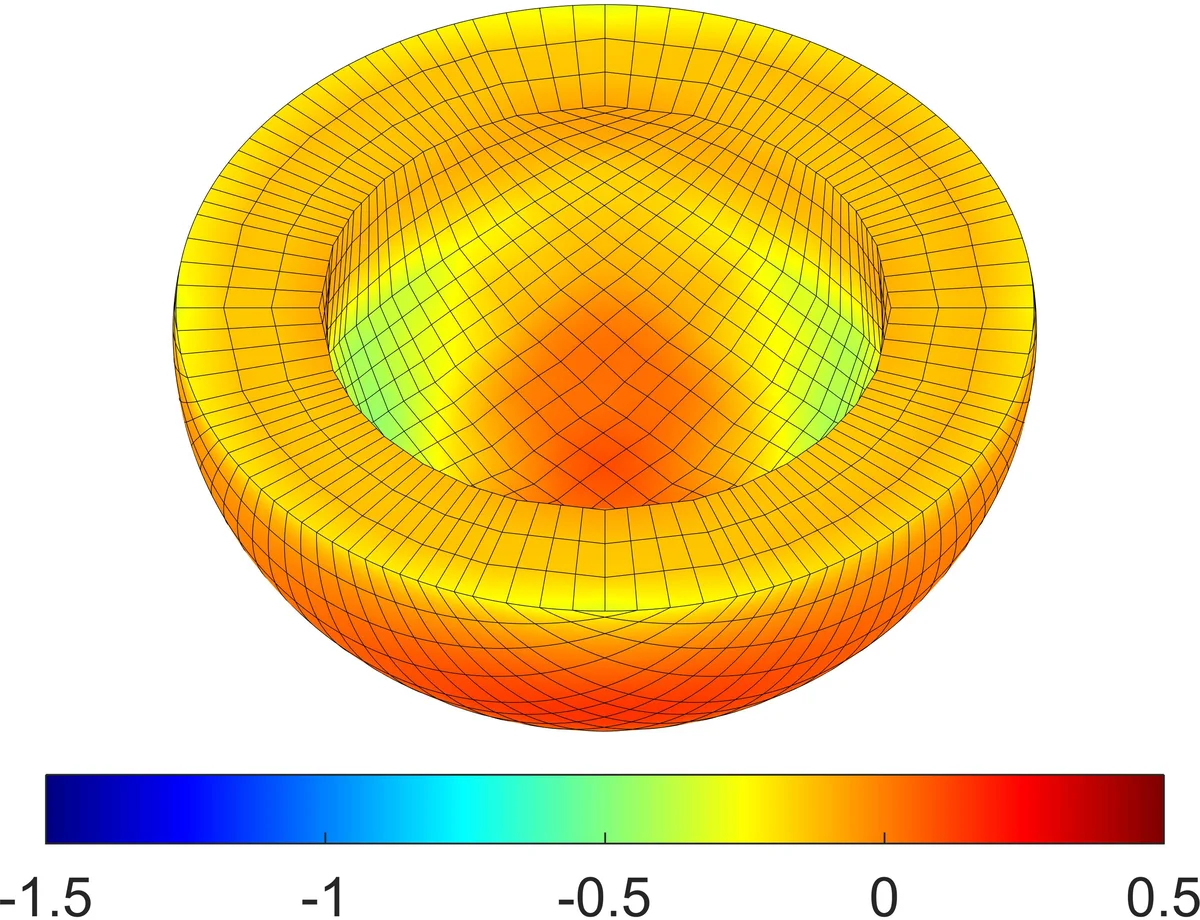
A novel adaptive local surface refinement technique based on Locally Refined Non-Uniform Rational B-Splines (LR NURBS) is presented. LR NURBS can model complex geometries exactly and are the rational extension of LR B-splines. The local representation of the parameter space overcomes the drawback of non-existent local refinement in standard NURBS-based isogeometric analysis. For a convenient embedding into general finite element code, the B'ezier extraction operator for LR NURBS is formulated. An automatic remeshing technique is presented that allows adaptive local refinement and coarsening of LR NURBS. In this work, LR NURBS are applied to contact computations of 3D solids and membranes. For solids, LR NURBS-enriched finite elements are used to discretize the contact surfaces with LR NURBS finite elements, while the rest of the body is discretized by linear Lagrange finite elements. For membranes, the entire surface is discretized by LR NURBS. Various numerical examples are shown, and they demonstrate the benefit of using LR NURBS: Compared to uniform refinement, LR NURBS can achieve high accuracy at lower computational cost.
💡 Research Summary
This paper introduces an adaptive local surface refinement technique based on Locally Refined Non‑Uniform Rational B‑Splines (LR NURBS) and demonstrates its effectiveness for contact analysis of three‑dimensional solids and membranes. Standard NURBS, while capable of representing complex geometries exactly, suffer from a lack of local refinement, which limits their efficiency in problems where only a small region (e.g., a contact zone) requires high resolution. LR B‑splines overcome this limitation by allowing knot insertion directly in the parameter domain, thereby creating locally refined basis functions. The authors extend LR B‑splines to their rational counterpart, LR NURBS, preserving exact geometry representation while enabling local refinement.
A central contribution is the formulation of a Bézier extraction operator tailored to LR NURBS. Traditional Bézier extraction assumes a tensor‑product knot structure; the new operator works with the irregular, locally refined meshlines of LR NURBS, producing element‑wise extraction matrices that can be plugged into existing finite‑element codes with minimal changes. This makes the integration of LR NURBS into commercial or legacy FEM software straightforward.
The paper also proposes an automatic remeshing algorithm that drives adaptive refinement and coarsening. An error indicator—based on quantities such as contact pressure, strain energy density, or gap function—is evaluated element‑wise. Elements exceeding a prescribed threshold are locally refined by inserting new meshlines; the associated LR B‑spline basis functions are split, and scaling factors are recomputed to maintain the partition‑of‑unity property. Conversely, elements where the error is below a lower bound are coarsened by removing meshlines or merging basis functions, thereby reducing the total number of degrees of freedom. This adaptive cycle is performed iteratively until the error distribution satisfies the user‑defined criteria.
For contact mechanics, the authors adopt a penalty formulation with a two‑half‑pass algorithm to evaluate contact tractions. Normal traction follows a linear penalty law, while tangential traction for frictional sliding obeys Coulomb’s law. Two discretization strategies are presented: (1) for solid bodies, only the contact surfaces are discretized with LR NURBS‑enriched finite elements, while the bulk is modeled with linear Lagrange elements; (2) for membrane structures, the entire surface is represented by LR NURBS elements. This hybrid approach leverages the high accuracy of isogeometric analysis where it matters most (the contact interface) while keeping the bulk computation inexpensive.
Four numerical examples illustrate the method. A spherical indentation problem shows that, for the same target error, the LR NURBS model uses roughly 40 % fewer control points than a uniformly refined NURBS model. A pin‑ball contact case demonstrates that local refinement captures the steep stress gradients at the contact edge without globally increasing the mesh density. A frictional sliding test on a composite membrane confirms that the method can handle large deformations and friction while maintaining exact geometry. In all cases, the LR NURBS approach achieves comparable or higher accuracy than uniform refinement but with significantly reduced computational cost (30–60 % fewer degrees of freedom and lower solution times).
The authors conclude that LR NURBS, combined with a Bézier extraction framework and an adaptive remeshing strategy, provides a powerful and practical tool for isogeometric contact analysis. The technique overcomes the global refinement limitation of traditional NURBS, integrates smoothly into existing FEM infrastructures, and delivers substantial efficiency gains. Open issues include the theoretical proof of linear independence for arbitrary three‑dimensional LR NURBS meshes; the current work circumvents this by using 2‑D LR NURBS enriched in the third direction. Future research directions suggested are extending the method to fully three‑dimensional LR NURBS, incorporating more sophisticated friction and adhesion models, and applying the framework to multi‑physics problems such as fluid‑structure interaction.
Comments & Academic Discussion
Loading comments...
Leave a Comment