A persistence landscapes toolbox for topological statistics
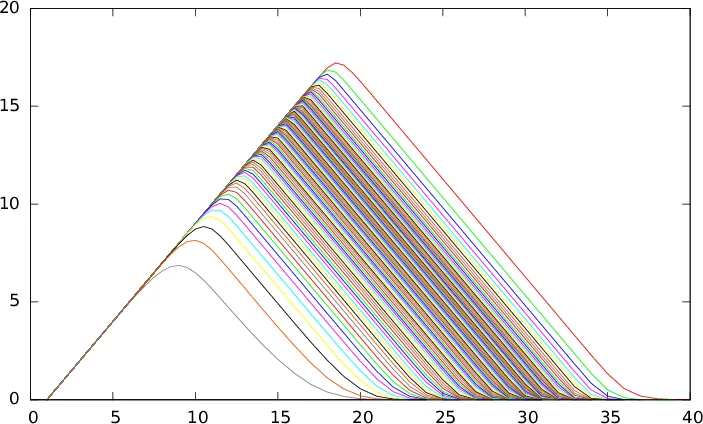
Topological data analysis provides a multiscale description of the geometry and topology of quantitative data. The persistence landscape is a topological summary that can be easily combined with tools from statistics and machine learning. We give efficient algorithms for calculating persistence landscapes, their averages, and distances between such averages. We discuss an implementation of these algorithms and some related procedures. These are intended to facilitate the combination of statistics and machine learning with topological data analysis. We present an experiment showing that the low-dimensional persistence landscapes of points sampled from spheres (and boxes) of varying dimensions differ.
💡 Research Summary
The paper presents a comprehensive toolbox for computing persistence landscapes, a functional summary of persistent homology, and for performing statistical operations such as averaging and distance measurement on these summaries. Persistence landscapes transform each birth–death pair (b, d) into a piecewise‑linear “tent” function f(b,d) and then, for each integer k, collect the k‑th largest value of these functions at every real coordinate t. This yields a sequence of functions λ₁, λ₂, … that live in a Hilbert space, making them amenable to standard statistical and machine learning techniques (e.g., inner products, kernels, clustering).
Two main algorithmic families are introduced. The first, an exact algorithm (Algorithm 1), assumes finite birth and death times. It sorts the input pairs, then iteratively extracts the k‑th landscape by scanning the sorted list once per landscape. The overall time complexity is O(n log n + K n), where n is the number of pairs and K ≤ n is the number of non‑zero landscapes; in the worst case this is O(n²), which the authors prove to be optimal for exact computation. When only a few low‑order landscapes are needed (e.g., λ₁,…,λ_d) the algorithm reduces to O(n log n).
The second family (Algorithm 2) exploits the fact that many persistent homology packages output birth and death times on an evenly spaced grid. By mapping the values onto a grid of size m, contributions from each pair are accumulated in an m × K array, then sorted locally. This yields a time complexity of O(m n + m K log K), which simplifies to O(m n log n) because K ≤ n. The grid spacing δ introduces at most δ² error in the bottleneck distance, guaranteeing stability of the approximation.
Beyond individual landscapes, the toolbox provides methods to compute point‑wise averages of N landscapes in O(n² N log N) time and to evaluate Lᵖ distances (including the supremum norm) between two averaged landscapes in the same asymptotic bound. These operations enable permutation tests, distance matrix construction, and nearest‑neighbor classification directly on topological summaries.
Implementation details are given for a C++ library that is released publicly, with an optional R interface (compatible with the TDA package). Users can switch between exact and grid‑based modes via a simple configuration file, allowing trade‑offs between accuracy, memory usage, and runtime. The library also includes utilities for plotting landscapes, computing inner products (for kernel methods), and performing statistical tests such as permutation‑based two‑sample tests.
Experimental validation uses point clouds sampled uniformly from spheres and hypercubes of varying ambient dimensions. For each dimension, many samples are generated, their persistence diagrams computed (via standard software), and the corresponding landscapes averaged. Pairwise L² distances between averaged landscapes clearly separate different dimensions, demonstrating that low‑dimensional landscapes retain sufficient geometric information to infer intrinsic dimension. Runtime benchmarks illustrate the speed advantage of the grid‑based algorithm over the exact method for large n, while preserving acceptable approximation error.
In summary, the paper delivers both theoretical contributions—optimal‑complexity algorithms for exact landscape computation and provably stable grid approximations—and a practical, open‑source toolbox that bridges topological data analysis with mainstream statistical and machine learning pipelines. This work substantially lowers the barrier for researchers to apply topological summaries in data‑driven contexts.
Comments & Academic Discussion
Loading comments...
Leave a Comment