The sunspot observations by Toaldo and Comparetti at November 1779
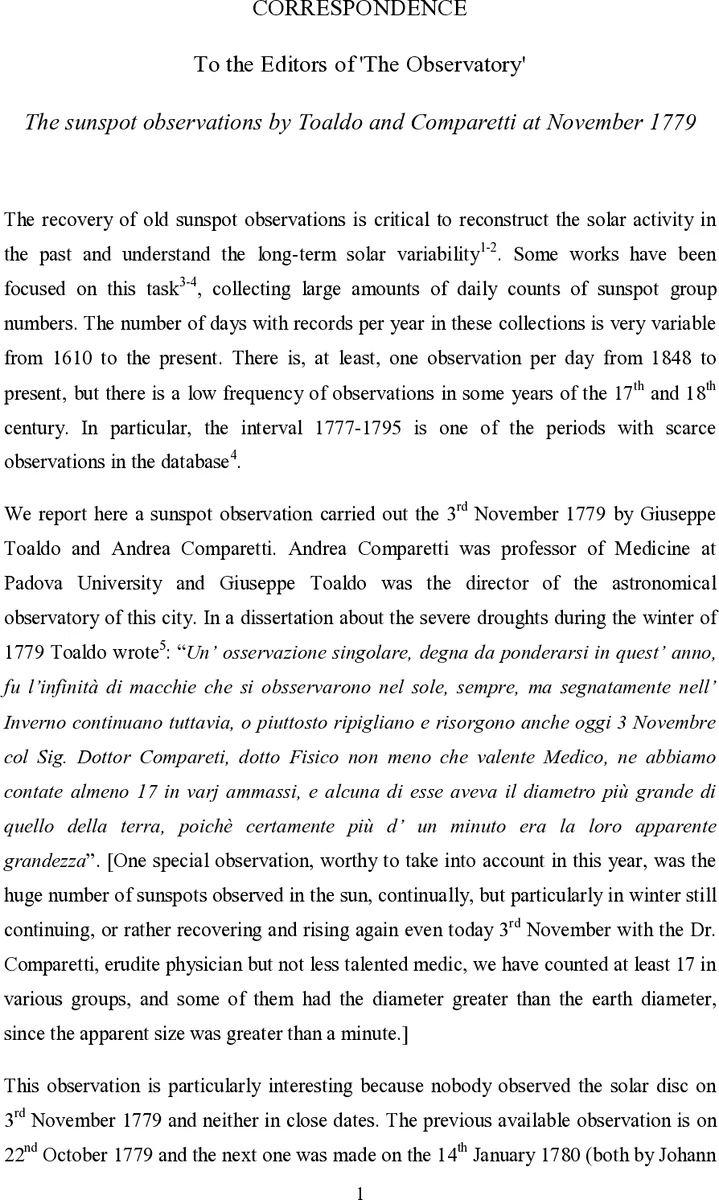
There is a low frequency of sunspot observations in some years of the 17th and 18th century. In particular, the interval 1777-1795 is one of the periods with scarce observations in the databases. In this note, we report a sunspot observation carried out the 3rd November 1779 by Giuseppe Toaldo and Andrea Comparetti.
💡 Research Summary
The paper addresses a notable gap in the historical record of sunspot observations during the late 18th century, a period characterized by sparse data, especially between 1777 and 1795. The authors present a previously under‑reported observation made on 3 November 1779 by Giuseppe Toaldo, director of the astronomical observatory in Padua, and Andrea Comparetti, a physician at the University of Padua. The observation is extracted from Toaldo’s “Astronomical‑Meteorological Journal” for the year 1780, where he describes a “singular observation” of an “infinite number of spots” that persisted throughout the winter. On the specific day in question, Toaldo and Comparetti counted at least 17 distinct sunspot groups, some of which appeared larger than the Earth’s diameter, with an apparent size exceeding one arc‑minute on the solar disc.
The authors emphasize the uniqueness of this record: the only documented sunspot observation for the year 1779, situated between a prior observation on 22 October 1779 and the next known observation on 14 January 1780 by Johann Casper Staudacher in Nuremberg. This temporal positioning makes the Toaldo‑Comparetti entry a crucial “bridge” that can help fill the lacuna in the sunspot number series for the late 1770s. The paper also notes that Toaldo was an active aurora observer, suggesting a broader habit of systematic solar‑related observations, which may imply that the 3 November observation was not an isolated event but part of a regular monitoring program.
From a data‑reconstruction perspective, the International Sunspot Number (ISN) and related databases suffer from extreme under‑sampling in the 1777‑1795 interval, with an average of only one or two observation days per year. The newly reported 17‑group count provides a concrete datum that could raise the estimated solar activity level for 1779. Moreover, the qualitative description that spots “continue, disappear, and reappear” hints at short‑term variability that aligns with modern understandings of sunspot evolution and the emergence‑decay cycle.
The authors argue for the “localization” of such non‑standard observations—i.e., the systematic integration of regional, often unpublished, records into the global sunspot database. They propose several avenues for future work: (1) a detailed philological and instrumental analysis of the original diary entries, including the type of telescope used and its magnification, which would help assess the reliability of size estimates; (2) cross‑validation with contemporaneous observations from other European sites (Germany, Britain, France) to confirm the presence of large sunspot groups on the same dates; (3) statistical incorporation of the 1779 data point into reconstruction algorithms (e.g., Bayesian methods used by Vaquero et al.) to quantify its impact on the long‑term solar activity curve.
In conclusion, the paper demonstrates that even a single, well‑documented observation from a peripheral source can significantly improve the fidelity of historical solar activity reconstructions. By bringing the Toaldo‑Comparetti record to light, the authors provide a valuable data point that may adjust the sunspot number for 1779 upward, refine estimates of sunspot group sizes during that winter, and underscore the importance of mining archival material for solar physics. The work was supported by European Union, Junta de Extremadura, and Spanish Ministry of Economy and Competitiveness grants, and the authors list their institutional affiliations and contact information. References include key works on historical sunspot catalogues, reconstruction methodologies, and recent efforts to augment the sunspot database.
Comments & Academic Discussion
Loading comments...
Leave a Comment