Cellular Automata on Group Sets
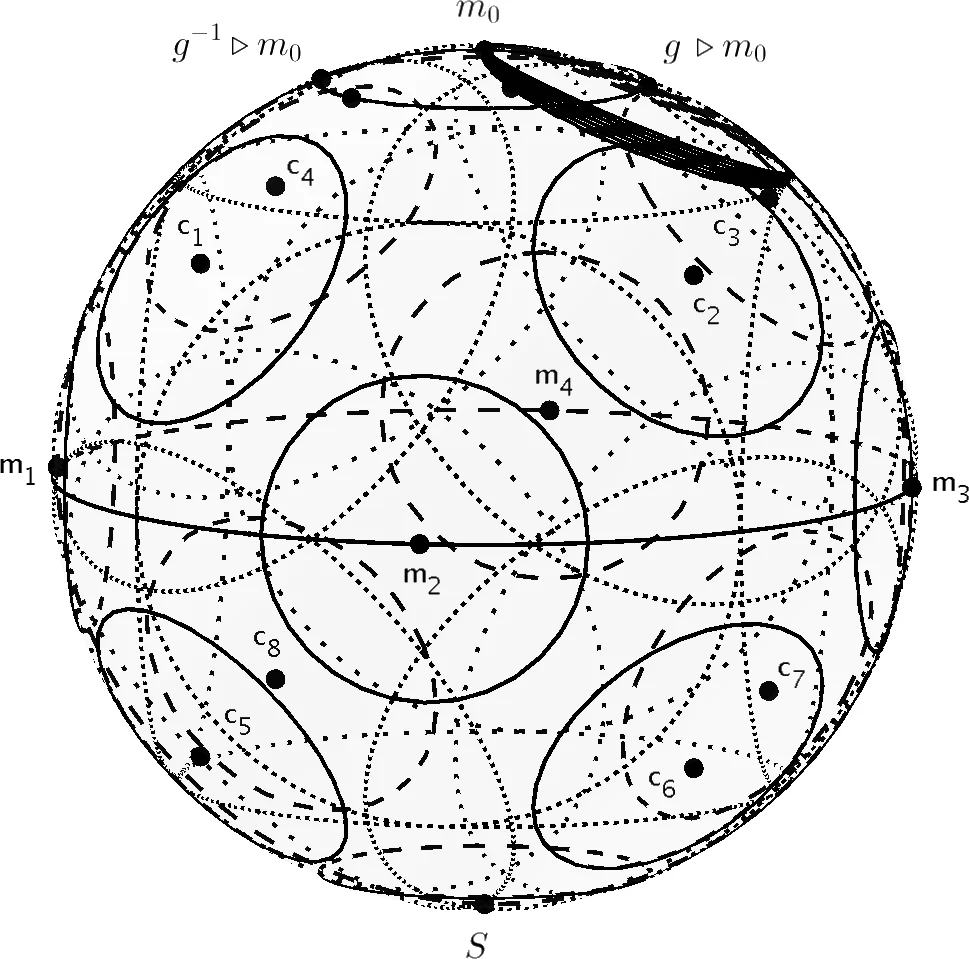
We introduce and study cellular automata whose cell spaces are left-homogeneous spaces. Examples of left-homogeneous spaces are spheres, Euclidean spaces, as well as hyperbolic spaces acted on by isometries; uniform tilings acted on by symmetries; vertex-transitive graphs, in particular, Cayley graphs, acted on by automorphisms; groups acting on themselves by multiplication; and integer lattices acted on by translations. For such automata and spaces, we prove, in particular, generalisations of topological and uniform variants of the Curtis-Hedlund-Lyndon theorem, of the Tarski-F{\o}lner theorem, and of the Garden-of-Eden theorem on the full shift and certain subshifts. Moreover, we introduce signal machines that can handle accumulations of events and using such machines we present a time-optimal quasi-solution of the firing mob synchronisation problem on finite and connected graphs.
💡 Research Summary
The dissertation “Cellular Automata on Group Sets” develops a comprehensive theory of cellular automata (CA) whose underlying cell spaces are not limited to the integer lattice ℤⁿ but are any left‑homogeneous spaces, i.e., sets M equipped with a transitive left action of a group G. This framework encompasses continuous spaces such as ℝⁿ or spheres acted on by translations or rotations, hyperbolic tilings, vertex‑transitive graphs (including Cayley graphs), and any group acting on itself by multiplication.
The work begins by formalising three levels of automata—semicellular, big‑cellular, and cellular—each defined by a local transition function δ. A central technical condition is that δ must be G‑equivariant (invariant under the group action). When this symmetry holds, the induced global transition function τ is equivariant with respect to the induced action on global configurations, and the composition of two such τ’s is again a global transition function. Without this symmetry, composition can break the uniform, local nature of CA.
Next, the thesis studies how τ behaves under algebraic manipulations of the cell space: taking quotients by normal subgroups, forming direct products, restricting to sub‑spaces (e.g., a subset of dimensions), and extending to supersets. It shows that if the neighbourhood of a CA lies inside a chosen factor, the CA can be restricted to that factor, and conversely it can be pulled back from a quotient or pushed forward to an extension, provided the local rule respects the corresponding symmetry.
A major contribution is a topological and uniform version of the Curtis‑Hedlund‑Lyndon (CHL) theorem for these generalized CA. By endowing the configuration space Qᴹ (where Q is the state set) with the product topology (or the corresponding uniformity), the author proves that a map τ: Qᴹ → Qᴹ is a global transition function of some CA iff it is continuous (or uniformly continuous) and equivariant under the group action. This extends the classic “continuous ⇔ CA” result from ℤⁿ to any left‑homogeneous space.
The dissertation then tackles amenability and the Garden‑of‑Eden theorem. For CA on groups, surjectivity of τ is equivalent to pre‑injectivity (injectivity on configurations that differ only on a finite set) precisely when the group is amenable. The author introduces right amenability for left‑homogeneous spaces, defines Følner nets and paradoxical decompositions in this broader setting, and proves a Tarski‑Følner theorem that characterises amenability via the existence of invariant means. Using these tools, a generalized Garden‑of‑Eden theorem is established: on an amenable left‑homogeneous space, τ is surjective iff it is pre‑injective, even when τ is restricted to shift spaces that are shift‑invariant, compact, of finite type, and strongly irreducible.
Shift spaces (subshifts) are examined in depth. The thesis defines shift‑invariant compact subsets of Qᴹ, shows that they inherit the CHL characterisation, and proves the Myhill‑Moore properties (surjectivity ⇔ pre‑injectivity) for them under the same amenability hypotheses.
Finally, the work introduces signal machines capable of handling accumulations of events, and uses them to construct a time‑optimal quasi‑solution to the Firing‑Squad (or Firing‑Mob) Synchronisation Problem on any finite, connected graph‑shaped cell space. The algorithm employs an unbounded number of states, but each state serves a simple geometric purpose (e.g., marking mid‑points of longest‑weight paths). The construction guarantees that, starting from a single “general” cell in a quiescent configuration, all cells enter the “fire” state simultaneously after exactly the minimal number of steps dictated by the graph’s diameter.
Overall, the dissertation unifies several strands of CA theory—equivariance, composition, topological characterisation, amenability, subshift dynamics, and synchronization—under the umbrella of group actions on arbitrary spaces. It not only generalises classical results (CHL, Garden‑of‑Eden, Myhill‑Moore) but also provides new algorithmic tools for distributed computation on non‑Euclidean and graph‑based media, opening avenues for applications in physics, biology, and networked systems.
Comments & Academic Discussion
Loading comments...
Leave a Comment