An Enhanced Lumped Element Electrical Model of a Double Barrier Memristive Device
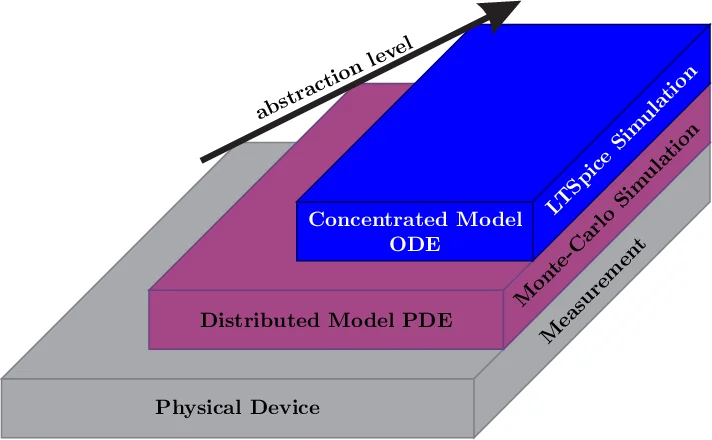
The massive parallel approach of neuromorphic circuits leads to effective methods for solving complex problems. It has turned out that resistive switching devices with a continuous resistance range are potential candidates for such applications. These devices are memristive systems - nonlinear resistors with memory. They are fabricated in nanotechnology and hence parameter spread during fabrication may aggravate reproducible analyses. This issue makes simulation models of memristive devices worthwhile. Kinetic Monte-Carlo simulations based on a distributed model of the device can be used to understand the underlying physical and chemical phenomena. However, such simulations are very time-consuming and neither convenient for investigations of whole circuits nor for real-time applications, e.g. emulation purposes. Instead, a concentrated model of the device can be used for both fast simulations and real-time applications, respectively. We introduce an enhanced electrical model of a valence change mechanism (VCM) based double barrier memristive device (DBMD) with a continuous resistance range. This device consists of an ultra-thin memristive layer sandwiched between a tunnel barrier and a Schottky-contact. The introduced model leads to very fast simulations by using usual circuit simulation tools while maintaining physically meaningful parameters. Kinetic Monte-Carlo simulations based on a distributed model and experimental data have been utilized as references to verify the concentrated model.
💡 Research Summary
The paper addresses the need for fast, physically meaningful simulation models of resistive switching devices that exhibit a continuous resistance range, which are promising candidates for neuromorphic computing. The authors focus on a double‑barrier memristive device (DBMD) comprising an ultra‑thin NbₓOᵧ solid‑state electrolyte sandwiched between an Al₂O₃ tunnel barrier and a Au/NbₓOᵧ Schottky contact. Experimental characterization shows a classic hysteresis loop when a triangular voltage waveform is applied, with a logarithmic current‑voltage plot revealing a smooth transition between high‑ and low‑resistance states.
Physical analysis, based on prior kinetic Monte‑Carlo (KMC) studies, identifies two coupled mechanisms: (1) under positive bias, oxygen ions drift toward the Schottky interface, lowering the barrier height, while positive ions accumulate at the tunnel barrier, effectively thinning it and increasing tunneling current; (2) under negative bias, the Schottky contact blocks current, creating a strong field that detaches the accumulated ions, allowing the system to relax back to its thermodynamic equilibrium. This dual‑barrier configuration yields intrinsic current compliance, low power consumption, and no forming step, making the DBMD attractive for neuromorphic circuits.
A key observation is that for long‑duration, high‑voltage stress the measured current continues to rise beyond the saturation predicted by a fixed‑defect KMC model. The authors therefore incorporate defect generation (oxygen vacancies and interstitials) into the kinetic model using an Arrhenius‑type rate equation. Simulations that allow the total number of defects to increase match the long‑time experimental data, indicating that defect formation is a slow but significant process under strong fields.
To enable circuit‑level design and real‑time emulation, the paper derives an enhanced lumped‑element (concentrated) electrical model that preserves the underlying physics. The Schottky contact is represented by a diode, while the tunnel barrier and electrolyte are each modeled as a parallel resistor‑capacitor pair. The internal state of the device is captured by a normalized average ion position (z\in
Comments & Academic Discussion
Loading comments...
Leave a Comment