Time-delay and reality conditions for complex solitons
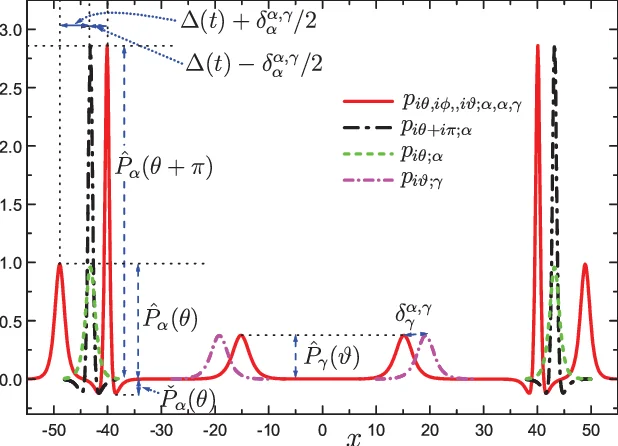
We compute lateral displacements and time-delays for a scattering processes of complex multi-soliton solutions of the Korteweg de-Vries equation.The resulting expressions are employed to explain the precise distinction between solutions obtained from different techniques, Hirota’s direct method and a superposition principle based on Baecklund transformations. Moreover they explain the internal structures of degenerate compound multi-solitons previously constructed. Their individual one-soliton constituents are time-delayed when scattered amongst each other. We present generic formulae for these time-dependent displacements. By recalling Gardner’s transformation method for conserved charges, we argue that the structure of the asymptotic behaviour resulting from the integrability of the model together with its PT-symmetry ensure the reality of all of these charges, including in particular the mass, the momentum and the energy.
💡 Research Summary
The paper investigates the scattering of complex multi‑soliton solutions of the Korteweg‑de Vries (KdV) equation, focusing on two intertwined issues: the explicit computation of lateral displacements (time‑delays) and the proof that all conserved quantities remain real despite the underlying field being complex. Starting from the complex KdV equation (u_t+6uu_x+u_{xxx}=0) with (u=p+i,q) and imposing (\mathcal{PT})‑symmetry by choosing the phase parameter (\mu=i\theta) (θ∈ℝ), the authors construct one‑soliton solutions via Hirota’s direct method. The τ‑function (\tau_{\mu;\alpha}=1+e^{\eta_{\mu;\alpha}}) with (\eta_{\mu;\alpha}=\alpha x-\alpha^3 t+\mu) yields the field (u_{i\theta;\alpha}=2\partial_x^2\ln\tau_{i\theta;\alpha}). Direct integration shows that the mass (m=\int u,dx), momentum (p=\int u^2dx), and energy (E=\int(\tfrac12u^3-u_x^2)dx) evaluate to (2\alpha), (\tfrac23\alpha^3) and (\tfrac25\alpha^5) respectively – all real numbers. The imaginary part (q) contributes no net mass, illustrating how a complex field can still generate real physical observables.
The analysis proceeds to non‑degenerate two‑soliton configurations. The τ‑function \
Comments & Academic Discussion
Loading comments...
Leave a Comment