Coalitional game based cost optimization of energy portfolio in smart grid communities
In this paper we propose two novel coalitional game theory based optimization methods for minimizing the cost of electricity consumed by households from a smart community. Some households in the community may own renewable energy systems (RESs) conjoined with energy storing systems (ESSs). Some other residences own ESSs only, while the remaining households are simple energy consumers. We first propose a coalitional cost optimization method in which RESs and ESSs owners exchange energy and share their renewable energy and storage spaces. We show that by participating in the proposed game these households may considerably reduce their costs in comparison to performing individual cost optimization. We further propose another coalitional optimization model in which RESs and ESSs owning households not only share their resources, but also sell energy to simple energy consuming households. We show that through this energy trade the RESs and ESSs owners can further reduce their costs, while the simple energy consumers also gain cost savings. The monetary revenues gained by the coalition are distributed among its members according to the Shapley value. Simulation examples show that the proposed coalitional optimization methods may reduce the electricity costs for the RESs and ESSs owning households by 20%, while the sole energy consumers may reduce their costs by 5%.
💡 Research Summary
The paper proposes two novel coalitional game‑theoretic frameworks for reducing electricity costs in a smart‑grid community composed of three types of households: (i) those that own renewable energy systems (RES) together with energy storage systems (ESS), (ii) those that own only ESS, and (iii) pure energy consumers that have no generation or storage assets. The authors first formulate a cost‑minimization problem for each RES/ESS household performed individually, which includes the cost of electricity purchased from the utility and a degradation cost proportional to the absolute amount of energy charged or discharged from the storage.
Building on this baseline, the first coalitional model allows all RES/ESS owners (the set M) to share their renewable generation and storage capacity and to exchange energy freely among themselves. The problem remains linear and convex, with constraints that enforce power balance, storage dynamics, charging/discharging limits, and non‑negative grid purchases. By solving a single linear program for the coalition, the total cost (grid purchases plus storage degradation) is minimized for the whole group.
The second coalitional model extends the first by incorporating the pure consumers (set P) into the optimization. Consumers can only receive energy from the coalition (their exchange variable is constrained to be non‑positive) and may also buy from the utility. The coalition sells electricity to these consumers at a price lower than the utility’s tariff, thereby generating additional revenue for the RES/ESS owners while still reducing the consumers’ bills. The objective now includes the revenue from sales to P, and the same linear constraints apply to all participants.
To allocate the coalition’s total benefit fairly, the authors model the interaction as a transferable‑utility (TU) coalitional game. The characteristic function v(S) for any subset S⊆M is defined as the difference between the sum of individual costs of members in S (if they acted alone) and the minimized coalition cost when only the members of S cooperate. The Shapley value is employed to compute each member’s payoff, ensuring that the allocation reflects each household’s marginal contribution across all possible coalitions. This method guarantees both efficiency (the total payoff equals the coalition’s total surplus) and fairness (symmetry, dummy player, and additivity properties).
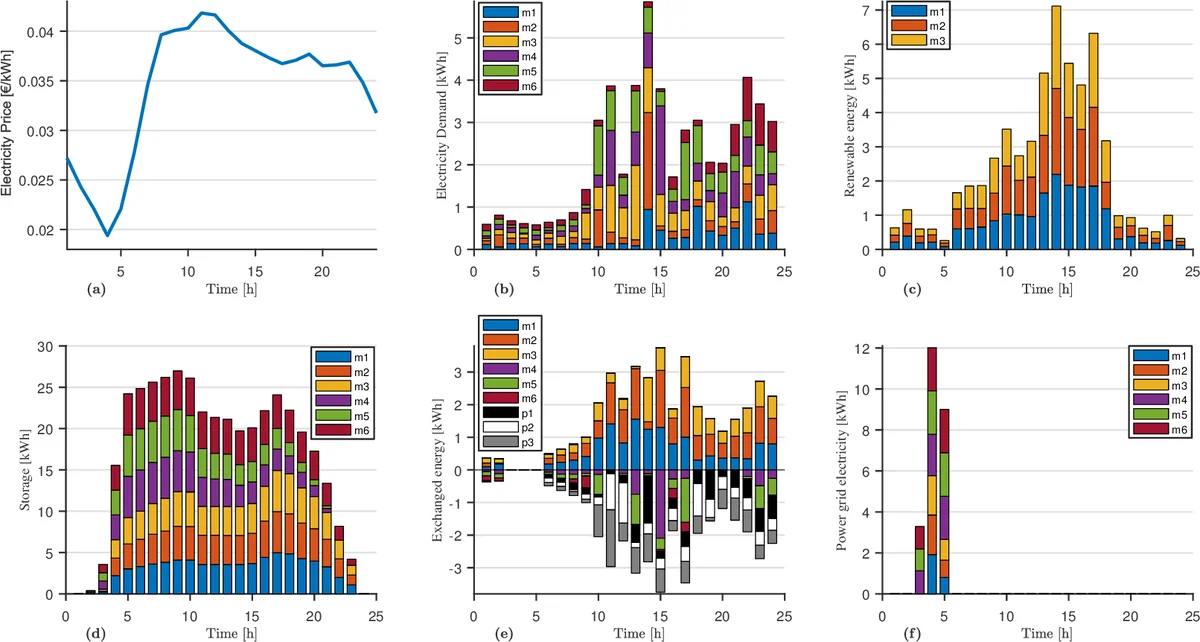
Simulation studies use realistic 24‑hour profiles of renewable generation (solar and wind) and household demand, with hourly time steps. Key parameters include time‑varying electricity prices from the utility, storage capacity, charging rate, leakage factor, and a degradation price for storage cycling. Results show that:
- Compared with individual optimization, the RES/ESS‑only coalition achieves an average cost reduction of about 13.5 %.
- Adding pure consumers to the coalition yields an additional 6.5 % reduction, for a total of roughly 20 % savings for RES/ESS owners.
- Pure consumers benefit as well, paying approximately 5 % less than the utility price.
The Shapley‑based revenue distribution confirms that households with larger renewable output or greater storage capacity receive higher compensation, providing sufficient incentive for participation.
The paper’s contributions are threefold: (1) a novel free‑exchange coalition among RES/ESS owners, (2) an extended coalition that includes non‑owning consumers and introduces low‑price energy sales, and (3) a tractable linear‑programming formulation coupled with a Shapley‑value allocation for fair profit sharing. Limitations include the reliance on accurate day‑ahead forecasts of demand and generation, the absence of real‑time re‑optimization to handle forecast errors, and the assumption of a centralized control unit with perfect communication. Future work is suggested on stochastic or robust optimization, decentralized implementation, integration of blockchain for transparent transaction recording, and scaling the model to multi‑utility or multi‑market environments.
Comments & Academic Discussion
Loading comments...
Leave a Comment