Can Distribution Grids Significantly Contribute to Transmission Grids Voltage Management?
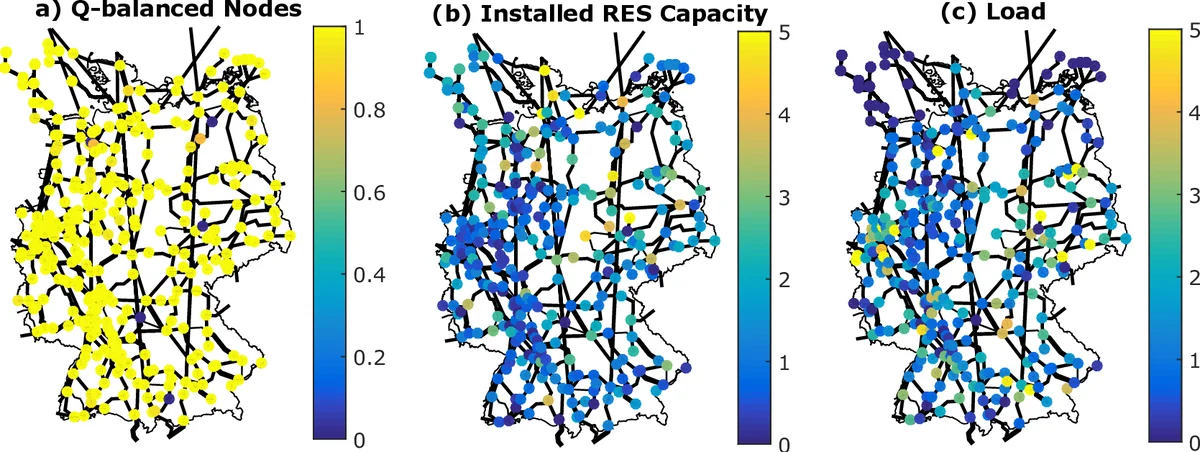
Power generation in Germany is currently transitioning from a system based on large, central, thermal power plants to one that heavily relies on small, decentral, mostly renewable power generators. This development poses the question how transmission grids’ reactive power demand for voltage management, covered by central power plants today, can be supplied in the future. In this work, we estimate the future technical potential of such an approach for the whole of Germany. For a 100% renewable electricity scenario we set the possible reactive power supply in comparison with the reactive power requirements that are needed to realize the simulated future transmission grid power flows. Since an exact calculation of distribution grids’ reactive power potential is difficult due to the unavailability of detailed grid models on such scale, we optimistically estimate the potential by assuming a scaled, averaged distribution grid model connected to each of the transmission grid nodes. We find that for all except a few transmission grid nodes, the required reactive power can be fully supplied from the modeled distribution grids. This implies that - even if our estimate is overly optimistic - distributed reactive power provisioning will be a technical solution for many future reactive power challenges.
💡 Research Summary
The paper investigates whether Germany’s future distribution grids (DGs) can provide the reactive power (Q) needed by the transmission grid (TG) for voltage management in a 100 % renewable electricity scenario for 2050. As conventional large‑scale thermal generators, which currently supply most of the TG’s reactive power, are replaced by numerous small, decentralized renewable generators (mainly solar PV and wind), the authors ask whether the DGs can compensate for the loss of central Q sources.
Because detailed, nationwide distribution‑grid models are unavailable, the authors construct an optimistic “scaled average” DG model. They assume that at every ultra‑high‑voltage (UHV) node of the TG a set of identical, fully symmetric tree‑structured distribution grids is connected. The tree follows a fixed node‑ratio across voltage levels (UHV‑HV‑MV‑LV) of 1 : 2 : 3 : 14 : 9 : 8. Realistic load and generation data from the Kombikraftwerk 2 (KKW2) 2050 study are normalized to this average grid using a load scaling factor n_load,i (peak load at node i divided by the average peak of 132 MW) and a generation scaling factor n_cap,i that limits the installed capacity to 1.5 times the average peak (to avoid unrealistic over‑capacity). After power‑flow calculations on the scaled model, results are re‑scaled back to the original node size.
The reactive‑power optimization is performed with a standard interior‑point nonlinear solver. The decision variables are the reactive power injections at the HV, MV and LV levels (Q_HV, Q_MV, Q_LV). The objective is to maximize or minimize the Q seen at the UHV‑HV interface (Q_UHV). Constraints include: (i) generator capability limits (Q² < C² − P²), (ii) voltage limits of ±10 % at every node, and (iii) discrete transformer tap positions (0.95, 1.00, 1.05). Line current limits are omitted because previous studies show voltage violations dominate in heavily renewable‑penetrated DGs. After each iteration, a forward/backward sweep solves the tree‑grid power‑flow equations.
To evaluate the whole country, the authors use the KKW2 2050 scenario, which provides hourly generation, load, and transmission‑grid power‑flow data for each UHV node. To keep the computational burden manageable, the 8760 hourly snapshots are clustered into 30 representative time steps using k‑means. For each cluster the reactive‑power optimization is run, and the resulting Q contributions from the DGs are aggregated over a 30 km radius to account for possible Q exchange between neighboring TG nodes. Nodes without load or located outside Germany are excluded.
Three prototypical distribution‑grid cases are examined in detail to validate the methodology:
- Passau – a sunny rural area with high PV generation and low load. The model shows that both capacitive and inductive Q can be supplied, but MV voltage limits restrict the maximum Q export.
- Munich – an urban area with high load and little distributed generation. The DG’s Q is predominantly inductive, matching today’s load‑dominated situation; transformer taps are mainly used to reduce losses.
- Goerlitz – a windy rural area with substantial wind generation at MV/HV levels. Large Q export potential exists, yet voltage limits and tap‑range constraints again bound the realizable Q.
Applying the same procedure nationwide, the authors find that approximately 95 % of the 606 UHV nodes can have their reactive‑power demand fully met by the underlying DGs under the optimistic assumptions. Only a small subset of nodes would require additional central compensation devices (e.g., STATCOMs, SVCs) or reinforcement of the distribution network. The authors stress that the results are deliberately optimistic: real distribution grids are not perfectly symmetric, line‑loading constraints, communication delays, and limited controllability of converters could reduce the actual Q provision.
The paper’s contributions are threefold:
- Quantitative estimation of the technical potential of distributed reactive‑power support on a national scale for a 100 % renewable scenario.
- Demonstration that transformer tap‑changing and the reactive‑power capability of renewable converters are the key levers for voltage control in the DG.
- Evidence that, under favorable conditions, distributed Q can satisfy the vast majority of TG voltage‑management needs, providing a strong technical argument for investing in smart‑grid communication, controllable tap‑changing infrastructure, and advanced DG control algorithms.
While the economic analysis, market mechanisms, and detailed implementation aspects are left for future work, the study offers a solid engineering baseline for policymakers and system planners considering a transition to a fully renewable German power system.
Comments & Academic Discussion
Loading comments...
Leave a Comment