Quasi-oscillatory dynamics observed in ascending phase of the flare on March 6, 2012
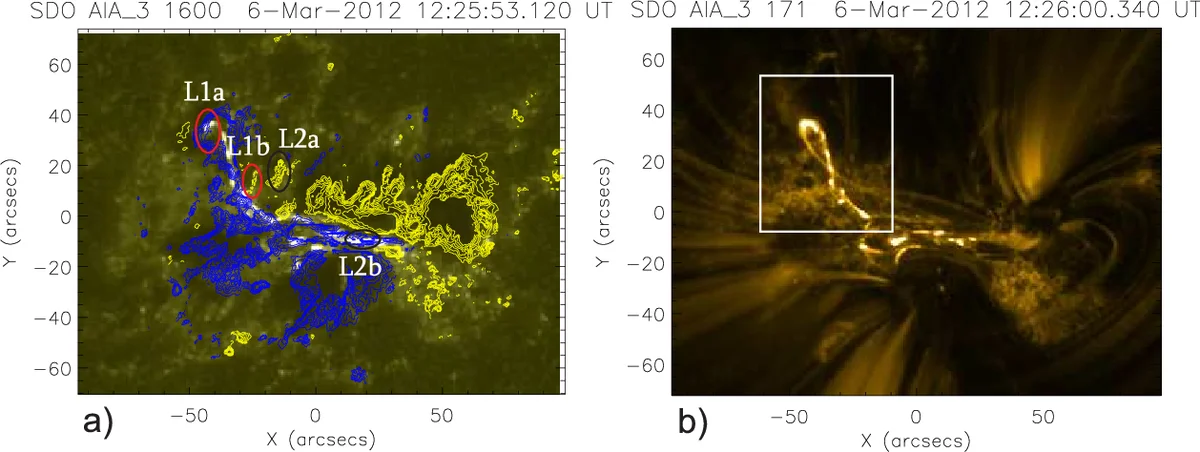
Context. The dynamics of the flaring loops in active region (AR) 11429 are studied. The observed dynamics consist of several evolution stages of the flaring loop system during both the ascending and descending phases of the registered M-class flare. The dynamical properties can also be classified by different types of magnetic reconnection, related plasma ejection and aperiodic flows, quasi-periodic oscillatory motions, and rapid temperature and density changes, among others. The focus of the present paper is on a specific time interval during the ascending (pre-flare) phase. Aims. The goal is to understand the quasi-periodic behavior in both space and time of the magnetic loop structures during the considered time interval. Methods.We have studied the characteristic location, motion, and periodicity properties of the flaring loops by examining space-time diagrams and intensity variation analysis along the coronal magnetic loops using AIA intensity and HMI magnetogram images (from the Solar Dynamics Observatory(SDO)). Results. We detected bright plasma blobs along the coronal loop during the ascending phase of the solar flare, the intensity variations of which clearly show quasi-periodic behavior. We also determined the periods of these oscillations. Conclusions. Two different interpretations are presented for the observed dynamics. Firstly, the oscillations are interpreted as the manifestation of non-fundamental harmonics of longitudinal standing acoustic oscillations driven by the thermodynamically nonequilibrium background (with time variable density and temperature). The second possible interpretation we provide is that the observed bright blobs could be a signature of a strongly twisted coronal loop that is kink unstable.
💡 Research Summary
The paper presents a detailed observational study of the dynamics of flaring coronal loops in active region NOAA 11429 during the pre‑flare (ascending) phase of an M2.1 solar flare that occurred on 6 March 2012. Using high‑cadence (12 s) and high‑resolution (0.6″ pixel⁻¹) data from the Solar Dynamics Observatory’s Atmospheric Imaging Assembly (AIA) and Helioseismic and Magnetic Imager (HMI), the authors focus on a specific interval between 12:23 UT and 12:30 UT, when the flare’s energy release was just beginning.
Two magnetic loops, designated L1 and L2, are identified in the 171 Å EUV channel. L1 is initially the only visible structure; a few minutes later L2 brightens and the two loops interact, leading to magnetic reconnection, plasma heating, loop widening, and eventual asymmetric breakup of L1. The most striking feature observed in L1 is the appearance of four to five bright plasma “blobs” that remain essentially stationary along the loop while their intensity oscillates quasi‑periodically. By extracting space‑time diagrams along the loop, the authors measure the positions of the blobs and the intensity minima between them, then fit sinusoidal functions to the detrended light curves. The derived periods lie in the range of roughly 28–35 seconds, with intensity amplitudes of about ±2000 DN.
Two physical interpretations are proposed. The first treats the oscillations as non‑fundamental (second or third) longitudinal standing acoustic modes (slow magnetoacoustic waves) propagating in a thermodynamically non‑equilibrium background whose density and temperature evolve rapidly during the flare onset. Assuming a loop length of ~36 Mm and a coronal temperature of 0.6–1.2 MK (sound speed ≈150 km s⁻¹), the fundamental acoustic period would be ≈240 s; the observed 30 s period corresponds to the 8th–9th harmonic, which could be preferentially excited by the rapid heating and cooling.
The second interpretation invokes a strongly twisted magnetic flux tube that has exceeded the kink‑instability threshold. In this scenario the bright blobs represent localized compressions formed by the growing kink mode. The near‑stationary nature of the blobs, together with their periodic brightening, is consistent with a rotating, helically distorted tube where magnetic pressure oscillates as the instability evolves.
The authors discuss the limitations imposed by the AIA cadence and spatial resolution, and suggest that complementary observations—such as high‑resolution spectroscopy from IRIS, radio imaging, or future missions with faster cadence—could discriminate between the wave‑based and instability‑based explanations. They also emphasize that the detection of such quasi‑periodic phenomena in the pre‑flare phase provides valuable insight into the mechanisms that trigger flare energy release, the modulation of reconnection rates, and the possible connection to subsequent coronal mass ejections. Overall, the study contributes to the growing body of evidence that both magnetohydrodynamic waves and magnetic instabilities play crucial roles in shaping the fine‑scale dynamics of solar flares.
Comments & Academic Discussion
Loading comments...
Leave a Comment