Building Interoperable and Cross-Domain Semantic Web of Things Applications
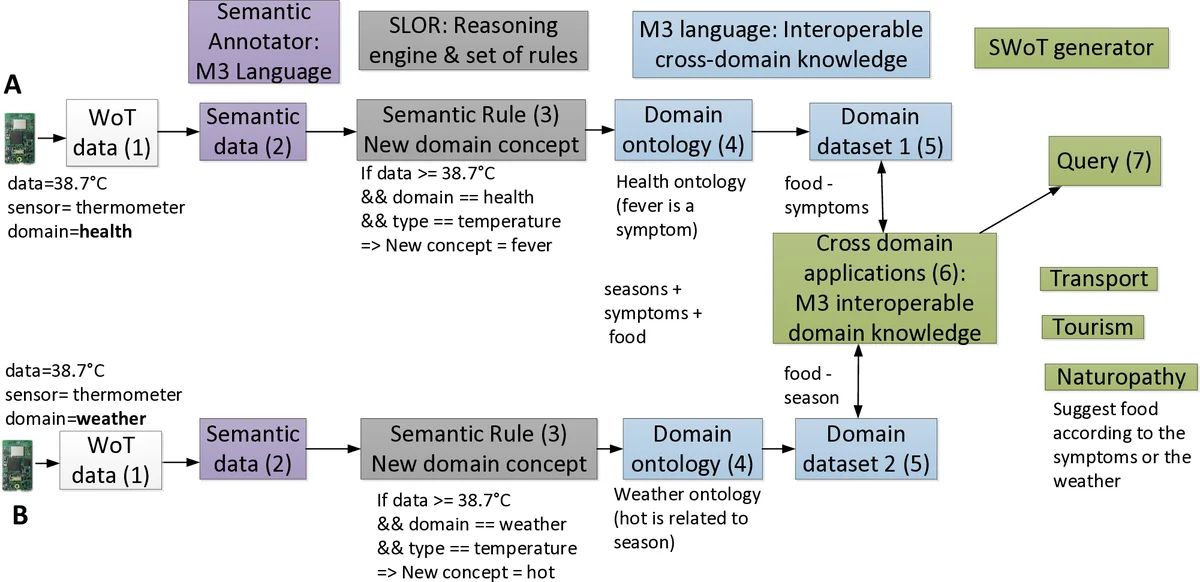
The Web of Things (WoT) is rapidly growing in popularity getting the interest of not only technologist and scientific communities but industrial, system integrators and solution providers. The key aspect of the WoT to succeed is the relatively, easy-to-build ecosystems nature inherited from the web and the capacity for building end-to-end solutions. At the WoT connecting physical devices such as sensors, RFID tags or any devices that can send data through the Internet using the Web is almost automatic. The WoT shared data can be used to build smarter solutions that offer business services in the form of IoT applications. In this chapter, we review the main WoT challenges, with particular interest on highlighting those that rely on combining heterogeneous IoT data for the design of smarter services and applications and that benefit from data interoperability. Semantic web technologies help for overcoming with such challenges by addressing, among other ones the following objectives: 1) semantically annotating and unifying heterogeneous data, 2) enriching semantic WoT datasets with external knowledge graphs, and 3) providing an analysis of data by means of reasoning mechanisms to infer meaningful information. To overcome the challenge of building interoperable semantics-based IoT applications, the Machine-to-Machine Measurement (M3) semantic engine has been designed to semantically annotate WoT data, build the logic of smarter services and deduce meaningful knowledge by linking it to the external knowledge graphs available on the web. M3 assists application and business developers in designing interoperable Semantic Web of Things applications. Contributions in the context of European semantic-based WoT projects are discussed and a particular use case within FIESTA-IoT project is presented.
💡 Research Summary
The chapter traces the evolution from the Internet of Things (IoT) through the Web of Things (WoT) to the emerging Semantic Web of Things (SWoT), emphasizing that while IoT connected devices and WoT leveraged web protocols for loose coupling, neither addressed the fundamental problem of data heterogeneity and lack of shared meaning. To enable truly cross‑domain services, the authors argue that sensor data must be semantically annotated, enriched with external knowledge graphs, and processed by reasoning engines that can infer high‑level situations from raw measurements.
The paper surveys existing semantic approaches such as Semantic Sensor Web, Linked Sensor Data, and the broader Linked Open Data movement, noting that their adoption in real projects is hampered by the need to design ontologies, write annotation pipelines, and configure reasoning rules—tasks that require specialized expertise and considerable development time.
To bridge this gap, the authors introduce the Machine‑to‑Machine Measurement (M3) semantic engine. M3 operates as a three‑stage pipeline: (1) raw sensor streams are transformed into RDF triples using standard IoT ontologies (SSN/SOSA); (2) SPARQL‑based mapping rules link these triples to external knowledge graphs (e.g., DBpedia, domain‑specific KG), thereby adding rich contextual metadata; (3) an open‑source reasoning engine (Apache Jena, RDF4J) applies OWL‑DL or SWRL rules to derive new facts such as “potential icing” or “abnormal body temperature.”
The key contribution of M3 is the automation of “semantic annotation + knowledge integration + reasoning,” allowing developers to build interoperable, cross‑domain applications without deep knowledge of semantic web technologies. The engine can be embedded in existing WoT infrastructures (HTTP/REST) and can be deployed partly at the edge (Fog of Things) to perform lightweight preprocessing before sending enriched data to the cloud for heavyweight inference, thus reducing latency and preserving privacy.
A concrete use case from the European FIESTA‑IoT project demonstrates M3’s scalability: it was applied to tens of thousands of devices across smart‑city, smart‑home, and healthcare domains, enabling services such as optimal building temperature control that also accounted for asthma patients’ health data. The case illustrates how M3 facilitates the reuse of existing domain ontologies, shortens development cycles, and supports the composition of simple services into more complex, value‑added applications.
Finally, the authors outline future research directions: (i) automated ontology alignment and machine‑learning‑driven rule generation, (ii) lightweight semantic engines for edge devices, and (iii) standardized SWoT APIs and security mechanisms. By addressing these challenges, SWoT—supported by platforms like M3—could become the foundational layer for data‑centric innovation across industries, turning heterogeneous IoT data into interoperable, knowledge‑rich assets.
Comments & Academic Discussion
Loading comments...
Leave a Comment