Fine-Grained Parameterized Complexity Analysis of Graph Coloring Problems
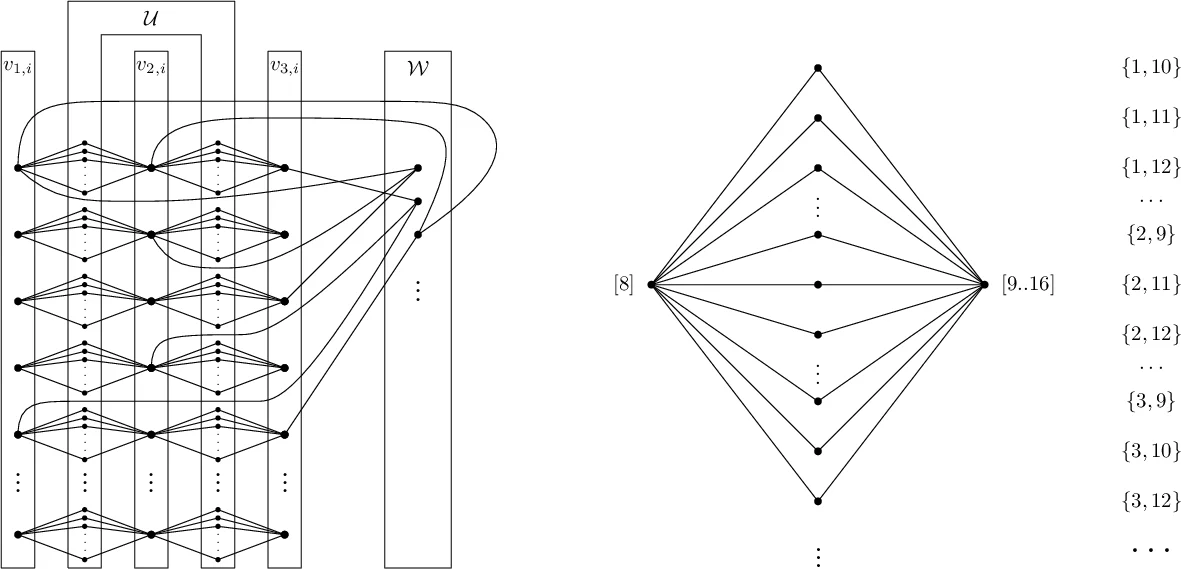
The $q$-Coloring problem asks whether the vertices of a graph can be properly colored with $q$ colors. Lokshtanov et al. [SODA 2011] showed that $q$-Coloring on graphs with a feedback vertex set of size $k$ cannot be solved in time $\mathcal{O}^((q-\varepsilon)^k)$, for any $\varepsilon > 0$, unless the Strong Exponential-Time Hypothesis (SETH) fails. In this paper we perform a fine-grained analysis of the complexity of $q$-Coloring with respect to a hierarchy of parameters. We show that even when parameterized by the vertex cover number, $q$ must appear in the base of the exponent: Unless ETH fails, there is no universal constant $\theta$ such that $q$-Coloring parameterized by vertex cover can be solved in time $\mathcal{O}^(\theta^k)$ for all fixed $q$. We apply a method due to Jansen and Kratsch [Inform. & Comput. 2013] to prove that there are $\mathcal{O}^((q - \varepsilon)^k)$ time algorithms where $k$ is the vertex deletion distance to several graph classes $\mathcal{F}$ for which $q$-Coloring is known to be solvable in polynomial time. We generalize earlier ad-hoc results by showing that if $\mathcal{F}$ is a class of graphs whose $(q+1)$-colorable members have bounded treedepth, then there exists some $\varepsilon > 0$ such that $q$-Coloring can be solved in time $\mathcal{O}^((q-\varepsilon)^k)$ when parameterized by the size of a given modulator to $\mathcal{F}$. In contrast, we prove that if $\mathcal{F}$ is the class of paths - some of the simplest graphs of unbounded treedepth - then no such algorithm can exist unless SETH fails.
💡 Research Summary
The paper conducts a fine‑grained parameterized complexity study of the classic q‑Coloring and q‑List‑Coloring problems. Building on the seminal SETH‑based lower bound of Lokshtanov et al. (SODA 2011), which shows that q‑Coloring on graphs with a feedback vertex set of size k cannot be solved in O*((q − ε)^k) time for any ε > 0, the authors explore whether a similar dependence on q remains when the parameter is weakened.
First, they prove that even when the parameter is the size k of a vertex cover, the base of the exponent must still contain q. Assuming the Exponential Time Hypothesis (ETH), they show that no algorithm running in O*(θ^k) for a constant θ independent of q can exist for all fixed q ∈ O(1). This establishes a strong ETH‑based lower bound that rules out any “q‑free” exponential dependence for the vertex‑cover parameter.
Next, the authors adapt the “No‑certificate” technique introduced by Jansen and Kratsch (Inform. & Comput. 2013). A graph class 𝔽 has g(q)‑size No‑certificates for q‑List‑Coloring if every No‑instance on a graph from 𝔽 contains a No‑subinstance on at most g(q) vertices. They prove that if such a bound exists, then q‑List‑Coloring (and consequently q‑Coloring) on 𝔽 + k_v graphs—graphs that become members of 𝔽 after deleting a modulator X of size k—can be solved in O*((q − ε)^k) time for some ε > 0 depending only on 𝔽. The algorithm enumerates partial colorings of the modulator, discarding those that immediately induce a minimal No‑certificate in the remaining graph. Because the certificates are of constant size, the branching factor is reduced from q^k to roughly (q · g(q))^{k/g(q)}, yielding the desired sub‑q exponential base.
The paper then links the existence of small No‑certificates to a structural property: bounded treedepth. They show that if every (q + 1)‑colorable graph in a hereditary class 𝔽 has treedepth at most d (a constant), then 𝔽 possesses constant‑size No‑certificates for q‑List‑Coloring. Consequently, for any such class, q‑Coloring on 𝔽 + k_v graphs admits an O*((q − ε)^k) algorithm. This result generalizes several earlier ad‑hoc algorithms for specific classes (e.g., split graphs, co‑chordal graphs).
To demonstrate the tightness of the treedepth condition, the authors consider the class of paths P, which has unbounded treedepth despite being extremely simple. They prove that for Path + k_v graphs, no O*((q − ε)^k) algorithm exists unless SETH fails. The reduction builds on the SETH‑hardness of q‑SAT and encodes clauses along a long path, ensuring that any algorithm with a base smaller than q would violate SETH. This establishes that bounded treedepth is essentially the exact threshold for obtaining sub‑q exponential algorithms in the modulator‑size parameterization.
Finally, the paper gives a dichotomy for hereditary classes that exclude a fixed complete bipartite graph K_{t,t}. For any such class 𝔽, q‑Coloring on 𝔽 + k_v admits O*((q − ε)^k) algorithms if and only if the (q + 1)‑colorable members of 𝔽 have bounded treedepth. Thus, the presence or absence of unbounded treedepth (often manifested by long induced paths) precisely determines the feasibility of sub‑q exponential parameterized algorithms.
In summary, the authors provide a comprehensive map of the parameterized complexity landscape for graph coloring: (i) a strong ETH‑based lower bound for vertex‑cover parameterization, (ii) a generic algorithmic framework based on small No‑certificates, (iii) a structural characterization via bounded treedepth, and (iv) tight SETH‑based lower bounds for classes with unbounded treedepth. Their work deepens our understanding of how fine‑grained structural parameters influence the exponential dependence on the number of colors, and it identifies treedepth as the pivotal property governing the existence of faster-than‑q algorithms in the modulator‑size setting.
Comments & Academic Discussion
Loading comments...
Leave a Comment