Optimal Distributed Channel Assignment in D2D Networks Using Learning in Noisy Potential Games
We present a novel solution for Channel Assignment Problem (CAP) in Device-to-Device (D2D) wireless networks that takes into account the throughput estimation noise. CAP is known to be NP-hard in the literature and there is no practical optimal learning algorithm that takes into account the estimation noise. In this paper, we first formulate the CAP as a stochastic optimization problem to maximize the expected sum data rate. To capture the estimation noise, CAP is modeled as a noisy potential game, a novel notion we introduce in this paper. Then, we propose a distributed Binary Log-linear Learning Algorithm (BLLA) that converges to the optimal channel assignments. Convergence of BLLA is proved for bounded and unbounded noise. Proofs for fixed and decreasing temperature parameter of BLLA are provided. A sufficient number of estimation samples is given that guarantees the convergence to the optimal state. We assess the performance of BLLA by extensive simulations, which show that the sum data rate increases with the number of channels and users. Contrary to the better response algorithm, the proposed algorithm achieves the optimal channel assignments distributively even in presence of estimation noise.
💡 Research Summary
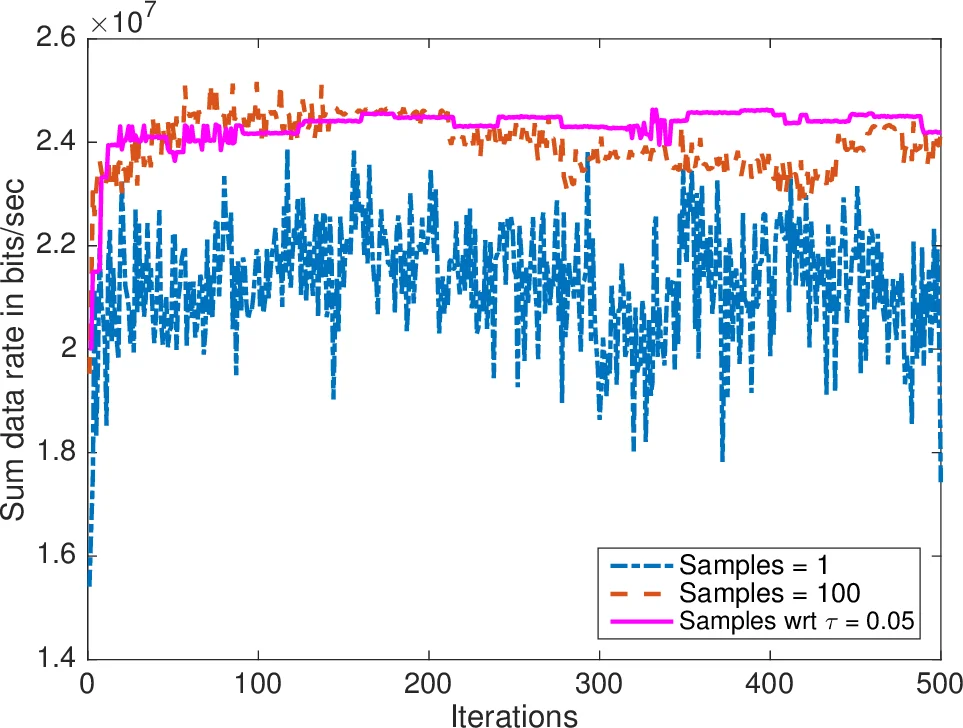
The paper tackles the channel assignment problem (CAP) in underlay device‑to‑device (D2D) networks, where the goal is to maximize the expected sum data rate under realistic conditions of noisy throughput estimates. Recognizing that exact channel state information (CSI) is unavailable and that measurement errors (due to fading, feedback delay, quantization, etc.) introduce stochasticity, the authors formulate CAP as a stochastic optimization problem and introduce a novel game‑theoretic framework called a “noisy potential game.” In this framework each D2D user is a player, the set of orthogonal channels constitutes each player’s action space, and the expected utility of a player is defined as the marginal contribution of that player to the total estimated throughput. By averaging over N independent measurement samples, the random utility’s variance can be reduced, and the expected utility aligns with a global potential function φ(a) that equals the expected sum rate.
The authors prove (Proposition 1) that with the proposed utility definition the resulting game is indeed a noisy potential game, i.e., its expected‑utility version is a deterministic potential game with potential φ. Building on this structure, they design the Binary Log‑linear Learning Algorithm (BLLA). In each time slot a base station randomly selects a player i and a trial channel âi. Player i uses its current channel during Phase I and the trial channel during Phase II; all users sharing either of the two channels measure their sample‑mean throughputs and report them to the base station. The base station computes the estimated utilities ˆU_N_i for the current and trial actions and selects the trial action with probability
P(âi) = 1 / (1 + e^{Δ_N_i / τ}),
where Δ_N_i is the utility difference and τ is a temperature parameter. The decision requires only a one‑bit feedback, making the scheme highly distributed.
Convergence analysis shows that BLLA induces an irreducible Markov chain over the action space. As τ → 0, the stationary distribution concentrates on the stochastically stable states, which are exactly the global maximizers of φ for potential games. Theorem 2 extends this result to noisy potential games, providing explicit lower bounds on the required number of samples N for two noise models: (1) bounded noise of interval size ℓ, yielding N ≥ (log(4/ξ)+2τ/ℓ)·
Comments & Academic Discussion
Loading comments...
Leave a Comment