Some Results on Circuit Lower Bounds and Derandomization of Arthur-Merlin Problems
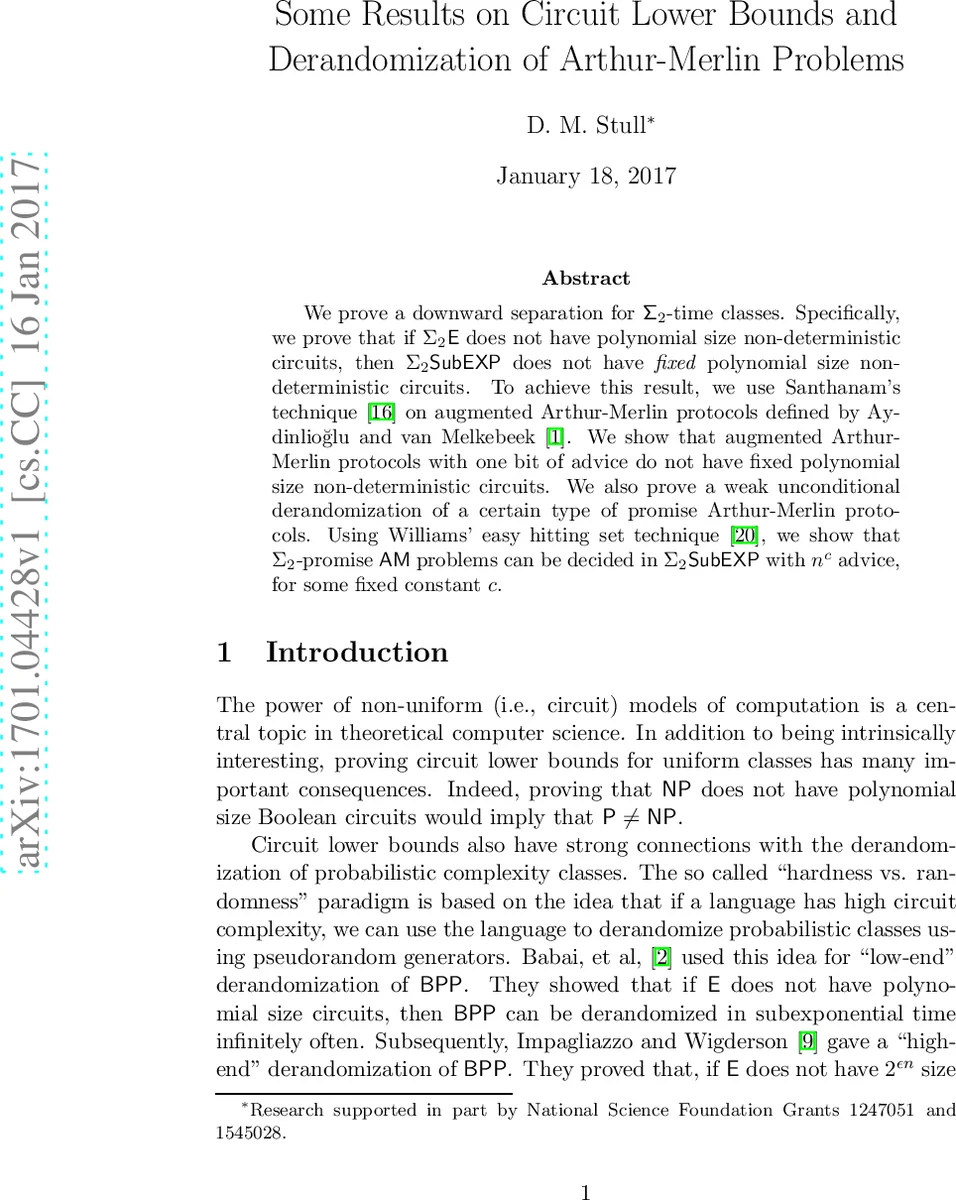
We prove a downward separation for $\mathsf{\Sigma}_2$-time classes. Specifically, we prove that if $\Sigma_2$E does not have polynomial size non-deterministic circuits, then $\Sigma_2$SubEXP does not have \textit{fixed} polynomial size non-deterministic circuits. To achieve this result, we use Santhanam’s technique on augmented Arthur-Merlin protocols defined by Aydinlio\u{g}lu and van Melkebeek. We show that augmented Arthur-Merlin protocols with one bit of advice do not have fixed polynomial size non-deterministic circuits. We also prove a weak unconditional derandomization of a certain type of promise Arthur-Merlin protocols. Using Williams’ easy hitting set technique, we show that $\Sigma_2$-promise AM problems can be decided in $\Sigma_2$SubEXP with $n^c$ advice, for some fixed constant $c$.
💡 Research Summary
This paper establishes a downward separation for Σ₂‑time complexity classes and connects non‑deterministic circuit lower bounds with the derandomization of Arthur‑Merlin (AM) protocols. The main result states that if Σ₂‑E (the class of languages decidable in exponential time with a Σ₂‑type quantifier structure) does not admit polynomial‑size non‑deterministic circuits, then Σ₂‑SubEXP (sub‑exponential time with the same quantifier structure) also cannot be computed by fixed‑polynomial‑size non‑deterministic circuits. In other words, a lower bound at the higher exponential level propagates down to the sub‑exponential level.
To achieve this, the authors adapt Santhanam’s technique—originally used to show that MA with a single bit of advice cannot have fixed‑polynomial‑size deterministic circuits—to the setting of augmented Arthur‑Merlin protocols (AugAM). AugAM, introduced by Aydinlioğlu and van Melkebeek, extends the standard AM model by adding a coNP verifier that checks whether a Merlin‑provided non‑deterministic circuit satisfies a “single‑valued” (SV) property: for each input there exists at least one witness that makes the circuit’s flag gate output 1, and all such witnesses agree on the output. This coNP verifier enables the simulation of interactive proofs even when the underlying circuit is non‑deterministic.
The paper first defines two families of non‑deterministic circuits: NSIZE(poly), which merely bounds the size of the circuit, and SVSIZE(poly), which imposes the stricter single‑valued condition. It then constructs promise problems Γ_M and Γ_M′ based on a PSPACE‑complete language L and probabilistic oracle Turing machines M and M′ (Lemma 1). These machines have the property that, when given a correct SV circuit for L as an oracle, they accept with probability 1 on yes‑instances and reject with probability at least 2/3 on no‑instances. Using these machines, the authors embed the verification of SV circuits into an AugAM protocol, yielding the promise problems Γ_M and Γ_M′, which are shown to lie in prAM (Lemma 2).
The core technical contribution is Theorem 3, which proves that AugAM with one bit of advice (denoted AugAM/1) does not have fixed‑polynomial‑size SV circuits. The proof proceeds by contradiction: assuming PSPACE has polynomial‑size SV circuits, PSPACE would be contained in AugAM (Theorem 2). A PSPACE‑complete language L is then used to define a language A that encodes the minimal SV‑circuit size for L via a carefully chosen padding parameter y (a power of two). The AugAM/1 protocol for A asks Merlin to supply a candidate SV circuit for L; the coNP verifier checks the SV property, and Arthur runs the Γ_M protocol to test correctness. If A had a small SV circuit, one could construct a smaller SV circuit for L, contradicting the minimality assumption. Hence AugAM/1 cannot be in SVSIZE(n^k) for any fixed k.
Theorem 4 strengthens this result by showing that the intersection of AugAM and its complement (coAugAM), still with one bit of advice, does not admit fixed‑polynomial‑size non‑deterministic circuits (NSIZE). The proof mirrors that of Theorem 3 but works with general non‑deterministic circuits rather than SV circuits, leveraging the fact that PSPACE = AugAM ∩ coAugAM under the same assumption.
From these lower‑bound results, the authors derive the downward separation: if Σ₂‑E lacks polynomial‑size non‑deterministic circuits, then Σ₂‑SubEXP also lacks them. This follows because a hypothetical polynomial‑size non‑deterministic circuit family for Σ₂‑SubEXP would yield, via padding and the constructions above, a polynomial‑size SV circuit family for PSPACE, contradicting Theorem 3.
The second major contribution is a weak unconditional derandomization of a class of promise AM problems. Using Williams’s “easy hitting set” technique, the authors construct hitting sets for certain promise AM protocols based on hard functions (e.g., SAT). They show that any Σ₂‑promise AM problem can be decided in Σ₂‑SubEXP with n^c bits of advice for some constant c (Theorem 5). This result parallels earlier “high‑end” derandomizations (e.g., E ⊄ P/poly ⇒ BPP = P) but operates in a “low‑end” regime where a modest amount of advice suffices.
Overall, the paper makes three notable advances:
-
Downward Separation for Σ₂‑Time Classes: It translates a non‑deterministic circuit lower bound at the exponential level (Σ₂‑E) into a comparable lower bound at the sub‑exponential level (Σ₂‑SubEXP), extending the reach of known lower‑bound techniques.
-
Circuit Lower Bounds for Augmented AM: By adapting Santhanam’s advice‑bit technique to AugAM, the authors prove that even with a single advice bit, AugAM cannot be captured by fixed‑polynomial‑size non‑deterministic (or SV) circuits. This introduces a new, robust model for studying the interplay between interactive proofs and circuit complexity.
-
Unconditional Derandomization with Advice: The application of Williams’s easy hitting set method yields a concrete derandomization of Σ₂‑promise AM within Σ₂‑SubEXP, albeit with polynomial advice. This bridges the gap between hardness assumptions and explicit algorithmic constructions in the Σ₂ hierarchy.
The work leaves open several directions: removing the advice requirement, extending the results to arbitrary polynomial sizes (instead of fixed exponents), and exploring whether similar downward separations hold for higher levels of the polynomial hierarchy. Nonetheless, the paper provides a compelling synthesis of circuit lower bounds, interactive proof systems, and derandomization techniques, advancing our understanding of the structural relationships among these central themes in complexity theory.
Comments & Academic Discussion
Loading comments...
Leave a Comment