Spectral Statistics of Lattice Graph Structured, Non-uniform Percolations
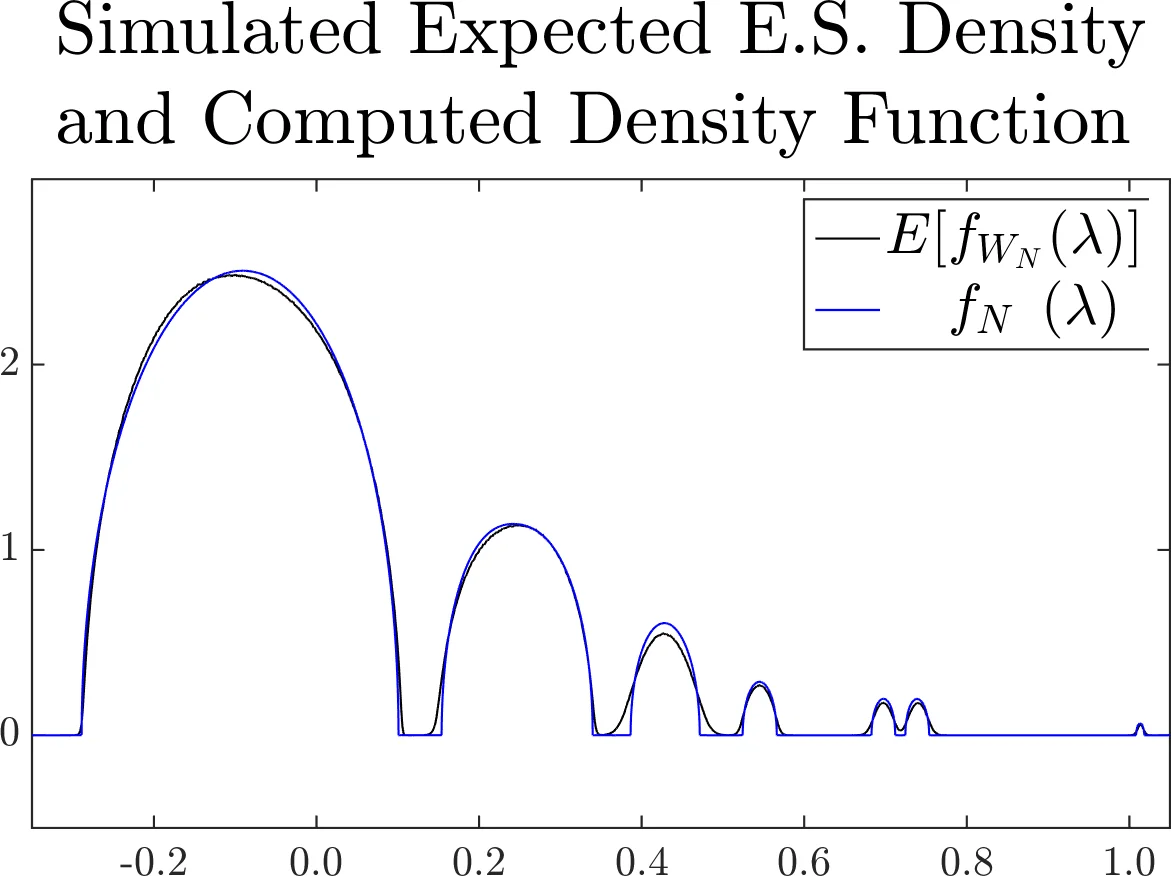
Design of filters for graph signal processing benefits from knowledge of the spectral decomposition of matrices that encode graphs, such as the adjacency matrix and the Laplacian matrix, used to define the shift operator. For shift matrices with real eigenvalues, which arise for symmetric graphs, the empirical spectral distribution captures the eigenvalue locations. Under realistic circumstances, stochastic influences often affect the network structure and, consequently, the shift matrix empirical spectral distribution. Nevertheless, deterministic functions may often be found to approximate the asymptotic behavior of empirical spectral distributions of random matrices. This paper uses stochastic canonical equation methods developed by Girko to derive such deterministic equivalent distributions for the empirical spectral distributions of random graphs formed by structured, non-uniform percolation of a D-dimensional lattice supergraph. Included simulations demonstrate the results for sample parameters.
💡 Research Summary
The paper investigates the spectral properties of adjacency matrices arising from a random graph model built on a D‑dimensional lattice supergraph where each edge is retained independently with a dimension‑specific Bernoulli probability p₍d₎. This “non‑uniform percolation” model captures realistic scenarios in which network links are subject to heterogeneous failure or activation rates across different spatial directions. The authors aim to provide deterministic equivalents for the empirical spectral distribution (ESD) of the scaled adjacency matrix W = (1/γ)A(Gₚₑᵣc), where γ = Σ₍d=1₎ᴰ p₍d₎(M₍d₎−1) is the expected node degree.
The theoretical backbone is Girko’s stochastic canonical equation framework, specifically the K₁ equation (Theorem 1). Under three mild conditions—bounded row sums of the mean matrix, bounded second moments of the centered entries, and a Lindeberg‑type condition—the ESD of a sequence of symmetric random matrices converges almost surely to a deterministic distribution whose Stieltjes transform S_F(z) can be expressed as the average of diagonal entries Cₖₖ(z) solving a coupled system of equations (11).
Applying this machinery to the lattice percolation setting, the authors first express the deterministic part B = E
Comments & Academic Discussion
Loading comments...
Leave a Comment