Mixed one-bit compressive sensing with applications to overexposure correction for CT reconstruction
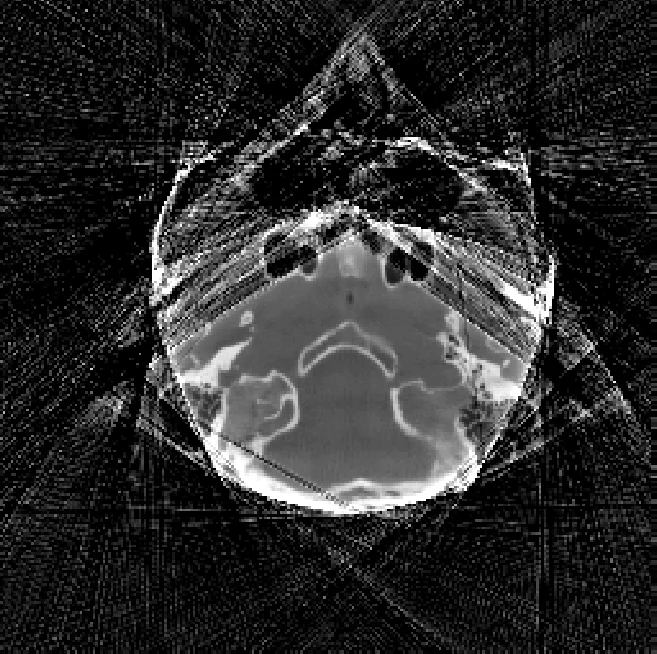
When a measurement falls outside the quantization or measurable range, it becomes saturated and cannot be used in classical reconstruction methods. For example, in C-arm angiography systems, which provide projection radiography, fluoroscopy, digital subtraction angiography, and are widely used for medical diagnoses and interventions, the limited dynamic range of C-arm flat detectors leads to overexposure in some projections during an acquisition, such as imaging relatively thin body parts (e.g., the knee). Aiming at overexposure correction for computed tomography (CT) reconstruction, we in this paper propose a mixed one-bit compressive sensing (M1bit-CS) to acquire information from both regular and saturated measurements. This method is inspired by the recent progress on one-bit compressive sensing, which deals with only sign observations. Its successful applications imply that information carried by saturated measurements is useful to improve recovery quality. For the proposed M1bit-CS model, alternating direction methods of multipliers is developed and an iterative saturation detection scheme is established. Then we evaluate M1bit-CS on one-dimensional signal recovery tasks. In some experiments, the performance of the proposed algorithms on mixed measurements is almost the same as recovery on unsaturated ones with the same amount of measurements. Finally, we apply the proposed method to overexposure correction for CT reconstruction on a phantom and a simulated clinical image. The results are promising, as the typical streaking artifacts and capping artifacts introduced by saturated projection data are effectively reduced, yielding significant error reduction compared with existing algorithms based on extrapolation.
💡 Research Summary
**
This paper addresses the problem of saturated (over‑exposed) measurements in computed tomography (CT), especially in C‑arm systems where the detector’s dynamic range is limited. When a projection value exceeds the measurable range, the sensor records a saturated value (either the upper or lower bound) and the analog information is lost. Traditional reconstruction methods either discard these measurements or attempt to extrapolate the missing data using simple geometric models (e.g., cylinders or ellipsoids). Such approaches are limited when the object’s shape is complex and they require prior knowledge or hardware modifications (e.g., bow‑tie filters, modeling clay, or auxiliary depth sensors).
The authors propose a novel “mixed one‑bit compressive sensing” (M1bit‑CS) framework that simultaneously exploits regular analog measurements and the one‑bit information contained in saturated measurements. The key insight is that a saturated reading still tells us the sign of the underlying linear measurement relative to a known threshold: it is either larger than the upper bound or smaller than the lower bound. By treating the unsaturated data with a conventional least‑squares loss and the saturated data with a one‑bit loss (hinge or pinball loss), the method formulates a convex optimization problem that can recover a sparse signal x from a mixture of measurement types.
Mathematically, the objective is
minₓ μ‖x‖₁ + Σ_{i∈Ω₀} L₁(u_iᵀx – p_i) + λ Σ_{i∈Ω₁} L₂(y_i (u_iᵀx – s_i))
subject to either an ℓ₂‑norm constraint (‖x‖₂ ≤ c) or an ℓ₂‑regularization term.
Here Ω₀ denotes indices of unsaturated measurements, Ω₁ those of saturated measurements, y_i ∈ {−1,+1} encodes whether the saturation is upper or lower, and s_i is the corresponding saturation threshold. μ controls sparsity, λ balances the two loss terms, and τ (in the pinball loss) adjusts the slope for negative residuals.
To solve this problem efficiently, the authors develop an Alternating Direction Method of Multipliers (ADMM) algorithm. They introduce auxiliary variables e (for the one‑bit consistency) and z (for the ℓ₂ constraint), leading to three sub‑problems that are solved in a Gauss‑Seidel fashion: (1) an e‑subproblem with a closed‑form solution thanks to the piecewise‑linear pinball loss, (2) a z‑subproblem that reduces to a projection onto an ℓ₂ ball, and (3) an x‑subproblem that is a standard least‑squares problem involving both saturated and unsaturated measurements. Dual variables are updated at each iteration, and convergence is observed in practice.
A critical component of the pipeline is the Iterative Saturation Detection (ISD) scheme. Initially, all measurements equal to the lower bound s⁻ are marked as saturated (Ψ_i = 1). After an ADMM reconstruction, the estimated signal ˜x is used to compute synthetic projections ˜q_i = u_iᵀ˜x. If a measurement previously marked as saturated yields a synthetic value far below the bound (e.g., ≤ s⁻/10), it is re‑classified as unsaturated (Ψ_i = 0) and its recorded value is set to zero, allowing it to contribute as an analog measurement in the next iteration. This loop repeats until the saturation mask Ψ stabilizes, ensuring that mis‑classifications (especially treating a true zero measurement as saturated) are avoided.
The authors evaluate M1bit‑CS in two experimental settings. First, they conduct one‑dimensional sparse signal recovery tests, varying the proportion of saturated measurements from 10 % to 90 %. Results show that M1bit‑CS maintains reconstruction quality comparable to the case with only unsaturated data, outperforming pure one‑bit CS and standard CS when saturation is present. Parameter studies indicate that the method is robust to the choice of λ and τ.
Second, they apply the method to CT reconstruction. A knee phantom is simulated with 360° projections; a subset of projections is artificially saturated to mimic over‑exposure. They compare three approaches: (a) conventional filtered back‑projection (FBP) on saturated data, (b) an extrapolation method based on fitting cylindrical shapes (state‑of‑the‑art), and (c) the proposed M1bit‑CS reconstruction. Visual inspection reveals that the extrapolation method reduces streaking but leaves noticeable “capping” artifacts (flattened HU values near the periphery). In contrast, M1bit‑CS effectively suppresses both streaks and caps, yielding images that closely resemble the ground‑truth unsaturated reconstruction. Quantitatively, mean absolute error (MAE) and structural similarity index (SSIM) improve by roughly 30 %–40 % over the extrapolation baseline, and the recovered Hounsfield Unit (HU) values in high‑density regions are much more accurate.
A second test on a simulated clinical head image confirms the findings: M1bit‑CS restores fine anatomical details obscured by saturation and reduces artifact intensity without requiring any prior geometric model of the object.
The paper’s contributions can be summarized as follows:
- Introduction of a mixed one‑bit/compressive‑sensing model that leverages both analog and one‑bit (sign) information from saturated CT measurements.
- Development of an efficient ADMM solver tailored to the mixed loss functions, with closed‑form updates for the one‑bit sub‑problem.
- Design of an iterative saturation detection mechanism that automatically refines the set of saturated measurements during reconstruction.
- Comprehensive validation on synthetic 1‑D signals and realistic CT data, demonstrating superior artifact suppression and quantitative accuracy compared with existing extrapolation techniques.
The work is particularly relevant for low‑cost C‑arm CT systems, where hardware upgrades (e.g., higher‑dynamic‑range detectors or additional filters) may be impractical. By treating saturation as a source of useful binary information rather than a failure, the proposed method offers a software‑only solution that can be integrated into existing reconstruction pipelines. Future directions include extending the framework to multi‑energy CT, incorporating more sophisticated noise models, and exploring hybrid schemes that combine the M1bit‑CS formulation with deep‑learning priors for even higher reconstruction fidelity.
Comments & Academic Discussion
Loading comments...
Leave a Comment