Efficient Uncertainty Quantification for the Periodic Steady State of Forced and Autonomous Circuits
This brief paper proposes an uncertainty quantification method for the periodic steady-state (PSS) analysis with both Gaussian and non-Gaussian variations. Our stochastic testing formulation for the PSS problem provides superior efficiency over both Monte Carlo methods and existing spectral methods. The numerical implementation of a stochastic shooting Newton solver is presented for both forced and autonomous circuits. Simulation results on some analog/RF circuits are reported to show the effectiveness of our proposed algorithms.
💡 Research Summary
This paper addresses the critical need for efficient uncertainty quantification (UQ) in periodic steady‑state (PSS) analysis of both forced and autonomous analog/RF circuits. Traditional approaches rely on Monte‑Carlo (MC) simulations, which require thousands of transient runs to achieve acceptable statistical accuracy, making them computationally prohibitive for realistic designs. Spectral methods such as polynomial chaos (PC), generalized PC (gPC), and stochastic Galerkin (SG) improve convergence rates but suffer from a rapid growth in computational cost—typically O(K³) where K is the number of gPC basis functions—especially when dealing with non‑Gaussian parameters and autonomous circuits that require simultaneous solution of the period and phase constraints.
The authors propose a novel stochastic testing (ST) framework that directly constructs the stochastic PSS equations using a carefully selected set of collocation (testing) points. By choosing K testing points that render the Vandermonde‑like matrix V invertible and well‑conditioned, the coupled stochastic system can be decoupled into K independent deterministic PSS problems. Each testing point corresponds to a deterministic shooting‑Newton simulation, allowing the reuse of existing PSS solvers without modification.
For forced circuits, the nonlinear differential‑algebraic equations (DAEs) are expanded with a truncated gPC series, and the state transition function Φ is evaluated at each testing point. The resulting BVP takes the familiar form g(ȳ)=Φ(ȳ,0,T)−ȳ=0, and the Jacobian reduces to the monodromy matrix of the deterministic problem. For autonomous circuits, the unknown period T(ξ) is expressed as T₀·a(ξ) with a gPC expansion; a time‑scaling transformation introduces a new variable τ, converting the original DAEs into a form identical to the forced case. Phase constraints are imposed by fixing one state variable, leading again to a set of independent shooting‑Newton problems.
A key mathematical insight is the use of a transformation matrix P (either Wₙ or Wₙ+1Θ) that maps the global stochastic residual vector into a block‑diagonal structure. Consequently, the global Jacobian J can be written as P⁻¹·diag(J₁,…,J_K)·P, where each block J_k is exactly the Jacobian of the deterministic PSS problem at the corresponding testing point. This decoupling reduces the overall computational complexity from O(K³·n³) to O(K·n³), where n is the number of circuit state variables. For large‑scale designs, matrix‑free iterative solvers can further lower the cost to O(K·n^β) with β≈1, and the approach is naturally parallelizable across testing points.
The methodology is implemented in a MATLAB‑based circuit simulator and validated on two benchmark circuits. The first case is a low‑noise amplifier (LNA) representing a forced circuit. Four random parameters (temperature, resistor, inductor, and threshold voltage) are modeled with Gaussian and uniform distributions. A third‑order gPC expansion (35 basis functions) yields mean and standard‑deviation results that match MC simulations with 8,000 samples within 1 % relative error. The total runtime of the decoupled ST solver is 3.4 seconds—42× faster than the coupled ST version, 71× faster than an SG‑based PSS solver, and roughly 2,200× faster than MC. Probability density functions of total harmonic distortion (THD) and power consumption are indistinguishable between ST and MC.
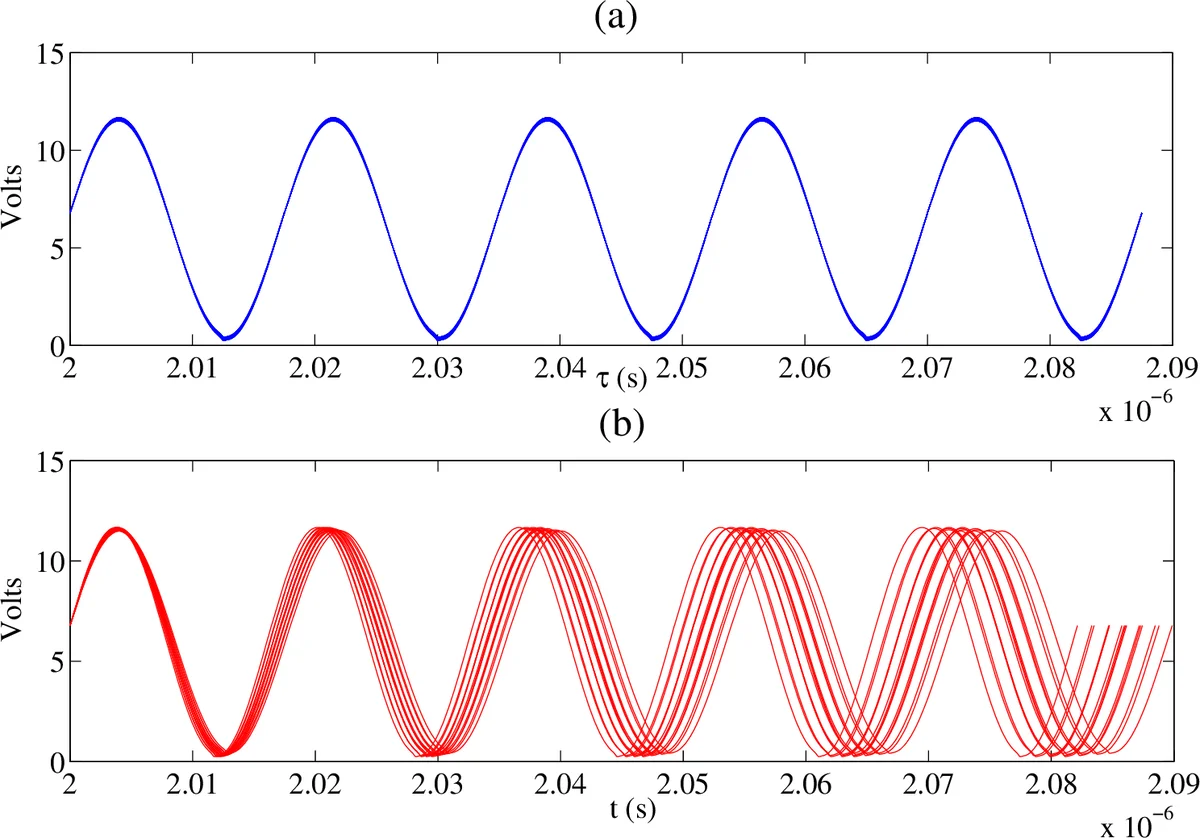
The second case is a BJT Colpitts oscillator, an autonomous circuit. Random variations are introduced in the inductance and capacitance (Gaussian and uniform). Using a third‑order gPC (20 basis functions), the ST solver accurately predicts the distribution of oscillation frequency, THD, and power consumption, again matching MC results while achieving speedups comparable to the forced case.
In summary, the paper delivers a practical, high‑efficiency UQ framework for PSS analysis that combines stochastic testing with the well‑established shooting‑Newton method. By decoupling the stochastic system into independent deterministic simulations, it retains the accuracy and convergence properties of existing PSS solvers while dramatically reducing computational effort. The approach is scalable, amenable to parallel execution, and can be extended to other PSS algorithms, higher‑order nonlinearities, and GPU‑accelerated environments, opening the door to real‑time or near‑real‑time uncertainty analysis in modern analog/RF design workflows.
Comments & Academic Discussion
Loading comments...
Leave a Comment