Combating False Reports for Secure Networked Control in Smart Grid via Trustiness Evaluation
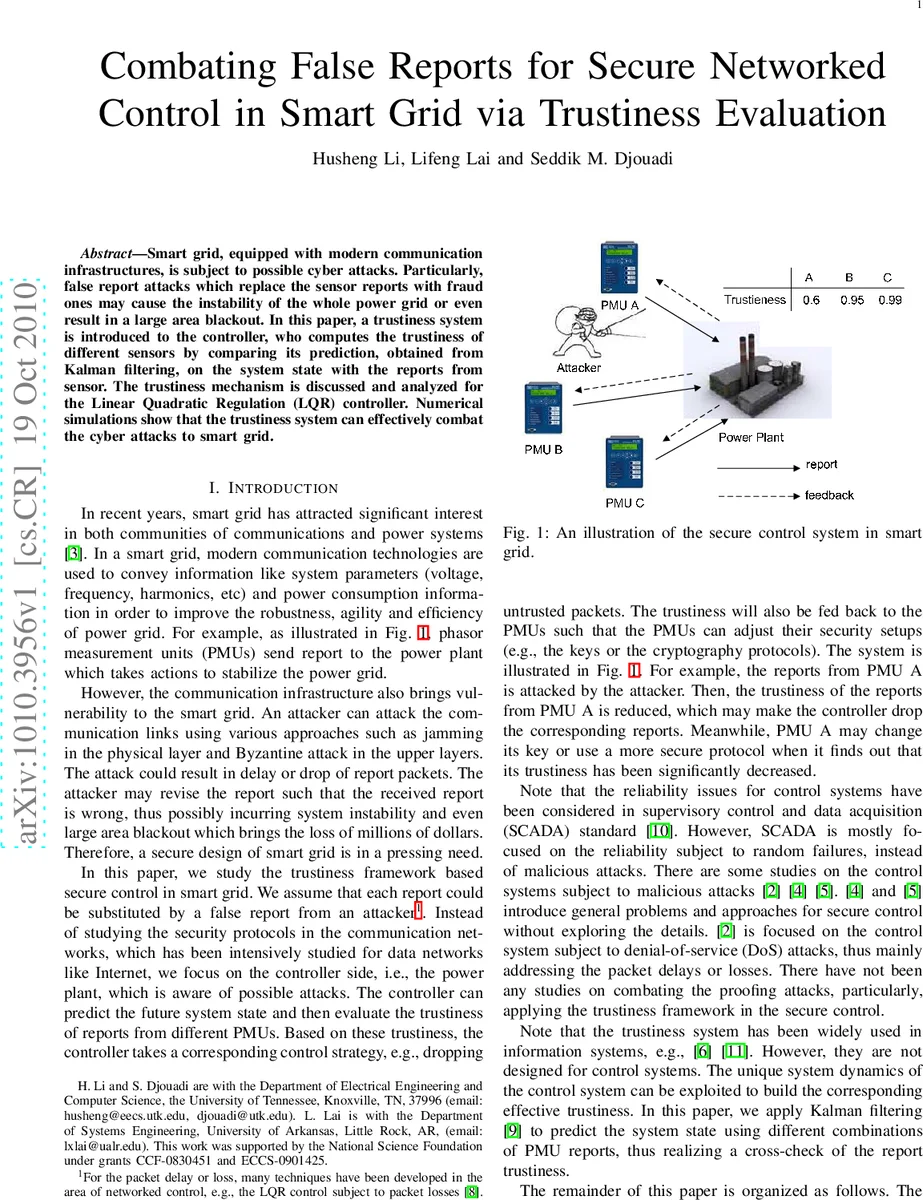
Smart grid, equipped with modern communication infrastructures, is subject to possible cyber attacks. Particularly, false report attacks which replace the sensor reports with fraud ones may cause the instability of the whole power grid or even result in a large area blackout. In this paper, a trustiness system is introduced to the controller, who computes the trustiness of different sensors by comparing its prediction, obtained from Kalman filtering, on the system state with the reports from sensor. The trustiness mechanism is discussed and analyzed for the Linear Quadratic Regulation (LQR) controller. Numerical simulations show that the trustiness system can effectively combat the cyber attacks to smart grid.
💡 Research Summary
The paper addresses the vulnerability of smart‑grid sensor measurements to false‑report attacks, where an adversary replaces legitimate PMU (Phasor Measurement Unit) data with fabricated values. Such attacks can destabilize the power system or cause large‑scale blackouts. Rather than focusing on securing the communication layer, the authors propose a controller‑centric trustworthiness framework that evaluates the reliability of each sensor in real time and adapts the control law accordingly.
The power‑grid dynamics are modeled as a discrete‑time linear system
x(t+1)=Ax(t)+Bu(t)+w(t), y(t)=Cx(t)+n(t),
with Gaussian process and measurement noise. In the absence of attacks, an infinite‑horizon Linear Quadratic Regulator (LQR) minimizes the cost J=E∑βᵗ
Comments & Academic Discussion
Loading comments...
Leave a Comment