On Space-Time Capacity Limits in Mobile and Delay Tolerant Networks
We investigate the fundamental capacity limits of space-time journeys of information in mobile and Delay Tolerant Networks (DTNs), where information is either transmitted or carried by mobile nodes, using store-carry-forward routing. We define the ca…
Authors: Philippe Jacquet, Bernard Mans, Georgios Rodolakis
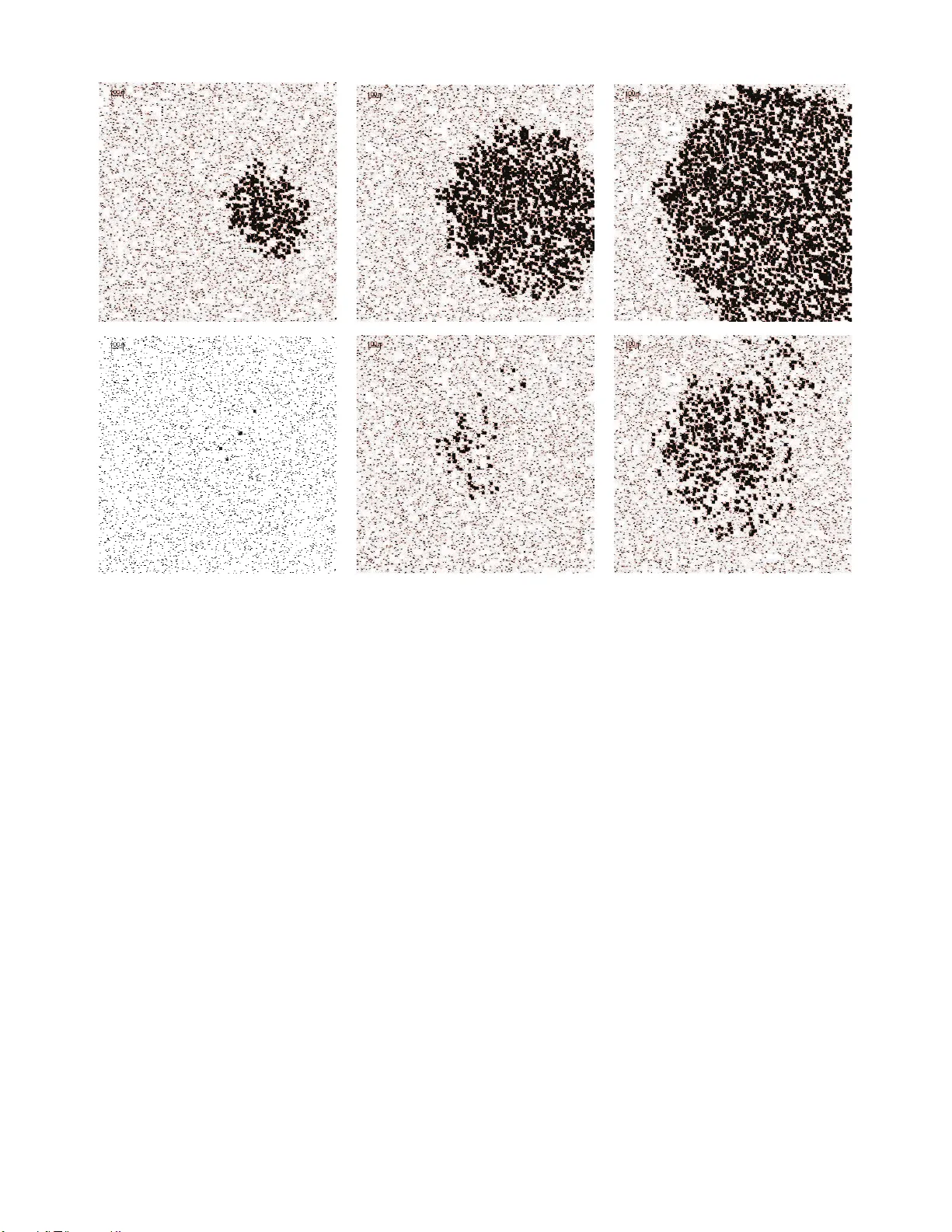
1 On Space-T ime Capacity Limits in Mobile and Delay T olerant Netw orks Philippe Jacquet, Bernard Mans and Georgios Rodolakis Abstract W e in vestigate the f undame ntal capacity limits of space-time journeys of informatio n in m obile and Delay T oler ant Networks (DTNs), where inform ation is either transmitted or carr ied by mobile node s, using store-car ry- forward routing. W e define the capacity of a journey ( i.e., a p ath in space and time, from a source to a destination) as the maximum am ount of data that can be tra nsferred from the source to the d estination in the gi ven journ ey . Combining a stochastic model ( conv eying all p ossible jo urneys) and an analysis of the durations o f the nodes’ encoun ters, we study the pr operties of journ eys that ma ximize the space-tim e information propag ation capa city , in bit-meters per seco nd. Mo re spe cifically , we p rovide theoretical lower and upper bounds o n th e information propag ation speed, as a f unction of the jour ney capacity . In the particular case of ra ndom way-point-like m odels ( i.e., when n odes move for a d istance of th e or der of the network domain size bef ore changin g direction) , we show that, for r elativ ely large jou rney cap acities, th e in formatio n pr opagatio n spee d is of the sam e o rder a s the mob ile node speed. Th is implies that, sur prisingly , in sparse but large-scale mobile DTNs, the spac e-time inform ation propag ation capacity in bit-meters p er second remains prop ortional to the mo bile nod e speed and to the size o f the transported d ata bundles, wh en the bundles are r elativ ely large. W e also verify th at all o ur analytical bo unds a re accurate in several simulation scen arios. I . I N T RO D U C T I O N The problem of determi ning fundamental limi ts on the performance of mobile and ad hoc networks continues to attract the in terest of researc hers. Sev eral i mportant results ha ve been achiev ed wit h the seminal papers by Gupta and Kumar [7] (which provided the first capacity bounds in static wireless networks) and by Grossglauser and Tse [6] (which showed that the mobility can increase the capacity of an ad hoc n etwork). V arious m obility models ha ve been st udied i n the l iterature, and the delay-capacity relationships under those m odels ha ve been characterized ( e.g ., [4], [13], [15]). Howe ver , the nature of these trade-offs is stron gly influenced by t he choice of the mo bility model [14]. Moreover , there has been an i ncreased i nterest in mobile ad hoc networks where end-to-end mul ti-hop paths may not e xist and communi cation routes may only be a vailable through time and mobility; depending on th e cont ext, these networks are n ow common ly referred as Int ermittently Connected Networks (ICNs) or Delay T olerant Networks (DTNs). Al though limi ted, the understandi ng of the fund amental properties of such networks is steadily increasing. There is a si gnificant number of results focusing on characterizing the packet propagati on delay [3], [5], [17], assuming that packet transmis sions are in stantaneous, and mo re recently , the informati on propagation speed [8], [10], [11]. The authors of [3] took a graph-theoretical approach i n order to up per bo und the tim e i t takes for disconnected mobile networks t o become con nected Part of t his work will be presented i n “On Space-Time Capacity Limits in Mobile and Delay T olerant Networks”, P . Jacquet, B. Mans and G. Rodolakis, IEEE Infocom, 2010. P . Jacquet i s with INRIA, 78153 Le Chesnay , F rance. E -mail: philippe.jacquet@inria.fr B. Mans and G. Rodolakis are with Macquarie Univ ersity , 2109 NSW , Australia. E-mails: bernard.mans@mq.edu.au, georg ios.rodolakis@mq.edu.au 2 through the mobility of the nodes. The papers [5], [17] analyze the delay of com mon routi ng schemes, such as epidemic routing, under t he assum ption that the inter-meeting time betw een pairs of nodes follows an exponential distribution. Howe ver , t his assumption is not generally verified, depending on the relationship between the size of the network domain and the relev ant time-scale of the network scenario under consid eration [1], and this can result in eit her an over -estimation or an under-estimation of the actual system performance [2]. Departing from the exponential inter-meeting time hypothesi s, in [10], [11], Kong and Y eh stud ied th e informati on d issemination latency in large wireless and m obile networks, in constrained i .i.d. mobilit y and Bro wnian motio n models. They showed that , when the network is not percolated, the latency scales li nearly with the Euclidean di stance b etween the sender and t he receiv er . The first analytical estimates of the cons tant upper bounds on the speed at which in formation can propagate in DTNs, again wit hout considering the qu antity of information t hat can be transmitted, were obt ained in [8]. In contrast, in this paper , w e in vestigate t he space-time capacity of such networks, i.e., the maximum amount of information that can be t ransferred from a source to a d estination over time. As the network is almost surely d isconnected, we refer t o journeys rather t han paths, where a jo urney is an alternation of d ata transmissio ns and carriages using store-carry-forward routing. Informally , our objective is to determi ne how fast a gi ven am ount of data y can reach its destination. Formally , we use a probabilistic model of space-time j ourneys of packets of inform ation in DTNs (in Section II), and d efine the journey capacity as well as the information propagati on speed (in Section III), t o provide the follo wing main contributions: • w e characterize the duration of node meeti ngs, by b ounding t he probability function of the duration s of the n odes’ encounters, in Section IV; • w e prove the first non t rivial lower bounds on t he informati on propagation speed (Theorem 1), for a bounded journey capacity , in random waypoint-like mobility , in Section V; • w e p rove general upper bounds on t he information p ropagation speed (Theorem 2 and Corollaries 1 and 2), as a function of the journey capacity , and we in vestigate th e properties of journeys that maximize the s pace-time network capacity in bit-meters per second, in Section VI; • w e compare and verify the analytical bou nds with simulation measurements in Section VII. W e provide concluding remarks in Section VIII. I I . N E T W O R K A N D M O B I L I T Y M O D E L W e consider a network of n nodes in a square area of size A = L × L and radio range R . As we want to focus on DTNs that are almost surely di sconnected, we w ill analyze the case where R is fixed, whi le n, A → ∞ , such that the node d ensity ν = n A is bo unded by som e constant. Formally , we adopt the random geometric graph mod el [16]: two nodes at dis tance s maller than a maximum radio range R can exchange information. Moreov er , we consi der that the rate at which nodes can transmi t data when they are within range is fixed, and equ als G u nits of data per second. 3 Initially , the nodes are distributed uniforml y at random. Every node follows an i.i.d. random trajectory , reflected o n the borders of the square (like billiard ball s). The nodes change direction at Poisson rate τ and keep a cons tant speed v between direction changes. The motion direction angles are uniformly d istributed in [0 , 2 π ) and are m utually independent among all nodes. When τ = 0 , we ha ve a pur e billiard mod el (nodes on ly change di rection at the border). Wh en τ > 0 , we hav e a random walk model ; when τ → ∞ we are on t he Bro wnian limit. When τ = O ( 1 L ) → 0 we are o n a random way-point-like model , since nodes trave l a distance of o rder L before changing di rection or hitt ing the border . I I I . S P A C E - T I M E J O U R N E Y A NA L Y S I S W e st udy jo urne ys with a g iven capacity , i. e., journeys t hat guarantee that at l east an amount o f d ata can be transferred to t he destination . Our aim is to find the shortest journey (in time) wit h jo urney capacity at least y , that connects any source t o any dest ination in the network domain, in order to derive the overall information propagation speed. W e base our analysis on a probabilistic model of journeys of packets of informati on that encapsulates all possible short est jo urneys originatin g at the source, as used in [8]. Let C be a simple jou rney ( i.e., a journey not returning to the same node twice). Let Z ( C ) b e the terminal point. Let T ( C ) be the t ime at which the journey terminates. Let p ( C ) be the probability of th e journey C . Let ζ be an inv erse space vector , i.e., with compo nents expressed in in verse dist ance units. Let θ be a scalar in in verse time unit s. W e denote by w ( ζ , θ ) the journe y Laplace transform , defined for a domain definition for ( ζ , θ ) : w ( ζ , θ ) = E (exp( − ζ · Z ( C ) − θ T ( C ))) = P C p ( C ) exp( − ζ · Z ( C ) − θ T ( C )) . W e call p ( z 0 , z 1 , t ) the normalized d ensity of journeys starting from z 0 at time 0, and arriving at z 1 before time t : p ( z 0 , z 1 , t ) = 1 R 2 X k z 1 − Z ( C ) k s ( y ) , then lim || z || ,t →∞ q ( z , t, y ) = 0 ; • i f || z || t < s ( y ) , then lim || z || ,t →∞ q ( z , t, y ) > 0 . W e also define the space-time in formation pr opagation capacity c ( y ) (from now on simply referred to as the space-time capacity ), as the maximal transport capacity in bit -meters per second, that can b e 4 achie ved by any j ourney of capacity y . Thus, in thi s model, the space-time capacity corresponds to the product c ( y ) = s ( y ) y . Therefore, in order to determin e the space-time capacity limi ts of mobile and delay tolerant networks, we wil l analyze the in formation propagation speed, as a function of the jo urney capacity; in t he following sections, we will com pute lower and upper bounds. In order to deriv e the bo unds, we first st udy the characteristics of node meetings. I V . N O D E M E E T I N G S A meeting (or encounter) between two nod es occurs when t heir distance becom es s maller than or equal to R , i.e., when the nodes come into communication range. Lemma 1: A node A , moving in direction ψ 0 , meets new nod es moving in d irection between ψ 1 and ψ 1 + dψ at rate: f ψ 1 | ψ 0 = 2 vν R π sin( ψ 1 − ψ 0 2 ) dψ , for ψ 0 , ψ 1 ∈ ( − π , π ] , where R is the radio range. Pr oof : See appendix. W e denote th e meeting duration by the random variable T . Lemma 2: The probability P ( T > t ) t hat a m eeting has duration at l east t sati sfies: P ( T > t ) ≤ min(1 , π 2 R 8 v t ) . Pr oof : The aver age number of neighbors of any n ode is π ν R 2 . From Lemma 1, the rate at which a node meets n e w neighbors is f = 8 vν R π . Therefore, from the L ittle formula, th e av erage meeting tim e ( i.e., the time that a node remains a neighbor) equals π ν R 2 f = π 2 R 8 v . The proof follows by applying M arko v’ s inequality . In the p ure bill iard m odel ( i. e., when τ = 0 ), we can give the exact formulas on th e meeting tim e distribution. W e note that our model where nodes bounce on the borders like billiard balls is equi valent to cons idering an infinite area made of mirror images of the original network dom ain square: a mobil e node m oves in the original square whi le its mi rror images move in t he mirror s quares [8]. Lemma 3: W e denot e the m eeting duration by the random variable T . The probabil ity densi ty fun ction p T ( t ) of T is : p T ( t ) = 1 4 log v R t + 1 v R t − 1 1 + R 2 ( v t ) 2 − R 2 v t , (1) for t ≥ 0 , where v is the node speed, R is the radio range. When t → ∞ , the cumulativ e probabili ty P ( T > t ) i s: P ( T > t ) = R 2 3( v t ) 2 + O R 4 ( v t ) 4 . Pr oof : See appendix. 5 V . L O W E R B O U N D W e prov e a lower bound s L ( y ) on the information propagation speed, for journe y capacity y , in the random way-point-like m obility model, i.e., wh en nodes trav el a distance of the order of the n etwork domain length before changin g direction. Initially , we focus on the pure b illiard mobility model, i.e., we assume that nodes do not change di rection unless they hi t the border . Finally , we remark that the result can be generalized to node mobility wit h a sm all change of direction rate. W e wi ll s how that, for all dest ination nodes which, at time t , are at distance r ∼ s L ( y ) t of the in itial source location, th ere i s a jou rney of d uration t and of capacity y from the source to the destination, with probability strictly lar ger th an 0 . W e con sider large di stances r = Θ( √ n ) , where n is the number of nodes in the network; in this case, the square network dom ain has a si de length r = Θ( √ n ) , as we are interested in the case where the node densit y is constant (but strictly large r than 0), as discussed i n Section II. W e show that, wh en the journey capacity is y ≤ K v , for a cons tant K , the l ower bound is s L ( y ) = v , where v is the m obile node sp eed. Fig. 1. Definitions of rendez-vou s point A of t he information generated at location S with the destination D (l eft), and of angle φ C with respect to the speed of node C and location B (right). W e consider a s ource node S and a dest ination no de D . W e denote by v S and v D the respectiv e vector speeds o f the source and the destination . W e assume that t he sou rce starts sending the information at ti me 0 . W e define the point A as t he third vertex of the isosceles triangle, form ed with the two other vertices located at S and D (at time 0 ) and with sides S A and D A of equ al length r , while D A is parallel to the desti nation speed v d , as illus trated in Figure 1. Point A i s th erefore the r endez-vous point of a node moving at constant speed v , in th e direction of S A , and t he desti nation node, while th e nodes contact (at the same location) occurs at ti me t A = r v . Similarly , if the (asymptot ic) information propagation speed is equal to the n ode speed v , the information will reach the destination at location A ′ = A ± ∆ Z , with | ∆ Z | = o ( r ) , at time t A ′ = t A + o ( r v ) . W e will describe a routing scheme that const ructs a journey of duratio n t A = r v + o ( r v ) , which originates at S and ends at any giv en point A , and guarantees t hat for any d irection of the destinati on node speed, the journey capacity is at least y . W e assume w .l.o.g. th at the radio range is R = 1 and the commu nication rate i s also G = 1 , t o sim plify the expressions (to generalize, i t is suf ficient to p erform a simple scali ng). W e note that, in t his case, ensuring a journey capacity at least equal to y is equivalent to ensuring a minimum meeting duration y for all transmi ssions in the journey . The routi ng schem e p roceeds i n th ree stages, illust rated in Figure 2. In all stages, the informat ion is 6 Fig. 2. Overview of the routing scheme achie ving the lower bound of information propagation tow ards the rendez-vous point A , in three stages. passed among n odes m oving at relativ e direction of angle between a 2 and a , wi th a value of a that we will precise in the fol lowing. Initially , we consider a point B located on t he dest ination’ s trajectory (before the rendez-vous point A ). W e also take B such t hat the distance from the rendez-vous point A is r B = Θ( √ r ) . In t he first stage, th e information is transmit ted to ne w nodes (according to the above ang le restriction and ensuring a journey capacity at least y ) u ntil reaching a node, whos e trajectory’ s d istance from B is at most √ r . In the second stage the node with the information s imply tra vels a s traight line (of length r + O ( √ r ) ) until approaching the point B withi n distance √ r . In the third stage, the information is transmitted t o new no des (again, with a relati ve direction angle in [ a 2 , a ] , and ensuring a journey capacity at least y ) until the information is transmitted to a node that passes within distance 1 of t he rendez-v ous point A , while th e contact duration with th e destination is suffi cient to transfer all the information. W e will show t hat t his routing scheme guarantees that the information will reach the destinatio n with a journey o f capacity at least y , with a total journey duration of r v + O ( √ r v ) . Mo re precisely , we show that the durati on of the first and third stages is O ( √ r v ) . Since the duration of the second s tage is r v + O ( √ r v ) , a lower bound on the information p ropagation speed is v . W e now analyze the duratio n of th e three routing stages. 1) Stage 1: W e int roduce the fol lowing not ations. Let C be the nod e that m ost recently recei ved all the information, moving at s peed v C . W e define φ C as the angl e formed between the vector C B (defined by the locations of the node C and the point B ) and t he speed v C , as depicted in Figure 1. Lemma 4: The duration t 1 of stage 1 of the rout ing scheme is Θ( √ r v ) , almo st surely . The distance tra veled is O ( √ r ) . Pr oof : See appendix. 2) Stage 2: Lemma 5: The duration t 2 of stage 2 of th e routing scheme is r v + O ( √ r v ) , almost surely . Pr oof : The init ial distance S B is at mos t r + r B = r + O ( √ r ) . From Lem ma 4, the dis tance r 1 = C A at the end of stage 1 is r + O ( √ r ) . The minimum d istance of node C trajectory to B , and is at most r 2 = r 1 sin( 1 √ r ) = √ r + O ( r − 1 2 ) , as depicted in Figure 2. Therefore, there is a poi nt i n t he trajectory s uch 7 that t he final distance of node C from the po int B is exactly √ r . Therefore, the total di stance traveled in stage 2 is at mos t r 1 (1 + ( 1 √ r )) = r + O ( √ r ) . 3) Stage 3: At the beginning of stage 3, there is a nod e carrying the information, located wit hin distance r B + √ r from the rendez-vous point , and within di stance √ r from the desti nation’ s trajectory . In this stage, the information is transmit ted to ne w nod es (again, according to the above angle restriction and ensuring a capacity at least y ) until reaching a nod e that passes with in distance 1 of the rendez-vous p oint A , whil e the contact duration with th e destinati on is at l east y . Equiv alently to stage 1, let C b e the node that mos t recently re ceiv ed all the information, moving at speed v C . W e introduce again the angle φ C , thi s time defined with respect to the rendez-vous poin t A ; namely , φ C is t he angle formed between th e vector C A (defined by the locations of the node C and the rendez-v ous po int A ) and the speed v C . Lemma 6: W e consi der a node C , at dist ance r C from the rendez-vous point, moving with speed v C at a directio n such that the relative angle with th e destination’ s direction is at m ost a = 1 2 uy . If the angle φ C is at mos t 1 2 r C , then the trajectory of C passes within range of the destination and guarantees that the meeting duration with a dest ination located at A , moving at constant speed, will be at l east equal t o y . Pr oof : The relativ e speed of the node C , with respect to the destination’ s speed, is at most 2 v sin( a 2 ) ≤ v a . If the node C passes wi thin distance m from the rendez-vous point , the meeting duration is at least 1 − m va (since the distance trav eled within range, in the frame of reference of t he destination, is at least 1 − m ). Therefore, in o rder for the meeting duration T to be at least equal to y , i t is sufficient th at: m ≤ 1 − y v a = 1 2 . In this case, we guarantee a m eeting duration at l east equal t o y . Moreover , if we have φ C ≤ 1 2 r C , the node will p ass wit hin distance 1 2 from the rendez-v o us point. Lemma 7: The duration t 3 of stage 3 is O ( √ r v ) , almo st s urely . At the end o f stage 3, the dest ination is reached at t he rendez-vous point with probability stri ctly lar ger than 0 . Pr oof : See appendix. Theor em 1: Consider a net work with const ant node densit y ν , radio range R and commu nication rate G , where nodes move at speed v > 0 and change direction at rate τ = 0 . When t he journey capacity is at most y = K v , where K is a constant, a lower bound on the i nformation propagation speed is s L ( y ) = v . Pr oof : Considering the final positio n of any destination, we can define a rendez-vous point A . If the distance of the rendez-v ous point from t he source locati on at time 0 is r → ∞ , based on the previous lemmas, there exists wit h strictly pos itive probability a jo urney of capacity at least y that reaches any rendez-v ous po int A with in time ∼ r v . Therefore, the asymptot ic information speed i s at l east v . W e note that, i n case the network domain A = L × L is sufficiently l ar ge, for all destination nodes which, at time t = Θ( L ) , are at distance r = o ( v t ) o f the in itial source locati on, there is alm ost surely a journey of duration t and of capacity y from the source to the dest ination. Remark 1: Altho ugh, we deri ved the lower bound in a pure bil liard mobil ity model, the proof can be easily generalized to a random walk m odel, where the change of direction rate is O ( 1 r ) , by restarti ng from the first s tage at any chang e of direction (an event w hich occurs a finite num ber of ti mes). 8 V I . U P P E R B O U N D A N D S P A C E - T I M E C A P A C I T Y In this sectio n, our aim is to find the shortest journey of capacity at least y that con nects any source to any destination in the network domain. W e prove an u pper bound s U ( y ) o n the informati on propagation speed, for journeys of capacity y . Theor em 2: Consider a network with n mo bile nodes with radio range R , communicatio n rate G , in a square area of size A = L × L , wh ere nodes mov e at speed v , and change d irection at rate τ . When n → ∞ , such that the node density becomes ν = n L 2 , an upper bound on the informatio n propagation speed, for journeys of capacity y , is the smallest ratio of θ ρ with: min ρ,θ > 0 θ ρ with θ = v u u t ρ 2 v 2 + τ + γ ( y )4 π v ν RI 0 ( ρR ) 1 − γ ( y ) π ν R 2 ρ I 1 ( ρR ) ! 2 − τ , where I 0 () and I 1 () are modified Bessel functi ons , and, • γ ( y ) = min( π 2 RG 8 vy , 1) , if τ > 0 ; • γ ( y ) = min( ( RG ) 2 3( vy ) 2 , 1) , if τ = 0 . Remark 2: The expression of θ has meaning when π ν R 2 γ ( y ) < 1 . Above this th reshold, the upper bound for th e informati on propagati on sp eed is infinite. Such a beha vior is expected, since there exists a critical node densi ty above which the graph is fully connected or at least p ercolates [12]. In addition, according to Theorem 2 , in percolated networks, there i s a critical journey capacity y c , such that, when y > y c , the p ropagation speed is bounded by a constant. Pr oof : W e assume t hat a sou rce starts emi tting information at position z = 0 and time t = 0 . W e consider the probabilistic space-time journey mod el presented i n Section III , which includes all shortest journeys originating at the source. Equiv alently , w e mod el journeys of very small beacons o f information, such that beacon transmis sions are inst antaneous. W e in itially consider an infinite network wi th a Poisso n density of nodes λ . W e will upper bound the probabil ity density of journeys in the infinite network mo del. Howe ver , by appl ying an analytical depoissonizatio n technique [9], we obtain an equiv alent asymptotic estimate of the j ourney dens ity wh en the num ber of nod es n is lar ge but not random . W e decompose the journeys into two types of segments, m odeling node movements and beacon trans- missions : • emi ssion se gments S e ( u , v ) : t he n ode transmi ts immedi ately after receiving the beacon; v is the s peed of the node that jus t receive d the beacon, and u is the emi ssion space vector and is such that | u | ≤ R ; • m ove-and-emit se gments S m ( u , v , w ) = M ( v , w ) + u : M ( v , w ) is the space-time vector correspond- ing to the motion of the node car rying the b eacon, where v is the init ial vector speed of the node when it recei ves t he beacon and w is the final speed of the node jus t b efore transmitt ing the beacon; the vector u i s the emission space vector which ends the segment. Considering any sequence of s egments, we can always upper bound th e segment probabil ities (see [8], Section III-B). In fact, the conditional p robabilities, g iv en the node direction and speed, are upper bounded by unconditi onal probabilities: 9 • ˜ P ( S e ( u )) = P ( u ) λ , where P ( u ) is the prob ability density of u ins ide the disk of radiu s R , and λ is the node density (to make the emis sion possible); • ˜ P ( S m ( u , v , w )) = P ( u ) P ( M ( v , w ))2 v λ , where P ( u ) is t he probability density of u on the circle of radius R (we only need to consider the earliest transmissio ns, which occur at the maximu m radi o range), P ( M ( v , w )) is the prob ability that t he node movement equals the space vector M ( v , w ) , and v is the node s peed. This upper bound j ourney model resul ts i n a higher densit y of journeys than i n the actual network. But, in this model, any journey can b e decomposed into a sequence of independent segments. Consequently , we can express a jo urney C as an arbitrary sequence of emission or move-and-emit segments, i.e., using regular e xpression n otation, C = ( S e + S m ) ∗ . Moreover , we can calculate the Lapl ace transform of the journey probabil ity densit y , based on the Laplace transforms of the segments. W e denote t he segment Laplace transforms by l e ( ζ , θ ) = E ( e − ( ζ ,θ ) · S e ) and l m ( ζ , θ ) = E ( e − ( ζ ,θ ) · S m ) , for emissio n and m ove-and- emit segments, respectively . Equiv alently to the formal id entity 1 1 − x = 1 + x + x 2 + x 3 + ... , which represents the Laplace transform of an arbit rary sequence of random va riables with Laplace transform x , th e journey Laplace transform h as a denominator k ( ζ , θ ) , equal to: k ( ζ , θ ) = 1 − ( l e ( ζ , θ ) + l m ( ζ , θ )) . (2) W e have the following Laplace transform expressions: • l e ( ζ , θ ) = E ( e − ζ · u ) , where u is uniform in the disk of radius R , wi th dens ity λ , i.e., l e ( ζ , θ ) = λπ 2 R | ζ | I 1 ( | ζ | R ) . • l e ( ζ , θ ) = E ( e − ζ · u ) E ( e − ( ζ ,θ ) · M ( v , w ) ) , where u is uni form on the circle of radius R , wi th density λ , i.e., E ( e − ζ · u ) = 2 π λRI 0 ( | ζ | R ) , and E ( e − σ · M ( v , w ) ) = 1 √ ( θ + τ ) 2 −| ζ | 2 v 2 − τ (see [8]). W e deriv e an upper bound on the information propagation speed, in the special case where the journey capacity is y = 0 , from the analysis of the singul arities of the journey Laplace trans form, for λ equal to the node density in the network ( cf. Th eorem 1 in [8]). The upper bound is the smallest rati o θ ρ of the non-negati ve pair ( ρ, θ ) which is a root of the d enominator k ( ρ, θ ) (with ρ = | ζ | ), obtained by su bstitutin g the segment Laplace t ransforms expressions in (2). In order to generalize to journeys of a gi ven capacity y > 0 , we will restrict the set of pos sible journeys, to those satisfying the desired capacity constraint, and calculate t he Laplace transform of the journey density in this restricted set. First, we remark t hat, a journey has a capacity at least y , if and only if the jo urney thi c kness ( i.e., the minimum duration of all data transmis sions in the journe y) is at least e qual to y G , with G the communication rate. Therefore, when considering journeys of a given capacity , we can equiva lently focus on t he possible journeys with minim um node meeting d uration y G . Therefore, in the up per -bound j ourney model, we can s ubstitute t he p robability of any emission segment with the p robability o f the same emission segment, while addi tionally ensuring that the emis sion durati on is at least y G . Thus, for the singularity analysis, we substitute in (2) the Poisson density λ with a node 10 density ν γ ( y ) , where γ ( y ) is an upper bound on the probabil ity that the meeting duration is at least y G . This direct subst itution is feasible because we work with the upp er bound jo urney model, where successive segments (includi ng all transm issions) are independent of the pre vious n etwork state. Again, this resul ts in considering a higher density of j ourneys than in the actual network (includ ing so me transmissions which are not actually possibl e, due to the node directions); ho we ver , there is no im pact on the v alidity of our analysis, sin ce we are interested in upper bounds. T o conclude the proof, it su f fices to substitu te q uantity γ ( y ) using Lemma 3 when τ = 0 , and Lemm a 2 when τ > 0 . W e derive th e foll owing corollaries expressing the behavior of the upper bound when the journey capacity is lar ge, in random waypoint-like ( τ → 0 ) and random walk/Brownian m otion mobility ( τ > 0 ), respectiv ely . Cor oll ary 1: When nodes move at speed v > 0 , and ν y → 0 ( i.e., the journey capacity y is lar ge) with τ > 0 , the propagation speed upper boun d is O ( q ν G y τ Rv ) . Pr oof : See appendix. Cor oll ary 2: When the node speed i s v > 0 , and ν y → 0 ( i.e., the journey capacity y is large) with τ = O ( 1 L ) → 0 , t he propagatio n speed upper bound is v + O ( τ + ν GR 2 y ) . Pr oof : See appendix. W e ob serve that, for lar ge jo urney capacities y , t he upper bound on the informati on prop agation speed s U ( y ) tends to the actual m obile node speed v in random way-point-like mobili ty , wh ile i t decreases with the in verse square root of t he journey capacity y in random walk or Bro wnian motion mobility . In bot h cases, the resul ting upper bound on the space-time capacity c ( y ) = s U ( y ) y is a function whi ch increases with y . Remark 3: When nodes move at speed v > 0 in random way-point-like mob ility: • from Theorem 1, a lower bound on the propagation sp eed i s v , for any b ounded y , and when the node density is ν = Θ(1) ; • from Corollary 2, an upper bound on the propagation speed is v , for journey capacities y such that ν = o ( y ) . Therefore, we notice that t here i s a range of values of y , for whi ch our bounds are almo st t ight. More generally , we deduce that the information propagation speed in rando m way-point-li ke mobility models is of the same order as the mobile n ode speed, for (bounded) j ourney capacities that are relatively lar ge with respect to the no de densit y . This im plies that, in sparse but large- scale mobil e DTNs, th e space-tim e inform ation propagati on capacity in bit-meters per second remains proportion al to the m obile node speed and to t he size of the transported data bundles, w hen the bundles are relatively large. It is rather surprising that the p ropagation speed does not t end to 0 when the size of the b undles in creases, which would result in a sub-linear increase of the space-time capacity . 11 Fig. 3. Snapshots of simulated information propagation at three different times ( t = 100 , 170 , 240 ), for a small j ourne y capacity y = 0 . 5 (top) and a larger journey capacity y = 2 . 5 (bottom). Larger black squares represent nodes that have receiv ed all the information at t he ti me of t he snapshot. V I I . N U M E R I C A L R E S U L T S In this section , we perform sim ulation measurements to com pare to the analyti cal bounds on the information propagation, deriv ed in the previous sections. W e dev eloped a sim ulator that follows the network and mob ility model described in Section II. W e simulat e the epidemic broadcast of inform ation, and we consi der j ourneys wit h a given lower bo und on the capacity y , as described in Section III. W e note that t he simulation is more general than the simple broadcast of a packet of si ze y , since the information can also be transferred on a given journey usi ng smaller packets. In fact, we precisely ens ure that the journeys of the simulated broadcast ha ve a capacity at least y , without imposin g further restrictions. For all the following simulat ions, we consi der a communication ra te G = 1 un its of data per second ( e .g., if one u nit of data corresponds to x Mbits, the jo urney capacity in t he following examples should be multipli ed by x Mbit s). W e first show how i nformation propagates in a full epidemic b roadcast, by il lustrating two typical and di stinct situatio ns, depending on the jo urney capacity y . In th e simulated scenario, a source s tarts broadcasting informat ion at time t = 50 , in a network of 5000 nodes, in a 2000 m × 2000 m square, with radio range R = 10 m , and mobile node s peed v = 5 m/s , with pure billi ard m obility ( τ = 0 ). In Figure 3, we consider two cases: a sm aller jou rney capacity y = 0 . 5 (top) and a lar g er j ourney capacity y = 2 . 5 12 (bottom). F or each case, we d epict three snapshots of the simulat ed informati on propagati on at three diffe rent times, t = 100 , 1 70 , 240 , from left t o right. The small black dots represent the mobil e nodes; when two dots are in contact, the correspon ding nodes are within communicatio n range. Th e larger black squares represent nodes that hav e received all the informati on at the time of the snapshot, i.e., thos e t hat can be reached by a journey of capacity y . The simul ation scenario is exactly the same in both the t op and bottom figures, wi th t he only change concerning the journe y capacities. In bo th cases, the l ocation of the s ource is approx imately located at the center of the disk containing the black squares, at the top left figure. W e observe that, at the top ro w of Figure 3 corresponding to a small jou rney capacity , the information propagates as a ful l disk that grows at a constant rate, which coincides with the i nformation propagation speed; all nodes inside the disk can be reached by a journey of capacity y , almo st surely . Equiv alently , this means that t he aver age inform ation propagation delay scales linearly with the d istance from the source, and the ratio of the propagation delay over the distance is equal to t he in verse of the information propagation speed. On the o ther hand, at the bottom row , corresponding t o a lar ger journey capacity , only so me of the nod es insi de the disk have been reached by a journey of capacity y . In this case, the average i nformation p ropagation delay does no t n ecessarily scale linearly wi th the di stance from the source. Howev er , the information stil l propagates at a (smaller than before) m aximum speed, equal t o the rate at which th e disk radius grows. Next, we simulate a network of 500 no des, moving i n an area 6 00 m × 600 m , wi th a radio range of 10 m , a mobile node speed of 5 m/s and a communication rate G = 1 units of data per second. W e simulate two di ff erent mobility parameters (rates of direction change): τ = 0 for the pure billiard mobility model, where nodes change direction on ly when the y bounce on the border , and τ = 0 . 05 for a random walk model. In Figure 4 we pl ot the ratio of t he propagation delay ov er th e distance from t he source, ver sus the distance, for journey capacities y = { 1; 2; 3 } . Each sample point in the plots corresponds to a simulation measurement. The dist ance is measured from t he location of th e source when th e information was emitted to the location of the destination when the inform ation was receiv ed. W e notice t hat, for all journey capacities, the ratio of the propagation delay over the distance is larger than a non-zero constant. The constant l ower bo und on the ratio, in this s imulation s cenario, is close t o the in verse of the mobile node speed (wh ich is plotted i n the figures as a straig ht li ne, for comparison). Furthermo re, this constant corresponds to the upper boun d on th e informatio n propagation speed, whi ch was calculated in T heorem 2. In f act, for small journey capacities ( e.g., y = 0 . 5 ), we not ice that the upper bound on the information propagation speed is lar ger than (but clos e to) the mobile node speed. For l ar ger journey capacities and τ = 0 , the upper bound can be obtained from Corollary 2, and indeed corresponds to the mobile node speed. W e also noti ce that, for τ = 0 . 05 , t he a verage distance that each node tra vels before changing direction is 100 m , which is of t he order of the square network dom ain length. Therefore , in this case, the upp er bo und on the propagatio n speed als o remains close to the est imate for random w aypoint-like 13 0 0.2 0.4 0.6 0.8 1 1.2 1.4 1.6 0 100 200 300 400 500 600 700 800 delay/distance distance from source emission capacity1.0 inverse mobile speed 0 0.2 0.4 0.6 0.8 1 1.2 1.4 1.6 1.8 2 0 100 200 300 400 500 600 700 800 delay/distance distance from source emission capacity1.0 inverse mobile speed 0 0.5 1 1.5 2 2.5 3 3.5 4 0 100 200 300 400 500 600 700 800 delay/distance distance from source emission capacity2.0 inverse mobile speed 0 0.5 1 1.5 2 2.5 3 3.5 4 0 100 200 300 400 500 600 700 800 delay/distance distance from source emission capacity2.0 inverse mobile speed 0 1 2 3 4 5 6 7 8 0 100 200 300 400 500 600 700 800 delay/distance distance from source emission capacity3.0 inverse mobile speed 0 1 2 3 4 5 6 7 8 9 10 0 100 200 300 400 500 600 700 800 delay/distance distance from source emission capacity3.0 inverse mobile speed Fig. 4. R atio of information propagation delay over distance versus distance from the source, for different j ourne y capacities ( y = { 1; 2; 3 } , respecti vely), compared to the in verse of the mobile node speed, with pure billi ard mobility ( τ = 0 − left), and random walk mobility ( τ = 0 . 05 − ri ght). mobility in Corollary 2, i.e., the mobile node s peed. In Figure 5, we depict t he simulated averag e p ropagation ti me versus the distance, for s e veral different journey capacity values y = { 0 . 5; 1; 1 . 5; 2 ; 2 . 5; 3 } . T ime is measured in seconds, and di stance in meters, therefore, t he in verse slope of the pl ots provides us wit h the information propagation speed in ms − 1 . W e compare it to a line o f fixed slope corresponding to the mobile node speed. For comparison, we plot the theoretical upper bou nds on the i nformation propagation speed (derived from Theorem 2) in Figure 6 . Simulations show that t he theoreti cal speed is clearly an upper b ound. Moreover , we notice that the upper bound in th e case correspondi ng to random waypoint-like mobil ity is tighter , due to t he fact that our analysis of the node encoun ter duration analysi s (see Lemma 2) is exact in this case. In Figures 5, we also notice t hat, for j ourney capacities up to 2 units of data per second, the measure- ments rapidly con ver ge to a straight line of fixed slope, which im plies a fixed information propagation speed, as ill ustrated by the to p row of Figure 3. Howev er , for larger journey capacities, border effects become significant and the slo pe of t he measurements tends to 0 ; this means t hat, alt hough the maximu m 14 0 50 100 150 200 250 300 350 400 0 100 200 300 400 500 600 700 800 average propagation delay distance from source emission capacity 0.5 capacity 1.0 capacity 1.5 capacity 2.0 capacity 2.5 capacity 3.0 mobile node speed 0 50 100 150 200 250 300 350 400 0 100 200 300 400 500 600 700 800 average propagation delay distance from source emission capacity 0.5 capacity 1.0 capacity 1.5 capacity 2.0 capacity 2.5 capacity 3.0 mobile node speed Fig. 5. A verage propagation delay versus distance for differen t journey capacities ( y = { 0 . 5; 1; 1 . 5; 2; 2 . 5; 3 } ), with pure bill iard mobilit y ( τ = 0 − top), and random walk mobility ( τ = 0 . 05 − bottom). Upper bound on propagation speed journey capacity y 0 2 4 6 8 10 0 5 10 15 20 Upper bound on propagation speed journey capacity y 0 2 4 6 8 10 0 5 10 15 20 Fig. 6. Upper bound for the information propagation speed as a function of the journey capacity ( n = 500 , A = 600 m × 600 m , R = 10 m , v = 5 m/s , G = 1 units of data per second), with pure billi ard mobility ( τ = 0 − left), and r andom walk mobility ( τ = 0 . 05 − right). information propagation sp eed is sti ll a non -zero constant, th e informatio n does not propagate un iformly as a dis k growing at constant speed. In this case, i nformation propagation occurs simil arly to t he expectation illustrated in the bottom ro w of Figure 3. Finally , in Figure 7, we plot the space-time capacity in bit-meters per second, versus t he dist ance from the source, achieved by journeys of different capacities y = { 0 . 5; 1 ; 1 . 5; 2 ; 2 . 5; 3 } , in the same simulatio n scenario. The s pace-time capacity is obtai ned by mult iplying the av erage prop agation speed s ( y ) with the jou rney capacity y . W e observe indeed that, for journey capacities up to 2 units of data, th e plots of the space-time capacity in Figure 7, conv er ge to c ( y ) = s ( y ) y ≈ v y ; this is consi stent with Remark 3. For larger capaciti es, the space-time capacity has not con ver ged to a constant va lue, d ue to the fact that the network domain is finite. Howe ver , we not e that, i n a lar ger n etwork, the space-time capacity would be lar ger for j ourneys of lar ger capacities. In fact, in an in finite network, the s pace-time capacity would con verge to a const ant value for any finite journey capacity . 15 0 2 4 6 8 10 12 14 0 100 200 300 400 500 600 space-time capacity (bit.m/s) distance from source journey capacity 0.5 journey capacity 1.0 journey capacity 1.5 journey capacity 2.0 journey capacity 2.5 journey capacity 3.0 0 2 4 6 8 10 12 14 0 100 200 300 400 500 600 space-time capacity (bit.m/s) distance from source journey capacity 0.5 journey capacity 1.0 journey capacity 1.5 journey capacity 2.0 journey capacity 2.5 journey capacity 3.0 Fig. 7. Space-time capacity in bit-meters per second, versus distance from the source, for journey capacities y = { 0 . 5; 1; 1 . 5; 2; 2 . 5; 3 } , with pure billiard mobility ( τ = 0 − t op), and random walk mobility ( τ = 0 . 05 − bottom). V I I I . C O N C L U D I N G R E M A R K S W e characterized the sp ace-time capacity limits of mobile DTNs, by providing lower (Theorem 1) and upper bound s (Theorem 2) on th e informatio n propagation speed, wit h a giv en journey capacity . M oreove r , we verified the accuracy o f our bou nds with e xtensive simulat ions i n sev eral scenarios. Such theoretical bo unds are paramount in order t o increase our understanding of the fundament al properties and performance limits of DTNs, as well as to design or opt imize t he performance of specific routing proto cols. In fact, our results provide lower and upper bounds on t he best achiev able propagation delay of bundles of data, over lar ge distances. It is also worth noting that our analy sis provides t he first known lower boun ds on the information propagation speed in mo bile DTNs (for random waypoint-like mobili ty models), and generalize previously known u pper bounds. More specifically , in the case of rando m waypoint-like mobility models, we showed t hat for relatively lar ge journey capacities, the information propagation s peed is of the same o rder as the mobile node speed. This implies th at, in sp arse but l ar ge-scale mobi le DTNs, the sp ace-time i nformation propagation capacity in bit-meters p er s econd remains p roportional to the mobile node s peed and to the s ize of the transported data bundles, when the bundles are relativ ely lar ge. A C K N OW L E D G M E N T The authors would li ke t o thank Matthieu Mangion for useful discussions that led to the proof of Lemma 3. R E F E R E N C E S [1] H. Cai and D. Y . Eun, “Crossing ov er the bounded domain: from expon ential to po wer-law inter-meeting time in Manet”, Mobicom, 2007. [2] H. Cai and D. Y . Eun, “ Aging rules: w hat does the past tell about the future in mobile ad-hoc networks?”, MobiHoc, 2009. [3] F . De Pellegrini, D. Miorandi, I. Carreras and I. Chlamtac, “ A Graph-based model for disconnected ad hoc networks”, Infocom, 2007. [4] A. El Gamal, J. Mammen, B. Prabhakar , and D. S hah, “Throughput delay trade-of f in wireless networks”, Infocom, 2004. [5] R. Groenev elt, P . Nain and G. Ko ole, “The message delay in mobile ad hoc networks”, P erformance Evaluation , V ol. 62, 2005. [6] M. Grossglauser and D. Tse, “Mobility i ncreases the capacity of ad hoc wireless netorks”, Infocom, 2001. 16 [7] P . Gupta and P . R. Kumar , “The capacity of wireless networks”, IE EE Tr ans. on Info. T heory , vol. IT -46(2), pp. 388-404, 2000. [8] P . Jacquet, B. Mans and G. Rodolakis, “Information propagation speed i n mobile and delay tolerant networks”, Infocom, 2009. [9] P . Jacquet and W . Szpanko wski, “ Analytical depoissonization and its applications”, Theore tical Computer Science , V olume 201, 1998 . [10] Z. K ong and E. Y eh, “On the latency for information dissemination in Mobile Wireless Networks”, MobiHoc, 2008. [11] Z. K ong and E. Y eh, “Connecti vity and Latency in Large Scale W ireless Networks with Unreliable L inks”, I nfocom, 2008. [12] R. Meester and R. Roy , Continuum P er colation , Cambridge Univ ersity Press, Cambridge, 1996. [13] M. J. Neely and E . Modiano, “Capacity and delay tr adeof fs for ad-hoc mobile networks ”, i n IE EE Tr ans. on Information Theory , 2005. [14] G. Sharma, R. Mazumdar and N. Shroff, “Delay and capacity trade-of fs in mobile ad hoc networks: a global perspectiv e”, Infocom, 2006. [15] S. T oumpis and A. Goldsmith, “Large wir eless networks under fading, mobility , and delay constraints”, Infocom, 2004. [16] M. Penrose, Random Geometric Graphs , Oxford Uni. Press, 2003. [17] X. Zhang, G. Neglia, J. Kurose and D. T owsley , “Performance modeling of epidemic routing”, Computer Networks , V ol. 51, 2007. A P P E N D I X A. Pr oof of Lemma 1 (Meeting Rat e) When n, A → ∞ , we can consider an infinite network with a Poisson dens ity of nodes ν = n A to simplify the proof. In fact, if we consid er an are a A of the infinite network, t he number of other nodes is gi ven by a Poisso n process of rate n , and we can depoissonize it [9], to ob tain t he equi v alent result when the number of nodes n is lar ge but not random . Let u be a unit vector always centered at the pos ition of node A . W e denote by f the rate at which mobile nodes enter the neighborhood range of node A at po sition R u with respect to the node location z A ( t ) , where R is the radio range. Let us denote by B a second network node, wit h a constant vector speed v B . The Poisson density of presence of B at any locatio n on the plane is ν . The relative speed o f t he n odes is v B − v A . The proj ection of the relativ e speed on the vector R u equals ( R u · ( v B − v A )) u . The rate at wh ich any node B enters the neigh borhood range of the node A at u , is f ( v A , v B , u ) = max { 0 , u · ( v B − v A ) ν R } . By ave raging on u , we h a ve the total meeting rate: f ( v A , v B ) = Z π 2 − π 2 | v B − v A | cos ψ ν Rdψ = 2 ν | v B − v A | R. Therefore, th e rate at which a node meets new neighbors is proportio nal to their relative speed. From the law of sines, the relative speed is proportional to sin ( ∆ ψ 2 ) , where ∆ ψ = ψ 1 − ψ 0 is the angle formed between the s peed vectors. By n ormalizing, we obtain the m eeting rate. B. Pr oof of Lemma 3 (Distribution o f Encoun ter Duration) W e consider the encounter of two nodes A and B , m oving at s peeds v A and v B respectiv ely . W e define ∆ v = v B − v A as the relative speed of the nodes. Therefore, taking as a frame of reference the po sition of node A , node B is moving at constant sp eed ∆ v , as ill ustrated i n Figure 10. W e denote by ∆ v the Euclidean norm o f the relati ve speed ( i.e., the relative velocity). From the law of cosi nes, it hol ds: ∆ v = || v B − v A || = 2 v sin( ψ 2 ) , (3) where ψ ∈ [0 , 2 π ) i s the angle between the node speed vectors. 17 From Lemma 1, the rate at which nodes meet i s prop ortional to t heir relative speed. Therefore, normalizing (3), t he angle ψ is distributed according to the probability density function : p ψ ( x ) dx = 1 4 sin( x 2 ) dx, x ∈ [0 , 2 π ) , (4) and, sub stitutin g V = 2 v sin ( x 2 ) according t o (3), the density funct ion p ∆ v ( V ) of the relative velocity is: p ∆ v ( V ) dV = V 2 v 1 √ 4 v 2 − V 2 dV , V ∈ [0 , 2 v ] . (5) Fig. 8. Encou nter of nodes A and B in the frame of reference centered at A : ∆ v is the relativ e speed of B , d is the length of the chord trav eled by B within range, ℓ is the distance of the chord d from A . t 0 1 2 3 4 5 0.5 1.0 1.5 2.0 2.5 3.0 Fig. 9. Probability density function p T ( t ) = v 4 log ˛ ˛ ˛ vt +1 vt − 1 ˛ ˛ ˛ (1 + 1 ( vt ) 2 ) − 1 2 t of the node encounter duration T , for v = 1 . Always in the frame of reference of node A , we denote by d the distance traveled by node B wit hin range of node A . In other words, d i s the length of a chord of the circle of radius R (t he radio range), centered at no de A . W e define ℓ as the distance of the chord from A , as depicted i n Figure 10. W e remark that, as a node moves and meets ne w neighbors, q uantity ℓ is distributed uniforml y at random between 0 and R , since meetings occur equip robably at any point o f t he diam eter perpendicular to the node relati ve speed. Therefore, since d = 2 √ R 2 − ℓ 2 , the d istribution of the lengt h d is: P ( d > x ) = r 1 − x 2 4 R 2 . (6) Diffe rentiating, we o btain the probability density fun ction: p d ( x ) = x 2 R √ 4 R 2 − x 2 , x ∈ [0 , 2 R ] . (7) 18 If T is the d uration of the encounter , we have: d = ∆ v × T , (8) where all quantities are random var iables. Let us consider a given relative velocity ∆ v = V . In t his case, we can define t he cond itional probability density p T ( t | ∆ v = V ) of the encounter duration , with t ∈ [0 , 2 V ] : p T ( t | ∆ v = V ) dt = p d ( x | ∆ v = V ) dx = p d ( V t ) V dt, where x = V t , according to (8). Combining with (7 ), p T ( t | ∆ v = V ) = V 2 t 2 p 4 − ( V t ) 2 . (9) Considering the prob ability density function p T ( t ) , and using (5) and (9), we ha ve for t ≥ 0 : p T ( t ) = Z 2 v 0 p T ( t | ∆ v = V ) × p ∆ v ( V ) dV = 1 4 log v R t + 1 v R t − 1 1 + R 2 ( v t ) 2 − R 2 v t . W e note t hat the fact th at nodes bounce on the borders do es not im pact on this resul t. W e pl ot the probability density function p T ( t ) (for R = 1 , v = 1 ) in Figu re 9. By sim ple integration, we obtain the probability P ( T > t ) : P ( T > t ) = 1 4 log v R t + 1 v R t − 1 R v t − v R t + 1 2 . (10) For large t , we hav e v R t +1 v R t − 1 > 0 . Therefore, using the identity log x = 2 P ∞ n =0 1 2 n +1 x − 1 x +1 2 n +1 , we ha ve: P ( T > t ) = R 2 3( v t ) 2 + O ( R 4 ( v t ) 4 ) . C. Pr o of of Lemma 4 (Duration of Ro uting Stage 1) Since we consider meetings of relative angle at most a , t he relative speed of two meeting nodes is maximized when the angle between them is a (and equals 2 v sin( a 2 ) ). Therefore, in order for t he meeting duration T to be at least equal to y , it is s uffi cient that the dist ance d traveled within range, in the frame of reference of one o f the nod es (see Figure 10), satisfies: d ≥ v ay ≥ 2 v sin( a 2 ) y . According to (6), P ( d > x ) = q 1 − x 2 4 , and P ( T ≥ y ) ≥ q 1 − a 2 v 2 y 2 4 . Assuming th at y ≥ 1 vπ , we take a = 1 2 vy , P ( T ≥ y ) ≥ √ 15 4 ≥ π 4 . For smaller y , the same b ound clearly still holds. 19 Fig. 10. Encounter of nodes A and B in the frame of reference centered at A : ∆ v is the relative speed of B , d is the length of the chord trav eled by B within range, ℓ is the distance of the chord d from A . From Lemma 1, t he probability to meet a n ode at an ang le in [ a 2 , a ] is P a = cos( a 4 ) − cos( a 2 ) ≥ 1 16 a 2 , since a ≤ π 2 . The rate at which a nod e meets new nodes at such an angle, ensuring th at the meeting duration is at least y , is: f 1 ≥ 4 v ν π P a P ( T ≥ y ) ≥ v ν 16 a 2 . W e note that t he angle φ C determines the dist ance d B of node C trajectory from the point B (see Figure 1). In fact, it holds: d B = | C B | sin φ C . When a node move s, φ C var ies, while d B remains unchanged. In fact φ C alwa ys increases when a nod e moves towards t he destination . Howe ver , after a n ode movement of dist ance δ , we have ∆ φ C = O ( δ | C B | ) , and i f δ = o ( | C B | ) , φ C is not m odified asymptot ically . Thus, if the initial ang le between the source and the destination is b , the expected t ime E ( t ′ 1 ) unt il a 2 ≤ φ C ≤ a is: E ( t ′ 1 ) ≤ 2 b af ≤ 32 π a 3 v ν = Θ( 1 v ν ) . From Lemma 1, the rate at whi ch a node meets nodes at relative angle [ ψ , ψ + dψ ] is 2 vν π sin( β 2 ) dβ . Therefore, the node C that last received th e information meets new nodes C ′ with angle φ ′ C ≤ 1 √ r , and with meeting duration at least y , wit h rate (assum ing that φ C remains between a 2 and a ): f 2 ≥ 2 v ν π P ( T > y ) Z a + 1 √ r a − 1 √ r sin( a 4 + x ) dx ≥ v ν sin( a 4 ) 4 √ r + O ( r − 3 2 ) . and the expected tim e E ( t ′′ 1 ) until meeting such a node is Θ( √ r vν ) (we note that 1 a ≤ 2 K ). W e not ice that the t ′′ 1 = o ( r ) almost surely , and we can ind eed assume t hat φ C remains constant until meeting C ′ . Therefore, it holds that t he duration t 1 of stage 1 is t 1 = t ′ 1 + t ′′ 1 = O ( √ r vν ) almost surely . The di stance tra veled is v t 1 + O ( 1 a ) , where t he second term correspon ds to the further dis tance moved by the in formation in O ( 1 a ) transm issions. Since 1 a = O (1) , t he total dis tance traveled is O ( √ r ν ) . D. Pr oof of Lemma 7 (Duration of Routing Stage 3) W e proceed equiva lently to stage 1 . Stage 3 ends when a node with angle φ C ≤ 1 2 r C recei ves the information. E quiv alently to the proof of Lemma 4 , the e xpected ti me t ′ 3 until th e relative speed of the node to the rendez-vous point A is between a 2 and a is E ( t ′ 3 ) = Θ( 1 vν ) . 20 W e consider meetings with nodes C ′ , such that 2 r C ′ ≤ √ r k 1 , where k 1 > 0 is a constant . The node C that last receiv ed the information meets ne w nodes C ′ with angle φ C ′ ≤ k 1 √ r ( ≤ 1 2 r C ′ ), and with meeting duration at least y , with rate (assum ing that φ C is between a 2 and a ): f 2 ≥ 2 v ν π P ( T > y ) Z a + k 1 √ r a − k 1 √ r sin( a 4 + x ) dx ≥ k 1 v ν sin( a 4 ) 4 √ r + O ( r − 3 2 ) . and the expected time E ( t ′′ 3 ) until meeting such a node i s Θ( √ r vν ) . Since φ C var ies, if it becomes large r than a (or s maller than a 2 ), the i nformation is forwarded to a new node such that φ C is between a 2 and a again (in constant time). Moreover , we have indeed that r C = O ( √ r ) ≤ √ r 2 k 1 (1 + O (1)) for some p ositive constant k 1 , sin ce the distance tra veled at this stage is at most v t ′ 3 + v t ′′ 3 + O ( 1 a ) = O ( √ r ) . W e assume that r C ≤ r B , which we can ensure by choo sing point B s uffi ciently far from the rendez-vous poi nt A . In this case, when the inform ation is transmitted to n ode C , the node’ s direction, with respect to the destination’ s speed, is of angle at most φ C ≤ a . Therefore, after time t 3 = Θ( √ r vν ) , the destination is reached with probabil ity strictly larger than 0 . E. Pr oof of Cor ol lary 1 W . l. o. g., we take R = 1 and G = 1 . Let ( ρ, θ ( ρ )) be an element of the set K . W e ha ve: θ ( ρ ) = p ( τ + γ ( y ) ν H ( ρ )) 2 + ρ 2 v 2 − τ , (11) with H ( ρ ) = 4 π v I 0 ( ρ ) 1 − γ ( y ) π ν 2 ρ I 1 ( ρ ) . (12) For y su f ficiently lar ge, such that γ ( y ) ν = π 2 ν 8 vy → 0 , θ ( ρ ) = p τ 2 + ρ 2 v 2 − τ + τ p τ 2 + ρ 2 v 2 H ( ρ ) π 2 ν 8 v y + O ( ν 2 y 2 ) , and, si nce H ( ρ ) = 4 π v I 0 ( ρ ) + O ( ν 2 y 2 ) , we obtain the ratio: θ ( ρ ) ρ = p τ 2 + ρ 2 v 2 − τ ρ + τ p τ 2 + ρ 2 v 2 I 0 ( ρ ) π 3 ν 2 y ρ + O ( ν 2 y 2 ρ ) . Therefore, when ρ → 0 , θ ( ρ ) ρ = ρv 2 2 τ + π 3 ν 2 y ρ + O ( ν 2 y 2 ρ + ν ρ 2 y ) The sum ρv 2 2 τ + π 3 ν 2 yρ is m inimized when ρ = π v q ν τ y , and its mini mum is π v q ν y τ . As a result, the ratio θ ( ρ ) ρ is minimized with v alue π v q ν y τ + O ( ν y 3 2 ) , which corresponds to the propagation speed bo und. 21 F . Pr oof of Corollary 2 Again, we take w . l. o. g., R = 1 and G = 1 , and we consid er the kernel set ( ρ, θ ( ρ )) . From (11), when τ → 0 , θ ( ρ ) = p ( γ ( y ) ν H ( ρ )) 2 + ρ 2 v 2 + O ( τ ) . W e obtain the ratio: θ ( ρ ) ρ = s ( γ ( y ) ν H ( ρ )) 2 ρ 2 + v 2 + O ( τ ρ ) . In this case, q ( γ ( y ) ν H ( ρ )) 2 ρ 2 + v 2 is m inimized when the quantity J ( ρ ) = γ ( y ) ν H ( ρ ) ρ is als o minim ized. W e take γ ( y ) = π 2 8 vy , since this is an upper bound for any value of t he parameters. T hus, u sing (12) when ν y → 0 , J ( ρ ) = π 2 ν H ( ρ ) 8 v y ρ = π 2 ν I 0 ( ρ ) 8 y ρ + O ( ν 2 y 2 ) . Therefore, th e mini mum of J ( ρ ) is π 2 ν 8 y min ρ ( I 0 ( ρ ) ρ ) + O ( ν 2 y 2 ) , attain ed for ρ = 1 . 608 . . . , and we have t he propagation speed up per bound: v + O ( ν 2 y 2 + τ ) .
Original Paper
Loading high-quality paper...
Comments & Academic Discussion
Loading comments...
Leave a Comment