Channel Estimation and Linear Precoding in Multiuser Multiple-Antenna TDD Systems
Traditional approaches in the analysis of downlink systems decouple the precoding and the channel estimation problems. However, in cellular systems with mobile users, these two problems are in fact tightly coupled. In this paper, this coupling is exp…
Authors: Jubin Jose, Alexei Ashikhmin, Phil Whiting
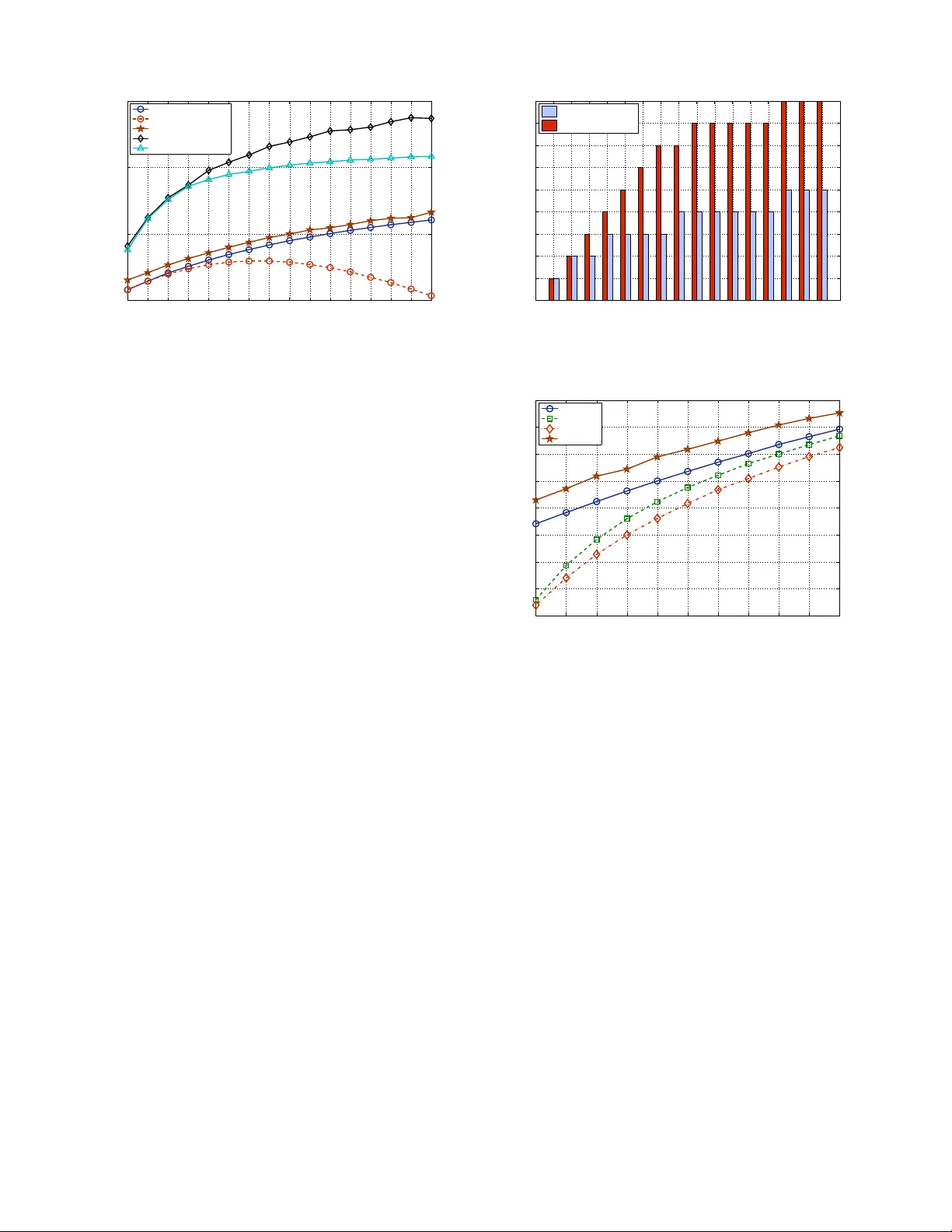
1 Channel Estimation and Linear Precoding in Multiuser Multiple-Antenna TDD Systems Jubin Jose, Studen t Member , IEEE, Alexei Ashikhmin, Senior Member , IEEE, Phil Whiting, and Sriram V ishwanath, Senior Member , IEEE Abstract —T raditional approac hes in the analysis of downlink systems decouple the precoding and the channel estimation problems. Howe ver , in cellul ar systems with mobile users, these two problems ar e in fact ti ghtly coupled. In this p aper , th is coupling is explicitly studied by ac counti ng f or channel training ov erhead and estimation error while determining the ov erall system throughput. Th e p aper studies the problem of utilizin g imperfect channel estimates for efficient linear precoding and user selection. It presents precoding methods th at take in to account the degree of channel estimation error . Inform ation- theoretic lower a nd upper b ounds are derived to evaluate the perfo rmance of th ese precoding method s. In typical scenarios, these bound s ar e close. Index T erms —Cellu lar d ownlink, channel estimation, linear precoding, wireless com muni cation I . I N T R O D U C T I O N T Here is a rich and varied literature in the d omain of mul- tiple antenna cellular systems. Ever s ince the intro duction of multi- antenna systems, almost every combination of anten- nas with physical settings has been modeled and an alyzed. The b ulk of th is literature, h owe ver , has focused o n de velop- ing strategies for fr equency division dup lex (FDD) systems, and not w ithout good r eason. FDD systems h av e d ominated deployment, while interest in deploying time d ivision dup lex (TDD) systems has grown only i n recent years. Althoug h TDD and FDD seem like interchang eable architectur al schemes for cellular systems, th ere a re som e fundamen tal differences that need to be is olated and studied in detail. The goal of this p aper is to bring the under standing of TDD systems closer to that of FDD systems today . It is now well established th at multip le antennas at th e transmitter a nd receiver in a p oint-to- point commun ication system can g reatly impr ove the overall throug hput of the system [2], [3]. In a m ulti-user setting, this gain re quires channel state information (CSI) and precoding strate gies tha t use this CSI a t th e b asestation. Given this CSI, the channel ca- pacity pr oblem can be f ormulated in terms of a multi-ante nna Copyri ght (c) 2011 IEEE. Personal use of this material is permitted. Ho wev er , permission to use this material for any other purposes must be obtaine d from the IEE E by sending a request to pubs-permissions@i eee.org. Results in this paper were presented in part at the IEEE Interna tional Conferen ce on Communicatio ns (ICC) 2008 [1 ]. J. Jose and S. V ishwanat h are with the Department of Electric al and Computer E ngineer ing, T he Unive rsity of T exas a t Austin, Austin , TX 78712 USA (email: jubin@a ustin.utexa s.edu; sriram@austi n.utexas.edu). W e thank support from the National Scienc e Founda tion under contra ct CNS-0905200 and the departme nt of defense. A. Ashikhmin and P . Whiting are with Bell Laborator ies, Alcate l-Lucent Inc., Murray Hill, NJ 07974 USA (email: aea@ research.bell- labs.com; pwhiting @research.bell -labs.com). Gaussian broad cast chann el (BC). Over the pa st decade, the capacity of a multi-an tenna Gaussian BC has been d etermined , and shown to be achieved by using dirty pap er co ding ( DPC) in [4], [5], [6], [7], [8]. Sub sequently , the order growth in the sum capacity gain with the number of antenn as an d the signal to noise ratio (SNR) have been char acterized in [9], [10]. An overview of the cap acity results in multi-user mu ltiple-inpu t multiple-ou tput (MI MO) chan nels can be found in [11]. Although dirty paper coding is known to be capacity achiev- ing with perf ect CSI, ther e a re several issues wh en attempting to apply it d irectly to a c ellular system. First, p ractical systems have to cop e with rapidly changin g ch annels so that chann el estimates a re valid only for a very short time, making the application of DPC a fraug ht pro blem. Furthe rmore, we are mainly concern ed with systems that hav e a large nu mber of base-station antennas. In such systems, the use of DPC might turn out to be prohibitively complex. I n co ntrast, many antenna system s with linear precoding offers a much m ore practical ro ute to provide high rate wireless com munication s. Estimation error is an inevitable issue f or the linear p recoded system (as well a s for DPC) a nd so the pap er concen trates on th is qu estion. Detailed investigation o f DPC perfo rmance with chan nel estimates obtaine d fro m TDD pilots r emains a question for further research . Giv en that we use lin ear pr ecoding , the g oal o f this paper is to analyze a multi-antenna do wnlink TDD system with channel training and estimation error factored into the net throu ghput expression. One of the primary differences betwe en TDD and FDD systems is th e mean s thro ugh wh ich ch annel trainin g and r esulting estima tion is con ducted. In FDD systems, a common mea ns of g aining CSI is feedba ck fr om the u sers to the b asestation. In TDD systems, channe l r ecipr ocity can be used to train on reverse lin k and o btain an estimate of the channel a t the ba se-station, see f or example [12], [ 13]. I n [1 4], channel recipr ocity h as been validated throug h experiments. Reciprocity thus eliminates t he need for a feedback mechanism (along with fo rward trainin g) to be developed. I n literature, the study of jo int pre coding and f eedback sch emes for FDD systems have been studied in great detail [15], [16], [17], [18], [19] (see prior work section for d etails). In a similar vein, we find that a joint study of chan nel estima tion and precod ing for TDD systems is needed to understand the resulting overall system thr oughp ut. T o provide som e typical system param eters, consider a carr ier frequen cy o f 190 0 MHz and (maxim um) mo bile velocity of 150 miles/hour . Then, the coheren ce time is approx imately 40 0 µ s [20]. Wi th typica l coheren ce bandwidth of 50 − 200 kHz, the effecti ve symbol 2 rates for n arrow-band operation is ap proxim ately 5 − 2 0 µ s. This leads to sho rt coherence tim e in sym bols o f 20 − 80 symbols, which clear ly mo tiv ate o ur joint stud y of channel training, cha nnel estimation a nd pr ecoding . Our analy tical framework considers a downlink system with a large n umber o f base-station antenn as (alo ng the lines of th e framework stud ied in [2 1]). In this framework, our fo cus is not on systems specified by cu rrent stand ards such as W iMax and L TE that u se on ly 2 − 4 antenn as. Instead, ou r focus is on p ossible futur e g eneration s of wireless systems where an antenn a arra y with a hundr ed or mo re an tennas at the base-stations is an attractive approach . Pre liminary feasibility studies show that f or 120 a ntennas we need a space occu pied by a cylinder of one meter d iameter an d one meter h igh: h alf- wa velength circu mferential spacing of 40 an tennas in e ach of three r ings, each r ing sp aced vertically two wav eleng ths apart. W ith suc h systems, TDD of fer s a significant advantage over FDD operation . I n FDD systems, the fo rward training overhead n eeded increases with the num ber of base-station antennas. This overhead also increases the (limited) feedback needed to gain CSI at the basestation which is often n eglected when FDD systems are an alyzed. In con trast to this, in this paper, we accou nt for all chan nel training overhead incur red in th e throu ghpu t analy sis we pr esent. The main contributions of this paper are: • W e determin e a method of linear preco ding an d user selection that maximize net th rough put f or realistic TDD systems. That is, channel e stimation and the co nsequent errors ar e taken into account. • Our r esults allow us to o ptimize the trainin g period in such TDD systems. In o ther words, we d etermine the optimal trade-o ff between estimating th e channel and using the channel. • W e p rovide achievable scheme s an d upp er bou nds on the sy stem throu ghput for the suggested precod ing and user selection schemes. W e demo nstrate that in ty pical scenarios these bounds are c lose and therefor e a llow one to accurately estimate the sum r ate of the sug- gested schemes. Th e bounds also show that the developed schemes gi ve significant improvement over othe r schemes in the literature (in particular the one given in [21]). It is important to emph asize that we do not limit our study to only those systems with a large n umber of base- station anten nas. W e f ocus on suc h systems in th e first part of th e pa per and develop simp le pr ecoder optim ization that takes advantage of large number of base-station antennas. Howe ver , the d esign is applica ble to systems with limited number of base- station an tennas. In the second par t of the paper, we stud y a modified version of th e preco der presented in [22] that do no t a ssume a large n umber of base-station antennas even for the design. In [22], a p recodin g matrix for d ownlink systems is obtained using an iterativ e algor ithm which attempts to determin e one of th e local ma xima of the sum rate maximization p roblem when CSI is av ailable at the base-station an d th e users. Since, in o ur setting, the base- station ob tains CSI th rough training an d thus m ay not b e perfect, we mod ify this algorithm to account for error in the estimation pr ocess. A. Prior W ork As is already well known, DPC [2 3] can b e used a s a precod ing strategy when the in terference signal is known non - causally an d per fectly at the transmitter . Given that translating DPC to practice is by n o means a trivial task, various a l- ternative precoding methods with low complexity have bee n studied assuming perfect CSI. Prior work on precoding [24], [25], [2 6], [22], [27] de monstrates th at su m rates clo se to sum capacity can be ach iev ed with lower compu tational complexity compare d to D PC. There are also oppo rtunistic sch eduling schemes [28] with lower com plexity com pared to DPC which can a chieve sum ra te that asym ptotically scales identica lly as the sum capacity with the num ber of u sers. T he existing literature on scheduling [2 9], [30] shows the significance of oppor tunistic scheduling towards max imizing th e sum rate in the downlink. As b riefly men tioned be fore, in FDD systems, a limited- CSI setting has be en studied in grea t detail primarily using a limited-feed back framework [15], [16], [17], [18], [ 19], [31], [32]. I n this fram ew ork, per fect CSI is assumed at the u sers and limited-feed back to base- station is studied . In [1 7], the authors show that, at high SNR, th e feed back rate r equired per user must grow linearly with the SNR (in dB) in order to obtain the full MIMO BC multiplexing gain. The ma in result in [1 8] is that CSI feedb ack can be sig nificantly red uced by exploiting multi-user d iv ersity . I n [ 19], th e auth ors design a joint CSI quantization , beamfor ming and sch eduling algorithm to attain optimal thr ough put scaling . However , all these papers assum e perfect channel knowledge at th e u sers and do not study TDD systems. The effect of train ing in m ulti-user MIM O systems using TDD operatio n is studied in [2 1]. The authors limit the study to homog eneous u sers and zero-for cing pre coding. Our paper is mo tiv ated f rom and builds on this work o n TDD systems. B. Notation W e use b old face to den ote vectors and matrices. All vectors are column vectors. W e use ( · ) T to denote the transpose, ( · ) ∗ to deno te the conju gate an d ( · ) † to deno te the Hermitian of vectors and m atrices. T r( A ) deno tes the tr ace of matrix A and A − 1 denotes th e inverse of m atrix A . diag { a } denotes a diagona l matrix with diagonal en tries equa l to the com ponen ts of a . deno tes eleme nt-wise g reater than or eq ual to. E [ · ] and v ar {·} stand for expectation and variance operation s, respectively . 1 {·} denotes the indicator func tion. C. Or ganizatio n The rest of th is pap er is organized as fo llows. In Section II, we describe th e system mo del a nd the assum ptions. W e consider two tra nsmission m ethods. First, we co nsider a trans- mission metho d with chan nel trainin g on reverse link only in Section III. Next, we consider a tran smission method which sends f orward pilo ts in addition to reverse pilots in Section IV. In Section V, we provide an upper b ound on the sum 3 User−1 Uplink Downlink Channel Wireless Base−Station User−2 User−3 2 H H T Forward Channel Reverse Channel Base Station 1 2 M 1 K Mobile Users Fig. 1. Multi-user MIMO TDD system model rate fo r commun ication schemes using linear pr ecoding at the base-station. W e compa re th e performan ce of the v ariou s schemes con sidered throug h nu merical results in Section VI and pr ovide o ur co ncluding remar ks in Sectio n VII. I I . S Y S T E M M O D E L The system model con sists of a base-station with M an- tennas and K single antenna users. The base-station c ommu- nicates with the users on b oth forward and reverse lin ks as shown in Figur e 1. The fo rward ch annel is characterized by the K × M m atrix H an d the forward SNRs. The sy stem model inc orpor ates frequ ency selectivity of fading by u sing orthog onal f requency-d ivision multiplexing ( OFDM). The du - ration of the coher ence interval (defined later ) in symbols is chosen for one OFDM sub-band. For simplicity , we co nsider OFDM sub-ba nds as pa rallel channels and conc entrate o n one OFDM sub-ban d ( where channel matrix is fixed an d there is no multi-path ). T he details of OFDM (inclu ding cyclic pr efix) are completely omitted, as th is is by no means the focus of the p aper . Further, we make the following assumptions. 1) Rayleigh block fading : The channel undergo es Rayleigh fading over block s o f T symbols called the cohe rence interval during which the channel r emains co nstant. In Rayleigh fading , the entries of the channel matrix H are independ ent and identically distributed (i.i.d.) zero- mean, circ ularly-sym metric complex Gaussian C N (0 , 1) random variables. 2) Reciprocity : The reverse channel between any user and the base-station (at any instant) is a scaled version of the for ward channel. 3) Coheren t u plink transm ission: Time synchro nization is present in the system. Let the forward and rev erse SNRs associated with k -th user be ρ f k and ρ r k , resp ectiv ely . T hese forward and reverse SNRs account for the average power at the b ase-station an d the users, and the propag ation factors (inclu ding path loss an d shadowing). Th ese propagation factors change at a much larger time-scale compar ed to fading. Hence, in the analysis, these parameters are treate d as constants. For simp licity of no tation, we ignor e th e time index. On th e forward link, the sign al received by the k -th u ser is x f k = q ρ f k h T k s f + z f k (1) where h T k is th e k -th r ow of the chann el m atrix H and s f is the M × 1 signal vector . The additive noise z f k is i.i.d. C N (0 , 1) . The average power constrain t at the base-station during transmission is E [ k s f k 2 ] = 1 so that the total tr ansmit power is fixed irrespective of its n umber of antenna s. T he received power d epends o n the c hannel n orm a nd he nce on the nu mber o f anten nas at the base-station. On the rev erse link, the vector received at the base-station is x r = H T E r s r + z r (2) where s r is the signal-vector transmitted by the users and E r = diag { [ p ρ r 1 p ρ r 2 . . . p ρ r K ] T } . The compon ents of the additive noise vector z r are i.i.d. C N (0 , 1) . The power co nstraint at the k - th user during trans- mission is given by E [ k s r k k 2 ] = 1 wh ere s r k is the k -th compon ent of s r . Remark 1: W e p rimarily focus on short coherence interv als. The need to study short coher ence intervals arises fro m the high m obility of the users. In this setting , it is impor tant that we acco unt for chan nel training overhe ad and estimation err or . Our go al is to account for th ese factors in the net throughp ut and develop sch emes that achieve high net thr oughp ut. For obtaining schemes of practical importance, we lo ok at schemes with low co mputation al requir ements. As mention ed earlier, we co nsider linear p recodin g tec hniques at the base-station . Remark 2: The performan ce metric of inter est is the achiev- able weig hted-sum rate. The motivation be hind looking at weighted-su m r ate is that weigh ts are u sed by higher lay er protoco ls such as the Proportio nal Fair scheduling alg orithm and the Max -W eig ht sch eduling algo rithm in or der to achieve goals such as efficient fair shar ing of throug hput (Propo rtional Fair) and qu eue stab ilization (Max W eig ht). For example, in the case of Max W eight th ey are fixed to b e qu eue lengths [33]. The weigh ts are passed to the physical lay er , which has the task of maximizing the weigh ted-sum rate with g iv en weights. It is this latter task and the performance ach iev ed with which the paper is con cerned. Th us, in a real system, these weights are adaptively con trolled by the high- layer algorithm to perf orm a gi ven network utility maximization [34]. By assumption, e very u ser knows th e system p arameters such as the weigh ts, the forward SNRs, the rev erse SNRs and the a chiev able strategy . In typical sy stems, these parameters change on a much larger time-scale compar ed to the coher ence interval and stays constant during many OFDM sy mbols. T y pical shadow fading assump tions lea d to th e conc lusion that 4 000 000 000 000 000 000 111 111 111 111 111 111 Data Transmission Coherence Interval (T) Computation Training Symbols ( τ r ) Fig. 2. Diffe rent phases in a coherence interv al significant SNR c hanges occur on ly over distance of 20 meters and above. Further, in commun ications standar ds like L TE, there are pr otocols tha t describ e how SNRs are estimated and passed to b ase-stations. W e d o not addr ess the se in this pap er , i.e., in o ur system mod el SNRs are assumed to be co nstant and kn own for the time-scale o f interest. Th e symb ol time of the L TE OFDM symbo l is 7 1 . 3 µ s. I f a mobile moves with the speed of 50 miles/hou r , then its SNR value will change after the transmission of approxim ately 12 600 OFDM symbols wher eas the chan nel coefficients will chang e within approx imately 2 0 OFDM sy mbols. In a typical Pro portion al Fair algorith m, weigh ts are kept fixed over a period of 1 − 10 seconds. Hence, the numb er of OFDM symbo ls tha t will b e transmitted in this time interval is again much larger than the coheren ce inter val. These typ ical n umbers clearly suggest that the overhead associated with lear ning system parameters is negligible compared to the chann el training overhead, which is accou nted for in this paper . I I I . T R A I N I N G O N R E V E R S E L I N K O N LY In this section, we consider a transmission scheme that consists of three phases as shown in Figure 2 - training, computatio n and data tran smission. In the tr aining p hase, the users transmit train ing sequen ces to th e base-station on the reverse link. The base-station perfor ms th e r equired compu - tations f or preco ding in the computatio n phase. W e assume that this causes a one-symb ol delay in order to emph asize the delay in co mputation /control. In pr actice, this delay is a system depend ent parameter . In the da ta transmission phase, the b ase-station transmits data symbols to the selected users. Remark 3: In this tr ansmission m ethod, the u sers d o not obtain any in formatio n r egarding the instan taneous chann el. The base-station obtain s an estimate of the in stantaneous channel. Th is is very different fr om the usual setting wher e the users also have estimates of c hannel gain s. As a r esult, the analysis is very different as well. Our g oal is to obtain a simple p recoding meth od that can achieve high weighted -sum rate. Th e capacity region of the system described in Sec tion II is not known even in the single user setting. In ad dition, capacity achieving scheme s can in general be very c omplex to im plement in prac tice. Th erefore , our approach is to obtain variants of well-studied simple algorithm s in the perfect CSI setting that is ap plicable in th e imperfect CSI setting, and analyze the system perf ormanc e. In particular, we con sider MMSE channel estimation, oppo rtunis- tic selection of u sers based on channel ga ins, an d generalized zero-fo rcing (described later) precodin g. Th e parameters u sed in the algorithm are optimized fo r im proved perform ance. The optimal p recoding is id entified in the course of a n asymptotic analysis, taking the number of base-station antennas to infinity . Next, we provide the de tails o f the algorith m and ou r a nalysis. A. Chann el Estimation Channel reciprocity is on e of the key advantages of time- division dup lex (T DD) systems over frequency-division dup lex (FDD) systems. W e exploit this pro perty to perf orm channel estimation by transmitting training seq uences on the reverse link. Every user tr ansmits a sequen ce o f train ing signals o f τ r symbols du ration in every co herence interval. T he k -th user tran smits the train ing sequen ce vector √ τ r ψ † k . W e u se orthon ormal sequen ces which imp lies ψ † i ψ j = δ ij where δ ij is the Kronecker delta. Remark 4: The u se o f o rthogo nal sequence s r estricts th e maximum n umber of u sers to τ r , i.e. , K ≤ τ r . The train ing signal matrix received at the base-station is Y = √ τ r H T E r Ψ † + V r where Ψ = [ ψ 1 ψ 2 . . . ψ K ] ( Ψ † Ψ = I ) and the components of V r are i.i.d. C N ( 0 , 1) . Th e base-station obta ins the linear minimum mea n-square error estimate (LMMSE) of the chan- nel ˆ H = diag " p ρ r 1 τ r 1 + ρ r 1 τ r . . . p ρ r K τ r 1 + ρ r K τ r # T Ψ T Y T . (3) The estimate ˆ H is the con ditional m ean of H g iv en Y . There- fore, ˆ H is th e MMSE estimate as well. By the properties of condition al mean and joint Gaussian distribution, the estimate ˆ H is ind ependen t of the estimation error ˜ H = H − ˆ H [35]. The compo nents of ˆ H ar e indepen dent and the elem ents o f its k -th row are C N (0 , ρ r k τ r / (1 + ρ r k τ r )) . I n additio n, the compon ents of ˜ H are indepen dent and the e lements of its k -th row are C N (0 , 1 / (1 + ρ r k τ r )) . B. Generalized Zer o -F or cing Pr ecoding Next, we describe a generalized zero -forcin g (ZF) pr e- coding. This pr ecoding consists of two steps: ( i ) preco der parameter optim ization, and ( ii ) u ser selection. The precod er parameters are non-n egati ve con stants p 1 , . . . , p K , which are later op timized over long- term 1 system par ameters su ch as th e weights, the f orward SNRs an d the reverse SNRs. The u ser se- lection algorithm is denoted b y S ( ˆ H ) = { S 1 , S 2 , . . . , S N } ⊆ { 1 , 2 , . . . , K } , i.e., based on the channel estimate ˆ H the scheduling algo rithm selects users S 1 , S 2 , . . . , S N . Thus, the user selection is dep endent on sho rt-term chan nel variations. Before proceed ing, we introd uce the n otation req uired to describe the precoding metho d. Let D S = diag h p − 1 2 S 1 p − 1 2 S 2 . . . p − 1 2 S N i T . Let ˆ H S be the N × M matrix formed from ˆ H a s fo llows: Th e i -th row ( 1 ≤ i ≤ N ) correspon ds to the S i -th row o f matrix 1 Strictl y speaki ng, these long-term parameters are constants in our system model. 5 ˆ H . Sim ilarly , define H S and ˜ H S . Let ˆ H DS = D S ˆ H S . Now , the g eneralized zero- forcing preco ding matrix is defined as A DS = ˆ H † DS ˆ H DS ˆ H † DS − 1 s T r ˆ H DS ˆ H † DS − 1 . (4) This p recodin g m atrix is normalized so that T r A † DS A DS = 1 . The matrix D S is intr oduced to optimally a llocate “reso urces” to users. Th is is requir ed as our system con sists of heter oge- neous u sers. Let q denote the vector of (coded) information symbols that have to transmitted to the N selected u sers. Th en, the transmission sign al-vector is g i ven by s f = A DS q . (5) Clearly , the base-station transmit power co nstraint can be satisfied irrespective of the values of p 1 , . . . , p K by imposing the c ondition s E [ k q n k 2 ] = 1 , ∀ n ∈ { 1 , . . . , N } . This generalized zero-forcing p recoding method r equires a choice of the p i values and a user selection alg orithm. Next, we character ize th e achievable thro ughpu t with th is precod ing method, an d then explain the pre coder optim ization and the user selection algorithm. C. Achievable Thr o ughpu t In this section, we obtain an achievable through put for the system u nder co nsideration (b y building on techn iques in [36]). Given a user selectio n algo rithm, we deno te the probab ility of selecting the k -th user as γ k . Th e th rough put derived dep ends on the u ser selection strategy th rough the random variable χ (defin ed later) and the p robabilities of selecting the users. Recall that M is the nu mber of an tennas at the b ase-station, K is th e nu mber of users, ρ f k is the forward SNR associated with the k -th user and ρ r k is the reverse SNR a ssociated with the k -th user . Let the weight associated with the k - th user be w k . The ba se-station p erforms MMSE channel estimation as describ ed in Section III-A. For c hannel estimation, th e training period used is τ r ≥ K symbols. From (1), th e signal- vector r eceived at the selected user s (accord ing to our system mode l the user k nows whether it is selected or not) is x f = E f S H S A DS q + z f (6) where E f S = diag ( q ρ f S 1 q ρ f S 2 . . . q ρ f S N T ) . The effectiv e for ward channel in (6) is G = E f S H S A DS = E f S D − 1 S ˆ H DS + ˜ H S A DS = E f S D − 1 S χ + E f S ˜ H S A DS , (7) where χ is the scalar random variable given by χ = T r ˆ H DS ˆ H † DS − 1 − 1 2 . (8) Suppose that th e k -th user is among the selected users. The signal received by the k - th user is x f k = g T q + z f k (9) where g T is the row correspon ding to k -th user in matrix G . From (7), we obtain g T = q ρ f k p k χ e T k + q ρ f k ˜ h T k A DS (10) where ˜ h T k is the k - th row of ˜ H and e k is the N × 1 column- vector with k -th elem ent e qual to one and all o ther elements e qual to zer o. Su bstituting (1 0) in (9) an d ad ding and sub tracting mean from χ , we obtain x f k = q ρ f k p k E [ χ ] q k + q ρ f k p k ( χ − E [ χ ]) q k + q ρ f k ˜ h T k A DS q + z f k (11) = q ρ f k p k E [ χ ] q k + ˆ z f k where the ef fective no ise ˆ z f k = q ρ f k p k ( χ − E [ χ ]) q k + q ρ f k ˜ h T k A DS q + z f k . According to o ur system m odel, each user k nows the systems p arameters. Howe ver, the users do not k now th e instantaneou s c hannels, whic h is the main overhead th at is often neglected. Hen ce, the user perfo rms the following: 1) It comp utes the expected value (over instan taneous channel distribution) of its “ef fective” c hannel given by ( ρ f k p k ) 1 / 2 E [ χ ] . I n oth er word s, this is th e expected gain multiplying its information symbo l. 2) It comp utes the variation of the effecti ve channel a round its expected v alue given by ρ f k p k v ar { χ } . This co n- tributes to the “ef fective” no ise variance. 3) It compu tes remainin g terms that contribute to effectiv e noise variance, which includ es the in terferen ce d ue to other in formatio n signals given by ρ f k / (1 + ρ r k τ r ) and the add iti ve no ise variance (which is unity). 4) It co mputes the effecti ve SNR f rom the above compu- tations, and uses it in the de coding. In the f ollowing th eorem, we formalize the ab ove by showing that the effectiv e noise is un correlated with signal and use this fact to o btain ach iev able weighted -sum rate. Theor em 1 : Consider the precoding method described above. Th en, the f ollowing weigh ted-sum rate is achievable during d ownlink transm ission: R Σ = K X k =1 γ k w k log 2 1 + ρ f k p k E 2 [ χ ] 1 + ρ f k 1 1+ ρ r k τ r + p k v ar { χ } , (12) where χ is the scalar random variable in (8). Pr o of: The expecte d value of any term on the rig ht-hand side of (11) is zero . The noise term z f k is indepe ndent o f all other terms and E h z f k q i = 0 , E h z f k q , ˆ H i = 0 , E h ˜ h T k q , ˆ H i = 0 . 6 Using the law of iterated expectations, we have E h q k q † k ( χ − E [ χ ]) i = E h q k q † k i ( E [ χ ] − E [ χ ]) = 0 , E h q k q † A † DS ˜ h ∗ k i = E h q k q † A † DS E h ˜ h ∗ k q , ˆ H ii = 0 , E h ( χ − E [ χ ]) q k q † A † DS ˜ h ∗ k i = E h ( χ − E [ χ ]) q k q † A † DS E h ˜ h ∗ k q , ˆ H ii = 0 . Hence, any two terms on the right-h and side of (11) are uncorr elated. Th e effecti ve noise ˆ z f k is thus un correlated with the signal q k . The effective noise h as zero m ean and variance v ar n ˆ z f k o = 1 + ρ f k E h ˜ h T k A DS E h qq † ˆ H , ˜ H i A † DS ˜ h ∗ k i + ρ f k p k v ar { χ } = 1 + ρ f k 1 1 + ρ r k τ r + p k v ar { χ } . Remark 5: The effecti ve no ise ˆ z f k is uncorrelate d with the signal q k , a nd in genera l no t in depend ent. Note th at we do n ot need in depend ence in the proo f. In ord er to o btain a set of achiev able rates, we consider ( T − τ r − 1 ) p arallel chan nels wher e noise is in depend ent over time as fading is independ ent over block s. Using th e fact that worst-case unco rrelated no ise distribution is ind ependen t Gaussian noise with same variance, we obtain the achievable weighted-su m rate g iv en in (12). This c ompletes the pr oof. The proo f assumes that the user s know if they are selected or not. In Section III- E, we discuss how th is a ssumption can be relaxed with a small reduction in n et ach iev able rate. Remark 6: The values E [ χ ] and v ar { χ } do not depen d on short-term channel variations. E [ χ ] and v ar { χ } depen d only on slowly chan ging parameters, namely on the weig hts, the reverse SNRs and the user selection strategy . T hese slowly changin g para meters stay constant over a large per iod compris- ing many coh erence intervals. W e assume th at the se param- eters are known at th e b ase-station and co rrespon ding users. The values E [ χ ] and v ar { χ } can be acc urately estimated via a Monte-Carlo simulation in the beginning of each per iod. These estimates can be p roduced either by users them selves or by the base-stations. In the la tter case, the base- station will have to pass the values E [ χ ] and v ar { χ } to the corresponding users, which would assume o nly a small overhead. Alternatively , one can generate a look up table for E [ χ ] and v ar { χ } for a g rid of param eter values. For interm ediate cases, the cor respond ing values can be found by interpolation. D. Optimization of Pr ecod ing Matrix W e introd uced the par ameters p 1 , . . . , p K in the generalized zero-fo rcing precod ing to handle th e h eterogen eity of users, i.e., differences in th e weig hts, the forward SNRs an d the reverse SNRs associated with u sers. In this section, our goa l is to o btain these par ameters as a function o f the weig hts, the forward SNRs and the r ev erse SNRs. W e make the following simplifications to achieve our goal. 1) The per forman ce metric of in terest is the ac hiev able weighted-su m ra te R Σ in ( 12). Howe ver, R Σ is a func- tion o f the user selectio n algo rithm. T o overcome th is, we simply consider the ca se o f selecting all users to obtain p 1 , . . . , p K . Hen ce, th is c an b e pe rformed b efore the user selection. 2) W e would like to cho ose non-negative values for p 1 , . . . , p K such that R Σ in (12) is maximized . How- ev er, this is a hard pro blem to analyze as clo sed-form expression for the expectation and the variance te rms in (12) is u nknown. W e consider th e asymptotic regime M /K ≫ 1 as this is appropriate in th is section. Remark 7: Apart fr om m aking the pro blem mathe matically tractable, the asy mptotic regime M /K ≫ 1 is of in terest due to the following reasons: ( i ) the system constrain ts K ≤ τ r , τ r ≤ T place an up per boun d on K , independ ent o f the number o f an tennas, and ( ii ) the b ase-station can be equip ped with many antenn as each powered by its own low-power tower -top amp lifier [21]. From the weak law of large n umber s, it is k nown th at lim M /K →∞ 1 M ZZ † = I K where Z is the K × M random m atrix whose elem ents ar e i.i.d. C N (0 , 1) . There fore, ZZ † can be approx imated b y M I K . Hence, th e rando m variable χ in ( 8) can be approx imated as χ ≈ v u u u t M K P j =1 a j p j (13) where a j = ρ r j τ r 1 + ρ r j τ r ! − 1 . Substituting (13) in (12), we get R Σ ≈ J ( p ) = K X i =1 w i log 2 1 + b i p i K P j =1 a j p j where b i = M ρ f i 1 + ρ f i (1 + ρ r i τ r ) − 1 . Under this ap proxima tion, we c an find the optimal values fo r p 1 , . . . , p K that m aximize J ( p ) as describ ed below . Theor em 2 : An optimal solution p ∗ of the objective func- tion max p J ( p ) is of the fo rm c p ∗ where c is any po siti ve real num ber and p ∗ = [ p ∗ 1 p ∗ 2 . . . p ∗ K ] T is given b y p ∗ i = max 0 , w i ν ∗ a i − 1 b i . (14) The po siti ve real number ν ∗ is unique and g i ven by K X i =1 a i p ∗ i = 1 . Pr o of: The proof idea is to intro duce an additional constraint to obtain a convex o ptimization prob lem. W e show 7 that the introductio n o f the additional constraint does not affect the o ptimal value of the optimization p roblem. Note that w i > 0 , b i > 0 and a j > 0 . Let a = [ a 1 a 2 . . . a K ] T . W e consider the optimization prob lem maximize J ( p ) (15) subject to p 0 . Since J ( p ) = J ( c p ) f or any c > 0 and p ∗ 6 = 0 , p ∗ such that a T p ∗ = c is an op timal solutio n to (15) if an d only if p ∗ = (1 /c ) p ∗ is an optimal so lution to th e conve x optimization p roblem minimize − K X i =1 w i log (1 + b i p i ) (16) subject to p 0 , a T p = 1 . In ord er to solve (16), we introd uce La grange multipliers λ ∈ R K for the in equality constraints p 0 an d ν ∈ R fo r the equality constrain t a T p = 1 . The nec essary and sufficient condition s for optimality are given by Karu sh-Kuhn-T uc ker (KKT) co nditions [37]. These condition s a re p ∗ 0 , a T p ∗ = 1 , λ ∗ 0 , λ ∗ i p ∗ i = 0 , − w i b i 1 + b i p ∗ i − λ ∗ i + ν ∗ a i = 0 , i = 1 , . . . , K. This set of equa tions can be simplified to p ∗ i = max 0 , w i ν ∗ a i − 1 b i , K X i =1 a i max 0 , w i ν ∗ a i − 1 b i = 1 . (17) Since th e lef t-hand of (17) is an in creasing f unction in 1 /ν ∗ , this e quation h as a uniq ue solu tion, which can be easily computed n umerically using bina ry search. This completes the proof . The optimized p ∗ giv en by (14) is substituted in (4) to obtain the optimiz ed p recoding matrix. W e remark that this p recoder design is o nly a symptotically o ptimal wh en M /K → ∞ . Howe ver, we use this optimized precod ing matrix even when n umber of users K is comp arable to numbe r of base-station a ntennas M . W e deno te the scheme where we use optimiz ed p i values for preco ding by Sch eme-1 and the scheme where we u se p i = 1 for precoding by Sch eme-0. In both th e schemes, we select all the user s. E. User S election S trate gy W e conside r a simple user selection strategy based on oppor- tunistic selection of users b ased on scaled estimated chan nel gains of users (details given later). W e igno re th e sp atial sep a- rability/orth ogona lity of chann els d ue to the fo llowing reason . As men tioned earlier, the transmission method in th is section is o f inte rest in the large number of base-station antenna s setting. In this setting, the spatial separability/o rthogo nality of channel play a less impo rtant role. Also, the ch annel estimate at the base-station is expecte d to be po or . The pred iction o f channel orthog onality based on th is poor estimate is g enerally inaccurate. In addition, brute-force search over subsets of users is computationally com plex. In the seco nd part of this paper , for the gen eral setting, we co nsider schem es that use sp atial separability/or thogon ality of cha nnels. In the user selection stra tegies presented be low , we need n ot assume any designated chann el f or inform ing u sers whether they were selec ted o r not. W e will show that th is does not result in a significant loss of da ta rate. Let us consider a selection scheme with a designated channel for alerting the selected users. Let I j be the a verage amount of in formation (in bits) that can be transmitted to the j -th user d uring o ne coheren ce in terval in this sche me. The averaging is conducted over m ultiple cohere nce in tervals in wh ich the user can be selected or not. Deno te b y I ′ j the correspo nding qua ntity f or the same user selection schem e, but without the designated chan nel. Theor em 3 : I ′ j ≥ I j − 1 . Pr o of: Let D j be the rand om variable indicating whethe r or not the j -th user was selected in a given coheren ce interval. The value D j = 1 ind icates that the user was selected and D j = 0 ind icates that it w as not. Let A D 1 ,...,D K be a precoding matrix. This m atrix depend s on th e values D 1 , . . . , D K . In particular the j - th column of A D 1 ,...,D K is the all-zero vector if D j = 0 . Den ote b y q t j the symb ol tha t is transmitted to th e j -th user at time instance t . Th en, the signal recei ved by the j -th u ser is x t j = q ρ f j h T j A D 1 ,...,D K q t 1 . . . q t K + z t k , (18) where z t k is Gaussian noise. Denote x j = ( x τ r +2 j , . . . , x T j ) and q j = ( q τ r +2 j , . . . , q T j ) . If the designated channel is a vailable, we h av e I j = I ( x j ; q j D j ) . It is important to note that this mutual information is over the commun ication chan nel defin ed by (1 8), which includes n ot only the M IMO transmission , but also the rand om variables D j . Note also that D j and q j are indepen dent. Similarly , if the design ated channel is absent, we hav e I ′ j = I ( x j ; q j ) . Using the chain rule for mutua l information , we obtain I j = I ( x j ; q j ) + I ( x j ; D j | q j ) = I ′ j + I ( x j ; D j | q j ) . Since D j is a b inary random v ariab le, we h av e I ( x j ; D j | q j ) ≤ 1 , and the assertion follows. It is worth noting that applying the chain rule, we obtain I j = I ( q j ; D j ) + I ( x j ; q j | D j ) = I ( x j ; q j | D j ) = I MIMO ( x j ; q j ) Pr( D j = 1) . (19) These equ alities follows fr om the fact that q j and D j are in- depend ent rand om variables and from th e fact I ( x j ; q j | D j = 8 0) = 0 . In (19), the mutual inform ation I MIMO ( x j ; q j ) is over the chann el defined in (9), that is over the MIM O ( the dimensions are time, n ot antennas) chan nel fo r selected users , which is dif fer ent from the channel (18). Another importan t c oncern is the practical realizatio n of the user selection sche me. One possible way is to design a criter ion that would allow each user to d ecide wheth er it was selected or n ot for each coherence interval. For instan ce, one may try to use the power of the received sign al x j as such criterion. W e belie ve that this is a poor a pproach , which incorpo rates a hard d ecision, which r esults in rate loss. A significantly better way is to assume the channel model (18) in which we always “transmit” signals q j indepen dent on wh ether the j -th u ser was selected or not. This is equiv- alent to data transm ission v ia a fading ch annel of the form x j = const · q j D j + noise . For recovering the transmitted symbols, we prop ose to use an err or co rrecting co de, wh ich approa ches the capac ity of this fading channel. In contrast to the p revious ha rd decision appr oach, the probab ilities Pr( D j = 0 | x j ) , Pr( D j = 1 , q j | x j ) for all possible values of q j , and passed to the decoder . It is not dificult to construct an LDPC code ap proach ing capacity o f this fading chann el, using, for instance, the EXIT f unction techniq ue described in [38], [39]. A decode r of such an LDPC code will upda te the prob abilities Pr( D j = 0 | x j ) , Pr( D j = 1 , q j | x j ) using intermediate decodin g r esults f rom ea ch iteration ( see [ 39] for details o f this technique). 1) Homogeneou s Users: First, we consider th e special c ase where the u sers are statistically identical. I n this ho mogen eous setting, the forward SNRs f rom the base-station to all the users are equal (giv en by ρ f ) and re verse SNRs from all the users to the base-station ar e equal ( given by ρ r ). Fur thermor e, th e weights assigned to all the users a re unity , i. e., w k = 1 . The need fo r explicit user selection a rises d ue to the Z F based precod ing used. With per fect chan nel knowledge at the base- station ( ˆ H = H ) and no user selection ( N = K ), the ZF precod ing diago nalizes the effecti ve fo rward cha nnel an d all users see same effecti ve channe l gains. W e use the following simple heuristic rule at the base- station. In every co herence in terval, the base-station selects those N users with largest estimated ch annel gains. This rule is motivated by the expectation term E [ χ ] appear ing in the achiev able weig hted-sum rate in (12). Let ˆ h T (1) , ˆ h T (2) , . . . , ˆ h T ( K ) be th e no rm-or dered r ows of th e estimated channel m atrix ˆ H . Then, th e matrix ˆ H S is g iv en by ˆ H S = [ ˆ h (1) ˆ h (2) . . . ˆ h ( N ) ] T and the achie vable sum rate in (1 2) becom es R Σ = N log 2 1 + ρ f ρ r τ r 1+ ρ r τ r E 2 [ η ] 1 + ρ f 1 1+ ρ r τ r + ρ r τ r 1+ ρ r τ r v ar { η } . (20) Here, the random variable η = T r h UU † − 1 i − 1 2 where U is the N × M matrix fo rmed by the N rows with largest n orms o f a K × M rand om matrix Z who se elements are i.i.d. C N (0 , 1) . Net a chiev able sum rate accou nts for the redu ction in achiev able sum rate due to training. In every coheren ce interval of T symbo ls, first τ r symbols are used f or trainin g on r ev erse link, a symb ol is used for com putation and the re maining ( T − τ r − 1) symb ols a re used for transmitting in formatio n symbols as sh own in Figure 2. The trainin g length τ r can be chosen such tha t net th rough put of the system is maximized. For N < K , the sum rate overhead associated with user selection would b e K / T . Thus, the net achiev able sum rate is defined as R net = max τ r ,N T − τ r − 1 T R Σ − 1 { N 2 K and T is odd. In the limit ρ r → ∞ , we can appro ximate the net r ate as R net ≈ d 2 T − τ r − 1 T where d 2 is a positiv e co nstant. This expr ession is maxim ized by the minimum po ssible training len gth which is τ r = K. The app roximatio ns sugg ests that ne arly half the coh erence time should be spen t for training when the reverse SNR is very low and the minim um po ssible nu mber of symbols (wh ich is K ) shou ld b e spent for tr aining wh en re verse SNR is very high. This co nclusion is similar to the result in [36] for MIMO. In summary , we d ev elop ed a n ew prec oding method referred to as gen eralized zero-fo rcing p recoding . It con sists of a u ser selection compon ent and an o ptimization c ompon ent. The user selection com ponen t is perform ed u sing op portun istic selection heur istics. The optimization comp onent is per formed using a convex optimization pro blem resulting f rom a relevant asymptotics of large num ber of base-station anten nas. The resulting precoding is simple and ther efore has significant practical value. W e demonstra te the improvement o btained in net th rough put thr ough numer ical examples in Section VI. The net throu ghput impr ovement r esults from all optim iza- tion param eters. Th e role of the training length param eter is clear, as there is tension be tween large train ing overhead and b etter channel estimatio n. Th e m ore sub tle para meters are the number of selected users N and the prec oder p arameters p 1 , . . . , p K . The ro le o f th e p recoder par ameters is to take advantage of long-term system parameters and statistics such as th e weights, the forward SNRs and the r ev erse SNRs whereas the role o f the pa rameter N is take ad vantage of the sho rt-term chan nel variations. In our a pproach , since th e precod er optimization is dependen t on lo ng-term variations, it is not dep endent on N . T he choice o f N would dep end on precod er p arameters and is therefo re m ore inv olved. However , since it is a single p arameter, this op timization can be han dled. I V . T R A I N I N G O N R E V E R S E A N D F O RW A R D L I N K S In this sectio n, we consider a transmission m ethod which sends forward pilots in addition to reverse pilots in Section IV 2 . In this section, we do not limit our appr oach to large number o f base-station antennas. In the transm ission metho d consider ed in the pr evious section, the users do not ob tain any knowledge a bout the instantaneou s channel. Every user can be p rovided with par tial knowledge about its effective chan nel gain in o ne of the following two ways. ( i ) The base-station ca n send quan tized informa tion of the effecti ve ch annel ga ins to the u sers. ( ii ) The base-station can send forward pilots to th e users so 2 There has been some pa rallel work in [40 ]. T he authors consider two -way traini ng [41] and study two varian ts of linear MMSE precoders as alt ernati ves to linear zero-forcing precoder used in [21]. 000 000 000 111 111 111 000 000 000 111 111 111 00000000000 00000000000 00000000000 11111111111 11111111111 11111111111 Computation Forward Pilots Coherence Interval (T) Data Transmission Reverse Pilots ( τ r ) ( τ f ) Fig. 3. Rev erse and Forward Pilots that the users ca n estimate the effecti ve gain s. It is ha rd to account f or the overhead when b ase-station sen d qu antized informa tion abo ut the effecti ve ch annel gains. In addition, pilot based channel training is conv ention al in wireless systems. Therefo re, we fo cus on send ing p ilots in th e forward link. This lead s to a tran smission metho d consisting of f our ph ases - reverse pilots, com putation phase, forward pilots an d data transmission - as shown in Figu re 3. In this sch eme, the u sers can obtain ef fective chann el g ain estimates at th e expense of increased trainin g overhead. A. Chann el Estimation an d Precoding As exp lained in Section III- A, the users tran smit or thogon al training sequ ences on the reverse link. From these training sequences, the base-station obtain s the MMSE estimate of the channel. The base-station uses this chann el estimate ˆ H to form a pr ecoding matrix to perfo rm linear precoding . L et A denote any p recoding matrix which is a func tion of the chan nel estimate, i.e., A = f ( ˆ H ) . The p recoding fu nction f ( · ) usually depend s on th e system param eters such as forward SNRs, reverse SNRs an d weigh ts assigned to the u sers. W e require that the precoding matrix is normalized s o that T r A † A = 1 . The transmission signal-vector is g iv en by s f = Aq , where q = [ q 1 q 2 . . . q K ] T is the vector of in formatio n sym bols for the users. The net achie vable r ate deriv ed later in this section is valid for any preco ding fun ction. Next, we describ e a particular precod ing method. In [22], the following ap proach was sugge sted f or finding a good precoding m atrix A . Le t h i be the i -th row of the channel matrix H and let a j be the j -th column of precoding matrix A . T he sum ra te o f the br oadcast c hannel can b e w ritten in the for m R ( H , A ) = M X j =1 log 2 1 + | h j a j | 2 σ 2 T r ( AA † ) + P l 6 = j | h j a l | 2 ! . Let b j = | h j a j | 2 and c j = σ 2 T r ( AA † ) + X l 6 = j | h j a l | 2 . Further, let ∆ and D be diag onal matrices d efined as ∆ = diag ( ( HA ) 11 c 1 ( HA ) 22 c 2 . . . ( HA ) M M c M T ) (23) and D = dia g ( b 1 c 1 ( b 1 + c 1 ) . . . b M c M ( b M + c M ) T ) . (24) 10 In [2 2], it is shown that the equations ∂ R ( H , A ) ∂ A ij = 0 imply A = (( σ 2 T r ( D )) I M + H † DH ) − 1 H † ∆ . (25) This equ ation allo ws o ne to use the following iterati ve algo- rithm fo r determ ining an ef ficient A : 1) Assign some initial values to matrices ∆ and D , for instance ∆ = I M , D = I M 2) Repeat steps 3 and 4 several times 3) Compu te A ac cording to (25); 4) Compu te ∆ and D accord ing to (2 3) an d (24). This ap proach can be extended fo r the scenario when only an estimate ˆ H of the ch annel matrix H and the statistics of the estimation error ˜ H is available. In th is c ase, we would like to m aximize the v alue of the average sum rate defined by R ( ˆ H , A ) = E ˜ H [ R ( ˆ H + ˜ H , A )] . Since the statistics of ˜ H is assumed to be known, w e can generate L samples ˜ H ( i ) , i = 1 , . . . , L , acco rding to the statistics. Define H ( i ) = ˆ H + ˜ H ( i ) . Th en, th e average rate can be approx imated as R ( ˆ H , A ) ≈ 1 L L X i =1 M X j =1 log 2 1 + | h ( i ) j a j | 2 2 T r ( AA † ) + P l 6 = j | h ( i ) j a l | 2 ! . W e define ∆ ( i ) and D ( i ) as in (23) and (24) u sing the matrix H ( i ) in stead o f H . Using arguments similar to those used in [22], we obtain that the equatio ns ∂ R ∂ A ij = 0 imply L X i =1 H ( i ) ∆ ( i ) − H ( i ) † D ( i ) H ( i ) − σ 2 T r ( D ( i ) ) A = 0 . (26) Let V = L X i =1 H ( i ) † D ( i ) H ( i ) + σ 2 T r ( D ( i ) ) I M , and T = L X i =1 H ( i ) ∆ ( i ) . From (2 6), we ha ve that A = V − 1 T . (27) This allows u s to use the fo llowing iterative algo rithm for determinin g A : 1) Assign some initial values to matrices ∆ ( i ) and D ( i ) , for instan ce ∆ ( i ) = I M , D ( i ) = I M 2) Repeat steps 3 and 4 several times 3) Compu te A ac cording to (27); 4) Compu te ∆ ( i ) and D ( i ) accordin g to (2 3) and (24) using H ( i ) instead of H . Remark 8: In numer ical simulatio ns (including the ones in Section VI), we have observed that L = 5 0 is sufficient. Further, for typ ical examples, 4 to 8 iterations are enough. Thus, the number of req uired iterations is sm all fo r n umerical conv ergence in most cases. However , similar to [ 22 ] , there is no theoretica l gu arantee on the convergence o f the algor ithm. Remark 9: The precod ing matrix is ob tained u sing nu meri- cal techniques. It sho uld be n oted that the precoding m atrices can be computed offline an d implemented u sing look-up tables. W e do not p rovide the details o f this in th e paper . Since the prec oding is linear, the online co mputation al comp lexity is low . B. F orwar d T raining The key idea b ehind sen ding f orward pilots is tha t users can use these pilots to compu te effective channel gains to higher accuracy and reduce th e variance of the e ffecti ve no ise. At the same tim e, we have to spend time for sending for ward pilots and a prio ri it is not clear whether one can obtain any g ain from using forward pilots. Th is motiv ates us to consider variable number o f forward pilots, which can be used for nu merical optimization in practical systems. Further, since the users nee d not estimate the entire chan nel matrices, we allow for pilo t lengths smaller than the number of users. The b ase-station tr ansmits τ f forward pilots so that e very user can obtain estimate of its effecti ve channel gain . Since we a re interested in sho rt c oherenc e intervals, we consid er the case with very f ew for ward pilots. Note that τ f can be less than the n umber of u sers K . For this reaso n, we do n ot restrict to or thogon al p ilots in forward training. The f orward pilots are o btained by pre-m ultiplying the vectors q (1) p , . . . , q ( τ f ) p with th e p recoding m atrix. I n th e case o f on e fo rward pilot ( τ f = 1 ) , we co nsider the forward pilots o btained f rom the vector q (1) p = [1 , 1 . . . ] T . In the case of τ f = 2 , we con sider the for ward pilots ob tained from th e vectors q (1) p = √ 2[1 , 0 , 1 , 0 . . . ] T and q (1) p = √ 2[0 , 1 , 0 , 1 . . . ] T . It is straightfor ward to extend this to any numb er of forward pilots. W e d enote the vector of forward pilots received by the k -th user b y x p k . The k -th user uses x p k to co mpute E [ g kk | x p k ] since variance of g kk − E [ g kk | x p k ] co ntributing to effective n oise is smaller that the variance of the corr espondin g term without forward pilots g kk − E [ g kk ] . C. Achievable Thr o ughpu t W e u se similar techniq ues (pro of is mo re involv ed) as in the p revious section to obtain n et ach iev able thr ough put fo r the transmission meth od with rev erse and fo rward pilots. From (1), the signal-vector receiv ed at the users (all K users) is x f = E f HAq + z f (28) where E f = diag ( q ρ f 1 q ρ f 2 . . . q ρ f K T ) . W e den ote the effecti ve forward channel in (2 8) by G = E f HA with ( i, j ) - th entry g ij . Theor em 4 : For the transmission meth od considere d, th e following downlink weighted -sum rate is achiev able dur ing transmission: R Σ = K X k =1 w k E C | E [ g kk | x p k ] | 2 1 + P i 6 = k E [ | g ki | 2 | x p k ] + v ar { g kk | x p k } (29) 11 where C ( θ ) = log 2 (1 + θ ) . Pr o of: In e very coh erence interval, the k -th user receives the vecto r x p k . In the da ta transmission phase, it rec eiv es x f k = g kk q k + X i 6 = k g ki q i + z f k = E [ g kk | x p k ] q k + ( g kk − E [ g kk | x p k ]) q k + X i 6 = k g ki q i + z f k = E [ g kk | x p k ] q k + ˆ z f k (30) where the ef fective no ise ˆ z f k = ( g kk − E [ g kk | x p k ]) q k + X i 6 = k g ki q i + z f k . The joint distribution o f x p k and G is kn own to all users as it depend s on th e long- term statistics alo ne (an d no t the chan nel realization). In (3 0), the no ise term ˆ z f k is un correlated with the signal q k . Note that these terms are not ind ependen t, and we do no t n eed ind ependen ce in the p roof. Following th e step s used in th e proo f of Theorem 1, we obtain the ac hiev able rate giv en in (29). Remark 10 : It is (c omputatio nally) easy to g enerate i.i.d . samples from the joint distribution of x p k and g ki . Even th en computin g condition al expectations can b e compu tationally intensive especially fo r co ntinuou s r andom variables. How- ev er, in our setting, we can take advantage of the fact th at z f k is indep endent of all other random variables. For example, consider the setting Y = X + Z , where Z is an in depend ent random variable with pro bability density function f Z ( z ) . In order to comp ute E [ X | Y = y ] , we can ge nerate i.i.d . samp les of X , say { x i } L i =1 , an d com pute E [ X | Y = y ] ≈ P L i =1 x i f Z ( y − x i ) P L i =1 f Z ( y − x i ) . This idea can be extended to our scenario. Irrespe cti ve of this, numerical techniqu es exist, as it is possible to sample fr om the jo int distribution. W e define n et achievable weigh ted-sum rate a s R net = max τ r T − τ r − τ f − 1 T R Σ which is consistent with the earlier definition. In summ ary , we developed a technique that uses the chan nel estimate to ob tain a precod ing matrix that is “good” in expec- tation for many chan nel r ealizations aroun d th is estimate. W e demonstra te the performan ce improvement th rough n umerical examples in Sectio n VI. V . U P P E R B O U N D O N S U M R A T E As in the previous section s, we assume th at an estimate ˆ H , the statistics of ˆ H , ˜ H , and H , and fo rward SNRs ρ f k are av ailable at the ba se-station. Using this infor mation, the b ase- station compu tes a precod ing matrix A . The signal received by user s is x = E f HAq + z . As before, we denote the f orward pilo ts received by the k -th user using x p k . Le t C j = max p ( q j ) I ( x j ; q j | x p k ) , where p ( q j ) is the pdf of q j . Th e sum c apacity is defined by C = C 1 + . . . + C K . In Sections III, IV, ac hiev able rates for d ifferent commun i- cation scenarios were derived. Th e f ollowing simple theorem defines an upper bo und on C . Theor em 5 : C ≤ K X j =1 log 2 1 + ρ f j | h T j a j | 2 1 + P l 6 = j ρ f l | h T j a l | 2 ! (31) Pr o of: Let G = HA . Then, C j = max p ( q j ) I ( x j ; q j | x p k ) ≤ max p ( q j ) I ( x j G ; q j | x p k ) = max p ( q j ) { I ( x j ; q j | G , x p k ) + I ( G ; q j | x p k ) } = max p ( q j ) I ( x j ; q j | G ) = log 2 1 + ρ f j | h T j a j | 2 1 + P t 6 = j ρ f t | h T j a t | 2 ! . Here, we used the facts tha t G and q j are inde penden t and therefor e I ( G ; q j | x p k ) = 0 , and that x p k is a no isy version of G and therefore I ( x j ; q j | G , x p k ) = I ( x j ; q j | G ) . It is easy to see that the same bo und is vali d if no f orward pilots are available to users. In general this upper bo und is valid for any particu lar scheme of gener ating precod ing matrix A . Hence, the bound can be used in all commu nications scenarios considered in the previous sections. In this way , we can obtain an up per bo und on th e sum rate of any specific commun ication scenario and any specific precodin g method . In the num erical r esults presented in the n ext section, we demonstra te that the gap between ou r achiev able rates d erived in the previous sections, and the c orrespon ding upper boun d is quite narrow . Instead o f u sing a specific prec oding method in Theorem 5, we can try to use a precodin g matrix A that maxim izes (31), und er assumption th at only ˆ H , th e statistics of ˆ H , ˜ H , and H , and forward SNRs ρ f k are available at the base-station. This would giv e us a n u pper boun d that is not depende nt on a specific p recodin g m ethod. In the case that su ch an upper bou nd is close to th e achievable sum rate of som e specific pr ecoding method, we could claim tha t we h av e no t only closely iden tified the sum r ate of that specific p recodin g method, but also that the sch eme itself is close to optimal linear pr ecoding . The proble m of findin g a p recodin g m atrix A that provably maximizes ( 31), especially in the case when the true channel matrix H is not available, looks to be very hard. W e suggest the f ollowing ap proxim ate ap proach . The algor ithm describ ed in Section IV -A allows u s to find, app roximately , A that provides a local max imum for E ˜ H [ R ( ˆ H + ˜ H , A )] . Run ning 12 1 2 3 4 5 6 7 8 9 10 11 12 13 14 15 16 0 5 10 15 Sum Rate (bits/s/Hz) Number of Users (K) Scheme−2 Scheme−0 Scheme−2−UB DPC Scheme−2, CSI at BS Fig. 4. Achie vabl e sum rate for forwa rd SNR of 0 dB and re verse SNR of − 10 dB the alg orithm several time s, with distinct random m atrices for ∆ and D in step 1, we can find several, say a h undre d, local maxima of E ˜ H [ R ( ˆ H + ˜ H , A )] . Let C-UB-Opt b e the maximum of these local maxim a. Though , strictly speak ing, C-UB-Opt is not the global ma ximum of E ˜ H [ R ( ˆ H + ˜ H , A )] , it is likely th at th ere is no linear precod ing meth od th at would significantly outper form C-UB-Op t. In the n ext sectio n, we will use C-UB-Opt as a scheme independ ent upp er bou nd fo r some com munication scenario s. V I . N U M E R I C A L R E S U LT S Scheme-UB refers to the up per boun d o btained by assuming perfect kn owledge of the ef fective c hannel matr ix at the users. Note th at this is a scheme depend ent upp er b ound. W e have conducted extensive simulation s for various system parameters, an d the o bservations pr ovided are based o n these simulations. Ho wever , we provide only few represen tativ e numerical resu lts here. A. T raining on Reverse Link Only W e con sider this transmission method in the co mmunicatio n regime when SNRs are lo w . Scheme- 0 deno tes ZF p recodin g method and Scheme- 1 deno tes the generalize d ZF pr ecod- ing metho d with optimized p i values but no user selection. Scheme-2 den otes the metho d wh ere user selection is used along with Scheme -1. Schem e-1 and Scheme-2 a re techn iques developed in this pap er . Schem e-0 refers to the scheme in [21]. 1) Homogeneou s Users: For ho mogen ous u sers, Scheme-1 is id entical to Sch eme-0. First, we keep the training sequence length equal to the number of users, i.e. , τ r = K . This setting clearly is the m inimum chann el tr aining overhead. In Figure 4, we plot sum rate versus the n umber of users K = { 1 , 2 , . . . , M } for M = 16 when forward SNR ρ f = 0 dB and reverse SNR ρ r = − 1 0 dB. In add ition to Scheme- 0 and Sch eme-2 sum rates, we plot upper bo und obtained accordin g to Th eorem 5 , Scheme-2 perfo rmance when CSI is av ailable at th e base-station, an d the DPC upper bou nd. The reduction in sum r ate due to lac k of f ull CSI at base-station is significant. As expected, the perfor mance of DPC is sig- nificantly b etter c ompared to linear p recoder espec ially when 1 2 3 4 5 6 7 8 9 10 11 12 13 14 15 16 0 1 2 3 4 5 6 7 8 9 Number of Users (K) Number of Users Selected (N opt ) ρ f = 0 dB, ρ r = −10 dB ρ f = 10 dB, ρ r = 0 dB Fig. 5. Number of select ed users versus total number of users 12 14 16 18 20 22 24 26 28 30 32 0 2 4 6 8 10 12 14 16 Number of Base−Station Antennas (M) Net Achievable Weighted−Sum Rate Scheme−2 Scheme−1 Scheme−0 C−UB−Opt Fig. 6. Net achie vabl e weighted-sum rate for a system with 12 users M = K . Now onwards, we do n ot compare with DPC as o ur focus is o n linear preco ders w ith c hannel imperfectio ns. Since the gap b etween the Schem e-2 sum rate and Scheme-2 upp er bound is relatively small, the r estriction to training on reverse link only is not significant for the SNRs considered here. W e observe that the user selection strategy used in Schem e-2 gives significant improvement over existing Scheme-0. In Figu re 5, we plot the num ber of users selected b y Scheme-2 N opt versus the num ber o f users present K fo r different SNRs (mentioned in the plot) and M = 16 . 2) Heter ogeneo us Users: W e con sider coherence inter - val T = 30 symbo ls and 1 2 users with forward SNRs { 0 , 0 , 0 , 5 , 5 , 5 , 5 , 5 , 5 , 10 , 10 , 10 } dB. The reverse SNR asso- ciated with every user is considered to be 10 dB lower tha n its forward SNR. All users are assigned u nit weigh ts. W e plot the net achievable sum r ate versus M fo r this system in Fig ure 6. The improvement obta ined using mod ified ZF p recodin g with op timized p i values is sign ificant. W e remar k that the perfor mance g ain due to user selection is very significant when the num ber of users are comparab le to th e num ber o f base- station anten nas. 3) Optimal T raining Length: W e consider a homogen eous system with M = 32 antennas at th e base-station, K = 8 users and coherence interval of T = 3 0 symb ols. For Schem e- 13 −15 −10 −5 0 5 10 15 0 2 4 6 8 10 12 14 Forward SINR (dB) Optimal Training Length ( τ rp opt ) Fig. 7. Optimal training length versus forward S NR −5 0 5 10 15 0 5 10 15 20 25 30 35 Forward SINR (dB) Net Sum Rate (bits/s/Hz) ZF−Sch ZF−Sch−UB Fig. 8. Net sum rate versus forward SNR 2, we obtain the op timal training len gth and the net sum rate fo r different v alue s of forward SNR th rough brute-f orce optimization . For every forward SNR c onsidered , we take the reverse SNR to be 10 dB lo wer than the correspondin g forward SNR. W e plot the optimal training length s in Figure 7 and net sum rates in Figure 8 . The behavior o f o ptimal training length with reverse SNR is as p redicted in Section III-F - T / 2 in low SNR regime and K in high SNR r egime. In Figu re 8, we denote ZF with user selection (sche duling) b y ZF-Sch and the correspo nding upper bou nd by Z F-Sch-UB. B. T raining on Reverse and F orward Links W e con sider this transmission m ethod f or mo derate to high SNRs. W e use FP( n ) to denote a prec oding metho d using n number of forward pilots. Note that FP( 0 ) den otes training on reverse link o nly . W e den ote r esults ob tained with zero- forcing by ZF , zero -forcin g with user selection b y ZF- Sch, the approa ch in [22] by SVH and the mo dified alg orithm given in Section IV -A by Mod-SVH. W e compare the perfo rmance of different m ethods using numerical examples. F or the algorithm Mod-SVH, we use the value L = 50 in the simulations and 5 iteration s. W e observe that these 5 iterations is enou gh to provide nume rical con vergence (i.e., a r easonable erro r boun d) in o ur examples. T ABLE I C O M PA R I S O N O F V A R I O U S S C H E M E S ρ f (dB) 5 10 15 20 25 30 ZF-FP( 0 ) 0 . 65 1 . 93 4 . 95 8 . 54 12 . 12 13 . 68 ZF-UB 1 . 22 2 . 89 6 . 42 11 . 97 19 . 10 27 . 62 ZF-Sch-FP( 0 ) 3 . 87 7 . 32 11 . 37 15 . 06 17 . 88 19 . 08 ZF-Sch-FP( 1 ) 2 . 59 5 . 38 9 . 39 13 . 27 19 . 64 26 . 22 ZF-Sch-FP( 2 ) 3 . 50 6 . 64 10 . 21 15 . 09 20 . 19 26 . 69 ZF-Sch-UB 4 . 74 8 . 42 13 . 39 19 . 33 25 . 83 32 . 71 SVH-FP( 1 ) 3 . 27 6 . 38 10 . 74 15 . 69 21 . 87 27 . 16 SVH-FP( 2 ) 3 . 71 6 . 95 10 . 98 16 . 17 21 . 33 27 . 15 SVH-UB 5 . 30 9 . 54 14 . 78 20 . 97 27 . 49 34 . 07 Mod-SVH-FP( 1 ) 3 . 33 6 . 54 10 . 62 16 . 92 22 . 44 29 . 45 Mod-SVH-FP( 2 ) 3 . 51 7 . 27 11 . 22 15 . 42 20 . 54 26 . 67 Mod-SVH-UB 5 . 34 9 . 71 15 . 28 21 . 57 28 . 25 35 . 06 5 10 15 20 25 30 0 5 10 15 20 25 30 35 40 Forward SINR (dB) Net Achievable Sum Rate (bits/s/Hz) ZF−Sch−FP(0) Mod−SVH−FP(1) ZF−Sch−UB Mod−SVH−UB Fig. 9. Net rate versus forward SNR for M = K = 8 W e con sider a system with K = 8 users, M = 8 antennas at the base-station, reverse training len gth of τ r = 8 and coheren ce interval of T = 30 symbols. W e consider the following example. W e keep the value of reverse SNR 10 dB lower than the for ward SNR. For the d ifferent methods considered , we o btain the ac hiev able sum rate f or forward SNRs rangin g fr om 5 dB to 30 dB. These sum rates ar e given in T able VI-B. W e p lot the methods ZF-Sch-FP( 0 ) and Mo d- SVG-FP( 1 ) in Figure 9. W e observe sign ificant improvement in net rate by utilizing forward pilots at high forward SNRs. In add ition, it is in teresting to no te that we perfo rm reasonably close to th e up per bound b y using on e or tw o forward p ilots. V I I . C O N C L U S I O N W e d evelop a gener al fram ew ork to study downlink TDD systems that acco unt fo r channel training overhead an d channel estimation error . In contrast to the limited-feed back frame work for FDD systems, we acco unt for all chann el training overhead in the overall system throu ghput. In th e first p art of the paper, we fo cus on downlink systems with large number of antenn as at the base-station . W e clearly demo nstrate the advantage o f TDD operatio n in this setting. In particular, with increasing number of base-station antennas, the TDD operation helps in improvin g the effectiv e forward channel without 14 affecting the trainin g seq uence len gth required . W e present a generalized zer o-for cing preco ding method in this setting. W e use a c ombinatio n of con vex optimization based tech nique and oppor tunistic user selection to m aximize the overall system throug hput. In the seco nd part of the paper, we consider the general setting, i.e., we do not limit fo cus to downlink systems with large numbe r of base-station antennas. W e present a linear preco ding m ethod than results from an approach to find a local maximum fo r a non- conv ex optim ization prob lem that is r elated to the system through put. Throug h simulations, we show that these precod ing schemes provide go od overall system th rough put. A C K N O W L E D G M E N T The auth ors would lik e to than k T . L. Marzetta f or help ful discussions on this topic. R E F E R E N C E S [1] J. Jose, A. Ashikhmin, P . Whiti ng, and S. V ishwana th, “Scheduling and pre-condi tioning in multi-user MIMO TDD systems, ” in Proc . IEEE Internati onal Confer ence on Communicati ons (ICC) , Beijing , China, May 2008, pp. 4100 – 4105. [2] G. J. Fosc hini, “Layered space-time archit ecture for wirele ss communi- catio n in fading en vironments when using multi-element anten nas, ” Bell Labs T ech. J. , vol. 1, Autumn 1996. [3] E. T elatar , “Capaci ty of multi-ante nna Gaussian channe ls, ” Eur opean T rans. on T elecomm. , Nov . 1999. [4] G. Caire and S. S hamai (Shitz ), “On the achi ev able throughput of a multiant enna Gaussian broadcast channel, ” IEEE T rans. Inform. Theory , vol. 49, pp. 1691–1707, Jul. 2003. [5] P . Vi swanath and D. N. C. Tse, “Sum capacity of the vec tor Gaussian broadca st channel and upli nk-downl ink duality , ” IEEE T rans. Inform. Theory , vol. 49, pp. 1912–1921, Aug. 2003. [6] S. V ishwana th, N. Jindal, and A. J. Goldsmith, “Duality , achie vab le rates, and sum-rate capacity of Gaussian MIMO broadcast channels, ” IEEE T rans. Inform. Theory , vol. 49, pp. 2658–2668, Oct. 2003. [7] W . Y u an d J. M. Ciof fi, “Sum capaci ty of Gaussian vector broadcast channe ls, ” IE EE T rans. Inform. Theory , vol. 50, no. 9, pp. 1875–1892, 2004. [8] H. W eingarten, Y . Stei nberg, and S. Shamai (Shitz ), “The capacity region of the Gaussian multiple -input mult iple-output broadcast channel, ” IEEE T rans. Inform. Theory , vol . 52, pp. 3936–3964, Sep. 2006. [9] B. Hochwal d and S. V ishwanat h, “Space-t ime multipl e acce ss: Linea r gro wth in s um rate, ” in Pro c. A llerton Confer ence on Commun., Contr ol and Computing , Allert on, IL, USA, Oct. 2002. [10] J. Lee and N. Jindal, “High SNR analysis for MIMO broadcast channels: Dirty paper coding versus linea r precoding, ” IE EE T rans. Inform. Theory , vol. 53, pp. 4787–4792, Dec. 2007. [11] A. Goldsmith, S. A. Jafar , N. Jindal, and S. V ishwanath , “C apacity limits of MIMO channel s, ” IEEE J. Sel. Areas Commun. , vol. 21, pp. 684–702, Jun. 2003. [12] B. V oj ˇ ci ´ c and W . M. Jang, “Tra nsmitter precoding in synchronous multiuser communic ations, ” IEEE T rans. Commun. , vol. 46, no. 10, pp. 1346 –1355, Oct. 1998. [13] T . L. Marzetta and B. M. Hochwal d, “Fast transfer of channel state informati on in wireless systems, ” IEEE T rans. Signal Pr ocess. , vol. 54, pp. 1268–1278, 2006. [14] M. Guillaud , D. T . M. Slock, and R. Knopp, “ A practi cal method for wireless channel reciproci ty exploi tation through relati ve calib ration, ” in Pr oc. ISSP A , 2005. [15] M. Sharif and B. Hassibi, “On the capacit y of MIMO broadc ast channels with par tial side informatio n, ” IEE E Tr ans. Inform. Theory , vol. 51, pp. 506–522, Feb . 2005. [16] P . Ding, D. J. Love, and M. D. Zolto wski, “On the sum rate of channel subspace feedback for multi-a ntenna broadca st channe ls, ” in Pr oc. IEEE Global T ele communications Confere nce (GLOBECOM) , Nov . 2005, pp. 2699–2703. [17] N. Jindal, “MIMO broadcast channels with finite-rat e feedback, ” IEE E T rans. Inform. Theory , vol . 52, pp. 5045–5060, Nov . 2006. [18] T . Y oo, N. Jindal, and A. Gold smith, “Multi -antenna broadcast channels with limited fee dback and user selec tion, ” IEE E J. Sel. Ar eas Commun. , vol. 25, pp. 1478–1491, 2007. [19] K. Huang, R. W . Heath, Jr ., and J. G. Andrews, “Space divi sion multiple access with a sum feedback rate constraint, ” IEEE T rans. Signal Pr ocess. , vol. 55, no. 7, pp. 3879–3891, 2007. [20] T . Rapp aport, W ireless communicati ons: principles and practic e . Pren- tice Hall PTR New Jersey , 2002. [21] T . L. Marzett a, “How much traini ng is requ ired for multiuser MIMO?” in Proc. Asilomar Confe rence on Signals, Systems and Computers (ACS SC) , Pacific Grove , CA, USA, O ct./No v . 2006, pp. 359–363. [22] M. Stoj nic, H. V ikalo, and B. Hassibi, “Rate maximiza tion in multi- antenna broadcast channels w ith linear preprocessing, ” IE EE T rans. W irele ss Commun. , vol. 5, pp. 2338–2342 , S ep. 2006. [23] M. Costa, “Writing on dirty paper , ” IE EE T rans. Inform. Theory , vol. 29, pp. 439–441, May 1983. [24] F . Boccardi, F . T osato, and G. Cai re, “Precoding schemes for the MIMO- GBC, ” in Int. Zuric h Seminar on Communica tions , Feb. 2006. [25] M. Airy , S. Bhadra, R. W . Heath, J r . , and S. Shakkottai , “Transmit precodi ng for the multiple antenn a broadcast channel, ” in V ehicula r T ech nology Confer ence (VTC) , vol. 3, 2006, pp. 1396–1400. [26] B. M. Hochwald, C. B. Peel, and A. L. Swindlehurst, “ A vector - perturba tion technique for near -capacity multiante nna m ultiuse r com- municati on part II: Pertu rbation, ” IEEE T rans. Commun. , v ol. 53, pp. 537–544, Jan. 2005. [27] S. Jang, J. Y ang, S. Eom, and D. K. Kim, “ A near optimal linear precodi ng for multiuser MIMO throughput maximiza tion, ” in V ehicula r T ech nology Confer ence (VTC) , 2008, pp. 792 –796. [28] M. Airy , R. W . Heath, Jr ., and S. Shakk ottai, “Multi-u ser di versity for the multiple ant enna broadcast channel with linear rece iv ers: Asymp- totic analysis, ” in Pro c. Asilomar Confere nce on Signal s, Syst ems and Computer s (ACSSC) , Nov . 2004, pp. 886–890. [29] K. P . Jagannat han, S. Borst, P . Whiting, and E . Modiano, “Scheduling multi-an tenna systems with heterog eneous users, ” in 4th International Symposium on Modeling and Optimization in Mobile , Ad Hoc and W irele ss Netw orks , Apr . 2006. [30] Z. Shen, R. Chen, J. G. Andrews, R. W . Heath, Jr ., and B. L. Evans, “Lo w complexity user s elect ion algorithms for m ultiuser MIMO systems with block diagona lization, ” IEEE T rans. Signal Proce ss. , vol. 54, pp. 3658–3663, Sep. 2006. [31] N. V u ˇ ci c, H. Boche , and S. Shi, “Rob ust transcei ver optimization in do wnlink multiuser MIMO s ystems, ” IEEE T rans. Signal Proce ss. , vol. 57, no. 9, pp. 3576–3587, 2009. [32] P . Xiao and M. Sella thurai, “Improv ed linear transmit proc essing for single-use r and multi-u ser mimo communicat ions syste ms, ” IEEE T rans. Signal Proc ess. , vol. 58, no. 3, pp. 1768 –1779, Mar . 2010. [33] L. T assiulas and A. E phremides, “Stability properties of constraine d queuing systems and scheduling policies for maximum th roughput in multihop radi o networks, ” IEEE T rans. Autom. Contr ol , vol. 37, no. 12, pp. 1936–1948, D ec. 1992. [34] S. S hakk ottai and R. Srikant, “Netw ork optimizatio n and contr ol, ” F oundat ions and T rends R in Network ing , vol . 2, no. 3, 2007. [35] T . Kailath, A. H. Sayed, and B. Hassibi, Linear E stimation . Prentice Hall, 2000. [36] B. Hassibi and B. M. Hochwald , “How much trainin g is needed in multiple -antenna wireless links?” IEE E T rans. Inform. Theory , vol. 49, pp. 951–963, Apr . 2003. [37] S. Boyd and L. V andenbergh e, Con vex Optimizat ion . Cambridge, UK: Cambridge Univ ersity Press, 2004. [38] A. Ashikhmin, G. Kramer , and S. ten Brink, “Extrinsic information transfer functions: model and erasure channe l propertie s, ” IEEE T rans. Inform. Theory , vol. 50, no. 11, pp. 2657–2673, 2004. [39] S. ten Brink, G. Kramer , and A. Ashikhmin, “Design of lo w -density parity-c heck codes for modulation and detection, ” IEEE T rans. Com- mun. , vol. 52, no. 4, pp. 670–678, 2004. [40] K. S. G omadam, H. C. Papad opoulos, and C.-E. W . Sundberg, “T ech- niques for multi-user MIMO with two-w ay training, ” in Pro c. IEEE Internati onal Confer ence on Communicati ons (ICC) , Beijing, China, May 2008, pp. 3360–3366. [41] C. Steger and A. Sabharw al, “Single-inp ut two-wa y S IMO channel : di versity-mul tiplexi ng trade off with two-way training, ” IEEE T rans. W irele ss Commun. , vol. 7, no. 12, pp. 4877 –4885, Dec. 2008.
Original Paper
Loading high-quality paper...
Comments & Academic Discussion
Loading comments...
Leave a Comment