Low-Density Parity-Check Codes for Nonergodic Block-Fading Channels
We solve the problem of designing powerful low-density parity-check (LDPC) codes with iterative decoding for the block-fading channel. We first study the case of maximum-likelihood decoding, and show that the design criterion is rather straightforwar…
Authors: Joseph J. Boutros, Albert Guillen i Fabregas, Ezio Biglieri
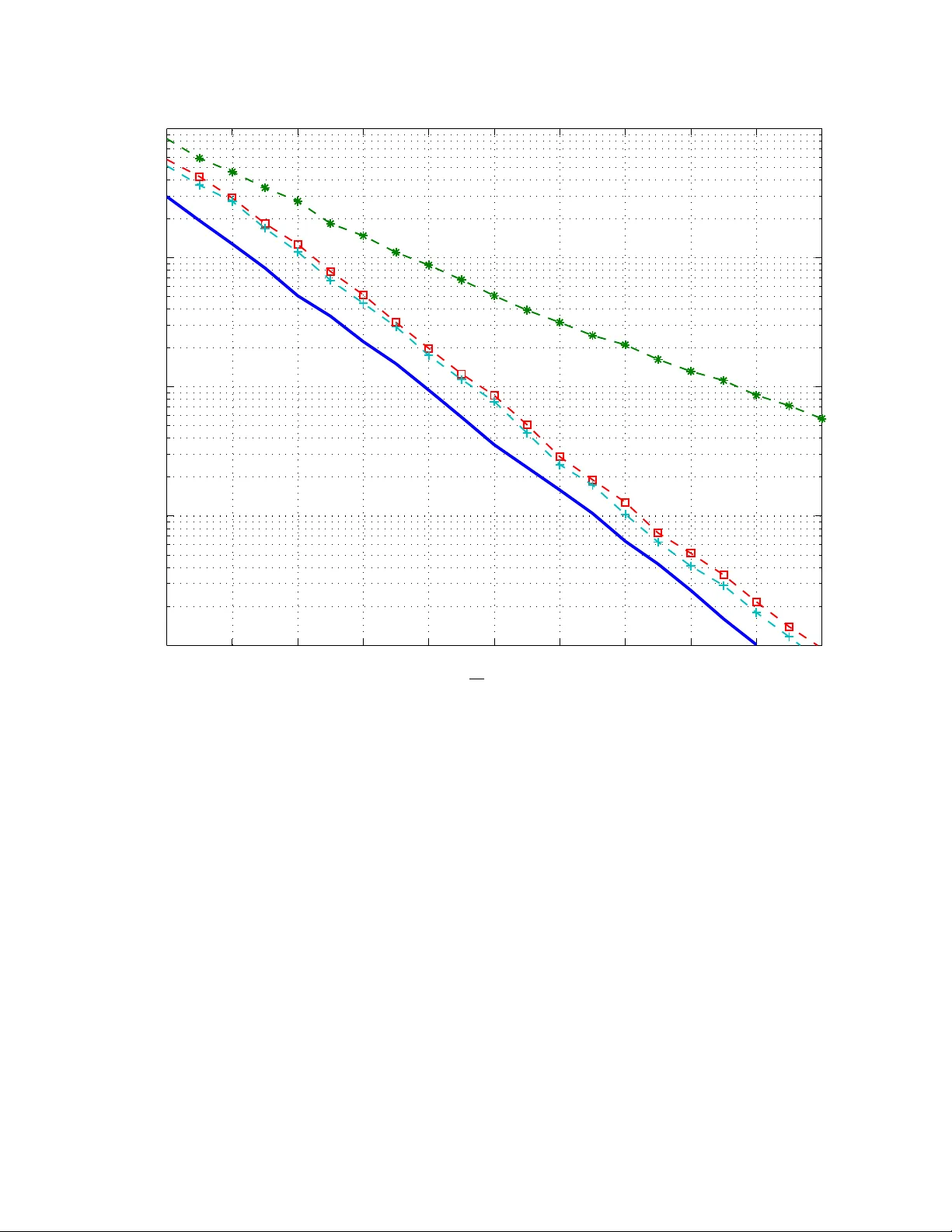
1 Lo w-Density P arity-Check Codes for Noner godic Block-Fading Channels Joseph J. Boutros, Albert Guill ´ en i F ` abreg as, Ezio Biglieri, and Gilles Z ´ emor Abstract W e solve the problem of designing po werful low-density parity-check (LDPC) codes with itera- tiv e decoding for the block-f ading channel. W e first study the case of maximum-likelihood decoding, and sho w that the design criterion is rather straightforward. Unfortunately , optimal constructions for maximum-likelihood decoding do not perform well under iterati ve decoding. T o ov ercome this limitation, we then introduce a ne w family of full-di versity LDPC codes that exhibit near -outage-limit performance under iterati ve decoding for all block-lengths. This f amily competes with multiple xed parallel turbo codes suitable for nonergodic channels and recently reported in the literature. Joseph J. Boutros (Email: boutros@ieee.org ) is with T exas A&M Univ ersity at Qatar, Doha, Qatar . Albert Guill ´ en i F ` abregas (Email: guillen@ieee.org ) is with the Department of Engineering. University of Cambridge, Cambridge, UK. Ezio Biglieri (Email: e.biglieri@ieee.org ) is with DITIC, Universitat Pompeu Fabra, Barcelona, Spain. Gilles Z ´ emor (Email: zemor@math.u-bordeaux1.fr ) is with the Institut de Math ´ ematiques de Bordeaux, Universit ´ e de Bordeaux 1, Bordeaux, France. This work has been presented in part at the 2007 Information Theory and Applications W orkshop, San Diego, CA, USA, January-February 2007. The work of Ezio Biglieri was supported by the Spanish Ministery of Education and Science under Project TEC2006- 01428/TCM. October 22, 2018 DRAFT 2 I . I N T RO D U C T I O N The block-fading (BF) channel model was first introduced in [16], and further elaborated upon in [2] (see also [1, p. 98 ff.]). This is a realistic and con venient model for a number of channels af fected by slowly v arying fading, and, as observed for example in [6], is especially relev ant in wireless communications in volving slo w time–frequency hopping (e.g., cellular networks and wireless Ethernet) or multicarrier modulation using orthogonal frequenc y division multiplexing (OFDM). The design of error-control codes for BF channels of fers a challenging problem, which dif fers greatly from its counterparts referred to additi ve white Gaussian noise (A WGN) or independent-fading channels (see [6] for a summary of recent results). The main reason for this unlikeness stems from the fact that in BF channels the random channel gains remain constant during a block of symbols (see below for additional details and definitions), and take independent v alues from block to block. As a result, while the word-error probability in independent-fading channels depends on the Hamming distances between code words, in BF channels it depends on a ne w parameter , the blockwise Hamming distance . Since codes exhibiting a large minimum Hamming distance may not hav e a large blockwise Hamming distance, codes that are good when used on the independent-fading channel may not be as good for a BF channel. In addition, ov er independently faded channels permutations of the symbols cause no variation of the code performance, but this property does not hold on the BF channel. Thus, if an off-the-shelf code, designed for the independent-f ading channel, is used for transmission over the BF channel, it is important to carefully select the best permutation of its symbols. Finally , one must consider that the BF channel is noner godic. As a consequence, to determine the information-theoretical rate limit which cannot be surpassed by the word error probability of any coding scheme, one cannot use channel capacity , b ut rather outage pr obability [1], [2], [16]. Classical random-lik e codes, designed to approach er godic capacity , cannot generally approach the ideal performance limits of BF channels, and hence code designs suited to the nonergodic nature of the channel are called for . This paper is dev oted to this design problem. T wo main parameters that determine the error rate of coded BF channels for high signal- to-noise (SNR) ratios are the diversity or der and the coding gain . The former determines the October 22, 2018 DRAFT 3 slope of the error-rate curve as a function of the SNR on a log-log scale 1 . Since the error probability of any coding scheme is lower -bounded by the outage probability , the div ersity order is upper-bounded by the intrinsic diversity of the channel, which reflects the slope of the outage limit. When maximum div ersity is achiev ed by a code, the coding gain yields a measure of SNR proximity to the outage limit. The maximum achie v able div ersity order with discrete input constellations is gi ven by the Singleton bound [6], [11], [14], and codes achieving the Singleton bound are termed blockwise maximum-distance separable (MDS). Blockwise MDS codes are outage-achie ving o ver the (noiseless) block-erasure channel [7], but may not achie ve the outage- probability limit on noisy BF channels. As a matter of fact, as shown in [6], blockwise MDS codes are necessary , b ut not sufficient to approach the outage probability of the channel. Recent code designs for BF channels include near-outage schemes based on a suitable permu- tation of parallel turbo codes [3]–[5]. Multiplex ers for con volutional, turbo and repeat-accumulate codes [3], [6], [11] appeared one decade after the analysis of random and periodic interleaving of con volutional codes on the block-erasure channel [13]. Random ensembles of low-density parity- check codes (LDPC) designed for ergodic A WGN channels [9], [19], in spite of the excellent decoding threshold of their irregular structures, do not hav e full-div ersity , and hence exhibit a poor performance over a BF channel. Decoding thresholds of LDPC code ensembles over ergodic BF channels have been studied [10]. Unfortunately , these codes are not designed to be blockwise MDS, and therefore fail to achieve the outage limit in the noner godic setup. In this w ork, we introduce a ne w family of blockwise MDS LDPC codes, the r oot LDPC codes , based on a special type of checknode that we call r ootchec ks . Under iterati ve message-passing decoding, they achie ve the outage-probability limit on block-erasure channels, and they perform close to that limit on Rayleigh BF channels. This paper is organized as follo ws. Section II introduces the channel model and the rele v ant notations. LDPC codes with full div ersity under Maximum Likelihood (ML) decoding are discussed in section III. Our ne w family of LDPC codes suited for iterativ e decoding is further described. Section V analyzes their density ev olution in the presence of block fading. Conclusions are finally drawn in Section VI. Complementary support material is sho wn in the Appendix. 1 The div ersity order is exactly the asymptotic slope for Rayleigh fading, while for other fading distrib utions it is only proportional to the slope. See [15], [22] for details. In this paper we shall restrict our attention to Rayleigh fading. October 22, 2018 DRAFT 4 α 1 α 1 α 1 α 2 α 2 α 2 . . . . . . N N 2 N 2 Fig. 1. Code word representation for a BF channel with n c = 2 . The fading gains α 1 , α 2 are independent between themselv es and among codew ords. I I . C H A N N E L M O D E L A N D N OTA T I O N W e consider code words of N binary digits transmitted on a BF channel, where n c independent fading gains (whose values form the channel state ) affect each code word. The length N is a multiple of n c , with ` , N /n c denoting the number of bits per fading block. The recei ved signal when symbol x i is transmitted is giv en by y i = α j x i + z i (1) where y i ∈ R , i = 1 . . . N , and j = 1 + [( i − 1) /` ] , with [ r ] denoting the integer part of a real number r . The nonnegati ve real number α j is the fading gain at block j , j = 1 . . . n c . The symbols x i are chosen from a BPSK alphabet, x i = ± √ E s , where E s is the av erage energy per symbol. The noise samples are i.i.d. with z i ∼ N (0 , σ 2 ) , σ 2 = N 0 / 2 . W e assume perfect channel state information (CSI) at the recei ver , and channel gains which are i.i.d. Rayleigh-distributed from block to block and from codew ord to codew ord. Thus, when the information rate is R bits per channel use, the av erage SNR per symbol is gi ven by γ = E s / N 0 , and the av erage SNR per bit is E b / N 0 = γ /R . Fig. 1 illustrates the channel model for n c = 2 and ` = N / 2 . In this work, we focus on linear binary codes C ( N , K ) 2 with block length N , dimension K , and rate R = K / N ≤ 1 /n c ≤ 1 / 2 . The code C is defined by an L × N parity-check matrix H (Fig. 2), or , equiv alently , by the corresponding T anner graph [1]. This has L single-parity checknodes. It is assumed that H has full rank L , so that R = 1 − L/ N . For a gi ven nonzero codeword c ∈ C , we define the blockwise Hamming weight vector October 22, 2018 DRAFT 5 S 1 S 2 H = N L ≥ N / 2 H 1 H 2 Fig. 2. Parity-check matrix notations for a block-fading channel with n c = 2 . The L − N / 2 extra ro ws are added in order to enhance the coding gain of a full-di versity code. ( ω 1 , . . . , ω n c ) , where ω j is the Hamming weight of the coded bits affected by fading α j . F ollo wing [6], [11] we define the block diversity of C as d = min c ∈ C −{ 0 } |{ ω j 6 = 0 }| . In w ords, the block di versity is the minimum number of blocks that ha ve non-zero Hamming weight, or the blockwise Hamming distance. Qualitativ ely , this implies that an ML decoder of C will be able to decode correctly in presence of d − 1 deep fades, which one can think of as block erasures. W e also define the minimum blockwise Hamming weight as ω ? = min c ∈ C −{ 0 } ( ω 1 , . . . , ω n c ) . Definition 1 An err or-corr ecting code is said to have full div ersity if ω ? > 0 . Having ω ? > 0 implies that d = n c , having nonzero weight in all blocks. No w , observ e that the blockwise Singleton bound [1], [6], [11], [14] d ≤ 1 + b n c (1 − R ) c determines R = 1 /n c as the highest achie v able rate for a full-div ersity code. Furthermore, the word error probability of a code with div ersity n c decreases as 1 /γ n c at high SNR [1], [17], October 22, 2018 DRAFT 6 [22]. The block-fading channel is not information stable [21], and therefore its Shannon capacity is zero since there is a non-v anishing probability that the decoder makes a word err or . In the limit of large block length, this probability is the information outa ge pr obability , defined as [2], [16] P out ( γ , R ) , P {I ( γ , α ) < R } (2) where I ( γ , α ) is the instantaneous input–output mutual information between the input and output of the channel, defined as I ( γ , α ) , 1 n c n c X i =1 I A W GN ( γ α 2 i ) , (3) with I A W GN ( s ) the input–output mutual information of an A WGN channel with SNR per symbol equal to s . The BF channel is also commonly referred to as nonergodic since, for finite v alues of n c , I ( γ , α ) is a non-constant random variable. The information outage probability P out ( γ , R ) is a fundamental lower bound on the word error rate for sufficiently large word length. Therefore, any code approaching P out ( γ , R ) should have a word-error probability that, as N increases, becomes independent of the code length [4], [6]. Unless stated otherwise, we shall focus our study on a coding rate R = 1 2 (or just slightly smaller than 1 2 ) and a nonergodic Rayleigh fading channel with n c = 2 blocks per codew ord, as depicted in Figs. 1 and 2. Ho wev er , most of our results can be easily generalized to R = 1 n c . I I I . F U L L - D I V E R S I T Y L D P C C O D E S U N D E R M L D E C O D I N G In this section, we study LDPC codes in the presence of BF under ML decoding. As we shall see, the design of full-di versity LDPC codes under ML decoding is rather straightforw ard. W e recognize that ML decoding is unfeasible in practice; howe ver , it yields valuable insight into code structures suitable for noner godic channels. The main result of this section is somewhat negati ve: under iterativ e decoding, ML-designed full-div ersity codes fail to guarantee di versity , due to badly located pseudo-code words. Follo wing the notations defined in the previous section, the L × N parity-check matrix H is written in the form H = [ H 1 | H 2 ] , where the left and right parts H 1 , H 2 are L × N/ 2 . The vector space generated by the N / 2 left columns is denoted S 1 . Similarly , S 2 is the vector space generated by the N / 2 right columns. October 22, 2018 DRAFT 7 Proposition 1 A binary code C with rate R ≤ 1 2 , i.e. L ≥ N / 2 , has full diversity if and only if H 1 and H 2 ar e both full-rank. Pr oof: If dim S 1 = N / 2 , then a nonzero codeword cannot hav e its support on H 1 , because all columns in H 1 are independent. Hence, ω 2 > 0 for all nonzero codewords. Similarly , ω 1 > 0 when dim S 2 = N/ 2 . Finally , ω 1 > 0 and ω 2 > 0 for all nonzero codew ords, which yields ω ? > 0 . The full-rank property of the abov e proposition was first observed in [8]. Its extension to coding rate 1 / 3 with H = [ H 1 | H 2 | H 3 ] can be obtained by imposing that the matrices [ H 1 | H 2 ] , [ H 1 | H 3 ] , and [ H 2 | H 3 ] all ha ve full rank. Generalization to any rate R = 1 n c is straightforward 2 . Proposition 2 Consider a binary code C with r ate R = 1 / 2 , and hence with L = K = N / 2 . If C has full diversity , then ω ? = 1 . Pr oof: If C has full di versity , then dim S 1 = dim S 2 = N / 2 . Any column from H 1 can then be written as a linear combination of columns from H 2 . This is also v alid for any column belonging to H 2 . Hence, nonzero code words with ω i = 1 exist for both i = 1 and i = 2 if the coding rate is exactly equal to 1 / 2 . The minimum blockwise Hamming weight must be increased in order to improve the coding gain of C . Proposition 2 states that to achiev e this, one must decrease the coding rate. The next proposition sho ws that adding just one extra ro w is enough to mo ve from ω ? = 1 to ω ? = 2 under ML decoding. Proposition 3 Ther e e xists a binary code C of r ate R = 1 / 2 − 1 / N that has full diversity with ω ? = 2 . Pr oof: The proof is based on the special parity-check matrix structure sho wn in Fig. 3 where H 2 is a full-rank matrix whose columns have odd Hamming weight (the identity matrix, for example). Let now H 1 be such that its first column is the all zero vector , and the remaining N / 2 − 1 columns are all ev en-weight and full-rank. 2 T wo interesting combinatorial problems arising from this Proposition are the following: (1) What is the probability of a random binary matrix to be full-rank? And, (2) What is the probability of a random binary sparse matrix to be full-rank? October 22, 2018 DRAFT 8 Next, we show that the ω ? corresponding to this construction is 2 . Clearly the first (leftmost) N / 2 columns of H and the last (rightmost) N / 2 columns of H hav e full rank, so that we have ω ? ≥ 1 . None of the first N / 2 columns of H can be a linear combination of the last N / 2 columns of H , due to the 1 in the last position of each of the first columns. None of the last N/ 2 columns of H can be a linear combination of the first N / 2 columns of H , because columns of H 2 hav e odd weight and any linear combination of columns of H 1 has ev en weight. These last statements imply that ω ? ≥ 2 . 111.......................111 000.........................000 S 1 S 2 H = N H 1 H 2 L = N 2 + 1 Fig. 3. ML-designed full-div ersity LDPC code with ω ? = 2 . The rate reduction necessary to achie ve ω ? = 2 is negligible for lar ge code length N . If we no w require ω ? = 3 , the follo wing result holds: Proposition 4 Consider a binary code C with rate R ≤ 1 / 2 . The code has ω ? = 3 only if R ≤ 1 / 2 − (1 / N ) log 2 (1 + N / 2) . Pr oof: Denote by H col 2 the set of columns of H 2 . Consider the 1 + N / 2 sets consisting of H col 2 together with its translates h 1 + H col 2 for all columns h 1 of H 1 . No two of these sets can intersect, otherwise either a column of H 1 , or a sum of tw o columns of H 1 , equals a sum of columns of H 2 , which would imply the existence of a code word of weight at most 2 on the first N / 2 positions. Therefore we must hav e 2 L ≥ (1 + N / 2)2 N/ 2 . October 22, 2018 DRAFT 9 Proposition 5 Ther e e xists a full-diversity binary code with ω ? ≥ 3 and R = 1 / 2 − (1 / N )2 log 2 ( N / 2+ 1) . Pr oof: The code has the parity-check matrix of Fig. 4. The presence of a Hamming code whose minimum distance is 3 rules out a blockwise Hamming weight equal to 2 . null block Hamming code Hamming code null block S 1 S 2 H = N H 1 H 2 L = N 2 + 2 lo g 2 ( N 2 + 1) Fig. 4. ML-designed full-div ersity LDPC code with ω ? ≥ 3 . W e are now in a position to examine the word-error rate of full-di versity LDPC codes designed for ML decoding, and compare it to the outage capacity limit. The results are illustrated in Fig. 5, for n c = 2 and the (3 , 6) ensemble using the constructions outlined above. W ith iterativ e decoding, an ML-designed LDPC code has di versity one. This ef fect is caused by the pseudo- code words [12] whose support is restricted to H 1 or H 2 , and hence have a minimum blockwise pseudo-weight equal to zero when iterativ e belief propagation decoding is applied. Even a random LDPC code (not shown in the figure) performs as poorly as an ML-designed code with ω ? = 1 . On the other hand, full di versity is guaranteed when a “genie-aided” ML decoder is used which kno ws whether errors occur in positions corresponding to H 1 or to H 2 . I V . F U L L - D I V E R S I T Y L D P C C O D E S F O R I T E R A T I V E B E L I E F P R O PAG AT I O N D E C O D I N G The results presented at the end of Section III show that, if iterati ve decoding is used, the design criteria deri ved under the assumption of ML decoding are irrelev ant. In this section, we proceed to design LDPC codes with the stipulation of iterativ e decoding. Our design is based October 22, 2018 DRAFT 10 10 12 14 16 18 20 22 24 26 28 30 10 −5 10 −4 10 −3 10 −2 10 −1 E b N 0 ( d B ) W o r d E r r o r R a t e Fig. 5. Rate 1 / 2 ML-designed LDPC codes with iterativ e decoding on a Rayleigh block-fading channel with n c = 2 . The thick solid line corresponds to the outage probability with BPSK inputs, the dotted lines with ∗ markers corresponds to the ML-designed code with iterati ve decoding, the dotted lines with markers corresponds to the ML-designed code with ω ? = 1 using a genie ML decoder and the dotted lines with + markers corresponds to the ML-designed code with ω ? = 3 using the genie ML decoder . The genie ML curves sho w the performance of a decoder that knows whether errors occur in positions corresponding to H 1 or H 2 . on a graphical representation [1], [20], which is then translated into a matrix description. W e then analyze the construction by means of log-ratio probability-density ev olution. A. A limiting case: bloc k-erasur e channels W e illustrate our solution to the design problem by referring to a limiting case. Specifically , observe that, if the fading coefficients α i belong to the set { 0 , + ∞} , the BF channel becomes a block-erasure channel [7], [13]. This corresponds to the large SNR regime. The reader is referred October 22, 2018 DRAFT 11 to Fig. 6, where the outage boundaries are illustrated (see [4] for more details). In our approach, we need to find a graph whose topology yields full div ersity . For simplicity , we illustrate the case of the (3 , 6) LDPC ensemble with n c = 2 (generalizations to other degree distributions and rates will be treated infra ). Fig. 7 shows the notation employed in this section. T wo examples of local graphs whose div ersity is not guaranteed are shown in Fig. 8. The checknodes defining an LDPC code are single-parity check codes, and hence they cannot tolerate more than one erased bit. F or example, if α 1 = 0 then the checknodes in Fig. 8 are not able to recov er the erased bit, because it is connected to bitnodes which are also erased, because they are subject to the same fading coefficient. Notice also that the design must be symmetric, i.e., any analysis with respect to α 1 is valid for α 2 , and hence permuting the order of the two fading gains should yield an equi valent design. The two unique local graphs that guarantee full di versity in the presence of block erasures are exhibited in Fig. 9. The immediate consequence is the definition of r ootchecks . W e start by building a regular (3 , 6) structure where bitnodes hav e degree 3 and checknodes have degree 6 , next we generalize to any ( λ ( x ) , ρ ( x )) degree distrib ution [19]. A checknode Φ connected to + + + + + + + + + + + + + + + + + + + + + + + + + + + + + + + + + + + + + + + + + + + + + + + + ergodic line bad code good code outage bound block-erasure channel block-erasure channel Fig. 6. Outage boundaries in the f ading plane for a BF channel with n c = 2 . T o approach the outage limit, one should: (a) Reduce the gap on the ergodic line, which requires an excellent decoding threshold, and (b) Reduce the gap at infinity , which requires a full-div ersity code (MDS) on a block-erasure channel. October 22, 2018 DRAFT 12 bits ϑ 1 , ϑ 2 , . . . , ϑ 6 is written as Φ( ϑ 1 , ϑ 2 , . . . , ϑ 6 ) . Definition 2 Let ϑ be a binary element transmitted on fading α 1 . A type- 1 r ootchec k for ϑ is a chec knode Φ( ϑ, ϑ 1 , . . . , ϑ 5 ) where all bits ϑ 1 , . . . , ϑ 5 ar e tr ansmitted on fading α 2 . T ype- 2 rootchecks are defined similarly . variable node on variable node on variable node on variable node on α 2 α 2 α 1 α 1 connected to a rootcheck connected to a rootcheck check node Fig. 7. Notations for graph representation. Using Definition 2, consider a length- N , rate- 1 / 2 LDPC code. Information bits are split into two classes: N/ 4 bits (tagged 1 i ) are transmitted on α 1 , while N / 4 bits (tagged 2 i ) are transmitted on α 2 . Parity bits are also partitioned into two sets, say 1 p and 2 p . Finally , we connect all information bits to rootchecks in order to guarantee full div ersity when word error probability is measured on those bits. The protection of parity bits is abandoned. This design produces the bipartite T anner graph drawn in Fig. 10(a). Its e xtension to rate 1 / 3 is portrayed in Fig. 11. Inte gers labeling edges indicate the degree of a node along those edges. The structure of H for a root-LDPC code is directly deriv ed from its T anner graph, and is shown in Fig. 10(b). The N/ 4 × N / 4 identity matrix is written twice in connections 1 i ↔ 1 c and 2 i ↔ 2 c . T wo October 22, 2018 DRAFT 13 Fig. 8. T wo examples of bad configurations under belief propagation decoding on a block-fading channel. Φ ϑ 1 ϑ 5 ϑ Φ ϑ 1 ϑ 5 ϑ ϑ 2 ϑ 3 ϑ 4 ϑ 4 ϑ 3 ϑ 2 Fig. 9. The two unique good configurations (rootchecks) under belief propagation decoding on a block-fading channel. all-zero N/ 4 × N/ 4 submatrices prohibit an y edge of type 1 p ↔ 1 c and 2 p ↔ 2 c . The other 4 submatrices are all sparse, H 1 i and H 2 i are random sparse matrices of Hamming weight 2 per ro w and per column. Similarly , H 1 p and H 2 p are random sparse matrices of Hamming weight 3 per row and per column. An irregular version of a root-LDPC code can be b uilt from a left degree distribution λ ( x ) and a right degree distribution ρ ( x ) by appropriately modifying the weight distribution of the 4 sub- matrices H 1 i , H 2 i , H 1 p , and H 2 p . Equiv alently , the degree distribution changes the distribution of edges connected to non-rootchecks in the T anner graph. Irre gularity has no influence on the di versity order because rootchecks are maintained. Irre gularity should enhance the coding gain by pushing the code boundary near the outage capacity limit on the er godic line. October 22, 2018 DRAFT 14 N 4 nodes N 4 nodes N 4 nodes N 4 nodes N 4 nodes N 4 nodes 1 i 1 p 1 c 2 c 2 i 2 p 1 3 2 1 3 2 (a) T anner graph. 1 1 1 1 0 1 1 1 1 0 H = 1 p 2 p 1 c 2 c H 1 i H 1 p H 2 i H 2 p 1 i 2 i (b) Parity-check matrix. Fig. 10. T anner graph and parity-check matrix for a re gular (3,6) root-LDPC code of rate 1 / 2 . An irre gular structure ( λ ( x ) , ρ ( x )) can be easily plugged on edges connected to non-root checknodes. Proposition 6 Consider a rate- R = 1 / 2 r oot-LDPC code with de gr ee distribution ( λ ( x ) , ρ ( x )) transmitted on a block-er asur e channel with n c = 2 . Then, under iterative message passing decoding, the r oot-LDPC code has full-diversity . Pr oof: The two fading coefficients α 1 and α 2 are independent and take two possible v alues { 0 , + ∞} . Examining the T anner graph of Fig. 10(a), we observe that the only outage ev ent occurs when α 1 = α 2 = 0 (both blocks erased). Indeed, when α 1 = 0 and α 2 = + ∞ , it is October 22, 2018 DRAFT 15 nodes nodes nodes nodes 1 i 1 p 2 i 2 p 3 p 3 i nodes nodes N 9 N 9 N 9 2 N 9 2 N 9 2 N 9 nodes N 9 nodes N 9 nodes N 9 nodes N 9 nodes N 9 nodes N 9 1 c 2 1 c 3 2 c 1 3 c 1 3 c 2 2 c 3 Fig. 11. T anner graph for a regular (4,6) root-LDPC code of rate 1 / 3 . The introduction of any ( λ ( x ) , ρ ( x )) irregularity is always possible on edges connected to non-root checknodes. straightforward to see that information bits 1 i are determined using rootchecks 1 c . Similarly , when α 1 = + ∞ and α 2 = 0 , information bits 2 i are determined using rootchecks 2 c . On a block-erasure channel, let be the probability that α i be equal to 0 . From the proof of Proposition 6 abov e, we find that the word error probability of a root-LDPC code is 2 . As shown in [7], this is precisely the outage probability of the channel, and therefore, full- di versity blockwise MDS codes are outage achieving in the block-erasure channel. As remarked in [7], blockwise MDS codes are necessary , but not suf ficient to achiev e the outage limit in noisy channels. In the follo wing, we study the behavior of root-LDPC o ver general Rayleigh BF A WGN channels. October 22, 2018 DRAFT 16 B. The gener al case No w we study the general case of Rayleigh BF . Some simple facts about 4 th-order χ 2 distributions are revie wed in the Appendix. In the sequel, we use the notations of the Appendix to analyze the div ersity metric in log-ratio messages. Proposition 7 Consider a rate- 1 / 2 , ( λ ( x ) , ρ ( x )) r oot-LDPC code transmitted on a Rayleigh block-fading channel with n c = 2 . Then, under iterative belief pr opagation decoding, the r oot- LDPC code has full-diversity . Pr oof: As indicated in the design of a root-LDPC code before Proposition 6, the diversity order of a root-LDPC code does not depend on its left or right de gree distrib ution. This can also be pro ved via the e volution trees in the ne xt section. Thus, we restrict this proof to a regular (3 , 6) LDPC. The e xtension to the irregular case is straighforward. Let Λ a i , i = 1 . . . δ − 1 , denote the input log-ratio probabilistic messages to a checknode Φ of degree δ . The output message Λ e for belief propagation is Λ e = 2 th − 1 δ − 1 Y i =1 th Λ a i 2 ! (4) where th ( x ) denotes the hyperbolic-tangent function. Superscripts a and e stand for a priori and extrinsic , respectiv ely . In order to simplify the proof, we will show that a suboptimal belief propagation decoder is able to achiev e diversity order 2 . Therefore, if a suboptimal decoder achie ves full diversity , the optimal decoder also achiev es full div ersity . Consider the min–sum decoder . The output message produced by a checknode Φ is now approximated by Λ e = min( | Λ a i | ) δ − 1 Y i =1 sign (Λ a i ) (5) a) F irst decoding iteration: W e first study the output after one decoding iteration. W e assume that the all-zero codeword has been transmitted. The channel crossov er probability associated with fading α j , j = 1 , 2 , is j = Q q 2 γ α 2 j October 22, 2018 DRAFT 17 The channel message for a bit ϑ transmitted o ver fading coefficient α is Λ 0 = log p ( y | ϑ = 0 , α ) p ( y | ϑ = 1 , α ) = 2 αy σ 2 = 2 σ 2 ( α 2 + αz ) (6) where y = α + z and z ∼ N (0 , σ 2 ) (assuming E s = 1 ). At the first decoding iteration, all input messages Λ a i in (5) ha ve an expression identical to (6). An information bit ϑ of class 1 i has Λ 0 = 2 σ 2 ( α 2 1 + α 1 z 0 ) . It also receiv es 3 messages Λ e i , i = 1 . . . 3 from its 3 neighboring checknodes. The total a posteriori message corresponding to ϑ is Λ = Λ 0 + Λ e 1 + Λ e 2 + Λ e 3 . Let Λ e 1 be the extrinsic message generated by the rootcheck of class 1 c connected to ϑ . The error rate P e (1 i ) on class 1 i is gi ven by the neg ati ve tail of the density of Λ messages. The addition of Λ e 2 + Λ e 3 to Λ 0 + Λ e 1 cannot degrade P e (1 i ) because the con volution with the density of messages from non-rootchecks can only physically upgrade the resulting density . Thus, it is suf ficient to prove that message Λ 0 + Λ e 1 brings full div ersity . The expression of Λ e 1 is found by applying (5). Input messages to the rootcheck are ne gati ve with probability 2 . Then Λ e 1 = S 1 2 σ 2 ( α 2 2 + α 2 z 1 ) where S 1 = X i even 4 i i 2 (1 − 2 ) 4 − i − X i odd 4 i i 2 (1 − 2 ) 4 − i W e obtain Λ e 1 = (1 − 2 2 ) 4 2 σ 2 ( α 2 2 + α 2 z 1 ) The partial a posteriori log-ratio message becomes Λ 0 + Λ e 1 = 2 σ 2 α 2 1 + (1 − 2 2 ) 4 α 2 2 + α 1 z 0 + (1 − 2 2 ) 4 α 2 z 1 ) The embedded metric Y = α 2 1 + (1 − 2 2 ) 4 α 2 2 guarantees full di versity . At high SNR (i.e., when E b / N 0 → + ∞ ), Y behav es exactly as α 2 1 + α 2 2 . b) Further decoding iterations: As can be seen from the decoding tree of a bitnode 1 i in Fig. 14, the di versity order 2 is maintained after the first iteration. Indeed, at the input of the rootcheck, information bits of class 2 i hav e already full diversity and parity bits 2 p bring always a term proportional to α 2 2 . Due to the particular structure of root-LDPC codes, the density of October 22, 2018 DRAFT 18 message Λ 0 + Λ e 1 can only be improved with respect to the first iteration. Hence, full di versity is preserved. The proof of the previous proposition is based on showing that the information bits have di versity 2 . In the following, we examine the di versity of the parity bits. A parity bit ϑ of class 1 p has Λ 0 = 2 σ 2 ( α 2 1 + α 1 z 0 ) . It also recei ves 3 messages Λ e i , i = 1 . . . 3 from its 3 neighboring checknodes all of class 2 c . The total a posteriori message of ϑ is Λ = Λ 0 + Λ e 1 + Λ e 2 + Λ e 3 . No w let us determine the nature of Λ e i based on input messages to a checknode Φ of class 2 c as illustrated in Figures 10(a) and 15. The node Φ is not a rootcheck. W e need to determine the metric Y embedded in its output message. In the case α 2 ≤ α 1 (this happens with probability 1 / 2 ), it can be shown that, after one decoding iteration, the e xtrinsic message produced by Φ satsifies Λ e i = S 2 σ 2 ( α 2 2 + α 2 z ) with probability G 4 ≥ 1 16 S 2 σ 2 ( α 2 1 + α 1 z ) with probability 1 − G 4 ≤ 15 16 where the function G is defined in the Appendix. On the contrary , when α 2 ≥ α 1 , it can be sho wn that Λ e i = S 2 σ 2 ( α 2 2 + α 2 z ) with probability G 4 ≤ 1 16 S 2 σ 2 ( α 2 1 + α 1 z ) with probability 1 − G 4 ≥ 15 16 W e conclude that, for parity bits, with a probability greater than 1 2 × 15 16 , the output message has di versity order one. In spite of the presence (with a nonzero probability) of di versity- 2 messages, the error probability of parity bits will be dominated by weak messages with di versity 1 . The abov e arguments are still v alid for further decoding iterations. Finally , we look at the minimum partial Hamming weight ω ? under belief propagation decod- ing. Corollary 1 A r oot-LDPC code with R = 1 / 2 has full-diversity under iterative belief pr opaga- tion decoding. Pr oof: Consider an information bit ϑ of class 1 i . Let δ b ≥ 2 be the degree of ϑ . At high SNR, the log-ratio message produced by its rootcheck has an embedded metric α 2 1 + α 2 2 . Consider the δ b − 1 non-root checknodes connected to ϑ . Since parity bits of class 1 p dominate the error October 22, 2018 DRAFT 19 probability at the input of 2 c checknodes, then its metric will be α 2 1 . Finally , the a posteriori log-ratio message associated to ϑ will contain a metric of the type δ b α 2 1 + α 2 2 which has div ersity 2. In Fig. 12, we illustrate the performance of the (3 , 6) root-LDPC ensemble. As we observe, the performance is similar for all ranges of N , and it is also close to the outage probability of the channel. This ef fect was first observed with blockwise-concatenated codes and repeat-accumulate codes in [6], and then in [3]–[5] for parallel turbo codes. This ef fect is due to the threshold behavior of good codes, i.e., for a gi ven channel realization, the code has a SNR threshold (independent of N ) below which the decoder cannot decode successfully . Hence, whene ver this threshold is lar ger than the SNR γ , the decoder will make an error for suf ficiently large word length [6]. This is considered in more detail in the follo wing section, where the analysis of the word error probability under iterati ve decoding for large N is done using density e v olution. V . D E N S I T Y E V O L U T I O N I N P R E S E N C E O F B L O C K FA D I N G The e volution of message densities [18], [20] under iterativ e decoding is described through six e v olution trees for a binary LDPC root-code. The e volution trees represent the local neighborhood of a bitnode in an infinite-length code whose graph has no c ycles. Figs. 13, 14, and 15 sho w the local neighborhoods of classes 1 i and 1 p . Similar e volution trees can be dra wn for classes 2 i and 2 p . Full di versity in the presence of fading is guaranteed, thanks to messages 1 c → 1 i (respecti vely , 2 c → 2 i ) as indicated in the proof of Proposition 7. Irregularity is defined in the standard way [19] through the polynomials λ ( x ) and ρ ( x ) . The polynomial λ ( x ) is replaced by ˜ λ ( x ) = λ ( x ) /x each time an edge is isolated at the input of a bitnode. In addition, the polynomial ρ ( x ) is replaced by ˜ ρ ( x ) = ρ ( x ) /x each time an edge is isolated at the input of a checknode. The following notations are used, where the superscript m is an inte ger denoting the decoding iteration order: • q m 1 ( x ) and q m 2 ( x ) : Probability density functions of log-ratio messages on the edges 1 i → 1 c and 2 i → 2 c respectiv ely . See Fig. 13. • f m 1 ( x ) and f m 2 ( x ) : Probability density functions of log-ratio messages on the edges 1 i → 2 c and 2 i → 1 c respectiv ely . See Fig. 14. • g m 1 ( x ) and g m 2 ( x ) : Probability density functions of log-ratio messages on the edges 1 p → 2 c October 22, 2018 DRAFT 20 10 12 14 16 18 20 22 24 26 28 30 10 −5 10 −4 10 −3 10 −2 10 −1 E b N 0 ( d B ) W o r d E r r o r R a t e Fig. 12. Regular (3,6) root-LDPC codes with iterative decoding on a Rayleigh block-fading channel with n c = 2 . W ord-error rate is measured on information bits. The thick solid line corresponds to the outage probability with BPSK, the dotted lines with × markers correspond to N = 200 , the dotted lines with markers correspond to N = 2000 and the dotted lines with markers ∗ correspond to N = 20000 . and 2 p → 1 c respectiv ely . See Fig. 15. • Let X 1 ∼ p 1 ( x ) and X 2 ∼ p 2 ( x ) be two independent real random variables. The den- sity function of X 1 + X 2 obtained by con volving the two original densities is written as p 1 ( x ) ⊗ p 2 ( x ) . The notation p ( x ) ⊗ n denotes the con v olution of p ( x ) with itself n times. The expression λ ( p ( x )) represents the density function P i λ i p ( x ) ⊗ i − 1 . • Let X 1 ∼ p 1 ( x ) and X 2 ∼ p 2 ( x ) be tw o independent real random v ariables. The density function p ( y ) of the v ariable Y = 2 th − 1 ( th ( X 1 2 ) th ( X 2 2 )) obtained through a checknode is written as p 1 ( x ) p 2 ( x ) and is called R-convolution [20]. The notation p ( x ) n denotes the October 22, 2018 DRAFT 21 α 1 1 i 1 c 2 c 2 c 1 i 1 p 2 i 1 p 1 i 2 i 1 3 1 3 1 1 λ ( x ) ρ ( x ) x ρ ( x ) x Fig. 13. Local neighborhood of bitnode 1 i . This tree is used to determine the ev olution of messages 1 i → 1 c . R-con volution of p ( x ) with itself n times. The expression ρ ( p ( x )) represents the density function P i ρ i p ( x ) i − 1 . Proposition 8 Consider an (er godic) A WGN channel (i.e., assume α 1 = α 2 = 1 ). Under iterative decoding, a ( λ ( x ) , ρ ( x )) r oot-LDPC code has the same decoding thr eshold as a random ( λ ( x ) , ρ ( x )) LDPC code. Pr oof: W ith the two fading gains equal to unity , the six e v olution trees degenerate into a single tree, and all densities become identical: q m 1 ( x ) = q m 2 ( x ) = f m 1 ( x ) = f m 2 ( x ) = g m 1 ( x ) = g m 2 ( x ) for any decoding iteration m . Thus, density e volution of a root-LDPC code reduces to a classical density e v olution of a random code giv en by p m +1 ( x ) = λ ( ρ ( p m ( x ))) . Proposition 9 Consider a nonergodic BF channel with n c = 2 . F or fixed fading coefficients October 22, 2018 DRAFT 22 α 1 1 i 1 c 2 c 1 i 1 p 2 i 2 i 1 3 1 3 2 ρ ( x ) x 2 c ρ ( x ) λ ( x ) x 1 2 p Fig. 14. Local neighborhood of bitnode 1 i . This tree is used to determine the ev olution of messages 1 i → 2 c . ( α 1 , α 2 ) , the density evolution equations of a ( λ ( x ) , ρ ( x )) r oot-LDPC code ar e, for all m , q m +1 1 ( x ) = µ 1 ( x ) ⊗ λ ( q m 2 ( x ) ˜ ρ ( f e f m 1 ( x ) + g e g m 1 ( x ))) f m +1 1 ( x ) = µ 1 ( x ) ⊗ ˜ λ ( q m 2 ( x ) ˜ ρ ( f e f m 1 ( x ) + g e g m 1 ( x ))) ⊗ ρ ( f e f m 1 ( x ) + g e g m 1 ( x )) g m 1 ( x ) = q m 1 ( x ) wher e the multi-edge type fraction is f e = 1 − g e = P i λ i /i P i λ i / ( i − 1) + P i λ i /i and µ 1 ( x ) is the Gaussian density at the output of the channel with fading α 1 . Similar density evolution equations are obtained by permuting the two fading gains. Pr oof: The abov e equations are directly deriv ed from local neighborhoods of bitnodes in the graphical representation of the LDPC code, following standard density ev olution analysis of multi-edge type LDPC codes [20]. October 22, 2018 DRAFT 23 α 1 2 c 2 c 1 i 1 p 2 i 1 p 1 i 2 i 1 2 2 2 2 1 λ ( x ) ρ ( x ) x ρ ( x ) x 1 p 2 c Fig. 15. Local neighborhood of bitnode 1 p . This tree is used to determine the ev olution of messages 1 p → 2 c . T o ev aluate the performance of LDPC codes via density e volution in presence of noner godic fading, we illustrate the results obtained by applying Proposition 9 to the calculation of asymp- totic error probability of the code, in a similar way to what is done in [4]. Three codes are shown in Fig. 16: a random (3 , 6) regular code, a root (3 , 6) regular code, and an LDPC irregular root code with left and right degree distributions giv en by the polynomials [19] λ ( x ) = 0 . 24426 x + 0 . 25907 x 2 + 0 . 01054 x 3 + 0 . 05510 x 4 + 0 . 01455 x 7 + 0 . 01275 x 9 + 0 . 40373 x 11 and ρ ( x ) = 0 . 25475 x 6 + 0 . 73438 x 7 + 0 . 01087 x 8 . Refer again to the outage boundary representation in the fading plane of Fig. 6. Let α 0 be the fading value defined by the intersection of the BPSK outage boundary and the ergodic line. For rate 1 / 2 , this intersection point satifies I b ( α 2 0 E b / N 0 ) = 1 / 2 , where I b ( x ) , I A W GN ( Rx ) is the a verage mutual information on an A WGN channel with a binary input and an SNR per bit October 22, 2018 DRAFT 24 10 12 14 16 18 20 22 24 26 28 30 10 −5 10 −4 10 −3 10 −2 10 −1 E b N 0 ( d B ) W o r d E r r o r R a t e Fig. 16. Density e volution of random-LDPC and root-LDPC codes with iterati ve decoding on a block-fading channel with n c = 2 . The thick solid lines correspond to the outage probability with BPSK, the dotted lines with × markers correspond to the random LDPC, the dotted lines with markers correspond to the (3 , 6) root LDPC and the dotted lines with ∗ markers correspond to the irregular root LDPC ensemble. equal to x . Let α th denote the f ading value defined by the intersection of the LDPC code outage boundary and the ergodic line. Then we ha ve α 2 th = E b N 0 th E b N 0 , October 22, 2018 DRAFT 25 where E b N 0 th is the decoding threshold of the LDPC code over the ergodic A WGN channel. Finally , we obtain α th = α 0 v u u t E b N 0 th I − 1 b ( 1 2 ) = α 0 √ ∆ where ∆ in the signal-to-noise ratio gap separating the decoding threshold and the capacity limit on the Gaussian channel. T o better understand the gain due to irregularity illustrated in Fig. 16, we ev aluate the ratio α th /α 0 . • For the regular (3,6) LDPC code, the threshold is 1 . 09 dB abov e the Gaussian channel. Hence, α th /α 0 = 1 . 107 . • For the irregular LDPC code giv en above, the threshold is 0 . 37 dB abov e the Gaussian channel. Hence, α th /α 0 = 1 . 045 . Using the best irregular code proposed in [19] with a threshold of 0 . 25 dB, we obtain α th /α 0 = 1 . 007 . Hence, with α c /α 0 close to 1 , the area between the outage capacity boundary and the code outage boundary is decreased in the neighborhood of the ergodic line. Ho wev er , this does not ensure that, the code outage boundary would be close to the outage capacity boundary in the critical re gion between the ergodic line and the block-erasure channel. Therefore, in order to approach the outage probability limit, a full-div ersity capacity-achie ving code is necessary , but may not be sufficient. V I . C O N C L U S I O N S W e have studied LDPC codes in the block-fading channel under both ML and iterativ e decoding. W e hav e shown that constructions designed for ML decoders fail to guarantee div ersity under iterati ve decoding. Driv en by this restriction, we hav e introduced the new family of root- LDPC codes, which achieve full div ersity under iterativ e decoding. W e have shown both finite- and infinite-length performance, and we hav e illustrated ho w the error-rate performance of root- LDPC is close to the outage probability limit and almost insensiti ve to the block-length. This makes root-LDPC codes attractiv e for slowly-v arying wireless communications scenarios. October 22, 2018 DRAFT 26 A P P E N D I X I C O D I N G G A I N O F A 4 T H - O R D E R U N B A L A N C E D χ 2 D I S T R I B U T I O N Here we limit our description to a di versity order of 2 , b ut all results are easily e xtendable to rate- 1 /n c coding on a channel with di versity order n c . In the context of ML decoding, the Euclidean distance between two codewords is proportional to ω 1 α 2 1 + ω 2 α 2 2 . As fading α i hav e a Rayleigh density , their squares are exponentially distributed, i.e., p α 2 i ( x ) = e − x . The latter is a central χ 2 distribution of order 2 with parameter σ 2 = 1 / 2 [17]. Di versity 2 is achie ved with a χ 2 distribution of order 4 . Hence, a full-diversity code must satisfy ω 1 > 0 and ω 1 > 0 in order to get the order - 4 , χ 2 distributed, metric ω 1 α 2 1 + ω 2 α 2 2 . Once maximum di versity is guaranteed, the maximization of the product ω 1 ω 2 increases the coding gain. The abov e simple facts are still v alid in the context of iterati ve probabilistic decoding. Let Λ be the a posteriori probability log-ratio of a binary element b . Achie ving full div ersity under iterati ve decoding is equi v alent to letting Λ behave as the metric Y = aα 2 1 + bα 2 2 , where a and b are two positi ve real numbers. The energy of Y is normalized, a + b = 1 . The exact mathematical expression relating Λ to Y depends on the type of iterativ e algorithm used for decoding, e.g., Λ ∝ Y + ν where ν is an additiv e noise. T o understand the influence of the product ab on the performance, one should study the error probability associated with Y , i.e. P ( Y < T ) = F ( a, b, T ) . When a = b = 1 / 2 , the order - 4 χ 2 distribution is balanced, and its probability density function is p Y ( y ) = 4 y e − 2 y (7) When a 6 = b = 1 − a , the order -4 χ 2 distribution is unbalanced, and its probability density function is p Y ( y ) = ( e − y /a − e − y /b ) 2 a − 1 (8) The expression of P ( Y < T ) = F ( a, b, T ) is obtained after integrating p Y ( y ) . The di versity order and the coding gain embedded in Y appear when T 1 . F or a balanced χ 2 distribution, we have F ( a, b, T ) = 1 − e − 2 T (1 + 2 T ) = 2 T 2 + o( T 2 ) (9) October 22, 2018 DRAFT 27 For an unbalanced χ 2 distribution, we obtain F ( a, b, T ) = 1 − ae − T /a − be − T /b 2 a − 1 = T 2 2 ab + o( T 2 ) (10) In Fig. 17, the performance function F ( a, b, T ) is plotted v ersus γ = 1 /T on a double log arithmic scale for different values of a and b . The slope is always 2 (i.e., F ( a, b, T ) ∝ 1 /γ 2 ) for all positi ve v alues of a and b . The function F degenerates to T + o( T ) when b = 0 (div ersity order equal to 1 instead of 2 ). Notice also that an unbalanced χ 2 distribution with a = 3 / 4 and b = 1 / 4 generates a coding loss about 0 . 65 dB. This loss is slightly higher (about 0 . 75 dB) when considering P (Λ < 0) for Λ ∝ Y + ν since additiv e noise depends on the fading coef ficients as sho wn in Section IV. 10 12 14 16 18 20 22 24 26 28 30 10 −5 10 −4 10 −3 10 −2 10 −1 1 T ( d B ) P r ( Y < T ) a = 1 2 , b = 1 2 a = 3 5 , b = 2 5 a = 3 4 , b = 1 4 a = 9 1 0 , b = 1 1 0 a = 9 9 1 0 0 , b = 1 1 0 0 a = 1 , b = 0 Fig. 17. Coding gain and di versity order of Y = aα 2 1 + bα 2 2 ( χ 2 of 4 th order) where α 1 and α 2 are Rayleigh distributed. October 22, 2018 DRAFT 28 0 0.5 1 1.5 2 0 0.5 1 1.5 2 10 −12 10 −10 10 −8 10 −6 10 −4 10 −2 10 0 α 1 α 2 G = P r ( | X 2 | < | X 1 | ) Fig. 18. A 3D plot of G = Pr( | X 2 | < | X 1 | ) versus α 1 and α 2 for a variance σ 2 = 1 / 10 . A P P E N D I X I I T H E B I D I M E N S I O N A L C U M U L A T I V E D E N S I T Y F U N C T I O N G = Pr( | X 2 | < | X 1 | ) Consider two real independent Gaussian random variables X 1 ∼ N ( α 2 1 , α 2 1 σ 2 ) and X 2 ∼ N ( α 2 2 , α 2 2 σ 2 ) . W e define the multiv ariate function G ( α 1 , α 2 , σ 2 ) , P ( | X 2 | < | X 1 | ) . The G function is gi ven by the integral expression G = 1 − Z ∞ 0 dt p 2 π α 2 1 σ 2 e − ( t − α 2 1 ) 2 2 α 2 1 σ 2 + e − ( t + α 2 1 ) 2 2 α 2 1 σ 2 ! Q t − α 2 α 2 σ + Q t + α 2 α 2 σ (11) where Q ( x ) is the Gaussian tail function. A 3D plot of G is illustrated in Fig. 18. The main properties of G are: October 22, 2018 DRAFT 29 • G ( α, α , σ 2 ) = 1 / 2 for all σ 2 > 0 . • G is a non-decreasing function of α 1 and a decreasing function of α 2 . Hence, G ≤ 1 / 2 if α 1 ≤ α 2 and G ≥ 1 / 2 if α 2 ≤ α 1 . • For fixed σ 2 and α 2 , G → 1 as α 1 → + ∞ . • For fixed σ 2 and α 1 , G → 0 as α 2 → + ∞ . October 22, 2018 DRAFT 30 R E F E R E N C E S [1] E. Biglieri, Coding for W ireless Channels . Ne w Y ork: Springer , 2005. [2] E. Biglieri, J. Proakis, and S. Shamai (Shitz), “Fading channels: Information-theoretical and communications aspects, ” IEEE T rans. Inf. Theory , vol. 44, no. 6, pp. 2619–2692, Oct. 1998. [3] J. J. Boutros, E. Calvanese Strinati, and A. Guill ´ en i F ` abregas, “T urbo code design for block fading channels, ” 2004 Allerton Conference on Communication, Contr ol, and Computing , Monticello, Illinois, Sept. 2004. Downloadable from www.josephboutros.org . [4] J. J. Boutros, A. Guill ´ en i F ` abregas, and E. Calvanese Strinati, “ Analysis of coding on non-ergodic channels, ” 2005 Allerton Conference on Communication, Contr ol, and Computing , Monticello, Illinois, Sept. 2005. Downloadable from www.josephboutros.org . [5] J. J. Boutros, G. M. Kraidy , and N. Gresset, ”Near outage limit space-time coding for MIMO channels, ” Inaugural IT A W orkshop , UCSD, San Diego, California, Feb . 2006. Downloadable from www.josephboutros.org . [6] A. Guill ´ en i F ` abregas and G. Caire, “Coded modulation in the block-f ading channel: Coding theorems and code construction, ” IEEE T rans. Inf. Theory , vol. 52, no. 1, pp. 91–114, Jan. 2006. [7] A. Guill ´ en i F ` abregas, “Coding in the block-erasure channel, ” IEEE T rans. Inf . Theory , v ol. 52, no. 11, pp. 5116–5121, Nov . 2006. [8] S. Hirst and A. Burr , “Design of low density parity check codes for space–time coding, ” in Proc. of the 3rd Int. Symp. on T urbo Codes and Related T opics , Brest, France, pp. 315–318, Sept. 1–5, 2003. [9] J. Hou, P . H. Siegel, and L. B. Milstein, “Performance analysis and code optimization of lo w density parity-check codes on Rayleigh fading channels, ” IEEE J . Selec. Areas Commun. , v ol. 19, no. 5, pp. 924–934, May 2001. [10] X. Jin, A. W . Eckford, and T . E. Fuja, “ Analysis of LDPC Decoding for Correlated and Uncorrelated Block Fading Channels, ” 2004 IEEE Int. Symp. Inf. Theory , Chicago, IL, USA, 2004. [11] R. Knopp and P . A. Humblet,“On coding for block fading channels, ” IEEE T rans. Inf. Theory , vol. 46, no. 1, pp. 189–205, Jan. 2000. [12] R. K oetter and P . O. V ontobel, “Graph covers and iterati ve decoding of finite-length codes, ” Pr oc. 3rd Int. Symposium on T urbo Codes and Related T opics , Brest, France, pp. 75-82, Sept. 1–5, 2003. [13] A. Lapidoth,“The performance of conv olutional codes on the block erasure channel using v arious finite interleaving techniques, ” IEEE T rans. Inf. Theory , v ol. 40, no. 5, pp. 1459–1473, Sept. 1994. [14] E. Malkamaki and H. Leib, “Evaluating the performance of conv olutional codes over block fading channels, ” IEEE T rans. Inf. Theory , vol. 45, no. 5, pp. 1643–1646, July 1999. [15] K. D. Nguyen, A. Guill ´ en i F ` abregas and L. K. Rasmussen,“ A Tight Lower Bound to the Outage Probability of Discrete- Input Block-Fading Channels, ” IEEE T rans. Inf. Theory , vol. 53, no. 11, Nov . 2007. Downloadable from http://arxiv. org/abs/0707.1588 . [16] L. H. Ozarow , S. Shamai (Shitz), and A. D. W yner , “Information theoretic considerations for cellular mobile radio, ” IEEE T rans. V ehicular T ech. , v ol. 43, no. 2, pp. 359–378, May 1994. [17] J.G. Proakis, Digital Communications . New Y ork: McGra w-Hill, 4 th ed., 2000. [18] T . J. Richardson and R. L. Urbanke, “The capacity of low-density parity-check codes under message-passing decoding, ” IEEE T rans. Inf. Theory , vol. 47, no. 2, pp. 599–618, Feb . 2001. [19] T . J. Richardson, M. A. Shokrollahi, and R. L. Urbanke, “Design of capacity-approaching irregular low-density parity-check codes, ” IEEE T rans. Inf. Theory , v ol. 47, no. 2, pp. 619–637, Feb . 2001. [20] T . J. Richardson and R. L. Urbanke, Modern Coding Theory . Cambridge, UK: Cambridge Univ ersity Press, 2007, to be published. [21] S. V erd ´ u and T . S. Han,“ A general formula for channel capacity , ” IEEE T rans. Inform. Theory , v ol. 40, no. 4, pp. 1147–1157, July 1994. [22] Z. W ang and G. B. Giannakis, “ A simple and general parameterization quantifying performance in fading channels, ” IEEE T rans. Commun. , V ol. 51, no. 8, pp. 1389–1398, August 2003. October 22, 2018 DRAFT
Original Paper
Loading high-quality paper...
Comments & Academic Discussion
Loading comments...
Leave a Comment