Identifying Design Requirements for Wireless Routing Link Metrics
In this paper, we identify and analyze the requirements to design a new routing link metric for wireless multihop networks. Considering these requirements, when a link metric is proposed, then both the design and implementation of the link metric wit…
Authors: Nadeem Javaid, Muti Ullah, Karim Djouani
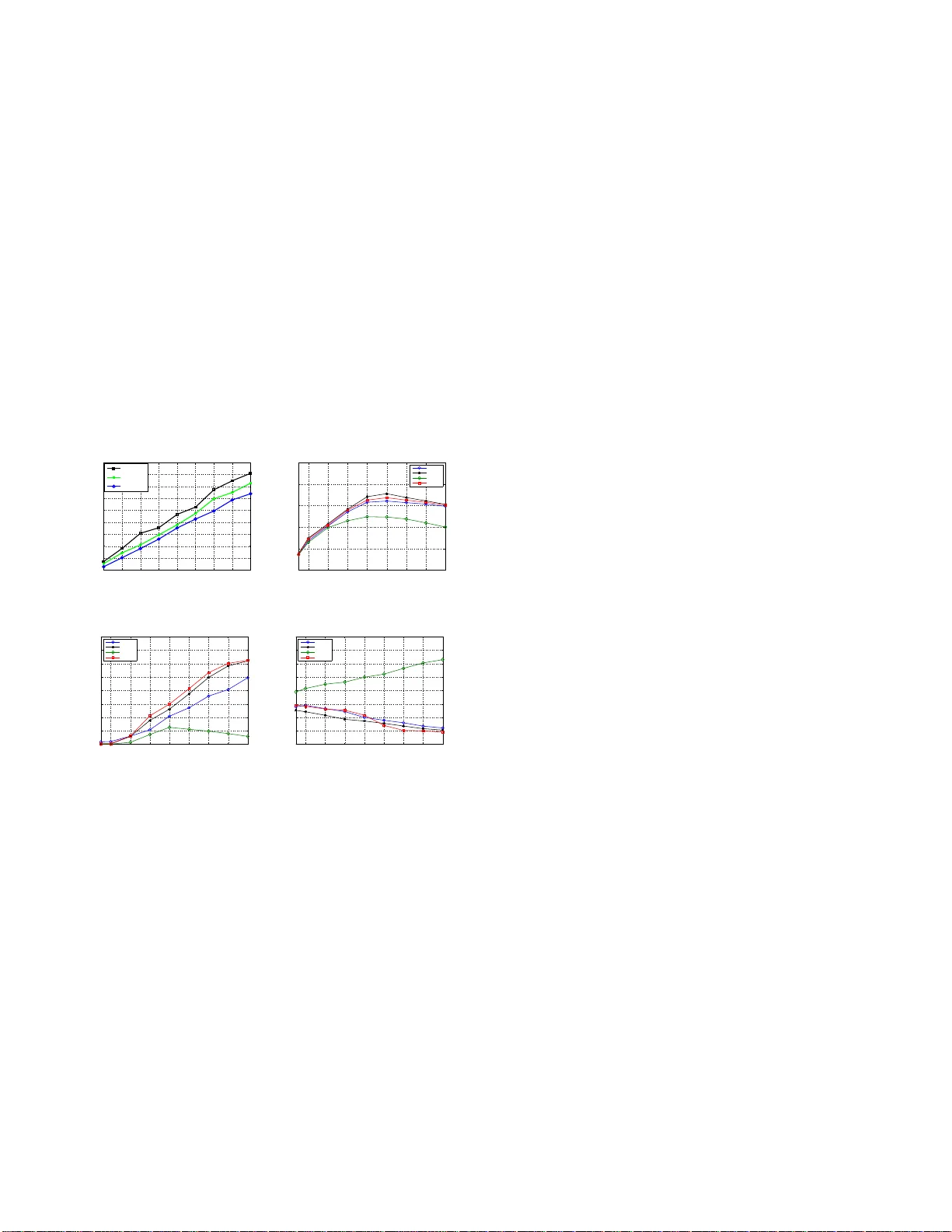
1 Identifying Design Requirements for W ireless Routing Link Metrics Nadeem Jav aid † ,♯ , Muti Ullah ‡ , Karim Djouani † , § † LISSI, Univ ersit ´ e Paris-Est Cr ´ eteil (UPEC), Franc e. { nade em.ja vaid,djouani@univ-paris12.fr } ♯ Dept. of Electrical Eng g., COMSA TS, Islamabad, Pakistan. { nadeemjav aid@comsats.e du.pk } ‡ ICIT , Gomal Un i versity , D.I.Khan, Pakistan. { matiull ahns @gmail.com } § F’SA TI, Pretoria, S outh Africa. { djouanik@tut.ac.za } Abstract —In this paper , we id entify and analyze the require- ments to design a new routing link metric f or wireless multi- hop networks. Considering these requirements, when a l ink metric is proposed, t hen b oth th e design and imp lementation of the link metric with a routing pro tocol become easy . Secondly , the u nderlying n etwork issues can easily b e tackled. T hirdly , an appreciable perfo rmance of the network is guaranteed. Along with the existing implementation of three link metrics Expected T ransmission Coun t (ETX), Minimu m Delay (MD), and Minimum Loss (M L), we implement inv erse ETX; i n vET X with Optimized Link State Routing (OLSR) using NS-2.34. The simulation results show that how the computational burden of a metric degrades the perfo rmance of the respectiv e protocol and how a metric h as to trade-off between different performance parameters. Index T erms —Routing link metric, ETX, in verse E TX, mini- mum delay , minimum loss, wireless multi- hop networks I . I N T RO D U C T I O N P ERFORMANCE of W ireless Multi-ho p Networks (WMhNs) depends upon the ef ficiency of the routing protoco l operatin g it and the mo st impo rtant comp onent of a routing pro tocol is ’ r outing link metric’. Becau se, a link metric first considers the quality routes then decides th e best end-to-end p ath. The link metric plays a key role to achieve the desired perf ormance o f the underly ing network by making the routing pro tocol: fast enough to adopt to pological changes, light-weigh t to minimally use the resources o f nodes, in telligent to select the fastest path from source to destination among the a vailable paths and cap able to enable the no des to h a ve a comp rehensive idea abou t the to pology . Considering the demand s o f a wireless multi-ho p ne twork from its operatin g pr otocol and th e factors influencing its perfor mance, a m etric is supposed to fulfill ce rtain require- ments. An efficiently designed routing metr ic can better help a routing protoco l to achieve appreciable performa nce from the underly ing network by d ealing with these issues. In this work , we, therefo re, identify the ch aracteristics that m ust b e taken into account while design ing a rou ting link me tric. I t is worth stating that it is impossible to im plement all men tioned char- acteristics in a sing le metric. Rather they provide guide lines that might be help ful to design a lin k metric. For instanc e, we have pr oposed and v alidated a ne w routing metric, Interference and Band width Adjusted ETX (IBET X) in Wireless Multi- hop Networks [1], that co nsiders link asymmetry , ban dwidth and interference of the wireless links in the same co ntention domain. By simulation results we have dem onstrated that the computatio nal ov erhead p roduced by a routing metric may degrade the pe rformance of the pr otocol. The issues that influence a wireless network , if efficiently tackled , they become the ch aracteristics of the newly developed pro tocol. I I . R E L AT E D W O R K A N D M OT I V A T I O N After analy zing reactive and proactive protocols, Y ang et a l. [2] pr oposed that the proac ti ve protocols that implemen t the hop-b y-hop r outing tech nique, as Destination-Sequ enced Dis- tance V ector (DSDV) [3] and Optimized Link State Rou ting (OLSR) [4] protocols are the best choice for m esh ne tworks. They h a ve a lso inspected the design requirem ents for rou ting link m etrics fo r the mesh n etworks and related them to the routing techniq ues and routing protocols. In the chapter , four design requiremen ts fo r link metr ics; stability , minimum hop count, po lynomial complexity of ro uting algorith m and loo p- freeness h a ve been suggested . Howev er, the fo cus has only been on the mesh network s. Second ly , all the work is merely restricted to these f our requirements. There are sev eral other requirem ents that may help to ach ie ve global o ptimization. For example, ’compu tational overhead’ that m ight be outcome of the mathematical comp lexity intr oduced in the link m etric or an a ttempt to design a m ulti-dimension al metric to tackle multiple issues simultan eously . Das et al. in [ 5], h a ve discussed the d ynamics of the well kn o wn metr ics: Expected Transmission Coun t (E TX) [6] , Expected T r ansmission T ime (ETT ) [7] an d L ink Bandwidth [8], in r eal test beds. Across v arious hardware platfor ms and changin g netw ork environments, they tested two requirem ents: stability an d sensitivity for some existing r outing link metrics. Authors have also d iscussed the dyna mics o f th e ab ove men- tioned m etrics and tested their perfor mance on the test beds for the ab ove stated requirem ents. Anyhow , bo th the design issues o f the link m etrics and the ir design requ irements are yet to be an alysed. In [9], Y a ling et al. systematically an alyzed the impact of working of wireless routing link metrics on the perfor mance of routing protoco ls. They relate d th e ch aracteristics of routing metrics to reactive and proac ti ve pr otocols. Th ey have pre- sented the ways by which the mathema tical pr operties of th e 2 weights given to the paths affect the pe rformance of routin g protoco ls. Th ey p roposed and discussed three oper ational requirem ents: optimality , consistency and loo p-freeness. How- ev er , these prop erties d o not cover all design r equirements; for example, co mputational overhead, a metric can pro duce and the perf ormance trade-offs a m etric has to make among different network perform ance factors. For example, a routing protoco l achieves h igher throug hput values at the cost of end- to-end delay or routing overhead. So , instead of generalizing the design requ irements, we have pointed -out an d an alyzed almost all p ossible design requir ements. I I I . F AC T O R S I N FL U E N C I N G W M H N S The factors affecting th e wireless networks help to h a ve an id ea abo ut the problems th ey have to face. Alo ng with other p rotocols that op erate a network, ro uting protoco ls play a significant role in the performa nce of wireless multi-hop networks. So, in this section, we st ate and discuss som e general issues regard ing wireless network s that will pr ovide a ground to discuss the requiremen ts for designing a routing metric. (A) In wir eless network s, generally th e link quality consid- erably varies in different per iods o f time . The reasons may be: some mobile nod es are moving ran domly , so me go-ou t of range, some inten tionally cu t-off the ongoin g com munication, some die-o ut due to batter y and so on . The respective routin g protoco ls must be able to d ynamically c op with the situation. (B) Usu ally , the b ehavior of c hannels varies in links an d then in com plete p aths from source to destina tion. In the case of Quality of Service (QoS) routing, the the link creating bottle neck fo r perfor mance must be g i ven attention. Similarly , change in the quality of one link affects the o thers, as in the case of intra-flow and inter-flo w in terferences but no t in the case of (m inimum) ho p count. (C) Upper layer pro tocols are affected by the ch oice of a particular link metric at the lower lay ers [5 ]. (D) The selection f or a particular flow on a p articular channel is not random in the case of multiple fl ows on multiple channels. (E) The wireless multi-h op ne tworks in which each n ode is equippe d with a single radio in terface and all r adio interfaces operate on the same fr equency cha nnel, often suf fer lo w channel utilization an d p oor system throu ghput. After d iscussing the behavior of w ireless networks, it would be appreciab le to discuss and analyze th e d esign req uirements for rou ting link m etrics. I V . D E S I G N R E Q U I R E M E N T S F O R R O U T I N G M E T R I C S Heretofor e, se veral r outing protoco ls either have been de- signed fr om scratch o r optimized to imp rove th e perf ormance of a pa rticular wireless n etwork. A routing protocol is respon- sible to choose th e b est path s fro m sour ce to destination . This decision is based upon the info rmation provided by link metric. Therefo re, p rimary emphasis has been g i ven to pro pose ne w link metric s of different varieties; a sing le metric, a single mixed m etric, a single compo und metric , m ultiple metrics and a compo site metr ic ar e few examples that have been design ed and implemen ted with th e existing pro tocols [10]. Th us, while designing a link metric for a routing protocol, follo wing design requirem ents must be taken into account. A. Minimizing hop- count or path leng th This is first of the several canonical d esign req uirements, a link metric is supposed to fulfill that has a g oal to rou te packets through minimum weig ht paths. Often a long er path increases the end-to -end delay and re duces the through put of a path . So, the r especti ve metr ic m ust pr efer a p ath with minimum length over it. This design requir ement is implicitly or explicitly attempted by almo st all of the existing link metrics. For instance, ETX ach ie ves maxim um thr oughpu t by minimizing the number of transmissions and thus raises a network throughpu t. Min imum Loss ( ML) [11] selects the paths with minimum loss rates or higher prob abilities of successful transmissions. Now , if all links in some end -to-end paths have the same pro babilities of success, then qualities of the paths becomes dependent on the nu mber of h ops. ML has been implemented with OLSR th at p refers min imum hop path in this case. Hop coun t is the mo st widely used metric in MANET ro uting protocols [12], as all of the RFC’ s prefer to use hop cou nt as a routin g m etric for the sake of simplicity and least com putational overhead . B. Balancin g traffic load T o achieve appreciab le thr oughpu t, the respectiv e metric can be designed to ensure that no node or li nk is dispro portionately used b y minimizing th e d if ference between th e m aximum and minimum traffic lo ad over the n odes or links. When a lin k be comes over-utilized and causes co ngestion, the link metric ca n choose to di vert th e tr af fic from th e congested path or overload ed nodes to the under loaded or idle ones to ease the burden . C. Minimizing delay A network p ath is preferred over the others because of its minimum delay . It is worth noting that if intra-flow and inter- flow interferences, queu ing d elays, and link capacity are not taken into consider ation, then delay minimization often en ds up being equ i valent to path length or hop-c ount minimiza tion. D. Maximizing data de livery/aggr e gating b andwidth Maximizing the proba bility of data d eli very , m inimizing the probab ility of data loss, minim izing the pac ket loss ratio, max- imizing the packet d eli very fraction, maximizing the individual path throug hput, increasing the network capacity , are the same and utmost impor tant features, a wireless routin g pr otocol is expected to im plement. So, in wireless network s, the attempt has a lw ays b een to choo se an end-to-end high capacity p ath. A pro tocol can ac hie ve max imum through put: (a) directly by m aximizing the data flows, (b) indirectly by minimizing interferen ce or retransmissions, (c) allo wing the multiple rates to coexist in a netw ork, where a higher channel rate is u sed over each lin k. It is possible if more packets can be delivered in th e same p eriod with th e consideratio n of packet loss rates [13], data can be splitted to the same destination into multiple streams, each routed through a different path. En d-to-end delay m ay also b e reduced as a direct result of larger band width. 3 E. Minimizing energy consu mption Energy consum ption is a major issue in all types o f wireless networks where the battery lifetime c onstrains the autonomy of network nodes. A proto col, if choo ses path with an unreliable link, it would pr obably pr oduce longer d elay due to high er retransmission rates, that ultimately results in ra ise in energy consump tion (along with comp utational processing overhead of agg ressi ve con trol packets). For en ergy saving, most of the w ork focuses on the co mmunication proto col design. For example, th e routing proto col Zig Bee [1 4] u ses a mod ified A OD V to be used by low-power devices. By adapting trans- mission power to the workload, Real-time Power-A ware Rout- ing (RP AR) protocol [1 5] reduces commun ications delays. F . Minimizing channel/in terface switching Both in single-h op and multi-ho p wireless networks, for the max imum utilization of av ailable bandwidth , one way is to use as many channe ls as p ossible d epending upo n the sophistication of the tech nology . In this case, the d if ferent data flows are to be switched on different ch annels, resulting in some d elay . So, th e p henomeno n ma y be given attention by the respe cti ve metric. When using multiple chann els, two adjacen t nod es can commun icate with each other only if they have at least o ne interface on a co mmon chann el. So, it may be necessary to periodically switch interfaces from one chan nel to an other with the produ ction of a delay . In [16], V aidya et al. u sed an interface assignmen t strategy th at keeps one interface fixed on a specific channel, wh ile other interfaces can be switch ed among the r emaining ch annels, when necessary . G. Minimizing the Comp utational overhea d While designing a r outing metric , necessary com putations should be c onsidered that must not c onsume m emory , pro- cessing capability and th e m ost impo rtant; batter y power . For example, we discuss the case of thre e widely u sed rou ting link metrics for wir eless routing protoco ls: ETX , its inverse, say , in vETX and ML . For a n e nd-to-end p ath, P e 2 e , these metrics are exp ressed by the f ollowing equations: E T X P e 2 e = X l ∈ P e 2 e 1 ( d ( l ) f × d ( l ) r ) (1) inv E T X P e 2 e = X l ∈ P e 2 e ( d ( l ) f × d ( l ) r ) (2) M L P e 2 e = Y l ∈ P e 2 e ( d ( l ) f × d ( l ) r ) (3) H. Minimizing interference Bandwidth of a wireless link is shared among n eighboring nodes, so, the conten ding nodes have to suffer from the inter- flow interference. The chan nels on the sam e link are always being distu rbed from the intra-flow inter ference. Both in tra- flow and inte r -flow interference s may result in ban dwidth starvation fo r som e n odes a s th ey may alw ays find the av ailable channels busy . Hence, both of the diversity o f ch annel a ssign- ments and the link capa city possibly need to be captur ed b y the link m etric, as Y ang e t al. have p resented in their work. Where ( d ( l ) f × d ( l ) r ) is the p robability of suc cess for de li very of pro be packets (13 4 by tes each ) on the lin k l on P e 2 e from source to destination (for ward dir ection) a nd from destination to source (reverse direc tion). Regarding th e com putational c omplexity , a ll of th e three metrics have to calculate the eq ual number of produ cts ( d ( l ) f × d ( l ) r ) for the same n umber of lin ks. But E T X has to suffer from mo re comp utational overhead (inverse a nd sum of n pro ducts) than M L (multiplication of n produc ts only). Similarly , M L ge nerates mor e comp utational overhea d than inv E T X . As a result, inv E T X achieves higher throug hputs than M L and E T X . Similar ly , M L perform s better than E T X . The comp utational overheads gen erated b y th e thr ee metrics have bee n sh o wn in Fig. 1 .a. Along with other imp le- mentation par ameters, the amo unt of comp utational load gen- erated by each metric influen ces its p erformanc e acco rdingly . This fact can be seen in Fig. 1.b , 1.c and 1.d . This overhead is directly pr oportiona l to the numb er of node s/links. I. Maximizing r o ute stability Unlike wired networks, freq uent topological change s in th e wireless links may not only hug e ge nerate ro uting lo ad but may also slow down the conv ergence of the respective rou ting protoco l operating the network. The stability of the paths is found by the path characteristics that ar e c aptured b y the routing metric that can be either load sensiti ve or topolog y- depend ent [2]. Former type o f m etrics assign a weigh t to a route acc ording to the tra f fic loa d on the route. This weight may change frequently as th e link b reak and establish. On the other hand, topolog y depen dent metrics assign a we ight to a path based on t he topological properties of the path, such as the hop-co unt and link cap acity of the path. Therefo re, topology - depend ent metrics are g enerally more stable, especially for static networks where the topology d oes not change frequently . Load-sensitive and topolog y-depen dent metrics are best used with different types of rou ting pr otocols, since routin g pro to- cols hav e different levels of tolerance of path weight instability [17]. J. Maximizing fau lt tolerance/min imizing r oute sensitivity In the case of multi-path routin g, the link metric can provide fault toleran ce by having red undant info rmation of the alterna - ti ve paths. This red uces the proba bility that co mmunication is disrupted in the case of link failure. T o reduce the n etwork loa d due to the redu ndancy , source cod ing can be em ployed with the aid o f some sophisticated alg orithms with compr omising on the issue of reliability . Such typ e of r aise in route r esilience usually depen dents upon the diversity , or disjoin tness like metrics for the a vailable path s [1 7]. K. A voiding sho rt an d long lived loop s A metr ic can better help a r outing alg orithm to a void forwarding loop (both short lived an d long li ved) to minimize the packet loss. Because selecting redundant links degrades the perfor mance of the network due to mor e path len gths and co n- sequently increa sed en d-to-end delay . For examp le, Faheem et 4 al. [ 18] have addr essed the p roblem o f transien t mini-lo op problem that takes place becau se of fisheye scop ing in Fish Eye OLSR (OFLSR) p rotocol. They have p rovided a potential solution that enables the router s to ca lculate ”safe” sco pe for a particular top ology for all up dates. The minimum TT L value that elim inates mini-lo ops, is calcu lated in distributed fashion by all mesh r outers in a dvance at the ”scope” bou ndary . Indepe ndent of th e scale of network, keeping efficiency of the algo rithm as before, the authors imp roved th e safety of OFLSR. L. Considering performan ce trade-offs Generally , a pro tocol achieves h igher throughp ut values at the cost of incr eased e nd-to-end delay in the case of static networks. Whereas, in m obile networks, the freq uent link beaks cause m ore routin g overhead to obtain better throu ghput from the network. T o discuss such type of trade-offs, we have set-up a simu lation scenario that is discussed in the following section. 2000 3000 4000 5000 6000 7000 8000 9000 10000 2 4 6 8 10 12 14 16 18 20 No of nodes Execution time(ms) ETX ML InvETX (a) Computatio nal Overhead of ETX, ML, In vE X 2 4 6 8 10 12 14 16 50 100 150 200 250 300 Packets/s Throughput (kb/s) ETX InvETX MD ML (b) Throughput of OLSR with 4 met- rics 2 4 6 8 10 12 14 16 0 0.5 1 1.5 2 2.5 3 3.5 4 Packets/s End−to−end Delay(s) ETX InvETX MD ML (c) E2E D of OLSR with 4 metrics 2 4 6 8 10 12 14 16 2 3 4 5 6 7 8 9 10 Packets/s NRL ETX InvETX MD ML (d) NRL of OLSR with 4 metrics Figure.1. Comp utational Ov erhead, Through put, Delay , Ro uting loa d by Metrics V . S I M U L AT I O N S W e use the implementation of ETX , Minimum Delay (MD) [19], and ML [11] wit h OLSR [10] in NS 2-2.34. Then we implement the f ourth metric, in vETX , as express ed by eq. (2). In the area of 1000 m x 1000 m , 50 nodes are placed randomly to form a static network. Constan t Bit Rate (CBR) traffic is randomly generated by 20 source-destination pairs with packet size of 64 by tes . Each simulation is performed for fiv e different topologies for 900 s e ach. Then t he av erage of five differen t valu es of each performance parameter is used to plot the graphs. T o observe the performance of OLSR with four metrics, we randomly generated the data traffic with number of packe ts fr om 1 to 16 per second. T o better understand t he performance trade-of fs, we take an examp le of the static wireless m ulti-hop networks that h av e two major issues; bandwidth and end-to-end delay . In this type of networks, the proactiv e protocols are preferred due to stabili ty , l ike , OL SR, instead of the reactiv e ones t hat are suitable for the en vironments where topology chan ges frequently due to mobility . Moreo ver hop- by-hop routing technique helps OLSR to handle aggressiv e o verhead as compa red to sou rce routing. Using t he Multi-point Relays (MPRs) selection along with proactiv e nature, OLSR ac hiev es minimum delay . In the follo wing subsections, we d iscuss the performance parameters; throughput, End-to-End Delay (E2ED) , and Normalized Routing Load (NRL) . Throughput In static netw orks, with vary ing data traffic rates, OLSR- MD produces lo west throughput as compared to OL SR-ETX / OLSR- in vETX and OLSR-ML . Moreov er , in medium and high network loads, there are more drop rates as compared to small load i n the case of MD metric. This is due to the one-way delay s that are used to co mpute the MD routing metric with small pro be packets before setting up the routing topology and not considering the traffic characteristics. It may thus happen that, if no other t raf fic is present i n the network , the probes sent on a link experience very small delays, bu t larger data packets may e xperience t he h igher delay or retransmission due to con gestion. Thus, OLSR-MD is not suitable for the st atic networks with high traffic load, as, it degrad es the netwo rk performance by achie ving less throughpu t values. The OLSR-ML in medium and high network loads produces higher throughput v alues because ML attains t he less drop ratios as compared to ETX . Moreov er , in ML the paths with minimum loss r ates or higher probabilities of successful (re)transmissions lead to high data deliv ery rates, with an additional adv antage of more stable end-to-end paths and less drop rates. OLSR-MD uses the Ad-hoc packet technique to measure the one- way delay . Then pro activ e delay assurance approac h is used to measure MD metric. The minimum delay metric performs best i n terms of average packet loss probability . In Fig. 1.c, OLSR-MD ’ s delay is sho wing the lowest values among other metrics. This is due to the route selection decision b ased on delay of ad-ho c probes. While OLSR-ETX and OLSR-ML produce increasing value of delay , when traffic increases. The very first reason is that both metrics have no mechanism to calculate t he round trip, unlike MD metric. Meanwhile, in ML , selection of longer routes with high probability of successful transmission augments the delay as compared to ETX . NRL OLSR- MD suffe red from the highest routing loads. As, ad-hoc probes are used to measure th e metric values and are sent periodically along with TC and HELLO messages. On the other hand, OLSR- ETX and OLSR-ML calculate the probabilities for the metric from the v alues obtained from the enhanced HELLO messages. OLSR uses HELLO and TC messages t o calculate the routing table and these messages are sent periodically . The delive ry ratios are measured using modified OLS R HELLO packets t hat are sent e very t seconds ( t = 2 , by default). Each node calculates the number of HELL O messag es receiv ed in a w second period ( w = 20 , by default) and divides it by the number of HELLO messages t hat should have been recei ved in the same period (10s, by de fault). Each modified HELLO p acket notifies the number of HELLO messages receiv ed by the neighbor during the l ast w seconds, in order t o allow each neighbor to calculate the rev erse delivery ratio. The worse the link quality , the higher the ETX link value. A link is perfect if the ET X value is 1 and its packet deliv ery fr action is also 1 , i.e. , no packet loss. On t he other hand, if in w seconds period a node has not receiv ed any HEL LO message then ETX is set t o 0 and the link is not considered f or routing due to 100% loss r atio. Thus, due to no extra overhead to measure the metric OLSR-ETX / OLSR-in vETX and OLSR-ML hav e to suffer from lo w routing load as compared to OLSR-MD . The ad-hoc probe packets are sent by MD to accurately measure the one-way delay . T hus, low latency is achiev ed by selecting the path with less Round T rip T ime (R TT). On the other hand, these ad-hoc probes cause routing ove rhead in a network and decrease t he throughpu t when data load is high in a static network. In static netw orks, t o measure an accurate link with less r outing load is a necessary condition. The delay cost due to increase in the number of intermediate hops is paid to achie ve throughput by OLSR-ML . As ML selects those paths which possess less loss rates, therefore, a l onger path with high successful deliv ery is preferred. Thus the product of the l ink probabilities selection de creases the drop rates and increase the R TT . 5 OLSR-ETX uses the same mechanism to measure the link quality as t hat of OLSR-ML , i. e., modified HELLO messages. But summing up the i ndi vidual probabilities and preference of t he shortest path reduces the delay of ET X as compared to ML . Thus, a slow link preference results more drop rates of OLSR-ETX as compared to OLSR-ML . This sort of trade-off is common in routing protocols. While designing a link metric, if demands of the underlying network are taken into consideration then it becomes easy t o decide that among which performance parameters, tr ade-of f(s) sho uld be made . For examp le, ML and E TX achiev e higher throu ghput v alues than MD , as sho wn in Fig. 1.b, whereas MD remarkably achie ves less end-to-end delay than ML and E TX that is depicted i n F ig. 1.c. In T able 1, we pro vide a list of routing link metrics and routing algorithms t hat hav e taken into account some of the design requirements suggested in this chapter . T able.1. Metrics implementing differe nt Design Requirements Design Requir ement Metric/ Algorithm Minimizi ng hop count Hop count [12] or path length Minimizi ng delay Per hop R TT [7] Minimizi ng packe t loss ratio Interfer ence clique transmissions [20] Balanc ing traf fic load MIC [12] Maximizi ng the probability Per hop PktPair [7], ML [11] of data deli very Maximizi ng path capaci ty Networ k chara cteriza tion with MCMR [21] Aggreg ating bandwidth/ Multipa th routing scheme for maximizin g fault toleran ce wireless ad-hoc netwo rks[11 ] Maximizi ng indi vidual ETX [6], [12] path throughpu t Max. throughpu t of indi vidual link ETX [6], [12] Maximizi ng networ k throughput ETX [6], [12] Max. throughpu t of indi vidual link ETX [6], [12], Per hop R TT [12] Minimizi ng interfer ence iA W A RE [12] Minimizi ng channel switching MIC [12], WCETT [12] Minimizi ng interf ace switching MCR Protocol [12] Maximizi ng route stability Link affini ty metric[22] Minimizi ng energ y consumption MTPR [23], MBCR [24 ] A voidi ng routin g loops Loop av oidance for Fish-Eye OLSR in Sparse WMN’ s [18] Minimizi ng computati onal overhe ad ML [11] V I . C O N C L U S I O N A N D F U T U R E W O R K In this work, we present a compr ehensiv e stud y on the design requirem ents for rou ting link metrics. W e select Ex - pected T ransmission Count (ETX), Minimum Delay (MD), Minimum Loss (ML) and ou r pro posed mer ic; Inverse ETX (in vETX) with OLSR. W e discuss several po ssible issues regarding wireless networks th at can better h elp in d esigning a link me tric. T he ambition of a h igh through put network can only be achie ved b y targeting a concrete compatib ility of the underly ing wireless n etwork, the ro uting p rotocol opera ting it, and routin g metric; heart of a rou ting pr otocol. Depe nding upon the most demandin g features of the networks, d if ferent routing proto cols impose different costs of ’message overhead’ and ’manag ement complexity’. T hese costs help to understand that wh ich typ e of routing protoco l is well suitab le for which kind o f underly ing wireless network a nd then wh ich routing link metric is a ppropriate for which rou ting protocol. In future, we ar e in terested in an analytica l study of suc h kind of compatibility . R E F E R E N C E S [1] Nadeem Java id, A yesha Bibi and Karim Djouani, ”Interfe rence and Bandwidt h Adjusted (ETX) in W ireless Multi-hop Networks” , IE EE SaCoN AS Globecom 2010. [2] Y . Y ang, J. W ang, and R. Kravets, ”Designin g Rout ing Metrics for Mesh Networ ks”, W iMesh, 2005. [3] C. E. Perkins and P . Bhagwat , ”Highl y dynamic Desti nation-Se quenced Distance -V ector routing (DSDV) for mobile computers, ” SIGCOMM Comput. Commun. Rev . , vol. 24, pp. 234-244, 1994. [4] T . Clausen and P . Jacquet, ”Optimized Link State Routing Protocol (OLSR), ” ed, 2003. [5] Das, S. M. and Pucha, H. an d P apagian naki, K. and Hu, Y .C., ” Studying wireless routing link metric dynamics”, 7th A CM SIGCOMM confer - ence on Internet measurement, p332, 2007. [6] D. S. J . de Couto, ”High-throughpu t routing for multi-hop wireless netw orks”, Ph.D. dissertati on, MIT , 2004. [7] R. Drav es, J. Padhy e, and B. Zill, ”Routing in multi-radi o, multi-ho p wireless mesh networks”, in A CM Internati onal Conference on Mobile Computing and Networki ng (MobiCom), Sept. 2004, pp. 114-128. [8] Richard Dra ves, Jitendra Padhye, Brian Zill, ”Co mparison of routing metrics for static multi-hop wireless networks”, V ol. 34, No. 4. (October 2004), pp. 133-144. [9] Y aling Y ang, Jun W ang, and Robin Krav ets, ”Interfere nce-a ware Load Balanc ing for Multihop Wire less Network s”, T ech. Rep. UIUCDCS-R- 2005-2526, Departmen t of Computer Science, Univ ersity of Illinois at Urbana-Ch ampaign, 2005. [10] Moreira , W . , Aguiar , E., Abelm, A., Stanton, M., ”Using multiple metrics with the optimized link state routing protocol for wireless m esh netw orks”, Simpsio Brasilei ro de Redes de Computadorese Sistemas Distrib udos, Maio (2008). [11] D. Passos, D. V . T eix eira, D. C. Muchaluat -Saade, L. C. S. Magalhaes, and C. V . N. de Albuquerque , ”Mesh network performance measure- ments”, I2TS, 2006. [12] Nadeem Jav aid, Akmal Jav aid, Imran Ali Khan, Karim Djouani, ”Perfor- mance Study of ETX based Wi reless Routing Metric s”, 2nd Internationa l Conferen ce on Computer , Control and Communication, p1-7, 2009. [13] Hongqian g Zhai and Y uguang Fang, ”Impact of Routing Metrics on Path Capaci ty in Multirate and Multihop W ireless Ad Hoc Networks”, Proceedi ngs of the IEEE Int ernatio nal Conference on Ne twork Protoc ols, 2006. [14] Boughanmi , N. and Song, Y .Q., ”A New routing metric for satisfying both energ y and delay constraints in wireless sensor netw orks”. Journal of Signal Processing Systems for Signal, Image, and V ideo T echnol ogy , p137–143, 2008. [15] O. Chipara, Z. He, G. Xing, Q. Chen, X. W ang, C. Lu, J. Stankovi c, and T . Abdelzaher , ”Real -time Powe r-A ware Routin g in Sensor Networks”, Forte enth IEEE International W orkshop on Qualit y of Service, 2006. [16] P . K yasanur and N. H. V aidya, ”Routi ng and Link-layer Protocols for Multi-Chan nel Multi-Inte rface Ad hoc W irele ss Netwo rks”, Mobile Computing and Communicatio ns Rev ie w , 10(1): pp. 3 1-43, Jan. 2006. [17] J. T sai and T . Moors, ”A Revi ew of Multipat h Routing Protocols: From W ireless Ad Hoc to Mesh Networks”, A CoRN Early Career Researche r W orkshop on Wi reless Multihop Netw orking, 2006. [18] Fahe em, Y . and Rougier , J.L ., ”Loop av oidance for fish-eye OL SR in sparse wirele ss mesh networks”, 6th internat ional confe rence on W ireless On-Demand Network Systems and Services, p215-21 8, 2009. [19] W . Cordei ro et al., ” Providing quality of service for mesh networks using link delay measurements” , 16th Internati onal Conferen ce on Computer Communicat ions and Networks, 2007. [20] Hongqian g Zhai and Y uguang Fang, ”Impact of Routing Metrics on Path Capaci ty in Multirate and Multihop W ireless Ad Hoc Networks”, Proceedi ngs of the IE EE Interna tional Conference on Network Protocols pp. 86-95, 2006. [21] M. Kodi alam and T . Nandag opal, ”Chara cterizi ng the Capacity Reg ion in Multi-Ra dio Multi- Channel W irele ss Mesh Networ ks”, Proc. ACM Mobi-Com’05, Sept. 2005. [22] K. Paul, S. Bandyipadh yay , A. Mukherjee, and D. Saha, ”Communica tion-a ware mobile hosts in ad-hoc wire less network”, IEEE ICPWC,1999. [23] K. Scott and N. Bambos, ”Routing and channel assignment for low po wer transmission in PCS”, In ICUPC, vol. 2, pp. 498-502, 1996. [24] J-P . Sheu, C-T . Hu, and C-M. Chao, ”The Handbook of Ad Hoc W ireless Networ ks, Chapter Energy-Con serving Grid Routing Protocol in Mobile Ad Hoc Networks”, RCR Press L LC, 2003.
Original Paper
Loading high-quality paper...
Comments & Academic Discussion
Loading comments...
Leave a Comment