Distributed Stochastic Power Control in Ad-hoc Networks: A Nonconvex Case
Utility-based power allocation in wireless ad-hoc networks is inherently nonconvex because of the global coupling induced by the co-channel interference. To tackle this challenge, we first show that the globally optimal point lies on the boundary of …
Authors: Lei Yang, Yalin E. Sagduyu, Junshan Zhang
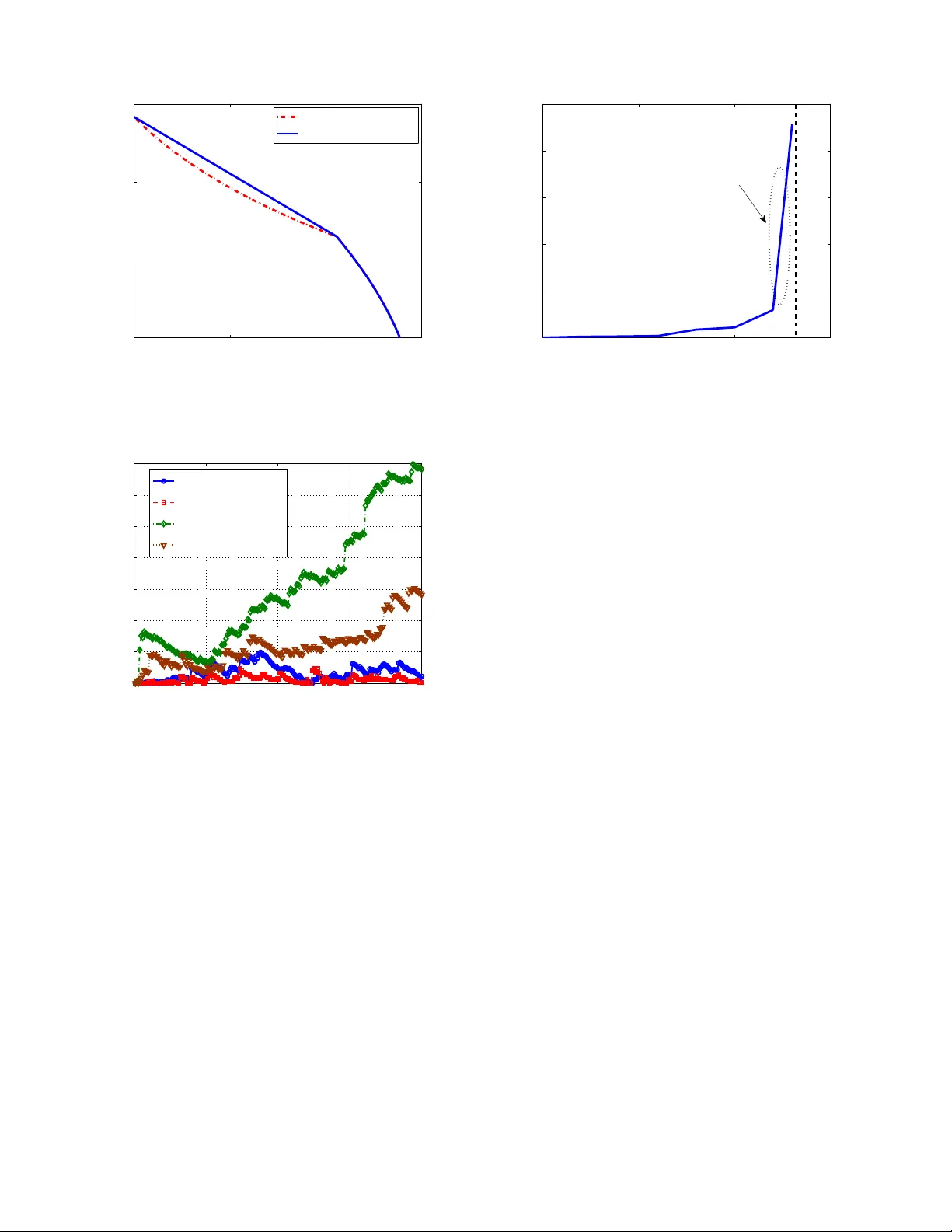
1 Distr ib uted Stochastic P o wer Control in Ad-hoc Networks: A Nonconv e x Case Lei Y ang, Y alin E. Sagduy u, J unshan Zhang, and Jason H. Li Abstract —Utility-based power allocation in wi reless ad-hoc networks is inherently nonconv ex because of the g lobal coupling induced by the co-channel interf erence. T o tackle this challeng e, we first show that the globally optimal point lies on the boundary of the f easible region, which is utiliz ed as a basis to t ransform the utility maximization prob le m into an equiv alent max-min problem with m ore structure. By using e xtended duality theory , penal ty m ultipliers are introduced f or penalizing the const raint violations, and the minimum weighted utility maximization problem is then decomposed into subproblems f or individual users to devise a distributed stochastic power cont rol algorithm, where each user stochastically adjusts its target utility to improve the t otal utility by sim ulated anneal ing. The proposed distributed pow er control algor ithm can guarantee gl obal optimality at the cost of slow conv ergence due to simulated annealing involv ed in the global optimization. The geometric cooli ng scheme and suitable p enalty parameters are used to improve the conver gen ce rate. Ne xt, by integrat ing the stochastic power control app roach with the back-pressure algor ithm, we dev elop a joi nt scheduling and pow er allocation policy to stabilize the queueing systems . Finally , we generalize the above distributed power control algorithms to multicast communications, and sho w their gl obal optimality f or multicast traffic . Index Terms —Dist r ibuted P ower Control, Nonconv ex Optimization, Extended Du ality T heory , Simulated Annealing, Queue Stability , Unicast Communications , Multicast Communications . ✦ 1 I N T R O D U C T I O N T H E broadcast natur e of wireless transm issions makes wireless networks susceptible to interference, which deteriorates quality of service ( QoS) provisioni ng. Power control is considered as a promisin g technique to miti- gate interference. One p rimary o bjective of power c ontrol is to maximize the s ystem utility that can achieve a variety of fairness objectives among users [2], [3], [4], [5]. However , maximizing the system utility , under the physical interference model, often involves nonconvex optimization and it is known to be NP-hard, due to the complicated coupling a mong users through interference [6]. Due to the nonconvex nature of the power contro l problem, it is challenging to find the globally optimal power allocation in a distributed manner . Notably , [7], [8] devised distributed p ower c ontro l a lgorithms to find power allocations that satisfy the local optimality con- ditions, but global optimality could not be guaranteed in general, except for some special convexifiable cases (e.g., with strictly increasing log-concave utility func- tions). Another thread of work applied ga me-theoretic approaches to power c ontro l by treating it as a non - cooperative game among tra nsmitters [9], [10]. However , distributed solutions that converge to a Na sh e quilib- rium may be suboptimal in terms of maximizing the • Lei Y ang and Junshan Zhang are with the School of ECEE , Arizo na State University, T empe, AZ, 85287, USA (e-mail: lyang55@asu.edu; Junshan.Zhang@asu.edu). • Y alin E. Sagduyu and Jason H. Li are with Intelligent Automation, Inc. , Rockvil le, MD 20855, USA (e-mail: ysagduyu@i-a-i.com; jli@i-a-i.co m ). • Part of this paper will be presented at the IEEE International Conference on Communications, ICC 2011 [1]. total system utility . Different from these approaches, [11] proposed a globally optimal power c ontro l scheme, named MAPEL, by exploiting the monotonic nature of the optimization problem. However , the complexity and the centraliz e d nature of MAPEL hinder its a p p lica bility in pra ctical scenarios, a nd thus it ca n be treate d rather as a benchmark for perf ormance evaluation in distributed networks. T o find the globally optimal power allocation in a distributed setting, an interesti ng work [12] has pro- posed the SEER algorithm based on Gibbs sampling [13], which can ap proach the globally optimal solution in an asymptotic sense when the control para meter in Gibbs sampling tends to infini ty . Notably , for each iteration in the SEER algorithm, e ach user utilizes Gibbs sampling to compute its tra nsition probability d istribution for updating its transmission power , where the requirement for message pa ssing and computing the transition prob- ability distribution in each iter ation can be demanding when ap p lied to ad-hoc communications . A challenging task in distributed power control in a d- hoc networks is to reduce the amount of message passing while preserving the global optimality . In this paper , we tackle this challenge by combining recent advances in extended duality theory (EDT) [14] with simulated annealing (SA) [1 5]. Compared with the cla ssical du- ality theory with nonzero duality gap for non convex optimization problems, EDT ca n guarantee z ero duality gap between the primal and dual probl e ms by utilizing nonlinear Lagrangian functions. This property allows for solving the nonconvex problem by its extended dual while preserving the global optimality with distributed imple- mentation. Furthermore, as will be shown in Section II, 2 for the subproblem of ea ch individual user , the extended dual can then be solved through stochastic search us- ing SA. In particular , we first transform the original utility maximiza tion problem into a n equivalent max- min problem. This step is ba sed on the key observa tion that in the case with continuous a nd strictly increasing utility functions, the globally optimal solution is always on the boundary of the feasible (utility) region. T hen, appealing to EDT and SA, we develop a distributed stochastic power control (DSPC) algorithm that stochas- tically sea rches f or the optimal power allocation in the neighborho od of the feasible region ’s boundary , instead of bouncing around in the entire fea sible region. Specifically , we first show tha t DSPC c an achieve the global optimality in the underlying nonconvex problem, although the convergence rate can be slow (b ut this is clearly due to the slow convergence nature of SA). Then, to impro ve the convergence rate of DSPC, we propose an enhanced DSPC (EDSPC) algorithm that e mploys the geometric cooling schedule and performs a careful selection of penalty parameter s. A s a benchmark for performance evaluation, we also d evelop a centralized algorithm to sea rch for the globally optimal solution over simplices that cover the utility region. The performance gain is further verified b y c ompar ing our distributed algorithms with MA PEL [11], SEE R [12], and ADP [7] algorithms. W orth noting is that the pro posed DSPC and EDSPC a lgorithms do not require any knowledge of channel gains, which is typica lly needed in existing algorithms, a nd instead they need only the Signal-to- Interference-plus-Noise (SINR) feedback f or ada p tation. Next, we integrate the above distributed power con- trol with the ba c k- pressure a lgorithm [22] and devise a joint scheduling and power a llocation policy for im- proving the stability in the presence of dynamic pa cket arrivals and de partures. This policy fits into the dynamic back-pressure a nd resource allocation f ramework a nd enables distributed utility maximization without extra technical conditions [23] [2 5]. Then, we generalize the study to consider multicast communications, where a single transmission may simultaneously deliver packets to multiple recipients [ 1 6]. Specifically , we extend DSPC and EDSPC algorithm s to multicast communications with distributed implementation, and show that these a l- gorithms can also achieve the global optimality in terms of jointly maximizing the minimum rates on bottleneck links in different multicast groups. The rest of the paper is organized as follows. In S ection 2, we first introduce the system model, e sta blish the equivalence between the utility maximization problem and its max-min form, and then develop both centraliz e d and distributed a lgorithms for the max-min problem. Next, in Section 3, building on these pow e r contr ol algorithms, we develop a joint scheduling and power allocation policy to stabilize queueing systems. The gen- eralization to multicast communications is presented in Section 4 . W e conclude the pape r in S ection 5. 1 1 2 2 L L n 1 n 2 n L h 11 h 12 h 22 h 21 Fig. 1 : System model. 2 P OW E R C O N T R O L F O R U N I C A S T C O M M U - N I C AT I O N S 2.1 System Model W e c onsider an ad- hoc wireless network with a set L = { 1 , ..., L } of links, where the channel is interference- limited, and all L links treat interference as noise, as illustrated in Fig. 1. Such a model of communication is also applicable to cellular networks [2]. Eac h link consists of a dedicated transmitter-receiver pair . 1 W e denote by h lk the fixed channel gain between user l ’s tra nsmitter and user k ’s receiver , and by p l the tr a nsmission power of link l with P max l being its maximum power constraint. For static channels, the received S INR for the l th user with a matched filter receiver is given by γ l ( p ) = h ll p l n l + P k 6 = l h kl p k , (1) where p = ( p 1 , ..., p L ) is a vector of the users’ trans- mission powers and n l is the noise power . Accordingly , the l th user receives the utility U l ( γ l ) , where U l ( · ) is continuous and strictly increasing. W e a ssume that each user l ’s utility is ze ro when γ l = 0 , i.e., U l (0) = 0 . For ease of reference, some notation is listed in T able 1. 2 2.2 Network Utility Maximization W e seek to find the optimal power allocation p ∗ that maximizes the overall system utility subject to the indi- vidual power constraints, given by the following opti- mization problem: maximize P l ∈L U l ( γ l ( p )) subject to 0 ≤ p l ≤ P max l , ∀ l ∈ L variables { p } . (2) 1. W e use the t erms “user ” and “link” interchangeably throughout. 2. W e use bold symbols (e.g., p ) t o denote ve ctors and calligraphic symbols (e. g., L ) t o d e note sets. 3 Notation Definition L set of links L total n umber of links h lk channel gain from link l ’s transmitter to link k ’s receiver H link gain matrix p l (in v ector p ) transmission power of link l n l (in vector n ) noise power for link l γ l SINR of link l γ l ( · ) SINR function of link l U l ( · ) utility fun ction of link l x l (in v ector x ) ratio of link l ’s utility t o the t otal ne t work utility r l (in v ector r ) transmission rate of link l r l ( · ) transmission rate function of link l α , β penalty multipliers T ABLE 1: S ummary of the notations and definitions. Approach Case I Case II Power Sum Rate Power Sum Rate GP [20, 7.68] 3.02 [1, 0. 61] 0.98 ADP [20, 6.46] 3.10 [1, 2] 1.16 MAPEL [20, 6.79] 3.10 [0, 2] 1.22 SEER [20, 6.90] 3.10 [0, 2] 1.22 T ABLE 2: The performance of the existing approaches for Case I and II. In general, (2) is a nonconvex problem 3 . In particular , if the utility function is the Shannon rate achievable over Gaussian flat fading channels, namely U l ( γ l ( p )) = w l log(1 + γ l ( p )) , where w l > 0 is a weight a ssociated with user l , (2) boils down to the weighted sum rate maximization problem, which is known to be nonconvex and NP-hard [ 6]. Note that the weights ca n serve as the fairness measures [17] for different scenarios. In particular , in queueing systems, f or arrival ra tes within the stability regio n, packet queues can be stabilized by solving this weighted sum rate maximization problem, when the instantaneous queue lengths are chosen as the weights. In Section 3, we will d iscuss how to stabilize the p a cket queues by integrating our distributed power control algorithms with the ba c k-pressure algorithm. Let F d enote the feasible utility region, where f or each point U = ( U 1 , ..., U L ) in F , there exists a power vector p such that U l = U l ( γ l ( p )) for all l ∈ L . T he fea sible utility region F is nonconvex, a nd in general, finding the globally optimal solution to ( 2) in F is challenging. In the following example, we illustrate the geometry of F for the utility U l ( γ l ( p )) = w l log(1 + γ l ( p )) a nd evaluate the solutions to (2) given by some existing power control approaches discussed in S ection 1. Example: For the ca se with two links, Fig. 2 illustrates the nonconvex feasible utility region F for different system par ameters. W e compare the performa nce of the existing approaches [2], [ 7], [ 11], [1 2] in T able 2. Remarks: The solutions to (2) given by [2], [7], [11] are either distributed but suboptimal or optimal but cen- tralized. In particular , [ 2] solves ( 2) by using geometric 3. For some special utility functions U l ( . ) , (2) can be transformed into a convex problem [4]. In this paper , we focus on the nonconvex case that cannot be transformed to a conv e x problem by change of variables. 0 1 2 3 4 5 0 1 2 3 4 5 6 7 U 1 U 2 Feasible Utility Region (I) Optimal Solution (I) Feasible Utility Region (II) Optimal Solution (II) Fig. 2: The feasible utility region F . Case (I): the channel gains are given by h 11 = 0 . 7 3 , h 12 = 0 . 0 4 , h 21 = 0 . 0 3 , and h 22 = 0 . 89 , and the maximum power a re P max 1 = 20 , P max 2 = 10 0 ; Case (II): the channel gains are given by h 11 = 0 . 30 , h 12 = 0 . 50 , h 21 = 0 . 03 , and h 22 = 0 . 80 , and the maximum power are P max 1 = 1 , P max 2 = 2 . In both ca se s, the noise power is 0.1 for each link, and the weights are w 1 = 0 . 57 , w 2 = 0 . 43 . programming (GP) under the high-SINR assumption, which yields a suboptimal solution to (2) when the assumption does not hold (e.g., this is the case in this ex- ample above). The A DP algorithm [7] ca n guara ntee only local optimality 4 in a distributed manner . The MAPEL algorithm [1 1] c an achieve the globally optimal solutions but it is centralized with high computational complexity . Compared with these algorithms, the SEER algorithm [12] can guarantee global optimality in a distributed manner but message passing needed in each iteration can be demanding, i.e., each link needs the knowledge of the channel gains, the receiver SINR and the signal power of all the other links. It is worth noting that the performance of SEER hinges on the control pa r ameter that can be challenging to choose on the fly . 2.3 From Network Utility Maximizat ion to Minim um W eighted Utility Maximization In order to devise low-complexity distributed algorithms that c an guarantee global optimality , we first study the basic properties f or the solutions to (2), and then convert (2) into a more structured max-min problem. Lemma 2 . 1: The optimal solution to (2) is on the boundary of the feasible utility region F . 4. The local optimal solution found by ADP happen s to be globally optimal only in one of the cases that are illustrated in T able 2. 4 Proof: Let U ∗ denote a globally optimal solution to (2) over F , a nd γ ∗ denote the corresponding SI NR that supports U ∗ . Since U l ( · ) is continuous a nd strictly increasing, proving that U ∗ is on the boundary of F is equivalent to showing that γ ∗ is on the boundary of the f easible SINR region. Suppose that γ ∗ is not on the boundary of the feasible SINR region, which indicates that there exists some point ˆ γ such that ˆ γ l ≥ γ ∗ l for all l ∈ L a nd ˆ γ l > γ ∗ l for some l . S ince U l ( · ) for any l ∈ L is strictly increasing in γ l , we have U l ( ˆ γ l ) ≥ U l ( γ ∗ l ) f or all l ∈ L and U l ( ˆ γ l ) > U l ( γ ∗ l ) f or some l , which contradicts the fa c t γ ∗ is a globally optimal solution. Hence, Lemma 2.1 follows. Based on Lemma 2 .1, if we can cha r acterize the bound- ary of F , then it is possible to solve (2) efficiently . Thus motivated, we first establish, by introducing a “contri- bution weight” for each user , the equivalence between (2) and the minimum weighted utility maximization problem. Lemma 2.2: Problem (2) is equivalent to the following minimum weighted utility maximization: maximize min l ∈L U l ( γ l ( p )) x l subject to 0 ≤ p l ≤ P max l , ∀ l ∈ L 0 ≤ x l ≤ 1 , ∀ l ∈ L P l ∈L x l = 1 variables { p , x } . (3) Proof: Let t = P l ∈L U l ( γ l ( p )) d e note the total utility . Since U l ( . ) is nonnegative, we define x l ∈ [0 , 1 ] as a ratio for the contribution of user l ’s utility to t . Therefore, U l ( γ l ( p )) = tx l and P l ∈L x l = 1 . Then (2) can be rewritten as maximize t subject to t = U l ( γ l ( p )) x l , ∀ l ∈ L 0 ≤ p l ≤ P max l , ∀ l ∈ L 0 ≤ x l ≤ 1 , ∀ l ∈ L 0 ≤ t, P l ∈L x l = 1 variables { p , x , t } . (4) Then, in the context of maximizing t , it suffices to relax t = U l ( γ l ( p )) x l in (4) as t ≤ U l ( γ l ( p )) x l , ∀ l ∈ L , which is equivalent to t ≤ min l ∈L U l ( γ l ( p )) x l . Therefor e, ( 4) ca n be treated a s the hypograph form of (3), i.e., (4) and (3) are equivalent [ 18], thereby concluding the proof. For given x , (3) is quasi-convex 5 . By introducing an auxiliary va riable t , we obtain the following equivalent formulation: maximize t subject to U − 1 l ( tx l )( n l + P k 6 = l h kl p k ) ≤ h ll p l 0 ≤ p l ≤ P max l , ∀ l ∈ L , 0 ≤ t variables { p , t } , (5) which can be solved in polynomial time through bi- nary search on t [18]. By transforming (2) to this more 5. By definition, a function f : R n → R is quasi-convex, if its domain dom f and all its sublev el set s S c = { x ∈ dom f | f ( x ) ≤ c } , for c ∈ R , are convex [18]. 0 2 U 1 U * l l L U t ! " # $ * * * 1 2 , x x ! x Fig. 3: A n illustration of the max-min problem for the case with two links. structured max-min problem (3 ), we are able to find each boundary point efficiently . Then, the p roblem is reduced to finding a globally optimal x ∗ , given which we can obtain a globally optimal solution, i.e ., the tangent point of the hyperplane and F , as illustrated in Fig. 3. Intuitively speaking, x represents a search direction. Once we find the best sea rch direction x ∗ , p ∗ can be obtained e fficiently by searching along the direction of x ∗ . 2.4 Algorithms for Global Optimization In this section, we study algorithms achieving global optimality for (3). First, we propose a ce ntra lized algorithm for (3), which will serve as a benchm a rk for performance comparison. Then, by using EDT and SA, we propose a distributed algorithm, DS PC, for the problem ( 3). Building on this, we propose an enhanced algorithm EDSPC to improve the convergence rate of DSPC. 1) A Centralized Algorithm Based on L e mma 2 .1 and Lemma 2.2, we d evelop a centra liz ed algorithm (Algorithm 1) to solve the max-min optimization problem (3) under considera- tion. Roughly speaking, by dividing the simplex S = { x | P l ∈L x l = 1 , 0 ≤ x l ≤ 1 , ∀ l ∈ L} into many small simplices, the algorithm can find the optimal point on the bounda r y of F . Propo si tion 2 .1: Algorithm 1 converges monotoni- cally to a globally optimal solution to (3) as the a pprox- imation factor ǫ approaches zero. Proof: For given ǫ , Algorithm 1 divides the simplex S = { x | P l ∈L x l = 1 , 0 ≤ x l ≤ 1 , ∀ l ∈ L} into ⌈ 1 /ǫ ⌉ simplices 6 . Then Algorithm 1 computes the power allocation p ∗ by solving (5) at x given b y the center point of the simplex. Since the optimal search direction x ∗ is in S , when the approximation fa ctor ǫ approaches 6. ⌈ 1 /ǫ ⌉ d enotes the smallest integer greater than 1 /ǫ . 5 zero, Algorithm 1 ex haustively searches eve ry point in the simplex S . Therefor e, Algorithm 1 can converge monotoni ca lly to a globally optimal solution to (3). Remarks: I n Algorithm 1, by controlling ǫ , one can obtain a solution arbitra rily close to a globally optimal one. Accordingly , Algorithm 1 can guarantee global optimality . However , the complexity of this algorithm can be high and this is possible only with c e ntralized implementation. Algorithm 1 will be used only as a benchmark for performance eva luation of distributed algorithms. Algorithm 1 Initiali zation : Choos e the approximation fa c tor ǫ > 0 , and construct the initial simplex S with the vertex set V = { v 1 , ..., v L } , where v l = e l and e l is the l th unit coordinate vector . L et v c = 1 L P l ∈L v l be the center of S . Compute p ∗ by solving ( 5) at the point x = v c . Repeat 1) Eac h simplex is divide d into L subsimplices S 1 , ..., S L . Let S be a simplex with the vertex set V = { v 1 , ..., v L } , and let v ∈ S \ V . Choose v = 1 L P l ∈L v l . Then, e a ch simplex S l is defined as having vertex set V \ v l S v . 2) For each new simplex, compute p ∗ by solving (5 ) at x given by the c e nter point of the simplex. 3) Find the current best solution to (3). Until The number of simplices is greater than 1 /ǫ . 2) D SPC Alg orithm Next, we devise a distributed stochastic power control (DSPC) algorithm based on EDT [14] and S A [15]. T o this end, we first introduce auxiliar y va riables and use EDT to tra nsform (3) with the a uxiliary variables into an un- constrained problem. Then, we solve the unconstrained problem by using the SA mechanism. Specifically , define t l = U l ( γ l ( p )) x l and rewrite (3) as minimize − min l ∈L t l subject to t l x l ≤ U l ( γ l ( p )) , ∀ l ∈ L P l ∈L x l = 1 0 ≤ p l ≤ P max l , ∀ l ∈ L 0 ≤ t l , 0 ≤ x l ≤ 1 , ∀ l ∈ L variables { p , x , t } . (6) Next, we use EDT to write Lagrangian for ( 6) a s L ( p , x , t , α, β ) = − min l ∈L t l + α P l ∈L x l − 1 + P l ∈L β l ( t l x l − U l ( γ l ( p ))) + , (7) where ( y ) + = max(0 , y ) , and α ∈ R and β ∈ R L are the penalty multipliers for penalizing the constraint violations. Based on EDT [ 14], there exist finite α ∗ ≥ 0 and β ∗ l ≥ 0 for all l ∈ L such that, for any α > α ∗ and β l > β ∗ l , ∀ l ∈ L , the solution to (7) is the same as (6). Note that (7) does not include the power constraints, due to the fact that there is no coupling a mong the user powers. Therefore, the minimization of ( 7) with respect to the primal var ia bles ( p , x , and t ) ca n be ca rried out individually by each user in a distributed fashion. The next key step is to perform a stochastic local search by each user based on SA. Le t t l , x l and p l denote the primal values of the l th user , a nd t ′ l and x ′ l denote the new values randomly chosen by the l th user . Accordingly , t ′ l x ′ l can be treated as a new target utility for the l th user . T o a c hieve this ta rget utility , the l th user updates p ′ l by p ′ l = min U − 1 l ( t ′ l x ′ l ) γ l p l , P max l , (8) where γ l is the current SINR measured at the l th user ’s receiver . Note that (8) does not need any information of channel gains except the SINR feedbac k, i.e., γ l . Since ( 8) corresponds to the distributed power control algorithm of standard form as described in [ 19] 7 , it converges geometrically fast to the target utility . Thus, we assume tha t each user l upda tes p l in a f aster time- scale than t l and x l such that p l always conver ges before the next update of t l and x l . Let ∆ denote the d ifference between L ( p l , x l , t l | p − l , x − l , t − l , α, β ) and L ( p ′ l , x ′ l , t ′ l | p ′ − l , x − l , t − l , α, β ) , where y − l is the ve c tor y without the l th user ’s va r iable. If ∆ ≥ 0 , i.e., t ′ l , x ′ l and p ′ l reduce La gr a ngian (7), then they a re a ccepted with probability 1; otherwise, they are accepted with probability e x p ∆ T , wher e T is a control par ameter (it is also called tempera ture). Note that, as T de creases, the accepta nce of uphill move becomes less and less probable, and therefor e a fine-gra ined search takes pla c e. It has been shown that, as T tends to 0 ac c ording to a logarithmic cooling schedule , S A converges to a globally optimal point [1 3], [2 0]. T o compute ∆ locally by each user l , we assume that user l broadcasts the terms t l , x l and β l ( t l x l − U l ( γ l ( p ))) + , whenever a ny of these te rms changes. Besides upda ting the primal varia bles, each user l also needs to update α and β l to satisfy α > α ∗ and β l > β ∗ l . Here, we apply the method given by [14] to upd a te α and β l . In particula r , if any constraint is violated, α and β l are updated as f ollows: α ← α + σ P l ∈L x l − 1 , β l ← β l + l ( t l x l − U l ( γ l )) + , ∀ l ∈ L , (9) where σ and l are used to control the rate of updating α and β l . Thus, a fter initializa tion, α a nd β l increase in pro- portion to the violation of the corresponding constraint, which may lead to excessively large penalty va lues. Since it is beneficial to periodically scale down the pe nalty values to ease the unconstrained optimization, α and β l are scaled down by multiplying with a ra ndom value (it is chosen empirically between 0.7 to 0. 95) 8 if the penalty decrease condition is satisfied, i.e., the maximum violation 7. A power control algorithm is of st andard form, if the inte rfer- ence function (the effective interference each link must overcome) is positive, monotonic and scalable in power allocation [19]. 8. See [14] for t he d etailed description on t he choice of these param- eters. 6 of constraints is not decreased after running Step 1 in Algorithm 2 several times c onsecutively , e.g., five times 8 . A detailed description of DSPC a lgorithm is given in Algorithm 2. Propo si tion 2 .2: T he distributed stochastic power control algorithm (Algorithm 2) converges monotoni- cally to a globally optimal solution to (3), as temperature T in SA decreases to ze ro. Proof: For a given pair of α and β , Algorithm 2 converges to a globally optimal solution to (7) by using the logarithmic cooling schedule [1 3], [2 0]. If the solution satisfies the constraints of ( 6), it is a lso a globally optimal solution to (6 ) ba sed on E DT , i.e . , current α and β satisfy α > α ∗ and β l > β ∗ l for all l ∈ L [14]. By iteratively upd ating α and β , Algorithm 2 will converge to a globally optimal solution to ( 3), when α and β satisfy α > α ∗ and β l > β ∗ l for all l ∈ L . Remarks: The DSPC algorithm can guarantee global optimality in a distributed manner without the need of channel information. In particular , it can adapt to chan- nel variations by utilizing the SINR fe e dback. However , the convergence rate of DSPC is slow due to the use of logarithmic cooling schedule. Algorithm 2 Distributed Stochastic Power Control (DSPC) Initiali zation : Choos e ǫ > 0 . Le t α = 0 , β l = 0 , ∀ l ∈ L , and randomly choose p , x a nd t . Step 1: update prima l variables Set T = T 0 , and select a sequence of time epochs { τ 1 , τ 2 , ... } in continuous time. Repeat for each us e r l 1) Randomly pick t ′ l and x ′ l in the feasible region, and update p ′ l according to (8). 2) Keep sensing the change of β l ( t l x l − U l ( γ l ( p ))) + broadcast by other user s. 3) Compute ∆ , and acc e pt t ′ l , x ′ l , and p ′ l with prob- ability 1, if ∆ ≥ 0 , or with probability e x p( ∆ T ) , otherwise. 4) Broadcast t ′ l and x ′ l , if t ′ l and x ′ l are updated . 5) For each time epoch τ i , update T = T 0 / log( i + 1) . Until T < ǫ . Step 2: update pen alty variables For ea ch user l , 1) Upda te α and β l according to (9), and scale down α and β l , if the penalty decrease condition is satisfied. 2) Goto Step 1 until no constraint is violated. 3) E nhanced DSP C Algorithm It can be seen f rom Algorithm 2 that it is critical to find the optimal penalty va riables α and β for computing (7). Moreover , a logarithmic cooling schedule is used to ensure convergence to a global optimum. T o improve the convergence r a te, we propose next an enhanced algo- rithm f or DSPC (EDSPC) by empirically choosing the ini- tial penalty values α 0 and β 0 and e mploying a geometric cooling schedule [15], which reduces the temperature T in SA by T = ξ T , 0 < ξ < 1 , at each time e p och. Compared with the logarithmic cooling schedule, T converges to 0 much faster under the geometric cooling schedule, which in turn improves the con ve rgence rate of DSPC. The resulting solution is given in Algorithm 3. W e note that although EDSPC converges much faster than DSPC, it may yield only nea r-optimal solutions. Based on EDT , we choose α 0 > α ∗ and β 0 l > β ∗ l , ∀ l ∈ L , to satisfy the optimality conditions for pe na lty var iables. Obviously , by choosing large α 0 and β 0 l , these conditions can be always satisfied. Nevertheless, very large penal- ties introduce heavy costs f or constraint violations such that EDSPC may end up with a feasible but suboptimal solution. Therefore, the selection of initial penalty values plays a cr itical role in the performance of EDSPC a nd deserves more attention in future work. Algorithm 3 Enhanced Di stributed Stochastic Power Control (EDSPC) Initiali zation : Choose ǫ > 0 . Let α = α 0 , β l = β 0 l , ∀ l ∈ L , and ra ndomly choose p , x and t . Set T = T 0 , and select a sequence of time epochs { τ 1 , τ 2 , ... } in continuous time. Repeat for each user l 1) Randomly pick t ′ l and x ′ l in the feasible region, and update p ′ l according to (8). 2) Keep sensing the c hange of β l ( t l x l − U l ( γ l ( p ))) + broadcast by other user s. 3) Compute ∆ , and accept t ′ l , x ′ l , and p ′ l with prob- ability 1, if ∆ ≥ 0 , or with probability e xp( ∆ T ) , otherwise. 4) Broadcast t ′ l and x ′ l , if t ′ l and x ′ l are updated . 5) For each time epoch τ i , update T = ξ T . Until T < ǫ . 2.5 Numerical Examples In this section, we evaluate the utility and convergence performance of Algorithms 2 and 3 (DS PC 9 and EDSPC). W e consider a wireless network with six links randomly distributed on a 10 m-by-10m square area. The channel gains h lk are equal to d − 4 lk , where d lk represents the dis- tance betwee n the transmitter of user l and the receiver of user k . W e assume U l ( γ l ( p )) = log(1 + γ l ( p )) , P max l = 1 and n l = 10 − 4 for all l ∈ L , and consider one randomly generated realization of channel gains given by H = 0 . 3318 0 . 0049 0 . 0141 0 . 0021 0 . 0016 0 . 0007 0 . 0031 0 . 9554 0 . 0063 0 . 0140 0 . 0012 0 . 0025 0 . 0155 0 . 0042 0 . 6166 0 . 0046 0 . 0108 0 . 0018 0 . 0017 0 . 2188 0 . 0340 0 . 6754 0 . 0062 0 . 0215 0 . 0020 0 . 0017 0 . 2216 0 . 0042 0 . 2955 0 . 0028 0 . 0007 0 . 0079 0 . 0254 0 . 2553 0 . 0404 0 . 3025 . 9. The geometric cooling schedule is em p loyed to accelerate the convergence rate of DSPC in the simulation. DSPC updates penalty values until th ey satisfy the threshold-based optimality condition. 7 0 200 400 600 800 1000 6 7 8 9 10 11 12 13 14 15 Iteration Total Utility DSPC EDSPC ( α 0 =10, β 0 =10) SEER ADP Optimal Total Utility Fig. 4: Convergence performance of DSPC, EDSPC, SEE R and ADP . DSPC EDSPC SEER ADP 0 10 20 Total Utility Fig. 5: Comparison of the a verage utility performance (with confidence interval) of DSPC, EDSPC, SEER and ADP . Fig. 4 shows how the total utility in the EDS PC algorithm converges over time, where we choose a ll the initial penalty values equal to 10. Also, we choose ξ = 0 . 9 , ρ = 1 and = 1 , and use Algorithm 1 as a benchmark to evaluate the optimal performance. As shown in Fig. 4 , the E DS PC algorithm a pproaches the optimal utility , when the initial penalty values are carefully chosen. Moreover , the convergence rate of the EDSPC algorithm is much faster than DSPC, since DSPC continues up d ating the penalty values after the optimal solution is found for the current penalty values. Fig. 5 illustrates the a verage perf ormance (with confidence interval) of DSPC, EDSPC, and S EER under 1 00 random initializations, with the same system para mete r s as in Fig. 4. As shown in Fig. 5, both DSPC and EDSPC are robust against the initial value variations. A compar ison with the SEER and ADP is also depicted in Fig. 4 and 5. As mentioned in Section 1, A DP ca n only guarantee local optimality . Therefore, for nonconvex problems ( e .g., in this example), ADP may conver ge to a suboptimal solution. A s noted in [1 2], the performance of SEER heavily hinges on the control parameter that can be cha llenging to choose on the fly . In contrast, DSPC can approach the globally optimal solution regardless of the initial pa rameter selection, but the convergence ra te may be slower . Further , EDSPC impr oves the convergence rate, but the initial penalty values would impact how close it ca n approach the optimal point. From the point of view of reducing the a mount of message passing, in our algorithms each link does not need any knowledge of the channel ga ins (including its own channel gain), the receiver SINR of the other links and the signal power of the other links, which a re all used in the SEER algorithm. 3 J O I N T S C H E D U L I N G A N D P OW E R C O N T R O L F O R S TA B I L I T Y O F Q U E U E I N G S Y S T E M S In Section 2, we studied the distributed power allocation, by using DSPC a nd EDS PC, for utility maximization in the saturate d case. In this section, we generalize the study by considering a queueing system with dynamic packet arrivals a nd departures. Specifically , we develop a joint sched uling and power a llocation policy to sta- bilize packet queues by integrating our power c ontro l algorithms with the celebrate d back-pressure algorithm [22]. 3.1 Stability Reg ion and Thr ou ghput Optimal Po w er Allocation P olicy Consider the same wireless network model with L links as in Section 2. W e assume that there are S classes of users in the system, a nd that the traffic brought by users of class s follows { A sl ( t ) } ∞ t =1 , which are i.i.d. sequences of random variables for all l = 1 , ..., L and s = 1 , ..., S , where A sl ( t ) denotes the a mount of traffic generated by users of class s that enters the link l in slot t . Let Q s T ( l ) ( t ) and Q s R ( l ) ( t ) denote the current backlog in the queue of class s in slot t on the transmitter a nd receiver sides of link l , respectively . The queue length Q s T ( l ) ( t ) e volves over time as Q s T ( l ) ( t + 1) = max( Q s T ( l ) ( t ) − r s l ( t ) , 0) + A sl ( t ) + P { m | T ( l )= R ( m ) ,m ∈L} r s m ( t ) , (10) where r s l ( t ) denotes the transmission rate of link l for users of cla ss s . The third term in (10) denotes the traffic from the other links. Assuming that the second moments of the arrival process { A sl ( t ) } ∞ t =1 are finite, the queue length process { Q s T ( l ) ( t ) } ∞ t =1 forms a Ma rkov chain. Let E sl = 1 be the indicator that the pa th of users of class s uses link l , a nd E sl = 0 , otherwise. As is standard [21], [22], [2 3], the stability region is defined as follows. Definition 3.1: The stability region Λ is the closur e of the set of all { ψ s } S s =1 for which there exists some feasible power allocation policy under which the sys- tem is stable, i.e., Λ = S p ∈P Λ( p ) , where Λ ( p ) = {{ ψ s } S s =1 | P S s =1 E sl ψ s < r l ( p ) , ∀ l } , and P denotes the set of feasible power allocation. Here ψ s denotes the first moment of { A sl ( t ) } ∞ t =1 , i.e. , the load brought by users of class s , and r l ( p ) denotes the rate of link l under p ower allocation p . 8 For the sake of compar ison, the thro ughput region 10 F of the correspon d ing satura ted ca se is defined as the set of all feasible link rates, i.e., F = { r | r l = r l ( p ) , p ∈ P } . In general, the throughput region F may b e different from the stability region Λ , except for some spe cial cases (e.g., in slotted ALOHA systems the throughput region and the stability region a re the same [28] for two links and in a multiple-acce ss channel the information theoretic capacity regio n is equivalent to its stability region [29]). The system is stable if the arrival rates of packet queues a re less than the ser vice rates such that the queue lengths do not grow to infinity . In order to sta- bilize packet queues, it is cr itical to find the optimal scheduling and power allocation policy that maximizes the weighted sum rate given by (11). By integrating our power cont rol a lgorithms and the back-pressur e algorithm, we pro pose the following joint scheduling and power allocation policy (presented in Algorithm 4) to stabilize the queueing system. Propo si tion 3 .1: T he joint scheduling and power al- location policy (Algorithm 4) can stabilize the system when the load { ψ s } S s =1 is strictly interior to the sta- bility region Λ , i.e. , there exists some ǫ > 0 such tha t { ψ s + ǫ } S s =1 ∈ Λ . The proof is similar to that in [23], [24], and is omitted for brevity . Note that A lgorithm 4 can be vie wed as a single-hop dynamic b a ck-pressure and resource allocation policy [24], cra fted towards solving the weighted sum rate ma x - imization problem (11). Spec ifically , by using the DSPC algorithm, Algorithm 4 can be implemented distribu- tively to find the globally optimal resource allocation. W e should caution that EDSPC can be applied to improve the convergence rate of Stage 2 in Algorithm 4 but it may render a suboptimal schedule ( i.e., it can not stabilize all possible { ψ s } S s =1 within Λ ), due to the fa ct that E DSPC may not always find the global optimal power allocation. T o reduce the complexity , we can consider a policy that computes (11) every few slots, and it can be shown that this policy can also stabilize the system, when { ψ s } S s =1 is strictly interior to the stability region Λ [26], [27]. 3.2 Numerical Examples In this section, we present numerical resul ts to illustrate the use of Algorithm 4 for stabilizing a queueing sys- tem. W e consider a one-hop network ( i. e ., E = { E sl } is the identity matrix) with two users (classes), where the channel gains are given by h 11 = 0 . 3 , h 12 = 0 . 5 , h 21 = 0 . 03 , and h 22 = 0 . 8 , and the noise power is 0.1 for each link. The maximum transmission power is set to 1 and 2 for links 1 and 2, respectively . Besides, we assume that the users of class s arrive at the network according to a Poisson process with rate λ s , and that the siz e of file brought by each user follows a n exponential distribution 10. Note that the feasible utility region F de fined in Section 2 is the throughput region, when the utility function is the same as the rate function. Algorithm 4 Joint Scheduling and Power Allocation Policy Stage 1: For each link l , select a link weight according to w l ( t ) = ma x s =1 ,...,S D s l ( t ) , where the difference of queue lengths of class s is D s l ( t ) = max( Q s T ( l ) ( t ) − Q s R ( l ) ( t ) , 0) , if the receiver of link l is not the destination of class s ’s tr a ffic, and D s l ( t ) = Q s T ( l ) , otherwise. Stage 2: Compute the optim a l power allocation p ∗ in each slot t by solving the following problem with DSPC algorithm p ∗ = arg max p L P l =1 w l ( t ) r l ( p ) . (11) Thus, the transmission rate of link l in slot t is given by r l ( p ∗ ) = lo g(1 + γ l ( p ∗ )) . Stage 3: L et s ∗ l = a rg max s =1 ,...,S D sl ( t ) denote the class scheduled in slot t ; if multiple classes satisfy this condition, then s ∗ l is randomly chosen as one of these classes. Then, schedule these c lasses according to the solution given by Stage 2. with mean ν s . The load brought by user s of class s is then ψ s = λ s ν s . For this example, we also study the sta b ility region Λ and compare it with the throughput region F of the corresponding saturated ca se as illustrated in Fig. 6. The stability region follows from the union of link rates that are c onditioned on whether the other link is backlogged or not [28], [29]. First, we derive the stability region f or the given power allocation. Then, we va ry power allocation in the feasible region, and by taking the envelope of these regions, we obtain the overall stability region show n in Fig. 6. However , different from the previous c ases, where the thr oughput regio n is the same as the stability region, e.g., in a slotted AL OHA system with two links [28] and in a multiple-access channel [29], in our case under the S INR model, the throughput region F is strictly smaller than the stability region (due to the underlying nonconvex optimization p roblem), as observed from Fig. 6, which is the convex hull of F , i.e., C o ( F ) , achieva ble by timesharing across different transmission modes 11 . Then, we vary the arriva l rate λ and the avera ge file size ν to change the traffic intensity ψ = λν . Assuming that the arrival rate and the average file size of ea ch user are the same, we compare the sample paths of each user ’s queue length for ψ = 1 ( λ = 1 , ν = 1 ) with ψ = 1 . 5 ( λ = 1 . 5 , ν = 1 ) in Fig. 7. When ψ = 1 , which falls in the stability region shown in Fig. 6, the system is stabilized by using A lgorithm 4, while, when ψ = 1 . 5 , which is outside the stability region, the system becomes unstable. Fig. 8 illustrates the avera ge delay of the system a s a function of the a r rival rate s. The de lay is finite for small loads and grows unbounded when the 11. The transm ission mode is d efined as the transmission rate pair within the th roughput region F . 9 0 0.5 1 1.5 0 1 2 3 ψ 1 ψ 2 Thoughput Region Stability Region Fig. 6 : Comparison of the stability region a nd the throughput region. 0 50 100 150 200 0 20 40 60 80 100 120 140 Iteration Queue Length Cla ss 1 ( ψ = 1 ) Cla ss 2 ( ψ = 1 ) Cla ss 1 ( ψ = 1 . 5 ) Cla ss 2 ( ψ = 1 . 5 ) Fig. 7: Comparison of sa mple paths of a user ’s queue length for different traffic loads. loads are outside the stability region. 4 P OW E R C O N T R O L F O R M U L T I C A S T C O M M U - N I C AT I O N S Due to wireless multicast a dvantage [1 6], multicasting enables efficient data delivery to multiple recipients with a single transmission. In this section, we extend the distributed stochastic power control algorithms in Section 2 to support multicast communications. 4.1 System Model Beyond the model described in Se c tion 2, we consider that ea c h user l has one transmitter a nd a set M l of receivers. The correspo nding transmission rate, r l , is de- termined by the bottleneck link among these transmitter- receiver pairs, i.e., r l = min m ∈M l r lm , where r lm denotes the link rate between the tra nsmitter of user l a nd its receiver m , and it is calculated based on the Shannon 0 0.5 1 1.5 0 20 40 60 80 100 ψ Average System Delay Delay increases indefinitely towards the boundary of the stability region Fig. 8: A verage delay of the system v s. system loads. rate log(1 + γ lm ( p )) for Gaussian, flat fad ing channels. Here, we do not consider the genera l broadcast capacity region but rather focus on max imizing the bottleneck link rates. 4.2 Network Utility Maximization W e seek to find the optimal power allocation p ∗ that maximizes the overall system utility subject to the power constraints in multicast communications, as follows: maximize P l ∈L U l ( r l ) subject to r l = min m ∈M l r lm , ∀ l ∈ L r lm = log(1 + γ lm ( p )) , ∀ l ∈ L , m ∈ M l 0 ≤ p l ≤ P max l , ∀ l ∈ L variables { p , { r l } , { r lm }} . (12) Similar to ( 2), (1 2) is nonconvex due to the complicated interference coupling between individua l links. In order to de vise distributed algorithms to solve (12), it suffices to relax r l = min m ∈M l r lm in ( 12) as r l ≤ log(1 + γ lm ( p )) , ∀ l ∈ L , m ∈ M l . Thus, (12) can be rewritten as maximize P l ∈L U l ( r l ) subject to r l ≤ lo g (1 + γ lm ( p )) , ∀ l ∈ L , m ∈ M l 0 ≤ p l ≤ P max l , ∀ l ∈ L variables { p , r } . (13) 4.3 Distributed Global Optimization Algorithms W e develop next distributed algorithms that ca n find the globally optimal solutions to (13) based on EDT a nd SA. T o this end, we first rewrite the optimization problem (13) a s minimize − P l ∈L U l ( r l ) subject to r l ≤ log(1 + γ lm ( p )) , ∀ l ∈ L , m ∈ M l 0 ≤ p l ≤ P max l , ∀ l ∈ L variables { p , r } . (14) 10 Next, we use EDT to write Lagrangian for ( 14) as L ( p , r , { α lm } ) = − P l ∈L U l ( r l ) + P l ∈L ,m ∈M l α lm ( r l − log(1 + γ lm ( p ))) + , (15) where α lm ∈ R are the penalty multipliers. Based on EDT , there e x ist finite α ∗ lm ≥ 0 for all l ∈ L , m ∈ M l such that, for any α lm > α ∗ lm , ∀ l ∈ L , m ∈ M l , the solution to (15) is the same a s (1 4) [ 1 4]. Since there is no coupling among the power constraints of the individual user s, (15) does not include the power constraints. Thus, each user satisfies its own power constraint while minimizing (1 5) in a distributed operation. As in S ection 2, the key step is to let each user perf orm a local stochastic search based on SA . Le t r l and p l denote the primal values of the l th user , and r ′ l denote the new values randomly c hosen by the l th user , which is treated as a new target transmission rate for the l th user . Different from the unicast communications case, the l th user updates p ′ l by p ′ l = min e r ′ l − 1 min m ∈M l γ lm p l , P max l , (16) where γ lm is the current SINR measured at the receiver m of user l . Note that (16) d oes not need any information of the channel gains ex c e pt the S INR feedba ck f rom the intended receivers, i.e., γ lm . Since ( 1 6) is in standard form as described in [19], it converges geometrically fast to the target utility . The steps to update r l and α lm are similar to DSPC Algorithm 2 in Section 2. A detailed description of DSPC algorithm f or multicast communications is presented in Algorithm 5. Propo si tion 4 .1: T he distributed stochastic power control a lgorithm for multicast communications (Algo- rithm 5) c onverges to a globally optimal solution to (13), as temperature T in SA a pproaches zero. Proof: The proof is based on EDT and SA, and follows similar steps used in the proof of Proposition 2.2, and it is omitted here for brevity . Likewise, to impro ve the convergence r a te, we also propose an enhanced algorithm for Algorithm 5 by empirically choosing the initial penalty values and em- ploying a geometric cooling schedule. The resulting al- gorithm is given in Algorithm 6. Similar to the unicast case, Algorithms 5 and 6 do not need any knowledge of channel information (or the bottleneck link) a nd they are dynamically upda ted by the SINR fee dback f rom the intended receivers. 4.4 Numerical Examples In this section, we evaluate the pe r formance of A lgo- rithms 5 and 6 for multicast communications. W e con- sider a wireless network with f our transmitters and each transmitter ha s two receivers. These transmitters a nd receivers are randomly place d in a 1 0m-by-10m square area. The channel gains h lm are equal to d − 4 lm , where d lm represents the distance between the tra nsmitter l and the receiver m . The channel gains h lm are equal to d − 4 lm , where d lm represents the dista nce between the Algorithm 5 DSPC for Multicast Communications Initiali zation : Choose ǫ > 0 . Let α lm = 0 , ∀ l ∈ L , m ∈ M l and randomly choose r and p . Step 1: update prima l variables Set T = T 0 , and select a sequence of time epochs { τ 1 , τ 2 , ... } in continuous time. Repeat for each user l 1) Randomly pick r ′ l , and update p ′ l according to (16). 2) Keep sensin g the change of P m ∈M l α lm ( r l − log(1 + γ lm ( p ))) + broadcast by other user s. 3) Let ∆ be the d ifference between L ( p , r l | r − l , { α lm } ) and L ( p ′ , r ′ l | r − l , { α lm } ) , and ac cept r ′ l and p ′ l with probability 1, if ∆ ≥ 0 , or with probability exp( ∆ T ) , otherwise. 4) Broadcast U l ( r ′ l ) , if r ′ l is a ccepted. 5) For each time epoch τ i , upda te T = T 0 / log( i + 1) . Until T < ǫ . Step 2: update pen alty variables For ea ch user l , 1) Update α lm ← α lm + lm ( r l − log(1 + γ lm ( p ))) + , and scale down α lm , if the condition of pe nalty decrease is satisfied. 2) Goto Step 1 until no constraint is violated. Algorithm 6 E DS PC f or Multicast Communication s Initiali zation : Choose ǫ > 0 . Let α lm = α 0 lm , ∀ l ∈ L , m ∈ M l and ra ndomly choose r and p . Set T = T 0 , and select a sequence of time epochs { τ 1 , τ 2 , ... } in continuous time. Repeat for each user l 1) Randomly pick r ′ l , and update p ′ l according to (16). 2) Keep sensin g the change of P m ∈M l α lm ( r l − log(1 + γ lm ( p ))) + broadcast by other user s. 3) Let ∆ be the d ifference between L ( p , r l | r − l , { α lm } ) and L ( p ′ , r ′ l | r − l , { α lm } ) , and ac cept r ′ l and p ′ l with probability 1, if ∆ ≥ 0 , or with probability exp( ∆ T ) , otherwise. 4) Broadcast U l ( r ′ l ) , if r ′ l is a ccepted. 5) For each time epoch τ i , update T = ξ T . Until T < ǫ . transmitter l and the receiver m . W e a ssume U l ( r l ) = r l , P max l = 1 , and n lm = 10 − 4 for all l ∈ L and m ∈ M l . Fig. 9 illustrates the fast convergence per formance of Algorithms 5 and 6 in multicast communications. 12 Besides, we examine the average performance (with confidence interva l) of DSPC and EDSPC for multicast communications unde r 100 random initializations with the sa me system p a rameters a s in Fig. 9. As illustrated 12. The oth er existing algorithms have been specificall y designed for unicast communications; t herefor e, they are excluded here from the performance comparison. 11 0 100 200 300 400 500 2 4 6 8 10 Iteration Total Utility DSPC for Multicast EDSPC for Multicast Fig. 9: Convergence performance of DSPC and EDSPC for multicast communications. DSPC for Multicast EDSPC for Multicast 0 2 4 6 8 10 Total Utility Fig. 10: Comparison of ave rage performance (with con- fidence interval) of DSPC and E DSPC for multicast. in Fig. 10, both a lgorithms 5 and 6 are robust against the initial value varia tions. 5 C O N C L U S I O N W e studied the distributed power control problem of op- timizing the system utility as a function of the achievable rates in wireless a d hoc networks. Ba sed on the observa - tion that the global optimum lies on the boundary of the feasible region for unicast communications, we f ocused on the equivalent but more structured problem in the form of maximizing the minimum weighted utility . Ap- pealing to extended d uality theory , we decomposed the minimum weighted utility maximization problem into subproblems by using penalty multipliers for constraint violations. W e then proposed a distributed stochastic power control (DS PC) algorithm to seek a globally opti- mal solution, where each user stochastically announces its target utility to improve the total system utility via simulated annealing. In spite of the nonconvexity of the underlying problem, the DS PC algorithm can guarantee global optimality , but only with a slow convergence rate. Therefore, we proposed a n enhanced distributed algorithm (E DS PC) to improve the convergence rate with geometric cooling schedule in simulated annealing. W e then compared DSPC and EDSPC with the e x isting power control algorithms and ver ified the optimality and complexity reduction. Next, we proposed the joint scheduling a nd power allocation policy for queueing sys tems by integra ting our distributed power control algorithms with the back- pressure algorithm. The stability region was evaluated, which is shown to be strictly greater than the through- put regio n in the corresponding saturated ca se. Beyond unicast c ommunications, we generalized our p ower con- trol algorithms to multicast communications by jointly maximizing the minimum rates on bottleneck links in different multicast groups. Our distributed stochastic power control approach guarantee s global optimality without the need of c ha nnel information, while reducing the computation complexity , in general systems with unicast and multicast communications, a nd applies to both ba c klogged and random traffic patterns. R E F E R E N C E S [1] L . Y ang, Y . E. Sagduyu, J. Zhang, and J. H. Li, “Distributed power control for ad-hoc communications via stochastic nonconvex util- ity optimization,” Proc. IEEE ICC , 2011. [2] M. Chiang, P . Hande, T . Lan, and C. W . T an, “Power control in wirel e ss cellular networks,” Foundations and T rends in Networking , vol. 2, n o. 4, pp. 381-553, 2008. [3] D. Julian, M. Chiang, D. O. Neill, and S. B oyd, “Qos and fairness constrained convex optimization of resource allocation for wire- less cellular and ad hoc networks,” Proc. IEEE INFO COM , 2002. [4] M. Chiang, C. W . T an, D. Palomar , D. O. Neill, and D. Julian, “Power control by geomet ric programming,” IEEE T rans. Wireless Commun. , v ol. 1, no. 7, pp. 2640-2651, 2007. [5] M. Xiao, N. B. Shroff, and E . K. P . Chong, “A utility-based power control scheme in wireless cellular syste ms,” IEEE/ACM T rans. Netw . , vol. 11, no. 2, pp. 210-221, 2003. [6] Z.-Q. Luo and S. Zhang, “Dynamic spectrum m anagement: com- plexity and duality ,” IEEE J. Sel. T opics Signal Process. , v ol. 2, no. 1, pp. 57-73, 2008. [7] J. Huang, R. B erry , and M. Honig, “Distributed interference compensation for wireless net works,” IEEE J. Sel. Areas Commun. , vol. 24, n o. 5, pp. 1074-1084, 2006. [8] P . Hande, S. Rangan, M. Chiang, and X. W u, “Distributed up- link power control for optimal SIR assignment in celluar d at a networks,” IEEE/ACM T rans. Netw . , v ol. 16, no. 6, pp. 1420-1433, 2008. [9] C. U. Saraydar , N. B. Mandayam, D. J. Goodman, “Efficient power control via pricing in wireless data networks,” IEE E T rans. Commun. , v ol. 50, no. 2, pp. 291-303, 2002. [10] T . Alpcan, T . Basar , R. Srikant, and E. Altman, “CDMA uplink power control as a noncooperative game , ” Wireless N etworks , v ol. 8, no. 6, pp. 659-670, 2002. [11] L . Qian, Y . J. Zhang, and J. W . Huang, “MAPEL : achieving global optimality for a n on -conve x power control problem,” IEE E T rans. Wirel ess Commun. , vol. 8, no. 3, pp. 1553-1563, 2009. [12] L . Qian, Y . J. Zhang, and M. Chiang, “Globall y optimal distributed power control for nonconcave utility maximization,” Proc. IEEE GLOBECOM , 2010. [13] S. Geman and D. Geman, “Stochastic relaxation, Gibbs distribu- tions, and the Bayesian restoration of images,” IEEE T rans. P attern Anal. Mach. Intell. , vol. 6, no. 6, pp. 721-741, 1984. [14] Y . Chen and M. Chen, “Extended duality for nonlinear program- ming,” Comput. O ptim. Appl. , vol. 47, no. 1, pp. 33-59, 2010. 12 [15] S. Kirkpatrick, C. D. Gelatt, and J. M. P . V ecchi, “Optimization by simulated anne aling,” Science , vol. 220, no. 4598, pp. 671-680, 1983. [16] J. E . W ieselth ier , G. D. Nguyen, and A. E p hremides, “On construc- tion of energy-efficient broadcast and multicast trees in wireless networks,” Proc. IEEE INFOCOM , 2000. [17] J. Mo and J. W alrand, “Fair end-to-end window-based congestion control,” IEEE/ACM T rans. Netw . , v ol. 8, no. 5, pp. 556-567, 2000. [18] S. Boyd and L . V andenberghe, Convex Optimizatio n . Cambridge, U.K.: Cambridge Univ . Press, 2004. [19] R. D. Y ates, “A framework for uplink power control in cellular radio systems,” IE EE J. Sel. Areas Commun. , vol. 13, no. 7, pp. 1341-1347, 1995. [20] B . Hajek, “Cooling sched ules for optimal anne aling,” M ath. Oper . Res. , vol. 13, no. 2, pp. 311-329, 1988. [21] X. Lin, N. B. Shroff, and R. Srikant, “On the connection-level stability of congestion-co n t roll ed communication networks,” IEEE T rans. Inf. T heory , v ol. 54, no. 5, pp. 2317-2338 , 2008. [22] L . T assiulas and A. Ephremides, “St ability properties of con- strained queueing systems and scheduling policies for maximum throughput in m ultihop radio n etworks,” IEEE T rans. Autom. Contro l , vol. 37, n o. 12, pp. 1936-1948, 1992. [23] M. J. Neely , E. Modiano, and C. E. Rohrs, “Dynamic power allocation and routing for time varying wireless networks,” IEEE J. Sel. A reas Commun. , vol. 23, no. 1, pp. 89-103, 2005. [24] L . Georgiadis, M . J. Neely , L . T assiulas, “Resourc e allocation and cros s-layer contr ol in wir eless networks,” Foundatio ns and T rends in Networking , vol. 1, n o. 1, pp. 1-149, 2006. [25] H.-W . Lee, E. M odiano, and L. B. Le, “Distributed th roughput maximization in wir eless networks via random power allocatio n, ” IEEE T rans. Mobile Comput. , 2011. [26] P . Chaporkar , S. Sarkar , “Stable scheduling policies for maximiz- ing t hroughput in generalized constrained queueing system s,” IEEE T rans. Autom. Control , vol. 53, n o. 8, pp. 1913-1931, 2008. [27] Y . Y i and J. Zhang an d M. Chiang, “Delay and effective through- put of wireless scheduling in h eavy t raffic regimes: vacation model for complexity ,” Proc. ACM Mobihoc , 2009. [28] R. Rao and A. Ephremides, “On the st ability of interacting queues in a multiple-access system,” IEEE T rans. Inform. Theory , vol. 34, no. 5, pp. 918-930, 1988. [29] A. ParandehGheibi, M. Med ard, A. Ozdaglar , A. Eryilmaz, “In- formation t heory vs. queueing th eory for resour ce allocation in multiple access channe ls,” Proc. IEEE Pers. Ind. Mob. Radio Commun. , 2008.
Original Paper
Loading high-quality paper...
Comments & Academic Discussion
Loading comments...
Leave a Comment