Two channel paraunitary filter banks based on linear canonical transform
In this paper a two channel paraunitary filter bank is proposed, which is based on linear canonical transform, instead of discrete Fourier transform. Input-output relation for such a filter bank are derived in terms of polyphase matrices and modulati…
Authors: Sudarshan Shinde
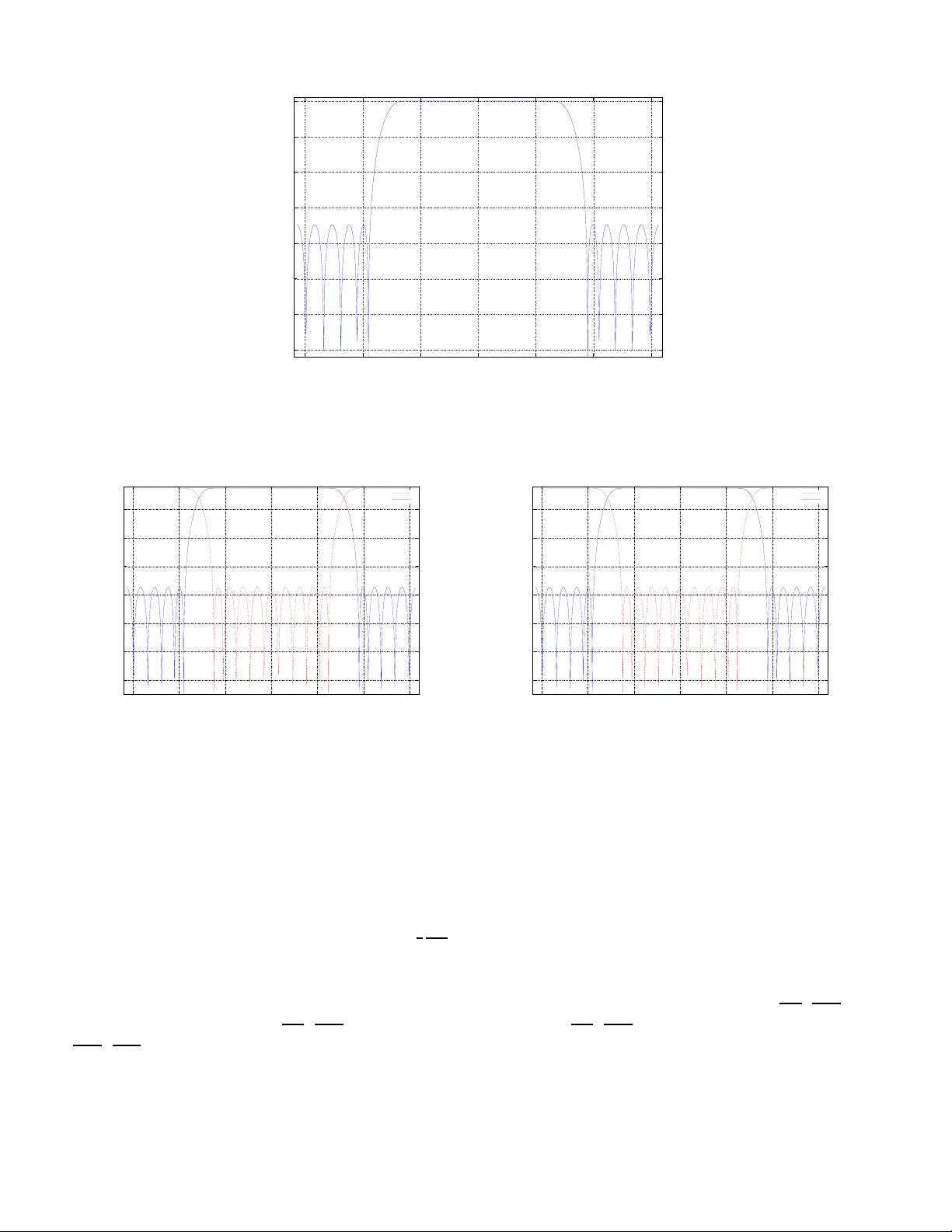
1 T w o channel paraunitary filter banks based on linear canonical transform Sudarshan Shinde Computational Research Laboratories, Pune,INDIA. Email:sudarshan shinde@iitb ombay .org Abstract In this pap er a two chann el paraunitary filter b ank is pro posed , which is based on linear can onical transfor m, instead of d iscrete Fourier transform. Input- output r elation for such a filter bank are deriv ed in terms of polyphase matrices and modulation matrices. It is sho wn that like con vention al filter banks, th e LCT ba sed pa raunitary filter b anks need on ly one filter to be designed and rest of the filters can be ob tained from it. It is also shown that LCT b ased para unitary filter ban ks can be desig ned by using co n ventional power -symmetric filter design in F ourier domain. Keywords Sub-ban d d ecompo sition, filter ban ks, linear canonical transform. paraun itray , po wer-symmetric, fraction al F ourier transform. I . I N T R O D U C TI O N A. Motivati on Filter banks are no w well kno wn tool for time-frequ enc y analysis of a signal [1], [2]. Gi ven a signal x ( n ) , a two chann el filter b ank (as shown i n fig.1), splits it s Fo urier transform (FT) spect rum into tw o by a lo w-pass and a high-pas s filter { h 0 ( n ) , h 1 ( n ) } respecti vely . Output of these fi lters are then do w n-sampled to produce analysis fi lter bank output { y 0 ( n ) , y 1 ( n ) } . T o re constr uct the signal { y 0 ( n ) , y 1 ( n ) } are p assed from a synthesis filter bank . The syn thesi s filter bank upsample s { y 0 ( n ) , y 1 ( n ) } , and after passin g them from synthesis filters { g 0 ( n ) , g 1 ( n ) } , adds them to form the filter bank output ˆ x ( n ) . The filter bank introduce s variou s distortions lik e alias disto rtion, magnitude distortion and phase distor tion into the signal . It can be sho wn that by careful design of the analysis and synthesis fi lters, all these distor tions could be eliminated and ˆ x ( n ) could be made a delayed v ersio n of x ( n ) by s ome intege r K . Such filter ban ks are called perfect reconst ructio n filter b anks (PRFB)[1], [2]. Discrete Fourier tran sform(DFT), and its generalizatio n z-transform (ZT ) find extens i ve use in the filter bank theory . Many key theorems of filter bank theory are express ed in Fo urier domain or z-d omain. T erms like lo w-pass and hi gh- pass make sense in the Fourier domain. Design of the filters is carried out by givin g th eir specificatio ns in the Fourier domain. In anothe r de velopment, the Fourier transform(FT) has been generalized to fractional Fourier Tra nsform (FrFT), by lookin g at FT as a transform that rotates the signal in time- freque ncy plan e by π/ 2 [3], [4]. It is found that the FrFT is a special case of three para meter family of transfor ms called Linear Canonical Tr ansfor m(LCT)[5 ], [6]. Giv en a contin uous time signa l x ( t ) , its LCT is gi ve n by X a,b,c,d ( u ) = s 1 j 2 πb Z ∞ ∞ x ( t ) e j ( a 2 b t 2 − 1 b ut + d 2 b u 2 ) dt (1) where ad − bc = 1 . In order to define FrFT and LCT on a discrete signa l, many sampling theore ms in F rFT domain and LCT doamin ha v e bee n de ri ve d [7], [8], [5], [9], [10]. It is sho wn [5] that i f a sign al is band-l imited in the LCT domain, th en it can be recons tructe d by its unifor mly sampled discrete samples . Based on unifo rm sampling, a discret e time LCT (DTLCT) is introd uced in [10], and samplin g rate con version theorems for this D TLCT are also deri ved. Since sampling rate con versio n is used in the filter banks, it is natural to ask if a sub- band decomposition scheme could be dev elope d which is base d on the D TLCT . In particu lar , w e w ant to kno w ho w a fi lter -bank can be desig ned that splits the DTLCT spect rum of an inpu t signal into two sub-ban d signals . 2 B. Contrib utions of the paper In this pap er the samplin g rate con ver sion theorems deri ved in [10 ] are us ed to de velop a sub -band decomposi tion scheme based on DTLC T . A c on v olutio n is defined in the DTLCT domain whi ch is suit able for the s ub-ban d decompo- sition scheme proposed. Input-out put rel ation of an LCT filter bank in polyp hase and modulation (or alias component) domains is deri ved. Conditi on for a two chann el LCT filter bank to be parau nitary (PU ) is als o deriv ed. It is sho wn furthe r that a two channel PU LC T filter bank can be desig ned from a power -symmetric fi lter in ZT domain. C. Notation s Giv en a signal x ( n ) , its L CT is denot ed by X ( ω ) , FT by X ( e j ω ) and ZT by X ( z ) . Sampli ng rate of x ( n ) is denoted by T x . Downs ampling x ( n ) by an inte ger N is denoted by x ( n ) ↓ N , and upsampling by N is denote d by x ( n ) ↑ N . Matrices are denoted by boldfac e le tters. Complex conjugate of X ( ω ) is denoted by X ∗ ( ω ) . Conjugate transpose of a matrix H ( ω ) is denot ed by H T ∗ ( ω ) . For a scalar H ( z ) , H ∗ ( z − 1 ) is denoted by ˜ H ( z ) , and for a matrix H ( z ) , H T ∗ ( z − 1 ) is denoted by ˜ H ( z ) . I I . R E V I E W O F F I LTE R B A N K S A N D D T L C T A. Revie w of DTLCT Let x ( n ) be a discre te signal , obtained by unifor m sampling of a continuous signal x c ( t ) with a sampling period T x , so that x ( n ) = x c ( nT x ) . The DTLCT of x ( n ) , with par ameters ( a, b, c, d ) is defined as [10], X ( ω ) = s 1 j 2 πb X n ∈ I x ( n ) exp j 2 a b n 2 T 2 x − 2 n sgn ( b ) ω + db T 2 x ω 2 , b 6 = 0 , (2) where sgn ( b ) is sign of b . In this pape r we will assume b > 0 to av oid sgn ( b ) term. This does not resul t in loss of genera lity , si nce all the results in this paper can be obtain ed for b < 0 case in the same way they are obta ined for b > 0 case. Upsampling a signal by L is d efined as ins erting L ze ros between tw o samples. This changes the sampling time of the upsample d signal. Thus if y ( n ) = x ( n ) ↑ L , then T y = T x /L . It can be sho wn that [10] Y ( ω ) = X ( Lω ) (3) Similarly do w nsamplin g a signal by M is defined as dropping M − 1 samples out of a block of M sampl es and retaini ng only the first sample. This also changes the samplin g time of the do wnsample d signal. Thus if y ( n ) = x ( n ) ↓ M , then T y = M T x . It can aga in be sho wn that [10] Y ( ω ) = 1 M M − 1 X m =0 exp " − j db 2 π m T 2 y ( ω + mπ ) # (4) B. Revie w of F ilter -bank s Consider a two channe l filter -bank sho wn in fig.1. The input-o utput relati on of this filte r -bank can be w ritten either in terms polyp hase matrices, or in terms of modula tion (or alias component) matrices [1 ], [2]. Giv en a discrete signal x ( n ) , havin g ZT X ( z ) , its type-1 polyp hase repre sentat ion is obtaine d by writing X ( z ) as X ( z ) = X 0 ( z 2 ) + z − 1 X 1 ( z 2 ) , w here X 0 ( z ) = P n ∈ I x (2 n ) z − n , X 1 ( z ) = P n ∈ I x (2 n + 1) z − n . Similarly a typ e- 2 polypha se repre sentat ion is obtained by writing X ( z ) = X 0 ( z 2 ) + z X 1 ( z 2 ) , where X 0 ( z ) is same as abo v e and X 1 ( z ) = P n ∈ I x (2 n − 1) z − n . Using thes e polyphas e represent ations , it can be sh o wn that ˆ X p ( z ) = G p ( z ) H p ( z ) X p ( z ) (5) where ˆ X p ( z ) def = " ˆ X 0 ( z ) ˆ X 1 ( z ) # 3 X p ( z ) def = " X 0 ( z ) X 1 ( z ) # G p ( z ) def = " G 00 ( z ) G 10 ( z ) G 01 ( z ) G 11 ( z ) # H p ( z ) def = " H 00 ( z ) H 01 ( z ) H 10 ( z ) H 11 ( z ) # (6) where the polyp hase decomposi tions of analy sis and synthesis filters are of dif ferent type (i.e., if { H 0 ( z ) , H 1 ( z ) } ha v e type-1 polypha se decompositi on, then { G 0 ( z ) , G 1 ( z ) } will ha ve type-2 represent ation and vice versa) , and the polyp hase decompos ition of X ( z ) and ˆ X ( z ) are of same type . The input- outpu t relation can also be expressed in terms of modulatio n matrices as ˆ X m ( z ) = 1 2 G m ( z ) H m ( z ) X m ( z ) (7) where ˆ X m ( z ) def = " ˆ X ( z ) ˆ X ( − z ) # X m ( z ) def = " X ( z ) X ( − z ) # G m ( z ) def = " G 0 ( z ) G 1 ( z ) G 0 ( − z ) G 1 ( − z ) # H m ( z ) def = " H 0 ( z ) H 0 ( − z ) H 1 ( z ) H 1 ( − z ) # (8) It can be seen that the polyph ase m atrices and the modulati on matrices are relat ed as " H 0 ( z ) H 0 ( − z ) H 1 ( z ) H 1 ( − z ) # = " H 00 ( z ) H 01 ( z ) H 10 ( z ) H 11 ( z ) # " 1 1 z − k − z − k # (9) where k = 1 for type-1 polyphas e decompositi on and k = − 1 for type-2 polyphase representat ion. A square polyno mial matrix H ( z ) is said to be paraun itary (PU) if H ( z ) ˜ H ( z ) = dI for some d > 0 . It can be seen from (9) that if polyph ase m atrix of analysi s fi lters is PU, then its alias compon ent m atrix will also be PU. If H m ( z ) is PU , then by making G m ( z ) = z − K ˜ H m ( z ) , where K is an integer appropri ate enoug h to mak e the synthe sis filte rs causa l, ˆ X ( z ) = z − K X ( z ) can be achiev ed, i.e. th e output is delayed ve rsion of the input, and perfe ction recons tructio n can be achie ved . If H m ( z ) is P U, the n it can be seen that H 0 ( z ) satisfies what is called power-s ymmetry property , i.e. | H ( e j ω ) | 2 + | H ( e j ( ω + π ) ) | 2 = d (10) Further H 1 ( z ) is related to H 0 ( z ) as H 1 ( z ) = cz − L ˜ H 0 ( z ) , | c | = 1 , L = odd (11) If H m ( z ) is P U, the n making G m ( z ) = z − K H m ( z ) w ill gi ve us PRF B. This gi ves G 0 ( z ) = z − K ˜ H 0 ( z ) G 1 ( z ) = z − K ˜ H 1 ( z ) (12) Thus all the filters of a two chan nel PU filter bank can be obtained by designing a power symmetri c filter H 0 ( z ) . If H 0 ( z ) is po wer-sy mmetric, then H 0 ( z ) ˜ H 0 ( z ) is an half-ba nd filter . Thus a po wer -symmetric filter can be d esigne d by designi ng a half-band fi lter and computin g an appropriate spectral factor (Please refer [1] for further details.). 4 h (n) 0 0 u (n) 0 y (n) 0 v (n) g (n) 2 2 0 x (n) ^ x (n) ^ 1 0 g (n) 2 2 x(n) x(n) h (n) 1 u (n) 1 y (n) 1 v (n) 1 1 Fig. 1 T H E T W O C H A N N E L FI LT E R BA N K . I I I . C O N VO L U T I O N A N D D E L A Y I N T H E D T L C T D O M A I N Filtering operation in sub-ba nd decompositio n is defined as taking product of the DFT(or Z T) of the signal with the filter . In time domain thi s corre spond s to con vo lution between the signal and th e filter . In cont inuou s FrFT and L CT domain also v arious con v olutio n theorems hav e been deri v ed [11],[12]. For LCT su b-ban d decompos ition, it is con veni ent to define con v olutio n of x ( n ) and h ( n ) as h ( n ) ∗ x ( n ) def = ∞ X k = −∞ h ( k ) x ( n − k ) e − j aT 2 b k ( n − k ) (13) Thus if y ( n ) = h ( n ) ∗ x ( n ) , then Y ( ω ) = H ( ω ) X ( ω ) e − j dbω 2 2 T 2 (14) W ith this definition of con volut ion, it is con venien t to define a new de lay operato r D [ . ] on a signal x ( n ) as D [ x ]( n ) = x ( n − 1) e j aT 2 2 b ( − 2 n +1) . (15) The prope rties of D [ . ] are summarized in the follo wing lemma, Lemma 1: The operator D [ . ] has the follo w ing propertie s, 1. D l [ D k [ x ]]( n ) = D l + k [ x ]( n ) for all k , l ∈ I . 2. If y ( n ) = D k [ x ]( n ) then Y ( ω ) = e − j kω X ( ω ) . 3. If y ( n ) = x ( n ) ∗ h ( n ) then D l [ x ]( n ) ∗ D k [ h ]( n ) = D l + k [ y ]( n ) . Pr oof: The first two res ults are straight-f orwar d. T o prov e the last result let D l [ x ]( n ) ∗ D k [ h ]( n ) = X r ∈ I D l [ x ]( r ) D k [ h ]( n − r ) e − j aT 2 b r ( n − r ) = X r ∈ I x ( r − l ) e j aT 2 ( − 2 rl + l 2 ) 2 b h ( n − r − k ) e j aT 2 ( − 2( n − r ) k + k 2 ) 2 b e − j aT 2 b r ( n − r ) (16) By re-arran ging the index and the po wer of e , we can obtain D l [ x ]( n ) ∗ D k [ h ]( n ) = D k + l [ y ]( n ) . I V . A T W O C H A N N E L L C T F I L T E R B A N K Consider the filter bank in fig.1, w ith con volu tion as de fined in (13). W e ar e interest ed in writin g the inp ut-out put relatio n of this filter bank in terms of polyph ase and m odula tion m atrices , if Z T (or DFT) is repl aced by D TLCT . A. P olyphase Domain Analysis T o define a type-1 polypha se decompo sition of x ( n ) , let x ( n ) = x e ( n ) + x o ( n ) , where x e ( n ) = ( x ( n ) n = ev en 0 n = odd (17) and x o ( n ) is similarly d efined. Let ¯ x o ( n ) = D − 1 [ x o ]( n ) , then X ( ω ) = X e ( ω ) + e j ω ¯ X o ( ω ) . Let x 0 ( n ) = x e ( n ) ↓ 2 and x 1 ( n ) = ¯ x e ( n ) ↓ 2 , th en type-1 polyph ase decomposi tion of x ( n ) is gi ve n as X ( ω ) = X 0 (2 ω ) + e j ω X 1 (2 ω ) . 5 0 x(n) g (n) 2 2 x (n) ^ u (n) y (n) v (n) h (n) Fig. 2 A FI LT E R B A N K C H A N N E L . 2 x(n) h (n) y (n) (a) ^ x (n) g (n) 2 y (n) (b) Fig. 3 F I LT E R BA N K C H A N N E L S : ( A ) A NA L Y S I S FI LT E R BA N K C H A N N E L ( B ) S Y N T H E S I S FI LT E R B A N K C H A N N E L Similarly , we can obt ain t ype-2 polyph ase decompo sition of x ( n ) by putting ¯ x o ( n ) = D [ x o ]( n ) . In this case X ( ω ) = X 0 (2 ω ) + e − j ω X 1 (2 ω ) . Note that the sampling time of the polyph ase components T x 0 = T x 1 = 2 T x . The input- outpu t relation of an analysis filter bank channel, sho wn in fig.3(a), is giv en in terms of polyphase compo- nents as Lemma 2: If y ( n ) = ( h ( n ) ∗ x ( n )) ↓ 2 , then Y ( ω ) = e − j dbω 2 T 2 y h H 0 ( ω ) H 1 ( ω ) i " X 0 ( ω ) X 1 ( ω ) # (18) where the polyph ase components of h ( n ) and x ( n ) are of dif ferent type. Pr oof: Let u ( n ) = h ( n ) ∗ x ( n ) , th en, u e ( n ) = x e ( n ) ∗ h e ( n ) + x o ( n ) ∗ h o ( n ) = x e ( n ) ∗ h e ( n ) + D [ x o ]( n ) ∗ D − 1 [ h o ]( n ) = x e ( n ) ∗ h e ( n ) + ¯ x o ( n ) ∗ ¯ h o ]( n ) (19) T aking DTLCT of both the sides, U e ( ω ) = e − j dbω 2 T 2 u ( H e ( ω ) X e ( ω ) + ¯ H o ( ω ) ¯ X o ( ω )) = e − j dbω 2 T 2 u ( H 0 (2 ω ) X 0 (2 ω ) + H 1 (2 ω ) X 1 (2 ω )) (20) By noting that Y ( ω ) = U e ( ω / 2) , and T y = 2 T u , and subs titutin g it i n (20), we obtain the require d result. Similarly the inpu t-outp ut relation of a synthesis filter b ank cha nnel, sho w n in fig.3(b), i s gi ven in terms o f p olyph ase compone nts as- Lemma 3: If ˆ x ( n ) = g ( n ) ∗ ( y ( n ) ↑ 2) , then " ˆ X 0 ( ω ) ˆ X 1 ( ω ) # = e − j dbω 2 2 T 2 y " G 0 ( ω ) G 1 ( ω ) # Y ( ω ) (21) where the polyph ase components of both g ( n ) and x ( n ) are of same type. Pr oof: Let v ( n ) = y ( n ) ↑ 2 . Then ˆ x e ( n ) = g e ( n ) ∗ v ( n ) and ˆ x o ( n ) = g o ( n ) ∗ v ( n ) . This gi ves D [ ˆ x o ]( n ) = D [ g o ] n ∗ v ( n ) . T aking LCT of both the sides , we hav e " ˆ X e ( ω ) ¯ ˆ X o ( ω ) # = e − j dbω 2 2 T 2 v " G e ( ω ) ¯ G o ( ω ) # V ( ω ) (22) By noting th at T y = 2 T v , V ( ω ) = Y (2 ω ) , X e ( ω ) = X 0 (2 ω ) and so on, and su bstitu ting them in (22) we g et the d esired result. 6 Using the abov e two lemma, The filter bank equ ation for the filter- bank in fig.1 is ˆ X p ( ω ) = e − j dbω 2 T 2 x 0 G p ( ω ) H p ( ω ) X p ( ω ) (23) where X p ( ω ) = " X 0 ( ω ) X 1 ( ω ) # ˆ X p ( ω ) = " ˆ X 0 ( ω ) ˆ X 1 ( ω ) # G ( ω ) = " G 00 ( ω ) G 10 ( ω ) G 01 ( ω ) G 11 ( ω ) # H ( ω ) = " H 00 ( ω ) H 01 ( ω ) H 10 ( ω ) H 11 ( ω ) # (24) B. Modulat ion D omain Analysis T o write th e filter bank equation in ter ms of alias component matrices, it is preferable to cons ider a chann el of the filter bank as sho wn in fig.2 . The inpu t-outp ut relation for this channel is giv en as follo ws- Lemma 4: For the cha nnel in fig.2 , the input and output are related by ˆ X ( ω ) = 1 2 1 X m =0 e − j db ( ω + mπ ) 2 T 2 x G ( ω ) H ( ω + mπ ) X ( ω + mπ ) (25) Moreo ver , ˆ X ( ω + π ) is gi ven by ˆ X ( ω + π ) = 1 2 1 X m =0 e − j db ( ω + mπ ) 2 T 2 x G ( ω + π ) H ( ω + mπ ) X ( ω + m π ) (26) Pr oof: By usin g the followin g relations U ( ω ) = e − j dbω 2 2 T 2 x F ( ω ) X ( ω ) Y ( ω ) = 1 2 1 X m =0 exp ( − j db 2 mπ ( ω + m π ) T 2 y ) U ( ω 2 + mπ ) T y = 2 T x V ( ω ) = Y (2 ω ) T v = T y / 2 = T x ˆ X ( ω ) = e − j dbω 2 2 T 2 x G ( ω ) V ( ω ) (27) and some algebra ic manipula tion we can obtain (25). T o prov e (26), we note that using (25), we ha v e ˆ X ( ω + π ) = 1 2 1 X 0 e − j db ( ω +( m +1) π ) 2 T 2 x G ( ω + π ) H ( ω + ( m + 1) π ) X ( ω + ( m + 1) π ) (28) Further noting that for an y X ( ω ) X ( ω + 2 π ) = e j db 2 π ( ω + π ) T 2 x X ( ω ) (29) and substi tuting from (29) into (28) we get (26). Using the abov e lemma we can write the follo wing input-o utput relation for the filter bank sho wn in fig.1 . ˆ X m ( ω ) = 1 2 G m ( ω ) H m ( ω ) A ( ω ) X m ( ω ) (30) 7 X m ( ω ) = " X ( ω ) X ( ω + π ) # ˆ X m ( ω ) = " ˆ X ( ω ) ˆ X ( ω + π ) # G m ( ω ) = " G 0 ( ω ) G 1 ( ω ) G 0 ( ω + π ) G 1 ( ω + π ) # H m ( ω ) = " H 0 ( ω ) H 0 ( ω + π ) H 1 ( ω ) H 1 ( ω + π ) # A ( ω ) = e − j dbω 2 T 2 x 0 0 e − j db ( ω + π ) 2 T 2 x (31) Using the relation X ( ω + 2 π ) = e j 2 πdb T 2 ( ω + π ) X ( ω ) , it can be shown that X m ( ω ) = B ( ω ) C ( e j ω ) X p ( ω ) (32) where B ( ω ) = " 1 0 0 e j 2 πdb T 2 (2 ω + π ) # C ( ω ) = " 1 e j ω 1 − e j ω # (33) V . T W O C H A N N E L P A R AU N I T A RY F I LTE R B A N K S A square matrix H ( ω ) is defined to be a paraunit ary matrix if H T ∗ ( ω ) H ( ω ) = dI for some d > 0 and for all ω . L et H m ( ω ) in (30) be PU, then by setting G m ( ω ) = e − j K ω A ∗ ( ω ) H T m ∗ ( ω ) (34) where K is an inte ger (needed to make the synthes is filters caus al), we can obtain perfect reconstruct ion. W e now sho w that as in the case of ZT , H ( ω ) can be made PU if H 0 ( ω ) is po wer -symmetr ic, and H 1 ( ω ) can be obtain ed from H 0 ( ω ) by inspectio n. Lemma 5: If H 0 ( ω ) is power sy mmetric, i.e. | H 0 ( ω ) | 2 + | H 0 ( ω + π ) | 2 = 1 , (35) and H 1 ( ω ) is such that H 1 ( ω ) = e j dbω ( ω + π ) T 2 +(2 L +1) ω H 0 ∗ ( ω + π ) , (36) for an inte ger L , then H ( ω ) is PU . Pr oof: By exp anding each element in H m ( ω ) H T m ∗ ( ω ) ,substitut ing from (35) and (36), and using the relati on H i ( ω + 2 π ) = e j 2 πdb T 2 ( ω + π ) H i ( ω ) , w here i ∈ { 0 , 1 } , we can get H m ( ω ) H T m ∗ ( ω ) = I . The abov e lemma su ggests that just like in the ZT filte r bank, pro blem of design ing a two channe l PU LCT filter ba nk can be reduce d to the problem of designing a power -symmetric filter , and rest of the fi lters could be obtain ed from this filter . Ho we ve r a po wer -symmetr ic filter in LCT domain can be obtain ed from a power -symmetric filter in Z T domain, as sho wn in the follo w ing lemma, Lemma 6: Let H 0 ( ω ) = D T LC T ( h 0 ) . Let ¨ h 0 ( n ) be defined as ¨ h 0 ( n ) = h 0 ( n ) e j an 2 T 2 2 b . Let ¨ H 0 ( e j ω ) = F T ( ¨ h 0 ) . If ¨ H 0 ( e j ω ) is po wer-symmetri c, then H 0 ( ω ) will also be po wer -symmetric . 8 0 0.1 0.2 0.3 0.4 0.5 -3 -2 -1 0 1 2 3 |X(omega)| Omega Fig. 4 M A G N I T U D E O F T H E I N P U T S I G N A L X ( ω ) . Pr oof: H 0 ( ω ) can be written as H 0 ( ω ) = X n h 0 ( n ) e j an 2 T 2 2 b e − j nω e j dbω 2 2 T 2 = e j dbω 2 2 T 2 ¨ H 0 ( e j ω ) (37) From this it can be seen that H 0 ( ω ) H ∗ 0 ( ω ) = ¨ H 0 ( e j ω ) ¨ H ∗ 0 ( e − j ω ) (38) and so if ¨ H 0 ( e j ω ) is po wer -symmetri c, then H 0 ( ω ) will also be po wer -symmetric . V I . A N E X A M P L E In this section w e take an exa mple which serve s as a demonstration of the LCT filter bank. In this examp le we take the LCT to be FrFT at an angle π / 4 . The [ a, b, c, d ] matrix will thus be " a b c d # = " cos( π / 4) sin( π / 4) − sin( π / 4) cos( π/ 4) # (39) The input s ignal x ( n ) is such that its LCT X ( ω ) has peaks at { 30 π 512 , 100 π 512 , 412 π 512 , 482 π 512 } , a s sho wn in fig.4. The sampling time of the input signa l x ( n ) is taken as T = 0 . 05 . An LCT po wer -symmetr ic filter is generated by apply ing lemma 6 on a ZT power -symmetric filter . In this exampl e, the ZT po wer symmetric filter h ( n ) is tak en from [1],example 5.3.2. T he magnitu de response is sho wn in fig(5). Using lemma 6, the LCT po wer symmetric filter h 0 ( n ) is gi ven by h 0 ( n ) = h ( n ) e − j 2 an 2 T 2 b (40) Filter h 1 ( n ) is obtai ned from h 0 ( n ) by applyin g lemma 5. This g i ve s h 1 ( n ) as h 1 ( k ) = h 0 ∗ ( N − k ) e j φ ( k ) , k ∈ { 0 ..N } (41) where φ ( k ) = − aT 2 2 b h ( N − k ) 2 + k 2 i + ( N − k ) π − db 2 T 2 π 2 (42) 9 -70 -60 -50 -40 -30 -20 -10 0 -3 -2 -1 0 1 2 3 Magnitude of H(db) Omega Fig. 5 M A G N I T U D E ( D B ) O F T H E P OW E R S Y M M E T R I C FI LT E R H ( e j ω ) , T H AT I S U S E D T O G E N E R A T E H 0 ( ω ) -60 -50 -40 -30 -20 -10 0 -3 -2 -1 0 1 2 3 Magnitude(db) Frequency H0 H1 (a) -60 -50 -40 -30 -20 -10 0 -3 -2 -1 0 1 2 3 Magnitude(db) Frequency G0 G1 (b) Fig. 6 M A G N I T U D E ( D B ) O F T H E L C T O F V A R I O U S FI LT E R S U S E D I N T H E L C T FI LT E R B A N K : ( A ) A N A L Y S I S FI L T E R S { H 0 ( ω ) , H 1 ( ω ) } ( B ) S Y N T H E S I S FI LT E R S { G 0 ( ω ) , G 1 ( ω ) } The magnitu de respon se of the L CT of analy sis filters is sho wn in fig.6(a). Finally the synth esis fi lters { G 0 ( ω ) , G 1 ( ω ) } are obtained from { H 0 ( ω ) , H 1 ( ω ) } using (34), which giv es g i ( k ) = h i ∗ ( N − k ) e − j 2 aT 2 b [ ( N − k ) 2 + k 2 ] , k ∈ { 0 ..N } , i ∈ 0 , 1 (43) The magnitu de respon se of the L CT of synth esis fi lters is sho wn in fig.6(b). The LCT of analysis filter outpu t { y 0 ( n ) , y 1 ( n ) } are sho wn in fig.7(a) and fig.7(b). The pea ks at { 30 π 256 , 100 π 256 } in Y 0 ( ω ) corres pond to peaks at { 30 π 512 , 100 π 512 } in X ( ω ) . Similarly peaks at { 30 π 256 , 100 π 256 } in Y 1 ( ω ) correspond to peaks at { 482 π 512 , 412 π 512 } in X ( ω ) . The signal is then reco nstruc ted by passin g { y 0 ( n ) , y 1 ( y ) } from synthesis fi lter . The LCT of the synthesis filter outpu t ˆ X ( ω ) is sh o wn in fig.8. It is obse rve d that the output matches with input delay ed by N samples. 10 0 0.1 0.2 0.3 0.4 0.5 -3 -2 -1 0 1 2 3 |Y0(omega)| Omega (a) 0 0.1 0.2 0.3 0.4 0.5 -3 -2 -1 0 1 2 3 |Y1(omega)| Omega (b) Fig. 7 M A G N I T U D E O F A N A L Y S I S FI L T E R B A N K O U T P U T : ( A ) Y 0 ( ω ) ( B ) Y 1 ( ω ) . 0 0.1 0.2 0.3 0.4 0.5 -3 -2 -1 0 1 2 3 |HatX(omega)| Omega Fig. 8 M A G N I T U D E O F T H E FI LT E R B A N K O U T P U T ˆ X ( ω ) . V I I . C O N C L U S I O N In th is pa per a t wo channe l paraunita ry filter bank ba sed on linear can onica l transform has bee n de velope d. This kind of filter bank can be use ful i n sub-band dec ompositi on of the signals t hat are no t ban d li mited in the Fouri er domain, b ut band limited in an LCT domain. Input-outp ut relatio ns for suc h a filter bank in polyphase and modulation domain are deri ved. It is a lso shown that such a filter bank can be design ed b y using stand ard design procedu re fo r po wer -symmet ric filters in Fouri er domain. The future work in th is di rection may include gene ralizat ion of LCT b ased filter bank to more t han t wo c hanne ls, and de v elopmen t of LCT based cosine modulated filter banks. 11 R EF E R E N C E S [1] P . P . V aidyanathan , Multirate Systems and Filter B anks . Englew ood Cliffs,Ne w Jerse y: Prentice Hall PTR, 1993. [2] M. V etterli and J. Ko vace vic, W avelets and Subband Coding . Engle wood C liffs,Ne w Jersey: Prentice Hall PTR, 1995. [3] H .M.Ozaktas, Z. Zalev sky , and M.A.Kutay , The F ractional F ourier T ra nsform wit h Applications in Optics and Signal Pr ocessing . New Y ork: J. W iley , 2000. [4] A .L.Almeida, “The Fractional Fourier T ransform and T ime-Frequenc y Representations, ” IEEE T ran s. on Sig.Pr oc. , vol. 42, no. 11, pp. 3084–3 091, 1994. [5] A .Stern, “Sampling of linear canonical transformed signals, ” Signal Pr ocessing , vol. 86, pp. 1421– 1425, 2006. [6] K .R.W olf, Inte gral T ra nsforms in Scienc e and Engineering . Ne w Y ork: Plenum Press, 197 9. [7] R . T . B. Z. Li and W .Y ue, “Ne w sampling formulae related to linear canonical transform , ” Science in China, Series F , vol. 49, no. 5, pp. 591–60 3, 2006. [8] C .Candan and H.M.Ozaktas, “Sampling and series expansion theo rems for fractional fourier an d other transforms, ” Signal Pr ocessing , vol. 83, pp. 245 5–2457 , 2003. [9] W . R.T ao, B. Deng and Y .W ang, “Sampling and sampling rate con version in fractional f ourier transform domain, ” IEEE T rans. on Signal Pr ocessing , v ol. 56, no. 1, pp. 158–17 1, 2008. [10] R. J. Zhao and Y .W ang, “Sampling rate con vertion of linear canonical transform, ” Signal Proc essing , vol. 8 8, pp. 2825–2 832, 2008. [11] R. T . D.Bing and W .Y ue, “Con volution theo rems for the linear canonical transform an d their application, ” Science in China, Series F , vol. 49, no. 5, p p. 591–603 , 2006. [12] A.L.Almeida, “Product and Con volution Theorems for the Fractional Fourier T ransform, ” IEEE Signal Processing Letters , vol. 4, no. 1, pp. 15–17, 1997.
Original Paper
Loading high-quality paper...
Comments & Academic Discussion
Loading comments...
Leave a Comment