Coalitions in Cooperative Wireless Networks
Cooperation between rational users in wireless networks is studied using coalitional game theory. Using the rate achieved by a user as its utility, it is shown that the stable coalition structure, i.e., set of coalitions from which users have no ince…
Authors: Suhas Mathur, Lalitha Sankar, Narayan B. M
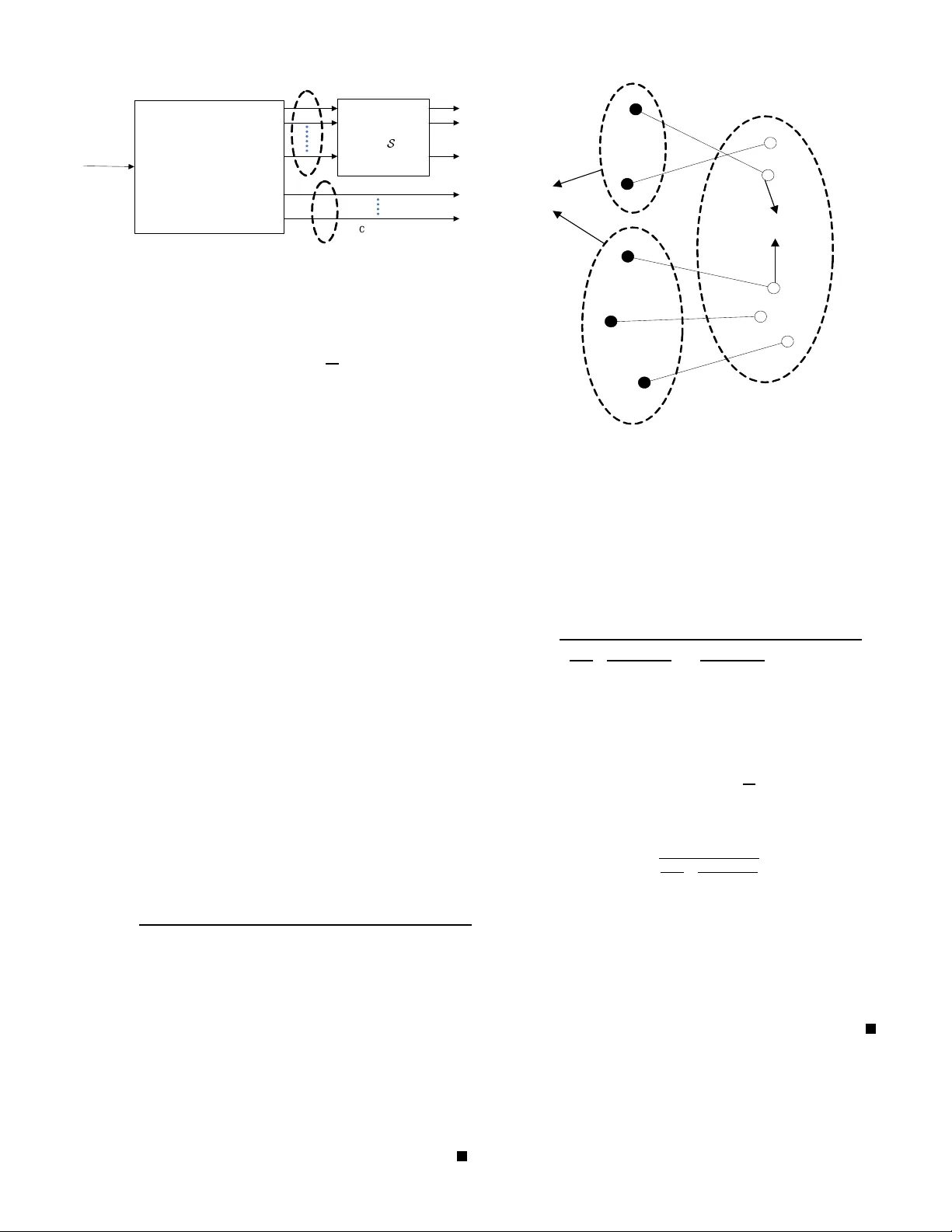
1 Coalitions in Cooperati v e W ir eless Networks Suhas Mathur , Me mber , IEEE, Lalitha Sanka r , Member , IEEE, and Naraya n B. Manda yam, Sen ior Member , IEEE Abstract — Cooperation between rational users in wire less net- works i s stu died using coalitional game theory . Using the rate achiev ed by a user a s its utility , it is shown that the stab le coalition structure, i.e., set of coalitions from which users hav e no incentiv es to defect, dep ends on th e manner in which the rate gains are apportioned among the cooperating users. S pecifically , the stability of the grand coalition (GC), i .e., the coalition of all users, is studied. T ransmitter and rec eiver cooperation in an interference channel (IC) are studied as illustrative cooperative models to determine the stable coalitions fo r both flexible ( transferable ) and fixed ( non-transferable ) apportionin g schemes. It is shown that th e stable su m-rate optimal coalition when only recei vers cooperate by jointly decodin g (transferable) is the GC. The stabil ity of th e GC depend s on the detector when recei vers cooperate using lin ear multi user detectors (non-transferable). T ransmitter cooperation is stu died assumin g that all receiv ers cooperate perfectly and that users outside a coalition act as jammers. The stabili ty of the GC is studied for both t he case of p erfectly cooperating transmitters (transferrable) and u nder a partial decode-and-forw ard strategy (non-transferable). In both cases, th e stabili ty is shown to depend on t he chann el gains and the transmitter jamming strengths. Index T erms — Coalitional games, cooperative communications, interference channel. I . I N T R O D U C T I O N Cooperation in wireless networks results when nodes exploit the bro adcast nature o f the wireless medium and use their power and b andwidth resou rces to mutually enh ance transm is- sions ( see, for e.g., [1], [2], [ 3] and the referen ces th erein). In general, it is assumed th at all the network nod es a re willing to cooperate. Howe ver, when rational (self-interested ) u sers are allowed to cooper ate it is n ecessary to examine whethe r the cooperatio n of all users, i. e., the grand coa lition (G C) of all users, c an be taken for g ranted. In fact, co operation may in volve sign ificant costs and the gr eatest immedia te b enefits may n ot be achie ved b y the users that bear the greatest immediate co st. An ad ditional d isincentiv e to co operation may result fro m the ru les by whic h the coo perative gains are Manuscript recei ved August 15, 2007; revised January 28, 2008. The work of S. Mathur , L. Sankar (previou sly Sankaranaraya nan) and N. B. Mandayam was supported in part by the National Science Foundation under Grant No. TF:0634973 . . The material in this paper was presented in part at the IEEE Interna tional Symposium on Information Theory , Seattle, W A, Jul. 2006; at the IEEE Conference on Information Sciences and Systems, Princet on, NJ, Mar . 2006; at the 40 th Annual Asilomar Confer ence on Signals, Systems, and Computers, Paci fic Grove , CA, Nov . 2006; and at the Information T heory and Applicat ions W orkshop, San Diego, CA, J an. 2008. S . Mathur and N. B. Mandayam are with the WINLAB, Department of E lect rical Engineeri ng, Rutgers Univ ersity , T echnology Center of NJ, 671 Route 1S, North Brunswick, N J, 08902. Em ail: suhas@winla b .rutgers.edu and narayan @winlab .rutgers.edu. L. Sankar is with the Department of Electri- cal E nginee ring, Princet on Univ ersity , E -Quad, Olden S treet , Princeton, NJ 08854. Em ail: lalit ha@princ eton.edu. distributed amon g participatin g users. In fact, f or max imum gains users may prefe r to co operate with a select set o f users to form coalitio ns that are closed to c ooperatio n fr om u sers outside the gro up. For example, con sider a multi- user wire less network wher e users labele d A , B , an d C ar e decoded at a central rec ei ver . Cooper ating users share the benefit of having their signals jo intly decoded at th e receiver while a user that chooses n ot to cooperate is dec oded in depend ently a nd is subject to inte rference fro m the other users. One can verify that the multiacc ess channel (MA C) that results when all three users co operate ac hiev es the maximu m informa tion-theor etic three-user sum-rate [4, 14.3] . Howe ver , it is not clear if the GC is also a stable coalition, i.e., a coalition whose users do not have an incentive to leave (for larger rates). For examp le, consider an ap portionm ent strategy where the sum-ra te ach ie ved is d i vided equally amon g the u sers in a coalitio n. In Fig. 1 we dem onstrate the stability o f the various co alitions as a f unction of the re ceiv ed sign al-to-noise ratio (SNR) of each user . Obser ve that the grand coa lition is desirable only when all users hav e similar SNR v alues. Further, for arbitrar y SNR values, th e users in the stable coalitions benefit from the exclu sion of the weak in terferer . Th us, even in th is relatively simple exam ple we see that user coop eration is d esirable only when the agg regate ben efits o f coo peration provide adequ ate incentives to all participating users. W e use the f ramew ork of coalitional g ame theory to d e- termine the stable co alition structure , i.e., a set of c oalitions whose users do no t have in centives to break away , wh en wireless nodes are allowed to coop erate (see for e.g., [5], [6]). W e conside r a K -link interf erence chan nel (I C) [7] as an illustrative network model to determine the stable coali- tions when tr ansmitters or rec ei vers ar e allowed to cooperate. Specifically , we f ocus o n th e stability of the gran d coalition and seek to un derstand if the GC also max imizes the utilities of all the u sers. For specific encodin g and decoding schemes, we model the max imum ac hiev able infor mation-theo retic r ate as a measur e of a user’ s utility . The encod ing and decodin g schemes also determin e the manner in which the rate gains can be appo rtioned between the cooper ating users in a coalition. Coalitional gam es ar e classified into two ty pes based on the apportio ning of ga ins among users in a coalition [8, Section IV]: i) a transferable utility (TU) game wher e the total rate achieved is apportioned arbitrarily be tween the users in a coa li- tion su bject to feasibility co nstraints an d ii) a no n-transferable utility (NTU) game where the apportion ing strategies h av e additional c onstraints th at prevent arbitrary apportion ing. In [9], [10], we app ly results fro m infor mation theory and TU gam es to stu dy the stable coalition structure whe n only receivers in an IC cooperate by jointly de coding th eir rec ei ved signals. W e show that the GC o f receivers is th e stable sum- 2 Fig. 1. Stable Coalit ion Structures as a function of the SNR values of users A and B and S N R C = 20 dB. rate maximizing coalition structure. On the other hand, for the case wher e the receivers c ooperate using linear multiuser detectors, we show th at the GC is always the stable co alition for the MMSE detector and is stable o nly in the high signal- to-noise ratio (SNR) regime for the decorrelatin g dete ctor . W e briefly revie w our r esults in Section IV. In th is paper, we study the for mation of stable coalition s when transmitter s are allowed to coop erate in a K -link IC. The coo perative strategies and r ate regions for a 2 - link IC with varying degrees of tran smitter an d receiver coo peration is studied in [ 11], [12] an d the referen ces therein. For a K -link IC, there is a co mbinator ial explosion in the ways in which the tran smitters can cooperate. Thus, knowledge of the stable coalition structures can be useful in choosing the appr opriate cooper ati ve strategies. W e assume th at the K r eceiv ers jointly decode their re ceiv ed sig nals thus simplifyin g the IC to a multi-access (MA C) channel with a multi-anten na receiver . W e also assume th at tran smitters in a coalition have no k nowledge of the transmission strategies of the users o utside. W e mod el the lack o f tran smit inf ormation betwee n com peting co alitions as a jamming game, i.e., we assume that each c oalition determines its stability by assuming worst case jamming interferen ce from o ther coalition s. W e first study th e TU game that results when the transmitters in a c oalition co operate perfectly , i.e., e ach tran smitter h as p erfect k nowledge o f the messages of the othe r tran smitters in its coalition. W e pr ove that the game is co hesive [ 8, ch ap. 1 3], i.e., the largest K -user sum-rate is ach iev ed b y the GC. T his allows us to show that the GC is th e o nly v iable stable co alition struc ture [8, p. 2 58], i.e., no stable coalitio n structu re exists when the GC is no t stable. Fin ally , using examples we demonstra te th at the GC is not always stab le an d that the stability depe nds o n the relativ e strengths of the user channe ls to the destina tion. W e also study the NT U game that results when all th e transmitters in a coalition decod e and join tly fo rward a part of their messag e streams via a pa rtial de code-an d-forwar d (PDF) strategy [ 13], [14]. W e assume perfec tly c ooperatin g co-located re ceiv ers with fixed c hannel g ains thus simp lifying the IC to a coop erativ e MAC. M otiv ated b y the results fo r the perfect tr ansmitter coo peration game, we focu s on a class of channels where all the u sers are clustered , i.e., their inter-user links are stronger th an the links betwee n the users and the destination. For this class, we prove that the achiev able rate region is m aximized wh en tr ansmitters in a coalition deco de all messages fr om on e another thus g eneralizing the r esults for a two-user cooper ati ve MAC in [1 5, Prop osition 1]. Howe ver , using examples, we show that when the jamming is weak, users may ha ve incentives to break away from the cluster , i.e., th e g ame m ay no t be coh esi ve. The se r esults fo r cluster ed users also point to the f act that for th e general class o f channels with ar bitrary in ter-user links the game may not be cohesive in ge neral. This pap er is organize d as fo llows . I n Section II we provide an overview of co alitional game th eory . In section III we introdu ce th e system mo dels. In Section IV we revie w our results on rece i ver co operation . In Sectio n V, we study trans- mitter coop eration as a coalitional gam e using two d ifferent cooper ation models. W e conclude in Sec tion VI. I I . C O A L I T I O N A L G A M E T H E O RY F O R R E C E I V E R A N D T R A N S M I T T E R C O O P E R A T I O N W e use the f ramework of coalitional g ame theo ry to deter- mine the stable rate m aximizing coo perative coalition s in a wireless network . T o determ ine stability one m ust in g eneral take into account the fact th at the rate achieved b y a coalition is also af fected by the actions of the users outside the coalition. Howe ver , determin ing th e stable coalition struc tures for such a general mo del is not straigh tforward [8, p. 25 8]. Thu s, it is common practice to assume that a g ame is in characteristic function form ( CFF), i.e., the utilities achieved by th e users in a coalition are unaffected by those o utside it [ 16]. When only receivers coop erate, th e game is in CFF . This is d ue to the fact that the tran smitters in these mod els do not cooper ate. In fact, for a fixed encoding at the transm itters, th e rate achieved by any c oalition only de pends on the c ombined interferen ce pr esented by the users outside the coalition an d not on the coalition structures to wh ich they belong . On th e other hand, th e g ames resu lting fr om b oth k inds o f transm itter cooper ation m odels are not in CFF beca use the coo perative strategies of user s outside a coalition affects the r ates achieved by the members of a coalition. W e con vert the game to a CFF by consider ing a jamming gam e , i.e., we assum e that a coalition assumes that the users outside coo perate to act as worst case jammers. Games in CFF ca n be further categor ized as TU and NTU games depend ing on whether the co operative g ains are divided arbitrarily or in a constrained manner, respectively . W e define both ga mes and their properties b elow . Definition 1 : A coalitional game with tra nsferable u tility hK , v i is defined as [8, Chap . 13 ] • a finite set of users K , • a value v ( S ) ∈ R + for all S ⊆ K with v ( { φ } ) = 0 . A coalition structure is a partition of th e set K , and thu s the nu mber of coalition structures, i.e., the numb er o f po ssible partitions of K , grows expo nentially with K [17]. I n fact, it 3 has been shown that finding the su m-rate maximizin g coalition structure is an N P -co mplete pro blem [17]. T o this end, the following p roperties of a TU game greatly simplify such a search. Definition 2 : A coalitional g ame with transfe rable utility is said to be cohesive if the value of the grand c oalition formed by the set of all users K is at least as large as the sum of the values of a ny partition of K , i.e. N X n =1 v ( S n ) ≤ v ( K ) (1) for any partition ( S 1 , . . . , S N ) o f K where 2 ≤ N ≤ K . Remark 3 : A TU game that is cohesive ha s the GC as the optimal coalition structu re [8, p. 258], i.e., the sum of the utilities of a ll the users is maximu m. This follows fro m the fact tha t all o ther coalition structur es will be u nstable as ev ery u ser has an incen ti ve to join th e GC and benefit fro m a redistribution of total utility . In ad dition to be ing cohesive, a TU coalitiona l g ame can also be supe radditive which is defined as follows. Definition 4 : A coalitional game w ith tran sferable pay off is said to be supera dditive if for any two d isjoint coalition s S 1 and S 2 , we h av e v ( S 1 ∪ S 2 ) ≥ v ( S 1 ) + v ( S 2 ) . (2) Remark 5 : Com paring (1) and (2), we see that superadditiv- ity r equires the cohesiv e proper ty to hold for any two d isjoint subsets of K with r espect to their union . W e refer to a vector describing the s hare of the rate (payoffs) received b y th e members ( players) of a coalition as a p ayoff vector . Definition 6 : For a ny coalition S , a vector x S = ( x m ) m ∈S of r eal nu mbers is a S - feasible pa yoff ve ctor if x ( S ) = P m ∈S x m = v ( S ) . The K -f easible payoff vecto r is referred to as a feasible payoff pr ofile . Of all possible coalition struc tures, the ones that are stable are of most interest. Further, due to the complexity o f fin ding stable co alition structure s f or non -cohesive g ames where th e GC d oes not ach iev e the largest value, coalitional games that are cohesive are th e easiest to study . For wirele ss networks, such game s a lso optim ize the sp ectrum utilizatio n. I n th e following defin ition, we assume that the gam e is coh esi ve and thus th e GC is the only possible stable coalition . Definition 7 : T he core , C ( v ) , of a coalition al g ame with transferable pay off, hK , v i , is the set of feasible pay off profiles x K for which there is no coalitio n S ⊂ K and a correspon ding S -feasible payoff vector y S = ( y m ) m ∈S such that y m > x m for all m ∈ S . For TU games, Definitio n 7 simplifies to the condition that the feasible p ayoff pro files x K in the cor e satisfy x ( S ) = P m ∈S x m ≥ v ( S ) for all S ⊂ K (3) x ( K ) = P m ∈K x m = v ( K ) . (4) This follows fro m the fact that in a g ame with tran sferable payoff if there exists a co alition S with v ( S ) > x ( S ) then we can always find a S -f easible pay off vector y S such th at y k > x k , for all k ∈ S . Such an assign ment c an result, for Tx Rx Fig. 2. An inter ference channel with K transmit-recei ve links. instance, when the S -feasible pa yoff vector y S is constru cted by assigning to each link k ∈ S , th e payoff x k and then un i- formly apportion ing the surplu s payo ff v ( S ) − x ( S ) between links in S . W e use th is e quiv alent definition to de termine the stability o f the cor e. Finally , we re mark that determinin g the non-em ptiness o f the co re simp lifies to determ ining wheth er the linear p rogram defin ed b y the inequalities in ( 3) and (4) is f easible. W e formally define an NTU ga me and its properties below [8, p. 26 8]. Definition 8 : A coalitional g ame with non -transferab le util- ity hK , V i consists of • A finite set K of K p layers, • A set fu nction V : S → R K + such th at for all S ⊆ K – V ( φ ) = φ (norm alized) – V ( S ) is a non- empty closed subset of R K + such that th e compo nents of the rate tuples in V ( S ) whose indices co rrespond to players not in S can be arbitrary , – for any length- K vectors x ∈ V ( K ) and y ∈ R K + with en tries y k ≤ x k , fo r all k , we have y ∈ V ( K ) (compr ehensive). Definition 9 : An NTU coalitio nal game hK , V i is coh esi ve if and o nly if N \ n =1 V ( S n ) ⊆ V ( K ) (5) where {S 1 , S 2 , . . . , S N } is any p artition of K where 2 ≤ N ≤ K . As with TU ga mes, we focu s o n the stability of th e GC and define a co re of a NTU ga me that is cohesive. Definition 1 0: The core C ( K , V ) of an NTU coalition al game hK , V i is the set of pay off vectors x ∈ V ( K ) such that there is no coalition S a nd p ayoff vector y ∈ V ( S ) su ch tha t y k > x k for all k ∈ S . I I I . C H A N N E L A N D C O O P E R A T I O N M O D E L S A. Cha nnel Mode l Our network consists o f K transmitter-receiver pair s (links), indexed by the set K = { 1 , . . . , K } [7] (see Fig. 2). W e mo del 4 each link as an add iti ve white Gaussian no ise cha nnel with fixed chan nel g ains. Th e received signal at receiver m is given by Y m = P K k =1 p h m,k X k + Z m m ∈ K (6) where h 1 / 2 m,k is the chan nel g ain between transmitter k an d receiver m . The noise entries Z m ∼ C N (0 , 1) , fo r all m , are independ ent, identically distributed (i. i.d), pr oper co m- plex zero-m ean unit-variance Gaussian r andom variables. The transmit p ower at transmitter k is constra ined as E | X k | 2 ≤ P k for all k ∈ K . (7) W e assume that the transm itters employ Gaussian signaling subject to (7). For the case where the receivers are co-located , our model simplifies to a MAC where all the transm itters commun icate with the same d estination, denoted as d such that Y d = Y k for all k . Finally , we write X S = { X k : k ∈ S } for all S ⊆ K an d S c as the comp lement of S in K . Finally , throug hout the paper, we use the words user and transmitter interchang eably . B. Coo peration Models a) Receiver coo peration via Joint decodin g: W e assume that the receivers that coop erate comm unicate via n oise-free links and that the transmitters do not cooper ate. W e assume that a co alition of co operating receivers treats signals from transmitters outside the coalition as interferen ce. For the cha n- nel in (6), ea ch n on-singleto n coalition can thus be m odeled as a single-in put, multiple-ou tput Gaussian multip le access channel (SIMO-MAC) who se c apacity region is kn own [1 8] and achiev ed by the G aussian input signaling chosen . b) Receiver coo peration using Linear multiuser detec- tors: W e assum e an IC with co-located rec ei vers the reby simplifying the channel to a single- antenna MA C. W e consider a BPSK modu lated, sync hronized CDMA system with no power c ontrol such that the correlation be tween any two user signature sequen ces is ρ . W e write the signal at the receiver as [ 19, p. 19 ] y ( t ) = K P k =1 √ P h k b k s k ( t ) + σ n ( t ) , t ∈ [0 , T ] (8) where P is the common transmit p ower of all users, h k is the ch annel gain from user k to the r eceiv er , b k ∈ { +1 , − 1 } is the bit tran smitted by user k in the bit interval [0 , T ] , s ( t ) is the signatur e sequence of user k , a nd n ( t ) is an add iti ve white Gaussian noise p rocess with unit variance. The receiv ed signal is filtered thr ough a bank of K matched filters to obtain a K × 1 received signa l vector [19] y = R Ab + n (9) where R ∈R K × K is a signature sequence cross correlation matrix, A is a d iagonal m atrix con taining th e rec ei ved ampli- tudes √ P h k , fo r all k , b is an K × 1 vector of transmitted bits, and n is a Gaussian rando m vector with zero mea n and covariance σ 2 R . T ransmitter Cooperation : W e stud y two models for trans- mitter coop eration in a K -lin k IC. In both cases, we assume that the r eceiv ers of all the link s jointly d ecode (see Fig. 5). Further, for simplicity , un der PDF , we assume co-located receivers thu s simp lifying the I C to a cooper ati ve MAC. Finally , in both cases, we assume that each coalition is af fected by worst-case jamming by co mpeting co alitions. c) P erfect coo peration: For perfect transmitter co op- eration each non-sing leton coa lition can be mo deled as a multi-inpu t, K -ou tput M IMO cha nnel with p er-antenna p ower constraints. The transmitter s in a coa lition m aximize their MIMO sum -capacity [ 18] subject to worst case jamm ing f rom other co alitions. d) P artial d ecode-a nd-forward: W e consider a MA C where a coalition of transmitters coop erate via a PDF scheme [13], [1], [14]. W e assume f ull du plex commu nications at the cooper ating transmitters. Th e received signals Y d and Y j at the d estination a nd at user j , respe cti vely , are Y d = P K k =1 p h d,k X k + Z d (10) Y j = P k ∈K ,k 6 = j p h j,k X k + Z j for all j ∈ K . (11) where h 1 / 2 j,k is the channels gain from user k to user j , and Z d and Z j are zero-mean u nit variance proper complex Gau ssian noise variables. W e focu s on a class o f cluster ed channels, i.e., a network where h m,k > h d,k for all m ∈ K , m 6 = k . (12) This repr esents a model where the u sers are m ost likely to cooper ate to overcome a relatively poor direct channel to the destination. I V . R E C E I V E R C O O P E R A T I O N In [ 9], [10], we determine the stable coalitions wh en receivers coopera te in an IC. The coop eration mod els are described in Sectio n III -B and we present the results here. A. R eceiver Coop eration via Joint Dec oding ( TU g ame) Consider the T U game that results when coopera ting re- ceiv ers in a K -link IC jointly deco de their r eceiv ed signals (Fig. 3). For fixed chann el gains, we define the value v ( S ) of a coalition S of links as the max imum inf ormation- theoretic sum-rate ach iev ed by the links in S , i.e., [9] v ( S ) = max R S ∈C S X i ∈S R i = max P X S I ( X S ; Y S ) (13) where R S = ( R i ) i ∈S is the vector of ra tes for lin ks in S and C S is th e capacity r egion of the SIMO- MA C form ed by the links in S . For th e wh ite Gaussian channel considered, the inp ut distribution P X S maximizing (13) is zero -mean indepen dent Gaussian signaling at each transmitter in S with variance set to the m aximum transmit power in ( 7). The value v ( S ) o f a co alition S can be ap portione d between its me mbers in any arbitr ary mann er . Dep ending on its allocated share of v ( S ) , a rece i ver may decide to b reak away f rom the coalition S and join ano ther coalition where it achieves a g reater rate. For this model, we pr ove the following results (see [9]). Theor em 1 1: The gran d coalition maximizes spectru m uti- lization in th e joint decod ing r eceiv er coopera tion coalition al game. 5 R x C o a liti o n s T ra n s mitters 1 S 2 S Fig. 3. Recei ver coaliti ons formed in a K -link IC when rece i vers cooperate via joint decoding and transmitt ers do not cooperate. Pr oo f: From d efinition 4 for a superadd iti ve game, the sum-rate of all link s is max imized by the gran d coalition . Since max imizing th e sum-rate is equiv alent to maxim izing the utilization of the shared spectru m, we o nly need to show that th e value of a coalition fo r this receiver coop eration coalitional game is a superadditive functio n. Consider two c oalitions S 1 and S 2 such that S 1 ∩ S 2 = φ . In order to prove that v ( S ) is super additive, we need to show that I ( X S 1 ∪S 2 ; Y S 1 ∪S 2 ) ≥ I ( X S 1 ; Y S 1 ) + I ( X S 2 ; Y S 2 ) (14) W e expan d I ( X S 1 ∪S 2 ; Y S 1 ∪S 2 ) as I ( X S 1 ∪S 2 ; Y S 1 ∪S 2 ) = I ( X S 1 ; Y S 1 ) + I ( X S 1 ; Y S 2 | Y S 1 ) + I ( X S 2 ; Y S 2 | X S 1 ) + I ( X S 2 ; Y S 1 | Y S 2 , X S 1 ) (15) Further expan ding I ( X S 2 ; Y S 2 | X S 1 ) , we h a ve I ( X S 2 ; Y S 2 | X S 1 ) = H ( X S 2 ) − H ( X S 2 | Y S 2 , X S 1 ) (16) ≥ I ( X S 2 ; Y S 2 ) (17) where (16) follows from the in depend ence o f the tran smitter signals a nd the inequality in (17) from the fact that condi- tioning r educes entro py . Finally , co mparing (15) with (14) and using the fact that mutual information is non-negative, we ha ve that th e joint decodin g receiv er coo peration coalition al gam e is sup eradditive. Theor em 1 2: The GC is the stable coalition structu re that maximizes the spectrum utilizatio n in the interferen ce ch annel with jointly d ecoding coo perating receivers. Pr oo f: Since the interfer ence chan nel co alitional g ame is sup eradditive, we need only co nsider the d efinition of the core in the context of the gr and coalition. Any feasible payoff profile R K = ( R k ) k ∈K that lies in the cap acity region, C K , of a SIMO- MA C with K independen t transm itters and a K - antenna r eceiv er satisfies the inequalities P k ∈S R k ≤ I ( X S ; Y K | X S c ) ∀S ⊆ K . (18) For Ga ussian MIM O-MA C ch annels, the bou nds in (18) a re maximized by independent Gau ssian signaling at th e trans- mitters. W e claim that every feasible pa yoff profile R K on th e dominan t face of the capacity region C K lies in the cor e. By the eq uiv alent definition of the cor e, in order to prove that a R K satisfying (18) lies in the core, we n eed to show that P k ∈S R k ≥ v ( S ) ∀ S ⊆ K (19) Since R K is a feasible pay off profile, i.e., P k ∈K R k = v ( K ) , we hav e X k ∈K R k = X k ∈S R k + X k ∈S c R k = I ( X K ; Y K ) . (20) W e rewrite (2 0) above as X k ∈S R k = I ( X K ; Y K ) − X k ∈S c R k (21) ≥ I ( X S , X S c ; Y K ) − I ( X S c ; Y K | X S ) (22) = I ( X S ; Y S , Y S c ) (23) = I ( X S ; Y S ) + I ( X S ; Y S c | Y S ) (24) ≥ I ( X S ; Y S ) (25) where the inequality in (22) follows from (18) assumin g opti- mal Gaussian signaling at the transmitters, (23) follows fro m applying the chain rule for mutua l infor mation in (22), and (25) fo llows fro m the n on-negativity of mutual info rmation. Thus, we have X k ∈S R k ≥ I ( X S ; Y S ) = v ( S ) (26) The ab ove inequa lity implies that ev ery po int on the dominan t face of C S , i.e., on the plane that maxim izes th e sum rate of all transmitter s, co rrespon ds to a fea sible r ate pay off pr ofile that lies in the co re. Thu s, the core fo r the interf erence channel coalitional game is not only non -empty but is, in ge neral, a lso non-u nique. B. R eceiver Cooperation using Multiuser Detec tors (NTU game) In [10], we study th e stability o f the co alitional game that results when the co-located receivers in an IC u se a linear mu ltiuser detec tor (MUD) to cooperatively process their matched filter signals [1 9, Chaps. 5 , 6]. As describ ed in Section III -B, the tr ansmitters use rand om signature sequen ces to transmit binary signals. W e consider a decorrelating [19, Chap. 5] an d a MM SE d etector [19, Chap . 6] an d in both cases determine the SNR regimes for which th e GC is the stable sum-r ate maxim izing coalition struc ture. An example of a coa lition of multiuser detectors in shown in Fig. 4. For any coalition S ⊂ K , the received sign al vector for this coalition is given by y S = R S A S b S + R S c A S c b S c + n S (27) 6 B A N K OF M A T C H E D F I L T E R S L c S S ( ) y t Fig. 4. Coalition of links for a decorrel ating detector coalit ional game. where R S is the cross cor relation ma trix of the transmit signature sequences in S ⊆ K , A S is a diag onal matrix containing th e rec ei ved amp litudes √ P h k for all k ∈ S , b S is the vector of b its f rom tr ansmitters in S , and n S is a rand om Ga ussian vector with zero mean and c ov ariance matrix σ 2 R S . The |S | × |S c | matrix R S c contains the cross correlation s betwe en the signature sequenc es of user s in S and S c , i.e., ( R S c ) ij = ρ , for all i = 1 , 2 , . . . , |S | and j = 1 , 2 , . . . , K − |S | . The |S c | × |S c | diagon al matrix A S c and the |S c | -length vector b S c contains the amplitudes and bits, respectiv ely , of transmitters in S c . A multiuser detecto r for the coalition S applies a linear transform ation L S and the resulting vector L S y S is used to decode the bits fr om the transmitters in S . For the d ecor- relating r eceiv er , L S = R − 1 S and fo r the MMSE rec ei ver , L S = R S + σ 2 A − 2 S − 1 . Links within a co alition ben efit from in terference supp ression offered by the ir MUD. The coalitional g ames for both detecto rs are NTU gam es since linear MUDs ach iev e a specific rate tuple fo r ea ch u ser in the coalition. Finally , for both detectors we assume that the rate achieved by each link is a m onoton ically increasing fu nction of its signal-to- interferen ce no ise ratio (SINR) at th e receiver . Theor em 1 3 ([10]): The grand coalition is always the stable and sum-rate maximizing coalition for the recei ver coo peration game using a MMSE detector . Pr oo f: For a co alition S , the linear MMSE rec ei ver minimizes both the noise and the interference for the links in S by applying th e linear transfo rmation L S = R S + σ 2 A 2 S − 1 . It can be sho wn that th e SINR γ k ( S ) of transmitter k belongin g to th e coalition S , for all k ∈ S , is [20] γ k ( S ) = [( L S R S ) kk ] 2 h 2 k P σ 2 ( L S R S L S ) kk + ρ 2 [( L S e S ) k ] 2 P j 6∈S h 2 j P + P j ∈S ,j 6 = k h ( L S R S ) kj i 2 h 2 j P (28) where e S is a vector of length |S | with entries e k = 1 for all k . Th e second an d third te rms in th e den ominator of (28) are the in terference presen ted to link k from other links o utside and within S , respectively . From (28) the SINR, and hence, the rate achieved by e very transmitter is max imized when all user s are a part of th e gr and coalition. Thu s, ev ery transmitter would prefer to belong to the grand coalition where it is not subject to additional interfere nce f rom n on-coo perating tran smitters, i.e., the gr and coalitio n is bo th sum -rate maxim izing a nd stable. R ec e ive rs T x C o alition s 1 S 2 S K Fig. 5. Tra nsmitter coali tions in a K -link IC when transmitters cooperate via noise-free links and all K recei vers cooperate . Theor em 1 4: The grand coalition is the stab le an d sum -rate maximizing co alition in the high SNR r egime for the r eceiv er cooper ation game using a decorrelatin g d etector . Pr oo f: Th e SINR η k ( S ) achieved at the decorr elating receiver by every tran smitter k in the coalition S is [20] η k ( S ) = h 2 k P σ 2 1 − ρ · 1+ ρ ( |S |− 2) 1+ ρ ( |S |− 1) + h ρ 1+ ρ ( |S |− 1) i 2 P j 6∈S h 2 j P (29) where the fir st and seco nd terms in the deno minator of (29) are the interfer ence d ue to other link s within and outside the coalition S , respectively . Recall th at the c ore of a NT U game is the set of all pa yoff profiles for which there is no co alition S ⊂ K that can achieve a p ayoff vector R S = ( R k ) k ∈S such that R k ( S ) > R k ( K ) for all k ∈ S . From (29), we see that the p ayoff of any link k when it is a p art of the g rand coalition is η k ( K ) = h 2 k P σ 2 1 − ρ · 1+ ρ ( K − 2) 1+ ρ ( K − 1) . (30) Further, com paring (29) and (30), in the hig h SNR regime we have lim σ → 0 η k ( S ) < lim σ → 0 η k ( K ) . (31) Thus, in the high SNR regime, the gran d coalition is stab le as ev ery link achiev es its largest SINR, and hence, rate, when it is a p art of the grand coalition and therefore has no incentive to de fect. V . T R A N S M I T T E R C O O P E R A T I O N A. T ransmitter Cooperation: P erfect T ransmit Side- Information The K receivers jointly dec ode their received signals, and thus, can be c onsidered as a d istributed K -anten na receiver . 7 For any coalitio n structu re ( S 1 , S 2 , . . . , S N ) where 2 ≤ N ≤ K , the I C simplifies to a MI MO-MA C with per-antenna power constraints such that the transmitter s in a coalition act as a single tran smitter with m ultiple an tennas (see Fig. 5 for N = 2 ) . For th e GC ( N = 1) the coo perative ch annel further simplifies to a M IMO point-to- point chan nel with per antenn a power constrain ts. Fro m (6), we write th e K × 1 vector of received signals at the K receivers, Y K , as Y K = X N n =1 H S n X S n + Z K (32) where H S n is a K × |S n | chan nel gains matrix , X S n is an input vector who se i th entry is the signal tr ansmitted by the i th transmitter in the coalition S n , an d Z K is the noise vecto r whose k th entry Z k is the no ise at the k th receiver . For the received sign als in ( 32), we o btain the sum-r ate achieved by the coalition S n as the cap acity of a |S n | × K MIMO channel [18] subject to worst case interf erence fr om the users not in S n . This is a mu tual informatio n game [4, Chap. 10, p. 26 3] and thus the sum -rate of a coalition is bo th maximized and minimized by Gaussian signaling at the u sers in S n and S c n , respectively , for all n . Further , the rate achie ved by transmitters in a coalition can be arbitrarily app ortioned b etween its users and thus the transmitter cooperatio n g ame is a TU gam e. W e hencefo rth refer to this game as a transmitter co operation jamming game . W e write Q A = E [ X A X † A ] to deno te the covariance matrix of th e users in A for all A ⊆ K where † den otes the conjug ate transpose o f a matrix an d I K for the identity matrix of size K . For Gau ssian signalin g, the value v ( S ) of a coalition S of transmitters is g iv en as v ( S ) = min Q S c max Q S I ( X S ; Y K ) (33) = min Q S c max Q S log I K + H K Q K H † K I K + H S c Q S c H † S c (34) such that the diagonal entries o f Q A for all A are constrained by (7) as ( Q A ) kk ≤ P k for all k ∈ A . (35) W e use th e following prop osition o n block diagonal m atrix multiplication to f urther simp lify (34). Pr op osition 15 : Th e pro duct AQA † for a block d iagonal matrix Q a nd K × K matrix A simp lifies as A QA † = A S Q S A † S + A S c Q S c A † S c (36) where Q S and Q S c are square m atrices and A S and A S c are K × |S | and K × | S c | matrices, respe cti vely , such that Q = Q S 0 0 Q S c and A = A S A S c . (37) Pr oo f: Th e proo f follows simp ly fro m expanding Q and A a s in (37), respectively , such tha t A QA † = A S A S c Q S 0 0 Q S c A † S A † S C (38) = A S Q S A S c Q S c A † S A † S C (39) which simplifies to (36). Since the transmitted signals of users acr oss competing coalitions S and S c are in depende nt, we use Proposition 15 to simplif y the log expre ssion in (34) as v ( S ) = min Q S c max Q S log I K + H S Q S H † S + H S c Q S c H † S c I K + H S c Q S c H † S c . (40) T o simplify the optim ization in (40), we use the following two lemmas on fun ctions of symmetric semi-definite m atrices where we wr ite S n + to denote the set of such matrices. Lemma 1 6 ([21]): The functio n f : S n + 7→ R defin ed as f ( K z ) = log ( | K x + K z | / | K z | ) (41) is co n vex in K z giv en K x is sym metric p ositi ve semi-de finite. The c on vexity is strict if K x is positiv e definite. Lemma 1 7 ([21]): The functio n g : S n + 7→ R defin ed as g ( K x ) = log ( | K x + K z | / | K z | ) ( 42) is strictly concave in K x giv en K z is symmetr ic positive definite. W e u se the preceding Lemmas 16 and 17 to prove the saddle point p roperty of the tr ansmitter coo peration jammin g game. For ease of exposition, w e henceforth wr ite l ( Q S , Q S c ) to denote th e lo g expression in (40). Lemma 1 8: The transmitter co operation jamm ing game has a saddle po int solutio n such that l ( Q S , Q ∗ S c ) ≤ l ( Q ∗ S , Q ∗ S c ) ≤ l ( Q ∗ S , Q S c ) (43) and max Q S min Q S c l ( Q S , Q S c ) = min Q S c max Q S l ( Q S , Q S c ) (44) where Q ∗ S and Q ∗ S c are cov ariance m atrices th at maxim ize and minimize l ( Q S , Q S c ) in (4 0), respec ti vely . Pr oo f: The proo f fo llows from the fact th at th e tr ansmit- ter coop eration jamm ing game is a m utual inform ation g ame (see [4, Chap. 1 0, p. 2 63]). Furth er from L emmas 16 and 17, the g ame has a saddle p oint at ( Q ∗ S , Q ∗ S c ) satisfy ing (43) such that a deviation from the optimal matrix for either S or S c worsens l ( Q S , Q S c ) from th at coalition’ s standpoin t [4, Chap. 10, p . 263 ]. Theor em 1 9: The tran smitter cooperatio n jamm ing g ame is cohesive. Pr oo f: From Definition 2 and Remark 3, the game is cohesive when v ( K ) ≥ X N i =1 v ( S i ) (45) where S 1 , . . . , S N is any par tition of K , and the value v ( S i ) of coalition S i is obtain ed from (40) b y setting S = S i . Th e value v ( K ) of th e GC is g i ven by (40) with S = K and S c = ∅ . Con sider a coalition stru cture S 1 , . . . , S N , for any 1 < N ≤ K . W e expand I ( X K ; Y K ) as I ( X K ; Y K ) = I ( X S 1 , . . . , X S N ; Y K ) (46) ≥ X N i =1 I ( X S i ; Y K ) (47) 8 where the inequality in (47) follows fr om ch ain r ule of mutua l informa tion [4, Theor em 2 .5.2] and th e fact th at con ditioning does no t increase entro py . Con sider the b lock diagon al matrix Q ( bd ) K Q ( bd ) K = Q ∗ S 1 0 0 . . . 0 Q ∗ S 2 0 . . . 0 0 . . . . . . . . . . . . . . . Q ∗ S N (48) where Q ∗ S i is the maximizin g cov ariance matr ix for v ( S i ) for all i an d all pa rtitions. From (48), the covariance matrix Q S c i of th e u sers in S c i is obtained from Q ( bd ) K by d eleting the rows and c olumns correspo nding to u sers in S i . In the f ollowing inequalities we wr ite ( · ) Q ∗ K to deno te that th e expression ( · ) is evaluated a t Q ∗ K . W e lower bo und v ( K ) as v ( K ) = [ I ( X K ; Y K )] Q ∗ K ≥ [ I ( X K ; Y K )] Q ( bd ) K (49) ≥ X N i =1 I ( X S i ; Y K ) Q ( bd ) K (50) = X N i =1 log I + H S i Q ∗ S i H † S i + H S c i Q S c i H † S c i I + H S c i Q S c i H † S c i (51) ≥ X N i =1 log I + H S i Q ∗ S i H † S i + H S c i Q ∗ S c i H † S c i I + H S c i Q ∗ S c i H † S c i (52) = X N i =1 v ( S i ) (53) where (4 9) follows from L emmas 17 and 1 8, (50) follow from (4 7), ( 51) f ollows fr om Pro position 15 and evaluating the resulting exp ression at Q ( bd ) K , (52) follows fro m Lem ma 18, and ( 53) follows fr om ( 40). Note tha t the Q ∗ S c i in (52) is the minimizing matrix in (40) for S = S i . For co hesiv e games [8, p . 25 8], th e gran d co alition is the o nly possible stable coalition structu re. T o determin e the stability of the GC fo r th e tr ansmitter co operation jamming game, i.e., to verify wh ether the core of this game is non - empty , we need to show that the GC is gu aranteed to have a t least o ne stab le pay off profile. An analytical pr oof fo r the core is intractab le since it requires com paring K -dimension al rate regions that are fu nctions of the channel and power pa rameters. Instead, using the simple linear program ming interp retation described in Sectio n II, we pr esent a num erical examp le that illustrates that th e cor e can be empty . Example 20: Con sider a 3 -link IC with p erfectly c ooper- ating receivers. All the transmitter s h a ve a max imum power constraint of unity and the ch annel matrix H K with entries h m,k between the m th receiver and k th transmitter is H = 0 . 3019 0 . 3772 1 . 8021 × 10 − 2 2 . 6256 × 10 − 8 3 . 1413 × 10 − 5 2 . 5662 × 10 − 5 2 . 6893 × 10 − 6 1 . 9941 × 10 − 3 0 . 8502 . (54) From (3) and (4) in Section II, f or the H in (54), the existence of a core with no n-zero rate tuple s ( R 1 , R 2 , . . . , R K ) is eq uiv alent to the feasibility o f the linear prog ram given b y P k ∈S R k ≥ v ( S ) for all S ⊆ K where v ( S ) is defined as in (40). Numerical ev aluation reveals that there doe s no t exist a feasible r ate vector wh ere all u sers achieve r ates larger than what they can achieve outside the GC, i.e. , the core is empty . As a result the GC is n ot stable since a subset of users tha t can a chieve better rates as a coalition will br eak away . No te howe ver , th at no o ther coalition structure is stable either . This is b ecause users br eaking away can be incen ti vized with larger payoffs by those users who do not wish to leave the GC. This in turn will result in a different sub set o f users a ttempting to leav e the GC fo r better rates and thus, the game results in an oscillatory beh a vior instead of a single co n vergent stable structure ( see also [8, p . 25 9]). Finally , our num erical analyses lead us to c onjecture that th e co re will be no n-empty , i.e., the GC will b e stable, when the chan nel g ains h m,k as well as the powers P k for all m and k are comp arable (see [22, Chap. 4] for details). Remark 2 1: The stability o f the gr and coalitio n is equiv a- lent to verifying the feasibility o f the linear p rogram given b y (3) and (4 ). Furthermo re, (3) and (4) also determin e the set of condition s on the channel gains and tr ansmit powers req uired to ach iev e a non -empty c ore. B. T ransmitter Coop eration: P artial Decode-a nd-F orward (PDF) W e now seek to u nderstand if relaxing the assum ption of perfect noiseless links betwee n the transmitters can still r esult in the GC as the only ca ndidate fo r the core. W e thus c onsider a clustered model introduced in equation (1 2) where the full- duplex transmitters have noisy in ter-user chan nels and the receivers are co -located. For this mo del, we co nsider a PDF strategy , introduced in [13, Chap. 7] for a two-user co operative MA C, and later extended in [14] f or K > 2 . Consider a coalition S ⊆ K o f users that cooper ate. In the PDF strategy , user k ∈ S transmits the two new messages w k, 1 ∈ { 1 , 2 , . . . , 2 nR k, 1 } and w k, 2 ∈ { 1 , 2 , . . . , 2 nR k, 2 } and a co operative message w 0 ∈ { 1 , 2 , . . . , 2 nR 0 } wh ere R k, 1 , R k, 2 , and R 0 are the rates in bits per cha nnel use at which the messages w k, 1 , w k, 2 , and w 0 are transm itted, respectively , and n is th e numb er of channel uses [1 4]. The signal X k transmitted by u ser k is X k = X k,d + V k,c + U for all k ∈ S (55) where X k,d , V k,c , a nd U ar e z ero-mean ind ependen t Gaussian random variables that carry the messages w k, 1 , w k, 2 , and w 0 and have variances p k,d , p k,c , and p k,u , respectively , such th at the tota l p ower p k at user k subject to (7) is p k = p k,d + p k,c + p k,u ≤ P k for all k ∈ S . (56) The strea m w k, 2 is decoded by a ll co operating users while the destination d ecodes a ll stream s. As with p revious analysis fo r perfectly coop erating tra ns- mitters, in evaluating th e value of a coalition we assume that the users ou tside a co alition cooper ate to act a s worst case jammers and tr ansmit Gau ssian signals th at are ind ependen t of the signals o f the users in the coalition. W e show that the 9 PDF jamming g ame is an NTU g ame. T o this e nd, we first determine the PDF rate region b y apply ing the result in [14, Thrm. 1]. Let G ⊆ S and G c be the co mplement o f G in S . W e write R G ,j = P m ∈G R m,j , j = 1 , 2 , R G = R G , 1 + R G , 2 , and the card inality o f G as |G | . Theor em 2 2: For the PDF jam ming gam e, a rate tu ple for a coalition S is achiev able if, for all G ⊆ S , it satisfies R G , 2 ≤ min m ∈G c { I ( V G ; Y m | X m , U, V G c ) } (57) R G , 1 ≤ I ( X G ; Y d | X G c , V S , U ) (58) R S ≤ I ( X S ; Y d ) . (59) Pr oo f: The proo f fo llows directly f rom [14, Thr m. 1] assuming worst case jamming from user s ou tside S . A boun d o n the su m-rate R G , 2 , for all G ⊂ S , results from jointly deco ding the me ssages w k, 2 , for all k ∈ G , a t a cooper ating user m 6∈ G . W e obtain the bo und in ( 57) by taking the sma llest boun d over all su ch m ∈ S . The b ound in (58) r esults from deco ding w k, 1 , for all k ∈ G , at the destination. Finally , the b ound in (5 9) r esults fro m de coding all messages at the destination . W e obtain the boun ds on R G , for all G ⊆ S , by sum ming the bo unds on R G , 1 and R G , 2 . The bound s o n R G , 1 are giv en by (5 8). W e hencefo rth denote this bo und as B G , 1 . On the other hand, in ad dition to the bound in (57), fo r any partition ( G 1 , G 2 , . . . , G N ) of G such that 1 ≤ N ≤ |G | , a bound o n R G , 2 is o btained as a sum o f the bound s on R G n , i.e., from the fact that R G , 2 = P N n =1 R G n , 2 . Thus, the smallest bou nd on R G , 2 is a minimum over all such partitions. Le t ( G ∗ 1 , G ∗ 2 , . . . , G ∗ N ) b e the m inimizing partitio n. Further, from (57), we see that for each G ∗ n , there exists a n index m ∗ n denoting the decodin g user at which the b ound on R G ∗ n , 2 is a minimum. W e wr ite this smallest bou nd on R G , 2 as B G , 2 ( {G ∗ n , m ∗ n } N ) to denote th e depend ence of th e bound on the m inimizing partition an d indexes su ch that R G ≤ B G , 1 + B G , 2 ( {G ∗ n , m ∗ n } N ) . W e obtain an achiev able rate region f or the users in a co alition S b y substituting (55) in (5 7)-(59) for each cho ice of ( p k,d , p k,c , p k,u ) subject to (56) and for all k ∈ S . W e write P to deno te the vecto r of tup les ( p k,d , p k,c , p k,u ) for all k ∈ S an d R S ( P ) for the r ate region achieved for each ch oice of P . For this signaling, the bou nds in (5 8) are co ncave functions of p k,d while th at in (59) d epend only p k and p k,u for all k ∈ G . Ho wev er , th e bounds in (57) are not concave functions since th ey inc lude interference fr om p k,d for all k 6 = m . Th us, the PDF rate region R P D F S is obtain ed as R P D F S = co [ P R S ( P ) (60) where co denotes the conve x hull op eration. Fur ther , eac h rate tuple on the hull may b e a chiev ed by a different P . W e define the value, V ( S ) , of a co alition S as a K -dimension al rate region wh ere the rates achieved b y the users in S belong s to the largest achie vable R P D F S while those for the users n ot in S can take arbitr ary v alues in the |S c | -dimension al orthant R |S c | + . For this V ( S ) , fro m Definition 8, the PDF jamming game is an NTU gam e. T o de termine the co re of this game, one has to verify if the game is cohesive, i.e., if the GC rate region, V ( K ) , satisfies (5) for all p artitions ( S 1 , S 2 , . . . , S N ) , 2 ≤ N ≤ K . W e 1 2 3 Fig. 6. A three-u ser clustered MA C. begin by determin ing th e power a llocations that max imize the region R P D F S for any co alition. Max imizing R P D F S is n ot a straightfor ward o ptimization pr oblem since the rate bou nds in (57) ar e no t in gen eral concave f unctions o f P . T o alleviate this p roblem, we will build o n the result in [ 15, Prop osition 1 ] where it has b een shown that f or a two-user co operative MA C, irrespective of the channel gains, the power alloca tion that maximizes th e rate region simplifies to setting either p k,d = 0 or p k,c = 0 fo r all k and for all c hoices o f p k and p k,u subject to (56). This allo cation also simplifies the rate boun ds to concave fu nctions of power th at can b e maximized using conv ex o ptimization techniques. W e prove a similar result fo r the cluster ed mo del and for arb itrary K . Our result has the intuitive interp retation that the clustered u sers benefit from exploiting th eir strong in ter-user g ains to decode and forward all messages for each other, i.e ., in a ddition to w 0 , each user transmits only o ne message stream which is decod ed b y all other co operating users. Theor em 2 3: The rate region R P D F S of a co alition S of clustered users, f or all S ⊆ K , is maxim ized when user k sets p k,d = 0 , for all k ∈ S . Pr oo f: W e assum e Gaussian signaling fo r all the users in K . For the users in S we choose the sign als a s in (55) and fix th e transmit and co operative powers p k and p k,u such that the remain ing power ˜ p k △ = p k − p k,u is split between p k,d and p k,c for all k ∈ S . The region R P D F S is given b y (6 0) fo r all choices of ( p k , p k,c , p k,u ) . W e develop th e results for the |S | -user su m-rate bo und R S . One c an extend the pro of in a straightfor ward manner to the bou nds on R G for any G ⊂ S . W ithout lo ss of generality , we write the jammin g n oise seen by a coalition S a s ( J S − 1) an d scale the signal p owers in (56) for all k ∈ S by J S such the total interf erence an d n oise power is unity . Sinc e the bound in ( 59) is ind ependen t of p k,d and p k,c for a fixed p k and p k,u , we focu s o n the bou nds on R S obtained as a sum o f the bou nds on R S , 1 and R S , 2 . Let {S ∗ n , m ∗ n } N be a par tition of S and a co llection of indexes that join tly ach ie ve the smallest b ound on R S , 2 such th at R S ≤ B S , 1 + B S , 2 ( { S ∗ n , m ∗ n } N ) (61) where as d escribed earlier B S , 1 and B S , 2 are the sma llest bound s on R S , 1 and R S , 2 , resp ecti vely . For the Gaussian signaling in (55), using (10) and (11) these terms simp lify as B S , 1 = log 1 + X i ∈S h d,i p i,d (62) 10 B S , 2 ( { S ∗ n , m ∗ n } N ) = log N Y n =1 1 + P i ∈S ∗ n h m ∗ n ,i p i,c 1 + P j ∈S ,j 6 = m ∗ n h m ∗ n ,j p j,d . (63) Observe that B S , 1 in (62) is an increasing f unction of p i,d while B S , 2 in (6 1) and (63) is decreasing in p i,d , fo r all i ∈ S . Therefo re, it is no t im mediately clear whether setting p i,d = 0 for all i ∈ S would max imize th e bou nds in (6 1). Consider the case whe re p i,d = 0 , su ch that p i,c = ˜ p i , for all i ∈ S . Denoting the m inimizing partitions and indexes for this case by S n and m n , respe cti vely , fo r all n = 1 , 2 , . . . , N , the bound s in (61) simplify as R S | p i,d =0 ≤ B S , 2 ( { S n , m n } N ) | p i,d =0 . (64) On th e other h and, for any p i,d > 0 , we de note the m inimizing partitions and indexes by S ′ t and m ′ t where t = 1 , . . . , T , an d rewrite (61) as R S | p i,d > 0 ≤ B S , 1 + B S , 2 ( { S ′ t , m ′ t } T ) . (65) Using the identity (1 + P k x k ) ≤ Π k (1 + x k ) , fo r all x k > 0 , we upper bo und B S , 1 , and th us, R S | p i,d > 0 in (65) with log " 1 + X i ∈S 1 h d,i p i,d ! . . . 1 + X i ∈S N h d,i p i,d !# (66) + B S , 2 ( { S ′ t , m ′ t } T ) ≤ log " 1 + X i ∈S 1 h d,i p i,d ! . . . 1 + X i ∈S N h d,i p i,d !# (67) + B S , 2 ( { S n , m n } N ) where the inequality in (67) follows from the fact that for the chosen values of p i,d > 0 , fo r all i ∈ S , the set { S ′ t , m ′ t } T results in the smallest bo und on R S , 2 . T o show that the bound in (65) is smaller than tha t in (64), from (66) and (67), it su ffices to sho w t hat B S , 2 ( { S n , m n } N ) | p i,d =0 is upper bound ed by log " 1 + X i ∈S 1 h d,i p i,d ! . . . 1 + X i ∈S N h d,i p i,d !# + B S , 2 ( { S n , m n } N ) . (68 ) Expand ing (68) u sing ( 62) and (63) an d r earrangin g the terms, we need to show that N Y n =1 1 + P i ∈S n h m n ,i ˜ p i 1 + P i ∈S n h m n ,i p i,c 1+ P j 6 = m n h m n ,j p j,d ≥ N Y n =1 1 + X i ∈S n h d,i p i,d ! . (69) Simplifying (6 9) further, it suffices to sh ow that, fo r all n = 1 , 2 , . . . , N , 1 + P i ∈S n h m n ,i p i,c 1 + P j 6 = m n h m n ,j p j,d ! ≤ 1 + P i ∈ S n h m n ,i ˜ p i 1 + P i ∈S n h d,i p i,d . (70) Recall th at ˜ p i and p i,c are the p owers f or transmitting w k,c when p i,d = 0 and p i,d 6 = 0 , respectively . For a fixed p i and p i,u , since ˜ p i > p i,c we can exp and h m n ,i ˜ p i as h m n ,i p i,c + h d,i p i,d + ( h m n ,i − h d,i ) p i,d , for a ll i ∈ S n . W e also expand 0 0.1 0.2 0.3 0.4 0.5 0.6 0.7 0 0.1 0.2 0.3 0.4 0.5 0.6 0.7 R 1 R 2 Rate region of 1 and 2 as part of grand coalition. Rates achieved by {1,2} for p 1,c = p 1 /6 and p 2,c = p 2 /6 h d,1 = h d,2 = 0.05 h d,3 = 0.025 h 1,2 = h 2,1 = 1.0 h 1,3 = h 3,1 = 0.1 h 2,3 = h 3,2 = 0.1 P 1 = P 2 = 5 P 3 = 2 Fig. 7. Rate regions for the GC an d the { 1 , 2 } coalit ion in the R 1 - R 2 plane. the deno minator o f the term to the left side of the in equality in (7 0) over all j ∈ S with j 6 = m n , wher e m n ∈ S c n = S \S n . W ith th ese two expansions (70) simplifies to req uiring P i ∈S n h m n ,i p i,c 1 + P j ∈S n h m n ,j p j,d + P j ∈ S c n ,j 6 = m n h m n ,j p j,d ≤ P i ∈ S n h m n ,i p i,c + P i ∈ S n ( h m n ,i − h d,i ) p i,d 1 + P i ∈S n h d,i p i,d . (71) Comparing the n umerator s an d denomin ators on both sides of (71), for the clu stered mo del where h m n ,i > h d,i for all i , one c an easily see th at th e in equality is satisfied. Thu s, for any ( p i , p i,u ) , setting p i,d = 0 , for a ll i , maxim izes the bound on R S . One can similarly show th at the rate b ounds for all G ⊂ S are also m aximized, and thu s, the region R S ( P ) is maximized. Since th e argument holds for all P th e rate tu ples on the hull of R P D F S are also max imized. Thus, fr om Theorem 23, setting p k,d = 0 for all k simp lifies the bound s in (61)-(63) to con cav e fun ctions of P k for all k ∈ S . As a result, th e rate region R P D F S does n ot require th e conv ex hull operation in (60) thu s simplifyin g the ev aluation of V ( S ) for any S . From Definitio ns 8 and 9, a nece ssary condition for th e game to be cohe si ve is that, for every S ⊂ K , the projection o f V ( S ) in the ra te space of S , i.e. R P D F S , is a subset of the projectio n to th e same space of the GC value set, V ( K ) . While Theor em 23 allows compu ting V ( S ) relativ ely easily , in gener al, inferences on the coh esi veness of the game can not be drawn easily for arbitrary values of channel g ains, user powers, and for any K . W e thus use an example to illustrate that the PDF user cooper ation g ame may not b e coh esi ve, i.e ., the GC m ay n ot achieve the largest rate region. In fact, our example reveals that f or asymm etric inter- user chan nel gains an d a few weak jammer s, users ca n fo rm smaller co alitions to achieve larger rates relativ e to the GC. 11 Remark 2 4: V erify ing whether th e grand co alition is co- hesiv e is e quiv alent to verifying whether the co nditions in (5) ho ld, i. e., (5) captures the functional depen dence b etween the chann el parameter s and transmit powers req uired for th e NTU g ame to be cohesive. In g eneral, h owe ver, verifying the requirem ent that the in tersection of the K -dimension al rate regions corre sponding to all possible co alition structures lies within the GC r ate r egion in ( 5) is not straig htforward. Furthermo re, th e verification complexity grows expon entially in K . Example 25: Con sider a coope rativ e MAC shown in Fig . 6 with 3 users lab eled 1 , 2 , and 3 that are clustered as in (12) with gains h d, 1 = h d, 2 = 0 . 05 , h d, 3 = 0 . 0 25 , h 1 , 2 = h 2 , 1 = 1 , h 1 , 3 = h 3 , 1 = h 2 , 3 = h 3 , 2 = 0 . 1 , and power co nstraints P 1 = P 2 = 5 , and P 3 = 2 . Thus, u sers 1 and 2 have a stronger in ter-user c hannel to each other than to u ser 3 while user 3 has a smaller transmit power . In Fig . 7, we plo t th e rate region ac hiev ed by 1 and 2 when they are pa rt of the grand coalitio n, i.e., we plot the projection o f the GC region V ( { 1 , 2 , 3 } ) o n the R 1 - R 2 plane co mputed using the bound s in (5 7)-(58) and Theo rem 23. Also shown is the rate r egion achieved by users 1 and 2 as a coalition { 1 , 2 } fro m Theorem 23 fo r p 1 ,c = p 2 ,c = P 1 / 6 and assum ing maxim um jam ming by user 3 . Sin ce the latter regio n contains the f ormer, th e game is not cohesive. Fur ther , f or ev ery rate tuple a chiev ed by users 1 and 2 when they are a part of the GC, there exists at least a tup le where bo th u sers achieve larger rates fo r the coalition { 1 , 2 } , and thus, the GC is not stable. This is because th e requirem ent of decod ing th e messages fro m users 1 a nd 2 at the relativ ely distant user 3 for the GC results in tighte r bounds than those a chiev ed by the c oalition { 1 , 2 } in the presen ce o f a weak jamm er 3 . V I . C O N C L U D I N G R E M A R K S W e ha ve studied the stability of the GC when users in a wireless network are allowed to cooper ate while maximizin g their own rates. For an IC, we h av e shown that when only receivers are allowed to coo perate by jointly decod ing their received signals, the GC is both stable and sum-rate optimal. Howe ver , we have sho wn that if the receivers cooperated using linear multiuser detectors, they can not arbitrarily sha re the gains from coopera tion and th e stability of the GC depen ds on the SNR regime and th e detector . W e hav e also studied transmitter coop eration in an IC with perfectly cooper ating receivers. W e have sh own that when tran smitters ar e allo wed to coop erate v ia noise-free links the GC is sum- rate op timal but may n ot be stable. Finally , we have shown that for a network where cluster ed transmitters co operate by m utually decodin g messages v ia PDF , the o ptimality of the GC fr om both a stab ility and a rate region p erspective depen ds on the network geometry and th e jamm ing p otential of th e users. For transmitter coop eration, we have pr esented a jammin g interpretatio n to character ize the v alue of a coalition . Although the assum ption represen ts an extreme adversarial r esponse of the comp lementary coa lition, it lower boun ds the rates achieved by a co alition that breaks away fro m the GC, and is theref ore a strong re sult when the co re is empty . Our work has also demo nstrated that stability d epends on the incen ti ves and disince ntiv es that users have to coop erate. For example, the noise enh ancement in a deco rrelating de tector can act as a disincentive to the stab ility o f the GC in th e low SNR regime. Similarly , ch annel ga ins and weak jammers ca n de stabilize the GC when transmitters co operate per fectly . Furthermo re, n oisy inter-user chan nels can also affect th e stability of the GC for decodin g tra nsmitters. R E F E R E N C E S [1] A. Sendonaris, E. Erkip, and B. Aazhang, “User coopera tion div ersity - part I: System description, ” IEEE T rans. Commun. , vol. 51, no. 11, pp. 1927–1938, Nov . 2003. [2] J . N. Laneman, D . N. C. T se, and G. W ornell , “Cooper ati ve div ersity in wireless networks: ef ficient protocols and outage behavior , ” IEEE T rans. Inform. Theory , vol. 50, no. 12, pp. 3062–3080, Dec. 2004. [3] G. Kramer , M. Gastpar , and P . Gupta, “Coopera ti ve strategie s and capac ity theorems for relay networ ks, ” IEEE Tr ans. Inform. Theory , vol. 51, no. 9, pp. 3027–3063 , Sept. 2005. [4] T . M. Co ver and J. A. T homas, Elemen ts of Information Theory . Ne w Y ork: W ile y , 1991. [5] R. La and V . Anantharam, “ A game-theore tic look at the Gaussian multi- access channel, ” A dvance s in Net work Informati on Theory , P r ocee dings of the Marc h 2003 DIMACS work shop on Ne twork Information Theory , vol. 66, pp. 37–42, Nov . 2003. [6] V . Rodoplu and T . Meng, “ Core capa city of wireless ad hoc networks, ” in Pr oc. of the 4th Internat ion Symposium on Wi rel ess Personal Mult imedia Communicat ions (WPMC) , vol. 1, Oct. 2002, pp. 247 –251. [7] A. B. Carleia l, “Interference channels, ” IEE E T rans. Inform. Th. , vol. 24, no. 1, pp. 60–70, J an. 1978. [8] M. Os borne and A. Rubenstein, A Course in Game Theory . MIT Press, 1994. [9] S. Mathur , L. Sankara narayana n, and N. Mandayam, “Coalition al games in Gaussian interfere nce channels, ” in Int. Symp. Inform. Theory , Seattle, W ashington, July 2006. [10] ——, “Coali tional games in recei ver coopera tion for s pectru m sharing, ” in Conf. on Information Sciences and Systems , Princeton, Ne w Jersey , Mar . 2006. [11] A. Host-Madsen, “Capac ity bounds for coopera ti ve dive rsity , ” IEEE T rans. Inf. Th. , vol. 52, no. 4, pp. 1522–1544, Apr . 2006. [12] C. T . K. Ng, N. Jindal, U. Mitra, and A. Goldsmith, “Capacity gain from tw o-transmitte r and two-re cei ve r cooperation, ” IEEE T rans. Inform. Theory , 2007, accept ed for publica tion. [13] F . M. J. Will ems, “Informatio ntheoret ical Results for the Discrete Memoryless Multiple Access Channel, ” Ph.D. dissertat ion, Doctor in de W etenscha ppen Proefschrift, Katholiek e U ni ver siteit Leuven, Leuve n, Belgiu m, Oct. 1982. [14] L . Sankaranar ayanan, G. Kramer, and N. B. Mandayam, “Cooperation vs. hierarchy: An information-t heoreti c comparison, ” in Intl . Symposium on Information Theory , Adelaide, Australia , Sept. 2005. [15] O. Kaya and S. Ulukus, “Po wer control for fadi ng cooper ati ve multiple access channels, ” IEEE T rans. on W ir eless Commun. , 2007, accepted for publica tion. [16] R. J. Aumann, “The core of a cooperati ve game without side payments, ” T rans. A mer . Math Soc. , vol. 98, pp. 539–552, Mar . 1961. [17] T . Sandholm, K. Larson, M. Anderson, O. S hehory , and F . T ohme, “Coali tion structure generatio n with worst case guarantees, ” Artificial Intell igenc e , vol. 10, pp. 209–238, July 1999. [18] E . T elatar , “Capacity of multi-anten na Gaussian channel s, ” Europe an T rans. T elecommunicat ions , vol. 10, pp. 585–595, Nov . 1999. [19] S. V erdu, Multi user Detection . Cambridge Univ ersity Press, 1998. [20] Y . Li and A. Ephremides, “Linear multiuser detectors for incompletel y kno wn symmetric s ignals in CDMA systems, ” IEEE T rans. Inform. Theory , vol. 50, no. 6, pp. 1026–1040, June 2004. [21] S. N. Diggavi and T . M. Cov er , “The worst additi ve noise under a cov ariance constraint, ” IEEE T rans. on IT , vol. 47, no. 7, pp. 3072– 3081, Nov . 2001. [22] S. Mathur , “Coali tional games in cooperati ve netw orks, ” Master’ s thesis, Rutgers, The State Univ ersity of New Jersey , Ne w Brunswic k, NJ, 2006. [Online]. A v ailabl e: http:// www . winlab .rutgers.edu/$ \ sim$suhas
Original Paper
Loading high-quality paper...
Comments & Academic Discussion
Loading comments...
Leave a Comment