Maximal Orders in the Design of Dense Space-Time Lattice Codes
We construct explicit rate-one, full-diversity, geometrically dense matrix lattices with large, non-vanishing determinants (NVD) for four transmit antenna multiple-input single-output (MISO) space-time (ST) applications. The constructions are based o…
Authors: Camilla Hollanti, Jyrki Lahtonen, Hsiao-feng Francis Lu
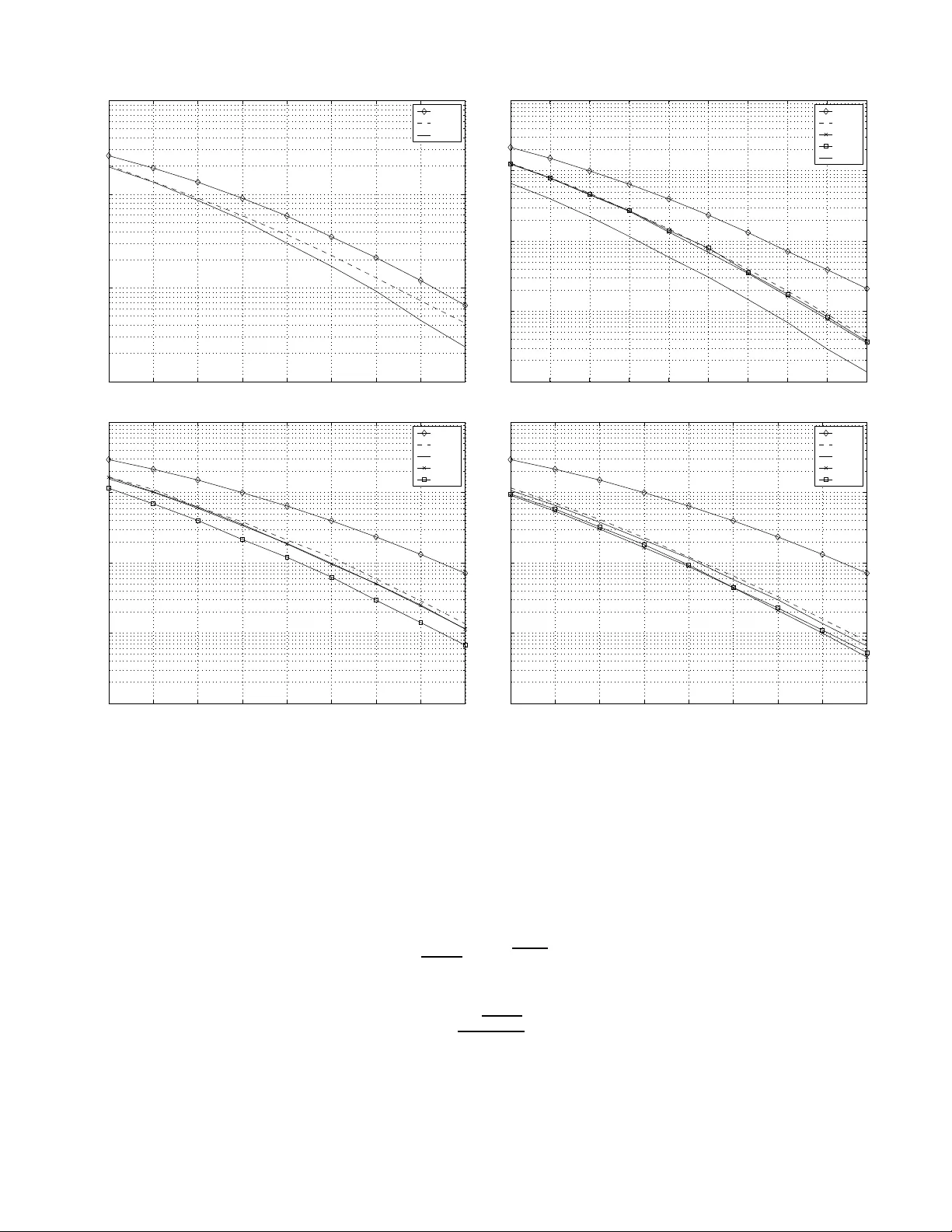
1 Maximal Orders in the Design of Dense Space-T ime Lattice C odes Camilla Hollanti, Jyrki Lahtonen, Me mber IEEE , and Hsiao-feng (Franc is) Lu Abstract W e construct explicit rate-one, f ull-diversity , geo metrically den se matrix lattices with large, non-vanishing determinan ts (NV D) fo r fou r transmit an tenna m ultiple-inp ut sin gle-outp ut (MI SO) space -time (ST) a pplications. The con structions ar e b ased on th e theory o f rings o f algebr aic in tegers and re lated subrings o f the Hamilto nian quaternio ns an d can be extended to a larger number of Tx an tennas. The usage of ideals gu arantees a non-vanishing determinan t larger than o ne an d an easy way to present the exact proof s for the min imum determina nts. The idea of finding denser sublattices within a given division algebra is then g eneralized to a mu ltiple-inpu t mu ltiple-outp ut (MIMO) case with a n arb itrary num ber of Tx antenn as by u sing the theory of cyclic d ivision algebras (CD A) and maximal orde rs. It is also shown that the explicit construction s in this p aper all ha ve a simple d ecoding meth od based on sphere decodin g. Related to the deco ding complexity , the notion of sensitivity is in troduced , and exp erimental evidence indicating a conn ection be tween sensitivity , decoding complexity and per forman ce is provided. Simulations in a qua si-static Rayleigh fading channel show that our dense quaternio nic constructions outperfo rm both th e earlier rectangu lar lattices and the rotated ABB A lattice as well as the D AST lattice. W e also show that ou r qu aternion ic lattice is better th an the DAST lattice in terms of the diversity-multiplexing gain tradeo ff. Index T erms Cyclic division algeb ras, dense lattices, maximal order s, multiple-in put m ultiple-ou tput (MIMO) chan nels, multiple-inp ut single-outp ut (MISO) channels, number field s, quaternio ns, space-time block co des (STBCs), sphere decodin g. I . I N T RO D U C T I O N A N D B AC K G R O U N D Multiple-antenna wireless c ommunication promises very high da ta rates, in particular w hen we have perfect channe l state information (CSI) available at the receiv er . In [1] the design criteria for such sys tems w ere developed and further on the evoluti on of ST cod es took two directions: trellis code s and block code s. Our work c oncen trates on the latter b ranch. The very first ST b lock co de for two transmit antenn as was the Alamo uti co de [2] rep resenting multiplication in the ring of quaternions. As the quaternions form a di vision alge bra, such matri ces must be in vertible, i.e. the resulting STBC meets the rank criterion. Matrix representations o f other division a lgebras h ave been propo sed as ST BCs at least in [3]-[15], and (though without explicitly saying so) [16]. The mos t rec ent work [6]-[16] ha s c oncen trated on adding multiplexing gain, i.e. multiple input-multiple output (MIMO) applications, and/or co mbining it with a good minimum determinant. In this work, we do n ot spe cifically seek a ny multiplexing gains, but want to improve upon e.g. the diag onal algebraic spac e time (D AS T) lattices introduc ed in [5] by u sing non-commutative division algebras. Other efforts to improve the D AST lattices an d ideas alike can be foun d in [17]-[19]. The main con trib utions of this work are: • W e g i ve energy efficient MISO lattice code s with simple decoding that win over e.g. the rotated ABB A [20] and the D AST lattice code s in terms of the block error rate (BLER) performance. • It is shown tha t by using a non-rectangular lattice on e can gain major en ergy savings without s ignificant increaseme nt in de coding c omplexity . The usag e of ide als mo reover gu arantees a non-vanishing determinant > 1 and an eas y way to present the exac t proofs for the minimum determinants. • In addition to the explicit MISO constructions , we pres ent a gen eral method for find ing de nse sublattices within a giv en CD A in a MIMO se tting. This is tempting as it h as been s hown in [15] that CD A-ba sed s quare ST C. Hollanti is wit h the Laboratory of Discrete Mathematics for Information T echnology , Turku Centre for Computer Science, Joukahaisen katu 3-5 B, FIN-20520 Tu rku, Finland. C. Hollanti & J. L ahtonen are with the Department of Mathematics, FIN-20014 Uni versity of Turku, Finland. E-mails: {cajoho, lahtonen }@utu.fi H.-f. Lu is with the Department of Commun ication Engineering, National Chung-Cheng Uni versity , Chia-yi, T aiwan E-mail: francis@ccu.edu.tw 2 codes with NVD ach iev e the div ersity-multiplexi ng gain tradeoff (DMT) introduce d in [21]. When a CDA is chosen the next ste p is to choos e a correspon ding lattice o r , what a mounts to the same thing, ch oose an o rder within the algeb ra. Most a uthors, a mong wh ich e.g. [11], [15], an d [16], have gone w ith the so-called natural order (see Section III-B, Ex ample 3.2). In a CD A ba sed c onstruction, the dens ity of a sublattice is lump ed together with the conc ept of ma ximality of an order . The idea is that o ne c an, on some occ asions, use several cosets of the natural order w ithout sacrificing a nything in terms of the minimum d eterminant. So the study of maximal orders is eas ily moti vated by an analog y from the theo ry of e rror c orrecting c odes: why one would use a p articular code o f a given minimum distance and len gth, if a larger c ode with the s ame parameters is av a ilable. • F urthermore, related to the dec oding c omplexity , the notion o f se nsiti vity is introduce d for the first time, and evidence of its practical a ppearanc e is provided. Also the DMT beh avior of our cod es will be given. At first, we are intereste d in the cohe rent MISO cas e with perfect CSI av a ilable at the rec eiv er . The received signal y ∈ C n has the form y = h X + n , where X ∈ C m × n is the trans mitted codeword drawn from a ST code C , h ∈ C m is the Rayleigh fading cha nnel response and the compone nts of the noise vec tor n ∈ C n are i.i.d. co mplex Gau ssian random variables. A lattice is a discrete finitely generated free a belian subg roup of a real or complex fin ite dimension al vector space V , a lso c alled the ambien t spa ce. Thus, if L is a k -dimensiona l lattice, there exists a fi nite set of vectors B = { b 1 , b 2 , . . . , b k } ⊂ V such that B is linearly independ ent over the integers a nd that L = { k X i =1 z i b i | z i ∈ Z , b i ∈ V for all i = 1 , 2 , . . . , k } . In the s pace-time se tting a na tural ambient spa ce is the space C n × n of comp lex n × n matrices. When a code is a s ubset of a lattice L in this a mbient s pace, the rank cr iterion [22] states that any non-ze ro ma trix in L mu st be in vertible. Th is follows from the fact tha t the dif ference of any two matrices from L is again in L . The rec eiv er and the decod er , howev er , (recall that we work in the MISO setting) observe vector lattices instea d of matrix lattices. When the channe l state is h , the receiv er expects to see the lattice h L . If h 6 = 0 and L meets the rank criterion, the n h L is, inde ed, a free a belian group of the same rank as L . Howe ver , it is we ll possible that h L is not a lattice, a s its gene rators may be linearly depe ndent over the rea ls — the lattice is s aid to c ollapse , whenever this ha ppens. From the pairwise e rror probability (PEP) point of vie w [22], the performanc e of a spac e-time cod e is de pende nt on two parameters: diversity gain and coding gain . Div ersity gain is the minimum of the rank of the difference matrix X − X ′ taken over all d istinct c ode matrices X , X ′ ∈ C , also called the rank of the code C . Wh en C is full-rank, the c oding gain is prop ortional to the determinan t o f the matrix ( X − X ′ )( X − X ′ ) H , where X H denotes the transpos e conjug ate of the matrix X . The minimum of this dete rminant taken over all distinct code matrices is called the minimum d eterminant of the c ode C and de noted by δ C . If δ C is b ounded away from z ero even in the limit as SNR → ∞ , the ST code is s aid to have the non-va nishing deter minant prope rty [8]. As me ntioned a bove, for non -zero squ are matrices being full-rank coincides with being in vertible. The da ta rate R in symbols p er c hannel use is gi ven b y R = 1 n log | S | ( |C | ) , where | S | and |C | are the size s of the symbol s et an d code resp ectiv ely . This is not to be confus ed with the rate of a co de design (shortly , code rate ) defin ed a s the ratio of the numbe r of transmitted information symbols to the d ecoding delay (equiv alen tly , b lock length) of these symbols at the receiv er for any g i ven numbe r of transmit antennas using any complex s ignal cons tellations. If this ratio is equa l to the delay , the code is sa id to have full rate . The correspo ndence is o r ganized a s follo ws: basic definitions of algeb raic number theory and explicit MISO lattice constructions are provided in Section II. As a (MIMO) ge neralization for the idea o f finding den ser lattices within a given division alge bra, the theo ry of cyclic algebras and ma ximal orders is b riefly introduced in Section III. In Section IV, we consider the de coding of the ne sted sequen ce of quaternion ic lattices from Section II. A 3 variety of results on decod ing complexity is established in Section IV, where also the notion of se nsiti vity is taken into a ccoun t. Simulation results are discusse d in Section V along with energy cons iderations. Finally in Sec tion VI, the DMT analysis of the p roposed co des will be given. This work h as been partly published in a co nference, se e [3] and [4]. For more backg round we refer to [22]-[29]. I I . R I N G S O F A L G E B R A I C N U M B E R S , Q UA T E R N I O N S A N D L A T T I C E C O N S T RU C T I O N S W e shall deno te the s ets of integers, rationals, reals, an d comp lex numb ers by Z , Q , R , a nd C respe cti vely . Let u s reca ll the set H = { a 1 + a 2 i + a 3 j + a 4 k | a t ∈ R ∀ t } , where i 2 = j 2 = k 2 = − 1 , ij = k , as the ring o f Ha miltonian qua ternions . Note that H ≃ C ⊕ C j , when the imaginary unit is identified with i . A s pecial interest lies o n the subs ets H L = { a 1 + a 2 i + a 3 j + a 4 k | a t ∈ Z ∀ t } ⊆ H and H H = { a 1 ρ + a 2 i + a 3 j + a 4 k | a t ∈ Z ∀ t, ρ = 1 2 (1 + i + j + k ) } ⊆ H called the Lipschitz’ and Hurwitz’ inte gral quatern ions resp ectiv ely . W e shall use extension rings o f the Gaus sian integers G = { a + bi | a, b ∈ Z } inside a given d i vision algebra. It would be easy to adapt the construction to use the slightly d enser hexagonal ring of the Eisen steinian integers E = { a + bω | a, b ∈ Z } , where ω 3 = 1 , a s a ba sic alph abet. Howe ver , the Gauss ian integers nicely fit with the pop ular 16-QAM an d QPSK alphabets. Natural examp les o f suc h rings are the rings of algebraic integers inside a n extension field o f the quotient fields of G , as well as their counterparts inside the quaternions . T o that en d we need division algebras A that are also 4-dimen sional vectors sp aces over the field Q ( i ) . A. Bas e lattice constru ctions Let now ζ = e π i/ 8 (resp. ξ = e π i/ 4 = (1 + i ) / √ 2 ) be a primiti ve 16 th (resp. 8 th ) root of unity . Our ma in examples of suitable division algebras a re the number field L = Q ( ζ ) , and the follo wing s ubskewfield H = Q ( ξ ) ⊕ j Q ( ξ ) ⊆ H of the Hamiltonian quaternions . N ote that as z j = j z ∗ for all c omplex numbe rs z , a nd as the field Q ( ξ ) is stab le under the usual complex c onjugation ( ∗ ) , the set H is, indeed, a sub skewfield of the qua ternions. As a lw ays, multiplication (from the left) b y a non-zero e lement of a d i vision algebra A is a n in vertible Q ( i ) -linear mapping (with Q ( i ) acting from the right). Therefore its matrix with respect to a cho sen Q ( i ) -basis B of A is also in vertible. Our example division algebra s L an d H have the sets B L = { 1 , ζ , ζ 2 , ζ 3 } an d B H = { 1 , ξ , j, j ξ } as natural Q ( i ) -bases. Thus we immediate ly arrive at the follo wing ma trix represe ntations of o ur division algeb ras. Pr op osition 2.1: Let the variables c 1 , c 2 , c 3 , c 4 range over all the elements of Q ( i ) . The di vision algeb ras L and H c an be identified via an isomorphism φ with the following rings of ma trices L = M L = M L ( c 1 , c 2 , c 3 , c 4 ) = c 1 ic 4 ic 3 ic 2 c 2 c 1 ic 4 ic 3 c 3 c 2 c 1 ic 4 c 4 c 3 c 2 c 1 4 and H = M = M ( c 1 , c 2 , c 3 , c 4 ) = c 1 ic 2 − c ∗ 3 − c ∗ 4 c 2 c 1 ic ∗ 4 − c ∗ 3 c 3 ic 4 c ∗ 1 c ∗ 2 c 4 c 3 − ic ∗ 2 c ∗ 1 . The isomorph ism φ from L into the ma trix ring is determined by Q ( i ) -linearity and the fact that ζ c orresponds to the choice c 2 = 1 , c 1 = c 3 = c 4 = 0 . The isomorphism φ from H into the matrix ring is determined b y Q ( i ) -linearity a nd the facts that ξ c orresponds to the choice c 2 = 1 , c 1 = c 3 = c 4 = 0 , and j correspon ds to the choice c 3 = 1 , c 1 = c 2 = c 4 = 0 . In particular , the determinan ts o f these matrices are n on-zero whenever at least one of the c oefficients c 1 , c 2 , c 3 , c 4 is no n-zero. In order to g et ST lattices an d us eful bounds for the minimum determinant, we ne ed to ide ntify suitable s ubrings S o f the se two algebras . Actually , we would like these rings to be free right G -modules of ran k 4. This is due to the fact tha t then the determinants o f the matrices of Propo sition 2.1 that belong to the subring φ ( S ) must be elements o f the ring G . W e repeat the well-known reas on for this for the sa ke of comp leteness : the de terminant of the ma trix represe nting the multiplication b y a fixed element x ∈ S d oes n ot d epend on the ch oice of the basis B and thus we may assume that it is a G -module ba sis. Ho wever , in that case x B ⊆ S , so the matrix will have entries in G as all the eleme nts of S are G -linear combina tions of B . The claim follows. In the case of the field L we are only intereste d in its ring of integers O L = Z [ ζ ] that is a free G -module with the basis B L . In this case the ring φ ( O L ) consists of those ma trices of L that h ave all the coe f ficients c 1 , c 2 , c 3 , c 4 ∈ G . Similarly , the G -module L = G ⊕ ξ G ⊕ j G ⊕ j ξ G spanne d by o ur earlier b asis B H is a ring o f the required type. W e c all this the ring o f L ipschitz’ inte gers o f H . Again φ ( L ) c onsists of thos e matrices of H that hav e a ll the coe fficients c 1 , c 2 , c 3 , c 4 ∈ G . While O L is known to be maximal amo ng the rings satisfying our req uirements, the same is not true about L . The ring H H also has an extension of the prescribed type ins ide H , called the ring of Hur witz’ inte gers o f H . This ring, de noted by H = ρ G ⊕ ρξ G ⊕ j G ⊕ j ξ G , is the right G -module ge nerated by the basis B H ur = { ρ, ρξ , j, j ξ } , where a gain ρ = (1 + i + j + k ) / 2 . Th e fact that H is a subring c an eas ily be verified by straightforward computations , e .g. ξ ρ = ρξ − j ξ . For future us e we express the ring H in terms o f the basis B H of Propo sition 2.1. It is not dif ficult to see that the element q = c 1 + ξ c 2 + j c 3 + j ξ c 4 ∈ H is an element o f H , if an d only if the c oefficients c t satisfy the requirements (1 + i ) c t ∈ G for all t = 1 , 2 , 3 , 4 and c 1 + c 3 , c 2 + c 4 ∈ G . As the ideal generate d by 1 + i h as ind ex two in G , we s ee tha t L is an add iti ve, index four subgroup in H . W e summa rize the se fin dings in Proposition 2.2. The b ound on the minimum de terminant is a c onseq uence of the fact that all the e lements o f G have a no rm at least on e. Pr op osition 2.2: The following rings of matrices form ST lattices with minimum determinan t equal to one . L 1 = { M L ( c 1 , c 2 , c 3 , c 4 ) | c 1 , c 2 , c 3 , c 4 ∈ G } , L 2 = { M ( c 1 , c 2 , c 3 , c 4 ) | c 1 , c 2 , c 3 , c 4 ∈ G } , L 3 = M ( c 1 , c 2 , c 3 , c 4 ) | c 1 , c 2 , c 3 , c 4 ∈ 1 + i 2 G , c 1 + c 3 ∈ G , c 2 + c 4 ∈ G . Remark 2. 1: Th e lattice L 1 is qu ite s imilar to the DAST lattice in the sen se that all of its matrices can be simultaneously d iagonalized . See more d etails in Section IV - B. The lattice L 2 , for its part, is a more developed case from the s o-called qu asi-orthogonal STBC sug gested e. g. in [30]. The matrix M ( c 1 , c 2 , c 3 , c 4 ) of P roposition 2.1 ca n also be found as an exa mple in the lan dmark pa per [6], but no optimization has been d one the re b y using , for example, idea ls as we shall do here. 5 A drawback sha red by the lattices L 1 and L 2 is that in the a mbient space of the transmitter they are isometric to the rectangular lattice Z 8 . Th e rectan gular s hape do es c arry the advantage that the sets of information carrying coefficients of the ba sis matrices a re simple and all iden tical which is u seful in e.g. sp here de coding. But, on the other han d, this shape is very wasteful in terms of transmission power . Geometrically dense r sublattices of Z 8 , e.g. the c heckerboa rd lattice D 8 = ( ( x 1 , ..., x 8 ) ∈ Z 8 8 X i =1 x i ≡ 0 ( mod 2) ) and the diamond lattice E 8 = ( ( x 1 , ..., x 8 ) ∈ Z 8 x i ≡ x j ( mod 2) , 8 X i =1 x i ≡ 0 ( mod 4) ) , are well-known (cf. e.g . [31]). Howev er , we must b e careful in picking the copies of the s ublattices, as it is the minimum de terminant we want to kee p an eye o n (see Rema rk 2.3). B. Den se sublattices inside the bas e lattice L 2 As o ur earlier simulations [3],[4] ha ve shown that L 2 outperforms L 1 , we concentrate on fin ding good sub lattices of L 2 . The un its of the ring L 2 are exactly the n on-zero matrices whos e determinants have the minimal abso lute value of o ne. Thus a natural way to find a sublattice with a better minimum de terminant is to take the lattice φ ( I ) , where I ⊂ S is a proper ideal. This idea has a ppeared at least in [3], [4], and [8]. Even earlier , ide als of rings of algebraic integers were use d in [27 ] to produce d ense lattices. Let us fi rst reco rd the following simple fact. Lemma 2 .3: Let A a nd B be diagonalizable complex s quare matrices of t he same size. Assume that they commu te and tha t their eigen v alues a re a ll real and non-negativ e. Then det ( A + B ) ≥ det A + det B with a strict ine quality if both A a nd B are in vertible. Pr oo f: As A and B commute, they c an be simultaneo usly diag onalized. Hence, we can redu ce the claim to the c ase of diagona l matrices with non-negative rea l en tries. In tha t ca se the claim is obvious . In Propo sition 2 .4 we gi ve a co nstruction isome tric to the che ckerboard lattice D 8 Pr op osition 2.4: Let I be the prime ideal o f the ring G generated by 1 + i . Define I L = { ( c 1 + ξ c 2 ) + j ( c 3 + ξ c 4 ) ∈ L | c 1 + c 2 + c 3 + c 4 ∈ I } . Then I L is a n ideal o f index two in L . The correspon ding lattice L 4 = { M ( c 1 , c 2 , c 3 , c 4 ) ∈ L 2 | c 1 + c 2 + c 3 + c 4 ∈ I } is a n index 2 sublattice in L 2 . Fu rthermore, the abso lute value of det( M M H ) , M ∈ L 4 \ { 0 } , is the n at least 4 . Pr oo f: It is straightforward to c heck that I L is s table und er (left or right) multiplication with the quaternions ξ an d j , s o I L is a n ide al in L . Let u s con sider a matrix M ∈ L 4 and write it in the block form M = A − B H B A H . W e se e that M M H = AA H + B B H 0 0 AA H + B B H , and AA H + B B H = α k ∗ k α , 6 where α = P 4 j =1 | c j | 2 is a non-negative integer and k = − ic 1 c ∗ 2 + c 2 c ∗ 1 − ic 3 c ∗ 4 + c 4 c ∗ 3 is a Gaussian integer with the p roperty k ∗ = ik . W e are to prove that d et M M H = α 2 − | k | 2 2 ≥ 4 . As sume first that c 3 = c 4 = 0 , i.e. the block B = 0 . Then d et( A ) is the relati ve norm det( A ) = N Q ( ξ ) Q ( i ) ( c 1 + ξ c 2 ) , which is a Gau ssian integer . As c 1 + ξ c 2 is a n on-zero eleme nt of the ide al I , we conclude that d et( A ) is a non-zero non-unit. The refore det( A ) det( A H ) ≥ 2 , a nd the claim follows. Let us then assume that b oth A and B are non -zero. Then det( A ) a nd d et( B ) are no n-zero Gaus sian integers and have a no rm at least o ne. The matrices A, A H , B , B H all commu te, so by Lemma 2.3 w e get det( M M H ) > d et( AA H ) 2 + d et( B B H ) 2 ≥ 2 . As det( M M H ) = α 2 − | k | 2 2 is a square of a rational integer , it must b e at least 4. Remark 2. 2: It is ea sy to se e that in the previous proposition a + bi ∈ I , if an d only if a + b is an even integer . Thus g eometrically the matrix la ttice L 4 is, ind eed, isometric to D 8 . W e proceed to de scribe two more interes ting subla ttices of L 2 with ev en better minimum d eterminants. T o that end we use the ring H (or the lattice L 3 ). The first sublattice is iso metric to the d irect su m D 4 ⊥ D 4 [31] of two 4-dimensional c heckerboa rd lattices. Pr op osition 2.5: Let again I be the ideal (1 + i ) G . The lattice L 5 = { M ( c 1 , c 2 , c 3 , c 4 ) ∈ L 2 | c 1 + c 3 , c 2 + c 4 ∈ I } has a minimum d eterminant equal to 16. The index of L 4 in L 2 is 4 . Pr oo f: The co efficients c 1 and c 3 can be chos en arbitrarily within G . Th e the ideal I ha s index 2 in G , and the coe f ficients c 2 and c 4 now must belong to the cose ts c 1 + I an d c 3 + I resp ectiv ely . Whence , the ind ex of L 5 in L 2 is 4. Th e matrices A in the lattice L 5 are of the form A = (1 + i ) M , wh ere M is a matrix in the lattice L 3 of Propo sition 2.2. Thus d et( AA H ) = 16 det( M M H ) an d the c laim follows from Proposition 2.2. The diamo nd lattice E 8 can b e des cribed in terms of the Gauss ian integers a s (cf. [32]) E 8 = 1 1 + i ( ( c 1 , c 2 , c 3 , c 4 ) ∈ G 4 | c 1 + I = c t + I , t = 2 , 3 , 4 , 4 X t =1 c t ∈ 2 G ) . By ou r identifica tion of qua druples ( c 1 , c 2 , c 3 , c 4 ) ∈ G 4 and the elemen ts of H it is straightforward to verify tha t (1 + i ) E 8 has { 2 , (1 + i ) + (1 + i ) ξ , (1 + i ) ξ + (1 + i ) j, 1 + ξ + j + j ξ } ⊆ L as a G -basis, when ce the s et { 1 + i, 1 + ξ , ξ + j, ρ + ρξ } ⊆ H is a G -basis for E 8 . By a nother simple computation we see that E 8 = H (1 + ξ ) , i.e. E 8 is the left ideal o f the ring H g enerated by 1 + ξ . Pr op osition 2.6: The lattice L 6 = ( M ( c 1 , c 2 , c 3 , c 4 ) ∈ L 2 | c 1 + I = c t + I , t = 2 , 3 , 4 , 4 X t =1 c t ∈ 2 G ) is a n index 16 sublattice of L 2 . Fu rthermore, the minimum d eterminant of L 6 is 64 . Pr oo f: Let M I = M (1 , 1 , 0 , 0) b e the matrix φ (1 + ξ ) un der the isomorph ism of Propo sition 2.1. W e s ee that det( M I M H I ) = 4 . By the preced ing discussion any ma trix A of the lattice L 6 has the form A = M M I (1 + i ) , w here M is a matrix in L 3 . As in the proof of Proposition 2.5, we s ee that det AA H = 16 det( M I M H I ) det( M M H ) . The claim on the minimum determinant now foll ows from Proposition 2.2. W e see that the coefficient c 1 can be chosen arbitrarily within G . The coefficients c 2 and c 3 then mus t belon g to the coset c 1 + I , a nd c 4 must be chosen s uch that c 1 + c 2 + c 3 + c 4 ∈ 2 G = I 2 . As I has index two in G , we s ee that the index of L 6 in L 2 is 1 6 as c laimed. Remark 2. 3: W e have now produce d a nested sequ ence of lattices 2 Z 8 = 2 L 2 ⊆ L 6 ⊆ L 5 ⊆ L 4 ⊆ L 2 = Z 8 ( ⊆ L 3 ) . (1) 7 T ABLE I L A T T I C E S F RO M A C O D I N G T H E O R E T I C A L P O I N T O F V I E W L 2 ↔ The 8-dimensional rectangular grid Z 8 ↔ no coding ↓ L 4 ↔ The check erboard lattice D 8 ↔ overall parity che ck code of length 8 ↓ L 5 ↔ The lattice D 4 ⊥ D 4 ↔ two blocks of the o ve rall parity check code of length 4 ↓ L 6 ↔ The diamond lattice E 8 ↔ extended Hamming-code of length 8 W e co ncentrate on the lattices that are sandwich ed between 2 Z 8 and Z 8 . It is worthwhile to n ote that these lattices are in a bijectiv e c orrespond ence with a binary linear c ode o f length 8 by p rojection modulo 2, see T able I a bove. As it hap pens, within this sequ ence of lattices the minimum Hamming distan ce of the binary linear code and the minimum de terminant of the lattice are somewhat relate d. Thereupon it is natural to ask that wha t if we simply co ncatena te the use of L 2 with a go od b inary co de (extended over several L 2 -blocks, if nee ded), and b e done with it. While the b inary linear codes a ppearing above are the first one s that come to on e’ s mind, we want to c aution the u nwary end-use r . Name ly , it is po ssible that there are high weight units in the ring in q uestion. If s uch binary words a re inc luded, then the minimum determinant of the correspond ing lattice is equal to 1 , i.e. no coding gain will take place . E. g. the u nit (1 − ξ 3 ) / (1 − ξ ) = 1 + ξ + ξ 2 = (1 + i ) + ξ of the ring L corresponds to the ma trix M (1 + i, 1 , 0 , 0) of determinant 1, an d thu s we mus t no t allow such words of weight 3. If the lattice L 1 were used, the s ituation would b e even w orse, as then we have units like (1 − ζ 7 ) / (1 − ζ ) in the ring O L that would b e mapped to a word o f Hamming we ight 7 . A co nstruction base d on ideals provides a mec hanism to av o id this problem cau sed by high weight units. I I I . C Y C L I C A L G E B R A S A N D O R D E R S In Se ction II we produce d a n ested se quence (1) o f qu aternionic lattices with the property that as the lattice gets de nser after resca ling the inc reased minimum d eterminant bac k to one, the BLER perfomance gets better . As the se quenc e (1) lies within a spe cific division algebra, an o bvious ques tion evok es how to g eneralize this idea . The theory of cyclic divi sion a lgebras and their maximal orders offer us an a nswer . When d esigning squa re ST matrix lattices for MIMO use, cyclic division algebras are of utmost inte rest as it has been shown in [15] that a non-vanishing de terminant is a sufficient condition for full-rate CD A bas ed STB C-designs to achieve the upper bound on the o ptimal DMT , h ence proving that the upper bound itself is the o ptimal DMT for any number of transmitters an d receiv ers. Given the n umber of trans mitters n , we pick a suitable cyclic division a lgebra of index n (more on this in a forthcoming pap er , se e Section V II an d [33]. Se e a lso [15] ). The matrix represe ntation of the alge bra, with some c onstraints on the eleme nts, will then co rrespond to the b ase lattice, similarly a s did the lattice L 2 in Section II. Now in order to ma ke the lattice dense r , we cho ose the elements in the matrices from an order . The na tural first ch oice for an order is the on e corresponding to the ring of alge braic integers of the max imal subfield inside the algeb ra. The de nses t poss ible sublattice is the one where the elements c ome from a maximal order . All a lgebras con sidered here are finite dimension al asso ciativ e algebras over a field. A. Cyc lic algebras The ba sic theory o f cyclic a lgebras and the ir represe ntations as matrices are thoroughly con sidered in [[34], Chapter 8.5 ] an d [6]. W e are only going to recapitulate the e ssential facts here. In the follo wing, we consider number field e xtensions E /F , wh ere F denote s the base field. F ∗ (resp. E ∗ ) denotes the set o f non-zero e lements of F (resp. E ). Le t E /F be a cyclic fie ld extension of degree n with the Ga lois group Gal ( E /F ) = h σ i , where σ is the generator o f the cyclic grou p. Let A = ( E /F , σ, γ ) be the correspond ing cyclic algebra o f index n , that is, A = E ⊕ uE ⊕ u 2 E ⊕ · · · ⊕ u n − 1 E , 8 with u ∈ A such tha t xu = uσ ( x ) for a ll x ∈ E a nd u n = γ ∈ F ∗ . An elemen t a = x 0 + ux 1 + · · · + u n − 1 x n − 1 ∈ A has the followi ng re presentation as a matrix A = x 0 γ σ ( x n − 1 ) γ σ 2 ( x n − 2 ) · · · γ σ n − 1 ( x 1 ) x 1 σ ( x 0 ) γ σ 2 ( x n − 1 ) γ σ n − 1 ( x 2 ) x 2 σ ( x 1 ) σ 2 ( x 0 ) γ σ n − 1 ( x 3 ) . . . . . . x n − 1 σ ( x n − 2 ) σ 2 ( x n − 3 ) · · · σ n − 1 ( x 0 ) . (2) Let u s comp ute the third c olumn as an exa mple: u 2 7→ au 2 = x 0 u 2 + ux 1 u 2 + · · · + u n − 1 x n − 1 u 2 = uσ ( x 0 ) u + u 2 σ ( x 1 ) u + · · · + γ σ ( x n − 1 ) u = u 2 σ 2 ( x 0 ) + u 3 σ 2 ( x 1 ) + · · · + uγ σ 2 ( x n − 1 ) , and he nce as the third column we ge t the vector ( γ σ 2 ( x n − 2 ) , γ σ 2 ( x n − 1 ) , σ 2 ( x 0 ) , . . . , σ 2 ( x n − 3 )) T . Let us denote the ring of algebraic integers of E by O E . A b asic, ra te- n MIMO STBC C is usu ally defin ed as C = x 0 γ σ ( x n − 1 ) · · · γ σ n − 1 ( x 1 ) x 1 σ ( x 0 ) γ σ n − 1 ( x 2 ) x 2 σ ( x 1 ) γ σ n − 1 ( x 3 ) . . . . . . x n − 1 σ ( x n − 2 ) · · · σ n − 1 ( x 0 ) x i ∈ O E . (3) Further optimi zation might be carried ou t by using e.g. i deals. If we denote the b asis o f E over O F by { 1 , e 1 , ..., e n − 1 } , then the e lements x i , i = 0 , ..., n − 1 in (3) take the form x i = P n − 1 k =0 f k e k , where f k ∈ O F for all k = 0 , ..., n − 1 . Hence n c omplex symbols are trans mitted per c hanne l u se, i.e. the design h as rate n . In literature this is often referred to as having a full rate . Definition 3.1: An alge bra A is called s imple if it has no nontrivial idea ls. An F -alge bra A is c entral if its center Z ( A ) = { a ∈ A| aa ′ = a ′ a ∀ a ′ ∈ A} = F . Definition 3.2: An ideal I is ca lled nilpoten t if I k = 0 for some k ∈ Z + . An alge bra A is semisimple if it has no nontrivial nilpotent ideals. Any finite d imensional s emisimple algebra over a fie ld is a finite and uniqu e direct sum of simple algebras. Definition 3.3: The de terminant (resp. trace) of the matrix A is called the reduced norm (resp. reduced trace ) of an element a ∈ A an d is denoted b y nr ( a ) (res p. tr ( a ) ) . Remark 3. 1: Th e conne ction with the us ual norm map N A/F ( a ) (resp. trace map T A/F ( a ) ) and the redu ced norm nr ( a ) (resp. reduc ed trace tr ( a ) ) of an eleme nt a ∈ A is N A/F ( a ) = ( n r ( a )) n (resp. T A/F ( a ) = ntr ( a ) ), where n is the degree o f E /F . In Section II we have attested tha t the algeb ra H is a division alge bra. The next old resu lt due to A. A. Albe rt [[35], Cha pter V .9] provides us with a condition for when an alge bra is indeed a division algebra. Pr op osition 3.1: The algebra A = ( E /F , σ, γ ) of index n is a division algebra, if and only if the smallest factor t ∈ Z + of n such that γ t is the norm of so me elemen t in E ∗ , is n . B. Orders W e are now rea dy to pres ent some of the b asic definitions and resu lts from the theory of maximal orders. The general the ory of maximal orders can be fou nd in [36]. Let S de note a Noe therian integral domain with a quotient field F , an d let A be a finite dimensional F -algeb ra. 9 Definition 3.4: An S -order in the F -algeb ra A is a subring Λ of A , having the same identity elemen t as A , and such that Λ is a finitely generated module over S a nd ge nerates A as a linear space over F . As usu al, an S -order in A is sa id to be maximal , if it is not properly c ontained in any other S -order in A . If the integral c losure S of S in A h appen s to b e an S -order in A , then S is automatically the unique maximal S -order in A . Let u s illustrate the a bove de finition by the following example. Example 3 .1: (a) Orde rs always exist: If M is a full S -lattice in A , i.e . F M = A , then the left or der of M defined a s O l ( M ) = { x ∈ A | xM ⊆ M } is an S -order in A . The right order is define d in a n ana logous way . (b) If A = M n ( F ) , the a lgebra of all n × n ma trices over F , then Λ = M n ( S ) is an S -order in A . (c) Le t a ∈ A be integral over S , that is, a is a z ero of a monic polyn omial over S . Then the ring S [ a ] is an S -order in the F -algebra F [ a ] . (d) Le t S be a Dede kind d omain, and let E be a finite s eparable exten sion o f F . Denote by S the integral closu re of S in E . Then S is an S -order in E . In pa rticular , taking S = Z , we see that the ring of algebraic integers of E is a Z -order in E . Hereafter , F will be an alge braic number fi eld and S a Dedekind ring with F as a fie ld of fractions. Pr op osition 3.2: Let A be a fin ite d imensional se misimple algebra over F and Λ be a Z -order in A . Let O F stand for the ring of a lgebraic integers of F . Then Γ = O F Λ is an O F -order containing Λ . As a conse quenc e, a maximal Z -order in A is a maximal O F -order as well. The following propos ition provides us with a useful too l for finding a max imal orde r within a given a lgebra. Pr op osition 3.3: Let Λ be a n S -order in A . For eac h a ∈ Λ we have nr ( a ) ∈ S and tr ( a ) ∈ S . Pr op osition 3.4: Let Γ be a subring of A containing S , such that F Γ = A , an d suppo se that e ach a ∈ Γ is integral over S . Then Γ is a n S -order in A . Conv ersely , every S -order in A has these p roperties. Cor o llary 3.5: Every S -order in A is conta ined in a maximal S -order in A . The re exists at leas t one maximal S -order in A . Remark 3. 2: As the previous co rollary indicates, a maximal order of a n algeb ra is not nece ssarily unique. Remark 3. 3: Th e a lgebra H can also be viewed a s a cyclic division algeb ra. As it is a subring o f the Hamiltonian quaternions, its cen ter cons ists of the intersection H ∩ R = Q ( √ 2) . Also Q ( ξ ) is an example of a sp litting fie ld of H . In the notation a bove we have a n obvious isomorph ism H ≃ ( Q ( ξ ) / Q ( √ 2) , σ, − 1) , where σ is the usua l co mplex conjuga tion. Remark 3. 4: In principle, the lattices from Section II c ould a lso be used a s MIMO codes , but when we pac k H in the form of (2), δ C becomes vanishing and the DMT canno t be a chieved. One extremely well-performing CD A based c ode taking advantage o f a maximal orde r is the c elebrated Golden code [8] (also ind epend ently fou nd in [9]) treated in the follo wing example. Example 3 .2: In any cyclic algebra where the element γ happe ns to be an algebraic integer , we have t he followi ng natural order Λ = O E ⊕ u O E ⊕ · · · ⊕ u n − 1 O E , where O E is the ring of integers of the field E . W e note that O E is the unique ma ximal orde r in E . In the so-called Golden Div ision Algebra (GD A) [8 ], i.e. the cyclic a lgebra ( E /F , σ, γ ) obtained from the d ata E = Q ( i, √ 5) , F = Q ( i ) , γ = i , n = 2 , σ ( √ 5) = − √ 5 , the natural order Λ is a lready ma ximal [37 ]. Th e ring of a lgebraic integers O E = Z [ i ][ θ ] , when we denote the golden ratio by θ = 1+ √ 5 2 . The authors of [8] further o ptimize the code by us ing an ideal ( α ) = (1 + i − iθ ) , an d the Golden c ode is then defind as G C = ( 1 √ 5 αx 0 iσ ( α ) σ ( x 1 ) αx 1 σ ( α ) σ ( x 0 ) x 0 , x 1 ∈ O E ) . (4) The Golden code achieves the DMT as the element γ = i is not in the image of the no rm map. For the proo f, s ee [8]. 10 Remark 3. 5: W e fee l that in [8], the usag e of a ma ximal order is just a coincide nce, as in this case it c oincides with the natural order wh ich is g enerally used in ST co de d esigns (cf. (3)). At le ast the authors do n ot mention maximal orders. As far as we know , but our c onstructions (see a lso [33]) there doe s not exist any d esigns us ing a maximal o rder other than the na tural one. Next we prove that the lattice L 6 is op timal within the cyc lic division algebra H in the sense that the d iamond lattice E 8 = H (1 + ξ ) correspond s to a proper idea l of a ma ximal order in H . Pr op osition 3.6: The ring H = { q = c 1 + ξ c 2 + j c 3 + j ξ c 4 ∈ H | c 1 , . . . , c 4 ∈ Q ( i ) , (1 + i ) c t ∈ G ∀ t , c 1 + c 3 , c 2 + c 4 ∈ G } is a maximal Z -order o f the divi sion alge bra H . Pr oo f: C learly the Q -s pan of H is the who le algebra H , and we have see n that H is a ring, s o it is an orde r of H . Furthermore, if Λ is any order o f H , then so is Λ[ √ 2] = Λ · Z [ √ 2] , as the element √ 2 is in the cen ter of H (cf. Proposition 3.2). There fore it su f fices to show that H is a maximal Z [ √ 2] -order . In what follows, we will call rational nu mbers in the cose t (1 / 2) + Z half-integers. Assume for contradiction tha t we c ould extend the order H into a larger order Γ = H [ q ] by a djoining the quaternion q = a 1 + a 2 j , where the c oefficients a t = m t, 0 + m t, 1 ξ + m t, 2 ξ 2 + m t, 3 ξ 3 , m t,ℓ ∈ Q for all t, ℓ are elemen ts of the field Q ( ξ ) . As ξ − ξ 3 = √ 2 , an d ξ ∗ = − ξ 3 , we see that tr ( q ) = a 1 + a ∗ 1 = 2 m 1 , 0 + √ 2( m 1 , 1 − m 1 , 3 ) . By Proposition 3.3 this mus t b e an element of Z [ √ 2] , so we may con clude that m 1 , 0 must be an integer or a half-integer , a nd that m 1 , 1 − m 1 , 3 must b e an integer . Similarly tr ( q ξ ) = − 2 m 1 , 3 + √ 2( m 1 , 0 − m 1 , 2 ) must be an eleme nt of Z [ √ 2] . W e may thus c onclude that all the coefficients m 1 ,ℓ , ℓ = 0 , 1 , 2 , 3 a re integers or half-integers, and that the pairs m 1 , 0 , m 1 , 2 (resp. m 1 , 1 , m 1 , 3 ) must be of the sa me type, i.e. e ither both a re integers or both a re half-integers. A similar stud y of tr ( q j ) and tr ( q j ξ ) shows that the same co nclusions also hold for the coefficients m 2 ,ℓ , ℓ = 0 , 1 , 2 , 3 . Becau se Z [ ξ ] ⊆ H , rep lacing q with any qu aternion o f the form q − ν , whe re ν ∈ Z [ ξ ] will not c hange the resulting order Γ . Thu s we may as sume that the coefficients m 1 ,ℓ , ℓ = 0 , 1 , 2 , 3 all belong to the se t { 0 , 1 / 2 } . Similarly , if neede d, replacing q with q − ν ′ j for some ν ′ ∈ Z [ ξ ] allows us to a ssume that the coe f ficients m 2 ,ℓ , ℓ = 0 , 1 , 2 , 3 also all be long to the set { 0 , 1 / 2 } . Further replac ements o f q by q − ρ or q − ρξ then p ermit us to restrict ourselves to the c ase m 2 ,ℓ = 0 , for a ll ℓ = 0 , 1 , 2 , 3 . If we are to get a proper extension of H , we are left with the case s q = (1 + i ) / 2 , q = ξ (1 + i ) / 2 and q = (1 + ξ )(1 + i ) / 2 . W e immediately see tha t no ne of the se h av e reduced no rms in Z [ √ 2] , so we have arri ved at a contradiction. Remark 3. 6: An other related well known maximal order is the icosian ring. It is a maximal order in anothe r subalgeb ra o f the Hamiltonian q uaternions, na mely ( Q ( i, √ 5) / Q ( √ 5) , σ, − 1) , where σ is a gain the usual complex co njugation. Th is order made a recent appea rance as a building block of a MIMO-code in a cons truction by Liu & Ca lderbank. W e refer the interested rea der to their work [38] o r [31] for a d etailed de scription of this order . The icosian ring and our order share one feature that is worth men tioning. As 2 × 2 matrices they d o n ot have the non-vanishing determinant property . Algebraically this is a conse quenc e of the fact the respectiv e centers, Q ( √ 5) or Q ( √ 2) both ha ve arbitrarily s mall a lgebraic integers, e.g. the sequence cons isting of po wers of the units ( √ 5 − 1) / 2 (resp. √ 2 − 1 ) c on verges to ze ro. W e shall re turn to this point in the n ext section, where a remedy is des cribed. 11 I V . D E C O D I N G O F T H E N E S T E D S E QU E N C E O F L A T T I C E S In this section, let us c onsider the coheren t MIMO cas e whe re the receiver perfectly kn ows the chann el coeffi- cients. Th e rece i ved signal is y = B x + n , where x ∈ R m , y , n ∈ R n denote the channe l input, output and noise sign als, a nd B ∈ R n × m is the Ra yleigh fading cha nnel response . The compone nts of the noise vector n are i.i.d. complex Gaussian rando m variables. In the spe cial case of a MISO c hannel ( n = 1 ) , the c hanne l ma trix takes a form of a vector B = h ∈ R m (cf. Section I). The information vectors to be enc oded into ou r c ode matrices are taken from the pulse amplitude modulation (P AM) signal s et X of the size Q , i.e., X = { u = 2 q − Q + 1 | q ∈ Z Q } with Z Q = { 0 , 1 , ..., Q − 1 } . Under this assu mption, the optimal de tector g : y 7→ ˆ x ∈ X m that minimizes the av erage error probability P ( e ) ∆ = P ( ˆ x 6 = x ) is the maximum-likelihood (ML) detector giv en b y ˆ x = ar g min x ∈ Z m Q | y − Bx | 2 , (5) where the comp onents of the no ise n h av e a c ommon variance equ al to one . A. Code contr olled s phere decoding The sea rch in (5) for the clos est lattice po int to a g i ven point y is known to be NP-hard in the ge neral ca se where the lattice does not exhibit any particular s tructure. In [39], howev er , Pohst prop osed an e f ficient strategy of enumerating all the lattice points within a sp here S ( y , √ C 0 ) cen tered at y with a ce rtain radius √ C 0 that works for lattices of a moderate d imension. For back ground, see [40]-[43]. For finite P AM sign als sphe re de coders can also be visualized as a bound ed search in a tree. The complexity of sphe re d ecode rs c ritically depe nds on the preprocessing s tage, the o rdering in which the compone nts are considered , a nd the initial choice of the sphere radius. W e sh all use the stand ard p reprocess ing and ordering tha t cons ists of the Gram-Schmidt orthonor malization B = ( Q, Q ′ ) R 0 of the c olumns of the c hanne l matrix B (equiv alently , QR deco mposition on B ) and the natural back -substitution c ompone nt orde ring giv en by x m , ..., x 1 . Th e matrix R is an m × m uppe r triangular matrix with pos iti ve diago nal elements, Q (resp. Q ′ ) is an n × m (resp . n × ( n − m ) ) un itary matrix, and 0 is an ( n − m ) × m zero matrix. The co ndition B x ∈ S ( y , √ C 0 ) can be written a s | y − B x | 2 ≤ C 0 (6) which after applying the Q R dec omposition on B takes the form | y ′ − R x | 2 ≤ C ′ 0 , (7) where y ′ = Q T y and C ′ 0 = C 0 − | ( Q ′ ) T y | 2 . Due to the upper triangular form of R , (7) implies the s et of conditions m X j = i y ′ j − m X ℓ = j r j,ℓ x ℓ 2 ≤ C ′ 0 , i = 1 , ..., m. (8) The sp here deco ding algorithm o utputs the point ˆ x for which the distan ce d 2 ( y , B x ) = m X j =1 y ′ j − m X ℓ = j r j,ℓ x ℓ 2 (9) is minimum. See details in [43]. 12 T ABLE II C C S D : A D D I T I O NA L C A S E C O N S I D E R A T I O N S CASE L 4 P 8 i =1 x i ≡ 0 ( m od 2 ) CASE L 5 x 1 + x 2 ≡ x 5 + x 6 , x 3 + x 4 ≡ x 7 + x 8 ( mod 2) CASE L 6 x 1 + x 2 ≡ x 3 + x 4 ≡ x 5 + x 6 ≡ x 7 + x 8 , P 2 | i x i ≡ P 2 ∤ i x i ≡ 0 ( m od 2 ) The de coding of the base lattice L 2 can b e performed by using the algorithm be low propos ed in [43]. Algorithm II , Sma rt Implementation (Input C ′ 0 , y ′ , R . Output ˆ x . ) STEP 1 : (Initialization) Set i := m, T m := 0 , ξ m := 0 , a nd d c := C ′ 0 (current sp here squa red radius). STEP 2 : (DFE on x i ) Set x i := ⌊ ( y ′ i − ξ i ) /r i,i ⌉ and ∆ i := sig n ( y ′ i − ξ i − r i,i x i ) . STEP 3 : (Main step) If d c < T i + | y ′ i − ξ i − r i,i x i | 2 , the n go to STEP 4 (i.e., we a re outside the sph ere). Else if x i / ∈ Z Q go to STEP 6 (i.e., we a re ins ide the sphere but o utside the signal se t bo undaries). Else (i.e., we a re inside the s phere and signal s et b oundaries ) if i > 1 , then {let ξ i − 1 := P m j = i r i − 1 ,j x j , T i − 1 := T i + | y ′ i − ξ i − r i,i x i | 2 , i := i − 1 , and go to STEP 2 }. Else (i=1) go to STEP 5. STEP 4 : If i = m , terminate, else s et i := i + 1 and go to STEP 6. STEP 5 : (A valid point is found) Let d c := T 1 + | y ′ 1 − ξ 1 − r 1 , 1 x 1 | 2 , s ave ˆ x := x . Then, let i := i + 1 and go to STEP 6 . STEP 6 : (Schn orr -Euchner enume ration of le vel i ) Let x i := x i + ∆ i , ∆ i := − ∆ i − sig n (∆ i ) . Then, go to STE P 3. Note tha t giv en the values x i +1 , ..., x m , taking the ZF-DFE (z ero-forcing d ecision-feedb ack e qualization) on x i av o ids retesting o ther nodes at le vel i in cas e we fall outside the sphere. Setting d c = ∞ would ensure that the first point found by the algorithm is the ZF -DFE point (or the Bab ai point) [43]. Howe ver , if the distance between the ZF-DFE po int and the received signal is very large this c hoice may cause so me inefficiency , espec ially for high dimensional lattices. The de coding of the other three lattices in (1) also relies on this a lgorithm, but we need to run some additional parity chec ks. This simply means that in a ddition to the che cks conce rning the facts that we have to be both inside the sphe re radius and inside the signa l set bound aries, we also have to lie inside a giv en sublattice. This will be taken ca re of by a method we ca ll code con tr olled sphe r e d ecoding (CCSD), that combines the a lgorithm above with c ertain case con siderations. T o this end, let us write the co nstraints on the elements c i as modulo 2 operations . Denote by x = ( x 1 , x 2 , ..., x 8 ) = ( ℜ c 1 , ℑ c 1 , ..., ℜ c 4 , ℑ c 4 ) ∈ R 8 the real vector corresp onding to the c hannel input. Note that when exploiting the se relations in the CCS D algorithm, we hav e to use dif ferent orderings for the bas is matrices of the lattice in d if ferent ca ses in orde r to make the parity chec ks as simple as pos sible. Let us first order the basis ma trices as B 1 = M (1 , 0 , 0 , 0) , B 2 = M ( i, 0 , 0 , 0) , ..., B 7 = M (0 , 0 , 0 , 1) , B 8 = M (0 , 0 , 0 , i ) . Then w hen decoding e.g. the L 5 lattice, we reorder the ba sis matrices as B 1 , B 2 , B 5 , B 6 , B 3 , B 4 , B 7 , B 8 in order to get the sum c 1 + c 3 as the sum of the first 4 compo nents and the sum c 2 + c 4 as the sum of the last 4 compone nts (cf. Proposition 2 .5). The co nditions for the Gaussian e lements of Propos itions 2.4-2.6 can c learly be translated into the follo wing modulo 2 integer c onditions, see for instance Remark 2.2. The ad ditional p arity che ck step s will hence be as shown in T ab le II above. As the Alamou ti scheme [2] has a very ef ficient decoding algorithm av ailable, and ou r quaternionic lattices have an Alamouti-like block structure, it is na tural to ask whether any of the ben efits of Alamouti d ecoding will su rvi ve for our lattices . W e shall see that the block structure allows us to dec ode the two block s indepen dently from each other . The follo wing s imple o bservation is the un derlying ge ometric reason for ou r ability to d o this. 13 17 18 19 20 21 22 23 24 25 26 15 20 25 30 35 40 SNR (dB) Average # of points visited Average complexity at 4 bpcu L 2 L 4 L 5 L 6 29 30 31 32 33 34 35 36 37 38 39 15 20 25 30 35 40 SNR (dB) Average # of points visited Average complexity at 8 bpcu L 2 L 4 L 5 L 6 Fig. 1. A verage comple xit y of 4 tx-antenna matr ix lattices at rates (approx imately) R = 4 and R = 8 bpcu. Lemma 4 .1: Let A an d B be two n × n matrices with the prope rty that the matrices A, B , A H , B H commute. Let h ∈ C 2 n be any (row) vector an d write M ( A, B ) = A B − B H A H . Then the vectors h M ( A, 0) and h M (0 , B ) are orthogonal to each other wh en we identify C 2 n with R 4 n and us e the u sual inner product o f a vector spac e over the real n umbers. Pr oo f: W ith the identification C 2 n = R 4 n the real inner product is the real part of the hermitian inn er product h , i of C 2 n . Write the vector h in the bloc k form h = ( h (1) , h (2) ) , where the blocks h ( j ) , j = 1 , 2 , are (row) vectors in C n . Th en we can compute h h M ( A, 0) , h M (0 , B ) i = h h M ( A, 0) M (0 , B ) H , h i = h h M ( A, 0) M (0 , − B ) , h i = h h M (0 , − AB ) , h i = h h (2) A H B H , h (1) i − h h (1) AB , h (2) i . As h u M , v i = h v M H , u i ∗ for all vectors u , v and matrices M , we see that the a bove hermitian inner produc t is pure imagina ry . Cor o llary 4.2: Let A and B rang e over s ets o f n × n -matrices . Let h and r b e vec tors in C 2 n . Then the Eu clidean distance be tween r and h M ( A, B ) is minimized for the A = A 0 and B = B 0 , wh en A 0 minimizes the Euclidea n distance be tween r and h M ( A, 0) an d B 0 minimizes the Euclidea n distanc e between r and h M (0 , B ) . Pr oo f: Write V A (resp. V B ) for the real vector spa ce spann ed by the vectors h M ( A, 0) (resp. h M (0 , B ) ). These s ubspa ces are orthog onal to ea ch other in the sens e of Lemma 4 .1. Whe nce we ca n uniquely write r = r A + r B + r ⊥ , where r A ∈ V A , r B ∈ V B and r ⊥ is in the (real) orthogona l complement of the direct sum V A ⊕ V B . A similar de compos ition for the vec tor h M ( A, B ) is h M ( A, B ) = h A + h B , where h A = h M ( A, 0) ∈ V A and h B = h M (0 , B ) ∈ V B . By the Pythagorea n theorem | r − h M ( A, B ) | 2 = | r A − h M ( A, 0) | 2 + | r B − h M (0 , B ) | 2 + | r ⊥ | 2 . Furthermore, here | r A − h M ( A, 0) | 2 = | r − h M ( A, 0) | 2 − | r B | 2 − | r ⊥ | 2 , 14 so the quantities | r A − h M ( A, 0) | 2 and | r − h M ( A, 0) | 2 are minimized for the sa me choice of the matrix A . A similar a r gument ap plies to the B -compon ents, s o the claim follo ws. B. Complexity issue s and c ollapsing lattices The number of no des in the se arch tree is used as a meas ure of c omplexity so that the implementation d etails or the phys ical e n vironme nt do not affect it. W e have analyz ed many d if ferent kinds o f situations con cerning the change o f co mplexity of the sphere dec oder when moving in (1) from right to left. In Fig. 1 we have p lotted the average numbe r of points visited by the algorithm in different cas es at the ra tes approximately 4 and 8 bpcu . The SNR regions c over the b lock error rates between ≈ 10% − 0 . 01% . As can be seen, in the low SNR end, the difference in c omplexity be tween the dif ferent lattices is clear but evens out whe n the SNR increases . For the sublattices L 4 , L 5 , and L 6 the a lgorithm visits 1 . 1 − 2 . 1 times as many points as for the base lattice L 2 . In the larger SNR en d, the performance is fairly similar for all the lattices . E.g. at 4 and 8 bpcu, whe n all the lattices reac h the bound of maximum 20 points visited, the block error rates o f L 4 , L 5 , and L 6 are still as big as 5% , 2% , and 1% respe ctiv ely . Definition 4.1: In a MISO s etting we s ay that a matrix lattice L o f ran k m collaps es at a chan nel realization h , if the receiver’ s version of the lattice h L span s a real vector spac e of dimension < m . W e call the s et of s uch channe l realizations the critical s et. W e sa y that the sensitivity s ( L ) (to wards c ollapsing) of the lattice L is r , if the c ritical set is a union of fin itely many sub space s of rea l dimen sion ≤ r . So we e.g. immed iately see tha t a lattice residing in an orthog onal des ign will have zero sensitivity . While we have no precise results the thinking unde rlying the conce pt can be motiv a ted as follo ws. When the infinite lattice collapses into a lower dimens ional spa ce, its linear structure is severely mutilated. For examp le the minimum Euclidean d istance d rops to zero — for a ny ǫ > 0 there wil l be infinitely many othe r lattice points within a distance < ǫ . Even wh en we restrict ou rselves to a finite subs et of the lattice, the coordinates of the n earby points ma y dif fer drastica lly . Thus ev en a n ML-dec oder will have problems , and an a lgorithm relying on the orderly linear structure of the lattice (like the sphere decoder) cannot w ork very ef ficiently . Similar problems are still there, when the a ctual ch annel realization h is close to a critical vector . The se nsiti vity then enters the sce ne as a crude me asure for the probab ility of this happ ening. It is easy to s ee that in a Ray leigh fading channe l the p robability of the ch annel vector h to be within ǫ of a c ritical vector behaves like O ( ǫ 2 n − s ) . Thus the lower the sensitivity , the lower the prob ability of the lattice bec oming d istorted by the channe l. W e lead off by de termining the sens iti v ity of the D AST -lattices. Example 4 .1: The re exist 8-dimension al lattices [5] of 4 × 4 matrices of the form M D AS T = x 1 x 2 x 3 x 4 x 1 − x 2 x 3 − x 4 x 1 x 2 − x 3 − x 4 x 1 − x 2 − x 3 x 4 . These matrices are s imultaneously diagonalizable as they have c ommon orthogonal eigenv ectors h 1 = (1 , 1 , 1 , 1) , h 2 = (1 , − 1 , 1 , − 1) , h 3 = (1 , 1 , − 1 , − 1) and h 4 = (1 , − 1 , − 1 , 1) 4 . Write the ch annel vec tor in terms of this basis h = P 4 j =1 a j h j . If a ny of the coefficients vanishes, sa y a k = 0 , then the D AST -lattice c ollapses , bec ause the receiv er’ s version of the lattice will be long to the comp lex span of the other three eigen vectors h j , j 6 = k . On the other h and, if all the c oefficients a j 6 = 0 , j = 1 , 2 , 3 , 4 , this chann el vector will not be critical. One way o f seeing this is that applying the linear mapping determined b y h j 7→ (1 /a j ) h j to the receiver’ s lattice then rec overs the original full rank lattice of vectors ( x 1 , x 2 , x 3 , x 4 ) . Suc h a mapping obviously can not af fect the dimension of the space s panned by the vec tors, s o the lattice won’ t collapse . W e have shown that the sensitivity of the D AST -lattice is six. W e p roceed to de termine the sens iti vities of the lattices L 1 of P roposition 2 .2 a nd the ones within the ne sted sequen ce (1). Let us first cons ider L 1 . Let U = h 1 . . . h 4 15 0 1 2 3 4 5 6 7 0 50 100 150 200 250 300 350 400 450 500 L 1 : Complexity vs sensitivity, R = 2 bpcu, SNR = 10 min( |h j | 2 ) # of points visited 0 2 4 6 8 10 12 14 16 18 0 50 100 150 L 2 : Complexity vs sensitivity, R = 2 bpcu, SNR = 10 min( |h + | 2 , |h − | 2 ) # of points visited 0 2 4 6 8 10 12 0 500 1000 1500 2000 2500 L 1 : Complexity vs sensitivity, R = 4 bpcu, SNR = 19 min( |h j | 2 ) # of points visited 0 5 10 15 20 25 0 50 100 150 200 250 300 L 2 : Complexity vs sensitivity, R = 4 bpcu, SNR = 19 min( |h + | 2 , |h − | 2 ) # of points visited Fig. 2. The impact of sensitivity on complexity , L 1 ( ≈ L D AS T ) vs L 2 . be the 4 × 4 ma trix with rows h 1 , h 2 , h 3 , h 4 of the form (1 , ζ j , ζ 2 j , ζ 3 j ) for j = 1 , 5 , 9 , 13 . Re call that e arlier we have used { 1 , ζ , ζ 2 , ζ 3 } as a n integral bas is, so the rows of U are the imag es of this orde red ba sis under the action of the Galois group G of the extension Q ( ζ ) / Q ( i ) . Now it happe ns that the matrix U is unitary (up to a constant factor) as U U ∗ = 4 I 4 . Le t z = c 1 + c 2 ζ + c 3 ζ 2 + c 4 ζ 3 be an arbitrary algebraic integer of Q ( ζ ) , and M ( z ) = M L ( c 1 , c 2 , c 3 , c 4 ) ∈ L 1 be the co rresponding matrix o f Proposition 2.2. Ac cording to the theory o f algebraic n umbers (and also triviall y verified by hand) the rows of U are (left) eigen vectors of M ( z ) , an d U M ( z ) U − 1 = z 0 0 0 0 σ 2 ( z ) 0 0 0 0 σ 3 ( z ) 0 0 0 0 σ 4 ( z ) is a d iagonal matrix with entries g otten by ap plying the elements of the Galois group G = { σ 1 = id, σ 2 , σ 3 , σ 4 } to the n umber z . So all the matrices M L ( c 1 , c 2 , c 3 , c 4 ) are diagonalized by U . Therefore we might call the latti ce L 1 ‘D AST -like’, as it sha res this p roperty with the lattices from [5]. Pr op osition 4.3: The lattice L 1 has s ensitivit y six. 16 Pr oo f: The situation is completely a nalogous to that of Ex ample 4.1. The lattice L 1 will collapse, i f f the channel realization belon gs to any of the 4 complex vector spac es s panne d by any three of the c ommon eigenv ectors. 0 0.05 0.1 0.15 0.2 0.25 0 50 100 150 200 250 300 350 400 450 500 L 1 : Complexity vs sensitivity (scaled), R = 2 bpcu, SNR = 10 min( |h j | 2 ) / ( |h 1 | 2 + |h 2 | 2 + |h 3 | 2 + |h 4 | 2 ) # of points visited 0 0.05 0.1 0.15 0.2 0.25 0.3 0.35 0.4 0.45 0.5 0 50 100 150 L 2 : Complexity vs sensitivity (scaled), R = 2 bpcu, SNR = 10 min( |h + | 2 , |h − | 2 ) / ( |h + | 2 + |h − | 2 ) # of points visited 0 0.05 0.1 0.15 0.2 0.25 0 500 1000 1500 2000 2500 L 1 : Complexity vs sensitivity (scaled), R = 4 bpcu, SNR = 19 min( |h j | 2 ) / ( |h 1 | 2 + |h 2 | 2 + |h 3 | 2 + |h 4 | 2 ) # of points visited 0 0.05 0.1 0.15 0.2 0.25 0.3 0.35 0.4 0.45 0.5 0 50 100 150 200 250 300 L 2 : Complexity vs sensitivity (scaled), R = 4 bpcu, SNR = 19 min( |h + | 2 , |h − | 2 ) / ( |h + | 2 + |h − | 2 ) # of points visited Fig. 3. The scaled impact of sensitivity on comple xity , L 1 ( ≈ L D AS T ) vs L 2 . In orde r to study the quaternionic lattices we fi rst obse rve that the 2 × 2 -matrices A an d B app earing as b locks of a matrix M ∈ L 2 all have (1 , ± ξ ) as their co mmon (left) eige n vectors. The same h olds for the adjoints A ∗ , B ∗ as they also ap pear as blocks of M ∗ that also happe ns to b elong to the lattice L 2 . From the proof o f Proposition 2.4 we see that the matrix M M ∗ , M = M ( c 1 , c 2 , c 3 , c 4 ) , has eigen values α ± | k | with respectiv e (left) eigen vec tors (1 , ± ξ , 0 , 0) and (0 , 0 , 1 , ± ξ ) . He re α = P 4 j =1 | c j | 2 and k = − ic 1 c ∗ 2 + c 2 c ∗ 1 − ic 3 c ∗ 4 + c 4 c ∗ 3 . W e ma ke this more precise b efore we determine the sen siti vity of the qua ternionic lattices. There is a co nnection between our MISO-code and the multi-block c odes introduc ed by Belfiore in [45 ] and Lu in [44] that c an be bes t explained with the notation of the presen t sec tion. Conside r the unitary matrix with the above basis vectors as co lumns U = 1 √ 2 1 1 0 0 ξ − ξ 0 0 0 0 1 1 0 0 ξ − ξ . 17 If we conjuga te the matrices of the algebra H b y U we ge t matrices of the form x 1 − x ∗ 2 0 0 x 2 x ∗ 1 0 0 0 0 τ ( x 1 ) − τ ( x 2 ) 0 0 τ ( x 2 ) τ ( x 1 ) ∗ , where the elements x 1 , x 2 belong to the fie ld Q ( ξ ) = Q ( i, √ 2) , and τ : Q ( ξ ) → Q ( ξ ) is the automorphism determined by τ ( i ) = i , τ ( √ 2) = − √ 2 . Thus we see that our MISO-cod e is unitarily equiv a lent to a multi-block code with a structure s imilar to [44] — only our c enter is smaller . The upshot here, as well as in [45], [44], and in the icosian cons truction from [38] is that wh ile the individual diagonal bloc ks may have arbit rarily small determinants, wh en we u se them together with their algebraic c onjugates , the diagonal blocks tog ether conspire to g i ve a non-vanishing de terminant. This is b ecaus e the algebraic conjugates of small nu mbers are necess arily jus t lar ge eno ugh to compensa te as the algeb raic norms are known to b e integers. Another benefi t enjoyed by our matrix representation o f the algebra H over the a bove mu lti-block represen tation is tha t the s ignal constellation is b etter b ehaved. Surely the simple QAM-cons tellation of our matrices is to be preferred over the linear co mbinations of two rotated QAM-sy mbols of the multi-block repres entation. This feature cle arly begs to be generalized to a MIMO-setting. One suc h c onstruction is the previously mentioned icosian co nstruction of Liu & Calderban k [38], where they man aged to add a mu ltiplexing ga in of 2 to a s imilar multi-block represen tation of the icosians. It turned ou t tha t the ques tion of how to best do this in the spirit o f the present a rticle is s omewhat delicate. The res ulting c odes will n ecess arily be asymmetric MIMO-codes, and w e refer the reade r to [46 ]. W e return to the se nsitivit y of the q uaternionic lattices. The following resu lt is now e asy to verify Pr op osition 4.4: Let V + (resp. V − ) be the complex s ubspac e of C 4 generated by the vectors (1 , ξ , 0 , 0) and (0 , 0 , 1 , ξ ) (resp . by (1 , − ξ , 0 , 0) an d (0 , 0 , 1 , − ξ ) ). The su bspac es V + and V − are orthogo nal complements o f ea ch other in C 4 , s o any cha nnel vector can be un iquely written as h = h + + h − , where h ± ∈ V ± respectively . If h be longs to on e of the sub space s V + , V − , the lattice h L 2 collapses . Otherwise the lattice L 2 does not collapse . In pa rticular the sen siti vity o f the lattices L 2 , L 3 , L 4 , L 5 , L 6 is four . Our s imulations, indee d, show that the complexity of a s phere dec oder increase s sharply , when we a pproach the critical set. A comparison between the lattices L 1 and L 2 does not show a dramatic dif ference between the a verage complexities of a sphe re decod er , but the d if ference bec omes very apparent, wh en studying the high -complexity tails of the complexity d istrib ution. In Fig. 2 we hav e plotted the c omplexity distributi on of 500 0 transmiss ions for diff erent data rates. On the horizontal axis the qua ntity min ( | h i | 2 ) (resp. min ( | h + | 2 , | h − | 2 ) ) d escribes how c lose the lattice L 1 (resp. L 2 ) is to the situation where it would c ollapse. That is, how close to z ero the minimum of the co mponents h i ∈ V i , i = 1 , 2 , 3 , 4 , (resp. h ± ∈ V ± ) gets (cf. Remark 4.3 and Propo sition 4 .4). For both L 1 and L 2 the figure shows tha t the s maller the qu antity , the higher the c omplexity . W e can also c onclude tha t the lattice L 1 nearly collapses a lot more o ften than the lattice L 2 . In addition, the numbe r o f p oints visited by the sp here d ecoding algorithm is much high er for L 1 than for L 2 . Th ese are ph enomena cau sed by the high er sens iti vity of L 1 . In Fig. 3 the scaled impa ct o f se nsiti vity is depicted. Note that a s L D AS T has the same sen siti vity as L 1 , w e ca n eq ually well analyz e the behavior of the D AST lattice on the basis o f Fig. 2 a nd Fig. 3. V . E N E R G Y C O N S I D E R A T I O N S A N D S I M U L A T I O N S As a summary of Prop ositions 2.2 – 2. 6 we get the follo wing. Pr op osition 5.1: (1) The lattice L 2 is isometric to the rectangu lar lattice Z 8 and has a minimum determinant equal to 1 . (2) The lattice L 4 isometric to D 8 is an index two sub lattice of L 2 and ha s a minimum d eterminant equ al to 4 . (3) The lattice L 5 isometric to D 4 ⊥ D 4 is a n index four sublattice of L 2 and ha s a minimum d eterminant equ al to 16 . 18 (4) The lattice L 6 isometric to E 8 is an index 16 sublattice of L 2 and has a minimum de terminant equa l to 64 . In orde r to c ompare these lattices we scale them to the same minimum determinant. When a rea l sc aling factor ρ is used the minimum determinant is multiplied by ρ 2 . As a ll the lattices have ran k 8, the fund amental volume is the n mu ltiplied b y ρ 8 . Let us ch oose the units so that the fundamen tal volume o f L 2 is m ( L 2 ) = 1 . Then a fter scaling m ( L 4 ) = 1 / 2 , m ( L 5 ) = 1 / 4 , and m ( L 6 ) = 1 / 4 . As the d ensity of a lattice is in versely proportional to the funda mental v olume, we thus expe ct the code s constructed within e.g. the lattices L 4 and L 6 to outperform the codes of the same size within L 2 . 1 1.5 2 2.5 3 3.5 4 4.5 5 5.5 6 0 50 100 150 200 250 300 Rate (bpcu) Average energy Average energy of some 4 Tx lattices L 2 L 4 L 6 L DAST 7 8 9 10 11 12 13 14 15 10 −3 10 −2 10 −1 10 0 SNR (dB) BLER Block error rates at 2 bpcu L DAST L ICOSIAN L ABBA L 2 Fig. 4. A verage ener gy (left) and block error rates of 4 Tx-antenna lattices at 2 bp cu wit h one recei ver (right). The exact av erage transmiss ion power data in Fig. 4 is c omputed as follo ws. Giv en the s ize K of the cod e we choose a random set of K s hortest vectors from eac h lattice. Th e average e nergy o f the code E av = P x ∈C k x k 2 K is then computed with the a id of theta functions [31]. All the lattices were normalized to have minimum de terminant equal to 1. When using the matrices M ( c 1 , c 2 , c 3 , c 4 ) of P roposition 2.1, in so me cases we are better off selec ting the inp ut vectors ( c 1 , c 2 , c 3 , c 4 ) from the cose t 1 2 (1 + i, 1 + i, 1 + i, 1 + i ) + G 4 instead of letting them ran ge over G 4 . Obviously su ch a translation do es not chan ge the minimum determinant of the c ode, but it sometimes res ults in significa nt ener gy savings. E.g . to get a code of s ize 256 it is c learly desirable to let the coe f ficients c 1 , c 2 , c 3 , c 4 range over the QPSK-alphabet. Fig. 5 shows the block error rates of the various c ompeting lattice c odes at the rates approximately 2, 4, 6, a nd 8 bpcu, i.e. all the codes con tain rough ly 2 8 , 2 16 , 2 24 or 2 32 matrices res pectively . For the lattices L 1 , L 2 , L D AS T , an d L AB B A [20] this simply amoun ted to letting the coe fficients c 1 , c 2 , c 3 , c 4 take all the values in a QPSK -alphabet. Therefore, it would have bee n easy to obtain bit error rates as well. For the lattices L 4 , L 5 , L 6 the rate is n ot exact, see (10) below and the prece ding explan ation. Of cou rse also the exa ct rate equal to a power of two could be a chieved b y just cho osing a mo re or less random s et of shortest lattice vectors. As the re is no na tural way to assign bit patterns to vectors of D 8 , D 4 ⊥ D 4 or E 8 , we cho se to show the block error rates instea d of the b it error rates. The s imulations were se t up, here, s o that the 95 per cent reliability range amou nts to a re lati ve error of a bout 3 per cen t at the low SNR end a nd to about 1 0 per cent a t the high SNR e nd (or to about 400 0 and 4 00 error events respectively). One rec eiv er was u sed for all the lattices. When moving left in (1) the minimum dete rminant increaces while the BL ER decreas es at the same time. Howe ver , the o ther side of the c oin is tha t improvements in the BLER p erformance cau se a slightly more co mplex decoding proc ess b y increas ing the numb er of po ints visited in the sea rch tree . Still after this increase ment, even 19 7 8 9 10 11 12 13 14 15 10 −3 10 −2 10 −1 10 0 SNR (dB) BLER Block error rates at 2 bpcu L DAST L ABBA L 2 16 17 18 19 20 21 22 23 24 25 10 −4 10 −3 10 −2 10 −1 10 0 SNR (dB) BLER Block error rates at 4 bpcu L DAST L 2 L 5 L 6 L 4 22 23 24 25 26 27 28 29 30 10 −4 10 −3 10 −2 10 −1 10 0 SNR (dB) BLER Block error rates at 6 bpcu L DAST L 2 L 4 L 5 L 6 29 30 31 32 33 34 35 36 37 10 −4 10 −3 10 −2 10 −1 10 0 SNR (dB) BLER Block error rates at 8 bpcu L DAST L 2 L 4 L 5 L 6 Fig. 5. Block error rates of 4 tx-antenna latt ices at appro ximately 2 . 0 , 4 . 0 , 6 . 0 , and 8 . 0 bpcu with one recei ve r . the lattice L 6 admits a fairly lo w av erage c omplexity as compa red to the lattices L 1 and L D AS T due to its lower sensitivity . In part of the pictures in Fig. 5, the o rder of the curves se ems not to res pect the above mentioned order , but this only ha ppens bec ause the ra tes are n ot exactly the same for all the lattices. E.g. at the rate ≈ 4 bpcu, the exact rates for L 2 , L 4 , L 5 , a nd L 6 are 4 , 3 . 75 , 4 . 14 , and 4 . 17 bpc u respec ti vely . Cons equen tly , the lattice L 4 seems to p erform b etter than wh at it actually do es. Let us sh ortly explain h ow these rates follow: when pick ing the elements x 1 , ..., x 8 from the se t Z Q (cf. Section IV (5) and the d iscussion after Algorithm II), the size o f the code within the lattice L i , i = 2 , 4 , 5 , 6 , will be Q 8 [ L 2 : L i ] = 2 log Q 8 [ L 2 : L i ] , where [ L 2 : L i ] is the index of the s ublattice L i inside L 2 (cf. Proposition 5.1). Hence, the da ta rate in bits per c hanne l us e ca n be computed as R = log Q 8 [ L 2 : L i ] 4 . (10) Now , for instanc e, to g et as c lose to the rate R = 4 bpc u as poss ible, we have to choo se Q = 4 , Q = 4 , Q = 5 , and Q = 6 for the lattices L 2 , L 4 , L 5 , and L 6 respectively . By s ubstituting Q and the sublattice ind ex in ques tion to (10) we obtain the above rates . Simulations at the rate 6 bpcu with one receiver sh ow that the lattice L 6 wins by a pproximately 1 dB over the lattice L 2 and by at least 2 . 5 dB over L D AS T . At the rate 2 bpcu, the rotated ABBA lattice L AB B A is already 20 beaten b y the L 2 lattice b y a fraction of a dB. The diff erence betwee n L 2 and L D AS T is even clearer: L 2 gains 1 − 2 dB over L D AS T , d epending on the SNR . At all d ata rates the lattice L 6 outperforms all the other lattices. Prompted by the ques tion o f one of the revie wers, we make the following remark in cas e that the reader is famili ar with the Icosian c ode [38] and ponde rs over whethe r and how it relates to the codes p resented in this paper . Remark 5. 1: Th e Icosian lattice L I C OS I AN presented in [38] takes use of the Ico sian ring (cf. Re mark 3.6) and has a similar looking structure to the Golde n code [11], where the matrix elements are rep laced with Ico sian Alamouti bloc ks A = A ( a 1 , a 2 , a 3 , a 4 ) = a 1 + a 2 i − a 3 + a 4 i a 3 + a 4 i a 1 − a 2 i and B = B ( b 1 , b 2 , b 3 , b 4 ) respectively: L I C OS I AN = A K B B A a i , b i ∈ Z [(1 + √ 5) / 2] ∀ i , where A de notes the algebraic co njugate of A with respec t to the map ping √ 5 7→ − √ 5 and K = i 0 0 − i . A cod e within this lattice is called Icos ian co de . Note tha t Jafarkhani’ s q uasi-orthogona l code [30] in the simulations of [38] is exactly o ur ba se lattice L 2 . First of all, note tha t the Icosian code ha s co de rate two, as the lattice is 16-dimensiona l over the reals. He nce, in order to en able efficient linear decod ing, at least two antennas are required a t the receiving e nd. T ak ing this into consideration, there is no good way to make fair comparison b etween the Icos ian lattice and the 8-dimens ional lattices propo sed in this pape r . If the application a t han d allows us to use one receiving a ntenna only , we either have to pu ncture L I C OS I AN (e.g. by setting B = 0 ) w hich will cau se it to lose its be nefits, or , we n eed to perform complex decoding p rocess (e.g . a s phere d ecode r ca nnot be u sed). Howe ver , if we still want to c ompare thes e code s with two rec eiv ers, our cod es will of course lose due to the lower cod e rate as they are designe d for MISO u se only . S imilar comp arison could be done e.g. with the 4 × 4 Perfect cod e [11] and the Icosian co de resulting to the loss of the Icosian c ode due to its lower rate (two vs . four). When using o ne receiver for the Icosian c ode b y punctring the b lock B , it will lose to L 2 by 0.5-1 dB a t 2 bpc u depend ing on the SNR as dep icted in F igure 4 . But, a s no ted above, in this way L I C OS I AN will of course lose its benefits (as we are not really us ing the whole Icosian ring) so this is not a comparison on which we sh ould put too mu ch value. T o con clude, the cod es in this pape r and the Icosian code are targeted into dif ferent types of ap plications: the first ones a re aimed for sys tems with on e receiving antenna , whereas the Icosian code naturally fits into systems with two rec eiving a ntennas. V I . D I V E R S I T Y - M U L T I P L E X I N G T R A D E O FF A NA L Y S I S This s ection contains the DMT an alysis of the MISO cod es co nstructed in this paper . W e denote by n t (resp. n r ) the number of transmitting (resp. rece iving) anten nas. For the res t of the notation, s ee [21]. Let u s first conside r the nu mber field construction. D enote (cf. Propos ition 2.2) L 1 = c 1 ic 4 ic 3 ic 2 c 2 c 1 ic 4 ic 3 c 3 c 2 c 1 ic 4 c 4 c 3 c 2 c 1 , c i ∈ A , where A ⊂ Z [ i ] is some constellation set. Th is co de is for the MISO system with n t = 4 transmit and n r = 1 receiv e antennas . Given the transmit code matrix X ∈ L 1 , the rece i ved signal vector is y T = θ h T X + n T , where h ∼ C N (0 , I 4 ) . 21 Let r b e the desired mu ltiplexing ga in; then we ne ed | L 1 | . = SNR 4 r . = |A| 4 and the above in turn giv es |A| . = SNR r . (11) Hence we see for every c i ∈ A k c i k 2 ˙ ≤ SN R r (12) and θ 2 . = SNR 1 − r . (13) Let λ := k h k 2 F = SNR − α and let δ 1 ≥ · · · ≥ δ 4 be the orde red eigen values of X X † ; then the random Eu clidean distance d E is lower bou nded by d 2 E ≥ θ 2 λδ 4 . = θ 2 λ Q 3 i =1 δ i ˙ ≥ SNR E L 1 (14) where E L 1 = 1 − r − α − 3 r = 1 − 4 r − α. (15) Now the DMT of this code is given by d L 1 ( r ) ≥ inf E L 1 < 0 4 α = 4(1 − 4 r ) , for 0 ≤ r ≤ 1 4 , (16) while the optimal trade off in this channe l is actually d ∗ ( r ) = 4(1 − r ) for 0 ≤ r ≤ 1 . (17) The qu aternionic co nstruction is L 2 = c 1 ic 2 − c ∗ 3 − c ∗ 4 c 2 c 1 ic ∗ 4 − c ∗ 3 c 3 ic 4 c ∗ 1 c ∗ 2 c 4 c 3 − ic ∗ 2 c ∗ 1 , c i ∈ A . First of all, as p ointed ou t in the proof of Proposition 2.4 , the ma trix M ∈ L 2 is of the followi ng form: M = A − B H B A H and M M H = AA H + B H B 0 0 A H A + B B H = AA H + B B H 0 0 AA H + B B H since AB = B A . Thus the ordered e igen values of M M H satisfy δ 1 = δ 2 ≥ δ 3 = δ 4 and in particular , δ 1 ≥ δ 3 are the ordered eige n values of AA H + B B H . Sec ondly , note that M M H satisfies the non-vanishing determinant property , and so doe s the matrix AA H + B B H . Now the b ound for the ran dom Euc lidean dista nce is d 2 E ≥ θ 2 λδ 4 . = θ 2 λ δ 3 ˙ ≥ SNR E L 2 , (18) where E L 2 = 1 − r − α − r = 1 − 2 r − α. (19) Now the DMT of this code is given by d L 2 ( r ) ≥ inf E L 2 < 0 4 α = 4(1 − 2 r ) , for 0 ≤ r ≤ 1 2 . (20) 22 The sa me of course a lso holds for c odes within the s ublattices L 4 , L 5 , L 6 ⊆ L 2 . Remark 6. 1: While our c odes are not DMT op timal, it h as to be notice d that without using a full-rate co de the DMT ca nnot be achieved. Hence, if one wishe s to e nable efficient de coding proces s with on e rec eiving anten na only (see the remark below), sa crifices in terms of the DMT have to b e made. Howe ver , our qua ternionic lattices L 2 , L 4 , L 5 , L 6 admit higher D MT as e.g . the D AST lattice, as the DMT of the D AST lattice c oincides with tha t of L 1 . Remark 6. 2: On e might po nder wh y not use e.g. the full-rate CD A bas ed c odes (cf. [6], [11]) as they are DMT optimal provided that they have non-vanishing determinant. The a nswer to this is in p rinciple the same as the one provided in Re mark 5 .1. W e could naturally do this, but co nsidering that we only want to use one receiving a ntenna it s hould b e clear that a full-rate cod e canno t be e f ficiently use d. Indee d, using a full-rate cod e would de stroy the lattice structure an d caus e exp onential complexity at the receiver . T o ena ble e fficient dec oding with one receiv er we have to limit ourselves to rate-one code s, which exac tly we have done in this p aper . W e want the reader to note tha t full-rate codes (e.g. the perfect c odes [11 ]) are optimally suited for systems with n t = n r > 1 , hence inapplicable to the purposes o f this pape r whe re we have n t = 4 and n r = 1 . V I I . C O N C L U S I O N S A N D S U G G E S T I O N S F O R F U RT H E R R E S E A R C H In this pa per , we have presen ted new constructions of rate-one, full-diversit y , a nd energy efficient 4 × 4 space - time codes with non-vanishing determinan t by using the theory of rings of algebraic integers an d their counterparts within the division rings of Lipsc hitz’ and Hurwitz’ integral quaternions . A comfortable, purely numbe r theo retic way to improve space-time lattice con stellations was introduced. The use of idea ls provided us with d enser lattices and an e asy way to presen t the exact proofs for the minimum d eterminants. The con structions c an be extend ed also to a larger number of trans mit a ntennas , and they nicely fit with the popular Q 2 -QAM and QP SK modulation alphabets. Th e idea of finding denser sublattices within a given division alge bra was a lso generalized to a MIMO case with arbitrary numbe r of Tx anten nas by using the theory of cyclic division a lgebras and, as a novel method, their maximal orde rs. This is enc ouraging as the CD A ba sed squ are ST cons tructions with NVD are k nown to achieve the DMT . W e have also s hown that the explicit c onstructions in this pape r all have a simple deco ding method base d o n sphere deco ding. Related to the dec oding complexity , the notion of sensitivity was introduc ed for the fi rst time in this pap er . T he expe rimental results have given evidence ab out the rele vance of this new notion. Comparisons with the four antenn a D AS T bloc k c ode have shown tha t our codes provide lo we r ene rgy and block error rates due to their good minimum d eterminant, i.e. high de nsity and lower s ensitivit y . At the moment, we are searching for well-performing MIMO codes arising from the the ory of cross ed produc t algeb ras a nd ma ximal orders of cyclic division algebras . W e have noticed that a lso the disc riminant of a maximal order plays an important role in code design. It is desirable to choose cyclic division algeb ras for which the discriminant of a maximal order is as small as p ossible [33]. By now , we are able to c onstruct an explicit cyclic division algebra of a n a rbitrary index over Q ( i ) (or Q ( ω ) ) that h as a maximal order with minimal discriminant. Despite the fact that we have not y et fully an alyzed the practical performance of code s arising from these c onstructions, the p reliminary resu lts have been very promising. Further details on this and on the algorithmic properties of maximal orders (see also [47]-[49]) will be g i ven in a forthcoming pape r [33]. V I I I . A C K N O W L E D G M E N T S The authors are grateful to gradu ate s tudent Mii a Mäki for partly implementing the sphere d ecode r tha t was used for the simulations. A thank-yo u is also due to anonymous revie we rs for their insightful co mments that grea tly improved the quality of this p aper . C. Hollanti was sup ported in part by the Nokia Foundation, the Foundation of T echnica l Development, and the Foundation of the Rolf Nev anlinna Institute, Finland. R E F E R E N C E S [1] J.- C. Guey , M. P . Fi tz, M. R. B ell, and W . Y . Kuo, “Signal design for transmitter div ersity wi reless communication systems ov er Rayleigh fading chann els”, in Pr oc. IEEE V ehicula r T echnolo gy Conf . , 1996 , pp. 136–14 0. Al so in IEEE T rans. Commun. , vol. 47, pp. 527–537 , April 1999. 23 [2] S . M. Alamouti, “ A Simple T ransmit Diversity T echnique for W ireless Communication” , IEEE J . on Select. Ar eas in Commun. , vol. 16, pp. 1451–1458 , October 199 8. [3] J. Hil tunen, C. Hollanti, and J. L ahtonen, “Four Antenna Space-T i me Latt ice Constellations from Division Algebras”, in P r oc. IEE E ISIT 2004 , p. 338., Chicago , Jun e 27 - July 2, 2004. [4] J. Hiltunen, C . Hollanti, and J. Lahtonen, “Dense F ull-Div ersity Matrix Lattices for Four Antenna MISO Channel”, in Proc . IEEE ISIT 2005 , pp. 1290– 1294, Adelaide, September 4 - 9, 2005 . [5] M. O. Damen, K. Abed-Meraim, and J.-C. Belfiore, “Diagona l Algebraic Space-T ime Bl ock Codes”, I EEE T rans. Inf. Theory , vol. 48, pp. 628–636, March 2002. [6] B. A. Sethuraman, B. S. Rajan, and V . Shashidhar , “Full- Div ersit y , High-Rate S pace-T ime Block Codes From Division Algebras”, IEEE T rans. Inf. T heory , vol. 49, pp. 2596– 2616, October 2003. [7] J.- C. Belfiore and G. Rekaya, “Quaternionic Lattices for Space-T ime Coding”, in Pr oc. ITW 2003 , Paris, France, March 31 - April 4, 2003. [8] J.- C. Belfi ore, G. Rekaya , and E. V iterbo, “The Golden Code: A 2x2 Full-Rate S pace-T ime Code with Non-V anishing Determinants”, in Proc . IEE E ISIT 200 4 , p. 308, Chicago, June 27 - July 2, 2004 . [9] H. Y ao and G. W . W ornell, “ Achie ving the Full MIMO Div ersity-Multiple xing F rontier wit h Rotation-Based Space-Time Codes”, in Pr oc. Allerton Conf. Commun., contr . , and Computing , Oct. 200 3. [10] J.-C. Belfi ore, G. Rekaya, and E . V iterbo, “ Algebraic 3x3, 4x4 and 6x6 Space-Time Codes w ith Non-V anishing Determinants”, in Pr oc. IEEE ISIT A 2004 , Parma, It aly , October 10 - 13, 2004. [11] J.-C. Belfiore, F . Oggier , G. Rekaya, and E. V iterbo, “Perfect Space-Time Block Codes”, IEEE T rans. Inf. Theory , v ol. 52, pp. 3885 – 3902, September 2006 . [12] Kiran. T and B. S. Raj an, “STBC -Schemes with Non-V anishing Determinant For Certain Number of T ransmit Antennas”, IEEE T rans. Inf. Theory , vol. 51, pp. 2984–299 2, August 2005. [13] V . Shashidhar , B. S. R ajan, and B. A. Sethuraman “STBCs using capacity achieving designs from crossed-produ ct di vision algebras”, in Proc . IEE E ICC 2004 , pp. 827–831, Paris, France, 20-24 June 2004. [14] V . Shashidhar , B. S . Rajan, and B. A. Sethuraman, “Information-Lossless STBCs from Crossed-Product Algebras”, IEE E T rans. Inf . Theory , vol. 52, pp. 3913–3 935, September 2006. [15] P . Elia, K. R. Kumar , P . V . Kumar , H.-F . Lu, and S. A. Pawar , “Explicit S pace-T ime Codes Achie ving the Di versity-M ultiplexing Gain T radeof f ”, IEEE T rans. Inf. Theory , v ol. 52, pp. 3869–388 4, September 2006. [16] G. W ang and X.-G. Xia, “On Optimal Multi-Layer Cyclotomic Space-Time Code Designs”, I EEE Tr ans. Inf. Theory , vol. 51, pp. 1102–1 135, March 2005. [17] M. O. D amen, H. E. Gamal, and N. C. Beaulieu, “Linear Threaded Algebraic Space-T i me Constellations”, IEEE T rans. Inf. Theory , vol. 49, pp. 2372 –2388, October 2003. [18] M. O. Damen and H. E. Gamal, “Uni versal Space-T ime Codin g”, I EEE T rans. Inf. Theory , vol. 49, pp. 1097–11 19, May 2003. [19] P . Dayal and K. V aranasi, “ Algebraic Space-Time Codes with Full Div ersit y and Low Peak-T o-Mean Power Ratio”, in Pr oc. Commun. Th. Symp., IEEE GLOBECOM , San Francisco, CA, Dec. 2003. [20] O. T irkko nen, A. Boariu, and A. Hottinen, “Minimal Non-Orthogona lity Rate 1 Space-Time Block Code for 3+ TX Antennas”, in Pr oc. IEEE ISSST A , vol. 2, pp. 429– 432, September 2000. [21] L. Zheng and D. Tse, “Dive rsity and Multiplexing: A Fundam ental Trad eof f in Multiple-Antenna Channels”, IEEE T rans. Inf. Theory , vol. 49, pp. 1073 –1096, May 2003. [22] V . T arokh, N. Seshadri, and A.R. Calderbank, “Space-T ime Codes for High Data R ate Wireless Communications: P erformance Crit erion and Code Construction”, IEEE Tr ansaction s on Information Theory , vol. 44, pp. 744–765, March 1998. [23] I. Stew art and D. T all, Algebr aic Number T heory , Chapman and Hall, London 1979. [24] V . T arokh, H. Jafarkhani, and A. R. Calderbank, “ Space-T i me Block Co des from Orthogonal Designs”, IEEE Tr ansactions on In formation Theory , vol. 45, pp. 1456–1 467, July 1999. [25] O. Tirkk onen, “Optimizing Space-T ime Bl ock C odes by Constellation Rotations”, i n Pr oceedings Fin nish W ir eless Communications W orkshop FWCW’01 , pp. 59–60, October 2001. [26] A. Hottinen and O. T irkkonen, “Square-Matrix Embeddable Space-Time Block Codes for Complex Signal Constellations”, IE EE T rans. Inf. Theory , vol. 48 (2), pp. 384–395, February 2002. [27] J. Boutros, E. V iterbo, C. Rastello, and J.-C. Belfi ore, “Good L attice Constellations for Both Rayleigh Fading and Gaussian Channels”, IEEE T rans. Inf. Theory , vol. 42, pp. 502–518 , March 1996. [28] B. Hassibi, B. M. Hochw ald, A. Shokrollahi, and W . Sweldens, “Representation Theory for High-Rate Multiple-Antenna C ode Design”, IEEE T rans. Inf. Theory , vol. 47, pp. 2335–23 64, September 2001. [29] F . E. Oggier and E. V it erbo, “ Algebraic number theory and code design for Rayleigh fading channels”, F oundations and T ren ds in Communications and Information Theory , December 2004 . [30] H. Jafark hani, “ A Quasi-Orthogon al Space-T ime Block Code”, IE EE WCNC , v ol. 1, pp. 42–45, S eptember 2000. [31] J. H. Conway and N. J. A. S loane, Spher e P ackings , L attices and Gro ups , Grundlehren der Mathematischen Wissens chaften #290, Springer-V erlag , New Y ork 1988. [32] D. Allcock, “Ne w Comple x- and Quaternion-Hyperbolic Reflection Groups”, Duke Mathematical Journal , v ol. 103, pp. 303–3 33, June 2000. [33] C. Hollanti, J. Lahtonen, K. Ranto, and R. V ehkalahti, "Optimal Matrix L attices for MIMO Codes from Di visi on Algebras" , in Pro c. IEEE ISIT 2006 , pp. 783–78 7, Seattle, July 9 - 14, 2006. Full paper submitted to IEEE Trans. Inf. Theory , Dec. 2006. A vailable at http://arxiv .org/abs/cs.IT/07030 52. [34] N. Jacobso n, Basic Algebra II , W . H. Fr eeman and Company , San Francisco 1980. [35] A. A. Albert, Structur e of Algebra s , American Mathematical S ociety , Ne w Y ork City 1939. [36] I. Reiner , Maximal Or ders , Academic Press, London 1975. 24 [37] C. Hollanti and J. Lahtonen, “ A New T ool: Constructing ST BCs from Maximal Orders i n Central Simple A lgebras”, in Proc. IEEE ITW 2006 , pp. 322–32 6, Punta del Este, Uruguay , March 13-17, 2006. [38] J. Liu and A. R. Calderbank, “The Icosian Code and the E 8 Lattice: A New 4 × 4 Space-Time Code with Non v anishing Determinant”, in Proc . IEE E ISIT 200 6 , S eattle, July 9 - 14, 2006. [39] M. Pohst, “On the Computation of Lattice V ectors of Minimal Length, Successiv e Minima and Reduced Basis with Applications”, ACM SIGSAM , vol. 15, pp. 37–44 , 198 1. [40] E. V iterbo and J. Boutros, “ A Unive rsal Lattice Code Decoder for Fading Channel”, IEEE T ransactions on Information Theory , vol. 45, pp. 1639 –1642, July 1999. [41] E. Agrell, T . Eriksson, A. V ardy , and K. Zeger , “Closest Point Search in Lattices”, IEEE T ransactions on Information T heory , vo l. 48, pp. 2201–2214 , August 2002. [42] M. O. Damen, A. Chkeif, and J.-C. Belfiore, “Lattice C odes Decoder for S pace-T ime Codes”, IEEE Commun. Lett. , vo l. 4, pp. 161–163 , May 2000. [43] M. O. Damen, H. El Gamal, and G. Caire, “On Maximum-Likelihood Detection and the Search for the Closest Lattice P oint”, IEEE T ransactions on Information Theory , vol. 49, pp. 2389–24 02, October 2003. [44] H.-f. ( F . ) Lu, “Explicit Constructions of Multi-Block S pace-T ime Codes that Achieve the Div ersit y-Multiplexing T radeoff ”, in Proc . IEEE ISIT 2006 , pp. 1149–1153, Seattle, 2006. [45] S. Y ang and J.-C. Belfiore, “Optimal Space-T i me Codes for the MIMO A mplify-and-Forw ard Cooperati ve Channel”, IEEE T rans. Inf. Theory , vol. 53, pp. 647–66 3, Feb . 2007. [46] C. Hollanti and H.-f. (F .) Lu, “Normalized Minimum Determinant Calculation for Multi-Block and Asymmetric Space-T ime Codes”, Applied Algebra, Algebra ic Algorithms and E rr or Corr ecting Codes , pp. 227–237, Springer -V erlag LNCS 4851, Berlin 2007. [47] L. Rónyai, “ Algorithmic Properties of Maximal Orders in Simple Algebras Ov er Q”, Computational Complexity 2 , pp. 225–243, 1992. [48] G. I v any os and L. Rónyai, “On the complex ity of finding maximal orders in algebras over Q”, Computational Complexity 3, pp. 245–26 1, 1993. [49] W eb page: http://magma.maths.usyd .edu.au/magma/htmlhelp /text835.htm# 8121 .
Original Paper
Loading high-quality paper...
Comments & Academic Discussion
Loading comments...
Leave a Comment