Asymptotic Capacity and Optimal Precoding Strategy of Multi-Level Precode & Forward in Correlated Channels
We analyze a multi-level MIMO relaying system where a multiple-antenna transmitter sends data to a multipleantenna receiver through several relay levels, also equipped with multiple antennas. Assuming correlated fading in each hop, each relay receive…
Authors: Nadia Fawaz, Keyvan Zarifi, Merouane Debbah
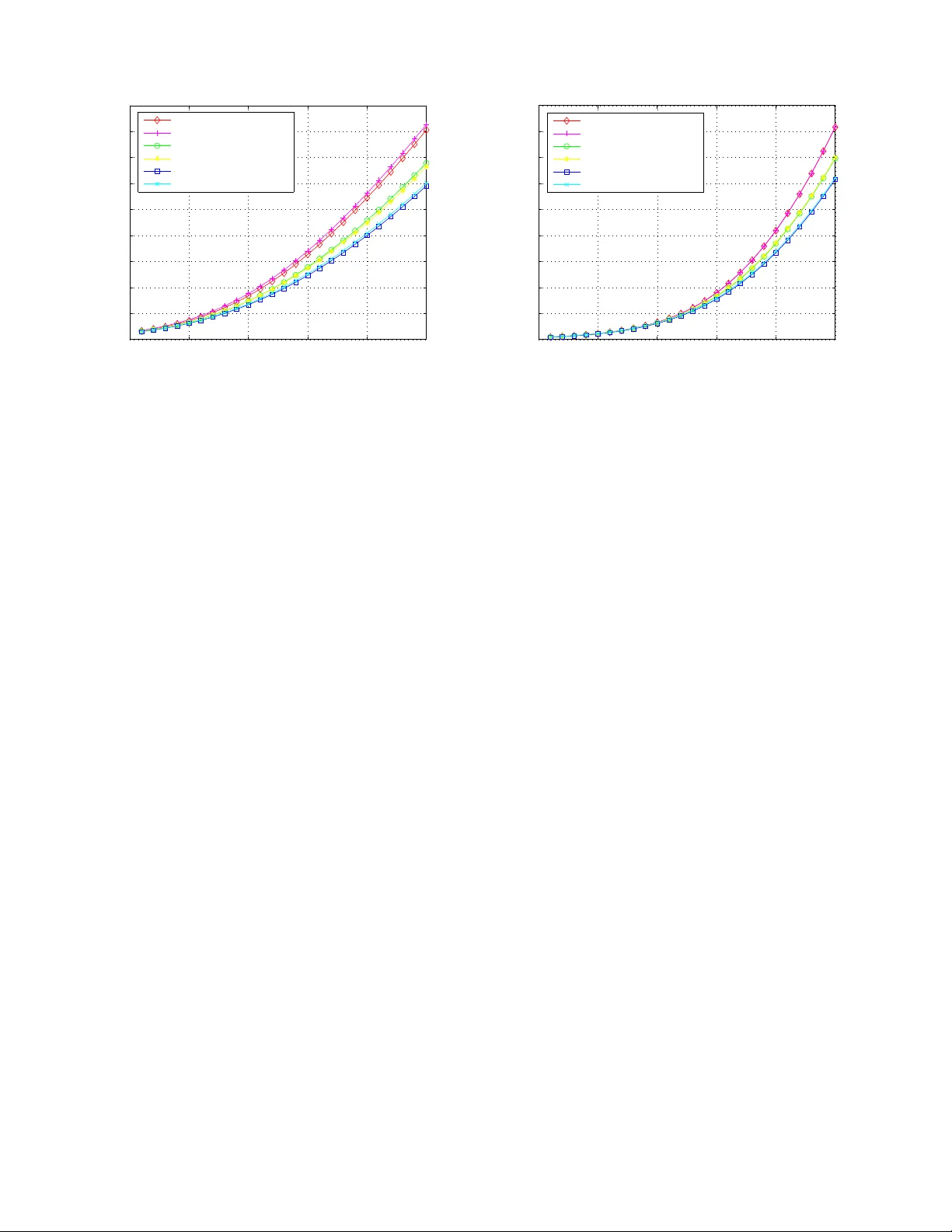
Asymptotic Capacity and Optimal Prec oding Strate gy of Multi-Le v el Precode & F orward in Correlate d Channels Nadia Faw az ∗ , Ke yvan Zarifi † , Merouane Debbah ‡ and Da vid Gesbe rt ∗ ∗ Mobile Commun ications Departmen t, Eureco m Institute, Soph ia-Antipolis, France { nadia.fawaz,david.gesbert } @eure com.fr † INRS-EMT & Concor dia University , Montr ´ eal, Canada keyv an.zarifi@emt.inr s.ca ‡ Alcatel-Lucen t Chair on Flexible Radio, SUPELEC, Gif-sur-Yvette, France merouan e.debba h@supelec.fr Abstract — W e analyze a multi-level MIMO r elaying system where a mu ltiple-antenna transmitter sen ds data to a multiple- antenna recei ver through se veral relay le vels, also equipped with multiple antennas. Assuming correla ted fading in each hop, each relay recei ves a faded version of the si gnal transmitted by t he prev ious lev el, perfor ms precoding on th e rec eive d signal and retransmits it to the next level. Using free probability theory and assuming that the noise power at th e relay levels - but not at the recei ver - is n egligible, a closed-fo rm expressio n of the end-to-end asymptotic instantaneous mu tual inform ation is deriv ed as the number of antennas in all levels gro w large with the same rate. This asymptotic expression is shown to b e ind ependent from the channel realizations, to only depend on the channel statistics and to also serv e as the asymptotic value of the end-to-end av erage mutual information. W e also provide the optimal singular vecto rs of the precoding matrices that maximize th e asymptotic mutual informa tion : the optimal transmit directions represented by the singular vecto rs of the precoding matrices ar e aligned on the eigen vectors of the channel corr elation matrices, theref ore th ey can be determined only using the known statistics of the channel matrices and do n ot depend on a particular channel realization. I . I N T RO D U C T I O N Relay comm unication systems have r ecently attracted muc h attention d ue to their p otential to substantially improve the signal r eception qu ality whe n the direct commun ication link between th e tran smitter an d th e re ceiv er is not reliable . Due to its major practical impo rtance as well as its sign ificant techni- cal challenge, deriving the capacity - or bounds on the capacity - of various relay com munication schem es is growing to an entire field of research. Of p articular interest, is the cap acity bound s for the systems in which the transmission, reception, or the relay le vels are equipped with multiple antennas. Assuming fixed channel conditio ns, lo wer an d upper bound s on the capacity o f multiple -input multiple o utput (MIMO) two-ho p relay channel have be en deriv ed in [1]. Similar bou nds have also b een o btained in the same pap er on th e ergod ic capacity when the com munication links undergo i.i.d. Rayleigh fadings. For a two-hop rela y system and the case wh en th e source- relay and the relay -destination channel matrices are perfe ctly known, the op timal relay p recodin g matrix is d eriv ed in [2]. In [3] the asympto tic capacity o f MIMO two-hop relay networks has been stud ied when th e numb er of relay no des grows to infinity while the nu mber of transmit and receive anten nas remain co nstant. T he asy mptotic cap acity o f the MIMO multi- hop am plify-and -forward re lay cha nnels has been derived in [4] wh en all chann el links experience i.i.d . Rayleigh fading while the numb er of tran smit and re ceiv e antenn as as well as the number of r elays at each hop go to infinity with th e same rate. The scalin g behavior of th e capacity of MIMO two-hop relay channel has also been studie d in [5] fo r the case when th e source an d d estination jointly co mmunicate to each other through the relay layer . Other related prob lems have been analyzed in, for instance, [6 ], [7], [8 ], [ 9]. In this paper we study MIMO N -hop relay commun ication system wherein data transmission fr om k 0 transmit anten nas to k N receive antenn as is made p ossible throu gh N − 1 relay lev els each of which ar e eq uipped with k i , i = 1 , . . . , N − 1 antennas. In this tr ansmission chain of N + 1 levels it is assumed that the direct com munication link is on ly viab le between two adjacent levels: Each relay receives a faded version of the multi-d imensional signal tran smitted fro m the previous lev el an d, af ter precoding , re transmits it to the next lev el. W e consid er the case wh ere all commun ication links undergo Rayleigh flat fadin g an d th e fading chann els in each hop (in-between two adjacent levels ) may be corre lated while the fading ch annels of any two d ifferent hops are un correlated. Using th e too ls fr om free prob ability theory a nd assum ing that the noise power at the relay le vels, but not at the receiver , is negligible, we derive a closed-for m expression for the end- to-end asymp totic instantaneous mutual infor mation between the tr ansmitter and the receiver as the numbe r of antenn as in all levels grows large with the same rate. This asy mptotic expression is shown to be in dependen t from the ch annel real- izations and o nly depend s o n the ch annel statistics. Ther efore, as long as th e statistical p roperties o f th e channe l matrices at all hops d o n ot ch ange, th e instantan eous mu tual in formation asymptotically conver ges to the same deterministic expression Z P S f r a g r e p l a c e m e n t s x 0 x 1 x 2 x N − 2 x N − 1 y 0 y 1 y 2 y N − 2 y N − 1 y N k 0 k 1 k 2 k N − 2 k N − 1 k N x 0 H 1 H 2 H N − 1 H N Fig. 1. Multi-le vel Relayi ng System for any arbitrar y channel realization. As a consequen ce, the so- obtained expre ssion also ser ves as th e asymp totic value of the end-to- end average mutual information between the transmitter and the receiver . Then we obtain the optimal sing ular vectors of the precoding matrices that maximize the asymptotic mutual informa tion. It is shown that, in the asymptotic regime, the optimal singular vector s o f the pr ecoding matrices are also in- depend ent f rom the channel realizations and can be determin ed only using the known statistics of the channel matric es. The rest o f the paper is o rganized as f ollows. In section II, n otations and th e system mod el are pr esented. In section III, the en d-to-en d instantane ous m utual informatio n in the asymptotic regime is derived, whereas the optimal singular vectors of the precod ing matrices are g iv en in section IV. Numerical results are provided in sectio n V and lead to the conclud ing section VI. I I . S Y S T E M M O D E L Matrices an d vectors are r epresented by b oldface uppercase. A T , A ∗ , A H denote the transpo se, the co njugate and the transpose co njugate of matrix A . tr ( A ) , det( A ) and k A k F = q tr ( A A H ) stan d fo r trace, determinant and Frobenius no rm of A . I N is the identity matrix of size N. Consider Fig. 1 tha t shows a multi-level relaying system with k 0 transmit antenna s, k N receive antennas a nd N − 1 relaying stage s. The i − th r elay stage is equip ped with k i antennas. W e assume that no ise power is zero at all relays while at the receiver we have E { zz H } = σ 2 I = 1 η I (1) where z is the circularly- symmetric zero -mean iid Ga ussian receiver noise vector . This simp lifying non -noisy-rela ys as- sumption is a first step tow ard mo re comp lete analysis whe re noisy relays will be considered in future work. (Remark: in [9] a m ulti-level AF r elay ne twork with iid Rayleigh fading is analyzed at high SNR and it is shown th at at high SNR the colored noise a t d estination can be con sidered a s white, which is equivalent to neglecting the noise at relay s but not at the d estination.) Chann el matrices are g i ven b y th e Kro necker model: H i = C 1 / 2 r,i Θ i C 1 / 2 t,i i = 1 , . . . , N (2) where C t,i , C r,i are the tran smit and receive correlation matri- ces and Θ i are zero-mea n iid Gaussian matrices, independ ent from e ach o ther . Moreover , deno ting [ Θ i ] kl the ( k , l ) entry of Θ i : E {| [ Θ i ] kl | 2 } = 1 k i i = 1 , . . . , N (3) The signal tr ansmitted by the tr ansmitter is x 0 = P 0 y 0 where y 0 is a circ ularly-symm etric zero -mean iid Gau ssian signal vector such th at E { y 0 y H 0 } = I . Relay at level i perfo rms linear pre coding on its received signal, by multiplying the rec ei ved vector by a precodin g matrix to form its transmitted sign al. Theref ore the vectors transmitted b y the relays x i , i = 1 , . . . , N − 1 ar e given b y: x i = P i y i i = 0 , . . . , N − 1 (4) where y i , i = 1 , . . . , N − 1 are the signals received at each relaying level, an d P i , are to-be-dete rmined preco ding matrices, respecting the per-node average power co nstraints: tr (E { x i x H i } ) ≤ P i i = 0 , . . . , N − 1 (5) Amplify-a nd-Forward is a par ticular case wh ere the precod ing matrix is diagon al. According to Fig. 1, th e signa l received at the final receiv er can be r epresented by y N = H N P N − 1 H N − 1 P N − 2 . . . H 2 P 1 H 1 P 0 y 0 + z = G N y 0 + z (6) where G N = H N P N − 1 H N − 1 P N − 2 . . . H 2 P 1 H 1 P 0 = C 1 / 2 r,N Θ N C 1 / 2 t,N P N − 1 C 1 / 2 r,N − 1 Θ N − 1 C 1 / 2 t,N − 1 P N − 2 . . . × C 1 / 2 r, 2 Θ 2 C 1 / 2 t, 2 P 1 C 1 / 2 r, 1 Θ 1 C 1 / 2 t, 1 P 0 (7) W e define the matr ices : M i = C 1 / 2 t,i +1 P i C 1 / 2 r,i i = 1 , . . . , N − 1 M 0 = C 1 / 2 t, 1 P 0 M N = C 1 / 2 r,N . (8) and can then rewrite (7) as: G N = M N Θ N M N − 1 Θ N − 1 . . . M 2 Θ 2 M 1 Θ 1 M 0 (9) The dimension s of the matrices/vectors that are in volved in our analysis are given below: x i : k i × 1 y i : k i × 1 P i : k i × k i H i : k i × k i − 1 C r,i : k i × k i C t,i : k i − 1 × k i − 1 Θ i : k i × k i − 1 M i : k i × k i I I I . A S Y M P T OT I C M U T UA L I N F O R M AT I O N In this section, we der i ve a closed-fo rm expression for the end -to-end asymptotic instantaneo us mu tual informa tion between the tra nsmitter and the receiver as th e n umber of antennas in all lev els g rows large with the same rate. I n other word s, we find th e asy mptotic instantaneo us mutu al informa tion per dimension I I = 1 k 0 log det( I + η G N G H N ) (10) when k 0 , k 1 , . . . , k N go to infinity while k i k N → ρ i i = 0 , . . . , N (11) The main result is summar ized in th e fo llowing theorem: Theor em 1 : For the system described in section II , as k 0 , k 1 , . . . , k N go to infinity wh ile k i k N → ρ i , i = 0 , . . . , N the asymp totic end-to-en d instantan eous mutual informa tion per dimension I is given by I = 1 ρ 0 N X i =0 ρ i E log 1 + η ρ i +1 h N i Λ i − N log e ρ 0 η N Y i =0 h i (12) where h 0 , h 1 , . . . , h N are the solutions of the system of N + 1 equations N Y j =0 h j = ρ i E h N i Λ i ρ i +1 + η h N i Λ i i = 0 , . . . , N (13) and where E is over Λ i with distribution F M H i M i ( λ ) The proof of this theorem uses to ols fro m fr ee pro bability theory . After intro ducing a few tran sformation s and lemmas, we pr ovide h ereafter the main steps of the proof of Theo r em 1 . For the f ull pr oof, th e rea der is r eferred to [10] . Before giving a sketch of the proof, we would like to point out that this expression of the asym ptotic instantaneous mutual informa tion is valid for any arbitrary set of matr ices P i . Moreover this asymptotic expression de pends only o n the channel statistics and not on a particular realization of the channel. Thus when the size of the system gets la rge, by knowing only th e statistics o f the chann el and not th e in - stantaneous chan nel realization, it is still p ossible to optimize the instantan eous mutual informatio n, mak ing Theorem 1 a powerful to ol for optimizing the system perform ance. Actu ally , it is a powerful optimization tool ev en for a small nu mber of an tennas. In deed as illustrated in section V, exper imental results show that the system beh a ves like in the asymptotic regime even for a small numb er of antennas. In o ther word s, the asy mptotic mu tual inform ation can be used to o ptimize the instantaneou s m utual inform ation o f a finite-size system when transmitting nod es kn ow only the statistics of the channe l ( the receiver is assum ed to know the channe l). Finally , since the asymptotic mutu al in formation depends only on chann el statistics, as long as the statistical properties of the chan nel ma trices do not vary a t all ho ps, th e instantaneou s mutual info rmation con verges asym ptotically to the same deterministic expr ession for any arbitrar y chann el realization . As a consequen ce, the asympto tic instantaneo us end-to -end mutual in formation is also the asym ptotic value of th e average end-to- end mutual informa tion. A. Preliminaries T o prove The or em 1 , we nee d to introduce the following transform ations [6]: Υ T ( s ) , Z sλ 1 − sλ dF T ( λ ) (14) S T ( z ) , z + 1 z Υ − 1 T ( z ) , S-transform (15) where T is a Hermitian matrix, F T is the asymptotic eigen- value distribution of T as its dimensions go to in finity and Υ − 1 (Υ( s )) = s . Finally , we n eed th e following lemmas: Lemma 1 ( [6, E q.(15) ]): Given an m × n matrix A with n m = ξ S AA H ( z ) = z + 1 z + ξ S A H A z ξ (16) Lemma 2 ( [11]): Let Θ b e a zer o-mean iid Gaussian matrix and T 1 and T 2 be Hermitian matrices in depende nt from Θ and with p roper dimensions such th at ΘT 1 Θ H T 2 is meanin gful. T hen, as the dimensions of the m atrices go to infinity , ΘT 1 Θ H and T 2 become asymptotically free, thus, S ΘT 1 Θ H T 2 ( z ) = S ΘT 1 Θ H ( z ) S T 2 ( z ) (17) Lemma 3 ( [6, Th eor em 1]): Consider an m × n matrix B with zero-mean iid en tries with variance 1 n . Assume th at the dimensions go to infinity while m n → ζ , then S BB H ( z ) = 1 1 + ζ z (18) B. Main Step s of p r oof of Theo r em 1 The proo f of Theor em 1 goes throu gh fou r step s as fo llows : • First step : Obtain S G N G H N ( z ) Using Lemmas 1, 3, 2 we show the following th eorem: Theor em 2 : A s k i , i = 0 , . . . , N go to infinity with the same r ate, the S-transfor m of G N G H N is g iv en by: S G N G H N ( z ) = S M H N M N ( z ) N Y i =1 ρ i z + ρ i − 1 S M H i − 1 M i − 1 „ z ρ i − 1 « (19) • Second step : Use S G N G H N ( z ) to find Υ G N G H N ( z ) Theor em 3 : L et us d efine ρ N +1 = 1 . W e have s Υ N G N G H N ( s ) = N Y i =0 ρ i +1 Υ − 1 M H i M i Υ G N G H N ( s ) ρ i (20) • Third step : Use Υ G N G H N ( z ) to obtain d I /dη . First we note that I = k N k 0 1 k N k N X i =1 log(1 + η λ i ( G N G H N )) = k N k 0 Z log(1 + η λ ) dF k N G N G H N ( λ ) a.s. → 1 ρ 0 Z log(1 + η λ ) dF G N G H N ( λ ) (21) where F k N G N G H N ( λ ) is th e emp irical ( non-asym ptotic) eigenv alue d istribution of G N G H N . Due to ( 21), in th e asymptotic regime, the deriv ati ve of th e mutual in forma- tion with respect to η is linked to Υ G N G H N ( z ) : d I dη = 1 − ρ 0 η ln 2 Υ G N G H N ( − η ) . (22) Thus using Th eorem 3, we show the fo llowing theorem: Theor em 4 : I n th e asym ptotic regime, as k 0 , k 1 , . . . , k N go to infinity while k i k N → ρ i , i = 0 , . . . , N , the deri vati ve of the instantane ous mutu al inform ation is given by: d I dη = 1 ρ 0 ln 2 N Y i =0 h i (23) where h 0 , h 1 , . . . , h N are th e solutio ns of the system of N + 1 eq uations N Y j =0 h j = ρ i E h N i Λ i ρ i +1 + η h N i Λ i i = 0 , . . . , N . (24) The expectation is over Λ i with distribution F M H i M i ( λ ) . • F o urth step : Integrate d I /dη to get I Since primitive func tions o f d I dη differ by a co nstant, the constant was cho sen such that the m utual info rmation (12) is n ull wh en SNR η goes to zero : lim η → 0 I ( η ) = 0 . I V . O P T I M A L T R A N S M I S S I O N S T R AT E G Y AT S O U R C E A N D R E L A Y S In previous section, the asy mptotic mutual info rmation (12), (13) was deri ved co nsidering arbitr ary preco ding matrices P i , i ∈ { 0 , . . . , N − 1 } . In th is section , we a nalyze the optimal linear p recodin g strategies P i , i ∈ { 0 , . . . , N − 1 } at source and relays that allow to ma ximize the m utual informa tion. W e characterize the optimal transmit direction s, mean ing the singular vectors of the precoding matrices at source and relays, that maximize th e asym ptotic m utual inf ormation. It turn s ou t that those transmit direction are also the one s th at m aximize the a verag e mutual informatio n o f finite size systems, i.e. when k 0 , k 1 , . . . , k N are finite. In f uture work, using the results on the o ptimal directions of tran smission an d the a symptotic mutual info rmation (1 2), (1 3), we intend to work out the optimal power allocation in the asym ptotic regime. The main result of this section is gi ven by the the orem: Theor em 5 : For i ∈ { 1 , . . . , N } let C t,i = U t,i Λ t,i U H t,i and C r,i = U r,i Λ r,i U H r,i be the eigen value d ecompo sitions of the covariance matrices C t,i and C r,i , wh ere U t,i and U r,i are unitary and Λ t,i and Λ r,i are diagon al, with their respective eig en values ord ered in decreasing ord er . Then the optimal linear pr ecoding matr ices, that maximize the a symp- totic mutual info rmation unde r power co nstraints (5 ) can be written P 0 = U t, 1 Λ P 0 P i = U t,i +1 Λ P i U H r,i , for i ∈ { 1 , . . . , N − 1 } (25) where Λ P i are diagon al m atrices with complex elem ents. Moreover , tho se prec oding matrices are also the ones wh ich maximize the average mutual inf ormation of a finite size (non - asymptotic) system. This theorem m eans that the transmit directions at sou rce and relays maximizing the asymptotic mutual info rmation are such that: • the source sho uld align the transm it covariance matrix Q = P 0 P H 0 on the e igen vectors of th e transmit cor rela- tion matrix of the channe l H 1 to th e first relaying layer • relay i should align the p recoding matrix P i on the eigenv ectors U r,i of receive correlatio n matrix of chan nel H i on th e right, and on the eigenvectors U t,i +1 of th e transmit correlation matrix of chan nel H i +1 on the left. • the pro blem of optimizin g P i can be divided in to two decoup led pro blems: o ptimizing the tran smit directions on one hand , and o ptimizing th e transmit powers o n th e other h and. For a detailed pr oof of Theorem 5 , we on ce again r efer th e readers to [10]. Nev ertheless, we would like to draw the attention o f the reader on two points. First, the proof of th is theorem does not rely o n the expression of the asympto tic mu tual in formation given in (12) and is ind ependen t of Theor em 1 . On th e con trary , the theorem is first proved f or the non-a symptotic regime , and th e resu lt is shown to still hold in the limit when the dimensions increase. Nev ertheless by com bining Theorem 1 and Theor em 5 , the ultimate objective is to find the optima l pr ecoding matrices using only knowledge of the statistics of the chan nel. Second, as in th e proo fs in [ 12] fo r th e average mutua l in- formation of multiple-antenn a single- user case with covariance knowledge at transmitter, or in [13] for the av erage m utual informa tion in the mu ltiple-antenn a multi-user case also with covariance knowledge a t transmitter, both without relaying , o r in [2] for the two-h op relay system with full CSI at the relay , our proo f of Theo rem 5 is based on T heorem H.1 .h in [1 4]. V . N U M E R I C A L R E S U L T S In this section, we present nume rical results to validate Theor em 1 and to show that even f or a small num ber of antenna, the beh avior of the system is close to the behavior in the asy mptotic regime, mak ing Theo r em 1 a useful tool for optimization of finite-size systems as well as large networks. Fig. 2 plots the asymp totic m utual info rmation fro m Theo- r em 1 as well as the i nstantaneo us mutual informatio n o btained for a n arbitr ary chann el r ealization ( ’experimental’ c urves) for a system w ith 1 0 antenna s at tran smitter , receiver and each relay level, and 1,2 or 3 hops, the case N = 1 hop correspo nding to a MIMO chann el. Fig. 3 plots the same typ e of cu rves, for a system with 100 an tennas at each levels. Equal power allo cation, i.e. matrices P i propo rtional to the identity matrix, as well as non-correlate d ch annels, i.e. channel correlation matr ices all equal to identity , w ere con sidered in these simulatio ns, whose pu rpose is m ainly to validate the formu la in T heorem 1, no t to optimize the sy stem. W e would 0 5 10 15 20 25 0 0.5 1 1.5 2 2.5 3 3.5 4 4.5 Instantaneous Mutual Information vs SNR − 10 antennas SNR [dB] Instantaneous Mutual Information [bits/s] N = 1, MIMO, Asymptotic N = 1, MIMO, Experimental N = 2, 1 relay, Asymptotic N = 2, 1 relay, Experimental N = 3, 2 relays, Asymptotic N = 3, 2 relays, Experimental Fig. 2. Asymptotic Mutual Information and Instantaneous Mutual Informa- tion with K = 10 antenn as, for MIMO, 1 relay le vel, and 2 relay lev els like to p oint out that plottin g the experimen tal cur ves for dif- ferent chann el realizations gav e similar results, and that fo r the sake of clarity and conciseness, we exhibit the exper imental curves only for o ne r ealization. Fig. 3 sh ows the p erfect match between the instantaneo us mutu al inf ormation of arbitrary channel realization and the asymp totic mutual infor mation, validating the formula for large dimensions of th e n etwork. On the other h and Fig. 2 shows th at the instantaneo us mu tual informa tion of a system with a small n umber of ante nnas behaves very clo sely to the asymptotic regime, justifying the usefulness of the asymptotic formu la even for optim izing systems with small dime nsions. V I . C O N C L U S I O N W e stud ied a multi-level MI MO relay network, in cor re- lated fading, wher e relay s p erform linear precod ing on their received sign al b efore retransmission. On o ne hand, using free p robab ility th eory , we derived a closed-f orm expression of the end-to-e nd instan taneous mutua l inf ormation in the asymptotic regime whe n the nu mber of an tennas at a ll levels goes to infinity w ith same rate. This expression turn s out to depend only on cha nnel statistics and no t on particular chann el realizations. W e also showed that mu lti-le vel networks with finite dimension s b ehave clo sely to the asym ptotic regime, ev en for a small n umber o f anten nas, making th e asym p- totic mutual informatio n a powerful too l for o ptimizing the instantaneou s mutual inf ormation of finite d imensions systems with on ly statistical knowledge of the channel. On the o ther hand, we showed that the precod ing matrices that maxim ize the asym ptotic mutu al informatio n, have a particu lar form: the precoding ma trices, th rough the ir sing ular vectors, must be aligne d on the eigen vectors of the cha nnel transmit an d receive cor relation m atrices. Combining asymp totic mutual informa tion and op timal directions of tr ansmissions, futur e work will focu s on optimizin g th e power allocations, so as to find the precod ing matrices optimizing th e mu tual in formation 0 5 10 15 20 25 0 0.2 0.4 0.6 0.8 1 1.2 1.4 1.6 1.8 Instantaneous Mutual Information vs SNR − 100 antennas SNR [dB] Instantaneous Mutual Information [bits/s] N = 1, MIMO, Asymptotic N = 1, MIMO, Experimental N = 2, 1 relay, Asymptotic N = 2, 1 relay, Experimental N = 3, 2 relays, Asymptotic N = 3, 2 relays, Experimental Fig. 3. Asymptotic Mutual Information and Instantaneous Mutual Informa- tion with K = 100 antennas, for MIMO, 1 relay le vel, and 2 relay le vels with o nly statistical chann el knowledge. A C K N OW L E D G M E N T The auth ors would like to thank the French Defen se Body DGA, BIONET S p roject (FP6-0 27748 , www .bio nets.eu) and Alcatel-Lucen t within th e Alca tel-Lucent Chair on flexible radio at SUPELEC fo r sup porting this work . R E F E R E N C E S [1] B. W ang, J. Zhang, and A. Høst-Madsen, “On the capa city of mimo relay channels, ” IEE E T rans. Inform. Theory , vol. 53, Jan. 2005. [2] X. T ang and Y . Hua, “Optimal design of non-regenera ti ve mimo wireless relays, ” IEEE T rans. W ireless Commun. , vol. 6, Apr . 2007. [3] H. B ¨ olcsk ei, R. Nabar , O. Oyman, and A. Paulraj, “Cap acity scali ng laws in mimo relay netw orks, ” IE EE T rans. W irel ess Commun. , vol. 5, no. 6, pp. 1433–1444, June 2006. [4] S. Y eh and O. Leve que, “ Asym ptoti c capacity of multi-le vel amplify- and-forw ard relay networks, ” in Proc. IEEE ISIT’07 , J une 2007. [5] R. V aze and R. W . J. Heath. Capacity scaling for mimo two-way relayi ng. submitted to IEEE Tra ns. Inform. Theory . [Online]. A va ilable : http:/ /arxi v . org/a bs/0706.2906v2 [6] R. M ¨ uller , “On the asymptotic eigen value distributi on of concat enated vec tor-v alued fading channels, ” IEEE T rans. Inform. Theory , vol. 48, no. 7, pp. 2086–2091, July 2002. [7] V . Morgenshte rn and H. B ¨ olc skei, “Cryst alliz ation in large wireless netw orks, ” IEEE T rans. Inform. Theory , vol. 53, Oct. 2007. [8] Y . Fan and J. Thompson, “Mimo configurations for relay channe ls: Theory and practi ce, ” IEEE Tr ans. W irele ss Commun. , vol. 6, pp. 1774– 1786, May 2007. [9] S. Y ang and J.-C. Belfiore. Div ersity of mimo multihop relay channel s. submitted to IEEE Trans. Inform. Theory . [Online]. A vaila ble: http:/ /arxi v . org/a bs/0708.0386 [10] N. Fa waz, K. Zarifi, M. Debbah, and D. Gesbert, “Multi-le vel precode & forward in correlat ed channels: Ho w random matrix theory leads to optimal precoding strategy , ” to be published . [11] M. Debbah, W . Hache m, P . Loubaton, and M. de Courville, “Mmse analysi s of certain lar ge isometric random precoded systems, ” IEEE T rans. Inform. Theory , vol. 49, no. 5, pp. 1293–1311, May 2003. [12] S. J afa r and A. Goldsmith, “Tra nsmitter optimizat ion and optimality of beamforming for m ultipl e antenn a systems, ” IEEE Tr ans. W ir eless Commun. , vol. 3, no. 4, pp. 1165–1175, July 2004. [13] A. S oysal and S. Ulukus, “Optimum po w er alloca tion for s ingle -user mimo and multi- user mimo-mac with parti al csi, ” IEE E J . Select. Areas Commun. , to appear . [14] A. W . Marshall and I. Olkin, Inequalities: Theory of Majorizat ion and Its Applicat ions . Ne w Y ork: Academic Press, 1979.
Original Paper
Loading high-quality paper...
Comments & Academic Discussion
Loading comments...
Leave a Comment