Distributed Opportunistic Scheduling for MIMO Ad-Hoc Networks
Distributed opportunistic scheduling (DOS) protocols are proposed for multiple-input multiple-output (MIMO) ad-hoc networks with contention-based medium access. The proposed scheduling protocols distinguish themselves from other existing works by the…
Authors: Man-On Pun, Weiyan Ge, Dong Zheng
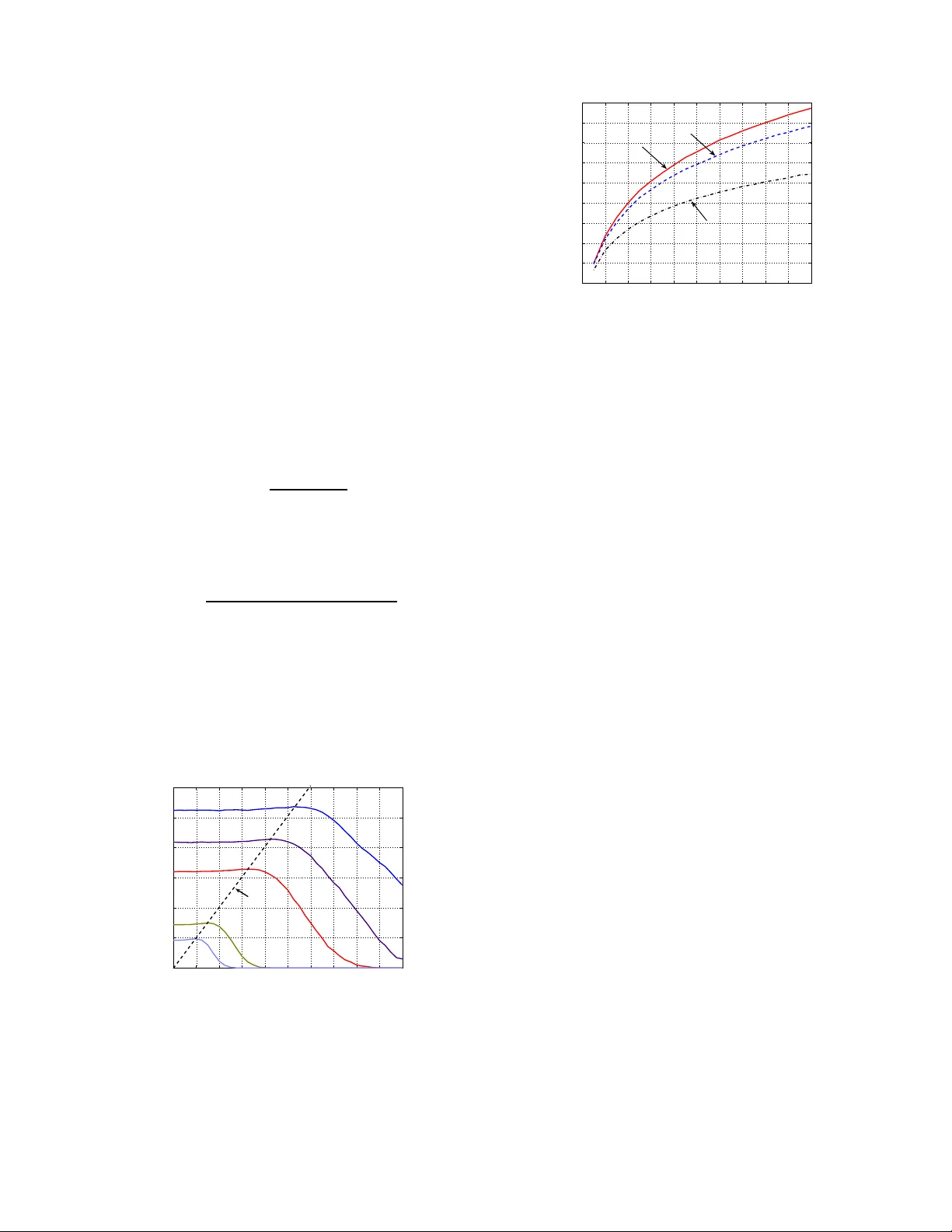
Distrib uted Opportunistic Scheduling for MIMO Ad-Hoc Netw orks Man-On Pun, W eiyan Ge, Dong Zheng, Junsh an Zhang a nd H . V incent Poor Abstract — Distributed opportuni stic scheduling (DOS) proto- cols are proposed for multip le-input multip le-output (MIMO) ad-hoc networks with contention-b ased medium access. The proposed scheduling protocols distingui sh themselv es from other existing works by their explicit design fo r system through- put improve ment through exploiting sp atial multip lexing and divers ity in a distributed manner . As a result, multi ple li nks can be scheduled to simultaneously transmit ov er the spatial channels formed by transmit/recei ver antennas. T aking in to account th e tradeoff between fee dback requirements and system throughput, we p ropose and compare protocols with different lev els of feedback info rmation. Furth ermore , in contrast to the con ventional rand om access protocols that ignore the physical channel conditions of contending links, the proposed p rotoco ls implement a p ure threshold policy derived from optimal stopp ing theory , i.e. only link s with thre shold-exceeding channel conditions are allowed for data transmission. Simulation results confirm that the proposed p rotocols can achieve impressi ve th roughput perfo rmance by exploitin g spatial multiplexing and diversity . I . I N T R O D U C T I O N In a wireless ad -hoc network, mu ltiple users communicate over wireless links by autono mously deter mining ne twork organization, link scheduling, and rou ting. Similarly to other wireless systems, w ireless ad- hoc n etworks encou nter critical design challenges impo sed b y time- varying fading channels and co -channe l interference. In the conventional ra ndom ac- cess p rotocols (e.g. CSMA), a link p roceeds to transmit its data after a suc cessful channel conten tion, regardless of its current channel condition s. This may c ause system throug hput degradation if th e successful link is d eep-faded. T o circum vent this obstacle, a distributed opp ortunistic sch eduling (DOS) scheme has been prop osed for wireless ad -hoc n etworks in [6]. In contra st with the co n ven tional rando m access protocol, DOS restricts data tran smission to the successful links whose channel condition s exceed threshold s p re-design ed using op- timal stopping the ory . For those successful links with channel condition s below the thresho ld, their data transmission o ppor- tunity is fo rgone, which allo ws o ther links to re- contend for the channel. T his p rocess continues until a successful cha nnel contention is achieved by a link with good ch annel co nditions. It has bee n demon strated in [6] that DOS can su bstantially Man-On Pun and H. V incent Poor are wit h the Department of Electric al Engineeri ng, Princeton Unive rs ity , Pri nceton , NJ 0 8544. W eiyan Ge and Junshan Zhang are with the Department of Electric al Engineeri ng, Arizona Sta te Uni versit y , T empe, AZ 85287. Dong Zheng is with Nex tW a ve W ireless Inc., San Diego, CA 92130. This re search wa s supported in pa rt by t he Croucher Foun dation und er a post-doct oral fello wship, in part by the U. S. National Science Foundati on under Grants ANI-02-38550, A NI-03-38807, CNS-06-25637, and CNS-07- 21820 and in par t by Office of Na val Resear ch through Grant N00014-05-1- 0636. outperf orm the conv entional random access protoco l in terms of system throu ghpu t. Despite its good perfor mance, the scheduling scheme p roposed in [6] is d evised for single- antenna ad- hoc networks. The recent success of multiple-inp ut multiple- output (MIMO) tech niques h as inspir ed muc h research interest in MIMO ad-h oc networks. Ho wev er , compared to the c on- ventional sing le-link poin t-to-poin t MIMO tr ansmission, by and large it is still a n open issue on how to fully harvest the intr insic spatial d egrees of f reedom of a MIMO ad-ho c network in a distributed fashion [2 ]. T aking an initial step, we pr opose novel MIMO DOS pr otocols with em phasis on exploiting spatial m ultiplexing and sp atial di versity gains for MIMO ad-hoc network s in this work. Mo re specifically , we consider a MIMO ad-ho c network where each user is equ ipped with M ante nnas, wh ere M ≥ 2 . T o exploit the spatial multiplexing and di versity g ains provided by the multip le antennas, we develop MIMO DOS pr otocols in which multiple links (in contr ast to a sing le link in [ 6]) are pr obed an d oppor tunistically selected . T o facilitate the pr oposed multi- link channel contention and data transmission, a group -based splitting chan nel con tention scheme is prop osed. Based on the c hannel contention ou tcomes an d th e instantaneous ra te, one or multiple links are scheduled to transmit over the M spatial ch annels if their chann el cond itions exceed thresholds designed using o ptimal stopp ing the ory . The resulting pro- tocols are shown to ach iev e h igher system perfor mance by exploiting the spatial multiplexing and spatial diversity g ains. Furthermo re, we in vestigate the tradeoff b etween feed back requirem ents and thro ughp ut g ain by de velopin g p rotoco ls with either full channel state inf ormation (CSI) at the trans- mitter (CSIT) or CSI at th e receiver only (CSIR). For th e sake of presentatio nal clarity , we concentrate on systems with M = 2 in this work. Howe ver, it should b e emphasized that the propo sed protoco l can be gen eralized for systems with M > 2 an tennas in a straig htforward manne r . I I . T W O - G RO U P M I M O S C H E D U L I N G P R OT O C O L W I T H C S I T ( T G - C S I T ) A. Pr oto col Description W e consider a single-hop ad-h oc n etwork in whic h each node is equ ipped with two antenna s. Suppose K active links, i.e. K p airs of source-destination (S-D) nodes { S k , D k } , k = 1 , 2 , · · · , K , contend for d ata transmission over two spatial channels con structed by transmit bea mformin g. Each sou rce node first rando mly categorizes itself into one of the tw o equ al-prob able gro ups, namely Group 1 and Group 1 2 N Fig. 1. An exa mple of two-channe l probi ng and data transmission where 0 and 1 indica te idle/colli sion state and successful channel contention, respecti vely . 2, befor e its fir st channel contention. T o facilitate the channel probin g of eac h group, the channel time is divided into m eta- slots co mposed of two mini-slots o f du ration τ , e ach of which is exclusi vely assigned to one gro up as sho wn in Fig. 1. A source node contends for both sp atial channels in the m ini- slots assigned to its group while all idle nod es eavesdrop commun ications o f both groups. If only one link has contended in a m ini-slot, th e c hannel contentio n is consider ed successful under the assumptio n that both the designated destination nod e and other idle nodes can p erfectly decod e the con tending messages. W e d efine the rand om dur ation of a chieving at least one suc cessful channel conten tion in a meta-slot as one roun d of cha nnel prob ing. Let i and m denote the gro up and spatial chan nel in- dices with i, m ∈ { 1 , 2 } , respectively . For presen tational conv enience, we d enote by { c 1 , c 2 } the channe l state o f a meta-slot with c i being “ 1 ” fo r successful chann el co ntention by the i -th grou p and “ 0 ” fo r eith er u nsuccessful chann el contention o r lac k o f active links ( idle). Th us, each probin g round is comp leted with one o f three possible ch annel states, namely , { 0 , 1 } , { 1 , 0 } and { 1 , 1 } . At the end of each p robing round , the destinatio n nod e of each successful link re turns informa tion about the link condition s to its source node. Based on the feedb ack informatio n, the source no de compa res the chan nel condition s again st thresholds pre -designed using optimal stoppin g theory , i.e. if the instantan eous tra nsmission rate is above a pre-designed thr eshold, the source node will proceed d ata tran smission; other wise, the sour ce nod e will forgo the op portun ity and let other links to contend in the next meta-slot. B. Sign al Model In this section we develop the signal mod el for channel state { 1 , 1 } , assumin g L i is the successful link o f the i -th gr oup f or i = 1 , 2 . Ex tension to the sign al m odels for { 0 , 1 } and { 1 , 0 } will be outlined in Sec. II-E wherea s the trivial case { 0 , 0 } is excluded from o ur f ollowing discussion s. For channel state { 1 , 1 } , L i is the only conten ding lin k in the i -th gr oup. Thus, th e received signal b y nod e D L j from node S L i , j = 1 , 2 , can be written as y L i ,L j = √ ρ L i ,L j · H L i ,L j · d L i + n L j , (1) where ρ L i ,L j is the average signal-to -noise ratio (SNR), H L i ,L j is the comp lex chann el g ain m atrix between nod e S L i and nod e D L j , d L i is the transmitted data symb ols fro m node S L i with E n | d L i | 2 o = 1 and n L j is mo deled as a circu larly symmetric wh ite Gaussian noise with C N ( 0 , I ) . Note that (1) represents the d esired signal m odel for i = j wh ereas it stand s for th e interfer ence signal m odel fo r i 6 = j . In this work, we co ncentrate on a ho mogen ous network a nd assume ρ L i ,L j = ρ s , i = j, ρ n , i 6 = j. (2) Furthermo re, we a ssume tha t node D L j has pe rfect inform a- tion ab out ρ s , ρ n and H L i ,L j by explo iting th e pream bles transmitted fro m nod e S L i during its ch annel conten tion. C. Statistics o f T ransmission Rate with CSIT Next, we inves tigate the statistics of tran smission ra te in the presence of two successful links f or the fo llowing two cases: only o ne successful link is selected for da ta tran smission or both links are sch eduled to transmit data simultaneously . 1) Single-lin k (S L) transmission: W e start from the case with only o ne tr ansmission link, wh ich amounts to the conv entional MIMO point-to- point transmission . Assum ing node S L i has per fect informatio n o f H L i ,L i and con structs parallel transmission channels along the eigenvectors of H H L i ,L i H L i ,L i , th e resulting data ra te is given by r (SL-CSIT) L i = 2 X m =1 log (1 + ρ s λ L i ,m ) , (3) where λ L i ,m is the eigenv alu e of H H L i ,L i H L i ,L i for m = 1 , 2 . The joint probability density function (PDF) of the eigen values has b een shown to be [4] f Λ L i ( λ L i , 1 , λ L i , 2 ) = 1 2 e − ( λ L i , 1 + λ L i , 2 ) ( λ L i , 1 − λ L i , 2 ) 2 . (4) Utilizing (4) and (3), th e PDF of R (SL-CSIT) L i can be compu ted in the following fashion: f R (SL-CSIT) L i ( r ) = 1 2 Z r 0 e − ( λ L i , 1 + v ) ( λ L i , 1 − v ) 2 dλ L i , 1 , (5) where v = 1 ρ s h 2 r − log(1+ ρ s λ L i , 1 ) − 1 i . (6) Subsequen tly , the correspo nding CDF of R (SL-CSIT) L i can be obtained b y F R (SL-CSIT) L i ( r ) = Z r 0 f R (SL-CSIT) L i ( r ′ ) dr ′ . (7) 2) T wo-link (TL) transmission: For th e case in which b oth successful links transmit simultane ously , the signal received by node D L i becomes the sup erposition of sign als from the two sourc e n odes an d is given by y (TL-CSIT) L i = √ ρ s · H L i ,L i · d L i + √ ρ n · H L j ,L i · d L j + n L i , (8) where j 6 = i . Clearly , ( 8) amo unts to a point-to- point MIMO signal mo del in the presence of interf erence. Only a fe w analytical results on the exact channel capacity are av ailable in the literature [1] . T o keep the f ollowing analysis tractab le, we appro ximate the interference term as a zero-m ean Gaussian noise with variance ρ n . Thu s, the d ata rate of link L i is given by r (TL-CSIT) L i = 2 X m =1 log 1 + ρ s 1 + ρ n λ L i ,m , (9) and we have th e sum-r ate of the two lin ks a s r (TL-CSIT) L 1 ,L 2 = r (TL-CSIT) L 1 + r (TL-CSIT) L 2 . (10) Recalling tha t H L i ,L j for i, j ∈ { 1 , 2 } are statistically indepen dent, th e PDF of R (TL-CSIT) L 1 ,L 2 can be compu ted as f R (TL-CSIT) L 1 ,L 2 ( r ) = Z r 0 f R (SL-CSIT) L 1 ( r L 1 ) f R (SL-CSIT) L 2 ( r − r L 1 ) dr L 1 , (11) where f R (SL-CSIT) L i ( r L i ) is given in ( 5) except that ρ s is rep laced by ρ s 1+ ρ n . Fina lly , the co rrespon ding CDF can be o btained as F R (TL-CSIT) L 1 ,L 2 ( r ) = Z r 0 f R (TL-CSIT) L 1 ,L 2 ( r ′ ) dr ′ . (12) D. Informa tion F eedback Figure 2 giv es a schematic d iagram of the chan- nel con tention an d feedbac k for channel state { 1 , 1 } . At the e nd of each p robing r ound, node D L i feeds back r (SL-CSIT) L i , r (TL-CSIT) L i , H L i ,L i to nod e S L i . L 1 L 2 L 1 L 2 Feedback Feedback L 1 L 1 , L 1 (SL-CSIT) L 1 (TL-CSIT) L 2 L 2 , L 2 (SL-CSIT) L 2 (TL-CSIT) Fig. 2. Schematic diagram of the channel content ion and feedback for TG- CSIT in channe l state { 1 , 1 } . Assuming that the feedback channel is error-free, nod e S L i receives r (SL-CSIT) L i , r (TL-CSIT) L i , H L i ,L i from no de D L i and overhears n r (SL-CSIT) L j , r (TL-CSIT) L j , H L j ,L j o from node D L j . Then , node S L i will c hoose the transmission strategy th at maximizes the transm ission rate given by r ∗ (TG-CSIT) L 1 ,L 2 = max n r (SL-CSIT) L 1 , r (SL-CSIT) L 2 , r (TL-CSIT) L 1 ,L 2 o . (13) For a reasonably large ρ s (more specifically , ρ s > ρ 2 n ), (13) can be simply appro ximated as r ∗ (TG-CSIT) L 1 ,L 2 ≈ r (TL-CSIT) L 1 ,L 2 , (14) which hold s wh en the m ultiplexing g ain outweigh s the signal- to-interfer ence-no ise (SINR) loss due to th e pr esence of two simultaneou sly activ e link s. In the following, we use (14) in place of (13). E. Extension to Cha nnel States { 0 , 1 } and { 1 , 0 } The sign al m odel d iscussed above can be straig htforwardly extended to ch annel states { 0 , 1 } and { 1 , 0 } . Assuming L i is the only successfu l link, r (SL-CSIT) L i and r (TL-CSIT) L i can be evaluated from (3) a nd (9), respectively , except that r (TL-CSIT) L i contains no useful in formatio n in ch annel states { 0 , 1 } a nd { 1 , 0 } . If nod e S L i overhears no fe edback beyond th at fr om nod e D L i , n ode S L i can safely a ssume tha t it is the o nly successful link and subsequen tly compare r (SL-CSIT) L i against the threshold for the data transmission d ecision. F . Optimal Th r esho ld Design In this section, we in voke o ptimal stopping theory to design the rate thresho ld su ch that the d ecision whether to transm it data or not max imizes the average system throug hput. Denote by p ℓ and I i the chann el conten tion probability of th e ℓ -th lin k and the link index set of Group i for i = 1 , 2 , respecti vely . The p robability o f a su ccessful channe l contention b y links of Group i can be com puted as p i,s = X ℓ ∈I i p ℓ Y j ∈I i j 6 = ℓ (1 − p j ) . (16) Subsequen tly , the instantaneo us tra nsmission r ate at th e end of each prob ing r ound can be trea ted as a co mpou nd rando m variable (r .v .) as R (TG-CSIT) = 2 X i =1 ,j 6 = i p i,s (1 − p j,s ) · R (SL-CSIT) L i | {z } { 1 , 0 } an d { 0 , 1 } + p 1 ,s · p 2 ,s · R (TL-CSIT) L 1 ,L 2 | {z } { 1 , 1 } . (17) In voking th e ren ew al theorem , the rate of return af ter N probin g rou nds can b e su bsequently defined as [ 6] x (TG-CSIT) = E n R (TG-CSIT) ( N ) · T o E { T N } , (18) where T is the d ata tr ansmission d uration, an d T N is the time duration including both T and the tim e elapsed over the N probin g rounds. As shown in [6], the optimal protoco l that maximizes the average rate of return in (18) is a pure thresho ld policy and the max imal throug hput x (TG-CSIT) max can be found by solving (19) where δ = τ / T . x (TG-CSIT) max = 2 X i =1 ,j 6 = i p i,s (1 − p j,s ) Z ∞ x (TG-CSIT) max r d h F R (SL-CSIT) L i ( r ) i + p 1 ,s · p 2 ,s Z ∞ x (TG-CSIT) max r d h F R (TL-CSIT) L 1 ,L 2 ( r ) i 2 δ + 2 X i =1 ,j 6 = i p i,s (1 − p j,s ) 1 − F R (SL-CSIT) L i ( x ) + p 1 ,s · p 2 ,s 1 − F R (TL-CSIT) L 1 ,L 2 ( x ) , (19) G. Pr otoc ol Summa ry Here, we summ arize the o peration of the pr oposed pro tocol. Suppose the sou rce node o f a su ccessful lin k, S L i , receiv e s feedback on r (SL-CSIT) L i , r (TL-CSIT) L i , H L i ,L i from its destination node D L i at the end of each p robing r ound. If node S L i cannot ov erhear feedback from the other group , it wil l compare r (SL-CSIT) L i against x (TG-CSIT) max and procee d to da ta tran smission only when r (SL-CSIT) L i ≥ x (TG-CSIT) max ; o therwise, S L i will give up the transmission o pportu nity and let other links to con tend for the ch annel in the next probing roun d. On th e oth er hand , if S L i detects the existence of an other successful link f rom the other gro up, it will compar e r (TL-CSIT) L i + r (TL-CSIT) L j against x (TG-CSIT) max , for i 6 = j . Both links will tra nsmit data simu ltaneously if r (TL-CSIT) L i + r (TL-CSIT) L j exceeds x (TG-CSIT) max . Otherwise, no links will pr o- ceed to data transmission. Dur ing data transmission, H L i ,L i is exploited to generate the eigen- beamfo rming matrix necessary for cr eating the parallel channels. In the sequel, th is proto col is referr ed to as tw o-grou p MIMO sched uling with CSIT (T G-CSIT) since nodes ar e categorized into two gr oups for ch annel conten tion and pe rfect CSI is req uired at the tran smit node . I I I . T W O - G R O U P M I M O S C H E D U L I N G P RO T O C O L W I T H C S I R ( T G - C S I R ) In TG-CSIT , an M × M channe l g ain m atrix H L i ,L i is required to be r eturned to the source nod e of each successfu l link, which m ay entail a form idable feed back burden for a large M . T o r educe the feedback am ount, we consider a p rotocol tha t re quires full CSI at th e r eceiv ers only , and feedback of two real-valued da ta rates, which we refer to as the two-gro up MIMO schedulin g pr otocol with CSIR (TG- CSIR) in the sequel. Similar to TG- CSIT , TG-CSIR also sp lits the conten ding links into two gro ups and assigns mini- slots to each group for channel c ontention . As a resu lt, each successful prob ing roun d also en ds with one o f th e thr ee states { 1 , 0 } , { 0 , 1 } and { 1 , 1 } . Howe ver, TG- CSIR red uces the req uired feedbac k amoun t by allowing e ach link to transmit only one d ata stream over th e two spatial chan nels. In other words, each link only reaps the div ersity gain for states { 1 , 0 } and { 0 , 1 } wherea s the spatial multiplexing gain is exploited only in state { 1 , 1 } by allowing two links to tra nsmit simultane ously . For states { 1 , 0 } and { 0 , 1 } , th e received signal b y no de D L j from no de S L i can be written as y ′ (SL-CSIR) L i ,L j = √ ρ L i ,L j · h ′ L i ,L j · d ′ L i + n ′ L j , (19) where h ′ L i ,L j is the effective channe l gain vector be tween nodes S L i and D L j , d ′ L i is the transmitted d ata symbol and n ′ L j is th e noise term mod eled as C N (0 , I ) . Since perfect CSI is assum ed to be available to node D L i , the max imal SNR γ (SL-CSIR) L i is ac hieved by pre- multiplyin g the received signal with h ′ H L i ,L i . After some calculation, we can find the C DF of γ (SL-CSIR) L i as F Γ (SL-CSIR) L i ( γ ) = 1 − 1 + γ 2 e − γ 2 ρ s . (20) Thus, th e resulting data ra te is given by r (SL-CSIR) L i = lo g(1 + ρ s γ L i ) (21) whose CDF takes the following form . F R (SL-CSIR) L i ( r ) = 1 − 1 + 2 r − 1 2 ρ s e − 2 r − 1 2 ρ 2 s . (22) For state { 1 , 1 } , node D L i is interfer ed by node S L j for i 6 = j and its received signal can b e wr itten as y ′ (TL-CSIR) L i = √ ρ s · h ′ L i ,L i · d ′ L i + √ ρ n · h ′ L j ,L i · d ′ L j + n ′ L i . (2 3) Since h ′ L i ,L i and h ′ L j ,L i are known to no de D L i , the opti- mal c ombinin g (OC) tec hnique pr ovides the maximum SINR γ (TL-CSIR) L i whose CDF can be shown to be [ 3], [ 5] F Γ (TL-CSIR) L i ( γ ) = 1 − 1 + 1 2 ρ n e − γ ρ s + 1 2 ρ n e − 1+2 ρ n ρ s γ . (24) Hence, th e CDF of the resulting d ata r ate r (TL-CSIR) L i = log 1 + γ (TL-CSIR) L i is giv en by F R (TL-CSIR) L i ( r ) = 1 − 1 + 1 2 ρ n e − 2 r − 1 ρ s + 1 2 ρ n e − 1+2 ρ n ρ s (2 r − 1) , (25) and th e corresp onding PDF can be compu ted as f R (TL-CSIR) L i ( r ) = 1 + 1 2 ρ n r 2 r − 1 ρ s e − 2 r − 1 ρ s − e − 1+2 ρ n ρ s (2 r − 1) . (26) Finally , we are read y to co mpute the sum-r ate of th e two link s defined as r (TL-CSIR) L 1 ,L 2 = r (TL-CSIR) L 1 + r (TL-CSIR) L 2 . (27) Since h ′ L i ,L j for i, j ∈ { 1 , 2 } are assumed to be statistically indepen dent, r (TL-CSIR) L 1 and r (TL-CSIR) L 2 are also statistically indep en- dent. T herefor e, the CDF o f R (TL-CSIR) L 1 ,L 2 is giv en by F R (TL-CSIR) L 1 ,L 2 ( r ) = Z r 0 F R (TL-CSIR) L 2 ( r − r L 1 ) f R (TL-CSIR) L 1 ( r L 1 ) dr L 1 . (28) Upon obtaining F R (TL-CSIR) L i ( r ) and F R (TL-CSIR) L 1 ,L 2 ( r ) , we can treat the instan taneous da ta rate as a comp ound r .v . R (TG-CSIR) and define the corr espondin g r ate of return x (TG-CSIR) in a similar fashion as shown in (1 7) an d (18). It is clear th at the optim al strategy for TG-CSIR is also a p ure th reshold po licy in which the thr eshold can be compu ted from (1 9) with F R (TL-CSIT) L i ( r ) and F R (TL-CSIT) L 1 ,L 2 ( r ) r eplaced b y F R (TL-CSIR) L i ( r ) a nd F R (TL-CSIR) L 1 ,L 2 ( r ) , respectively . It is easy to see th at TG-CSIR requ ires o nly node D L i to fe ed back r (SL-CSIR) L i , r (TL-CSIR) L i , irr espectiv e o f M , which results in sub stantial f eedback reduc tion for a large M compare d to TG-CSIT . Howe ver, this feed back reductio n is obtained b y sacrificing partial ach iev able m ultiplexing g ain. I V . S I N G L E - G RO U P M I M O S C H E D U L I N G ( S G ) P RO T O C O L W I T H C S I T ( S G - C S I T ) For co mparison purpo ses, we also co nsider a straightfor- ward extension of the DOS scheme pr oposed in [6] . In this protoco l, all links are a llowed to conten d in each min i-slot and the transmission rate of a succ essful link, r (SG-CSIT) , is given by (3). Since all nod es b elong to one g roup compar ed to two group s in TG-CSIT/CSIR, this protocol is referred to as s ingle- group MIMO scheduling protocol with CSIT (SG-CSIT) in the sequel. It is straigh tforward to show that the av erage rate of return of SG is g i ven b y x (SG-CSIT) = p ′ s E [ r (SG-CSIT) T ] E [ T N ] , (29) where p ′ s is defin ed in (1 6) with I i containing all lin k ind ices. The cor respond ing maximal av erage ra te of return can be found b y solvin g (30): x (SG-CSIT) max = p ′ s R ∞ x (SG-CSIT) max r d [ F R (SG-CSIT) ( r )] δ + p ′ s [1 − F R (SG-CSIT) ( x (SG-CSIT) max )] , (30) where F R (SG-CSIT) ( r ) can b e comp uted from ( 7). V . S I M U L A T I O N R E S U LT S In this section, we conduct Mon te Carlo experiments to assess the performance o f th e proposed p rotocols. Unless otherwise specified, we set p 1 ,s = p 2 ,s = e − 1 , ρ n = 1 and δ = 0 . 1 . Further more, the unit of thr oughp ut is nats/sec/Hz. 0 1 2 3 4 5 6 7 8 9 10 0 1 2 3 4 5 6 Threshold, x Throughput ρ s =5 ρ s =10 ρ s =20 ρ s =0.5 ρ s =1 y=x Fig. 3. Throughput as a function of the threshold with dif ferent ρ s v alues for TG-CSIT . Figure 3 shows the network thro ughpu t as a fun ction of the threshold for TG-CSIT . It is clear from Fig. 3 tha t th e throug hput is maximized when th e thresho ld is set to x (TG-CSIT) max , which is indicated by th e line labeled “ y = x ”. 0 2 4 6 8 10 12 14 16 18 20 1 1.5 2 2.5 3 3.5 4 4.5 5 5.5 SNR, ρ s Maximal Throughput x max SG−CSIT x max TG−CSIR x max TG−CSIT Fig. 4. Maximal throughput of the proposed protocols as a function of SNR. Figure 4 depicts the maximal throu ghpu t as a func tion of ρ s for the p roposed schemes. Inspection of Fig. 4 con firms that TG-CSIT achieves substantial pe rforman ce improvement over SG-CSIT . In p articular, Fig. 4 re veals that TG-CSIT outperf orms SG-CSIT and T G-CSIR b y 10% a nd 4 0% at SNR= 20 dB, r espectively . It should be emphasized that SG- CSIT ach iev es more thr oughp ut over TG-CSIR a t the cost of more feedb ack amou nt. V I . C O N C L U S I O N In th is p aper, three distributed oppor tunistic schedu ling pro - tocols, namely TG-CSIT , TG-CSIR and SG-CSIT , hav e bee n propo sed for M IMO ad- hoc n etworks. T o fully h arvest th e multiplexing and spatial d i versity gains provided by mu ltiple antennas in a distributed fashion, lin ks are divided into g roups during channel contention such that multiple links may be con- sidered for data tr ansmission simultaneously over parallel spa- tial chann els gen erated by mu ltiple transmit/receive antennas. Furthermo re, to m aximize th e overall system thro ughpu t, a pure thre shold policy has been derived using optim al stopping theory . Thus, data transmission is only sche duled for success- ful lin ks with channe l condition s exceed ing the p re-design ed threshold. It has bee n dem onstrated by simula tion that a ll three pro posed pr otocols can achieve im pressiv e thro ughpu t perfor mance an d that TG-CSIT o utperfo rms TG-CSIR at the cost o f increa sed f eedback . R E F E R E N C E S [1] M. Chiani, M. Z . Win, and H. Shin, “Capac ity of m ulti-a ntenna gaussian channe ls, ” Pr oc. 2006 IEEE Global Commun. Conf. , San Francisco, CA, Nov . 2006. [2] M. Hu and J. Zhang, “MIMO ad hoc networks: medium access control, saturati on throughput, and optimal hop distance,, ” J ournal of Communi- cations and Networks , vol. 6, pp. 317–330, Dec. 2004. [3] R. A. Monzingo and T . W . Miller , Intr oduction to Adaptive A rrays . Ne w Y ork: W ile y-Intersc ience , 1980. [4] I. E. T elat ar , “Capacity of multi-ante nna Gaussian channel s , ” Eur op. T rans. T elcommun. , vol. 10, pp. 585 – 595, Nov . 1999. [5] E. V illier , “Performance analysis of optimum combining with multiple interfe rers in flat rayleigh fading, ” IEEE T rans. on Commun. , vol. 47, no. 10, pp. 1503 – 1510, Oct. 1999. [6] D. Zheng, W . Ge, and J. Z hang, “Distribute d opportunistic scheduling for ad-hoc communicat ions: A optimal stopping approach, ” Pr oc. ACM MobiHoc 2007 , Montreal , Canada , Sep. 2007.
Original Paper
Loading high-quality paper...
Comments & Academic Discussion
Loading comments...
Leave a Comment