Multiple Access Outerbounds and the Inseparability of Parallel Interference Channels
It is known that the capacity of parallel (multi-carrier) Gaussian point-to-point, multiple access and broadcast channels can be achieved by separate encoding for each subchannel (carrier) subject to a power allocation across carriers. In this paper …
Authors: Viveck R. Cadambe, Syed A. Jafar
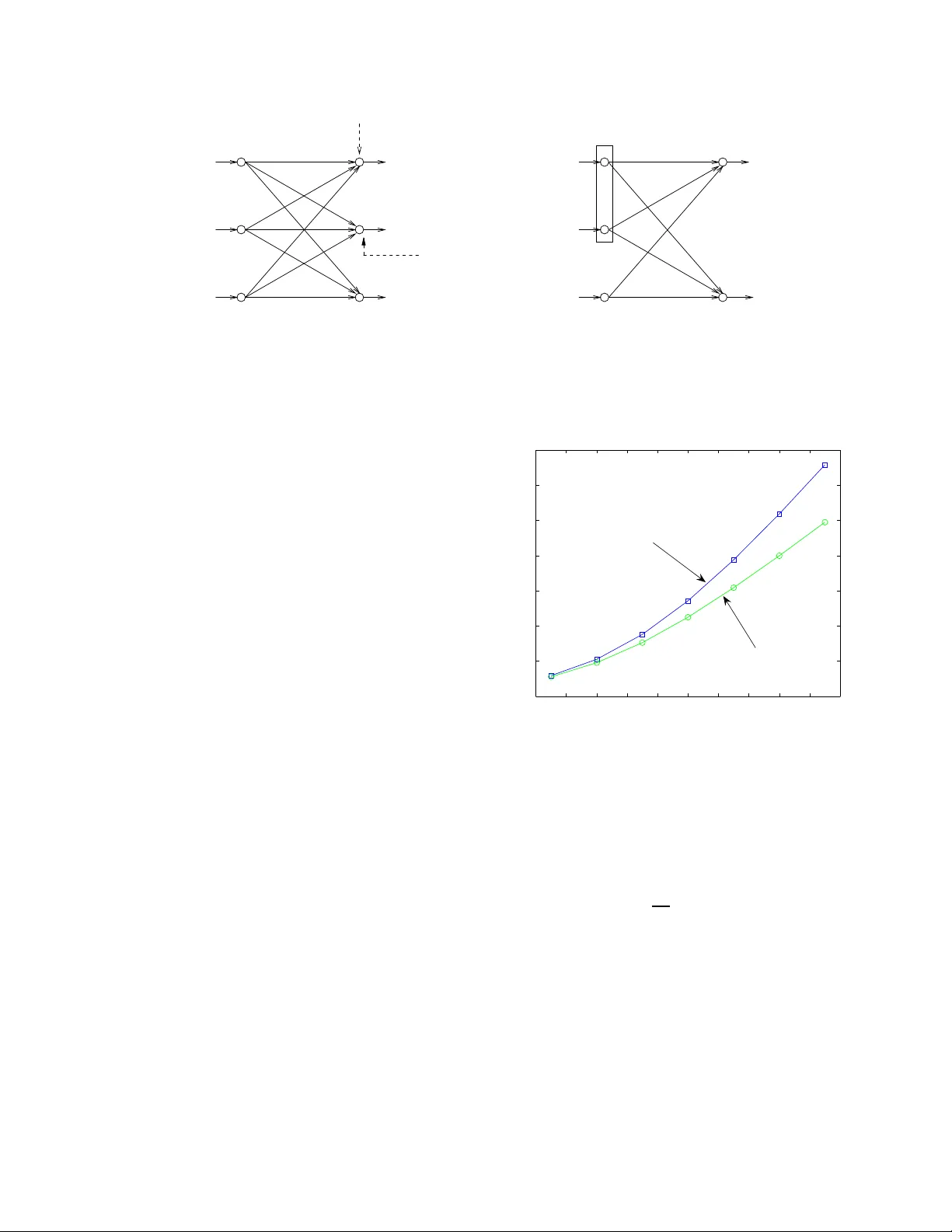
Multiple Access Outerbounds and the Inseparability of P aralle l Interfer ence Chann els V i veck R. Cadambe , Syed A. Ja far Electrical Engineering and Com puter Science University of California I rvine, Irvine, Califo rnia, 9 2697, USA Email: vca dambe@uci.ed u, syed@uci.edu Abstract — It is known that the capacity of parallel (multi-carrier) Gaussian point-to-point, multiple access and broadcast chann els can be achiev ed by separate encoding fo r each subchannel (carrier) subject to a power allocation acros s carriers. In this paper we show that such a separa- tion does not apply to parallel Gaussian in terference chan- nels in general. A counter-exa mple is provided i n the form of a 3 user in terference channel where sep arate encoding can only achieve a sum capacity of log ( SNR ) + o (log ( SNR )) per ca rrier while the actual capacity , a chieved o nly by joint- encoding across carriers, is 3 / 2 log( S NR )) + o (log( S NR )) per carrier . A s a b yproduct of our analysis, we propose a class of multiple-access-outerbounds on the capacity of t he 3 user interference channel. I . I N T RO D U C T I O N The study of p arallel Gaussian channels is motivated by the f requen cy-selecti ve or time- varying natu re of the wireless ch annel. W ith multi-ca rrier modulation , (as- suming no inter-carrier interference (ICI)) a freque ncy selecti ve channel can be viewed as a set of parallel channels with channel coefficients that vary from one carrier to another but may be assumed co nstant (flat- fading) over each carrier . Similarly , if inter-symbol- interferen ce ( ISI) is absent, the time- varying chan nel giv es r ise to pa rallel ch annels whose values are fixed during each symbol b u t v ary from one symbol to another . In this pap er , we will u se th e ter minolog y of freq uency- selecti ve channels and m ulti-carrier modula tion to refer to parallel Gaussian chan nels. It is understood th at the model is equally applicable to the time -varying cha nnel as well. It is well kn own that over the pa rallel Gaussian point- to-poin t chann el, coding separately over the individual subchann els (carriers) ach iev es the cap acity subjec t to optimal power allo cation. Thus the capacity of the par - allel Gaussian point-to -point cha nnel is equal to the sum of th e capacities of th e point-to-po int G aussian subchann els with co rrespon ding p owers ch osen th rough the water-filling algor ithm. Similarly , it h as also been shown that separ ate codin g over each carrier is op ti- mal for para llel Gaussian multiple access (MAC) and broadc ast (BC) ch annels [1 ], [2 ]. The separab ility of parallel Gaussian point-to-p oint, MA C and BC is use- ful because it pr ovides a direct co nnection b etween the single-carrier ch annel models stud ied e xtensively in classical information theory and the fre quency-selective (or time varying) chann els that may be mo re relev ant in p ractice. Coding sch emes d esigned for the classical (single car rier) mod els can be applied dire ctly to multi- carrier systems subject to a power allocation across carriers. A key que stion that remain s open is whe ther such a separ ation holds fo r other Gaussian networks, and in p articular, if separate encod ing is optimal f or multi- carrier interf erence network s. Much work on multi-carrier interferen ce networks (e.g. in the con text of DSL [3] –[11] ) has focused on optimal p ower allocation acr oss carr iers u nder the as- sumption of separate coding over each carrier . For th e two user p arallel interf erence channel with strong inter- ference it is shown in [1 1] that indeed the sum capacity is th e sum of the rate s th at can b e ach iev ed by separ ately encodin g over each car rier su bject to an overall p ower optimization . For the case where more th an 2 users are pre sent or when the channe ls are not restricted to the stro ng interf erence case, since the capacity o f even the single- carrier interf erence chan nel is not kn own, usually the rate optimization is carried out und er the practically motiv ate d a ssumption that all interference is to be treated as n oise. Both centralized and d istributed algorithm s, some o f which are based on game-theor etic formu lations, have been prop osed for this “dyn amic spectrum man agement” p roblem an d the optimality and conv ergence pr operties of th ese algorithms have b een established u nder the separate encod ing assumptio n. Joint en coding of mu ltiple-carrier s has bee n used recently in [12] to characterize the sum cap acity per carrier, of the K user multi- carrier Gaussian interferen ce channel. Th e sum capacity (per carrier) is found to be C ( SNR ) = K 2 log( SNR ) + o (log ( SNR )) , where SNR repre sents the signal to noise p ower ratio. In other words, the K user interf erence channel has K/ 2 degrees of freedom 1 per o rthogo nal time and frequ ency dimension. The key to the capacity cha racterization is the idea of inter ference alignment (see [14 ] and the ref- erences ther ein) - a c onstruction of signa ls such tha t they cast overlapping shadows at the receivers where they constitute interferen ce while th ey r emain distingh ishable at th e r eceiv ers whe re they a re desired. The interferen ce alignment co nstructions pro posed in [ 12] are based on joint encodin g over mu ltiple frequen cies. Due to in ter- ference a lignment, the joint encoding sch eme o f [12] outperf orms the dynamic s pectrum managemen t schem es of [4 ]–[8] in terms o f degrees of fre edom 2 . Howe ver , it has not been shown that this join t encoding is nec- essary to achieve capacity . Interesting ly , another recent work in [ 15] h as provided examples where interference alignment is achieved ov er a sing le-carrier interference channel, i.e., with sepa rate e ncoding . T hus, it remains unclear whether the capacity of multi-carr ier interference channels can be achieved by separate encod ing o ver each carrier an d a p ower allocation acro ss carriers. It is th is open pr oblem that we ad dress in this paper . The main result o f this paper is that unlike the point-to- point, multiple-access and broad cast channels, in g eneral sep arate c oding does not suffice to achieve the capacity of the interfer ence chan nel. W e establish this result by co nstructing a cou nterexample - a 3 -user frequen cy-selectiv e interferen ce c hannel where separate coding can only achieve a sum rate of log( SNR ) + o (log( SNR )) per carrier while the capacity is shown to be 3 / 2 log( SNR ) + o (log( SNR )) pe r c arrier . Thus, par - allel in terference ch annels are, in gen eral, inseparab le. As a bypro duct of our analysis we also pr opose a class of o uterbo unds on the capacity of the 3 user inter- ference cha nnel. These outerbo unds share the p roperty that one receiver (po ssibly aide d by a ge nie an d/or noise reduction ) is ab le to decode all message s - so that the m ultiple-access chan nel capacity to the genie-aided receiver becom es an o uterbou nd on the sum cap acity of the 3 user inter ference channel. The MA C outerbo unds can be viewed as a generalization of C arliel’ s outer bound [16] on the 2 user interferen ce chann el to th e case of more than 2 users. These ou terboun ds play an im portant role in identif ying singu larity c ondition s for in terference channels that do not achie ve the K/ 2 degrees o f free - dom. However , the boun ds ar e gen erally loose in the degrees of freedo m sen se and tighter b ounds at h igh SNR may be obtain ed b y an a pplication of Carlieal’ s outerbo und o n each o f th e 2 user channels contained within the K user interfere nce channel. 1 Also known as multiple xing-gain (See [13]) or capac ity pre-log. 2 Interest ingly , in both cases interfe rence is treated as noise, so no multiuser detection is in volv ed. ˆ W 1 ˆ W 2 ˆ W 3 X 1 X 2 X 3 Y 1 Y 2 Y 3 W 1 W 2 W 3 Fig. 1. The 3 user interferenc e chan nel W e start with the classical (sing le-carrier) Ga ussian 3 user inter ference cha nnel. I I . T H E G AU S S I A N 3 U S E R I N T E R F E R E N C E C H A N N E L W e study the 3 user (single- carrier) Gau ssian interfe r- ence channel whose in put-ou tput relations are described as fo llows Y i ( n ) = 3 X j =1 h i,j X j ( n ) + Z i ( n ) , i = 1 , 2 , 3 where at the n th symb ol, Y i ( n ) and Z i ( n ) respectively represent th e rece i ved signal and the no ise at the i th receiver , an d X j ( n ) re presents the signal tra nsmitted by the j th tran smitter . h i,j represents the chan nel g ain between transmitter j and r eceiv er i . All chan nel gains are assumed to be non-zer o and known to all the nodes in the network. T r ansmitter i has message W i for r eceiv er i for i = 1 , 2 , 3 . The noise Z i ( n ) is a zer o-mean add iti ve white Gaussian n oise (A WGN), assumed independ ent identically d istributed (i.i.d.) acro ss users and symb ols. W ith the noise power at each r eceiv er n ormalized to unity , the to tal tran smit p ower can be expressed as E " 1 N 3 X i =1 N X n =1 | X i ( n ) | 2 # ≤ SNR, whe re N is th e length of th e co dew ord. The rate of the i th user is defin ed as R i ( SNR ) = log( | W i | ) N where | W i | is the car dinality of the message set corresp onding to m essage W i . A rate vector R ( SNR ) = ( R 1 ( SNR ) , R 2 ( SNR ) , R 3 ( SNR )) is said to be achievable if messages W i , i = 1 , 2 , 3 , can be encode d at rates R i ( SNR ) , i = 1 , 2 , 3 so that the probab ility of d ecoding error can b e made arb itrarily small b y cho osing an appro priately large N . T he cap ac- ity region C ( SNR ) re presents the set of all ach iev ab le rate vectors in the network. The sum cap acity C Σ ( SNR ) of the network is defined as C Σ ( SNR ) = max R ( SNR ) ∈ C ( SNR ) 3 X i =1 R i ( SNR ) The numbe r of degrees of freedo m of the n etwork is defined as d Σ = lim SNR →∞ C Σ ( SNR ) log( SNR ) Equiv alently , d Σ is the total num ber of degree s of freedom of the ne twork if an d on ly if we can write C Σ ( SNR ) = d Σ log( SNR ) + o (log ( SNR )) . Theorem 1 : Consider the 3 user interfer ence chan nel where h i,j h i,i = h k,j h k,i for some i, j, k ∈ { 1 , 2 , 3 } , j 6 = k , k 6 = i, i 6 = j . Th en, this interf erence c hannel has 1 d egree o f freed om, or equiv alently , the sum capacity of the interferen ce cha nnel may b e expressed as C Σ ( SNR ) = lo g( SNR ) + o (log ( SNR )) Pr oof: Achiev ability is tr ivial since setting W 2 = W 3 = φ , we get a po int-to-p oint Gaussian channel whose ca pacity is kn own to be of the form lo g( SNR ) + o (log( SNR )) . W e show the converse for the sp ecial case whe re k = 1 , i = 2 , j = 3 . i.e., we consider th e case where h 2 , 3 h 2 , 2 = h 1 , 3 h 1 , 2 = γ , γ 6 = 0 . By symmetry , th e con verse extend s to all other cases. Consider any achievable c oding scheme. Let a g enie giv e X 1 to recei ver 2 (Figure 2(a) ). Now , receiver 2 can cancel the interfer ence fro m tra nsmitter 1 to obtain ˜ Y 2 which m ay be written as ˜ Y 2 = h 2 , 2 X 2 + h 2 , 3 X 3 + Z 2 ˜ Y 2 = h 2 , 2 ( X 2 + γ X 3 ) + Z 2 (1) The dep endence on the symb ol index n is droppe d above for convenience. Note that any achievable scheme over the original chann el is also achiev able over this genie - aided chann el and therefo re, the genie does no t af fect the conv erse argu ment (See for example [14]) . Now , since we started with an a chiev a ble co ding scheme , receiver 1 can decode X 1 reliably and theref ore, c ancel the effect of X 1 from Y 1 to obtain ˜ Y 1 = h 1 , 2 X 2 + h 1 , 3 X 3 + Z 1 ˜ Y 1 = h 1 , 2 ( X 2 + γ X 3 ) + Z 1 (2) Note that receiver 2 is able to deco de W 2 from ˜ Y 2 . Equation s ( 2) and (1) imply that b y reducing the v ar iance of Z 1 sufficiently , we can ensure that ˜ Y 2 is a noisy version of ˜ Y 1 . Th erefore, in a channel with sufficiently reduced n oise, we can ensur e that recei ver 1 can decode W 2 as well. Note that reducing noise can on ly incre ase the capacity of a ch annel a nd ther efore the converse argument is not affected. Thus, b y red ucing noise and with the aid of a genie (Figu re 2(a) ), we have ensured that any message wh ich can be decode d at receiver 2 can be decoded at receiv er 1 a s well. No w , in this channel, we can let transmitters 1 an d 2 co-op erate to f orm a MIMO two user interfere nce chan nel as in Figure 2( b). Again , note th at allowing tr ansmitters to co- operate cann ot r educe capacity . Thus, the MI MO inter- ference ch annel of Figur e 2( b) h as a capac ity region that contains th e capacity region of the 3 user inte rference channel of Figu re 1. Reference [17] has shown that the MIMO interference ch annel of Fig ure 2 (b) h as 1 d egree of freed om mea ning th at its cap acity is of the form log( SNR ) + o (log ( SNR )) . Therefor e, we have sho w n that C Σ ( SNR ) = lo g( SNR ) + o (log ( SNR )) and th e converse argu ment is comp lete. I I I . T H E PA R A L L E L G AU S S I A N 3 U S E R I N T E R F E R E N C E C H A N N E L The p arallel Gaussian inter ference chann el consisting of M par allel subcha nnels may be expressed as Y i ( n ) = 3 X j =1 H i,j X j ( n ) + Z i ( n ) , i = 1 , 2 , 3 where, correspo nding to the n th symbol Y i ( n ) , Z i ( n ) , X j ( n ) are M × 1 vectors whose M entries rep resent the signal received at receiver i over the M sub-chann els, the i.i.d . A WGN experien ced by receiver i over the M carriers, and the sig nal tran smitted by th e j th transmitter over the M carr iers, respectively . H i,j is a M × M diag onal matrix whose m th diago nal entry represents the channel gain between transmitter j and r eceiv er i correspon ding to the m th sub channel. All channel gains are assum ed to be n on-zer o and kn own apriori to all n odes. Messages, ach iev ab le rates, power constraints, cap acity and degrees o f freedom are defined in the u sual man ner as d escribed in th e pr evious section. Let C [ m ] Σ ( SNR ) deno te the sum capacity of th e inter- ference ch annel over th e m th carrier and SNR m denote the total tran smit power c onstraint over the m th carrier . The main question addressed in this cor responde nce is the following - Can the capacity (per carrier) of th e parallel interferenc e channel be expr essed as the sum of the c apacities achieved by the constituent interfe rence channels over each carrier, i.e., C Σ ( SNR ) = 1 M M X m =1 C [ m ] Σ ( SNR m ) (3) for some power allocation vector ( SNR 1 , SNR 2 , . . . SNR M ) such that M X m =1 SNR m ≤ SNR . (4) ˆ W 1 , ˆ W 2 ˆ W 3 W 1 W 2 W 3 Reduce Noise X 1 Genie ˆ W 3 ˆ W 2 ˆ W 1 W 1 W 2 W 3 (a) (b) Fig. 2. The con verse argument of Theorem 1 The existence of a power vector satisfying the a bove equations would imply that a capacity -optimal scheme is to code separately over each car rier with p ower SNR m allocated to the m th car rier . W e will use the result of Th eorem 1 to construct a p arallel interfe rence channel where indep endent co ding over its subchann els is subop timal. Specifically , we constru ct a multi-car rier interferen ce channel wh ere, 1) I nterferen ce alignm ent achieves 3 /2 degrees of freedom so that the cap acity of the chann el is 3 / 2 log( SNR )) + o (log ( SNR )) per car rier . 2) E ach subchannel has o nly 1 d egree of f reedom meaning that separate encodin g over each carrie r is suboptim al since it can only achieve a capacity of log ( SNR ) + o (log ( SNR )) p er carr ier . This is easily don e as fo llows. Consid er the case where we h av e 2 carriers, so M = 2 . L et H i,j = 1 0 0 1 , ∀ i 6 = j, i , j ∈ { 1 , 2 , 3 } (5) H 2 , 2 = H 1 , 1 = 1 0 0 − 1 (6) H 3 , 3 = − 1 0 0 1 (7) It can be easily verified that each subch annel in this above channel satisfies the conditio ns of Theorem 1 so that each subch annel has 1 degree of freed om. Fur- thermor e, it can also b e verified that by b eamfor ming messages along vector [1 1] T at eac h user ensures th at at all r eceiv ers, interf erence aligns along [1 1] T . The desired m essages can be deco ded along the zero-f orcing vector [1 − 1] T at each receiv er and thus 3 / 2 d egrees of freedom are ach iev ab le over this network. W e now state this r esult f ormally in a theor em. −6 −4 −2 0 2 4 6 8 10 12 14 0 0.5 1 1.5 2 2.5 3 3.5 Power in dB Rate in bits/symbol (per carrier) Joint encoding (achievable rate) Separate encoding (rate outerbound) Fig. 3. A comparison of the performance of joint coding ver sus separat e coding on the parallel 3 user interfere nce cha nnel Theorem 2 : Parallel G aussian interferen ce ch annels are in gene ral, not sep arable. Eq uiv alen tly , in gen eral there d o no t exist co ding schemes such that C Σ ( SNR ) = 1 M M X m =1 C [ m ] Σ ( SNR m ) M X m =1 SNR m ≤ SNR The above th eorem clear ly imp lies th e sub-optim ality of sep arate co ding over each carr ier of the 3 user interferen ce channel in general. Figure 3 illustrates the suboptimality of separate cod- ing over each car rier in compar ison with the interfe rence alignment based joint coding scheme for th e chann el described in equations (5)- (7). T he outerboun d f or the rate ach iev ab le by separate en coding (p lotted in Figu re 3) is der i ved later in Section IV (See example 1 in the referred sectio n). Note that in Figure 3 the separa te encodin g ou terboun d is no t limited to schemes th at treat interferen ce as noise. The o uterbou nd is for th e sum of the Shan non capacities o f the inter ference chann els over each carrier, and thu s allo ws arbitrary encoding/deco ding schemes, possibly in cluding multi-user detection, with the only restric tion th at in depend ent d ata is sent thr ough separate codebo oks over sep arate carriers. Thus, separate encodin g schemes that treat interfe rence as n oise may perfor m much worse tha n the separate encoding outer- bound . The joint encoding ac hiev ab le rate in Figure 3 on the other hand, is based o n treating in terference as noise and is on ly an innerbo und on the rates achiev- able with joint en coding . Thus, even the simple joint encodin g schem e which uses Gaussian cod ebook s (not known to be optim al) and treats interfer ence as no ise is able to achiev e high er rates than could be achiev ed with the best separate enco ding schemes. Fu rther, while our coun terexample is b ased on a degrees o f freed om argument which is meaning ful o nly at high SNR, the plot in Figure 3 shows that th e cap acity with joint encoding can be substan tially high er than with separate e ncoding ev en a t mo derate to low SNRs. Lastly , n ote that n o such example ca n be constructed for the para llel Ga ussian point to point, multiple access and broad cast ch annels because in all th ose cases separate coding over each carrier is capacity-o ptimal for an y chan nel realization. An interesting inter pretation of the coun terexample presented above is the following. Consider a game that is played between two players. The players will pick th e channel coefficient values for a (sing le-carrier) 3 user interferen ce chann el. Player 1 intends to maximize th e number of degrees o f freedom of the channel. Player 2 wants to minimize the n umber o f d egrees of freedom o f the chann el. In this game, player 1 moves first and player 2 moves secon d. During his turn , p layer 1 is allowed to select th e values of all the channel coefficients. Player 2 can only ch ange the value of 1 c hannel coefficient after the values h av e bee n cho sen b y p layer 1 . Which chan nel coefficient player 2 is allowed to ch ange is also decided by player 1 . T here is a constraint that all ch annel co - efficients (diagonal terms of the channel matrix ) must be non-zero . First, consider the con stant interf erence channel. Note that [15] has already sho wn that there exist 3 user chann els with clo se to 3 / 2 degrees o f freedom . Therefo re, in absence o f player 2 , play er 1 can design a channel that will achieve close to 3 / 2 d egrees of freedom . Howe ver, if play er 2 can control a ny one of the channel co-e fficients, he can use the r esult of The orem Y 2 Y 3 X 1 X 2 X 3 Y 1 W 1 W 2 W 3 ˆ W 1 , ˆ W 2 , ˆ W 3 ˆ W 2 ˆ W 3 Genie S 1 = a 1 X 1 + a 2 X 2 + a 3 X 3 + ˜ Z 1 Reduce noise Fig. 4. Multiple access outerbound for the classical 3 user interferenc e channe l 1 to win the gam e by redu cing the n umber o f degrees o f freedom to unity . For example, if player 2 has co ntrol of h 1 , 2 , he can choose the channe l co-efficient to be eq ual to h 1 , 3 h 2 , 2 h 2 , 3 to ensure that the ch annel has only 1 degree of fr eedom. Th us, in a co nstant single-c arrier chann el, player 2 wins th e game. Now , suppose the ch annel coefficients vary with time, i.e., we hav e a parallel Gaussian channel. At each tim e instant the player s take turns to d esign the chan nel coefficients acco rding to th e rules described above. Co r- respond ing to e ach sub- channel, player 2 has con trol of o ne of the channel co-efficients. In this case, play er 2 can kill the degrees of freedom of the individual subchann els by using Theo rem 1. Howe ver, play er 1 still win s the game since 3 / 2 degrees of freedom ar e achiev able thro ugh the interfer ence align ment scheme of [12] which codes across all parallel channels. Thus, in the time-varying case, player 1 wins the game. Note th at, it is im portant that user 2 h as c ontrol o f dif- fer en t chann el co-efficients over differ ent sub-c hannels. If user 2 con trols the same chann el co -efficient o f all the subchannels, it can, in fact, use Theorem 1 to kill the degrees of freed om of the channel. For example, consider the case where if user 2 has c ontrol of all the entries of H 1 , 2 over all subchann els, th en it c an choose H 1 , 2 = H 1 , 3 H 2 , 2 ( H 2 , 3 ) − 1 . I V . M U LT I P L E AC C E S S O U T E R B O U N D S F O R T H E C A PAC I T Y O F 3 U S E R I N T E R F E R E N C E C H A N N E L In this section, we provide an interestin g application of the result of Theo rem 1 in the form o f a class of ou terboun ds for the classical (sing le-carrier) 3 u ser interferen ce chan nel. The o uterbou nd argumen t goes as follows. Co nsider any achiev able coding scheme. Using this co ding scheme, rece i ver 1 can d ecode W 1 . O ur aim is to enhan ce re ceiv er 1 w ith enough inform ation so that it can de code W 2 and W 3 as well ( see Figure 4). Then the capacity region of the multip le access ch annel(MAC) formed by th e three tra nsmitters and th e (enhanced) receiver 1 fo rms an outerbou nd for the capacity region of the in terference channe l. The imp rovements to receiv er 1 are described in the fo llowing steps 1) T o help r eceiver 1 decode W 2 : Let a genie provide receiver 1 w ith a S 1 = a 1 X 1 + a 2 X 2 + a 3 X 3 + ˜ Z 1 where ˜ Z 1 is an A WGN ter m ind ependen t of X i , i = 1 , 2 , 3 . Note that th is side inform ation effecti vely acts as an additional antenna at receiv er 1 . The noise ter m ˜ Z 1 can possibly be correlated with other noise variables Z i , i = 1 , 2 , 3 . No w , r eceiv er 1 can linearly co mbine its received sign al with its side informa tion to fo rm U 1 = αY 1 + β S 1 to fo rm another (noisy) linear com bination of the code words X i , i = 1 , 2 , 3 . α and β ca n be chosen su ch that the c o-efficients of X 1 and X 2 in U 1 satisfy the condition s of Theor em 1. Note that if these chann el co-efficients alr eady satisfy the co ndition of 1, th en side information of S 1 is not needed. Now , the proof of Theorem 1 implies that by sufficiently reducing the no ise at receiver 1 , we can ensure th at receiver 1 d ecodes W 2 as well. Thus, with th e aid o f a genie and possibly red ucing the no ise, we have e nsured that receiver 1 can dec ode W 2 . No te that ne ither the g enie inf ormation , nor the red uction of noise reduce the capacity of this channel and ther efore do n ot affect the outerbou nd a rgument. 2) T o help r eceiver 1 deco de W 3 : Receiver 1 , en- hanced as describ ed in the pr evious step, can now decode W 1 and W 2 . W e ca n now choose ¯ α, ¯ β , ¯ γ such tha t V 1 = ¯ αX 1 + ¯ β X 2 + ¯ γ Y ′ 1 = h 3 , 1 X 1 + h 3 , 2 X 2 + h 3 , 3 X 3 + ¯ γ Z ′ 1 . Note th at receiver 1 can for m V 1 . W e u se Y ′ 1 and Z ′ 1 above rath er than Y 1 and Z 1 since the pr evious step inv o lves reducin g the n oise at re ceiv er 1 . Statistically , V 1 differs from Y 3 only in the variance of the noise term. Therefo re, by further reducing the noise if req uired, receiver 1 can also d ecode W 3 . As in the previous step, it is impor tant to no te th at the reduction of noise d oes n ot affect the ou terbou nd argument Steps 1 and 2 above imply that the capacity r egion of the 3 user Gaussian interferen ce channe l is outer- bound ed by the cap acity region of the single-input- multiple-ou tput (SIMO) Gau ssian MAC which rec eiv er S 1 on one antenna and a re duced-n oise version of Y 1 on the other . This class o f bou nds can b e optimized over a i , i = 1 , 2 , 3 and the statistics of ˜ Z 1 . Fu rther, similar outerboun ds can be found by enhanc ing r eceiv er 2 or rec ei ver 3 rathe r than receiver 1 . No te that, sinc e a MAC with two antenn as has 2 d egrees of f reedom, this class of ou terboun ds is loose fro m the p erspective of degrees of freed om. Using the Carliel’ s outerbou nds on eac h of the two user chann els contain ed within the 3 user in terference channel o btains a degre es of freedo m outerbo und of 3 / 2 (See [1 2], [18]) . W e n ow provide 2 examples of th is class of o uterbou nds. Example 1: Here, we consider the interference channel formed on the first carrier of the parallel Gau ssian interferen ce ch annel de scribed in Equation s (5)-(7) in the previous section. In this channel, h i,j = 1 , i 6 = j, i, j ∈ { 1 , 2 , 3 } . Also h 11 = h 22 = 1 , h 33 = − 1 . With A WGN power at each recei ver nor malized to un ity , the total transmit power at all the transmitters is defin ed as SNR. Con sider any achiev able co ding schem e. No te that this chann el already satisfies the conditions of Th eorem 1. Th erefore, we do n ot need the aid o f a genie. In fact, both receiver 1 and rece i ver 2 receive sign als of the for m X 1 + X 2 + X 3 + Z where Z is an A WGN term o f u nit variance. There fore, any message that can be decod ed at receiv er 2 can also be decoded at recei ver 1 ( and v ice-versa). Receiv er 1 c an h ence d ecode W 2 . Furthermo re, re ceiv er 1 can co mpute X 1 + X 2 − Y 1 = h 3 , 1 X 1 + h 3 , 2 X 2 + h 3 , 3 X 3 − Z 1 . Since ( − Z 1 ) is a A WGN term having the variance as Z 3 , receiver 1 can decode W 3 without requ iring any no ise redu ction. Thu s, the capac ity region of this ch annel is bou nded by th e capacity region of th e multiple access c hannel forme d at receiver 1 . The su m-capacity of this interf erence chann el is ther efore bo unded by C Σ ≤ 1 / 2 log (1 + SNR ) It can b e easily verified that the sum-capacity o f the interferen ce cha nnel co rrespond ing to the second carrier of the para llel channe l described b y Equ ations (5)-(7) can also be bo unded as above. Example 2: Consider the perfectly symmetric 3 u ser interferen ce ch annel where h i,i = 1 ∀ i = 1 , 2 , 3 and h i,j = h > 1 , ∀ i 6 = j, i, j ∈ { 1 , 2 , 3 } . Also, let th e total transmit power be equal to SNR . Since the chan nel d oes not satisfy the con ditions of The orem 1, a g enie provides receiver 1 with informatio n of S 1 = a 1 X 1 + (1 − h ) X 2 + X 3 + ˜ Z 1 where ˜ Z 1 is an i.i.d A WGN term correlated with Z 1 such that E h ( Z 1 + ˜ Z 1 ) 2 ) i = 1 . Note th at since we started with an achiev able cod ing schem e, rec eiv er 1 can decode W 1 using informatio n from Y 1 . Receiver 1 can subtract th e ef fect o f X 1 from S 1 and Y 1 and to obtain ˜ S 1 = (1 − h ) X 2 + ˜ Z 1 and ˜ Y 1 = hX 2 + hX 3 + Z 1 . Now receiver 1 can now dec ode X 2 from U 1 hX 1 + Y 1 + S 1 since it is of th e fo rm hX 1 + X 2 + hX 3 + Z ′ 2 where Z ′ 2 is a A WGN term with unit variance. Now that receiver 1 is aware o f X 1 and X 2 , it can add appropriate terms to Y 1 to fo rm V 1 = h ( hX 1 + hX 2 + X 3 ) + Z 1 . Since h > 1 , Y 3 is a d egraded version of V 1 which implies that receiver 1 can d ecode W 3 as well. Th us, all rates achiev ab le in this interfer ence channel, are achievable in the sing le- input-mu ltiple-outp ut (SIMO) multiple access channel with 3 single anten na nod es respectively transmitting X 1 , X 2 , X 3 and a two-antenna no de receiving Y 1 along the first an tenna and S 1 along the secon d. T hus, the capacity region of this m ultiple access channe l is an outer-bound fo r the capacity of the interfer ence c hannel. Furthermo re, para meters a 1 and ˜ Z 1 are parameters wh ich can b e used for optimizatio n. So, for example, we can bo und the sum-cap acity C Σ ( SNR ) o f the 3 user interferen ce channel by C Σ ( SNR ) ≤ 1 2 min ( a 1 , ˜ Z 1 ) E h ( Z 1 + ˜ Z 1 ) 2 i ≤ 1 ˜ Z 1 ∼ N (0 , σ 2 ) C MAC ( ρ, a 1 , ˜ Z 1 ) where C MAC ( SNR , a 1 , ˜ Z 1 ) = log | K z + SNR 3 HH † | | K z | ! | A | indicates the detereminant of matrix A , K z indicates the covariance matrix co rrespon ding to no ise vector [ Z 1 ˜ Z 1 ] T and H = 1 h h a 1 (1 − h ) 0 V . C O N C L U S I O N W e constructed a 3 user in terference channel with constant (i.e., n ot frequ ency-selective or time-varying) channel coefficients such that it h as 1 degree of f reedom. Furthermo re, we p rovided a mult-ca rrier extension o f this ch annel su ch that separate co ding over each carrier can o nly achieve sum rate log( SNR ) + o (log ( SNR )) per carrier, while the actual capa city is 3 / 2 lo g( SNR ) + o (log( SNR )) which can be achiev ed only throug h c od- ing across car riers. The result imp lies that, in general, indepen dent coding over the various c hannel states of the parallel G aussian interfer ence channel is not capacity optimal. Thus, u nlike pa rallel Gau ssian p oint to point, multiple access and bro adcast chan nels, para llel Gaus- sian interferen ce channels are, in gen eral, n ot sep arable. The key is that even though interf erence alignmen t may no t be p ossible over ea ch carrier, it may still be accomplished by coding across carriers. An interesting q uestion th at remains open is the sep- arability of parallel Gau ssian interference channels f or two users. Th e counter example provided in this work applies to the 3 user scenario and by simple extension to K ≥ 3 users. Howe ver, since o ur examples rely on interferen ce alignm ent w hich is only kn own to be relev a nt for in terference c hannels with 3 o r mor e users, we have no t shown th at the 2 user parallel Gaussian interferen ce channel is in separable. It is interesting to note that the 2 user interfe rence channe l is separable under stro ng inter ference [11] . The insepara bility of th e interferen ce chan nel m ay have interesting implications, especially for the existence of single-letter capacity characterizations for interference channels. From a p ractical perspective, it pro mpts a closer look at the perfo rmance o f separate e ncoding versus joint cod ing schem es in p arallel Ga ussian inter- ference ch annels. R E F E R E N C E S [1] D. Tse and S. Hanly , “Multiacc ess fading c hannels. i. pol ymatroid structure , optimal resource allo cation and throughput capa citie s, ” IEEE T ransactions on Information Theory , vol. V ol.44, no. 7, 1998. [2] D. Tse, “Optimal po wer allocation over parallel gaussian broad- cast channels, ” IEEE Interna tional Symposium on Informatio n Theory , 29 Jun-4 Jul 1997. [3] S. T . Chung and J. Cioffi, “The capac ity region of frequenc y- select i ve gaussian interferenc e channe ls under strong inte rfer- ence, ” IEEE T ransactions on Communications , vol. 55, no. 9, pp. 1812–1821, Sept. 2007. [4] G. Scutari, D. Palomar , and S. Barbarossa, “ Asynchronous iter - ati ve water -filling for gaussian frequenc y-select i ve interfe rence channe ls: A unified framew ork, ” IEEE 7th W orkshop on Signal Pr ocessing Advances in W irele ss Communicat ions , pp. 1–5, 2-5 July 2006. [5] K.-K. Leung, C. W . Sung, and K. Shum, “Iterati ve w aterfill ing for paral lel gaussian inte rference channels, ” IEEE Internatio nal Confer ence on Communicatio ns , vol . 12, June 2006. [6] J.-S. Pang, G. Scutari, F . Facchi nei, and C. W ang, “Dis- trib uted power allocat ion with rate constraints in gaus- sian frequency-se lecti ve interfere nce channels, ” arxiv .org , 2007. http:/ /arxi v .org/a bs/cs/0702162. [7] W . Y u and J. Ciof fi, “Competiti ve equili brium in the gaussian interfe rence channe l, ” IEEE Internat ional Sympo sium on Infor- mation Theory , 2000. [8] W . Y u, G. Ginis, and J. Ciof fi, “Distribute d multiuser po wer control for digital subscriber lines, ” IEEE J ournal on Selecte d Area s in Communications , vol. 20, no. 5, pp. 1105–111 5, Jun 2002. [9] R. Cendri llon, W . Y u, M. Moonen, J. V erlinden, and T . Bostoen, “Optimal multiuser spectrum balanci ng for digital subscriber lines, ” IEEE T rans. on Communicati ons , vol. 54, no. 5, pp. 922– 933, May 2006. [10] W . Y u and R. Lui, “Dual methods for noncon vex spectrum optimiza tion of multicarrie r systems, ” IEEE T rans. on Commu- nicati ons , vol. 54, no. 7, pp. 1310–1322, July 2006. [11] S. T . Chung, “Tra nsmission s chemes for frequenc y selecti ve gaussian interferenc e channe ls, ” 2004. Ph.D Thesis. [12] V . R. Cadambe and S. A. Jafar , “Interf erence alignment and degre es of freedom region for the k user inte rference channel , ” arxiv .org , 2007. arxi v eprint = cs/0707.0323. [13] L. Z heng and D. N. Tse, “Pa cking spheres in the grassmann manifold: A geometric approach to the non-coher ent multi- antenna channe l, ” IEEE T rans. Inform. Theory , vol. 48, Fe b 2002. [14] S. A. Jafar and S. Shamai, “Degrees of freedom regi on for the mimo x channel, ” IEEE T ransacti ons on Informati on Theory , vol. 54, pp. 151–170, Jan 2008. [15] V . R. Cadambe , S. A. Jafar , and S. S. (Shitz), “Interf erence alignmen t on the determinist ic channe l and applicat ion to fully connec ted a wgn interferenc e net works, ” Nov ember 2007. arxi v eprint = 0711.2547. [16] A. B. Carli el, “Outer bounds on the capacity of interfere nce channe ls, ” IEEE T rans. Informati on Theory , vol. 50, pp. 581– 586, March 2004. [17] S. A. Jafar and M. Fakhereddin, “Deg rees of freedom of the mimo interf erence channel, ” IEEE T ransacti ons on Informatio n Theory , vol. 7, pp. 2637–2642 , July 2007. [18] A. Host-Madse n A.; Nosratinia , “The multiple xing gain of wire- less netw orks, ” Internatio nal Symposium on Information Theory , 2005 , pp. 2065–2069, 4-9 Sept. 2005.
Original Paper
Loading high-quality paper...
Comments & Academic Discussion
Loading comments...
Leave a Comment