The structure and modeling results of the parallel spatial switching system
Problems of the switching parallel system designing provided spatial switching of packets from random time are discussed. Results of modeling of switching system as systems of mass service are resulted.
Authors: Denis Kutuzov
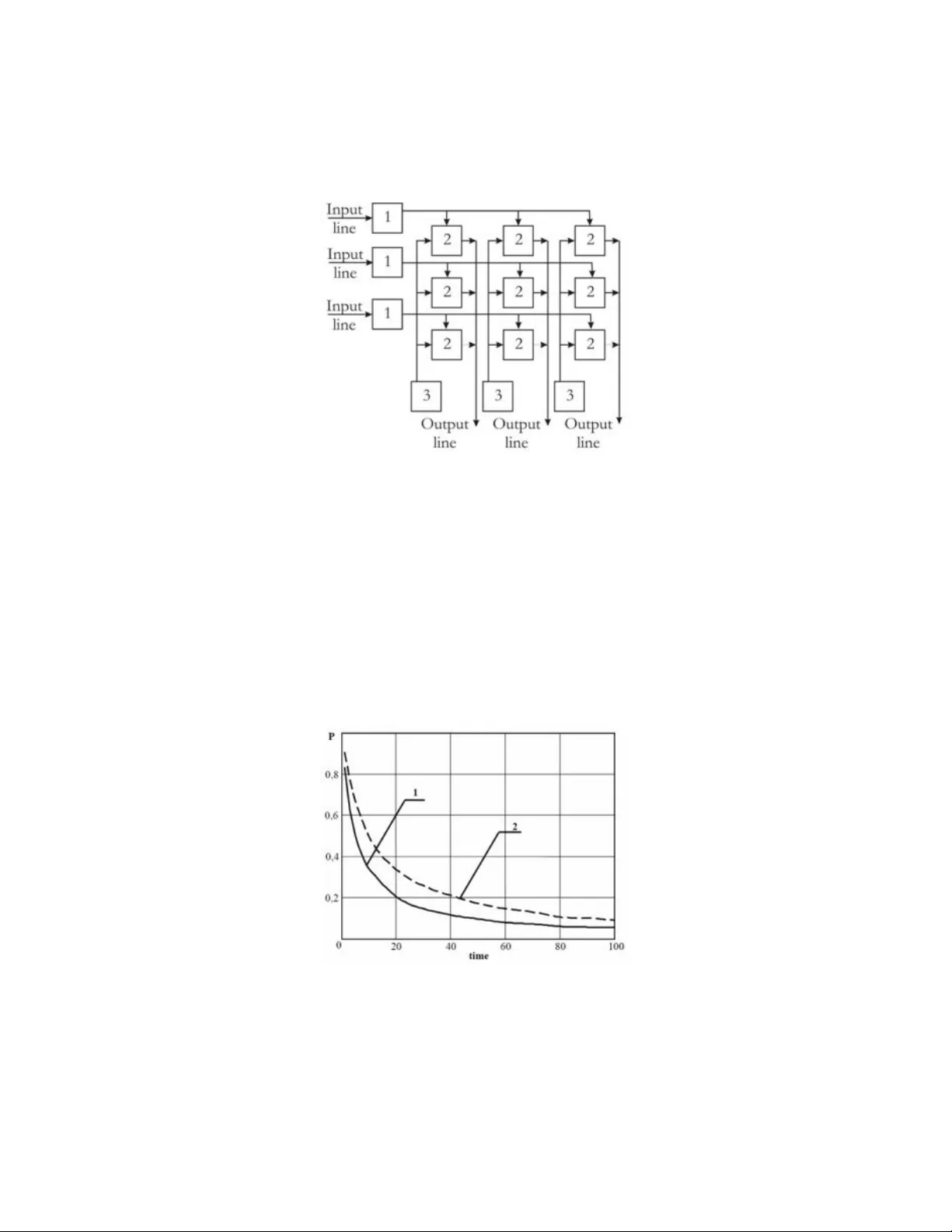
The structure and mo deling results of the parallel spatial switc hing system Denis Kutuzo v ( d_kutuzov@mail.ru ), Alexey Osovsky April 20, 2007 Information Systems Dept., Astrakhan State Univ ersity , 20a, T atischev a Str., Astrakhan, 414056, Russia, ( http://www.aspu.ru/ ) Abstract Problems of the switching parallel system designing provided spatial switc hing of pac k ets from random time are discussed. Results of modeling of switc hing system as systems of mass service are resulted. Index T erms: parallel switching, information systems, system of mass service, pack et switching, communication net work. The increase of rate of switching system elements, as w ell as other devices o ccurs basically due to adv an tages in technological base. A t the same time an- other decision is possible. It is perfection of algorithms and methods of switc hing and creation a new switc hing decisions, not dep enden t on technological base. Suc h decision for switching systems may become a parallel pro cess metho d whic h w ould allo w to increase transfer rate and to decrease losses at pro cessing pac kets. The parallel switc hing system [ 1 ] pro vides a parallel spatial switching of the information pac kets at the random moments of time and consists of the follo wing blo c ks (see Fig. 1 ): blo c k of synchronization of the input pack et with the momen t of iden tification (1), elemen ts of switc hing (2) and blo c ks of tag generation for the target lines (3). Op eration of system is carried out with the following algorithm: a require- men t of connection establishment is transferred on the system input. Eac h requiremen t represen ts the information pac ket ha ving headline (tag) which iden- tifies a target line of the switc hing system whic h it is necessary to send the giv en pac ket. As requirements of the establishment connections (pack ets) arriv ed on the system inputs at the random time, that is asynchronously , and identifica- tion v is p ossible only at the certain moments of time, the requirement (pack et) should b e delay ed up to the momen t when the tag comparison and to start switc hing is p ossible. Suc h delay is carried out by blo c ks of pack et synchroniza- tion with the momen t of iden tification and ma y b e v arious for the pac k ets which ha ve arrived at die different time. Some requirements (pack ets), exp ecting the b eginning of identification represent a pack. 1 Figure 1: The structure of the parallel spatial switching system Iden tification represen ts pro cess of bit-b y-bit tag comparison for connection lines (it con tains in a pack et), and the target line tags whic h generated blo c ks 3 (Fig. 1 ). At coincidence of the target line tag with heading tag in the pack et, the appropriate switc hing elemen t establishes connection for transfer of pack et on the system output. After transfer of the pack et the connection should b e destro yed. All functions of the conflict resolution, for example, at attempt of t wo and more input lines to establish connection with one target line are assigned to switc hing elements 2 (Fig. 1 ). Diagrams of loss probabilities of pack ets (P) from av erage (mo deling) time b et w een pack et receiving are sho wn in Fig. 2 . Figure 2: The mo deling results of the parallel spatial switc hing system It is p ossible to make a conclusion on reduction of loss probability in com- 2 parison with the system with consecutive switc hing b y results of mo deling of the parallel switching system [ 2 ]. The diagram 1 in Fig. 2 corresp onds to parallel switc hing system, the diagram 2 is consecutive one. References [1] D.V. Kutuzo v, “P arallel adjustment of matrix switching system at dynami- cal requirements” // Engineering and technology , 2005. No. 2(8), pp. 57–59. [2] A.P . Lunev, I.Y u. Petro v a, D.V. Kutuzov, A.V. Oso vsky , “Simulation of matrix switch b oards”. The patent regisrtation No. 2005611003, the legal o wner Astrakhan State Universit y . 3
Original Paper
Loading high-quality paper...
Comments & Academic Discussion
Loading comments...
Leave a Comment