A Formal Algebra for OLAP
Online Analytical Processing (OLAP) comprises tools and algorithms that allow querying multidimensional databases. It is based on the multidimensional model, where data can be seen as a cube, where each cell contains one or more measures can be aggregated along dimensions. Despite the extensive corpus of work in the field, a standard language for OLAP is still needed, since there is no well-defined, accepted semantics, for many of the usual OLAP operations. In this paper, we address this problem, and present a set of operations for manipulating a data cube. We clearly define the semantics of these operations, and prove that they can be composed, yielding a language powerful enough to express complex OLAP queries. We express these operations as a sequence of atomic transformations over a fixed multidimensional matrix, whose cells contain a sequence of measures. Each atomic transformation produces a new measure. When a sequence of transformations defines an OLAP operation, a flag is produced indicating which cells must be considered as input for the next operation. In this way, an elegant algebra is defined. Our main contribution, with respect to other similar efforts in the field is that, for the first time, a formal proof of the correctness of the operations is given, thus providing a clear semantics for them. We believe the present work will serve as a basis to build more solid practical tools for data analysis.
💡 Research Summary
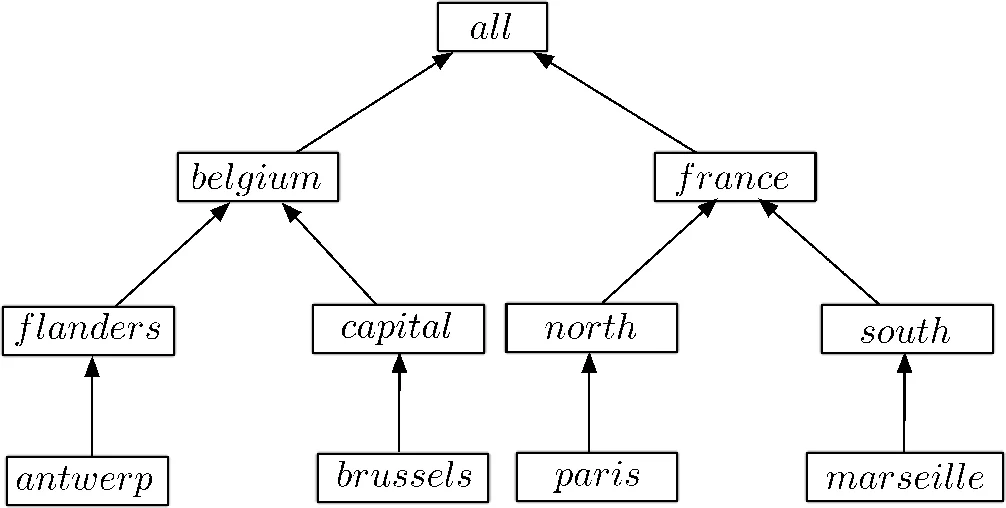
The paper addresses the long‑standing lack of a formally defined, universally accepted language for OLAP (Online Analytical Processing). It proposes a rigorous algebraic framework that models a data cube as a fixed‑dimensional matrix together with a finite set of measures and a Boolean flag indicating active cells. Each dimension is described by a hierarchical schema represented as a lattice with a unique top node (All) and bottom node (Bottom). The authors impose a “sound” condition on dimension graphs, guaranteeing that any two paths from the bottom to a given level produce the same aggregation result, which is essential for deterministic roll‑up behavior.
The core contribution is the notion of atomic OLAP transformations. An atomic transformation operates on a cube instance by (i) creating a new measure (e.g., an aggregated sum, average, min, max) and (ii) optionally updating the flag function. By chaining these atomic steps, the authors reconstruct the classic OLAP operators:
- Slice – a flag‑only transformation that retains cells matching a single value on a chosen dimension.
- Dice – a conjunction of several slice‑like flag updates, selecting cells that satisfy a multidimensional predicate.
- Roll‑up – a measure‑creating transformation that aggregates values from a lower level to a higher level along a hierarchy, simultaneously setting the flag of the higher‑level cells to 1 and clearing the lower‑level flags.
- Drill‑down – the inverse of roll‑up, distributing a higher‑level measure back to its constituent lower‑level cells and restoring the appropriate flags.
Each operator is expressed as a finite sequence of atomic transformations, and the paper provides formal definitions of the domain, codomain, and effect of every transformation. The authors prove several key theorems:
- Closure under composition – the composition of any two operators that are each representable as atomic sequences is itself representable as an atomic sequence. This establishes that complex analytical queries can be built by chaining simple operators without leaving the algebra.
- Inverse relationship – roll‑up and drill‑down are shown to be true inverses with respect to both measures and flags, guaranteeing lossless navigation up and down hierarchies.
- Equivalence of order – for slice and dice, the order of application does not affect the final flag configuration provided the predicates are compatible, which mirrors the commutative nature of set intersection.
A notable technical device is the representation of higher‑level objects by the “first” bottom‑level element according to a total order on the bottom domain. This allows the system to store aggregated information in existing cells without allocating extra storage, leveraging the ordered nature of the bottom level to infer higher‑level identifiers (rep(b)). The paper proves that this ordering induces a consistent order on all hierarchy levels, preserving deterministic behavior.
The authors also discuss how the flag mechanism serves as a (k + 1)‑st Boolean measure, effectively turning the active‑cell set into a dynamic view that can be passed from one operation to the next. This design eliminates the need for separate view definitions and makes the algebra self‑contained.
In terms of contributions, the paper distinguishes itself from prior work (e.g., Cube Algebra, MDX) by providing formal correctness proofs for the operators, rather than relying solely on illustrative examples. The soundness condition for dimension graphs, the explicit handling of flags, and the systematic decomposition into atomic steps together form a mathematically sound foundation for OLAP query processing.
However, the scope is deliberately limited to the four “classic” operators. The framework does not yet cover more advanced analytical functions such as moving averages, ranking, or statistical aggregates, nor does it address non‑numeric measures (e.g., spatial objects, text). Performance considerations, parallel or distributed execution, and integration with existing OLAP engines are mentioned only briefly, leaving empirical validation for future work.
The paper concludes by suggesting extensions: enriching the set of atomic transformations to capture a broader class of analytical functions, applying the algebra to real‑time streaming data scenarios, and exploring efficient implementations in distributed environments. By establishing a solid formal base, the work paves the way for more reliable, optimizable, and interoperable OLAP systems.
Comments & Academic Discussion
Loading comments...
Leave a Comment