Eigenvalue based Spectrum Sensing Algorithms for Cognitive Radio
Spectrum sensing is a fundamental component is a cognitive radio. In this paper, we propose new sensing methods based on the eigenvalues of the covariance matrix of signals received at the secondary users. In particular, two sensing algorithms are su…
Authors: Yonghong Zeng, Ying-Chang Liang
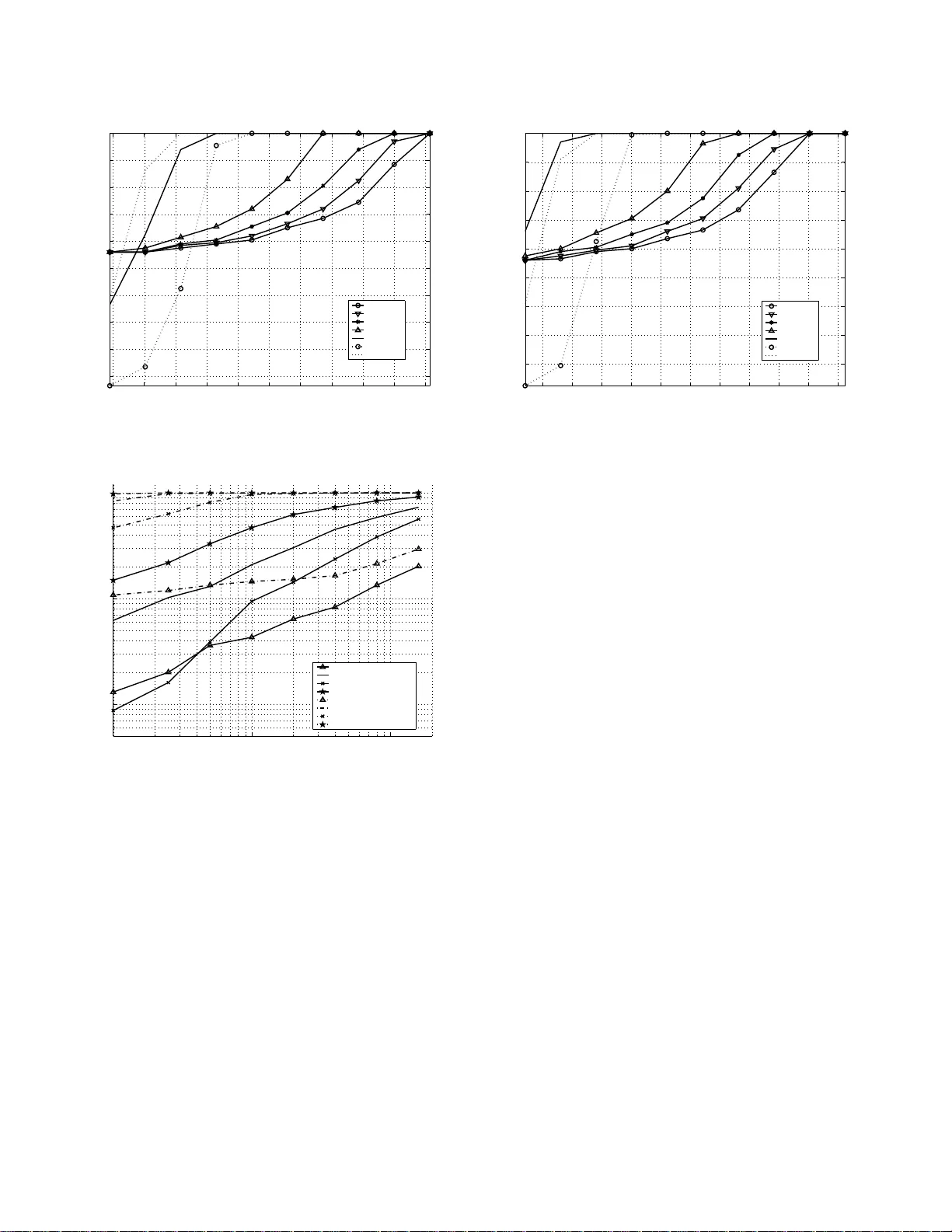
Eigen v alue based Sp ectrum Sensing Algorithms for Cognitiv e Radio ∗ Y onghong Zeng, Sen ior Mem b er, IEEE, and Ying- Ch ang Liang, Senior Mem b er, IEEE Institute for Info comm Res earc h, A*ST A R, Singap ore. No ve mber 26, 2024 Abstract Spectr um sensing is a fundamen tal comp onent is a cogni- tiv e radio. In this pap er, we propose new s e ns ing methods based o n the eigenv alues of the cov ariance matr ix of sig- nals r eceiv ed at the secondar y users. In pa rticular, tw o sensing algor ithms are suggested, o ne is based on the ra- tio of the maximum eigen v alue to minim um eigen v alue; the other is bas e d on the r atio of the av era g e eigenv alue to mini- m um eigenv alue. Using s ome latest random matrix theo r ies (RMT), we quantify the distributions o f these ratios and derive the probabilities o f false alarm and pr obabilities of detection for the prop osed algorithms. W e also find the thresholds of the methods f o r a given probability o f fals e alarm. The prop osed methods o vercome the noise uncer- taint y problem, and ca n even p erform better than the ideal energy detection w hen the signals to be detected are highly correla ted. The methods ca n b e used for v arious signal detection applications without requiring the knowledge of signal, channel a nd noise power. Simulations based on ra n- domly generated signa ls , wireless micropho ne signals and captured A TSC DTV signals are pre s en ted to verify the ef- fectiv e nes s of the propo sed methods. Key w ords: Signal detection, Sp ectrum sensing, Sensing algorithm, Cog nitiv e radio, Random ma trix, Eigenv alues, IEEE 80 2.22 Wireless regiona l a rea net works (WRAN) 1 In tro duction A “Co g nitiv e Radio” senses the sp ectral environmen t over a wide r ange of frequency bands and exploits the tempora lly uno ccupied bands for opp ortunistic wireless tra nsmissions [1, 2, 3]. Since a cognitive radio op erates as a secondary user which do es not have pr ima ry rights to any pre-assig ned frequency bands, it is necessa ry for it to dynamically de- tect the presence of primary users. In December 2 003, the F CC issued a Notice o f Prop osed Rule Making that iden- tifies co gnitiv e radio as the candidate for implementing ne- gotiated/opp ortunistic sp ectrum shar ing [4]. In resp onse to this, in 2004, the IEEE formed the 8 02.22 W orking Group ∗ Pa r t of this w ork has b ee n presented at IEEE PIMRC, At hens, Greece, Sept. 2007 to develop a standar d for wireless re g ional area netw or k s (WRAN) based on cog nitiv e radio technology [5]. WRAN systems will op erate on unu sed VHF/UHF bands that are originally a llo cated for TV broa dcasting services and other services suc h as wireless microphone, whic h are called pri- mary users. In order to av oid interfering with the primary services, a WRAN sys tem is required to p eriodica lly detect if there are ac tive primary us e r s around that regio n. As discussed ab o ve, sp ectrum sensing is a fundamental comp onen t in a cognitive r adio. There are how ever several factors whic h make the sensing pro blem difficult to solve. First, the signal-to-nois e ra tio (SNR) of the primary users received at the secondary rece iv ers may b e very low. F or ex- ample, in WRAN, the target detection SNR level at worst case is − 20dB. Secondly , fading and time disp ersion of the wireless channel ma y complicate the sensing pro blem. In particular, fading will cause the received signal power fluc- tuating dramatically , while unknown time disp ersed channel will cause coherent detection unreliable [6, 7, 8]. Thirdly , the noise/interference level changes with time whic h results in noise uncertain ty [9, 6, 10]. There are tw o t yp es of no ise uncertaint y: r eceiv er device no ise uncer tain ty and environ- men t noise uncertaint y . The sour c es of rece iv er device noise uncertaint y include [6, 10]: (a) non-linear ity of co mponent s; and (b) thermal no is e in co mponents, which is non-uniform and time-v arying. The environment noise uncerta int y may be c a used by tra ns missions of other users, including nea r-b y unin tentional transmissio ns a nd far-aw ay inten tional tr ans- missions. Becaus e of the noise uncer tain ty , in practice, it is very difficult to o btain the accurate noise p ow er. There ha ve b een several sensing a lgorithms including the energy detection [11, 9 , 12, 6 , 1 0], the matched filtering [12, 6, 8, 7] and cyc lo stationary detection [13, 14, 15, 16], each having different op erational requirements, adv antages and disadv antages. F or example, cyc lo stationary detection requires the knowledge of cy c lic frequencies of the primary users, and matc hed filtering needs to kno w the wav eforms and channels of the pr imary users. On the other hand, en- ergy detection do es not need an y information of the s ignal to b e detected and is robust to unknown disp ersiv e chan- nel. How ever, energy detection relies on the knowledge of accurate noise pow er, and inacc ur ate estimation of the noise p o wer leads to SNR wall and high probability of false 1 alarm [9, 10, 1 7]. Th us energy detection is vulnerable to the noise uncertaint y [9, 6, 10, 7]. Finally , while energy de- tection is o ptimal for detecting independent and iden tically distributed (iid) signal [1 2], it is no t optimal for detecting correla ted sig nal, which is the ca se for most pr actical appli- cations. T o ov erco me the s hortcomings of energy detection, in this pap er, we prop ose new metho ds based o n the eigenv alues o f the cov ar iance matrix of the received signal. It is shown that the ratio of the maximu m o r a verage eig en v alue to the minim um eigenv alue can be used to detect the the presence of the signal. Based on some latest random matrix theories (RMT) [18, 19 , 20, 21], we quan tify the distributions of these ratios and find the detection thre s holds for the prop osed de- tection algor ithms. The probability of false alar m and prob- abilit y of detection ar e also derived by using the RMT. The prop osed metho ds overcome the noise uncer tain ty problem and can even p erform b etter than energy detection when the signals to b e detected are highly corre la ted. The methods can be used for v ario us signal detection applications with- out knowledge of the signa l, the c ha nnel and noise p ow er. F urthermore, different fro m ma tc hed filtering, the prop osed methods do not require accurate synchronization. Simula- tions based on r andomly generated signals, wireless micro - phone signa ls and captured dig ita l televis io n (DTV) signals are carried out to verify the effectiveness of the prop osed methods . The rest of the paper is organized as follows. In Section II, the system mo del and some background informa tio n are provided. The sensing algorithms a re presented in Section II I. Section IV gives theoretical analysis and finds thresho lds for the algo rithms bas e d on the RMT. Simulation results based on randomly generated signals, wireless microphone signals and captured DTV signals are given in Section V. Also some open questions a re present e d in this section. Con- clusions are drawn in Section VI. A pre-whitening technique is given in App endix A for pro cessing na r ro wband noise. Fi- nally , a proo f is given in Appendix B for the equiv alence of av erag e eigenv alue and signal p ow er. Some notations us e d in the pap er are listed as follows: supe r scripts T and † stand for tra nspose a nd Hermitian (transp ose-conjugate), r espectively . I q is the identit y ma- trix of order q . 2 System Mo del and Bac kground Let x c ( t ) = s c ( t ) + η c ( t ) b e the contin uous-time r eceiv ed signal, where s c ( t ) is the pos sible primary user’s signa l and η c ( t ) is the noise. η c ( t ) is assumed to b e a s tation- ary pro cess satisfying E( η c ( t )) = 0, E( η 2 c ( t )) = σ 2 η and E( η c ( t ) η c ( t + τ )) = 0 for a n y τ 6 = 0. Assume that we a re in terested in the frequency band with cen tra l frequency f c and bandwidth W . W e s ample the received signa l at a sam- pling rate f s , where f s ≥ W . Let T s = 1 /f s be the s ampling per iod. F or no ta tion simplicit y , we define x ( n ) , x c ( nT s ), ¯ s ( n ) , s c ( nT s ) and η ( n ) , η c ( nT s ). There are t wo hy- po thesizes: H 0 , signal do es not exist; and H 1 , signal exists. The r eceiv ed signal sa mples under the tw o h y pothesizes are given resp e ctiv ely a s fo llows [6, 8, 7]: H 0 : x ( n ) = η ( n ) , (1) H 1 : x ( n ) = ¯ s ( n ) + η ( n ) , (2) where ¯ s ( n ) is the rec eiv ed signal samples including the ef- fects of path loss, m ultipath fading and time disp ersion, and η ( n ) is the received white noise assumed to b e iid, and with mean zero and v ar iance σ 2 η . Note that ¯ s ( n ) can b e the supe r position of signals from m ultiple primary users. It is assumed that noise a nd signal are uncorrelated. The spec- trum sensing or signa l detection problem is to determine if the signal exis ts or no t, bas ed on the r eceiv ed sa mples x ( n ). Note: In ab ov e, we hav e as sumed that the noise s amples are white. In practice, if the received samples ar e the filtered outputs, the co rrespo nding noise samples may be correlated. How ever, the corr elation among the noise sa mples is only related to the receiving filter. Th us the noise correla tion matrix can be found base d on the receiving filter, and pr e - whitening tec hniques ca n then be used to whiten the noise samples. The details of a pre-whitening method are given in App endix A. Now w e consider tw o spe c ia l cases o f the signal model. (i) Digital modulated and ov er -sampled signa l. Let s ( n ) be the mo dulated digital source signa l and denote the sym- bo l dur ation as T 0 . The discre te sig nal is filtered and tra ns- mitted through the communication channel [22, 23, 2 4]. The resultant s ignal (excluding receive noise) is g iv en as [22, 2 3, 24] s c ( t ) = ∞ X k = −∞ s ( k ) h ( t − k T 0 ) , (3) where h ( t ) encompas ses the effects o f the transmission fil- ter, c hannel resp onse, and receiver filter. Assume that h ( t ) has finite supp ort within [0 , T u ]. Assume that the received signal is over-sampled b y a factor M , that is, the sampling per iod is T s = T 0 / M . Define x i ( n ) = x (( nM + i − 1 ) T s ) , h i ( n ) = h (( nM + i − 1) T s ) , η i ( n ) = η c (( nM + i − 1) T s ) , (4) n = 0 , 1 , · · · ; i = 1 , 2 , · · · , M . W e hav e x i ( n ) = N X k =0 h i ( k ) s ( n − k ) + η i ( n ) , (5) where N = ⌈ T u /T 0 ⌉ . This is a t ypical single input multi- ple o utput (SIMO) system in communications. If there a r e 2 m ultiple sour ce s ignals, the r eceiv ed signa l turns out to b e x i ( n ) = P X j =1 N ij X k =0 h ij ( k ) s j ( n − k ) + η i ( n ) , (6) where P is the n umber of source signals, h ij ( k ) is the chan- nel res ponse fro m source sig nal j , and N ij is the order o f channel h ij ( k ). This is a typical multiple input mult iple output (MIMO) system in commun ications. (ii) Multiple-receiver model. The mo del (6) is als o a p- plicable to multiple-receiver case where x i ( n ) becomes the received signa l at receiver i . The difference b et ween the ov er-s a mpled mo del and mu ltiple-receiver model lies in the channel prop ert y . F or ov er- s ampled mo del, the ch annels h ij ( k )’s (for different i ) are induced by the same channel h j ( t ). Hence, they a re usually correlated. Howev er, for m ultiple receiver mo del, the c ha nnel h ij ( k ) (for different i ) can be indep enden t o r cor related, depending on the a ntenna separation. Conceptually , the ov er-s ampled and multiple- receiver mo dels can b e treated as the same. Mo del (2) ca n be trea ted as a specia l ca se o f model (6) with M = P = 1 and N ij = 0, and s ( n ) r eplaced by ¯ s ( n ). F or simplicity , in the following, we only consider mo del (6). Note that the metho ds are directly applicable to mo del (2) with M = P = 1 (later the sim ul at ion for wireless microphone is based on this mo del) . Energy detection is a basic sensing method [11, 9, 12, 6]. Let T ( N s ) b e the av era ge p o wer of the received signals, that is, T ( N s ) = 1 M N s M X i =1 N s − 1 X n =0 | x i ( n ) | 2 , (7) where N s is the num be r of samples. The ener gy detection simply co mpares T ( N s ) with the noise pow er to decide the signal ex is tence. Accurate kno wledge on the noise p o wer is therefore the k e y to the success of the metho d. Un fortu- nately , in pra c tice, the noise uncertaint y always presents. Due to the noise uncertaint y [9, 6, 1 0], the estimated noise power may b e different from the actual noise p ow er. Let the es timated no is e power be ˆ σ 2 η = ασ 2 η . W e define the noise uncerta int y fa c to r (in dB) as B = max { 10 log 10 α } . (8) It is ass umed that α (in dB) is evenly distributed in an in terv a l [ − B , B ] [6, 17]. In pra ctice, the no is e uncerta in ty factor of r eceiving dev ice is no rmally 1 to 2 dB [6]. The environmen t noise uncertaint y ca n be m uch higher due to the existence of interference [6]. When there is noise un- certaint y , the ener gy detection is not an effectiv e metho d [9, 6, 10, 17] due to the existence of SNR wall and/ or high probability o f false ala rm. 3 Eigen v alue based Detections Let N j def = ma x i ( N ij ). Zero -padding h ij ( k ) if necessary , a nd defining x ( n ) def = [ x 1 ( n ) , x 2 ( n ) , · · · , x M ( n )] T , (9) h j ( n ) def = [ h 1 j ( n ) , h 2 j ( n ) , · · · , h M j ( n )] T , (10) η ( n ) def = [ η 1 ( n ) , η 2 ( n ) , · · · , η M ( n )] T , (11) we can expres s (6 ) int o a vector for m as x ( n ) = P X j =1 N j X k =0 h j ( k ) s j ( n − k ) + η ( n ) , n = 0 , 1 , · · · . ( 12) Considering L (called “smo othing factor”) consecutiv e out- puts and defining ˆ x ( n ) def = [ x T ( n ) , x T ( n − 1) , · · · , x T ( n − L + 1)] T , ˆ η ( n ) def = [ η T ( n ) , η T ( n − 1) , · · · , η T ( n − L + 1)] T , ˆ s ( n ) def = [ s 1 ( n ) , s 1 ( n − 1) , · · · , s 1 ( n − N 1 − L + 1) , · · · , s P ( n ) , s P ( n − 1) , · · · , s P ( n − N P − L + 1)] T , (13) we get ˆ x ( n ) = H ˆ s ( n ) + ˆ η ( n ) , (14) where H is a M L × ( N + P L ) ( N def = P P j =1 N j ) matr ix defined as H def = [ H 1 , H 2 , · · · , H P ] , (15) H j def = 2 6 4 h j (0) · · · · · · h j ( N j ) · · · 0 . . . . . . 0 · · · h j (0) · · · · · · h j ( N j ) 3 7 5 . (16) Note that the dimension of H j is M L × ( N j + L ). Define the s ta tistical cov ariance matrices of the signals and noise as R x = E( ˆ x ( n ) ˆ x † ( n )) , (17) R s = E ( ˆ s ( n ) ˆ s † ( n )) , (18) R η = E( ˆ η ( n ) ˆ η † ( n )) . (19) W e can v e r ify that R x = H R s H † + σ 2 η I M L , (20) where σ 2 η is the v ar iance of the noise, and I M L is the identit y matrix of order M L . 3.1 The algorithms In practice, we only hav e finite num b er of samples. Hence, we can only obtain the sample cov ariance matr ix other than the s tatistic cov ariance ma trix. Bas ed o n the sa mple cov ar i- ance matrix, we prop ose t wo detection methods as follows. 3 Algorithm 1 Maximum-minimum eigenvalue (MME) de- te ction Step 1. Compute t he sample c ovarianc e matrix of the r e c eive d signal R x ( N s ) def = 1 N s L − 2+ N s X n = L − 1 ˆ x ( n ) ˆ x † ( n ) , (2 1) wher e N s is the numb er of c ol le cte d samples. Step 2. Obtain the maximum and minimum eigenvalue of the matrix R x ( N s ) , that is, λ max and λ min . Step 3. De cision: if λ max /λ min > γ 1 , signal exists (“yes” de cision); otherwise, signal do es not exist (“no” de cision), wher e γ 1 > 1 is a thr eshold, and wil l b e given in the next se ction. Algorithm 2 Ener gy with minimum eigenvalue (EME) de- te ction Step 1. The same as that in Algo rithm 1. Step 2. Compute the aver age p ower of the r e c eive d signal T ( N s ) (define d in (7)), and the minimum eigenvalue λ min of the matrix R x ( N s ) . Step 3. De cision: if T ( N s ) /λ min > γ 2 , signal ex ists (“yes” de cision); otherwise, signal do es not exist (“no” de- cision), wher e γ 2 > 1 is a thr eshold, and wil l b e given in the next se ction. The differe nce be tw een conv entional energy detection and EME is as follows: energy detection co mpa res the signal energy to the noise p o wer, which needs to b e es timated in adv ance, while EME compares the signa l ener gy to the min- im um eig en v alue of the sample cov ariance matrix, which is computed from the re c eiv ed signal only . Remark : Similar to energy detection, b oth MME and EME only use the received signal samples for detections , and no information o n the transmitted signal and channel is needed. Such metho ds can b e ca lled blind detection meth- o ds . The ma jor adv antage of the pro posed methods ov er energy detection is as follows: energ y detection needs the noise p o wer for dec is ion while the prop osed metho ds do not need. 3.2 Theoretical analysis Let the eigenv a lues of R x and H R s H † be λ 1 ≥ λ 2 ≥ · · · ≥ λ M L and ρ 1 ≥ ρ 2 ≥ · · · ≥ ρ M L , resp ectiv ely . Obviously , λ n = ρ n + σ 2 η . When there is no signa l, that is, ˆ s ( n ) = 0 (then R s = 0), we hav e λ 1 = λ 2 = · · · = λ M L = σ 2 η . Hence, λ 1 /λ M L = 1. When there is a signal, if ρ 1 > ρ M L , we hav e λ 1 /λ M L > 1. Hence, we can detect if signal exists b y chec king the ratio λ 1 /λ M L . This is the ma thematical ground for the MME. Obviously , ρ 1 = ρ M L if a nd only if H R s H † = λ I M L , where λ is a p o sitiv e num b er. F ro m the definition of the matrix H and R s , it is highly pro bable tha t H R s H † 6 = λ I M L . In fact, the w o rst c a se is R s = σ 2 s I , that is, the s o urce sig nal samples ar e iid. At this case, H R s H † = σ 2 s HH † . Obviously , σ 2 s HH † = λ I M L if and only if all the rows of H hav e the same power and they a re co-or thogonal. This is only p ossible when N j = 0 , j = 1 , · · · , P and M = 1, that is, the source sig nal samples are iid, all the c ha nnels are fla t-fading and there is only one receiver. If the smo othing factor L is sufficiently lar ge, L > N / ( M − P ), the matrix H is tall. Hence ρ n = 0 , λ n = σ 2 η , n = N + P L + 1 , · · · , M L . (22) A t this ca se, λ 1 = ρ 1 + σ 2 η > λ M L = σ 2 η , and furthermor e the minim um eigenv alue actually g iv es an es timation of the noise p o wer. This prop ert y has b een succes s fully used in system ident ification [2 3, 25] and direction of arriv al (DOA) estimation (for example, see [21], pag e 656). In practice, the num b er of source signals ( P ) and the channel or ders usually a re unkno wn, and therefore it is dif- ficult to c ho ose L suc h that L > N / ( M − P ). Mor eo ver, to reduce complexit y , we may only choose a small smo othing factor L (may no t satisfy L > N / ( M − P )). At this case, if there is signa l, it is po s sible that ρ M L 6 = 0. Ho wever, as explained ab ov e, it is almost sur e that ρ 1 > ρ M L and there- fore, λ 1 /λ M L > 1. Hence, we can almost a lw ays detect the signal ex is tence b y c hecking the ratio λ 1 /λ M L . Let ∆ b e the av er age of all the eig en v alues of R x . F or the same reason shown ab o ve, when there is no signa l, ∆ /λ M L = 1 , and when there is signal, ∆ /λ M L > 1 . Hence, we can also detect if signal exists by chec king the ratio ∆ /λ M L . The average eigenv alue ∆ is almost the same as the signal energy (see the pro of in the app endix B). Hence, we can use the r atio of the signal energy to the minim um eigenv a lue for detection, which is the mathematical ground for the EME . 4 P erformance A nalysi s and Detec- tion Threshold A t finite n umber of samples, the sa mple cov ariance ma trix R x ( N s ) may be well aw ay from the statistical cov ar iance matrices R x . The eig en v alue distribution of R x ( N s ) b e- comes very complicated [18, 19, 20, 2 1]. This makes the choice of the threshold very difficult. In this section, we will use some latest rando m matrix theories to set the threshold and obtain the pr obabilit y of detection. Let P d be the probability o f detection, that is, at h yp oth- esis H 1 , the proba bilit y of the alg orithm ha ving detected the signal. Let P f a be the probability of false alarm, that is, a t H 0 , the probabilit y o f the algorithm having detected the sig nal. Since we ha ve no information o n the s ig nal (ac- tually w e even do not know if there is signal or not), it is difficult to s e t the threshold based on the P d . Hence, usually 4 we choo se the threshold base d on the P f a . The threshold is therefore not related to signal pro p erty a nd SNR. 4.1 Probabilit y of false alarm and thresh- old When there is no signal, R x ( N s ) turns to R η ( N s ), the sam- ple cov aria nce ma trix of the noise defined as, R η ( N s ) = 1 N s L − 2+ N s X n = L − 1 ˆ η ( n ) ˆ η † ( n ) . (23) R η ( N s ) is nearly a Wishart random matr ix [18]. The study of the sp ectral (eigenv alue distr ibutions) of a ra ndom ma trix is a very ho t topic in recent years in ma thematics a s well as communi cation and ph ysics. The joint probability density function (PDF) of ordered eigenv alues of a Wishart r andom matrix has be e n known for many years [1 8]. How ever, since the expression of the P DF is very complica ted, no closed form express io n has be e n found for the marginal P DF of ordered eigenv alues . Recently , I. M. Jo hnstone and K. Jo- hansson hav e found the distribution of the lar gest eig en v alue [19, 20] as describ ed in the following theorem. Theorem 1 . Assume that the noise is rea l. Let A ( N s ) = N s σ 2 η R η ( N s ), µ = ( √ N s − 1 + √ M L ) 2 and ν = ( √ N s − 1 + √ M L )( 1 √ N s − 1 + 1 √ M L ) 1 / 3 . Assume that lim N s →∞ M L N s = y (0 < y < 1). Then λ max ( A ( N s )) − µ ν conv erge s (with pro ba bilit y one) to the T racy-Widom distribution of order 1 ( W 1 ) [26, 27]. Bai and Yin found the limit of the smallest e igen v alue [21] as described in the following theorem. Theorem 2 . Assume that lim N s →∞ M L N s = y (0 < y < 1). Then lim N s →∞ λ min = σ 2 η (1 − √ y ) 2 (with proba bilit y one). Based o n the theorems, when N s is large, the larg est and smallest eigen v a lues of R η ( N s ) tend to deterministic v alues σ 2 η N s ( √ N s + √ M L ) 2 and σ 2 η N s ( √ N s − √ M L ) 2 , resp ectiv ely , that is, they a re centered at the v a lues, res p ectively , and hav e v aria nces tend to zeros . F urthermore, T heo rem 1 gives the distribution of the largest eigenv alue for lar ge N s . The T racy -Widom distributions were found by T racy a nd Widom (1996) as the limiting law of the large s t eigenv alue of certain random matrice s [26, 27]. Let F 1 be the cum ula- tiv e distr ibution function (CDF) (sometimes simply called distribution function) of the T racy-Widom distribution of order 1. Ther e is no close d form expres sion for the distri- bution function. The distribution function is defined a s F 1 ( t ) = exp − 1 2 Z ∞ t q ( u ) + ( u − t ) q 2 ( u ) du , (24) where q ( u ) is the solution o f the no nlinear Painlev ´ e II dif- ferent ial equatio n q ′′ ( u ) = u q ( u ) + 2 q 3 ( u ) . (25) It is generally difficult to ev a luate it. F or tunately , there hav e b een tables for the functions [19] and Matlab co des to compute it [28]. T able 1 gives the v alues of F 1 at some po in ts. It can also b e us ed to co mpute the inv er se F − 1 1 at certain p oint s. F or example, F − 1 1 (0 . 9) = 0 . 45, F − 1 1 (0 . 95) = 0 . 98. Using the theories, we a re rea dy to analyze the algo - rithms. The probability of false alar m of the MME detection is P f a = P ( λ max > γ 1 λ min ) = P σ 2 η N s λ max ( A ( N s )) > γ 1 λ min ! ≈ P λ max ( A ( N s )) > γ 1 ( p N s − √ M L ) 2 = P λ max ( A ( N s )) − µ ν > γ 1 ( √ N s − √ M L ) 2 − µ ν ! = 1 − F 1 γ 1 ( √ N s − √ M L ) 2 − µ ν ! . (26) This lea ds to F 1 γ 1 ( √ N s − √ M L ) 2 − µ ν ! = 1 − P f a , (27) or, equiv alently , γ 1 ( √ N s − √ M L ) 2 − µ ν = F − 1 1 (1 − P f a ) . (28) F rom the definitions of µ and ν , we finally obtain the thresh- old γ 1 = ( √ N s + √ M L ) 2 ( √ N s − √ M L ) 2 · 1 + ( √ N s + √ M L ) − 2 / 3 ( N s M L ) 1 / 6 F − 1 1 (1 − P f a ) ! . (29) Please no te that, unl ik e energy detection, here the threshold is not related to noise p o wer. The thresh- old can b e pre-computed based o nly on N s , L and P f a , irresp ectiv e of sig nal a nd no ise . Now we analyz e the EME metho d. When there is no signal, it can b e verified that the average ener gy defined in (7) sa tisfies E( T ( N s )) = σ 2 η , V ar( T ( N s )) = 2 σ 4 η M N s . (30) T ( N s ) is the av erage of M N s statistically indep enden t and iden tically distributed r a ndom v ar iables. Since N s is la rge, the central limit theor em tells us that T ( N s ) can b e ap- proximated b y the Gaussian distr ibution with mean σ 2 η and 5 t -3.90 -3.18 -2.78 -1.91 -1.27 -0.59 0.45 0.98 2.02 F 1 ( t ) 0 .0 1 0.05 0 .10 0.30 0.50 0 .70 0.90 0.95 0.99 T able 1: Numerical table for the T racy-Widom distribution of or der 1 v a riance 2 σ 4 η M N s . Hence the pro babilit y of false ala rm is P f a = P ( T ( N s ) > γ 2 λ min ) ≈ P T ( N s ) > γ 2 σ 2 η N s ( p N s − √ M L ) 2 ! = P T ( N s ) − σ 2 η q 2 M N s σ 2 η > γ 2 √ M ( √ N s − √ M L ) 2 − √ M N s √ 2 N s ≈ Q γ 2 √ M ( √ N s − √ M L ) 2 − √ M N s √ 2 N s ! (31) where Q ( t ) = 1 √ 2 π Z + ∞ t e − u 2 / 2 d u. (32) Hence, we should cho ose the threshold suc h that γ 2 √ M ( √ N s − √ M L ) 2 − √ M N s √ 2 N s = Q − 1 ( P f a ) . (33) That is, γ 2 = Q − 1 ( P f a ) √ 2 N s + √ M N s √ M ( √ N s − √ M L ) 2 = r 2 M N s Q − 1 ( P f a ) + 1 N s ( √ N s − √ M L ) 2 . (34) Similar to MME, here the threshold is not related to noise p o wer. The threshol d can b e pre-computed based onl y on N s , L and P f a , irresp ectiv e of si gnal and noise . 4.2 Probabilit y of detection When there is a signal, the sample co v a riance matrix R x ( N s ) is no long er a Wishart matrix. Up to now, the distributions of its eigenv alues are unknown. Hence, it is very difficult (mathematically in tractable) to obtain a pre- cisely closed form formul a for the P d . In this subsection, we try to approximate it and devise some empirical formulae. Since N s is usually very lar ge, we hav e the approximation R x ( N s ) ≈ H R s H † + R η ( N s ) . (35) Note tha t R η ( N s ) approximates to σ 2 η I M L . Hence, we hav e λ max ( R x ( N s )) ≈ ρ 1 + λ max ( R η ( N s )) , (36) λ min ( R x ( N s )) ≈ ρ M L + σ 2 η . (37) F or the MME metho d, the P d is P d = P ( λ max ( R x ( N s )) > γ 1 λ min ( R x ( N s ))) ≈ P λ max ( R η ( N s )) > γ 1 ( ρ M L + σ 2 η ) − ρ 1 = 1 − F 1 γ 1 N s + N s ( γ 1 ρ M L − ρ 1 ) /σ 2 η − µ ν ! . (38) F rom the formula, the P d is related to the num b e r of s am- ples N s , and the ma xim um and minimum eigenv alues of the signal cov ariance matrix (including channel effect). Both the P d and thres ho ld γ 1 in (29) are related to L and N s . F or fixed N s and P f a , the optimal L is the one which max imizes the P d . B ased on (29) and (38), w e c a n find that optimal L . Howev er, the optimal L do es not hav e high pr actical v alue because it is rela ted to sig na l prop ert y which is usually unkno wn at the receiver. As pr o ved in App endix B, T ( N s ) = T r( R x ( N s )) M L ≈ T r( H R s H † ) M L + T r( R η ( N s )) M L , (39) where T r( · ) means the trace of a matrix. As discussed in the last subsection, the minim um eigenv alue o f R η ( N s ) is approximately σ 2 η N s ( √ N s − √ M L ) 2 . Hence, eq uation (37) is an ov er- e stimation for the minimum eig en v alue of R x ( N s ). On the o ther hand, ρ M L + σ 2 η N s ( √ N s − √ M L ) 2 is o b viously an under- estimation. Therefore, we ch o ose an estimation betw e e n the tw o as λ min ( R x ( N s )) ≈ ρ M L + σ 2 η √ N s ( p N s − √ M L ) . (40) Based on (39) and (40), we o btain an appr o ximation for the P d of EME as P d = P ( T ( N s ) > γ 2 λ min ( R x ( N s ))) (41) ≈ P „ T r( R η ( N s )) M L > γ 2 ρ M L + σ 2 η √ N s ( p N s − √ M L ) ! − T r( H R s H † ) M L ! = Q 0 B B @ γ 2 „ ρ M L + σ 2 η √ N s ( √ N s − √ M L ) « − T r ( H R s H † ) M L − σ 2 η q 2 M N s σ 2 η 1 C C A . F rom the for m ula, the P d is rela ted to the n um b er o f sa mples N s , and the average and minim um eigenv alues of the sig nal cov ariance matr ix (including channel effect). Similarly , fo r fixed N s and P f a , we can find the o ptimal L based on (3 4) and (41). 6 4.3 Computational complexit y The ma jor complexity of MME and EME comes from tw o parts: computation of the cov aria nce matrix (equation (21)) and the eigenv alue decomp osition of the co v ar iance matrix. F or the first part, noticing that the cov ariance matr ix is a blo c k T o eplitz ma trix a nd Hermitian, we only needs to ev a l- uate its first blo ck row. Hence M 2 LN s m ultiplications and M 2 L ( N s − 1) additions are needed. F or the second part, generally O(( M L ) 3 ) multiplications a nd additions a re suffi- cient . The total complexity (multiplications and additions, resp ectiv ely) are therefore a s follows: M 2 LN s + O( M 3 L 3 ) . (42) Since N s is usually muc h lar ger than L , the first part is dominate. The energ y detection needs M N s m ultiplications and M ( N s − 1) additions. Hence, the complexity o f the prop osed methods is a bout M L times that of the energy detection. 5 Sim ulations and Discussions In the following, we will give some simulation results using the rando mly genera ted signa ls , wireless micro pho ne signals [29] and the captured DTV signals [30]. 5.1 Sim ulations W e define the SNR as the ratio of the av er age received signa l power to the average no ise power SNR def = E( || x ( n ) − η ( n ) || 2 ) E( || η ( n ) || 2 ) . (43) W e require the probability of false ala rm P f a 6 0 . 1. Then the thres hold is fo und bas e d on the formulae in Section IV. F or compariso n, w e also sim ulate the energy detection with or without noise uncer tain ty for the same system. The threshold for the energ y detection is giv en in [6]. At noise uncertaint y case, the thres ho ld is alwa ys set bas e d on the assumed/estimated noise power, while the real noise p ow er is v arying in each Monte Carlo r ealization to a certain de- gree a s sp ecified by the noise uncertaint y factor defined in Section I I. (1) M ultiple-receiv er si gnal detection . W e co nsider a 2-input 4-receiver system ( M = 4, P = 2) a s defined by (6). The channel order s are N 1 = N 2 = 9 (10 taps). The channel taps are random n um b ers with Gauss ian distribution. All the results are a veraged over 100 0 Monte Carlo realiza tio ns (for ea ch rea lization, ra ndom ch annel, random noise and random BPSK inputs ar e generated). F or fixed L = 8 and N s = 100000 , the P d for the MME and energ y detection (with or without noise uncertaint y) are shown in Figure 1, where and in the following “EG-x dB” −20 −18 −16 −14 −12 −10 −8 −6 −4 −2 0 0.1 0.2 0.3 0.4 0.5 0.6 0.7 0.8 0.9 1 SNR (dB) Probability of detection EG−2dB EG−1.5dB EG−1dB EG−0.5dB EG−0dB EME EME−theo MME MME−theo Figure 1: Pr obabilit y of detection: M = 4, P = 2, L = 8 . means the energ y detection with x -dB noise uncer tain ty . If the noise v aria nce is exactly known ( B = 0), the ener gy detection is very go od (note that it is optimal for iid signa l) . The pro posed metho ds a re slightl y worse than the energ y detection with ideal no ise power. How ever, as discussed in [9, 6 , 31], noise uncertaint y is always present. As shown in the figure, if there is 0.5 to 2 dB no ise uncertaint y , the detection probability o f the e ner gy detection is m uch w o r se than that of the prop osed metho ds . F rom the figure, we see that the theoretical form ula e in Section IV.B for the P d (the curves with mark“MME-theo” and “EME-theo”) a re somewhat co nserv ative. The P f a is shown in T able 2 (second row) (no te that P f a is not related to the SNR because ther e is no sig nal). The P f a for the prop osed methods and the energy detection without noise uncer ta in ty a lmost meet the requirement ( P f a 6 0 . 1), but the P f a for the energy detection with noise uncertaint y far exceeds the limit. This means that the energ y detection is very unreliable in practical situations with no ise uncer- taint y . T o test the impact of the n umber of samples, w e fix the SNR at -20dB and v ary the num b er of samples fr om 40000 to 180 000. Figur e 2 a nd Figure 3 show the P d and P f a , r e- sp e c tively . It is seen that the P d of the prop osed algo r ithms and the energy detection without noise uncer tain ty increases with the n umber of samples, while that o f the energy detec- tion with noise uncer tain ty almos t do es not change (this phenomenon is also v er ified in [10, 17]). This means that the nois e uncertaint y pro blem cannot b e s olv ed b y increas- ing the num b er of samples. F or the P f a , all the algor ithms do not change m uch with v ary ing num b er of samples. T o test the impact of the smo othing factor, we fix the SNR at -2 0dB, N s = 13000 0 and v ary the smoo thing fac- tor L from 4 to 14. Figure 4 shows the results for b oth P d and P f a . It is s een that b oth P d and P f a of the pro- 7 method EG-2 dB EG-1.5 dB EG-1 dB EG-0.5 dB EG-0dB EME MME P f a ( M = 4, P = 2 , L = 8, N s = 10 5 ) 0.499 0.4 99 0.498 0.4 95 0.104 0.0 65 0.103 P f a ( M = P = 1, L = 10 , N s = 5 × 10 4 ) 0.497 0.49 6 0.488 0.4 7 0 0.107 0.019 0.074 P f a ( M = 2, P = 1, L = 8, N s = 5 × 10 4 ) 0.499 0.4 99 0.497 0.4 86 0.097 0.028 0.072 T able 2: Proba bilit y of false alarm a t differen t parameters 0.4 0.6 0.8 1 1.2 1.4 1.6 1.8 x 10 5 0.2 0.3 0.4 0.5 0.6 0.7 0.8 0.9 1 Number of samples Probability of detection EG−2dB EG−1.5dB EG−1dB EG−0.5dB EG−0dB EME MME Figure 2: Probability of detection: M = 4, P = 2, L = 8, SNR= − 20 dB. 0.4 0.6 0.8 1 1.2 1.4 1.6 1.8 x 10 5 0.1 0.15 0.2 0.25 0.3 0.35 0.4 0.45 0.5 Number of samples Probability of false alarm EG−2dB EG−1.5dB EG−1dB EG−0.5dB EG−0dB EME MME Figure 3: Pr obabilit y of false alarm: M = 4, P = 2, L = 8. 4 5 6 7 8 9 10 11 12 13 14 10 −2 10 −1 10 0 Smoothing factor P d and P fa EG−0.5dB (P fa ) EG−0dB (P fa ) EME (P fa ) MME (P fa ) EG−0.5dB (P d ) EG−0dB (P d ) EME (P d ) MME (P d ) Figure 4 : Impact of smo othing factor: M = 4, P = 2, SNR= − 20 dB, N s = 1300 00. po sed algorithms sligh tly increase with L , but will reach a ceiling at some L . Even if L 6 N / ( M − P ) = 9 , the meth- o ds still works well (m uch b etter than the energy detectio n with noise uncertain ty). No ting that smaller L means lower complexity , in practice, we can c ho ose a relatively small L . How ever, it is very difficult to cho ose the b est L becaus e it is r elated to signal pro perty (unknown) . Note that the P d and P f a for the energy detection do not change with L . (2) Wirel ess microphone signal dete ction . FM mo d- ulated ana log w ir eless micr ophone is widely use d in USA and elsewhere. It op erates o n TV ba nds and typically o ccu- pies ab out 200 K Hz (or less) bandwidth [2 9]. The detection of the signal is o ne of the ma jor challenge in 802.2 2 WRAN [5]. In this sim ula tion, wireless micropho ne soft sp eaker sig- nal [29] a t central frequency f c = 200 MHz is used. The sampling rate at the receiver is 6 MHz (the s ame as the TV bandwidth in USA). The smo othing factor is chosen as L = 10. Simu lation res ults a re shown in Fig ure 5 and T able 2 (third row for P f a ). F rom the figure and the table, w e see that all the claims a bov e are a ls o v alid here . F urthermor e, here the MME is even b etter than the ideal energy detec- tion. The reas on is that here the signal samples are highly 8 −22 −20 −18 −16 −14 −12 −10 −8 −6 −4 −2 0.1 0.2 0.3 0.4 0.5 0.6 0.7 0.8 0.9 1 SNR (dB) Probability of detection EG−2dB EG−1.5dB EG−1dB EG−0.5dB EG−0dB EME MME Figure 5: Probability of detection for wireles s microphone signal. 10 −3 10 −2 10 −1 10 −2 10 −1 10 0 Probability of false alarm Probability of detection EG−0.5dB (SNR=−20dB) EG−0dB (SNR=−20dB) EME (SNR=−20dB) MME (SNR=−20dB) EG−0.5dB (SNR=−15dB) EG−0dB (SNR=−15dB) EME (SNR=−15dB) MME (SNR=−15dB) Figure 6: ROC curve for wireless microphone signa l: N s = 50000 . correla ted and therefore ener g y detectio n is no t optimal. The Receiver Op erating Chara cteristics (R O C) curve is shown in Figure 6, where the sample size is N s = 50000 . Note that we need slig htly adjusting the thresholds to keep all the metho ds having the same P f a v a lues (esp ecially for the energy detection with noise uncertaint y , the threshold based on the predicted noise p o wer and theoretical formula is v e r y inaccur ate to obtain the ta rget P f a as shown in T able 2). It shows that MME is the best among all the metho ds. The EME is w o rse than the ideal energ y detection but better than the energy detection with no is e uncertaint y 0.5 dB. (3) Captured DTV si gnal detection . Here w e test the algorithms based on the captured A TSC DTV sig nals [30]. The real DTV signals (field measurements) are c o llected a t W ashing ton D.C. and New Y ork, USA, res pectively . The sampling rate o f the vestigial sideband (VSB) DTV signal −20 −18 −16 −14 −12 −10 −8 −6 −4 −2 0 0.2 0.3 0.4 0.5 0.6 0.7 0.8 0.9 1 SNR (dB) Probability of detection EG−2dB EG−1.5dB EG−1dB EG−0.5dB EG−0dB EME MME Figure 7: P r obabilit y of detection for DTV sig nal W AS- 003/2 7/01. is 10.76 2 MHz [32]. The sa mpling rate at the r eceiv er is tw o times that ra te (oversampling factor is 2). The multipath channel and the SNR o f the received s ignal are unknown. In order to use the signals fo r simulating the algorithms at very low SNR, we need to a dd white noises to obtain v ar ious SNR levels [31]. In the simulations, the smo othing factor is chosen a s L = 8. The n umber of samples used for e a c h test is 2 N s = 1 00000 (corresp onding to 4.65 ms sampling time). The results are a veraged over 1000 tests (for differen t tests, different data samples and nois e samples are used). Figure 7 g iv es the P d based on the DTV sig na l file W AS-003/27 /01 (at W ashington D.C., the r eceiv er is o utside and 48.4 1 miles from the DTV station) [30]. Figure 8 gives the re s ults base d on the DTV signa l file NYC/205 / 44/01 (at New Y ork, the receiver is indoor and 2 miles from the DTV station) [3 0]. Note that each DTV signal file contains data s amples in 25 seconds. The P f a are shown in T able 2 (fourth row) . The simu lation r esults her e are similar to those for the randomly generated signals. In summar y , all the simulations show that the prop osed methods work well without using the informa tion o f signal, channel and noise p o wer. The MME is a lw ays b etter than the EME (yet theoretica l pro of has not been found). The energy detection are not reliable (low probability of detec- tion and high probability of false alar m) when there is noise uncertaint y . 5.2 Discussions Theoretic a nalysis of the propo sed methods highly relies on the random ma tr ix theory , whic h is currently one o f the hot topic in mathematics as well as in ph ys ic s and communica- tion. W e hope adv ancement o n the r andom matrix theor y can solve the following o p en pr oblems. (1) Accurate and ana lytic expression for the P d at given 9 −20 −18 −16 −14 −12 −10 −8 −6 −4 −2 0 0.2 0.3 0.4 0.5 0.6 0.7 0.8 0.9 1 SNR (dB) Probability of detection EG−2dB EG−1.5dB EG−1dB EG−0.5dB EG−0dB EME MME Figure 8: P robabilit y of detection for DTV signal NYC/205/4 4/01. threshold. This req uir es the eige nv a lue distr ibution of ma- trix R x ( N s ) when bo th signal and nois e are pres en t. At this case, R x ( N s ) is no lo nger a Wishart random matrix. (2) When there is no signa l, the exact s olution of P ( λ max /λ min > γ ). This is the P f a . That is, w e need to find the distribution o f λ max /λ min . As we know, this is s till an unsolved problem. In this pap er, we ha ve approximated this pro babilit y through replacing λ min b y a deterministic n um b er. (3) Strictly sp eaking, the sa mple cov ariance ma tr ix of the noise R η ( N s ) is not a Wishart random matrix, b ecause the ˆ η ( n ) for differen t n are correla ted. Although the co r rela- tions are weak, the eig e nv a lue distribution may be a ffected. Is it p ossible to obtain a mor e accura te eigenv alue distribu- tion by using this fact? 6 Conclusions Methods based on the eigen v a lues o f the sample cov ariance matrix of the received signa l have been pr oposed. La test random ma trix theories have bee n used to set the thres holds and obtain the probability of detection. The methods can be used for v ar ious signa l detection applications without knowledge of s ignal, c hannel and noise power. Simulations based on randomly generated signals, wireless microphone signals and captured DTV signals have b een done to verify the metho ds. App endix A A t the r eceiving end, usua lly the re c eiv ed signa l is filtered by a nar ro wba nd filter. Therefore, the noise embedded in the received signal is also filter e d. Let η ( n ) b e the noise samples befo r e the filter, which are a ssumed to b e indep endent and iden tically distributed (i.i.d). Let f ( k ) , k = 0 , 1 , · · · , K , b e the filter. After filtering, the noise samples turns to ˜ η ( n ) = K X k =0 f ( k ) η ( n − k ) , n = 0 , 1 , · · · . (44) Consider L consecutive outputs and define ˜ η ( n ) = [ ˜ η ( n ) , · · · , ˜ η ( n − L + 1)] T . (45) The statistical cov ariance matrix of the filtered noise b e- comes ˜ R η = E ( ˜ η ( n ) ˜ η ( n ) † ) = σ 2 η HH † , (46) where H i s a L × ( L + K ) matrix defined as H = 2 6 6 6 4 f (0) f (1) · · · f ( K ) 0 · · · 0 0 f (0) · · · f ( K − 1) f ( K ) · · · 0 . . . . . . 0 0 · · · f (0) f (1) · · · f ( K ) 3 7 7 7 5 . (47) Let G = HH † . If analog filter or both a nalog a nd digital filters a re used, the matrix G sho uld be defined based on those filter pro perties. Note that G is a p ositiv e definite Hermitian matrix. It can b e dec o mposed to G = Q 2 , where Q is also a po s itiv e definite Hermitian matrix. Hence, we can trans fo rm the statistical cov ariance matrix into Q − 1 ˜ R η Q − 1 = σ 2 η I L . (48) Note tha t Q is only re la ted to the filter. This means that we can always transform the statistical cov ariance matrix R x in (17) (by using a matrix o btained from the filter ) suc h that equation (20) ho lds when the noise has b een passe d through a narrowband filter. F urthermore, since Q is not related to sig nal and no ise, we can pre-c o mpute its inverse Q − 1 and store it for later usa ge. App endix B It is known that the summation of the eigenv alues of a ma- trix is the tr a ce of the matrix. Let ∆( N s ) be the av er age of the eige n v alues of R x ( N s ). Then ∆( N s ) = 1 M L T r( R x ( N s )) = 1 M LN s L − 2+ N s X n = L − 1 ˆ x † ( n ) ˆ x ( n ) . (49) After so me mathematical manipulations, w e obtain ∆( N s ) = 1 M LN s M X i =1 L − 2+ N s X m =0 δ ( m ) | x i ( m ) | 2 , (50 ) 10 where δ ( m ) = m + 1 , 0 ≤ m ≤ L − 2 L, L − 1 ≤ m ≤ N s − 1 N s + L − m − 1 , N s ≤ m ≤ N s + L − 2 (51) Since N s is us ually m uch large r tha n L , we hav e ∆( N s ) ≈ 1 M N s M X i =1 N s − 1 X m =0 | x i ( m ) | 2 = T ( N s ) . (52) References [1] J. Mitola and G. Q. Ma guire, “Cognitive radios: mak- ing softw ar e radios mor e p ersonal,” IEEE Personal Communic ations , vol. 6, no . 4, pp. 13–18, 19 99. [2] S. Haykin, “Cognitive radio : brain-emp o wered wire- less communications,” IEEE T r ans. Communic ations , vol. 23, no. 2, pp. 201–22 0, 200 5. [3] D. Cabric, S. M. Mishra, D. Willkomm, R. Bro dersen, and A. W o lisz, “A cognitive radio appro ac h for usage of virtual unlicensed sp ectrum,” in 14th IST Mobile and Wir eless Communic ations Su mmit , June 2005 . [4] FCC, “F acilitating opp o rtunities for flexible, efficien t, and relia ble s p ectrum use employing cognitive ra dio tech nologies, no tice of pro posed r ule making and o r - der,” in FC C 03-32 2 , Dec. 2003 . [5] 80 2.22 W orking Gr o up, IEEE P802.22 /D0.1 Dr aft Standar d for Wir eless R e gional Ar e a Networks . h ttp://group er.ieee.org/ groups/802/22/ , May 2006. [6] A. Sahai and D. Cabric, “Sp ectrum sensing: funda- men tal limits and pra ctical challenges,” in Pr o c. IEEE International Symp osium on New F r ontiers in Dy- namic Sp e ctru m A c c ess Networks (DySP AN) , (Balti- more, MD), Nov. 2005. [7] D. Cabric, A. Tk a c henko, and R. W. Br odersen, “Sp ec- trum sensing measurements of pilot, energy , a nd col- lab orative detection,” in Military Comm. Conf. ( MIL- COM) , pp. 1–7, Oct. 2006 . [8] H.-S. Chen, W. Gao , and D. G. Daut, “Signature based sp e c tr um sensing algo rithms for IE E E 80 2.22 WRAN,” in IEEE Intern. Conf. Comm. (ICC) , June 2007 . [9] A. Sonnensc hein and P . M. Fishman, “ Radiometric de- tection of spre a d-spectrum sig nals in noise of uncer - taint y p o wer,” IEEE T r ans. on Aer osp ac e and Ele c- tr onic Systems , vol. 28 , no. 3, pp. 654 – 660, 1992. [10] R. T andra a nd A. Saha i, “F undament al limits o n de- tection in low SNR under noise uncertaint y ,” in Wir e- lessCom 2005 , (Maui, HI), J une 2005 . [11] H. Urkowit z, “E nergy detection o f unk own deter min- istic signals,” Pr o c e e dings of the IEEE , vol. 55, no. 4, pp. 52 3–531, 1967. [12] S. M. Kay , F undamentals of Statistic al Signal Pr o c ess- ing: Dete ction The ory , vol. 2. Pre ntice Hall, 19 98. [13] W. A. Gardner, “Exploitation of sp ectral redundancy in cyclostationar y signals,” IEEE Signal Pr o c essing Magazine , vol. 8, pp. 14–3 6, 1 991. [14] W. A. Gardner, “Sp ectral correlation of mo dulated sig- nals: part i-analo g mo dulation,” IEEE T r ans. Commu- nic ations , vol. 35, no. 6, pp. 584– 595, 1987. [15] W. A. Gardner, W. A. B r o wn, I I I, and C.-K. Chen, “Sp ectral correlation of mo dulated signals: par t ii- digital mo dulation,” IEEE T r ans. Communic ations , vol. 35, no. 6, pp. 595–60 1, 1987. [16] N. Han, S. H. Sho n, J. O. Jo o, and J. M. Kim, “Spectr al correla tio n based signal detection metho d for sp ectrum sensing in IEEE 8 02.22 WRAN systems,” in Intern. Conf. Ad vanc e d Communic ation T e chnolo gy , (Ko rea), F eb. 2006 . [17] S. Shellhammer a nd R. T andra, Perfor manc e of the Power D ete ctor with N oi s e Unc ertainty . do c. IEEE 802.22 -06/0134 r0, J uly 200 6. [18] A. M. T ulino and S. V erd ´ u, Ra ndom Matrix The ory and Wir eless Communic ations . Hanov er , USA: now Publishers Inc., 2004. [19] I. M. Johnstone, “On the distribution of the larg est eigenv alue in principle comp onen ts analysis,” The An- nals of Statistics , v o l. 29, no. 2, pp. 295–32 7, 2001 . [20] K . Johansson, “Shape fluctuations a nd random matri- ces,” Comm. Math. Phys. , v o l. 209, pp. 437–47 6, 20 00. [21] Z . D. Ba i, “Metho do logies in sp ectral a nalysis of lar ge dimensional r andom matrices, a review,” S t atistic a Sinic a , vol. 9, pp. 611–6 77, 1999 . [22] L . T o ng, G. Xu, a nd T. K ailath, “Blind iden tifica- tion a nd equalization based on second-order statistics: a time domain approach,” IEEE T r ans. Information The ory , vol. 40, pp. 340– 349, Mar. 1994. [23] E . Moulines, P . Duhamel, J. F. Cardoso , and S. Mayrarg ue, “Subspace methods for the blind iden ti- fication of m ultichannel FIR filters ,” IEEE T r ans. Sig- nal Pr o c essing , vol. 43 , no. 2, pp. 516– 525, 1995. [24] J . G. Proa kis, Digital Communic ations (4th e dition) . New Y ork , USA: McGraw-Hill, 2001 . 11 [25] Y. H. Zeng and T. S. Ng, “ A se mi- blind channel es- timation method for m ulti-user m ulti-anten na OFDM systems,” IEEE T r ans. Signal Pr o c essing , vol. 52, no. 5, pp. 14 19–1429 , 2 004. [26] C. A. T ra cy and H. Widom, “ On orthog o nal and symplectic matrix ense m bles,” Comm. Math. Phys. , vol. 177, pp. 727–75 4, 199 6. [27] C. A. T racy and H. Widom, “The distribution of the largest eig en v alue in the gaussian ensembles,” in Calo ger o-Moser-Sutherland Mo dels (J. van Diejen and L. Vinet, e ds.) , (New Y ork), pp. 461– 472, Springer , 2000. [28] M. Dieng, RML ab V ersion 0.02 . h ttp://math.arizona.edu/ ˜ momar /, 2 006. [29] C. Clanton, M. Kenkel, and Y. T ang , “ Wireless mi- crophone signa l sim ulatio n metho d,” in IEEE 802. 22- 07/01 24r0 , March 2007 . [30] V. T awil, 51 c aptur e d DTV signal . h ttp://group er.ieee.org/ groups/802/22/ , May 2006. [31] S. Shellhammer, G. Chouinard, M. Muterspaugh, and M. Ghosh, Sp e ctrum sensing simu lation mo del . h ttp://group er.ieee.org/ groups/802/22/ , July 2 006. [32] W. Bretl, W. R. Meintel, G. Sgrignoli, X. W ang, S. M. W eiss, and K. Salehian, “A TSC RF, modula tio n, and transmission,” Pr o c e e dings of the IEEE , vol. 94, no. 1, pp. 44 –59, 2006. 12
Original Paper
Loading high-quality paper...
Comments & Academic Discussion
Loading comments...
Leave a Comment