Natural Language Object Retrieval
In this paper, we address the task of natural language object retrieval, to localize a target object within a given image based on a natural language query of the object. Natural language object retrieval differs from text-based image retrieval task as it involves spatial information about objects within the scene and global scene context. To address this issue, we propose a novel Spatial Context Recurrent ConvNet (SCRC) model as scoring function on candidate boxes for object retrieval, integrating spatial configurations and global scene-level contextual information into the network. Our model processes query text, local image descriptors, spatial configurations and global context features through a recurrent network, outputs the probability of the query text conditioned on each candidate box as a score for the box, and can transfer visual-linguistic knowledge from image captioning domain to our task. Experimental results demonstrate that our method effectively utilizes both local and global information, outperforming previous baseline methods significantly on different datasets and scenarios, and can exploit large scale vision and language datasets for knowledge transfer.
💡 Research Summary
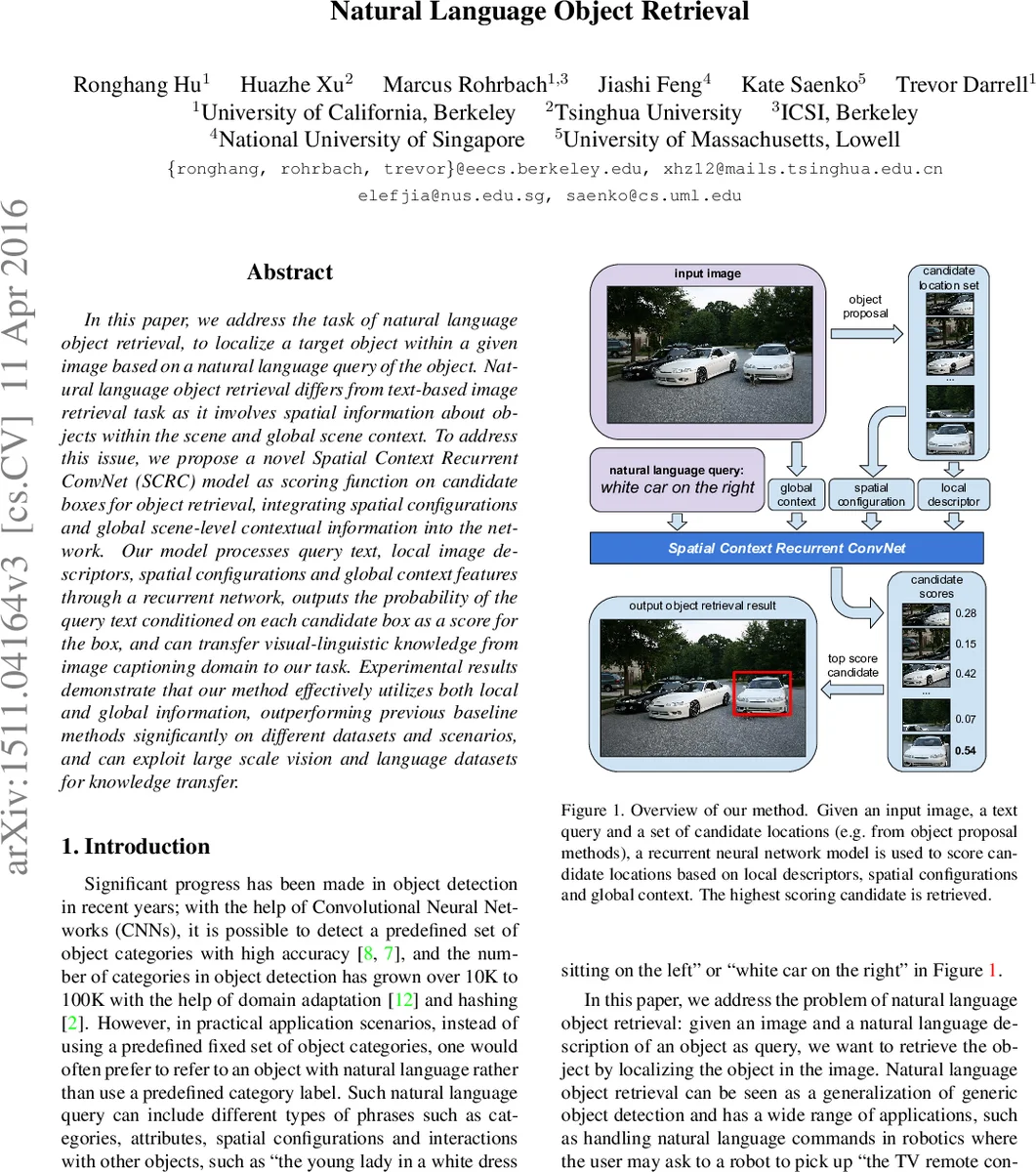
The paper introduces the task of Natural Language Object Retrieval (NLOR), which requires locating a specific object in an image given a free‑form textual description. Unlike conventional text‑based image retrieval that matches whole images to queries, NLOR must reason about object categories, attributes, spatial relations, and the overall scene context. To address this, the authors propose the Spatial Context Recurrent ConvNet (SCRC), a scoring function that evaluates each candidate bounding box by jointly considering (1) a local visual descriptor extracted from the box, (2) an 8‑dimensional spatial configuration vector, and (3) a global scene descriptor derived from the whole image.
The architecture builds on the Long‑term Recurrent Convolutional Network (LRCN). It contains three LSTM units: LSTM_language processes the embedded query word sequence; LSTM_local receives the concatenation of the language hidden state, the local box feature, and the spatial vector; LSTM_global receives the language hidden state together with the global image feature. Two VGG‑16‑based CNNs provide the 1000‑dimensional fc8 features for the local box (CNN_local) and the whole image (CNN_global). At each time step the model predicts the next word using a linear combination of the hidden states from LSTM_local and LSTM_global followed by a softmax. The probability of the entire query conditioned on a candidate box, p(S|I_box, I_im, x_spatial), is obtained by multiplying the per‑word probabilities; this value serves as the score for that box.
Training proceeds in two stages. First, the network is pretrained on a large image‑caption dataset (e.g., MS‑COCO) by disabling the local LSTM contribution (setting its weight matrix to zero). This stage learns robust word embeddings, language modeling, and global visual‑text alignment, essentially reproducing LRCN. After pretraining, the weights of LSTM_global are copied to LSTM_local, and the spatial‑related weights are initialized to zero, providing a good starting point for the full model. In the second stage, the model is fine‑tuned on NLOR data, which consist of images, bounding boxes, and multiple natural‑language descriptions per object. The loss is the negative log‑likelihood of the ground‑truth description given the local box, global image, and spatial vector, summed over all annotated objects and descriptions. End‑to‑end back‑propagation updates all components simultaneously.
Experiments use object proposals (e.g., EdgeBox) to generate candidate boxes. The authors compare SCRC against several baselines: (a) using only local visual features, (b) using only global context, (c) an LRCN‑style model without spatial information, and (d) a bag‑of‑words approach from prior work. Across multiple datasets, SCRC consistently outperforms these baselines in average precision and top‑k accuracy. Ablation studies show that removing either the spatial vector or the global context degrades performance, confirming that both are essential for handling queries that involve location (“on the right”, “behind the house”) and scene‑level cues.
Key contributions include: (1) formalizing NLOR as a distinct retrieval problem, (2) designing a recurrent architecture that fuses local, spatial, and global visual information with language, (3) demonstrating effective knowledge transfer from image captioning to NLOR via pretraining, and (4) providing extensive empirical evidence of the model’s superiority. Limitations are acknowledged: the approach relies on the quality of object proposals, and more complex relational queries (e.g., “the object between A and B”) may require explicit attention or relational reasoning mechanisms. Future work could incorporate depth cues, 3D scene understanding, or graph‑based relation modeling.
In summary, the Spatial Context Recurrent ConvNet offers a powerful, end‑to‑end solution for grounding natural‑language descriptions in images, bridging the gap between language‑driven search and fine‑grained visual localization, and opening avenues for applications in robotics, human‑computer interaction, and visual search systems.
Comments & Academic Discussion
Loading comments...
Leave a Comment