Fiber networks amplify active stress
Large-scale force generation is essential for biological functions such as cell motility, embryonic development, and muscle contraction. In these processes, forces generated at the molecular level by motor proteins are transmitted by disordered fiber networks, resulting in large-scale active stresses. While these fiber networks are well characterized macroscopically, this stress generation by microscopic active units is not well understood. Here we theoretically study force transmission in these networks, and find that local active forces are rectified towards isotropic contraction and strongly amplified as fibers collectively buckle in the vicinity of the active units. This stress amplification is reinforced by the networks’ disordered nature, but saturates for high densities of active units. Our predictions are quantitatively consistent with experiments on reconstituted tissues and actomyosin networks, and shed light on the role of the network microstructure in shaping active stresses in cells and tissue.
💡 Research Summary
Large‑scale force generation in biology—whether driving cell motility, embryonic morphogenesis, or muscle contraction—relies on molecular motors that pull on filamentous networks. While the macroscopic mechanical properties of such networks (actin cytoskeleton, extracellular matrix) are well characterized, a quantitative link between the microscopic active forces and the resulting macroscopic stresses has been missing, especially because biological networks are both disordered and highly nonlinear: fibers stiffen under tension but buckle under compression.
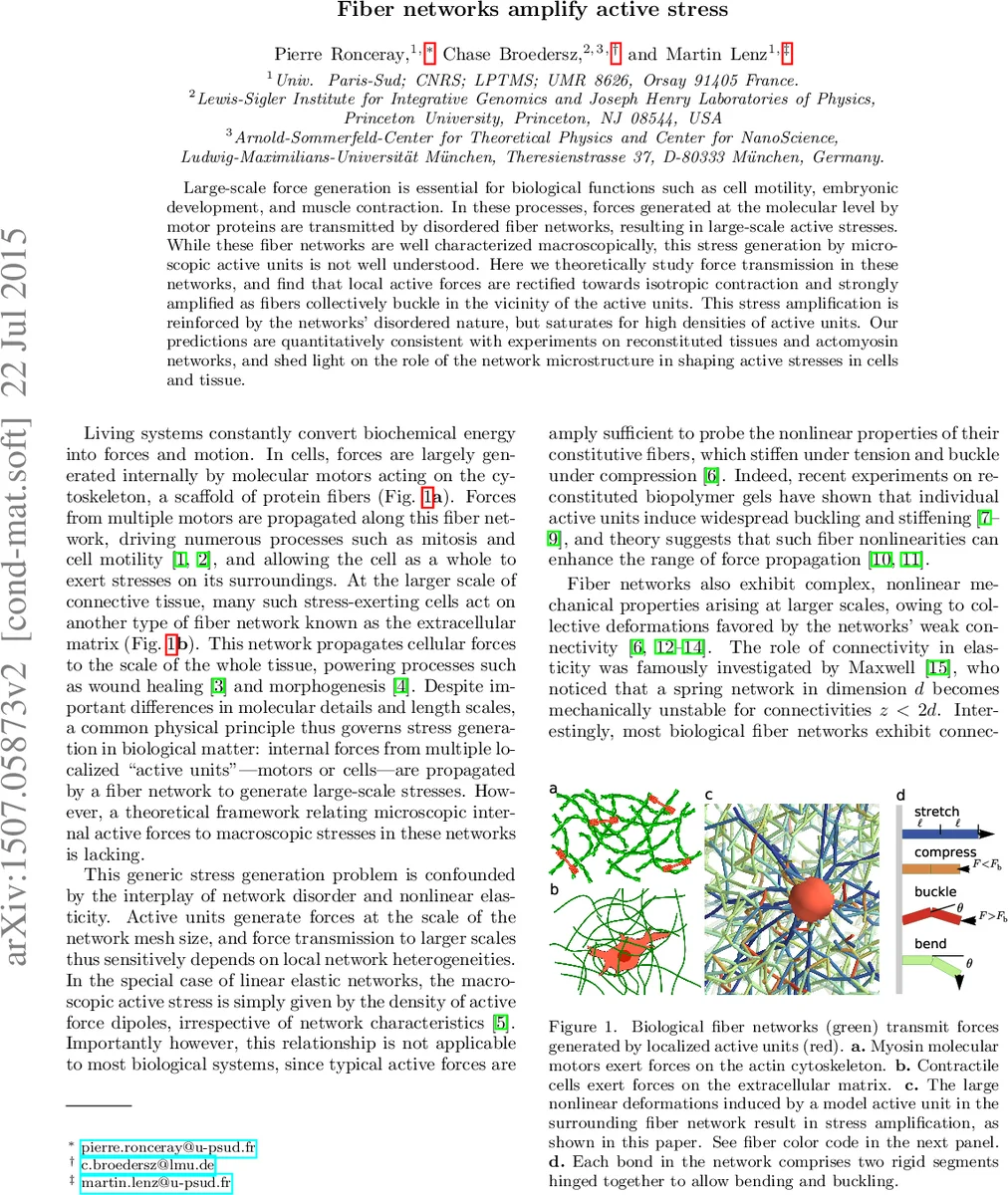
In this work, Ronceray, Broedersz, and Lenz develop a lattice‑based model of elastic fiber networks to address this gap. Each bond in the lattice consists of two rigid segments hinged together, allowing three deformation modes: stretching (with a large modulus µ≈10³), bending (unit modulus), and buckling under a critical compressive force Fb=1. By randomly removing bonds with probability p they control the average connectivity, thereby spanning stretching‑dominated (p>pcf) and bending‑dominated (pb<p<pcf) regimes, while avoiding the mechanically unstable region (p<pb).
Active units are first introduced as simple force dipoles: two opposite point forces of magnitude F0 applied at neighboring vertices. In the linear regime (F0≪Fb) the average far‑field dipole Dfar equals the local dipole Dloc, reproducing the classic result σ=−ρDloc for a homogeneous linear elastic medium. However, because force transmission follows a random network of tension‑ and compression‑bearing “force lines,” the distribution of Dfar/Dloc is extremely broad; a substantial fraction of realizations even show negative amplification (effective extensility in response to a contractile dipole).
When the applied forces exceed the buckling threshold (F0≫Fb), the network response becomes highly nonlinear. Buckling eliminates the propagation of compressive stresses, leaving only tensile pathways that extend far from the source. Consequently three robust phenomena emerge: (i) Rectification – regardless of the sign of the local dipole, the far‑field response is contractile; (ii) Amplification – the average magnitude of Dfar can be 5–7 times larger than Dloc for contractile sources (and −3 to −4 for extensile ones); (iii) Isotropization – the far‑field stress tensor becomes nearly isotropic, as quantified by a vanishing anisotropy parameter. These effects persist in both regular and randomly depleted lattices, and appear at lower forces in bending‑dominated networks.
To capture the behavior of real molecular motors or contractile cells, which can exert arbitrarily large forces without collapsing, the authors introduce an “isotropic puller” model. A central vertex pulls radially on all vertices within a radius 2R0 with a prescribed force profile, defining an effective surface force F at r=2R0. Numerical simulations reveal a crossover radius R* beyond which buckling no longer dominates. R* grows with the applied force as a power law R*∝F^α (α≈0.5–0.7), reflecting the formation of a rope‑like, tension‑bearing region around the active unit. In this regime the radial stress decays as σ_rr∝1/r^d rather than the linear‑elastic 1/r^{d‑1}, dramatically extending the range over which strong contractile stresses are felt.
The theoretical predictions are quantitatively compared with experiments on reconstituted actomyosin gels and on cells embedded in extracellular matrices. Measured stress amplification factors and the scaling of the buckling zone with motor activity match the model’s output, confirming that the observed macroscopic stiffening and remodeling of tissues arise from the same buckling‑induced rectification and amplification mechanisms.
Overall, the paper provides a unified framework linking microscopic active forces to macroscopic stresses in disordered fiber networks. It shows that the nonlinear buckling of fibers, together with network disorder, can convert modest local forces into large, isotropic contractile stresses that percolate over many mesh sizes. This insight reshapes our understanding of how relatively few molecular motors can generate the substantial forces required for tissue‑scale processes, and opens avenues for designing synthetic active materials that exploit similar amplification mechanisms.
Comments & Academic Discussion
Loading comments...
Leave a Comment