Data Injection Attacks on Smart Grids with Multiple Adversaries: A Game-Theoretic Perspective
Data injection attacks have recently emerged as a significant threat on the smart power grid. By launching data injection attacks, an adversary can manipulate the real-time locational marginal prices to obtain economic benefits. Despite the surge of existing literature on data injection, most such works assume the presence of a single attacker and assume no cost for attack or defense. In contrast, in this paper, a model for data injection attacks with multiple adversaries and a single smart grid defender is introduced. To study the defender-attackers interaction, two game models are considered. In the first, a Stackelberg game model is used in which the defender acts as a leader that can anticipate the actions of the adversaries, that act as followers, before deciding on which measurements to protect. The existence and properties of the Stackelberg equilibrium of this game are studied. To find the equilibrium, a distributed learning algorithm that operates under limited system information is proposed and shown to converge to the game solution. In the second proposed game model, it is considered that the defender cannot anticipate the actions of the adversaries. To this end, we proposed a hybrid satisfaction equilibrium - Nash equilibrium game and defined its equilibrium concept. A search algorithm is also provided to find the equilibrium of the hybrid game. Numerical results using the IEEE 30-bus system are used to illustrate and analyze the strategic interactions between the attackers and defender. Our results show that by defending a very small set of measurements, the grid operator can achieve an equilibrium through which the optimal attacks have no effect on the system. Moreover, our results show how, at equilibrium, multiple attackers can play a destructive role towards each other, by choosing to carry out attacks that cancel each other out, leaving the system unaffected.
💡 Research Summary
The paper addresses the emerging threat of data injection attacks (DIAs) on smart power grids, extending the analysis from the traditional single‑attacker setting to a more realistic scenario involving multiple adversaries and a single defender (the grid operator). Recognizing that multiple attackers can act concurrently, each targeting different measurement devices, the authors develop two game‑theoretic frameworks to capture the strategic interactions and to design effective defense mechanisms under limited information.
The first framework models the interaction as a Stackelberg game. The defender, acting as the leader, selects a subset of measurements to protect, subject to a budget constraint and a utility that balances the cost of protection against the expected reduction in attack impact. Once the defender’s protection strategy is fixed, each attacker (follower) independently chooses a data injection vector that maximizes its profit from manipulating real‑time locational marginal prices (LMPs) while incurring an attack cost. The attackers’ non‑cooperative game is shown to admit a Generalized Nash Equilibrium (GNE); the existence and properties of the overall Stackelberg equilibrium are rigorously proved. To compute this equilibrium, the authors propose a distributed learning algorithm that requires only partial knowledge of other players’ cost functions and strategies. Each player iteratively updates its decision based on locally observable outcomes, and the algorithm is proven to converge to the Stackelberg equilibrium despite the limited system information.
The second framework addresses the situation where the defender cannot anticipate the attackers’ reactions. Here, the defender seeks a strategy that satisfies a predefined performance constraint (e.g., limiting LMP deviations) rather than directly optimizing an objective function. This leads to a hybrid game that combines a Satisfaction Equilibrium (SE) for the defender with a Nash equilibrium for the attackers. The defender’s problem becomes one of finding the smallest set of measurements whose protection guarantees the performance constraint, while the attackers still play a non‑cooperative game. The authors introduce a search algorithm that systematically explores protection sets and prove its convergence to a hybrid equilibrium.
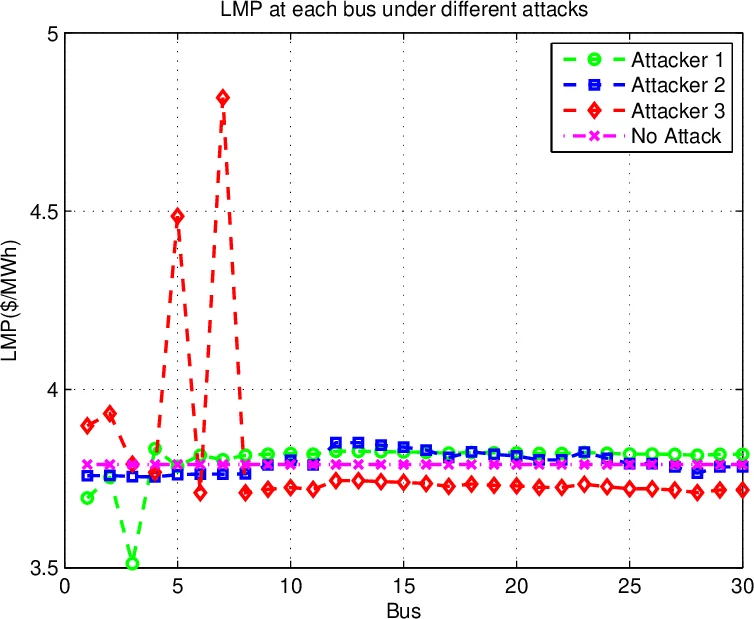
Both models are evaluated on the IEEE 30‑bus test system. Numerical results reveal several key insights: (1) Protecting a very small fraction of the total measurements can neutralize the most damaging attacks, demonstrating that strategic, sparse protection is sufficient for system security. (2) When multiple attackers act simultaneously, they may select attack vectors that cancel each other’s effects, leading to a “destructive interference” phenomenon where the net impact on LMPs is negligible. (3) Comparing the Stackelberg and hybrid models, the authors define a “price of information” metric that quantifies the loss in defender utility caused by the lack of foresight about attackers’ responses. The metric shows that information about attackers’ best‑response behavior can significantly improve defensive outcomes.
The paper’s contributions are threefold: (i) It introduces the first comprehensive game‑theoretic model for multi‑attacker DIAs in smart grids, incorporating realistic attack and defense costs. (ii) It provides two distinct analytical frameworks—one assuming full anticipatory capability (Stackelberg) and one assuming only satisfaction constraints (hybrid)—along with provably convergent algorithms suitable for decentralized implementation. (iii) It offers extensive simulation evidence that sparse protection, strategic defender design, and understanding of attacker interactions can dramatically enhance grid resilience while keeping defense expenditures low.
Overall, the work advances the state of the art in cyber‑physical security of power systems by bridging the gap between theoretical game models and practical defense strategies, and it lays a solid foundation for future research on multi‑adversary security, adaptive defense mechanisms, and market‑aware protection policies in modern electricity markets.
Comments & Academic Discussion
Loading comments...
Leave a Comment