Doubling property for biLipschitz homogeneous geodesic surfaces
In this paper we discuss general properties of geodesic surfaces that are locally biLipschitz homogeneous. In particular, we prove that they are locally doubling and that there exists a special doubling measure analogous to the Haar measure for local…
Authors: Enrico Le Donne
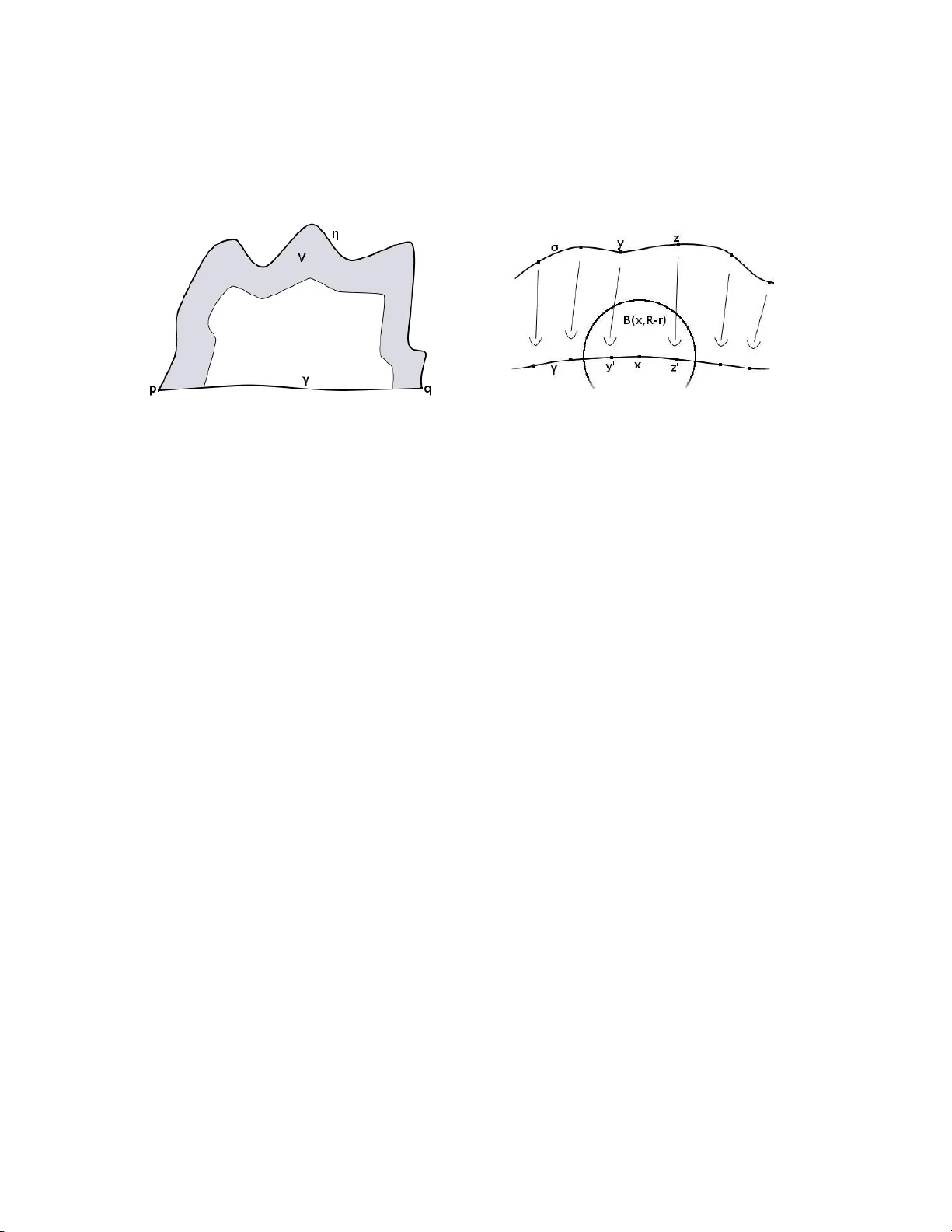
DOUBLING PR OPER TY F OR BI LIPSCHITZ HOMOGEN E OUS GEODESIC SURF A CES ENRICO LE DONNE Abstract. In this pa p er we discuss ge ner al prop erties of geo desic surfaces that are lo cally biLipsc hitz homogeneous. In pa rticular, we pr ov e that they are loca lly doubling and that there exists a sp ecial doubling mea sure analog ous to the Haar measure for lo cally compact groups. 1. Introd uction According to a cons equence of a general theorem b y V. N. Be resto vski ˘ ı [Ber88, Ber89a, Ber89b], if a geo desic distance d on a surface S induces the surface top olo g y of S and ha s the pro p ert y that the isometries of ( S, d ) act transitiv ely on S , then ( S, d ) is isometric to a Finsler surface. In particular, suc h spaces are lo cally biLipsc hitz equiv alent to a planar Euclidean domain. Although, some geo desic distances on the plane a re not lo cally biLipsc hitz e quiv a- len t to the Euclidean distance. Laa kso constructed in [L a a02] geo desic metrics on the plane that are not biLipsc hitz em b eddable in to an y R n , but still share many prop- erties with the Euclidean metric. Some of these prop erties are Ahlfors 2-regularity , lo cal linear con tractibilit y , and the fa ct that a Poincar ´ e inequalit y holds ; se e [Hei01] for an introduction to these last definitions. In this pap er w e b egin the study of a prop ert y that holds in the case of the Euclidean plane but has nev er b een singled out: the fact that biLipsc hitz maps act transitiv ely . Since ev ery R iemannian/F insler surface is lo cally biLipsc hitz equiv alent t o a n Eu- clidean planar domain, ev ery t w o points on the surface hav e neigh b orho o ds that are biLipsc hitz equiv alen t. Briefly , w e say tha t eve ry Finsler surface is lo cally biLips- c hitz homog eneous; see the next section fo r the general definitions. Th us our natural question is whether ev ery geo desic distance on the pla ne, or on a surface, wh ere the biLipsc hitz ma ps act lo cally transitiv ely , is biLipsc hitz equiv alen t to a Riemannian distance a nd so, lo cally , to the Euclidean distance. General homo g eneit y app ears frequen t ly in different mathematical areas and is as natural to assume as it is ha rd to handle in pro ofs. W e refer, for example, to the Date : March 1, 2010. 1 c hallenging op en conjecture of Bing and Borsuk, [BB65], whic h states that an n - dimensional, homogeneous, absolute neigh b orho o d retract, should b e an n -manifold. See [Bry06 , HR08] for definitions, pro g ress and references. Homogeneit y b y isometries in the case of geo desic me tric spaces has b een success- fully studied and characterized b y Beresto vski ˘ ı [Be r88, Ber89 a, Ber89b]. The in terest in biLipsc hitz homog eneit y is relatively recen t. It has been studied by sev era l authors [Bis01, GH99, FH08] in dimens ion o ne for planar curv es with metrics induced by the am bient geometry . BiLipsc hitz homogeneity for geo desic spaces has app eared nat- urally in Geometric Gr o up Theory for some actions on quasi-planes, i.e., geometric ob jects that a re coar sely 2 dimensional, e.g., in [KK 06, KK0 5]. Our purp ose is to study the 2- dimensional case together with the h yp ot hesis, as is common in Geometric G roup Theory , t ha t the metric is geo desic. Suc h a n assumption in dimension one w ould give trivial results. The main result o f this pap er is that a n y geo desic metric surface that is lo cally biLipsc hitz homogeneous is a lo cally doubling metric space. This fact leads to plen t y of conseq uences, e.g., t he Hausdorff dimension is finite and there exists a doubling measure that, like the Ha a r measure on Lie groups is preserv ed b y (left) translations, is “biLipsc hitz preserv ed” by biLipsc hit z maps. 1.1. Definitions, results, and str at egies. In a metric s pace ( X, d ), the leng th of a curve γ : [ a, b ] → X is Length d ( γ ) := sup ( n X i =1 d ( γ ( t i ) , γ ( t i − 1 )) : n ∈ N and a = t 0 < t 1 < · · · < t n = b ) . A r e ctifiable curve is a curv e with finite length. A ge o desic sp ac e is a metric space where an y t wo p oints are the end p oints of a rectifiable curv e whose length is exactly the distance b etw een the t wo p oints. A metric space ( X , d ) is do ublin g if there is a constan t N ∈ N suc h that eac h ball B ( x, 2 R ) ⊂ X is contained in the union of ≤ N balls o f radius R . W e sa y that ( X , d ) is lo c al ly doubling if a ny p oint has a neigh b orho o d that is doubling. W e sa y that a metric space ( X, d ) is lo c al ly biLips chitz homo gene ous if, f o r ev ery t wo p oints x 1 , x 2 ∈ X , there ar e ne igh b orho o ds U 1 and U 2 of x 1 and x 2 resp ectiv ely and a biLipsc hitz homeomorphism f : U 1 → U 2 , such that f ( x 1 ) = x 2 . A metric space ( X , d ) is lo c al ly line arly c ontr actible if there is a constan t C ≥ 1 suc h that eac h metric ball of radius R < C − 1 in the space can b e con tracted to a p oin t inside the ball of the same cente r but radius C R . See [Sem96] for an ample analysis o f this condition. W e prov e the following: Theorem 1.1. L et ( X , d ) b e a ge o desic metric sp ac e top o lo gic al ly e quivalent to a surfac e. Assume that X is lo c al ly biLipschitz h omo gene ous. Then 2 (1) The metric sp ac e ( X , d ) is lo c al ly doublin g, (2) The Hausdorff dimension of ( X , d ) is finite, (3) The H ausdorff 2 -me asur e H 2 of s m al l r -b al l B r has a quadr atic lower b ound: for e ach p oin t p ∈ X , ther e ar e c onstants c, ¯ r > 0 , so that H 2 ( B ( p, r )) ≥ cr 2 , for r < ¯ r , and (4) Every p oint o f ( X , d ) ha s a neighb orho o d that is lo c al ly li n e arly c ontr actible. Subsequen tly , w e inv estigate t he prop erties of general doubling biLipsc hitz homoge- neous spaces. W e show that they admit an analog of the Haar measure: there exists a doubling measure that is quasi-preserv ed b y biLipsc hitz maps and is quasi-unique. F or α > 0, w e consider t w o Borel measures ν and µ to b e α -quasi-equiv alen t, writing ν α ≈ µ , when, for all Borel sets A , 1 α µ ( A ) ≤ ν ( A )) ≤ αµ ( A ) . (1.2) With suc h a nota tion w e can precisely fo rm ulate the result. Prop osition 1.3. [Existenc e] L et X b e a lo c al ly c omp act and sep ar able metric sp ac e whose metric is doubling. Then ther e exists a (non-zer o) R adon me asur e µ with the pr op erty that, for any L > 1 , ther e exists a p ositive numb er α = α L such that (1.4) µ α ≈ f ∗ µ, for a l l L -biLipschi tz maps f : X → X . [Uniqueness] If mor e over ( X, d ) is L -biLipschitz homo gene ous, then, whenever an- other R adon me as ur e ν also satisfies (1.4), we have that µ β ≈ ν , for some β > 1 . Measures satisfying (1.4) are called Haar- lik e. In section 4 , w e discuss some con- nections b etw een the existence of a P oincar´ e inequalit y and upper b ounds on the Hausdorff dimension, cf. Prop osition 4.17. W e also show that ev ery Haar- like mea- sure satisfies a low er and an upp er p o lynomial b o und for the measure of balls in terms of the radius of the ball, cf. Corollary 4.13. Before summarizing the strategy for proving Theorem 1.1, let us recall some ter- minology; a standard reference is [GdlH90]. A geo desic triangle is said to be δ - thin if eac h edge is in the δ -neighborho o d o f t he other tw o edges. If ev ery geodesic triang le is δ - thin, the space is said to b e δ - hyp erb olic . A triangle that is not δ -thin is said δ - f a t . Here is the in tuition b ehind the pro of of Theorem 1.1: us ing c ha rts and a prelimi- nary argumen t, cf. Lemma 2.1, we may supp ose that our space is a neighborho o d U of the origin O in the pla ne R 2 that is uniformly biLipschitz homogeneous, say with constan t L . Th en w e consider t w o complemen t ary situations, o ne is going to imply the theorem, the other will result in a con tra diction. 3 Either: there exists some ρ suc h tha t , for an y r smaller than ρ , there exists an r / M -fat triangle in B ( O , r ); M will b e a fixed n um b er dep ending only on the biLipsc hitz constan t L . In this case, cf. Corollary 2.7, there exists a n r (10 M ) − 1 -ball surrounded b y the triangle. The basic idea of the argumen t is to consider the surrounding function Sur ( p, r ) whic h is the minim um len gth of lo ops that surround the metric ball B ( p, r ), remind that B ( p, r ) is no w a subset of R 2 . Therefore, the surrounding function for the ab ov e ball is less tha n the length of the triangle’s edges, which is les s than 6 r . Using “quasi in v ariance” of the function, cf. Lemma 3.3, in Corollary 3 .4 w e get the existence o f some constan t k suc h that, for some ρ ′ > 0, Sur( p, r ) < k r , ∀ p ∈ U, ∀ r < ρ ′ . F rom this last b ound, w e deduce the lo cal doubling and lo cally linearly con- tractible pro p erties, cf. Prop o sition 3.8 and Prop osition 3.7 resp ectiv ely . Or: fo r a ny natural n umber n , there exists r n < 1 /n such that an y triangle in B ( O , r n ) is r n / M -thin. In other w ords, B ( O , r n ) is r n / M -h yp erb o lic. BiLipsc hitz homogeneity im- plies that an y r n /L ball is Lr n / M -h yp erb o lic. Ho w eve r, suc h a lo cal h yp er- b olicit y implies , via a corollar y of Gromov ’s coarse v ersion of the Cart a n- Hadamard Theorem, cf. Corollary 2.4, t hat the space is glo ba lly h yp erb olic, if w e chose M carefully . Set M = C L 2 (the constan t C is the univers al constan t in the theorem of Gromov): then Gr o mo v Theorem holds and so our initia l neigh b o rho o d U is C ′′ r n -h yp erb olic for an y n ∈ N ( C ′′ is depending only on L ). Since r n go es to 0, we ha ve that U is 0-h yp erb olic. Ev ery 0-hy p erb olic space is a tree or an R - t r ee, c f. [GdlH90, page 31]. This is a top ological con- tradiction since U is an op en set of the plane. This second situation could not in fact o ccur. The idea of the construction of Haa r-lik e measures is as follows . F or eac h r > 0, w e consider a maximal r -separated net N r . Let µ r b e a sum of Dirac masses at the elemen ts of N r , and re-scale the result so that the mass of some unit ball B ( x 0 , 1) is 1. Then w e claim that the measures µ r sub-con v erge w eakly to the go o d measure on X . No w, t he e xistence o f t he me asure is assured b y the doubling property and do es not require biLipsc hitz homog eneit y , cf. Prop osition 4.3 . The equiv alence class of such measures is unique when the space is biLipsc hitz homogeneous, cf. Prop osition 4.5. Contents 1. In tro duction 1 1.1. Definitions, r esults, and strategies 2 2. Preliminaries 5 4 2.1. Uniform biLipsc hitz homogeneity 5 2.2. Existence of fat triangles a nd Gr o mo v’s coarse v ersion of Cartan- Hadamard Theorem 6 2.3. Existence o f surrounded balls 8 2.4. Existence o f cutting-throug h biLipsc hitz segmen ts 9 3. The surrounding function 10 3.1. Lo cal linear contractibilit y and the doubling prop erty 13 4. Consequenc es of the doubling prop erty 14 4.1. Dimension consequences 14 4.2. Go o d measure class: the Haar-like measures 15 4.3. Upp er b ounds for the Hausdorff dimension 21 4.4. Lo w er b ound for the Hausdorff 2- measure 22 References 24 Man y thanks go to Bruce Kleiner f o r inspirational advice and encouragemen t during the inv estigation of this problem . 2. Preliminaries Throughout all pap er, ( X, d ) will b e a lo c al ly biLip s chitz homo gene ous metric space, i.e., with the prop ert y that, for ev ery tw o p oin ts x 1 , x 2 ∈ X , there is a p ointed biLipsc hitz homeomorphism f : ( U 1 , x 1 ) → ( U 2 , x 2 ), where U i is a neigh b o rho o d of x i , for i = 1 , 2. 2.1. Uniform biLipsc hitz homogeneit y. Giv en a f a mily F of homeomorphisms o f X , w e say that F is t r ansitive on a subse t U ⊂ X if, for eac h pair of p oin ts p, q ∈ U , there exists a map f ∈ F suc h that f ( p ) = q . W e will no w prov e that lo cally biLipsc hitz homogeneit y implies that some family of uniformly biLipsc hitz maps, defined o n some neigh b orho o d U of some p oin t, is transitiv e on U . Suc h argumen t is based on Baire Category Theorem and ha s b een used sev eral times in the theory of homog eneous compacta, e.g., in [MNP98, Theorem 3.1] or [Hoh85, Theorem 6.1]. Lemma 2.1. L et ( X , d ) b e any lo c al ly c omp act metric sp ac e. Supp ose ( X , d ) is lo c al ly biLipschitz homo gene ous. Then, for any p oint of X , ther e exist a c om p act neighb o r- ho o d U of the p oint and a c onstant L with the pr op erty that the family L -B iLip ( U ; X ) , i.e., the m aps define d on U w i th values on X that ar e L -biLipschitz, is tr ansitive on U . 5 Pr o of. Fix a base p oint O ∈ X that w e will call or igin, and let W b e a compact neigh b o rho o d of the orig in. Consider the sets S n,m := ( p ∈ W | f ( O ) = p, for some f : B O , 1 m → X, n − biLipsc hitz ) . By transitivit y , w e hav e W = S m,n ∈ N S n,m . W e claim that eac h S n,m is closed. T ak e a sequence p j ∈ S n,m con ve rging to p ∈ W . Eac h p j giv es a function f j : B ( O , 1 m ) → X . The f j ’s are n -biLipsc hitz , and f j ( O ) = p j con ve rges. The Ascoli-Arzel` a argumen t implies that f j con ve rges t o some f uniformly on the closed ball B ( O , 1 m ), and the limit function is n -biLipsc hitz. There fore, f ( O ) = p for an n -biLipsc hitz map f on B ( O , 1 m ). Th us p ∈ S n,m and so S n,m is closed. Baire Category Theorem implies that there exis ts a n S N ,M that ha s non-empt y in te- rior. Therefore S N ,M is a compact neigh b orho o d of some p o in t q . Let f q : B ( O , 1 M ) → X b e a n N -biLipsch itz map suc h that f q ( O ) = q . W e claim that U := f − 1 q ( S N ,M ) ∩ B ( O , 1 2 M N 4 ) is a neigh b orho o d satisfying t he conclusion of the lemma with L := N 4 . Indeed, f o r any tw o p oints p 1 , p 2 ∈ f − 1 q ( S N ,M ), for i = 1 , 2, f q ( p i ) ∈ S N ,M ; so the re exists an N -biLipsc hitz map f i : B ( O , 1 M ) → X , suc h that f i (0) = f q ( p i ). Th us we ha v e p 2 = f − 1 q ◦ f 2 ◦ f − 1 1 ◦ f q ( p 1 ) and f − 1 q ◦ f 2 ◦ f − 1 1 ◦ f q is L -biLipsc hitz . If mor eov er p 1 ∈ B ( O , 1 2 M N 4 ), the function is defined in all B ( O , 1 2 M N 4 ). B ( O , 1 2 M N 4 ) ⊂ B ( p 1 , 1 M N 4 ) f q / / B ( f q ( p 1 ) , 1 M N 3 ) f − 1 1 ( ( P P P P P P P P P P P P B ( O , 1 M N 2 ) f 2 v v ♥ ♥ ♥ ♥ ♥ ♥ ♥ ♥ ♥ ♥ ♥ ♥ B ( p 2 , 1 M ) B ( f q ( p 2 ) , 1 M N ) f − 1 q o o 2.2. Existence of fat triangles and Gromov’s coarse v ersion of Cartan- Hadamard Theorem . F rom no w on, ( X , d ) will b e a biLipschitz hom o gene ous ge o- desic surfac e as in the assumptions of Theorem 1 .1, i.e., a geo desic metric space tha t is top ologically equiv a len t to a surface and is lo cally biLipsc hitz homogeneous. The pla n fo r proving Theorem 1.1 has b een ske tc hed in the introduction. W e now pro ceed in sho wing the details. By Lemma 2.1, and since X is a surface, we ha ve that X is lo cally isometric to a compact neigh b orho o d U of the origin O in the plane 6 R 2 equipped with a geo desic distance suc h that, for some L > 1, the a ction of the L -biLipsc hitz maps on U is transitiv e. W e proceed now with the proof that in U there are triangles that are sufficien tly fat, i.e., not thin in the sense of G romo v. Prop osition 2.2. L et U b e a n e ighb orho o d of a p oint O in a ge o desic surfac e ( X , d ) . Assume that L -B iLip ( U ; X ) is tr ansitive on U . Then ther e exist p ositive c onstants M and ρ such that for any r < ρ ther e exists an r / M -fat triangle in B ( O , r ) . The argumen t for the ab ov e prop osition will b e b y con tradiction a nd will be based on Gromo v’s generalization of Cartan-Hadamard Theorem. This result states a lo cal- to-global phenomenon: if small balls a r e δ -hyperb olic then the space is δ ′ -h yp erb olic. The g eneral ve rsion of the theorem is the following. Theorem 2.3 ( Cf. [Gro87], [Bow 91, Theorem 8.1.2]) . Ther e ar e c onstants d 0 , C 1 , C 2 , and C 3 with the fol lowing pr op erty. L et X b e a metric sp ac e of b ounde d ge ometry. Assume that for some δ , an d d ≥ max( C 1 δ , d 0 ) , every b al l of r adius C 2 d in X is δ -hyp erb olic, and the d -R ips c om p lex 1 Rips d ( X ) is 1 -c onne cte d. Then X is C 3 d - hyp erb olic. F or an exp osition of the ab ov e theorem, together with the cited definitions, refer to the app endix b y M. Kap o vich and B. K leiner in [OOS09]. What w e need is the follo wing immediate consequence of Theorem 2.3 . Corollary 2.4. Ther e ar e c onstants C and C ′ with the fol low i n g p r op erty. If X is a simply-c onne cte d ge o desic metric sp ac e s uch that, for some R > 0 , eve ry b al l of r adius C R is R -hyp erb olic, then the sp ac e X i s C ′ R -hyp erb olic. Pr o of of Pr op osition 2. 2 . The idea is to lo cally use Corollary 2.4. W e ma y assume that U is a simply connec ted planar domain whic h w e will consider as a subse t of R 2 . One can show, cf. [LD 09], that there is a subset A ⋐ U tha t has non empt y in terior and is geo detically closed, i.e., it is a geo desic space. Clearly , w e may assume that A is simply connected, otherwise w e add to it all the comp onen ts of U \ A non con taining ∂ U , and the set w ould still b e geo detically close d. Since A is a simply-connected geo desic metric space we can apply Corollary 2.4. Let C and C ′ b e the constant in Corollary 2.4. Set M = C L 2 . If the conclusion of the prop osition we re not true, then, for a ny natural num b er n , there exists r n < 1 /n suc h that an y triangle in B ( O , r n ) is r n / M -thin. In other w ords, B ( O , r n ) is r n / M - h yp erb olic. W e now us e L -biLipsc hitz homogeneit y to conclude that an y r n /L -ball of U (and so of A ) is Lr n / M -h yp erb o lic. Using the definition of M , w e hav e that 1 The d - Ri ps c omplex Rips d ( Z ) of a metric space Z is defined to be the simplicial complex whose vertex set is Z , where distinct p oints x 0 , ..., x n ∈ Z span a n n -simplex in Rips d ( Z ) if a nd o nly if d ( x i , x j ) ≤ d for all 0 ≤ i, j ≤ n . 7 ev ery C r n C L -ball is r n C L -h yp erb olic. Therefore, by Coro lla ry 2.4, the whole set A is C ′ r n C L -h yp erb olic, for an y n ∈ N . Since r n go es to 0, this sa ys that A is 0- h yp erb olic. Ev ery 0-h yp erb olic space is a tree or an R -tree. This is a con tr a diction since A is a set of the plane with non-empty in terior. 2.3. Existence of surrounded balls. As an ticipated in the in tro duction, as so on as w e hav e a fat tria ng le, w e are in terested in lo o king at a ball inside the triangle of radius prop ortional to the fat ness of the triangle. The purp ose is to ha ve a ball surrounded b y the triangle. Definition 2.5. A lo op γ ⊂ X s urr ounds a subset Σ ⊂ X if γ ∩ Σ = ∅ and γ separates Σ from infinity , i.e., an y prop er path R + → X starting at Σ in tersects γ . In other w ords, each pa th in X starting at a p oint in Σ t ha t escap es ev ery compact set m ust in tersect γ . The ideas in this subsection w ere partially inspired b y [Pap05]. Prop osition 2.6. L et p and q b e two p oints in a ge o de sic planar and simply c onne cte d domain. L et γ b e a ge o desic fr om p to q and let η b e another curve fr om p to q . Supp ose γ is not c ontaine d in the R -neighb orho o d of η . Then ther e exists an R / 2 -b al l surr ounde d by γ ∪ η . Pr o of. Let 0 < r < R . Call U the ‘inside’ r -neigh b orho o d of γ and V the ‘inside’ r -neighborho o d of η . The w ord ‘inside’ means that w e consider the in tersections of the r -neighborho o ds of the curv es with the unio n of the b o unded comp onen ts of R 2 \ ( η ∪ γ ), see Figure 1(a). W e claim that the complemen t of U ∪ V has a b ounded comp onen t. As a conse quence, the r -ba ll cen tered at an y p oin t in that comp onen t would b e surrounded b y γ ∪ η , and the pro of w ould b e concluded. If suc h a claim w ere not true, then (by Jorda n separation) the union U ∪ V would be simply connected. Since b ot h U and V are connected, Ma ye r-Vietoris Theorem tells us that the in t ersection U ∩ V is connected as we ll. (Note that p and q are in U ∩ V ) . Let σ b e a curv e from p to q inside U ∩ V . F rom the hypothesis w e know that there exists a ball of radius R and cen ter at some p oin t x ∈ γ that do not in tersect η . W e claim that σ cannot a v oid the ball of ce n ter x and radius R − r . Assume otherwise. T ak e an r -net along the curv e σ . T o eac h p oin t in the net w e can asso ciate a p oint on γ , differen t from x , at distance less than r , see Figure 1 ( b). The asso ciation can b e done since σ is in the r -neighborho o d of γ . This asso ciatio n has to ‘c hange sides’ of x a t some p oin t, in the sense that there are tw o consecutiv e p oints y and z of the net that hav e asso ciated p oin ts y ′ and z ′ in disjoint comp onen t o f γ \ { x } , see Figure 1(b). Now , since b o t h y and z are outside the ( R − r )-ball, d ( x, y ′ ) ≥ d ( x, y ) − d ( y , y ′ ) ≥ ( R − r ) − r = R, 8 (a) The set V is the collection of points at distance less than r from η tha t are ‘inside’ the closed curve η ∪ γ . (b) An r -net in σ ca n be pro jected on γ . Figure 1. The pro of of the existence of surrounded balls. and similarly d ( x, z ′ ) ≥ R . This tells us that on one hand, since y ′ , x, z ′ are on a geo desic in this order, w e hav e d ( y ′ , z ′ ) = d ( y ′ , x ) + d ( x, z ′ ) ≥ 2 R. On the other hand, d ( y ′ , z ′ ) ≤ d ( y ′ , y ) + d ( y , z ) + d ( z , z ′ ) ≤ 3 r . But if w e c ho ose r = R/ 2 , then w e get 2 R ≤ 3 r , whic h is false. Th us σ in tersects t he ball of radius R − r center at x . Ho w ev er, eac h p oin t in σ is not farther than r fro m η . This w ould imply that x is at distance strictly less than R from η . This is a contradiction. Corollary 2.7. I n a ge o desic, pla n ar, and simply c onne cte d domain, e ach ge o desic triangle that is not R -thin surr ounds an R/ 2 b al l. Pr o of. Let γ b e the geo desic edge that is not in the R -neighbor ho o d of the o ther t w o edges and let η b e the concatenation of the other t w o edges. No w use the previous prop osition. 2.4. Existence of cutting-through biLipsch itz segmen ts. By Lemma 2.1, eac h p oin t in the space X of Theorem 1.1 has a neigh b orho o d that is uniformly biLipsc hitz homogeneous. Lemma 2.8. L et U b e a neighb orho o d of a p oint O in a ge o desic surfac e ( X , d ) . Assume that L -BiLip ( U ; X ) is tr ansitive on U . T hen ther e is a sm a l ler ne i g hb orho o d V ⊂ U of O such that, f o r any p ∈ V , ther e is a L 2 -biLipschitz im a ge o f an interval into X p assing thr ough p and starting and ending outside V . 9 Pr o of. T ak e a geo desic η in U starting at O and ending at some p oint ˜ q . T ak e V ⊂ U to b e a neigh b orho o d of O suc h that diam( V ) < d ( O , ˜ q ) 2 L 2 . Let q ∈ η b e the midp oint, i.e., d ( O , q ) = 1 2 d ( O , ˜ q ) . T ak e f an L -biLipsc hitz map suc h that f ( q ) = O . F or an y point p ∈ V , let f p an L - biLipsc hitz map such that f p (0) = p . Then w e claim that f p ◦ f ◦ η is an L 2 -biLipsc hitz curv e passing through p whose end p o in ts are o utside V . Indeed, since q ∈ η , p = f p ( O ) = f p ( f ( q )) ∈ f p ◦ f ◦ η ; the end p oint f p ( f ( O )) lies outside V since d ( f p ( f ( O )) , p ) = d ( f p ( f ( O )) , f p ( f ( q ))) ≥ 1 L 2 d ( O , q ) = 1 2 L 2 d ( O , ˜ q ) > diam( V ) and a nalogously d ( f p ( f ( ˜ q ) ) , p ) > diam( V ). 3. The surroundin g function W e no w consider surrounding functions in a biLipsc hitz homogeneous geo desic sur- face ( X , d ). Studying linear b ounds of surrounding functions is useful for the pro of of the doubling prop ert y . W e defined the notion of a lo op surrounding a set in Definition 2.5. If γ is a lo op in X , w e let | γ | denote the length of γ with r esp ect to the metric d . Definition 3.1 (Surrounding function) . Giv en p ∈ X , r ∈ R + , let Sur( p, r ) b e the infim um of lengths of lo ops γ ⊂ X that surround the metric ball B ( p, r ) ⊂ X . W e actually need a lo cal substitute to control the dia meter o f the surrounding lo ops. Definition 3.2. Given p ∈ X , r 1 , r 2 ∈ R + , with r 2 > r 1 , let Sur r 2 ( p, r 1 ) be the infim um of lengths of lo ops γ ⊂ B ( p, r 2 ) that surround the metric ball B ( p, r 1 ) ⊂ X . Note that, since X is lo cally compact, if the set of s uc h lo ops is non-empt y , then there exists a minim um b y Ascoli-Arzel` a Theorem. W e will refer to a lo op γ that realizes the minim um as a smal lest or s h ortest lo op that surrounds B ( p, r 1 ). 10 Lemma 3.3. The function Sur ( · ) ( · , · ) is “quasi-invariant”: if f : U ⊂ X → X is an L -biLipschitz map with f ( p ′ ) = p such that B ( p ′ , r 2 ) ⊆ U , then 1 L Sur Lr 2 p, r 1 L ≤ Sur r 2 ( p ′ , r 1 ) . Pr o of. W e may supp ose that Sur r 2 ( p ′ , r 1 ) is finite. Cho ose a smallest lo op γ ⊂ B ( p ′ , r 2 ) tha t surrounds B ( p ′ , r 1 ). Then f ( γ ) is a lo op that surrounds B ( p, r 1 /L ), is in B ( p, Lr 2 ), and its length is no more than L | γ | . Therefore Sur Lr 2 ( p, r 1 /L ) ≤ L | γ | = L Sur r 2 ( p ′ , r 1 ). By Prop osition 2.2, w e can now pro v e the upp er b ound f or the surrounding function. Corollary 3.4. L et U b e a ne i g hb orho o d of a p oint O in a ge o desic surfac e ( X , d ) . Assume that U is hom e omorphic to a pl a nar c omp act domain and that L -BiLip ( U ; X ) is tr ansitive on U . Then ther e exist c onstants C an d ρ ′ such that Sur( p, r ) < C r , for a n y p ∈ U and r < ρ ′ . Pr o of. Let M a nd ρ b e the constants from Prop osition 2.2. Set ρ ′ := 1 6 M L min { ρ, d ( O , U c ) } and C > 12 M L 2 . F or any r < ρ ′ , since 2 M Lr < ρ , Prop osition 2 .2 giv es the existence of a 2 Lr -f a t triangle in B (0 , 2 M Lr ). Coro llary 2.7 sa ys that suc h a triangle surrounds a n Lr - ball, whic h w e call B ( ˜ p, Lr ). By definition of ρ ′ and the fact that ˜ p ∈ B (0 , 2 M Lr ), we ha ve (3.5) B ( ˜ p, 4 M Lr ) ⊂ B (0 , 6 M Lr ) ⊂ U. F urthermore, since B (0 , 2 M Lr ) ⊂ B ( ˜ p, 4 M Lr ) and since the length of a triangle can b e b ounded b y three times the diameter of a ba ll containing it, w e ha v e Sur 4 M Lr ( ˜ p, Lr ) ≤ 12 M Lr . T ak e a n y p ∈ U and tak e f : U → X a n L -biLipsc hitz with f ( ˜ p ) = p. Th us, using Lemma 3.3 together with (3.5), we finally ha ve Sur( p, r ) ≤ Sur 4 M L 2 r ( p, r ) ≤ L Sur 4 M Lr ( ˜ p, Lr ) ≤ (12 M L 2 ) r < C r . W e no w presen t some tec hnical preliminaries used later for pro ving lo cal linear connectednes s a nd the doubling pr o p ert y f o r U in Prop osition 3.7 and 3.8 resp ectiv ely . Lemma 3.6. Supp ose to b e in the c onclusion of L emma 2.8. S et R 0 := d ( V , U c ) . We c an supp ose R 0 > 0 . L et r ∈ (0 , R 0 ) and p ∈ V . L et γ ⊂ U b e a lo op that surr ounds the b al l B ( p, r ) . F or the c onstants C 0 := 2 / L 4 , C 1 := 2 L 4 , C 2 := 4 L 4 the fol lowing pr op erties ar e true. 11 1. We have diam( γ ) ≥ C 0 r . 2. We have Sur( p, r ) ≥ C 0 r . 3. F or r ′ < C 0 r and e ach p ′ ∈ γ , the length of γ ∩ B ( p ′ , r ′ ) is at le ast r ′ . 4. The lo op γ must lie in B ( p, C 1 | γ | ) . 5. The c onne cte d c omp onent of p in X \ γ is c ontain e d in B ( p, C 2 | γ | ) . Pr o of. 1. Set K = L 2 . By Lemma 2.8 w e can consider a K - biLipsc hitz segmen t σ through V with σ (0 ) = p . Since γ surrounds B ( p , r ) there are t w o p oin ts p ± ∈ γ suc h that σ ( T ± ) = p ± , with T − < 0 < T + . Th us diam( γ ) ≥ d ( p − , p + ) ≥ 1 K ( T + − T − ) = 1 K [ d ( T − , 0) + d (0 , T + )] ≥ 1 K 2 d ( p − , p ) + d ( p, p + ) ≥ 1 K 2 ( r + r ) = 2 K 2 r . 2. Let γ b e a smallest lo op surro unding B ( p, r ). By part (1) Sur( p, r ) = | γ | ≥ diam( γ ) ≥ 2 K 2 r . 3. According to ( 1), diam( γ ) ≥ C 0 r . Hence, fo r eac h r ′ ≤ C 0 r and p ′ ∈ γ , the metric sphere S ( p ′ , r ′ ) ha s nonempt y in tersection with γ . Th us the length of γ ∩ B ( p ′ , r ′ ) is at least r ′ . 4. Let p ± b e the p oin ts considered in (1). Then d ( p ± , p ) ≤ K d ( T ± , 0) = K | T ± | ≤ K | T + − T − | ≤ K 2 d ( p + , p − ) ≤ K 2 | γ | . Th us, for an y z ∈ γ , d ( z , p ) ≤ d ( z , p + ) + d ( p + , p ) ≤ | γ | + K 2 | γ | ≤ 2 K 2 | γ | . Therefore γ ⊂ B ( p, C 1 | γ | ) . 5. Consider a p oin t q ∈ X \ γ that lies in the same comp onen t of X \ γ as p . Then either q / ∈ Nbhd r ( γ ) or d ( q , γ ) ≤ r . In the first case the lo o p γ surrounds b oth B ( p, r ) and B ( q , r ). Hence, b y ( 4 ) γ ⊂ B ( p, C 1 | γ | ) and γ ⊂ B ( q , C 1 | γ | ) , i.e., any p oint o f γ is at dis tance less than C 1 | γ | fro m b oth p a nd q . By the triangle inequalit y we conclude that d ( p, q ) ≤ 2 C 1 | γ | = 4 K 2 | γ | . In the second case, if d ( q , γ ) ≤ r , then d ( q , γ ( t )) ≤ r , for some t . Thus , using (4) and (2), we ha v e d ( p, q ) ≤ d ( p, γ ( t )) + d ( γ ( t ) , q ) ≤ C 1 | γ | + r ≤ C 1 | γ | + | γ | /C 0 = 5 2 K 2 | γ | < 4 K 2 | γ | . Therefore q ∈ B ( p, C 2 | γ | ) . 12 3.1. Lo cal linear contractibilit y and the doubling prop erty. W e are ready to prov e lo cal linear contractibilit y and the lo cal doubling prop ert y , fo r biLipsc hitz homogeneous geo desic surface. Prop osition 3.7. L et ( X , d ) b e a biLipschitz h o mo gene ous ge o desic surfac e. Then any p oint of X has a lo c al ly line arly c ontr actible neighb orho o d. Pr o of. Fix a p oin t O ∈ X . Let U b e the neigh b orho o d giv en b y Lemma 2.1, so w e are in the assumption of Corollary 3.4. Let V b e the neigh b orho o d for O giv en b y Lemma 2.8. Therefore the conclusions of Lemma 3.6 hold. W e will consider U and V as planar domain of R 2 . On them the surrounding function has t he linear upp er b ound, b y Corollary 3.4. Let p ∈ V and r < ρ ′ , so that Corollary 3.4 holds. Consider the ball B ( p, r ) and a length minimizing surrounding lo op γ . Note that the ball B ( p, r ) is connected, b eing the metric g eo desic. Since γ is minimizing, then it is a simple lo op. Thus , b y Jordan Theorem, the b ounded comp onen t E of R 2 \ γ is ho meomorphic to a disk, in par t icular E is homotopic to a p oint. Since the ball B ( p , r ) is connected, it is con t a ined in E . Th us B ( p, r ) is homotopic to a p oin t in E . By po in t (5) in the previous lemma, E is con tained in B ( p, C 2 | γ | ) . The b ound on the surrounding function gives | γ | = Sur ( p, r ) < C r and so B ( p, C 2 | γ | ) ⊂ B ( p , C 2 C r ). In c onclusion, B ( p, r ) is homotopic to a p oint in B ( p, C 2 C r ). Prop osition 3.8. L et ( X , d ) b e a biLipschitz h o mo gene ous ge o desic surfac e. Then any p oint of X has a neighb orho o d that is doubling. Pr o of. As in the previous pro o f, fixed a p oin t O ∈ X , let U and V b e the neighbor- ho o ds given b y Lemma 2.1 and Lemma 2.8 resp ectiv ely . W e will consider U a nd V as planar domain of R 2 . Th us the conclusions of Corollary 3.4 and Lemma 3.6 hold. In particular, we ha ve the upp er b ound for the surrounding function. Namely , for p ∈ V and r < ρ ′ , if γ surrounds B ( p, r ) and is a minimizer for Sur( p, r ) , then, b y Corollary 3.4, w e ha ve | γ | ≤ C r . Moreo v er, Part (5) of Lemma 3.6 sa ys that the connected comp onen t of p in X \ γ is con ta ined in B ( p, C 2 C r ), since C 2 C r ≥ C 2 | γ | . Fix p ∈ V . Choose a lo op γ 1 ⊂ X with length at most C r that surrounds B ( p, r ), and set L 1 = { γ 1 } . Let N 1 b e an r 2 L 2 -separated r 2 -net in γ 1 . Then, b y Lemma 3.6 (3), the cardinality of N 1 is at most | γ 1 | r / (4 L 4 ) ≤ C r r / (4 L 4 ) = 4 L 4 C = : c. Let L 2 b e a collection of loops (eac h having le ngth at most C r ) surrounding the r - balls cen tered at the p o in ts in N 1 . Pro ceed inductive ly in this fashion, building up k la yers of surrounding loops in X . The union V k := N 0 ∪ . . . ∪ N k has cardinalit y at most c k +1 = (4 L 4 C ) k +1 . 13 W e claim that the collection o f C 2 C r -ba lls cen tered at the p oints in V k co ve rs B ( p, k r 2 ). T o show such a claim, consider a path σ of length at most k r 2 starting at p . Inductiv ely break σ into a concatenation of at mos t k sub-paths of length at least r 2 as follo ws. Let σ 1 b e the initial segmen t of σ until σ inte rsects γ 1 . The path σ 1 has length a t least r a nd terminates within distance r 2 of a p oin t p 1 ∈ N 1 . Let σ 2 b e the initial segmen t of σ \ σ 1 un til σ \ σ 1 in tersects the surrounding loop fo r B ( p 1 , r ), et cetera. A t eac h step the segmen t σ i has length at least r 2 , and from what w as said at the b eginning of the pro of, each σ i is contained in ∪ q ∈V k B ( q , C 2 C r ). Th us B p, k r 2 ⊂ c k +1 [ i =1 B ( p i , C 2 C r ) , for eac h p ∈ V . Cho ose k suc h that k 2 = 2 C 2 C (clearly w e may assume C 2 , C ∈ N ) and define the constant N := c k +1 . W riting ρ in the form ρ = C 2 C r , w e ha v e pro v ed that, for an y p ∈ V , B ( p, 2 ρ ) ⊂ N [ i =1 B ( p i , ρ ) . In other words V is doubling. 4. Conse quences of the doubling p roper ty 4.1. Dimension consequences. Recall that doubling spaces are precisely those spaces with finite Assouad dimen sion (also kno wn as metric cov ering dimension or uniform metric dim ension in the lit erature). See [Hei01] for the definition. Ho wev er, the Assouad dimension of a metric space can b e defined equiv alen tly a s the infimum of all num b ers D > 0 with the prop ert y that ev ery ball of radius r > 0 ha s at mos t C ǫ − D disjoin t p oints of m utual distance at least ǫr , for some C ≥ 1 indep enden t of the ball. Let us recall that a set N ⊂ X is said to b e ǫ - sep ar ate d if d ( x, y ) ≥ ǫ fo r each distinct x, y ∈ N . Also, a set N ⊂ X is said to b e an ǫ - net if, for eac h x ∈ X , d ( x, N ) ≤ ǫ . Clearly an ǫ -separated set that is maximal with resp ect to inclusions of sets id an ǫ -net; such a set is called a maximal ǫ - separated net. Th us, a metric space X o f Assouad dimension less than D has the property that there exists a constan t C suc h that, fo r any p ∈ X and any r > 0, (4.1) N δ is δ -separated = ⇒ #(( N δ ∩ B ( p , r )) ≤ C δ r − D . Since the Hausdorff dimension of a metric space do es not exceed its Assouad di- mension, the next corollary is immediate. 14 Corollary 4.2. A lo c al ly biLipsc hitz ho mo gene ous ge o desic surfac es has finite Haus- dorff dimen sion. Pr o of. By Prop osition 3 .8 any p oint has a neigh b orho o d that is doubling. Thus the Hausdorff dimension of suc h a neigh b orho o d is finite, sa y α . No w, since the space is biLipsc hitz homogeneous and biLipschitz maps preserv e Hausdorff dimension, all p oin ts hav e neigh b orho o ds with Hausdorff dimension equal to α . Since the Hausdorff dimension dep ends on lo cal data, the dimension of the space is α . 4.2. Go o d measure class: the Haar-lik e measures. W e will now give the details regarding the Haar - lik e measures. Throughout this section, let O be a fixed p oin t and let B r = B r ( O ). Let δ p b e the Dirac measure defined by δ p ( A ) = 1 if p ∈ A a nd δ p ( A ) = 0 if p / ∈ A . Notation µ α ≈ ν . F or µ and ν Bor el measures and a n um b er α > 0, w e sa y that µ α ≈ ν if 1 α ν ( A ) ≤ µ ( A ) ≤ α ν ( A ) , for eac h Borel set A . Equiv alen tly , if they are a bsolute contin uous with resp ect to eac h other and the Radon-Nikodym deriv ativ es are bo unded betw een 1 α and α , i.e., there exists a function h : X → [ 1 α , α ] so that dν = hdµ . F or a set N ⊂ X suc h that #( N ∩ B 1 ) < ∞ , define the Radon measure µ N := 1 #( N ∩ B 1 ) X p ∈ N δ p , i.e., µ N ( A ) = #( N ∩ A ) #( N ∩ B 1 ) , for an y Borel set A . The normalization has the purpose of ha ving µ N ( B 1 ) = 1, for an y set N . No w, the existence of a go o d measure is assured by the doubling prop ert y , and do es not r equire homogeneit y . Recall that, if f : X → X is an y Bo rel function, then any Borel measure µ on X can b e pushed forw a rd a s ( f ∗ µ ) ( A ) := ( f # µ ) ( A ) := µ f − 1 ( A ) , for any Borel set A . Prop osition 4.3 ( Existence) . L e t ( X , d ) b e any doubling metric sp ac e. T hen ther e exists a non-zer o R adon me asur e µ , wi th the pr op erty that, for any L > 1 , ther e is a c onstant α = α L such that µ α ≈ f ∗ µ , for e ach f ∈ L − BiLip ( X , d ) . 15 Pr o of. F or eac h ǫ > 0 c ho ose a maximal ǫ -separated net N ǫ and consider the asso ciated measure µ ǫ := µ N ǫ defined as ab o ve, i.e., µ ǫ ( A ) := #( N ǫ ∩ A ) #( N ǫ ∩ B 1 ) , for any Borel set A . By Theorem 1.59 in [AFP00], since the µ ǫ are (finite) Radon measures and µ ǫ ( B 1 ) = 1, there is a sub-sequence µ ǫ n that is w eak ∗ con ve rgen t to a measure µ . Recall that, if cl ( B ) is the closure of a set, then lim sup µ ǫ n ( cl ( B )) ≤ µ ( cl ( B )) . (4.4) Let us prov e that µ satisfies the conclusion of t he prop osition. T ak e an y f ∈ L -Bilip( X , d ). Then note that f ( N ǫ ) is an ǫ L -separated Lǫ -net. Fix any ball B . T ak e tw o other balls B ′′ ( B ′ ( B with same cen ter and differen t radii r ′′ < r ′ < r . If ǫ ≤ r ′ − r ′′ and B ( p, ǫ ) ∩ B ′′ 6 = ∅ , then w e ha ve that p ∈ B ′ . Thus B ′′ ⊂ [ p ∈ B ′ ∩ N ǫ B ( p, ǫ ) , ∀ ǫ ≤ r ′ − r ′′ , since N ǫ is an ǫ -net. Moreo v er, since f ( N ǫ ) is ǫ L -separated, f r o m (4.1) w e hav e #( B ( p, ǫ ) ∩ f ( N ǫ )) ≤ C ǫ/L ǫ − D = C L D . Then # ( B ′′ ∩ f ( N ǫ )) ≤ X p ∈ B ′ ∩ N ǫ # ( B ( p, ǫ ) ∩ f ( N ǫ )) ≤ C L D #( B ′ ∩ N ǫ ) . So, f ∗ µ ǫ ( B ′′ ) ≤ # ( f − 1 ( B ′′ ) ∩ N ǫ ) #( B 1 ∩ N ǫ ) = # ( B ′′ ∩ f ( N ǫ )) #( B 1 ∩ N ǫ ) ≤ C L D #( B ′ ∩ N ǫ ) #( B 1 ∩ N ǫ ) = C L D µ ǫ ( B ′ ) ≤ C L D µ ǫ ( cl ( B ′ )) . T aking the limit for ǫ n → 0, fr o m the last estimate a nd fro m (4.4), w e hav e f ∗ µ ( B ′′ ) ≤ lim inf f ∗ µ ǫ n ( B ′′ ) ≤ lim sup C L D µ ǫ n ( cl ( B ′ )) ≤ C L D µ ( cl ( B ′ )) ≤ C L D µ ( B ) . 16 Since B ′′ ⊂ B w as arbitrary , w e get f ∗ µ ( B ) ≤ C L D µ ( B ) . In conclusion, f ∗ µ ≤ αµ , for α := C L D , on ev ery (small) ball, so t he same inequalit y holds on ev ery open set and therefore on ev ery Borel set. Since f − 1 ∈ L -Bilip( X , d ) , w e also get 1 α µ ( A ) ≤ f ∗ µ ( A ) , for each Borel set A . So b oth the required inequalities are prov en. The equiv alence class of the Haa r-lik e measures is unique when the space is biLip- sc hitz homogeneous. Prop osition 4.5 (Uniqueness) . L et ( X , d ) b e a doubling metric s p ac e with a tr ansitive set F of L -bilip maps. Supp ose that two non-zer o R ado n me asur es µ 1 and µ 2 on X ar e such that µ i α ≈ f ∗ µ i , for i = 1 , 2 a n d for e ach f ∈ F . Then µ 1 β ≈ µ 2 , for a c onstructive β > 1 . Let us prepare f or the pro o f of the uniqueness o f the class of go o d measure s with a lemma whic h will b e useful again in the pro of of p olynomial growth of suc h measu res. The follo wing lemma sa ys that if µ is a Haar- lik e measure, then the µ measure of the ǫ -balls is approximately the inv erse of the cardinalit y of a maximal ǫ -separated net in the unit ball. Lemma 4.6. L et ( X , d ) b e a doubling m e tric sp ac e with a tr ansitive set F of L - biLipschitz maps. Supp ose that a non-zer o R adon me asur e µ on X is such that µ α ≈ f ∗ µ , for e ach f ∈ F . Then ther e ar e p ositive c onstants ǫ 0 , k , and h such that, for any ǫ < ǫ 0 and for any maximal ǫ -sep ar ate d net N ǫ , defining c ǫ := # ( N ǫ ∩ B 1 ) , w e have (4.7) µ ( B ( p, Lǫ )) ≥ k c − 1 ǫ , and (4.8) µ B p, ǫ 2 L ≤ hc − 1 ǫ . Pr o of. Set ǫ 0 = 1 / 2. Let ǫ < ǫ 0 . Fix p ∈ X . F or an y p j in the ma ximal ǫ -separated net N ǫ , c ho ose f j ∈ F such that f j ( p ) = p j . Th us B ( p j , ǫ ) ⊂ f j ( B ( p, Lǫ )). T o sho w (4.7), consider that, since N ǫ is an ǫ -net, the fa mily { B ( p j , ǫ ) } p j ∈ N ǫ is a co ve r of X . Therefore B 1 2 ⊂ [ { B ( p j , ǫ ) : p j ∈ N ǫ ∩ B 1 } , 17 b ecause ǫ < 1 2 (w e had to reduce to the ball B 1 2 since, remo ving those ǫ -balls with cen ter outside B 1 , we migh t fail to co ver B 1 \ B 1 − ǫ ). So 0 < µ ( B 1 2 ) ≤ µ [ { B ( p j , ǫ ) : p j ∈ N ǫ ∩ B 1 } ≤ X p j ∈ N ǫ ∩ B 1 µ ( B ( p j , ǫ )) ≤ X µ ( f j ( B ( p, Lǫ ))) = X ( f − 1 j ) ∗ µ ( B ( p, Lǫ )) ≤ X p j ∈ N ǫ ∩ B 1 αµ ( B ( p , Lǫ )) = #( N ǫ ∩ B 1 ) · αµ ( B ( p, Lǫ )) = c ǫ αµ ( B ( p , Lǫ )) . Setting k = α − 1 µ ( B 1 2 ), w e obtain (4.7). No w w e show (4.8). Since N ǫ is ǫ -separated and ǫ < 1 / 2, w e hav e that B ( p j , ǫ 2 ) p j ∈ N ǫ ∩ B 1 is a disjoin t family of subsets of B 3 2 .Therefore, µ ( B 3 2 ) ≥ µ [ n B p j , ǫ 2 : p j ∈ N ǫ ∩ B 1 o = X p j ∈ N ǫ ∩ B 1 µ B p j , ǫ 2 ≥ X µ f j B p, ǫ 2 L = X ( f − 1 j ) ∗ µ B p, ǫ 2 L ≥ X p j ∈ N ǫ ∩ B 1 α − 1 µ B p, ǫ 2 L = #( N ǫ ∩ B 1 ) · α − 1 µ B p, ǫ 2 L = c ǫ α − 1 µ B p, ǫ 2 L . Setting h = α µ ( B 3 2 ), we obtain (4.8). Pr o of of Pr op osition 4. 5 . Let s = h/k . Then (4.7) and (4.8) imply that, for eac h ǫ < 1 2 , w e ha v e (4.9) µ 1 B p, ǫ 2 L ≤ sµ 2 ( B ( p, Lǫ )) . 18 No w w e pla n to es timate the measure µ 2 ( B ( p, Lǫ )) with a constan t times µ 2 B p, ǫ 2 L using the fact that ( X , d ) is doubling. Indeed, there is a num b er m , not dep ending on ǫ , so that m balls of radius ǫ/L cov er B ( p, Lǫ ). L et q 1 , q 2 , . . . , q m ∈ X b e suc h that B ( p, Lǫ ) ⊂ m [ i =1 B ( q i , ǫ/L ) . F or eac h i = 1 , . . . , m , c ho ose g i ∈ F with g i ( q i ) = p . Then µ 2 ( B ( p, Lǫ )) ≤ m X i =1 µ 2 ( B ( q i , ǫ/L )) ≤ m X i =1 αµ 2 ( f ( B ( q i , ǫ/L ))) ≤ m X i =1 αµ 2 ( B ( p, ǫ/ 2 L )) = mαµ 2 ( B ( p, ǫ/ 2 L )) . Hence, fro m (4.9), w e hav e that there exists γ > 0, suc h tha t, for all ǫ > 0, µ 1 B p, ǫ 2 L ≤ γ µ 2 B p, ǫ 2 L . In conclusion, µ 1 is smaller than γ µ 2 on ev ery small ball, so the same is true on ev ery op en set and t h us on ev ery Borel set. The symmetric hypothesis on µ 1 and µ 2 giv es us the other inequalit y to o. Lemma 4.10. L et ( X , d ) b e a metric sp ac e wher e a b al l B 1 / 2 has Hausdorff dimension α . Then, for any t > 0 and c > 0 , ther e exists a n ǫ 0 > 0 such t hat any ǫ -net N ǫ with ǫ < ǫ 0 has t he p r op erty that # ( N ǫ ∩ B 1 ) ≥ c ǫ α − t . Pr o of. Since the Hausdorff dimens ion is α , all the Hausdorff measures of dime nsion less than α are infinite: (4.11) H α − s ( B 1 / 2 ) = ∞ , ∀ s > 0 . Let us assume that the conclusion of t he lemma is not true, i.e., there exist t, c > 0 so that , for all ǫ 0 > 0, there is an ǫ - net N ǫ , with ǫ < ǫ 0 with (4.12) # ( N ǫ ∩ B 1 ) ≤ c ǫ α − t . Since N ǫ is an ǫ -net, the collection of balls { B ( p, ǫ ) : p ∈ N ǫ ∩ B 1 } , 19 for ǫ < 1 / 2, is a cov ering of B 1 / 2 b y sets of diameter less than 2 ǫ . W e can e stimate the Hausdorff measure H α − s 2 ǫ ( B 1 / 2 ) := inf n X (diam V i ) α − s : diam V i ≤ 2 ǫ, B 1 / 2 ⊂ ∪ V i o ≤ X p ∈ N ǫ ∩ B 1 (diam B ( p, ǫ )) α − s ≤ X p ∈ N ǫ ∩ B 1 (2 ǫ ) α − s ≤ # ( N ǫ ∩ B 1 ) · (2 ǫ ) α − s ≤ c ǫ α − t (2 ǫ ) α − s = 2 α − s cǫ t − s . T aking s ∈ (0 , t ), w e ha v e that 2 α − s cǫ t − s → 0, as ǫ → 0. Thus , for the infinitesimal sequence of ǫ ’s w here (4 .1 2) holds, w e ha v e that H α − s 2 ǫ ( B 1 / 2 ) go es to zero a s w ell. Therefore H α − s ( B 1 / 2 ) := lim δ → 0 H α − s δ ( B 1 / 2 ) = 0 , con tradicting (4.1 1). Let us remark that since ( X , d ) is doubling, the cardinality of N ǫ ∩ B 1 is finite. In fact, using (4.1), suc h a cardinality is b o unded b y C ǫ − D , for some constants C > 0 and a n y D greater than the Assouad dimension. Using Lemma 4.10 and Lemma 4.6 w e conclude the follow ing. Corollary 4.13. L et ( X , d ) b e a doubling L -biLipschitz homo gene ous m e tric sp ac e. L et µ b e a Haar-like me asur e. Then, for any t > 0 , ther e exis ts r 0 > 0 and K > 1 such that, for al l p ∈ X and any r < r 0 , 1 K r dim A ( X,d )+ t < µ ( B ( p, r )) < K r dim H ( X,d ) − t . Recall that dim top ≤ dim H ≤ dim A , so for r < 1, w e ha ve r dim A ≤ r dim H ≤ r dim top . Corollary 4.14. L et γ b e a r e ctifiable c urve. F or any Haar-like me asur e µ , we have µ ( γ ) = 0 . Since an y doubling measure is non-atomic and strictly p ositiv e o n non-empt y op en sets, we are allow ed to use the following theorem by Oxtob y and Ulam. Theorem 4.15 ([OU41, Theorem 2]) . L et µ b e a R adon me asur e on the squar e Q = [0 , 1] n , n > 2 , with the pr op erties that (i) µ is zer o on p oints, (ii) µ is strictly p ositive on non-void o p en sets, (iii) µ ( Q ) = 1 , 20 (iv) µ ( ∂ Q ) = 0 . Then ther e exists a n home omorphism h : Q → Q s uch that µ = h ∗ L . As an immediate consequence w e hav e the f o llo wing: Corollary 4.16. Any doubling me asur e on the plane is lo c al ly a multiple o f the L eb esgue me asur e up to a c ontinuous change of va riables. 4.3. Upp er b ounds for the Hausdorff dimension. It is an op en question whether a biLipsc hitz ho mogeneous geo desic surface satisfies a P oincar ´ e inequality . Ho w ev er, w e now sho w that the exis tence of a P oincar´ e inequality implies a bound on the Hausdorff dimension. Let 1 ≤ p < ∞ . W e sa y tha t a measure metric space ( X , d, µ ) admits a w eak (1 , p )-Poincar ´ e inequalit y if there are constants λ ≥ 1 and C ≤ 1 so t hat − Z B | u − u B | dµ ≤ C (diam B ) − Z λB ρ p dµ 1 /p , for all balls B ⊂ X , all b ounded con tinuous functions u on B , and all upp er gradien ts ρ of u . Recall that ρ is an upp er gradient for u if | u ( x ) − u ( y ) | ≤ Z γ xy ρ ds, for each rectifiable curve γ xy joining x and y in X . Prop osition 4.17. L et ( X , d ) b e a biLipschitz ho mo gene ous ge o desic surfac e. If a we ak (1 , p ) -Poinc ar´ e i n e quality holds for a H aar-like me asur e µ , then dim H ( X , d ) ≤ 1 + p. Pr o of. W e ma y assume that X is a planar domain. Fix any geo desic σ in X . Consider a simply connected set B ⊂ X that is divided in to t wo parts b y σ , i.e., B \ σ = A 0 ⊔ A 1 with A 0 and A 1 simply connected. Define the f ollo wing functions: δ ( p ) := d ( p, σ ) for p ∈ A 1 − d ( p, σ ) fo r p ∈ A 0 and u ǫ ( p ) := ǫ − δ ( p ) 2 ǫ for − ǫ ≤ δ ( p ) ≤ ǫ 0 for δ ( p ) ≤ − ǫ 1 for δ ( p ) ≥ ǫ . The function u ǫ is 0 o n those p oin ts of A 0 at distance more than ǫ from σ . In the ǫ -neigh b orho o d of σ it increases linearly in the distance from σ to the v alue 1 a t those p oin ts of A 1 at distance more tha n ǫ from σ . Therefore the function ρ ǫ defined to b e 1 2 ǫ on the ǫ -neigh b orho o d of σ and 0 elsewhere is an upp er- gradien t fo r u ǫ . Since u ǫ → χ A 1 as ǫ → 0, an easy computat io n gives that − Z B | u ǫ − ( u ǫ ) B | dµ → 2 µ ( A 0 ) µ ( A 1 ) ( µ ( B )) 2 6 = 0 . 21 So the limit is non-zero. Let us now see how the P oincar ´ e inequalit y es timates the previous limit. Co v er the ǫ -neigh b orho o d of σ with length( σ ) ǫ balls of radius 2 ǫ . Thu s, if α is an y nu m b er smaller than the Hausdorff dimension, using Corollary 4.1 3 , w e get − Z λB ρ p dµ 1 /p ≤ X j ( µ ( B ( p j , 2 ǫ )))( 1 2 ǫ ) p ! 1 /p ≤ length( σ ) ǫ K (2 ǫ ) α (2 ǫ ) p 1 /p = K ′ ( ǫ α − 1 − p ) 1 /p . If it w ould be possible to hav e α > 1 + p , then this las t term w ould go to z ero, as ǫ go es to zero, and it would giv e a con tradiction. So α and hence dim H ( X , d ) m ust b e smaller than 1 + p . An immediate consequence of the ab o ve prop osition is tha t the existen ce of a (1 , 1)- P oincar´ e ine qualit y implies that the Hausdorff dimension is 2. 4.4. Lo wer b ound for t he Hausdorff 2 -measure. Another consequence of the lo wer b ound on the surrounding function is a density b ound on the 2-dimensional Hausdorff measure. Prop osition 4.18. Supp ose a metric surfac e U h a s the pr op erty that ther e ar e c on- stants C, R > 0 and a c omp act nei g hb orho o d V such that Sur( p, r ) < C r , for al l p ∈ V and al l r < R . Then, for r < R , any r -b al l in V has 2 -dimensional Hausdorff me asur e gr e ater than C r 2 . If the space is coun tably 2-rectifiable, the Hausdorff 2-measure of a n R -ball can b e calculated b y in tegrating from 0 t o R the 1-Hausdorff measure of the b oundary of the r -ball in d r . If the space is not countably 2-rectifiable, the in t egr a l is alw a ys a low er b ound (up to some factor), cf. [F ed69]. Let H k ( X ) b e the k -dimensional Hausdorff measure o f a metric s pace X . W e will mak e use of the following theorem. Theorem 4.19 (F ederer, [F ed69, 2.1 0 .25]) . L e t X b e a metric sp ac e and let f : X → R b e a Lipschitz map . If A ⊂ X and k , m ≥ 0 , then (Lip f ) m ω ( k ) ω ( m ) ω ( k + m ) H k + m ( A ) ≥ Z ∗ R H k ( A ∩ f − 1 { r } ) d H m ( r ) , wher e R ∗ is the upp er inte gr al and ω ( k ) is the me asur e of the k -dim ensional unit b al l. 22 Pr o of of Pr op osition 4. 1 8. Using the theorem for f ( · ) = d ( p, · ) (whic h is 1-Lipsc hitz), A = B ( p, R ) , and k = m = 1, w e hav e ω ( 1 ) 2 ω ( 2 ) H 2 ( B ( p, R )) ≥ Z ∗ R H 1 ( B ( p, R ) ∩ f − 1 { r } ) d H 1 ( r ) = Z ∗ [0 ,R ] H 1 ( ∂ B ( p, t )) d t. F or the last equalit y , note that f − 1 { r } = ∂ B ( p, r ). Thus (4.20) H 2 ( B ( p, R )) ≥ C 1 Z ∗ [0 ,R ] H 1 ( ∂ B ( p, r )) dr, where C 1 is a suitable constan t. W e claim that H 1 ( ∂ B ( p, r )) ≥ C r . The rest of the subsection will b e dev o ted to the demonstration of the claim. Ho wev er, mo dulo this claim, the theorem is prov ed. Indeed, using it in (4.20) and integrating, w e get H 2 ( B ( p, R )) ≥ C 2 R 2 . The reason b ehind the claim is that either ∂ B ( p, r ) ha s infinite length or it is a curv e surrounding the ba ll B ( p, r ). If the measure is infinite there is no thing to prov e. Consider the case when the measure is finite. Call Σ the exterior b o undary of B ( p, r ) , i.e., the boundary of the un b ounded component o f the c omplemen t of B ( p, r ). Note that Σ surrounds B ( p, r ), then if Σ w ere a curv e, its 1 dimensional Hausdorff measure w ould b e its length. Th us the ass ertion of the claim follo ws from the b ound on the surrounding function. T o pro v e that Σ := ∂ ext B ( p, r ) is a curve , w e w an t to use a general theorem [Maz20]: Theorem 4.21 ( The Hahn-Mazurkiewic z theorem) . A Hausdorff top olo gic al sp ac e is a c ontinuous image o f the unit in terva l if an d only if it is a Pe ano sp ac e, i.e., it is a c omp act, c onne cte d, lo c al ly c onne cte d metric sp ac e. T o apply t he theorem we only need to pro ve that Σ is lo cally connected. By a corollary of the Phragm ´ en-Brouw er theorem, see [Wh y42, page 106], since Σ is a common b oundary of tw o domains, it is a con t inuum. In order to complete the pro of of Prop o sition 4 .1 8 w e just need to r ecall the following: Prop osition 4.22. Each c ontinuum Σ w i th H 1 (Σ) < ∞ is lo c al l y c onne cte d. A pro of of the prop osition can be argued using Theorem 12.1 in [Wh y42 , page 18]. In what follows w e give an alt ernat iv e and easier pro of. Pr o of of Pr op osition 4. 2 2. Supp ose that Σ is not lo cally connected. Hence there exist a p oin t p and a closed normal neigh b orho o d V of it suc h that a ny other neigh b orho o d of p contained in V is not connected. 23 Lemma 4.23. The close d set Z := ∩{ S | p ∈ S, S ⊂ V , S c lop en } is not a neig hb or- ho o d of p . Pr o of. Supp ose Z is a neigh b orho o d of p . Since Z ha s to b e disc onnected, there are Z 1 and Z 2 t wo closed (a nd therefore compact), disjoint subsets of Z suc h that Z = Z 1 ∪ Z 2 and p ∈ Z 1 but p / ∈ Z 2 . Since V is normal, in V there are disjoin t op en neighborho o ds H 1 and H 2 of Z 1 and Z 2 resp ectiv ely . Let H = H 1 ∪ H 2 . Since V \ H is a compact subset of V \ Z there is a finite num b er of clop en subsets K 1 , . . . , K n of V not containing p that co ve r V \ H . Their union K is also a clop en subset of V , not con taining p that c o vers V \ H . Clearly K ∪ H 2 is a clopen subse t of V containing Z 2 but not p . No w fix a close d neighbor ho o d U ⊂ V of p suc h that c :=dist( U, ∂ V ) > 0 . By Lemma 4.23 there is a non-empt y clop en set Y of V that in tersects U but do es not con tain p . Since Σ is connected and U and V are closed (and clearly differe n t from Σ), Y also inte rsects ∂ U and ∂ V non-trivially . Lemma 4.24. H 1 ( Y ) ≥ c . Pr o of. The function ρ : Y → R defined by ρ ( y ) =dist( y , ∂ V ) is no n-expanding. Supp ose there is a p oint ξ ∈ R disconnecting ρ ( Y ) ⊂ R . Then the set of a ll p oin ts of Y with distance from ∂ V bigger than ξ is a clop en set of Y not inte rsecting ∂ V . Th us suc h a set is a prop er clop en subset of Σ. This con tradicts t he fact tha t Σ is connected. Hence ρ ( Y ) is a connected sub set of the p ositiv e real line , and m oreo ver it con tains 0 and c . The refore the image o f ρ contains the interv al [0 , c ]. Since 1-Lipsc hitz maps do not increase Hausdorff measures and H ([0 , c ]) = c , w e get H 1 ( Y ) ≥ c . W e can no w conclude the pro of of Prop osition 4.22b y con tradicting the fact that H 1 (Σ) < + ∞ . W e will construct a sequence Y i of disjoint clop en subsets of V with H 1 ( Y i ) ≥ c for eac h i and arr iv e at a con tradiction since H 1 (Σ) ≥ H 1 ( V ) ≥ P i H 1 ( Y i ) = + ∞ . Put U 1 = U , V 1 = V and Y 1 = Y . Inductiv ely , consider U j +1 := U j \ Y j and V j +1 := V j \ Y j , whic h are still close d. Using Lemma 4.23, c ho ose a clop en set Y j +1 of V j +1 that do es not contain p but meets U j +1 , hence it meets a lso ∂ U j +1 and ∂ V j +1 . Note that since V j is a clop en s ubset of V then V j \ ∂ V is open and so ∂ V j ⊂ ∂ V . Similarly ∂ U j ⊂ ∂ U and hence dist( ∂ U j , ∂ V j ) ≥ dist( ∂ U, ∂ V ) ≥ c . As for Y = Y 1 w e hav e that H 1 ( Y j ) ≥ c . Reference s [AFP00] Luigi Ambrosio, Nicola F usco, and Diego Pallara, F unctions of b oun de d variation and fr e e disc ontinuity pr oblems , Oxford Mathematical Monogra phs, The Clarendon Press Oxford Univ ersity Pr ess, New Y o rk, 2000 . 24 [BB65] R. H. Bing and Kar ol Borsuk, Some r emarks c onc erning top olo gic al ly homo gene ous sp ac es , Ann. of Math. (2) 81 (1965 ), 10 0–11 1 . [Ber88] V aleri ˘ ı N. Ber estovski ˘ ı, Homo gene ous manifolds with an intrinsic met ric. I , Sibirs k. Mat. Zh. 29 (1988), no. 6, 17–2 9. [Ber89a ] , Homo gene ous manifolds with an int rinsic m etric. II , Sibirsk. Mat. Z h. 30 (19 89), no. 2, 14–2 8, 225 . [Ber89b] , The structur e of lo c al ly c omp act homo gene ous sp ac es with an intrinsic metric , Sibirsk. Mat. Zh. 30 (198 9 ), no. 1, 2 3 –34. [Bis01] Christopher J. Bisho p, Bi-Lipschitz homo gene ous curves in R 2 ar e quasicir cles , T rans. Amer. Math. So c. 353 (2001 ), no. 7 , 2655–2 663 (ele c tr onic). [Bow91] Bria n H. Bowditc h, Notes on Gr omov’s hyp erb olici ty criterio n for p ath-metric sp ac es , Group theory fro m a geometrica l viewp oint (Trieste, 199 0), W or ld Sci. Publ., River Edge , NJ, 1991 , pp. 64 –167 . [Bry06] John L. Br yan t, Homolo gic al ly ar c-homo gene ous ENRs , Exotic homolog y manifolds— Ob erwolfac h 20 03, Geo m. T o p o l. Monogr ., vol. 9, Geom. T op ol. Publ., Coven try , 2006, pp. 1–6 (electronic). [F ed69] Herbert F ederer , Ge ometric me asur e t he ory , Die Gr undlehren der mathema tischen Wis- senschaften, Band 1 53, Springer-V er lag New Y o rk Inc., New Y ork, 196 9. [FH08] David F reeman and Da vid Herron, Bilipschitz homo geneity and inner diameter distanc e , Preprint (20 08). [GdlH90] ´ Etienne Ghys and Pierr e de la Harp e (eds.), Su r les gr oup es hyp erb oliques d’apr` es Mikhael Gr omov , Progres s in Mathematics, vol. 83, Birkh¨ auser B oston Inc., Boston, MA, 1990 , Papers from the Swiss Seminar on Hyp erb olic Gro ups held in Bern, 1 988. [GH99] Manouchehr Ghamsar i a nd David A. Herron, B i-Lipschitz homo gene ous Jor dan curves , T rans. Amer. Ma th. So c. 351 (1999 ), no. 8, 3 1 97–3 216. [Gro87] Mikha il Gromov, Hyp erb olic gr oups , Essays in group theory , Math. Sc i. Res. Inst. Publ., vol. 8, Springer , New Y ork, 1987 , pp. 75– 2 63. [Hei01] Juha Heinonen, L e ctu r es on analysis on m etric sp ac es , Universitext, Springer -V erla g , New Y ork, 200 1. [Hoh85] Aarno Hohti, On Lipschitz homo geneity of the Hilb ert cub e , T rans. Amer. Math. So c . 291 (1985), no. 1, 75–8 6 . [HR08] Denise M. Halverson and Du ˇ san Repov ˇ s, The Bing-Borsuk and the Busemann c onje ctures , Preprint (20 08). [KK05] Mic ha e l Ka p ovich and Bruce Kle iner, Co arse fibr ations and a gener alization of the Seifert fib er e d sp ac e c onje ctur e , Manuscript (2005). [KK06] , Ge ometry of quasi-planes , Ma nuscript (200 6). [Laa02] T omi J. Laa kso, Plane with A ∞ -weighte d metric not bi-Lipschitz emb e ddabl e t o R N , Bull. London Math. So c. 34 (200 2 ), no. 6, 6 67–67 6. [LD09] Enrico Le Donne, Ge o detic al ly close d neighb orho o ds , P r eprint (2009). [Maz20] Stefan Mazurkiewicz , Sur les lignes de jor dan , F und. Ma th. 1 (1920), 166–20 9. [MNP98] Paul MacMa n us, Raimo N ¨ akki, and Br uc e Palk a, Quasic onformally homo gene ous c om- p acta in the c omplex pla ne , Michigan Ma th. J . 45 (1998), no. 2, 227– 241. [OOS09] Alexander Y u. Olshanskii, Denis V. Osin, and Mark V. Sa pir, L acunary hyp erb olic gr oups , accepted in Geometry and T o po logy (2009). [OU41] Jo hn C. Oxtob y and Stanisla w M. Ulam, Me asur e-pr eserving home omorphisms and met - ric al tr ansitivity , Ann. of Math. (2) 42 (1941 ), 87 4 –920 . [Pap05] Panos Papasoglu, Q uasi-isometry invarianc e of gr oup splittings , Ann. o f Math. (2) 1 61 (2005), no. 2, 759– 8 30. 25 [Sem96] Stephen Semmes, Finding curves on gener al sp ac es thr ough quantitative top olo gy, with applic ations to Sob olev and Poinc ar ´ e ine qualities , Selecta Math. (N.S.) 2 (19 96), no. 2 , 155–2 95. [Wh y42] Gordon Thoma s Whyburn, Analytic T op olo gy , American Ma thematical So ciety Collo- quium Publications, v. 28 , America n Mathematical So ciety , New Y o rk, 1942 . Enrico Le Donne: Departmen t of Mathematics Y ale Univ ersit y New Hav en, CT 065 20 enrico.ledonne@y ale.edu 26
Original Paper
Loading high-quality paper...
Comments & Academic Discussion
Loading comments...
Leave a Comment