Relative hyperbolicity and relative quasiconvexity for countable groups
We lay the foundations for the study of relatively quasiconvex subgroups of relatively hyperbolic groups. These foundations require that we first work out a coherent theory of countable relatively hyperbolic groups (not necessarily finitely generated…
Authors: G. Christopher Hruska (University of Wisconsin--Milwaukee)
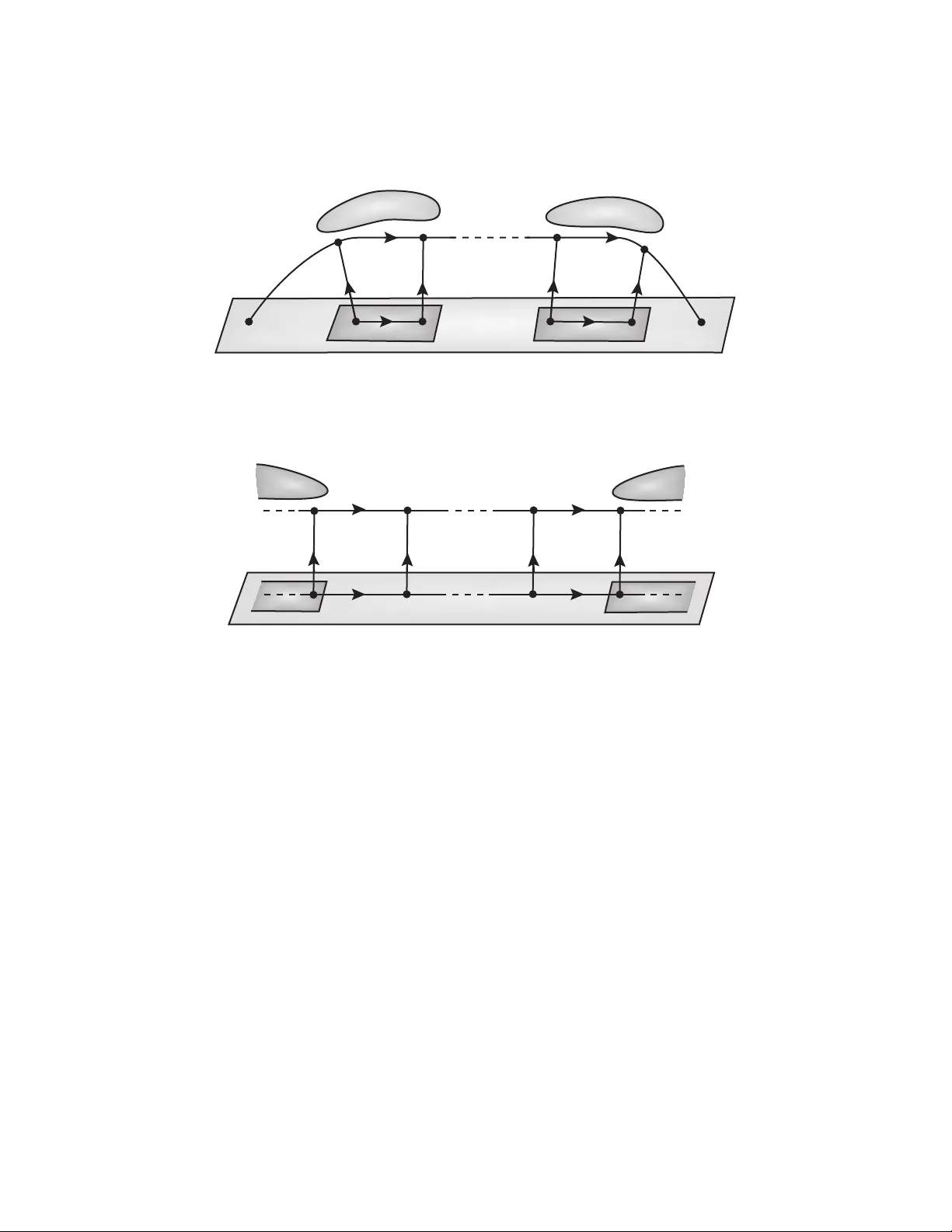
RELA TIVE HYPERBOLICITY AND RELA TIVE QUASICONVEXITY F OR COUNT ABLE GR OUPS G. CHRISTOPHER HR USKA † Abstract. W e la y the foundations for the study of relatively quasi- con vex subgroups of relatively h yp erb olic groups. These foundations require that we first work out a coheren t theory of countable relatively h yp erbolic groups (not necessarily finitely generated). W e prov e the equiv alence of Gromo v, Osin, and Bo wditch’s definitions of relativ e h y- p erbolicity for coun table groups. W e then give several equiv alen t definitions of relatively quasiconv ex subgroups in terms of v arious natural geometries on a relatively hy- p erbolic group. W e show that eac h relativ ely quasiconv ex subgroup is itself relativ ely h yperb olic, and that the intersection of tw o relativ ely quasicon vex subgroups is again relativ ely quasiconv ex. In the finitely generated case, we prov e that every undistorted subgroup is relativ ely quasicon vex, and we compute the distortion of a finitely generated rel- ativ ely quasiconv ex subgroup. 1. Introduction Gromo v in tro duced the theory of hyperb olic groups in [Gro87]. In this theory , the quasicon v ex subgroups pla y a cen tral role. They are geometri- cally the simplest and most natural subgroups: those whose in trinsic geom- etry (the word metric with resp ect to a finite generating set) is preserv ed under the embedding into the hyperb olic group. The tw o most fundamen tal prop erties of quasiconv ex subgroups of a hyperb olic group are the follo wing. (1) Each quasiconv ex subgroup is itself word hyperb olic. (2) The intersection of tw o quasiconv ex subgroups is quasiconv ex. In the same article, Gromo v also introduced relativ ely hyperb olic groups. In the presen t article, we lay the foundations for a theory of “relatively quasicon v ex” subgroups, which are exp ected to play a central role in the theory of relatively hyperb olic groups. There are sev eral equiv alen t w ays to form ulate this idea. Two of these form ulations were in troduced by Dahmani and Osin [Dah03a, Osi06] in sp ecial cases. Indeed Osin’s definition has already b een used in work of Mart ´ ınez-P edroza [MP09, MP] and Manning– Mart ´ ınez-P edroza [MMP10]. Date : No vem ber 26, 2024. 2000 Mathematics Subje ct Classific ation. 20F67, 20F65. † Researc h supp orted b y NSF grants DMS-0505659 and DMS-0731759. 1 RELA TIVE HYPERBOLICITY FOR COUNT ABLE GROUPS 2 Y et Dahmani’s and Osin’s definitions w ere not previously kno wn to b e equiv alent, and neither of these notions w as kno wn to satisfy both of the fun- damen tal prop erties ab ov e. In addition, no criterion w as previously known for relative quasicon v exit y using the “intrinsic” geometry of geo desics in the Ca yley graph (for a finite generating set). In this article, w e give several definitions of relativ e quasiconv exit y , pro v e their equiv alence, and use them to pro ve many properties of such subgroups. In particular, we sho w that relativ ely quasiconv ex subgroups satisfy analogues of the t w o fundamental prop erties listed ab ov e. 1.1. Non–finitely generated groups and relative h yp erb olicit y . His- torically the main conceptual difficulty to forming a satisfying theory of relativ e quasicon v exity has b een the necessity of considering non–finitely generated groups. Relativ ely h yp erb olic groups hav e been defined in differ- en t w a ys b y Gromov, F arb, and Dru , tu–Sapir [Gro87, F ar98, DS05]. Three differen t mo del geometries arise in these three definitions. The geometry in Gromo v’s definition can b e obtained b y attac hing “horoballs” to the p eriph- eral subgroups. This definition generalizes the fundamental group of a finite v olume h yperb olic manifold. The geometry in F arb’s definition (of strong relativ e hyperb olicity) is obtained by collapsing each p eripheral subgroup to a set of b ounded diameter. This definition generalizes the structure of a free pro duct acting on its Bass–Serre tree. The geometry in Dru , tu–Sapir’s definition is the “intrinsic” geometry of the word metric with resp ect to a finite generating set. This definition generalizes the geometry of a CA T(0) space with isolated flats. These mo del geometries hav e substantially differ- en t fla v ors. F arb’s and Dru , tu–Sapir’s definitions each require that the group in ques- tion b e finitely generated. How ever, Gromo v’s definition requires only that the group b e countable. (It m ust act prop erly discontin uously on a prop er metric space.) In the setting of finitely generated groups, these three defi- nitions are equiv alent. (See Bo wditc h [Bow99] and Dru , tu–Sapir [DS05] for details.) Bo wditc h and Osin hav e given v arian ts of F arb’s definition that do not require finitely generated groups [Bow99, Osi06]. (They are v ariants in the sense that they essentially use the same mo del geometry introduced b y F arb.) The exact relation b et w een these definitions has not b een clear. Man y researchers ha v e concluded that finite generation should b e part of the definition of relative h yp erb olicit y . (Gromo v and Osin are notable ex- ceptions to this trend.) Indeed, no version of Dru , tu–Sapir’s definition is kno wn for non–finitely generated groups. Y et an y natural definition of relativ ely quasicon v ex subgroups will include non–finitely generated groups. Additionally , the intersection of t wo finitely generated relatively quasiconv ex subgroups is often not finitely generated. Th us in order to form ulate a natural theory of relative hyperb olicity , w e m ust allo w non–finitely generated relatively hyperb olic groups. RELA TIVE HYPERBOLICITY FOR COUNT ABLE GROUPS 3 The following theorem reconciles the v arious existing definitions in to a unified theory of relative hyperb olicity that includes all of the ab o v e ex- amples. See Section 3 for precise statemen ts of the v arious definitions of relativ e h yp erb olicit y . Theorem 1.1. If G is c ountable and P is a finite c ol le ction of infinite sub gr oups of G , then the definitions of r elative hyp erb olicity for ( G, P ) given by Gr omov, Bowditch, and Osin ar e e quivalent. In fact, there are numerous examples of non–finitely generated relativ ely h yp erb olic groups: • A free pro duct A ∗ B where A or B is not finitely generated is rela- tiv ely h yp erb olic with resp ect to the factors. • A non uniform lattice Γ in a rank one Lie group G ov er a nonarc hime- dian lo cal field is relatively h yp erb olic with resp ect to its parab olic subgroups by Lub otzky [Lub91]. These lattices are never finitely generated. A typical example is the lattice Γ = SL 2 F q [ t ] in the group G = SL 2 F q ((1 /t )) . In this case Γ acts on the Bruhat–Tits tree for G with quotient a ray . • Many relatively quasiconv ex subgroups of relativ ely h yp erb olic groups are not finitely generated. 1.2. Relativ e quasiconv exity . As mentioned ab ov e, t w o differen t defini- tions of a relatively quasiconv ex subgroup H of a relativ ely h yperb olic group G ha v e b een in tro duced b y Dahmani and Osin in the special case that G is finitely generated. Dahmani’s “dynamical quasiconv exit y” is defined in terms of the dynamics at infinit y in Gromo v’s mo del geometry . Osin’s “rel- ativ e quasiconv exit y” is defined in terms of F arb’s “coned–off ” mo del geom- etry and mak es sense only for subgroups of a finitely generated relatively h yp erb olic group. Dahmani’s definition immediately implies that a dynam- ically quasiconv ex subgroup is itself relativ ely hyperb olic. On the other hand, Mart ´ ınez-P edroza used Osin’s definition to prov e that the intersec- tion of tw o relatively quasiconv ex subgroups is again relatively quasicon v ex [MP09]. Osin asked whether the tw o definitions are equiv alent, and also ask ed whether all relativ ely quasiconv ex subgroups are relatively hyperb olic (using his definitions) [Osi06]. In this article, we clarify the notion of relativ ely quasicon vex subgroups by giving criteria for relativ e quasiconv exit y in terms of the mo del geometries of Gromov, F arb, and Dru , tu–Sapir. (Recall that Dru , tu–Sapir’s geometry , the word metric for a finite generating set, is defined only when G is finitely generated.) When G is finitely generated, these subgroups coincide with those studied b y Dahmani and Osin. A significan t part of this pap er in v olv es sho wing that v arious definitions of relativ e quasicon vexit y are equiv alen t. This equiv alence has sev eral consequences. Theorem 1.2. L et G b e a c ountable gr oup that is r elatively hyp erb olic with r esp e ct to a finite family of sub gr oups P = { P 1 , . . . , P n } . RELA TIVE HYPERBOLICITY FOR COUNT ABLE GROUPS 4 (1) If H ≤ G is r elatively quasic onvex, then H is r elatively hyp erb olic with r esp e ct to a natur al induc e d c ol le ction of sub gr oups. (2) If H 1 , H 2 ≤ G ar e r elatively quasic onvex, then H 1 ∩ H 2 is also r ela- tively quasic onvex. In the manifold setting, our characterization of relative quasiconv exit y has the following corollary . Corollary 1.3. L et G b e a ge ometric al ly finite sub gr oup of Isom( X ) for X a c omplete, simply c onne cte d manifold with pinche d ne gative curvatur e. Then H ≤ G is r elatively quasic onvex ( with r esp e ct to the maximal p ar ab olic sub gr oups of G ) if and only if H is ge ometric al ly finite. F urthermor e, if H, K ≤ G ar e ge ometric al ly finite then H ∩ K is also ge ometric al ly finite. In the sp ecial case when X is the real h yp erb olic space H n , the second claim of the preceding corollary is due to Susskind–Swarup [SS92]. See also Corollary 1.6 b elow, which strengthens the first conclusion in the real h yp erb olic case. The preceding corollary appears to be new ev en in the sp ecial case of complex hyperb olic manifolds. If G is relativ ely h yp erb olic, H ≤ G is relatively quasicon v ex, and b oth H and G are finitely generated, we compute the distortion of H in G , which measures the difference b etw een the word metric on H and the word metric on G . See Theorem 10.5 for a more precise statemen t. Theorem 1.4. L et G b e r elatively hyp erb olic with r esp e ct to P 1 , . . . , P n . Supp ose H ≤ G is r elatively quasic onvex, and b oth H and G ar e finitely gener ate d. Then the distortion of H in G is a c ombination of the distortions of the infinite sub gr oups O ≤ P i wher e O = g H g − 1 ∩ P i . Mor e pr e cisely, the distortion ∆ G H of H in G satisfies f ∆ G H f wher e f is the supr emum of the distortions of the sub gr oups O ≤ P i and f is the sup er additive closur e of f . The pro of of this theorem uses a characterization of relative quasiconv ex- it y in terms of the w ord metric on G with resp ect to a finite generating set. Indeed Gromov’s and F arb’s mo del geometries are p o orly suited to pro ve suc h a result, since the subgroups P i are badly distorted in these geometries (exp onen tially distorted in the Gromov mo del and crushed to a finite diam- eter in the F arb mo del). On the other hand, the pro of is quite natural using the w ord metric b ecause b y Dru , tu–Sapir [DS05] the p eripheral subgroups P i are undistorted in G . Dru , tu–Sapir previously show ed that undistorted subgroups of a finitely generated relatively h yperb olic group are themselves relativ ely hyperb olic [DS05]. The following theorem places Dru , tu–Sapir’s result in the con text of relativ e quasicon v exity . RELA TIVE HYPERBOLICITY FOR COUNT ABLE GROUPS 5 Theorem 1.5 (Undistorted = ⇒ relatively quasicon v ex) . L et G b e a finitely gener ate d r elatively hyp erb olic gr oup and let H b e a finitely gener ate d sub- gr oup. If H is undistorte d in G , then H is r elatively quasic onvex. Using Theorem 1.4 and a result of the author from [Hru05], we obtain a c haracterization of the geometrically finite subgroups H of a geometrically finite Kleinian group G that strengthens the conclusion of Corollary 1.3. Corollary 1.6. L et G b e a ge ometric al ly finite sub gr oup of Isom( H n ) , and let H ≤ G b e a sub gr oup. The fol lowing ar e e quivalent. (1) H is ge ometric al ly finite. (2) H is r elatively quasic onvex with r esp e ct to the maximal p ar ab olic sub gr oups of G . (3) H is finitely gener ate d and undistorte d in G , in the sense that the inclusion H → G is a quasi-isometric emb e dding with r esp e ct to the wor d metrics for finite gener ating sets. (4) H is CA T(0) –quasic onvex in G , in the sense that whenever G acts pr op erly, c o c omp actly, and isometric al ly on any CA T(0) sp ac e X , the orbits of H ar e quasic onvex in X . 1.3. Summary of the sections. In Section 2 we review the definition of a horoball in a δ -hyperb olic space and pro v e several lemmas ab out geo desics in horoballs. In Section 3 we explicitly state six different definitions of relative h yp erb olicit y . Section 4 is a review of Grov es–Manning’s construction of com binatorial horoballs based on a connected graph. W e observe that their construction can b e applied more generally to produce horoballs based on an arbitrary metric space. Using this observ ation, we state more general v ersions of some results of Gro v es–Manning that w e apply in the follo wing section. Section 5 consists of the pro of that the six definitions of relativ e h yp erb olicit y are equiv alen t. Man y of the directions are prov ed b y observing that v arious proofs in the literature go through without c hange when one uses w eak er h yp otheses. In Section 6 w e in tro duce five equiv ale n t definitions of relativ e quasi- con v exity for subgroups of a relativ ely hyperb olic group. Section 7 contains a pro of of the equiv alence of the definitions in troduced in the previous sec- tion. In Section 8 w e turn our atten tion to the w ord metric on a relatively h yp erb olic group G with a finite generating set. In the case when G is finitely generated, we c haracterize relatively quasicon vex subgroups H in terms of the word metric on G . In Section 9 we prov e several basic results ab out relatively quasiconv ex subgroups, including Theorems 1.2 and 1.5 and Corollary 1.3. W e also char- acterize strongly relativ ely quasiconv ex subgroups, which w ere in tro duced b y Osin in [Osi06]. Finally in Section 10 w e examine distortions of rel- ativ ely quasiconv ex subgroups, proving Theorem 10.5 (Theorem 1.4) and Corollary 1.6. RELA TIVE HYPERBOLICITY FOR COUNT ABLE GROUPS 6 1.4. Remark. Shortly after the initial circulation of this article, Agol– Gro v es–Manning [A GM09] in tro duced another definition of a relativ ely quasi- con v ex subgroup. Manning and Mart ´ ınez-P edroza [MMP10] ha v e sho wn that this definition is equiv alen t to definition QC-3 of the presen t article. 2. Hyperbolic sp aces and hor oballs A geo desic space ( X , ρ ) is δ –hyp erb olic if ev ery geo desic triangle with ver- tices in X is δ –thin in the sense that each side lies in the δ –neigh b orho od of the union of the other t wo sides. If X is a δ –hyperb olic space, the b oundary (or b oundary at infinity ) of X , denoted ∂ X , is the set of all equiv alence classes of geo desic ra ys in X , where t w o ra ys c, c 0 are equiv alen t if the dis- tance d c ( t ) , c 0 t ) remains b ounded as t → ∞ . The set ∂ X has a natu- ral top ology , whic h is compact and metrizable (see, for instance, Bridson– Haefliger [BH99] for details). Increasing the constant δ if necessary , we will also assume that every geo desic triangle with vertices in X ∪ ∂ X is δ –thin. Let ∆ = ∆( x, y , z ) b e a triangle with vertices x, y , z ∈ X ∪ ∂ X . A c enter of ∆ is a p oint w ∈ X such that the ball B ( w , δ ) intersects all three sides of the triangle. It is clear that each side of ∆ con tains a cen ter of ∆. A function h : X → R is a hor ofunction ab out a p oint ξ ∈ ∂ X if there is a constan t D 0 suc h that the follo wing holds. Let ∆( x, y , ξ ) b e a geodesic triangle, and let w ∈ X b e a cen ter of the triangle. Then h ( x ) + ρ ( x, w ) − h ( y ) − ρ ( y , w ) < D 0 . A closed subset B ⊆ X is a hor ob al l c enter e d at ξ if there is a horofunction h ab out ξ and a constant D 1 suc h that h ( x ) ≥ − D 1 for all x ∈ B and h ( x ) ≤ D 1 for all x ∈ X − B . W e remark that every horoball or horofunction has a unique cen ter, and ev ery ξ ∈ ∂ X is the center of a horofunction (see Gromo v [Gro87, Section 7.5] for details). Lemma 2.1. L et B b e a hor ob al l of a δ –hyp erb olic sp ac e ( X, ρ ) . F or e ach L > 0 , ther e is a c onstant M 0 = M 0 ( B , L ) such that any ge o desic c in N L ( X − B ) ∩ B has length at most M . The notation N r ( A ) denotes the op en r –neighborho o d of A ; i.e., the set of all p oints at a distance less than r from A . Pr o of. Let ξ ∈ ∂ X b e the center of B , and choose a horofunction h and constan ts D 0 , D 1 for B as ab ov e. Supp ose c has endp oin ts x 0 and x 1 , and c ho ose geodesic rays [ x i , ξ ) for i = 1 , 2. Cho ose z ∈ c within a distance 2 δ of b oth rays [ x i , ξ ), and c ho ose a ra y [ z , ξ ). In order to complete the pro of, it suffices to b ound ρ ( x i , z ) from ab ov e. W e first compute an upp er b ound for h ( z ). If we choose w ∈ X − B such that ρ ( w , z ) < L , then h ( w ) ≤ D 1 . Applying the definition of horofunction RELA TIVE HYPERBOLICITY FOR COUNT ABLE GROUPS 7 to a triangle with vertices w , z , ξ and center p ∈ [ w , z ], giv es h ( z ) + ρ ( z , p ) < h ( w ) + ρ ( z , p ) + D 0 . Th us w e obtain the following upp er b ound: h ( z ) < h ( w ) + ρ ( w , p ) − ρ ( z , p ) + D 0 ≤ h ( w ) + ρ ( w , z ) + D 0 ≤ D 1 + L + D 0 . On the other hand, since x i ∈ B w e ha ve a lo w er b ound h ( x i ) ≥ − D 1 . Let ∆ i = ∆( x i , z , ξ ) b e the triangle with sides [ x i , ξ ), [ z , ξ ), and [ x i , z ], where [ x i , z ] is the p ortion of c from x i to z . Observe that z is a center of ∆ i . Applying the definition of horofunction to ∆ i , w e ha v e ρ ( x i , z ) < h ( z ) − h ( x i ) + D 0 ≤ ( D 1 + L + D 0 ) + D 1 + D 0 , completing the pro of. The follo wing result can b e also pro ved by a similar pro of. Lemma 2.2. L et B and B 0 b e hor ob al ls of ( X , ρ ) c enter e d at the same p oint ξ ∈ ∂ X . Ther e is a c onstant M 1 = M 1 ( B , B 0 ) such that any ge o desic c in B − B 0 has length at most M 1 . Lemma 2.3. L et B b e a hor ob al l of ( X , ρ ) with c orr esp onding hor ofunction h . Ther e is a c onstant M 2 = M 2 ( B , h ) such that the fol lowing holds. Sup- p ose x, y ∈ X − B satisfy h ( x ) = h ( y ) = 0 . Then for any ge o desic c joining x and y we have c ∩ ( X − B ) ⊆ N M 2 { x, y } . Pr o of. Let z b e an arbitrary p oin t of c ∩ ( X − B ). Then h ( z ) ≤ D 1 . Cho ose ra ys [ x, ξ ), [ y , ξ ) and [ z , ξ ). The p oin t z is within a distance 2 δ of one of the rays [ x, ξ ) or [ y , ξ ), sa y [ x, ξ ). Since z is a cen ter of ∆ = ∆( x, z , ξ ), the definition of horofunction implies that ρ ( x, z ) ≤ h ( z ) + D 0 ≤ D 1 + D 0 , completing the pro of. 3. Notions of rela tive hyperbolicity for count able groups It is well-kno wn that finitely generated relativ ely hyperb olic groups can b e c haracterized in several equiv alen t wa ys. In this section, we discuss natural extensions of these properties to the setting of countable groups. Through- out the section, G is a coun table group with a finite collection of subgroups P = { P 1 , . . . , P n } . RELA TIVE HYPERBOLICITY FOR COUNT ABLE GROUPS 8 3.1. Geometrically finite groups. The first definition of relative h yp er- b olicit y is in terms of dynamical prop erties of an action on a compact space M . More precisely , below w e define a group G to b e relativ ely hyperb olic if it admits a geometrically finite conv ergence group action on some com- pactum M . In fact by Corollary 5.3 b elo w the compactum M alw a ys arises as the b oundary of a δ –hyperb olic space on which G acts. Thus we lose no generality by keeping this geometric example in mind throughout the follo wing definitions. The notion of a conv ergence group action was in tro duced by Gehring– Martin in [GM87] to axiomatize certain dynamical prop erties of the action of a Kleinian group on its limit set in the ideal sphere at infinit y of real h yp erb olic space. The dynamical v ersion of geometrical finiteness defined here w as in tro duced by Beardon–Maskit [BM74] for Kleinian groups. A c onver genc e gr oup action is an action of a group G on a compact, metrizable space M satisfying the following conditions, dep ending on the cardinalit y of M : • If M is the empty set, then G is finite. • If M has exactly one p oin t, then G can b e any countable group. • If M has exactly tw o p oints, then G is virtually cyclic. • If M has at least three p oin ts, then the action of G on the space of distinct (unordered) triples of points of M is properly discontin uous. In the first three cases the action is elementary , and in the final case the action is nonelementary . Supp ose G has a conv ergence group action on M . An element g ∈ G is loxo dr omic if it has infinite order and fixes e xactly t w o p oints of M . A subgroup P ≤ G is a p ar ab olic sub gr oup if it is infinite and contains no lo xo dromic elemen t. A parab olic subgroup P has a unique fixed p oin t in M , called a p ar ab olic p oint . The stabilizer of a parabolic p oin t is alwa ys a maximal parabolic group. A parabolic p oin t p with stabilizer P := Stab G ( p ) is b ounde d if P acts cocompactly on M − { p } . A p oin t ξ ∈ M is a c onic al limit p oint if there exists a sequence ( g i ) in G and distinct p oin ts ζ 0 , ζ 1 ∈ M suc h that g i ( ξ ) → ζ 0 , while for all η ∈ M − { ξ } we hav e g i ( η ) → ζ 1 . T ukia has shown that ev ery properly discontin uous action of a group G on a prop er δ –hyperb olic space induces a con vergence group action on the b oundary at infinity [T uk94] (a similar result was pro v ed indep endently by F reden [F re95]). A conv ergence group action of G on M is ge ometric al ly finite if ev ery p oin t of M is either a conical limit point or a bounded parab olic p oin t. In addition if P is a set of represen tativ es of the conjugacy classes of maximal parab olic subgroups, then we say that the action of the pair ( G, P ) on M is geometrically finite. Observe that ev ery elemen tary conv ergence group action is geometrically finite. RELA TIVE HYPERBOLICITY FOR COUNT ABLE GROUPS 9 The follo wing definition was prop osed by Bo wditc h in [Bow99] and studied b y Y aman in [Y am04] (with the additional assumption that the p eripheral subgroups P ∈ P are finitely generated). Definition 3.1 (RH-1) . Supp ose ( G, P ) has a geometrically finite conv er- gence group action on a compact, metrizable space M . Then ( G, P ) is r ela- tively hyp erb olic . The follo wing definition is similar to the preceding one, except that w e assume that the compact space M is the b oundary of a δ –hyperb olic space. This definition was introduced by Bowditc h in [Bow99]. Definition 3.2 (RH-2) . Supp ose G has a prop erly discon tin uous action on a prop er δ –hyperb olic space X such that the induced conv ergence group action on ∂ X is geometrically finite. If P is a set of representativ es of the conjugacy classes of m aximal parab olic subgroups then ( G, P ) is r elatively hyp erb olic . In this case, we also say that ( G, P ) acts ge ometric al ly finitely on X . 3.2. Cusp uniform actions. The next definition is essen tially Gromov’s original definition of relative hyperb olicit y from [Gro87], as stated b y Bo wditc h in [Bo w99]. The structure is analogous to the w ell-known decomp osition of a finite v olume hyperb olic manifold as the union of a compact part together with finitely man y cusps due to Garland–Ragh unathan [GR70] (see also Th urston [Th u97, Section 4.5]). Definition 3.3 (RH-3) . Supp ose G acts prop erly discontin uously on a prop er δ –hyperb olic space X , and P is a set of representativ es of the con- jugacy classes of maximal parabolic subgroups. Supp ose also that there is a G –equiv ariant collection of disjoin t horoballs centered at the parab olic p oin ts of G , with union U op en in X , suc h that the quotien t of X − U by the action of G is compact. Then ( G, P ) is r elatively hyp erb olic . In this case, w e say that the action of ( G, P ) on X is cusp uniform , and the space Y = X − U is a trunc ate d sp ac e for the action. By a sligh t abuse of notation, we refer to the horoballs of U as hor ob al ls of Y . If U 0 is any other G –equiv ariant family of disjoin t op en horoballs centered at the parab olic p oin ts of X , then G also acts co compactly on Y 0 = X − U 0 , and hence Y 0 is also a truncated space for the cusp uniform action of ( G, P ) on X (see Bo wditc h [Bo w99] for details). 3.3. Fine h yp erb olic graphs. The following definition of relative h yp er- b olicit y was prop osed by Bo wditch in [Bow99] as an abstraction of the F arb approac h that does not require finite generation. Bo wditc h studied finitely generated groups satisfying this condition, but it is a completely trivial mat- ter to remov e the finite generation hypothesis from his definition. A graph K is fine if eac h edge of K is con tained in only finitely many circuits of length n for each n . RELA TIVE HYPERBOLICITY FOR COUNT ABLE GROUPS 10 Definition 3.4 (RH-4) . Supp ose G acts on a δ –hyperb olic graph K with finite edge stabilizers and finitely man y orbits of edges. If K is fine, and P is a set of represen tativ es of the conjugacy classes of infinite v ertex stabilizers then ( G, P ) is r elatively hyp erb olic . 3.4. The coned-off Ca yley graph and Bounded Coset Penetration. Next w e consider F arb’s notion of (strong) relative hyperb olicit y from [F ar98]. (Our terminology here does not agree with F arb’s and has b een adjusted to b e more consisten t with the other definitions of relativ e h yperb olicity in this article.) In brief, F arb’s definition requires that the “coned-off ” Cayley graph is h yp erb olic and satisfies Bounded Coset Penetration (defined below). F arb also considered a weak version of relative hyperb olicit y , which has many in teresting applications. W e will not discuss weak relativ e hyperb olicity here. F arb originally prop osed this definition for finitely generated groups. Af- ter the work of Bo wditc h and Osin [Bo w99, Osi06], it is clear that the follo w- ing condition is the natural form ulation of F arb’s notion in the non–finitely generated setting. Let G b e a group with a collection of subgroups P = { P 1 , . . . , P n } . A set S is a r elative gener ating set for the pair ( G, P ) if the set S ∪ P 1 ∪ · · · ∪ P n is a generating set for G in the traditional sense. W e will alw a ys implicitly assume that S is symmetrized, so that S = S − 1 . Let Γ b e the Cayley graph Ca yley( G, S ). Note that Γ is connected if and only if S is a traditional generating set for G . W e do not require connectedness of Γ. F orm a new graph ˆ Γ( G, P , S ), called the c one d-off Cayley gr aph , as follows. F or each left coset g P with g ∈ G and P ∈ P , add a new vertex v ( g P ) to Γ, and add an edge of length 1 / 2 from this new v ertex to eac h elemen t of g P . The key p oint to note here is that the coned-off Cayley graph is connected if and only if S is a relativ e generating set for ( G, P ). Giv en an oriented path γ in the coned-off Cayley graph, we say that γ p enetr ates the coset g P if γ passes through the cone p oint v ( g P ). A vertex v i of p immediately preceding the cone point is an entering vertex of p in the coset g P . Exiting vertices are defined similarly . Observe that entering and exiting vertices are alw a ys elements of G , and hence can also b e considered as v ertices of Γ. A path γ in the coned-off Ca yley graph is without b acktr acking if, for ev ery coset g P whic h γ p enetrates, γ nev er returns to g P after lea ving g P . Definition 3.5 (Bounded Coset P enetration) . Let S b e a relativ e generating set for ( G, P ). The triple ( G, P , S ) satisfies Bounde d Coset Penetr ation if for eac h λ ≥ 1, there is a constan t a ( λ ) > 0 suc h that if γ and γ 0 are ( λ, 0)–quasigeo desics without backtrac king in the coned-off Cayley graph ˆ Γ( G, P , S ) with initial endp oin ts γ − = γ 0 − and terminal endp oin ts γ + and γ 0 + , and d S ( γ + , γ 0 + ) ≤ 1, then the following tw o conditions hold. RELA TIVE HYPERBOLICITY FOR COUNT ABLE GROUPS 11 (1) If γ p enetrates a coset g P , but γ 0 do es not p enetrate g P , then the en tering v ertex and exiting v ertex of γ in g P are at an S –distance at most a from each other. (2) If γ and γ 0 b oth p enetrate a coset g P , then the entering vertices of γ and γ 0 in g P are at an S –distance at most a from eac h other. Similarly , the exiting v ertices are at an S –distance at most a from eac h other. Definition 3.6 (RH-5) . Supp ose G is finitely generated relativ e to P , and eac h P i is infinite. The pair ( G, P ) is r elatively hyp erb olic if for some (every) finite relative generating set S , the coned-off Ca yley graph ˆ Γ( G, P , S ) is δ –hyperb olic and ( G, P , S ) has Bounded Coset P enetration. In the finitely generated case, BCP is indep enden t of the c hoice of gen- erating set due to the follo wing fact: a change of generating set induces a quasi-isometry of Ca yley graphs and also a quasi-isometry of coned-off Ca yley graphs. Ho wev er, in general this indep endence is less ob vious. The difficult y is that a Cayley graph for a nongenerating set is not connected. It is p ossible for tw o group elemen ts to b e connected by an edge in one Ca yley graph and lie in distinct comp onents of another. In Section 5 w e indicate a pro of of this indep endence based on argumen ts of Dahmani [Dah03b]. 3.5. Linear relative Dehn function. Finally w e state the definition due to Osin in terms of relative isoperimetric functions introduced in [Osi06]. The definition, as presented here, includes only coun table groups G with finitely man y infinite p eripheral subgroups P = { P 1 , . . . , P n } . W e remark that Osin’s theory do es not imp ose such restrictions. Ho w ev er, these re- strictions are necessary for the equiv alence with other definitions of relativ e h yp erb olicit y . Let G b e a group with a collection of subgroups P . If ( G, P ) has a relative generating set S , then there is a canonical homomorphism from the group K := F ( S ) ∗ ∗ P ∈ P ˜ P on to G . Here F ( S ) denotes the group freely generated by S , and ˜ P denotes an abstract group isomorphic to P . Let N b e the kernel of this homomor- phism. If R ⊆ N is a subset whose normal closure in K is equal to N , then we sa y that G has a r elative pr esentation h P , S | R i . If S and R are b oth finite, then the relative presen tation ab o v e is a finite r elative pr esentation . Supp ose ( G, P ) has a relative presen tation as abov e. Consider the disjoin t union P := a P ∈ P ˜ P − { 1 } . RELA TIVE HYPERBOLICITY FOR COUNT ABLE GROUPS 12 Eac h word W in the alphabet ( S ∪ P ) naturally represen ts b oth an elemen t of K and an element of G (via the quotient map ab ov e). If W represen ts 1 in G , then in K w e ha ve an equation ( † ) W = K ` Y i =1 f − 1 i R i f i where R i ∈ R and f i ∈ K for each i . A function f : N → N is a r elative isop erimetric function for the relative presen tation h P , S | R i if for each m ∈ N and any word W ov er ( S ∪ P ) of length at most m representing the iden tit y of G , w e ha v e an equation in K of the form ( † ) with ≤ f ( m ). W e remark that some relative presentations do not admit a finite relativ e isop erimetric function. The r elative Dehn func- tion of a relative presentation is the smallest p ossible relative isop erimetric function. If there do es not exist a relative isop erimetric function with finite v alues, we say that the relativ e Dehn function is not well-defined. Definition 3.7 (RH-6) . Supp ose P is a finite collection of infinite subgroups of a coun table group G . If ( G, P ) has a finite relativ e presen tation, and the relativ e Dehn function is well-defined and linear for some/every finite relative presen tation then ( G, P ) is r elatively hyp erb olic . W e remark that if one finite relative presen tation has a linear relative Dehn function then so do es an y other b y Osin [Osi06, Theorem 2.34]. 4. The cusped sp ace Our immediate goal is to pro v e that the definitions of relativ e hyperb ol- icit y for countable groups given ab o ve are equiv alen t. As discussed b elow in Section 5 sev eral of the necessary implications are either already kno wn or follo w from straightforw ard modifications of existing pro ofs in the literature. In this section w e la y the groundw ork for the implication (RH-6) = ⇒ (RH- 3). The main step is the construction of a space obtained by attaching certain “com binatorial horoballs” to G along the left cosets of the p eripheral subgroups. The idea of gluing horoballs on to a finitely generated group is due to Cannon–Co op er [CC92], and v ariations hav e b een studied by Bowditc h, Rebb ec hi, and Grov es–Manning [Bo w99, Reb01, GM08]. The construction presented here is closely mo deled on Grov es–Manning’s com binatorial horoballs. Grov es–Manning constructed horoballs based on an arbitrary connected graph, and show ed that such a horoball is alw ays δ –hyperb olic. A minor mo dification of the Grov es–Manning construction pro duces connected horoballs based on any metric space. If the base metric space is discrete and prop er, the resulting horoball is a lo cally finite δ – h yp erb olic graph. Using this mo dification, Gro ves–Manning’s pro ofs ab out finitely gener- ated relatively hyperb olic groups extend to an y countable relativ ely hyper- b olic group equipp ed with a prop er, left inv arian t metric. RELA TIVE HYPERBOLICITY FOR COUNT ABLE GROUPS 13 Definition 4.1 (Com binatorial horoballs) . Let ( P , d ) b e a metric space. The c ombinatorial hor ob al l based on P , denoted H ( P, d ) is the graph defined as follo ws: (1) H (0) = P × N . (2) H (1) con tains the follo wing t w o t yp es of edges (a) F or each k ∈ N and p, q ∈ P , if 0 < d ( p, q ) ≤ 2 k then there is a horizontal e dge connecting ( p, k ) and ( q , k ). (b) F or eac h k ∈ N and p ∈ P , there is a vertic al e dge connecting ( p, k ) and ( p, k + 1). As in Grov es–Manning [GM08], we consider eac h edge of H to ha v e length one, and w e endo w H with the induced length metric d H . W e iden tify P with its image P × { 0 } in H . The follo wing result is pro v ed b y Grov es–Manning under the additional h yp othesis that ( P, d ) is the set of vertices of a connected metric graph where eac h edge has length one [GM08, Section 3.1]. The pro of giv en there extends with no changes to the current setting. Theorem 4.2. L et ( P , d ) b e any metric sp ac e ( with al l distanc es finite ) . Then H ( P , d ) is c onne cte d and δ –hyp erb olic for some δ ≥ 0 indep endent of ( P , d ) . Mor e over, if ( P , d ) is a discr ete, pr op er metric sp ac e, then H ( P , d ) is a lo c al ly finite gr aph. Definition 4.3 (The augmentated space) . Supp ose G is a countable group with subgroups P = { P 1 , . . . , P n } . Let S b e a finite relative generating set for ( G, P ), and choose a prop er, left in v ariant metric d i on each P i . The metric d i induces a metric (again called d i ) on each left coset g P i using left translation by g . The metric space ( g P i , d i ) is lo cally finite. Consequen tly , H ( g P i , d i ) is a lo cally finite connected graph. Let Γ b e the graph Ca yley( G, S ). The augmente d sp ac e is the space X := Γ ∪ [ H ( g P i , d i ) (1) , where the inner union ranges ov er all i = 1 , . . . , n and all left cosets g P i of P i , and where each coset g P i ⊆ Γ (0) is identified with g P i ⊂ H ( g P i , d i ) in the ob vious w a y . Observ e that X is locally finite since each combinatorial horoball is locally finite and the collection of cosets g P i is lo cally finite in G (i.e., eac h finite subset of G intersects only finitely many suc h cosets). F urthermore X is connected b ecause S is a relativ e generating set. The natural action of G on X is prop erly discontin uous and isometric. The next theorem follows from arguments of Grov es–Manning in [GM08, Section 3.3]. Gro v es–Manning assume that G is finitely generated, but their pro ofs remain v alid when G is countable and X is constructed as ab o ve. The only difference here is that w e hav e imp osed a prop er, left inv arian t metric on eac h p eripheral subgroup, while Grov es–Manning metrize eac h p eripheral subgroup using the word metric for a finite generating set. RELA TIVE HYPERBOLICITY FOR COUNT ABLE GROUPS 14 Theorem 4.4. Supp ose G is c ountable and P is a finite c ol le ction of sub- gr oups of G . Cho ose a finite r elative gener ating set S for ( G, P ) . F or e ach P i ∈ P cho ose a pr op er, left invariant metric d i . If ( G, P ) has a finite r elative pr esentation with a line ar r elative Dehn function, then the augmente d sp ac e X is δ –hyp erb olic. 5. Equiv alence of notions of rela tive hyperbolicity for count able groups The goal of this section is the follo wing theorem. Theorem 5.1. The six definitions of r elative hyp erb olicity given ab ove ar e e quivalent. In addition, c ondition (RH-5) do es not dep end on the choic e of r elative gener ating set. Our strategy for pro ving the theorem is to explain the following implica- tions: (RH-1) k s + 3 (RH-2) k s + 3 (RH-3) + 3 (RH-4) (RH-6) 5 = r r r r r r r r r r r r r r r r r r (RH-5w) k s 4 < r r r r r r r r r r r r r r r r r r (RH-5s) k s where (RH-5s) denotes the strong condition that (RH-5) holds for ev ery finite relative generating set, and (RH-5w) denotes the weak condition that it holds for some particular finite relative generating set. W e hav e included the implication (RH-5w) = ⇒ (RH-4) in order to give a more direct pro of of the equiv alence of the w eak and strong forms of (RH-5). In fact most of the ingredien ts already exist in the literature. Some are pro v ed completely , and others are prov ed for the finitely generated case but the pro ofs don’t really use finite generation. In several places we replace the Cayley graph for a finite generating set with the (p ossibly disconnected) Ca yley graph for a finite relativ e generating set. With this small c hange of p ersp ectiv e, the pro ofs in the literature go through almost verbatim. As explained in the previous section, the most significant changes o ccur in our pro of of (RH-6) = ⇒ (RH-3), where we need to modify the Grov es– Manning construction of com binatorial horoballs to accoun t for non–finitely generated groups. Note that we also use com binatorial horoballs to prov e (RH-1) = ⇒ (RH-2) in the elemen tary parab olic case. The first implication w e discuss is a consequence of the following theorem due to Y aman. Theorem 5.2 ([Y am04]) . If G acts as a nonelementary ge ometric al ly finite c onver genc e gr oup on a metrizable c omp actum M , then ther e is a pr op er δ – hyp erb olic sp ac e X on which G acts pr op erly such that M is G –e quivariantly home omorphic to ∂ X with its induc e d G –action. Corollary 5.3. Definitions (RH-1) and (RH-2) ar e e quivalent. RELA TIVE HYPERBOLICITY FOR COUNT ABLE GROUPS 15 Pr o of. The implication (RH-2) = ⇒ (RH-1) is ob vious. No w suppose ( G, P ) satisfies (RH-1). If the action of G on M is nonelemen tary , then we are done b y Theorem 5.2. If the action on M is elementary , it is a simple matter to construct an appropriate h yp erb olic space X as follo ws. If M is empty , then G acts trivially on a p oint X = { a } . If M has one point then we choose a prop er, left in v ariant metric d on G , and let G act prop erly on the com binatorial horoball X = H ( G, d ). If M has tw o p oints, then G is virtually cyclic and acts prop erly on the line X = R . In this last case, arrange the action so that g ∈ G preserv es the orientation of R if and only if g fixes b oth points of M . In eac h case it is clear that the induced action on ∂ X is equiv alent to the given action on M , establishing (RH-2). The equiv alence (RH-2) ⇐ ⇒ (RH-3) was discov ered b y Th urston in the classical setting of 3–dimensional Kleinian groups [Th u80], and has b een ex- tended to v arious manifold cases b y Apanaso v and Bo wditc h [Apa83, Bow93, Bo w95]. The following result due to Bowditc h [Bo w99] extends this equiv a- lence to actions on δ –hyperb olic spaces. Theorem 5.4 ([Bow99]) . L et G act pr op erly on a pr op er δ –hyp erb olic sp ac e X . L et P b e a finite family of sub gr oups of G . Then the action of ( G, P ) on X is ge ometric al ly finite if and only if it is cusp uniform. Corollary 5.5. Definitions (RH-2) and (RH-3) ar e e quivalent. The following is one of the main theorems of [Bo w99]. W e note that the result is stated with the extra assumption that the p eripheral subgroups are finitely generated, but this hypothesis pla ys no role in the pro of and is presen t only to make the result consistent with Bo wditch’s conv ention that p eripheral subgroups should b e finitely generated. Theorem 5.6 ([Bow99]) . Definition (RH-3) implies (RH-4) . As an aside, we remark that Bowditc h also pro v es the conv erse (RH-4) = ⇒ (RH-3) for finitely generated groups. How ev er, his proof uses the finite generation h yp othesis in an essen tial manner, and the pro of do es not extend to non–finitely generated groups. This implication is not necessary for our purp oses. Recall that in the finitely generated case (RH-5s) and (RH-5w) are equiv- alen t by a standard argument. This standard argument do es not extend in the ob vious w a y to the non–finitely generated case. Bo wditc h claims without pro of in [Bow99] that (RH-4) and (RH-5) are equiv alent for finitely generated groups. Dahmani pro vides a sketc h in [Dah03a] and a complete pro of in an app endix to his thesis [Dah03b]. Dah- mani’s proof extends with trivial mo difications to the general case. F or the b enefit of the reader, w e sketc h the outline of a pro of based on Dahmani’s argumen ts indicating places where mo difications must b e made. RELA TIVE HYPERBOLICITY FOR COUNT ABLE GROUPS 16 Pr o of of (RH-4) = ⇒ (RH-5s) . Suppose G acts on a fine, δ –hyperb olic graph K with finite edge stabilizers and finitely many orbits of edges. Cho ose edges represen ting the G –orbits, and let { v 1 , . . . , v ` } b e the set of all vertices inci- den t to an y of these finitely man y edges. If v i and v j lie in the same G –orbit, c ho ose g ij ∈ G so that g ij ( v i ) = v j . Then G is generated b y the stabilizers of the v i and the finitely man y elements g ij (see, for instance, Bridson–Haefliger [BH99, Theorem I.8.10]). In particular, G is finitely generated with resp ect to the infinite vertex stabilizers. No w let S be an arbitrary finite relative generating set for ( G, P ). Observ e that the coned-off Cayley graph ˆ Γ := ˆ Γ( G, P , S ) has trivial edge stabilizers and finitely many orbits of edges. The argumen t in [Dah03b, Lemma A.4] pro duces a fine graph K 0 with finite edge stabilizers and finitely man y orbits of edges suc h that K and ˆ Γ b oth em b ed equiv ariantly and simplicially into K 0 . An y subgraph of a fine graph is fine, so ˆ Γ is fine. F urthermore, a connected, equiv arian t subgraph of K 0 is quasi-isometric to K 0 . Since K is δ –hyperb olic, it follows that ˆ Γ is quasi-isometric to K , so ˆ Γ is δ 0 –h yp erb olic for some δ 0 ≥ 0. No w b y [Dah03b, Lemma A.5], the fineness of the coned- off Cayley graph ˆ Γ implies that ( G, P , S ) has Bounded Coset P enetration. (The pro of of [Dah03b, Lemma A.5] never uses the connectedness of Γ, so it remains v alid when S is a relativ e generating set, as opposed to a generating set in the traditional sense.) Pr o of of (RH-5w) = ⇒ (RH-4) . This implication follows directly from [Dah03b, Prop osition A.1] with no change, as Dahmani’s pro of do es not use the finite generation h yp othesis. Pr o of of (RH-5w) = ⇒ (RH-6) . This implication is prov ed b y Osin in the finitely generated case in an app endix to [Osi06]. Ho wev er, he never uses the finite generation hypothesis in the pro of. Again, the finite generation h yp othesis seems to b e presen t only to mak e the statemen t consistent with F arb’s original v ersion of (RH-5) for finitely generated groups. W e remark that Osin also gives a substan tially more inv olv ed pro of of the conv erse (RH-6) = ⇒ (RH-5) for finitely generated groups. These ar- gumen ts use finite generation extensively , and it is not clear whether the same argumen ts go through in general. Note that we do not require this implication. Pr o of of (RH-6) = ⇒ (RH-3) . Choose an y finite relative generating set S for ( G, P ) and c ho ose a proper, left inv ariant metric d i for eac h subgroup P i ∈ P . By Theorem 4.4, the augmented space X corresp onding to these data is connected and δ –hyperb olic for some δ ≥ 0. It is straightforw ard to v erify that the com binatorial horoballs of X are also horoballs as defined in Section 2. Deleting these horoballs from X giv es the (p ossibly disconnected) Ca yley graph Ca yley( G, S ) for G , on whic h G acts with compact quotien t. Therefore ( G, P ) is relatively hyperb olic in the sense of (RH-3). RELA TIVE HYPERBOLICITY FOR COUNT ABLE GROUPS 17 6. Rela tivel y quasiconvex subgroups: definitions No w that w e hav e established the notion of relative hyperb olicity for coun table groups, w e turn our atten tion to the most natural class of sub- groups, namely the relatively quasiconv ex subgroups. In this section we in tro duce these subgroups from sev eral differen t p oin ts of view, corresp ond- ing to the v arious characterizations of relativ e h yperb olicity . In eac h setting, w e describ e a geometrically natural family of “relativ ely quasicon vex” sub- groups. As before, our main goal is to show that the v arious definitions of relative quasiconv exit y are equiv alen t. As part of this equiv alence, we will show that each of the conditions b elo w is an in trinsic prop erty of the subgroup H in the relativ ely h yp erb olic group ( G, P ), and does not dep end on an y sp ecific choices made throughout the definition. Throughout this section, we assume that G is countable, P = { P 1 , . . . , P n } is a finite collection of subgroups, and that ( G, P ) is relatively hyperb olic. Definition 6.1 (Quasiconv ex subspace) . Let X b e a geo desic metric space. A subspace Y ⊆ X is κ –quasiconv ex for some κ > 0 if ev ery geo desic of X connecting t w o p oin ts of Y lies in the κ –neighborho o d of Y . Definition 6.2 (QC-1) . A subgroup H ≤ G is r elatively quasic onvex if the follo wing holds. Let M b e some (any) compact, metrizable space on which ( G, P ) acts as a geometrically finite conv ergence group. Then the induced con v ergence action of H on the limit set Λ H ⊆ M is geometrically finite. The next t wo definitions of relativ e quasicon v exit y allo w us to recognize relativ ely quasiconv ex subgroups in the setting of Gromo v’s original defini- tion of relative hyperb olicity . T o express the first, we need the notion of the join of a set in the b oundary . Definition 6.3 (Join) . Let X b e δ –hyperb olic, and suppose Λ ⊆ ∂ X is a subset with at least tw o p oin ts. The join of Λ, denoted join(Λ), is the union of all geo desic lines in X joining pairs of p oints in Λ. Remark 6.4. One should think of the join as a “quasiconv ex h ull.” In fact, it is easy to see that if X is δ –hyperb olic, then join(Λ) is a κ –quasiconv ex subspace for some κ = κ ( δ ) (see for instance Gromov [Gro87, Section 7.5.A]). By an elementary argumen t, join(Λ) is quasi-isometric to a geo desic hyper- b olic space Y whose b oundary ∂ Y is canonically homeomorphic to Λ. Any horofunction on X based at a p oint of Λ restricts to a horofunction on Y . Consequen tly a horoball of X centered in Λ restricts to a horoball of Y . Definition 6.5 (QC-2) . A subgroup H ≤ G is r elatively quasic onvex if the follo wing holds. Let X b e some (any) prop er δ –h yp erb olic space on whic h ( G, P ) has a cusp uniform action. Then either H is finite, H is parabolic, or H has a cusp uniform action on a geo desic h yp erb olic space Y quasi- isometric to the subspace join(Λ H ) ⊆ X . Definition 6.6 (QC-3) . A subgroup H ≤ G is r elatively quasic onvex if the following holds. Let ( X , ρ ) b e some (any) prop er δ –hyperb olic space on RELA TIVE HYPERBOLICITY FOR COUNT ABLE GROUPS 18 whic h ( G, P ) has a cusp uniform action. Let X − U b e some (any) truncated space for G acting on X . F or some (any) basep oin t x ∈ X − U there is a constan t µ ≥ 0 such that whenever c is a geo desic in X with endp oin ts in the orbit H x , we hav e c ∩ ( X − U ) ⊆ N µ ( H x ) , where the neighborho o d is tak en with resp ect to the metric ρ on X . The following construction w as in tro duced by F arb [F ar98] in the context of manifolds with pinc hed negativ e curv ature, and further elab orated b y Bo wditc h [Bo w99]. F arb credits the “electric” terminology to Thurston. Definition 6.7 (Electric space) . Supp ose ( G, P ) has a cusp uniform action on a δ –hyperb olic space ( X, ρ ), and let X − U b e a truncated space for the action. The ele ctric pseudometric ˆ ρ on X is the path pseudometric obtained b y modifying ρ so that it is iden tically zero on eac h horoball of U (essentially collapsing eac h horoball of U to a p oin t). The ele ctric sp ac e asso ciated to the pair ( X , U ) is the pseudometric space ( X , ˆ ρ ). A r elative p ath ( γ , α ) in ( X , U ) is a path γ together with a subset α consisting of a disjoint union of finitely many paths α 1 . . . , α n o ccurring in this order along γ suc h that eac h α i lies in some closed horoball B i of U . W e also assume that B i 6 = B i +1 . The r elative length of ( γ , α ) is the length in X of γ − α . W e write γ = β 0 ∪ α 1 ∪ β 1 ∪ · · · ∪ α n ∪ β n , where the β i are the complementary paths of γ . (Either of β 0 or β n could b e a trivial path.) A relativ e path ( γ , α ) is efficient if B i 6 = B j for i 6 = j , and is semip olygonal if eac h α i is a geo desic of X . There are natural notions of a relativ e path ( γ , α ) b eing an ele ctric ge o- desic or an ele ctric –quasige o desic given by comparing the relativ e length of an arbitrary subsegment with the electric distance b et ween its endp oin ts in the obvious wa y . The follo wing result, roughly sp eaking, sa ys that an electric quasigeo desic is also a quasigeo desic in ( X , d ). Lemma 6.8 (Lemma 7.3, [Bow99]) . Given c onstants δ, > 0 , ther e ar e c onstants r = r ( δ ) and 0 = 0 ( δ, ) so that the fol lowing holds. Supp ose ( G, P ) has a cusp uniform action on a δ –hyp erb olic sp ac e ( X , ρ ) . L et X − U b e a trunc ate d sp ac e for the action such that any two hor ob al ls of U ar e sep ar ate d in X by a ρ –distanc e at le ast r , and let ˆ ρ b e the c orr esp onding ele ctric metric. If ( γ , α ) is an efficient, semip olygonal r elative p ath in ( X, U ) and also an ele ctric –quasige o desic then γ is an 0 –quasige o desic in X . Roughly sp eaking the following definition sa ys that a subgroup is rela- tiv ely quasiconv ex if its orbits are quasicon v ex with resp ect to electric geo- desics. Definition 6.9 (QC-4) . A subgroup H ≤ G is r elatively quasic onvex pro- vided that the follo wing holds. Let ( G, P ) ha ve a cusp uniform action on RELA TIVE HYPERBOLICITY FOR COUNT ABLE GROUPS 19 some (any) δ –hyperb olic space ( X , d ), and c ho ose some (an y) truncated space X − U for the action. Supp ose each pair of horoballs of U is separated b y at least a distance r , where r = r ( δ ) is the constant giv en by Lemma 6.8. F or some (eac h) basepoint x ∈ X − U there is a constant κ > 0 so that for every efficien t, semip olygonal relative path ( γ , α ) that is also an electric geo desic connecting p oin ts of H x , the subset γ − α lies in the κ –neighborho o d of H x in ( X , ρ ). Observ e that a similar condition will hold for electric quasigeodesics con- necting p oin ts of the orbit H x , since Lemma 6.8 implies that electric quasi- geo desics with common endp oints track Hausdorff close in X . The next definition is quite close to the one in tro duced by Osin for sub- groups of a finitely generated relativ ely h yp erb olic group. The only differ- ence b et ween Osin’s definition and the one b elow is that w e use a proper, left in v ariant metric d on G where Osin used the word metric for a finite generating set. It is not clear whether one can use the w ord metric for a finite relativ e generating set in place of the prop er, left inv arian t metric. Definition 6.10 (QC-5) . A subgroup H ≤ G is r elatively quasic onvex if the following holds. Let S be some (any) finite relative generating set for ( G, P ), and let P b e the union of all P i ∈ P . Consider the Cayley graph Γ = Ca yley( G, S ∪ P ) with all edges of length one. Let d b e some (any) prop er, left inv arian t metric on G . Then there is a constan t κ = κ ( S , d ) suc h that for each geo desic c in Γ connecting t wo p oin ts of H , every vertex of c lies within a d –distance κ of H . W e will see that the preceding definition is indep enden t of the choice of finite relative generating set S and the choice of proper metric d . In particular, if S is a finite generating set for G in the traditional sense, then w e can choose d to b e the word metric for S . Thus in the finitely generated case, (QC-5) is equiv alen t to the definition given by Osin in [Osi06]. 7. Rela tive quasiconvexity: Equiv alence of definitions W e now establish the equiv alence of the v arious definitions of relative quasicon v exity introduced in the previous section. Throughout this section ( G, P ) is a relatively hyperb olic group and H is an y subgroup of G . Prop osition 7.1. Definitions (QC-1) and (QC-2) ar e e ach wel l-define d and ar e e quivalent. The pro of uses the following result due to Bo wditc h. Theorem 7.2 (Theorem 9.4, [Bo w99]) . Supp ose ( G, P ) has cusp uniform actions on sp ac es X and X 0 . Then ∂ X and ∂ X 0 ar e G –e quivariantly home- omorphic. Pr o of of Pr op osition 7.1. By Corollary 5.3, if ( G, P ) has a geometrically fi- nite con v ergence action on a compact, metrizable space M , then ( G, P ) RELA TIVE HYPERBOLICITY FOR COUNT ABLE GROUPS 20 acts geometrically finitely on a prop er δ –h yp erb olic space X and M is G – equiv ariantly homeomorphic to the boundary of X . It follo ws from Theo- rem 7.2 that condition (QC-1) do es not dep end on the choice of compactum M or the c hoice of geometrically finite action of ( G, P ) on M . Supp ose ( G, P ) has a cusp uniform action on a prop er δ –h yp erb olic space X . Then the induced action on M = ∂ X is a geometrically finite conv er- gence action. W e will show that (QC-1) holds for the action of G on M if and only if (QC-2) holds for the action of G on X . By the preceding paragraph, it follo ws immediately that (QC-2) is indep endent of the choice of X . Recall our conv en tion that the unique action of a finite group H on the empt y set is a con v ergence group action. Therefore eac h finite subgroup H ≤ G satisfies both (QC-1) and (QC-2). Similarly , the unique action of a coun table group H on a single point is a conv ergence group action. If H is parab olic then Λ H is a single point, and hence H satisfies b oth (QC-1) and (QC-2). No w supp ose H is neither finite nor parabolic. Then Λ H ⊆ ∂ X contains at least tw o points, and join(Λ H ) is a nonempt y quasicon v ex subspace of X in v ariant under the action of H . By Remark 6.4, the subspace join(Λ H ) with the subspace metric is quasi-isometric to a δ 0 –h yp erb olic geo desic space Y for some δ 0 ≥ 0, and ∂ Y is H –equiv ariantly homeomorphic to Λ H ⊆ ∂ X . Applying Theorem 5.4 to Y , w e see that (QC-1) holds for ∂ Y = Λ H if and only if (QC-2) holds for Y . Lemma 7.3. L et ( G, P ) have a cusp uniform action on a δ –hyp erb olic sp ac e ( X , ρ ) with asso ciate d trunc ate d sp ac e X − U . F or e ach N ther e is a c onstant M 1 so that the fol lowing holds. Cho ose two ρ –ge o desics c, c 0 such that max { ρ ( c − , c 0 − ) , ρ ( c + , c 0 + ) } < N . If c ∩ ( X − U ) and c 0 ∩ ( X − U ) ar e b oth nonempty then the Hausdorff ρ –distanc e b etwe en c ∩ ( X − U ) and c 0 ∩ ( X − U ) is less than M 1 . Pr o of. The geodesics c and c 0 are opp osite sides of a 2 δ –thin geodesic quadri- lateral. It follows that the Hausdorff distance in X b et w een c and c 0 is at most N 0 := N + 2 δ . Cho ose a p oint p ∈ c ∩ ( X − U ). Then p is within a distance N 0 of a p oin t q ∈ c 0 . Observe that q also lies in N N 0 ( X − U ). By Lemma 2.1 there is a segmen t of c 0 from q to X − U of length at most M 0 , where M 0 dep ends only on X − U and N 0 . Therefore p lies within a distance N 0 + M of a point r ∈ c 0 ∩ ( X − U ). In terchanging the roles of c and c 0 completes the pro of. Lemma 7.4. L et ( G, P ) have a cusp uniform action on a δ –hyp erb olic sp ac e ( X , ρ ) . L et X − U and X − U 0 b e two c orr esp onding trunc ate d sp ac es. Then ther e is a c onstant M 2 such that for e ach ρ –ge o desic c in X , if c ∩ ( X − U ) and c ∩ ( X − U 0 ) ar e b oth nonempty then the Hausdorff ρ –distanc e b etwe en c ∩ ( X − U ) and c ∩ ( X − U 0 ) is at most M 2 . RELA TIVE HYPERBOLICITY FOR COUNT ABLE GROUPS 21 Pr o of. Recall that the horoballs of U and U 0 lie in finitely man y G –orbits, corresp onding to the finitely many p eripheral subgroups of P . By shrinking the horoballs of U and U 0 equiv ariantly , we can obtain a third truncated space X − V such that V ⊆ U ∩ U 0 . If c has nonempt y intersection with eac h of the given truncated spaces then it also has nonempty intersection with X − V . Th us it suffices to prov e the lemma in the sp ecial case when U 0 ⊆ U . Moreo ver, it is enough to consider the further sp ecial case that U and U 0 differ on only one orbit of horoballs, since this case can be iterated finitely man y times to obtain the desired result. Supp ose U and U 0 agree on all but one orbit, and this exceptional orbit is represen ted by horoballs B and B 0 of U and U 0 resp ectiv ely , such that B 0 ⊂ B . Then X − U ⊂ X − U 0 . Clearly w e ha ve c ∩ ( X − U ) ⊆ c ∩ ( X − U 0 ) . On the other hand, any subsegment c of c that lies in X − U 0 but not in X − U is a translate of a geo desic in B − B 0 . By Lemma 2.2, suc h a segmen t has length at most M 1 = M 1 ( B , B 0 ). Thus c ∩ ( X − U 0 ) ⊆ N M 0 c ∩ ( X − U ) , completing the pro of. Prop osition 7.5. Supp ose ( G, P ) has a cusp uniform action on ( X, ρ ) , and H ≤ G . If H satisfies (QC-3) with r esp e ct to one choic e of trunc ate d sp ac e X − U and b asep oint x ∈ X − U , then H satisfies (QC-3) with r esp e ct to any other trunc ate d sp ac e X − U 0 and b asep oint x 0 . Pr o of. Let us first consider the effect of changing the basep oin t x ∈ X − U to another point x 0 ∈ X − U in the same truncated space. Cho ose h 0 , h 1 ∈ H , a ρ –geo desic c from h 0 ( x ) to h 1 ( x ), and a ρ –geo desic c 0 from h 0 ( x 0 ) to h 1 ( x 0 ). Then ρ ( c − , c 0 − ) = ρ ( c + , c 0 + ) = ρ ( x, x 0 ) . By Lemma 7.3, the Hausdorff distance b etw een c ∩ ( X − U ) and c 0 ∩ ( X − U ) is at most M 1 for some constant M 1 that depends on x and x 0 but not on the choice of h 0 and h 1 . If c ∩ ( X − U ) lies in N κ ( H x ) then c 0 ∩ ( X − U ) lies in N κ + M 1 ( H x 0 ). Therefore if w e fix X − U , then (QC-3) do es not dep end on the choice of basep oint x ∈ X − U . No w supp ose X − U and X − U 0 are tw o truncated spaces corresponding to the action of G on X . Choose basep oints x ∈ X − U and x 0 ∈ X − U 0 . Shrinking horoballs, w e can obtain a third truncated space X − V with V ⊆ U ∩ U 0 . In particular, note that x and x 0 b oth lie in X − V . If H satisfies (QC-3) with respect to X − U with basep oin t x , then by Lemma 7.4 it also satisfies (QC-3) with resp ect to X − V with basep oin t x . By the preceding paragraph, H also satisfies (QC-3) with resp ect to X − V and basep oint x 0 . Finally , another application of Lemma 7.4 shows that H satisfies (QC-3) with resp ect to X − U 0 and basep oin t x 0 . RELA TIVE HYPERBOLICITY FOR COUNT ABLE GROUPS 22 Th us (QC-3) is indep enden t of the choice of truncated space X − U and indep enden t of the choice of basep oint x ∈ X − U . Prop osition 7.6. Definition (QC-3) is wel l-define d and e quivalent to Def- inition (QC-2) . Pr o of. In Prop osition 7.5 w e show ed that for each fixed cusp uniform action of ( G, P ) on a space ( X , ρ ), whether a subgroup H satisfies (QC-3) do es not dep end on the c hoice of truncated space and basep oin t. In Prop osition 7.1 w e sho wed that (QC-2) do es not dep end on the c hoice of space X or the c hoice of cusp uniform action of ( G, P ) on X . Thus, in order to show that (QC-3) is also indep enden t of the space X and cusp uniform action, it suffices to sho w that (QC-2) holds for a particular action of G on X if and only if (QC-3) holds for the same action with resp ect to some c hoice of truncated space X − U and basep oin t x ∈ X − U . (QC-2) = ⇒ (QC-3): Cho ose an y truncated space X − U for the action of G on X . If H is finite, then (QC-3) is immediate since the orbit H x is bounded. If H is parabolic with parabolic fixed p oint p ∈ ∂ X , and x ∈ X − U is any basep oin t, then there is a horofunction based at p that is identically zero on the orbit H x . Let B b e the horoball of U cen tered at p . By Lemma 2.3, there is a constant M 2 suc h that for each geo desic c = [ a, b ] connecting tw o p oin ts of H x , we hav e c ∩ ( X − U ) ⊆ N M 2 { a, b } . Th us (QC-3) holds for H . No w supp ose Λ H contains at least t w o p oin ts. Then join(Λ H ) is nonempt y and κ –quasicon v ex for some κ > 0. Suppose the action of H on Y is cusp uni- form, where Y is quasi-isometric to join(Λ H ). Under this quasi-isometry , ev- ery horoball of Y pulls bac k to a subset of join(Λ H ) of the form B ∩ join(Λ H ) for some horoball B of X . Therefore, the action of H on join(Λ H ) is “cusp uniform” in the sense that X con tains a union of horoballs U 0 cen tered at the parab olic p oin ts of H suc h that the horoballs lie in finitely many H –orbits and such that H acts co compactly on the “truncated space” join(Λ H ) − U 0 . Shrink the horoballs of U 0 H –equiv arian tly so that ρ ( U 0 , X − U ) > κ . Then H still acts co compactly on join(Λ H ) − U 0 . Let ν < ∞ b e the ρ – diameter of a compact set K ⊆ X whose H –translates co ver join(Λ H ) − U 0 . Cho ose a basep oint x ∈ join(Λ H ) − U 0 , and let c b e a geo desic in X connecting tw o p oin ts of H x . Since the endpoints of c lie in join(Λ H ), the κ –quasicon v exity of join(Λ H ) implies that each p ∈ c ∩ ( X − U ) is within a distance κ of a p oin t q ∈ join(Λ H ). Observe that q is also in N κ ( X − U ). By our c hoice of U 0 , it follo ws that b oth x and q lie in join(Λ H ) − U 0 . Therefore, for some h ∈ H , we ha ve ρ ( hx, q ) < ν , establishing (QC-3). (QC-3) = ⇒ (QC-2): Supp ose ( G, P ) has a cusp uniform action on ( X , ρ ), and H ≤ G is infinite and not parabolic. Then join(Λ H ) is nonempty and κ –quasicon v ex for some κ > 0, and quasi-isometric to a h yp erbolic geo desic RELA TIVE HYPERBOLICITY FOR COUNT ABLE GROUPS 23 space Y . In order to establish (QC-2), it suffices to show that the action of H on Y 0 := join(Λ H ) is cusp uniform in the ab ov e sense. Cho ose a truncated space X − U for the cusp uniform action of G on X and a basep oin t x ∈ Y 0 − U such that H satisfies (QC-3) with respect to X − U and x using quasicon vexit y constant µ . Then an y geo desic c connecting tw o p oints of H x satisfies c ∩ ( X − U ) ⊆ N µ ( H x ) If c is a bi-infinite geo desic in X obtained as a p oint wise limit of suc h seg- men ts c , then c connects tw o p oints of Λ H and satisfies c ∩ ( X − U ) ⊆ N µ ( H x ) . Since X is δ –hyperb olic, and each p oint of Λ H is a limit p oint of H x , every geo desic connecting tw o points of Λ H lies in the 2 δ –neighborho o d of such a geo desic c . (This is b ecause any t w o bi-infinite geodesics with the same endp oin ts at infinit y in a δ –hyperb olic space hav e Hausdorff distance at most 2 δ .) Therefore Y 0 − U ⊆ N 2 δ + µ ( H x ) , pro ving that H acts co compactly on Y 0 − U . In order to establish (QC-2), w e m ust sho w that H acts co compactly on Y 0 − U 0 , where U 0 is an H –equiv ariant family of horoballs centered only at the parab olic p oints of H . It suffices to show that the horoballs B of U that meet Y 0 and are not based in Λ H ha ve uniformly bounded in tersections with Y 0 . Since then Y 0 − U is quasidense in Y 0 − U 0 . If a horoball B of U − U 0 meets Y 0 , then it also meets Y 0 − U , which lies in N 2 δ + µ ( H x ). Hence, ρ ( B , H x ) is at most 2 δ + µ . Then the translate hB of B b y some elemen t h ∈ H in tersects B ( x, 2 δ + µ ). Since only finitely man y horoballs of U meet any metric ball in X , the horoballs of U meeting Y 0 m ust lie in only finitely many H –orbits. If suc h a horoball is not based in Λ H , then its intersection with Y 0 is bounded. Com bining these b ounds for the finitely many H –orbits gives a uniform b ound on the diameter of all suc h in tersections, whic h completes the pro of. Prop osition 7.7. Definition (QC-4) is wel l-define d and e quivalent to (QC- 3) . Pr o of. Recall that we ha v e sho wn that if a subgroup H ≤ G satisfies (QC-3) with resp ect to a cusp uniform action, truncated space, and basep oint, then it satisfies (QC-3) with resp ect to an y other suc h choices. Cho ose a prop er δ –hyperb olic space ( X, ρ ), a cusp uniform action of ( G, P ) on X , a truncated space X − U , and a basepoint x ∈ X − U . Supp ose further that the horoballs of U are pairwise separated by a ρ –distance at least r , where r = r ( δ ) is the constant provided by Lemma 6.8. W e will show that H satisfies (QC-3) with resp ect to these choices if and only if it satisfies (QC-4). More sp ecifically , w e will show that there is a constan t L such that the follo wing holds. Let c be a ρ –geo desic and ( γ , α ) a semip olygonal relative RELA TIVE HYPERBOLICITY FOR COUNT ABLE GROUPS 24 path that is also an electric geo desic. If c and γ ha v e the same endp oin ts in H x , then the Hausdorff ρ –distance b etw een c ∩ ( X − U ) and γ − α is at most L . By Lemma 6.8, the path γ is an –quasigeo desic in ( X , ρ ) for some uniform constan t . By the Morse Lemma, the Hausdorff ρ –distance b et w een c and γ is at most η = η ( δ , ). Since ( γ , α ) is an electric geo desic with respect to ( X , U ), the subset γ − α m ust lie in X − U . Therefore any p oint p ∈ γ − α is within a ρ –distance η of a p oint q ∈ c ∩ N η ( X − U ). By Lemma 2.1 the p oint q is within a ρ –distance M 0 of a p oin t q 0 ∈ c ∩ ( X − U ), where M 0 dep ends only on η and U . (Here we are using that N η ( X − U ) differs from X − U on only finitely many orbits of horoballs.) A similar argument (using a quasigeo desic v ariation of Lemma 2.1) b ounds the distance from an arbitrary p oin t of γ − α to c ∩ ( X − U ). Th us we ha v e an upp er b ound on the Hausdorff ρ –distance b et w een γ − α and c ∩ ( X − U ). It is no w clear that if either set lies near H x , then so do es the other. It is a well-kno wn result, first observed by Efromo vic h [Efr53] that if X is a connected length space, and G is a group acting metrically prop erly , cob oundedly , and isometrically on X , then G is finitely generated and quasi- isometric to X . Recall that a length space is connected if and only if all distances are finite. The follo wing result dealing with actions on arbitrary length spaces is an easy corollary to Efromo vic h’s Theorem. Prop osition 7.8 (Disconnected Efromovic h’s Theorem) . L et X b e a length sp ac e ( p ossibly disc onne cte d ) . L et G b e a c ountable gr oup with pr op er, left invariant metric d acting metric al ly pr op erly, c ob ounde d ly, and isometric al ly on X . L et Y b e a c omp onent of X . Then the G –tr anslates of Y c over X , the stabilizer H of Y has a finite gener ating set S , and for e ach b asep oint x 0 ∈ X , the map g 7→ g ( x 0 ) induc es a quasi-isometry fr om the ( p ossibly disc onne cte d ) Cayley gr aph Cayley( G, S ) to X . Pr o of. Since any t wo components of X are separated b y an infinite distance, it is clear that H acts cob oundedly on Y . Applying Efromo vic h’s theorem to the action of H on the connected length space Y gives a finite generating set S for H and sho ws that Cayley( H, S ) is quasi-isometric to Y . Note that if H 6 = G , then Ca yley( G, S ) and X are b oth disconnected with all comp onents separated b y infinite distances. Since G acts on X with a connected quotient, the translates of Y co ver X . In other words, the path comp onents of X are precisely the translates of Y , which are in one-to-one corresp ondence with the left cosets g H of H in G , which in turn correspond to the path comp onen ts in the Cayley graph. Prop osition 7.9. Supp ose ( G, P ) is r elatively hyp erb olic with finite r elative gener ating set S . L et ( G, P ) have a cusp uniform action on ( X , ρ ) with asso ciate d trunc ate d sp ac e X − U . Supp ose the hor ob al ls of U ar e p airwise sep ar ate d by some minimum p ositive distanc e r . RELA TIVE HYPERBOLICITY FOR COUNT ABLE GROUPS 25 F or e ach b asep oint x ∈ X − U the orbit map g 7→ g ( x ) extends to a quasi-isometry f : Cayley( G, S ∪ P ) → ( X , ˆ ρ ) , wher e ˆ ρ denotes the ele ctric pseudometric for ( X , U ) . F urthermor e, f c an b e chosen so that e ach ge o desic e dge-p ath in the Cayley gr aph maps to an efficient semi-p olygonal r elative p ath in ( X , U ) . Pr o of. Cho ose a basep oint x ∈ X − U , and let Z b e the rectifiable-path comp onen t of X − U containing x . Then Z is connected when endow ed with the induced length metric. Let Y b e the union of all G –translates of Z . Since G acts co compactly on ( X − U, ρ ) and Y is a nonempt y , G –equiv arian t subspace of X − U , it follo ws that Y is quasi-dense in ( X − U, ρ ). Therefore, G acts on Y with a rectifiable-path connected quotient. Let ρ denote the length metric on Y induced by ρ . Then G acts cob oundedly , metrically prop erly , and isometrically on ( Y , ρ ). By Prop osition 7.8, the stabilizer H of Z is generated by a finite set T , and the orbit map g 7→ g ( x ) induces a quasi-isometry Ca yley( G, T ) → ( Y , ρ ). Under this quasi-isometry , the set of left cosets g P for all g ∈ G and all P ∈ P corresponds with the set of horoballs in U . The electric space ( X, ˆ ρ ) is quasi-isometric to its quasi-dense subspace ( Y , ˆ ρ ), whic h in turn is clearly quasi-isometric to Ca yley( G, T ∪ P ). In particular, since the electric space is connected, this Ca yley graph is also connected, establishing that T is a relative generating set for ( G, P ). By an elemen tary argumen t (see, for instance, Osin [Osi06, Prop osition 2.8]), the iden tit y G → G induces a quasi-isometry Ca yley( G, S ∪ P ) → Cayley( G, T ∪ P ) for any other relativ e generating set S . Comp osing these quasi-isometries giv es a quasi-isometry f : Cayley( G, S ∪ P ) → ( X , ˆ ρ ) mapping g 7→ g ( x ) for eac h g ∈ G . Since G is quasi-dense in the Cayley graph, w e can mo dify f so that it sends the edges of the Ca yley graph to an y relativ e paths w e lik e, pro vided that the relative lengths of these paths are uniformly b ounded. F or eac h generator s ∈ S , c ho ose a ρ –geo desic β s from x to s ( x ), considered as a relativ e path ( γ , α ) with α empty . Let f map eac h Ca yley graph edge lab eled b y s to the appropriate translate of β . F or each P ∈ P , choose a ρ –geo desic β P from x to the horoball B stabilized by P . F or eac h generator lab eled by p ∈ P , let ( γ p , α p ) b e the relative path with γ p := β P ∪ α p ∪ ( p ◦ β P ), where α p is a ρ –geo desic path in B from the terminal p oin t b of β P to the p oin t p ( b ), and where the bar indicates following a path in the reverse direction. Let f map each Ca yley graph labeled by p to the appropriate translate of ( γ p , α p ). Observ e that eac h edge path in the Ca yley graph is mapp ed by f to a semip olygonal relative path. F urthermore, if the image ( γ , α ) is not efficien t, and α is a disjoin t union of paths α 1 , . . . , α n , then for some i < j the paths RELA TIVE HYPERBOLICITY FOR COUNT ABLE GROUPS 26 α i and α j lie in the same horoball B . Let e i and e j b e the corresp onding edges in the Cayley graph. It follo ws that the initial p oin t v of e i and the terminal p oin t w of e j lie in the same left coset g P of some P ∈ P . In particular, in the Cayley graph, the distance from v to w is at most 1, so the giv en edge path cannot b e geo desic. Prop osition 7.10. Definition (QC-5) is wel l-define d and e quivalent to (QC- 4) . Pr o of. Fix a finite relativ e generating set S for ( G, P ), and supp ose H sat- isfies (QC-5) with resp ect to S and some proper left-in v arant metric d with quasicon v exity constant κ = κ ( S , d ). W e first show that (QC-5) contin ues to hold if w e replace d with another proper left-inv ariant metric d 0 . Let B b e the finite ball of radius κ cen tered at the identit y in the metric space ( G, d ). Let κ 0 := max { d 0 (1 , g ) | g ∈ B } + 1 < ∞ . W e will see that (QC-5) holds for S and d 0 with κ ( S , d 0 ) := κ 0 . Let c b e any geo desic in Ca yley( G, S ∪ P ) connecting tw o points of H , and let v ∈ G b e a vertex of c . Then there is an element w ∈ H suc h that d ( v , w ) < κ . Since d is left-in v ariant, d (1 , v − 1 w ) < κ so that v − 1 w ∈ B . But then d 0 ( v , w ) = d 0 (1 , v − 1 w ) < κ 0 as desired, establishing (QC-5) for S and d 0 . Note that the ab o v e argument holds ev en if d or d 0 is a pseudometric (rather than a metric) pro vided that b oth are prop er and left-in v ariant. No w let us consider the equiv alence of (QC-4) and (QC-5). Fix a finite relativ e generating set S for ( G, P ) and a cusp uniform action of ( G, P ) on a prop er δ –hyperb olic space ( X , ρ ) with an asso ciated truncated space X − U . Supp ose further that the horoballs of U are pairwise separated b y at least a distance r , where r = r ( δ ) is the constant giv en by Lemma 6.8. Fix a basep oin t x ∈ X − U . Define a prop er left-in v ariant pseudometric d G on G using distances in X b etw een orbit p oin ts; that is, w e set d G ( g 1 , g 2 ) := ρ g 1 ( x ) , g 2 ( x ) . T o pro v e the prop osition, it suffices to show that (QC-5) holds for S and d G if and only if (QC-4) holds for X , U , and x . Since S is arbitrary , it therefore follo ws that (QC-5) is indep endent of the c hoice of S . (QC-4) = ⇒ (QC-5): By Prop osition 7.9, there is an –quasi-isometry f : Cayley( G, S ∪ P ) → ( X , ˆ ρ ) for some > 0, such that f maps g ∈ G to g ( x ) and such that eac h geodesic c in Ca yley( G, S ∪ P ) with endp oin ts in H maps to an efficient, semipolygonal relativ e –quasigeo desic ( γ , α ) in ( X , U 0 ) such that γ has endp oin ts in H x . Let ( γ 0 , α 0 ) b e an efficien t, semip olygonal relativ e geo desic suc h that γ 0 has the same endpoints as γ . By Lemma 6.8, γ and γ 0 are 0 –quasigeo desics in ( X , ρ ) for some 0 dep ending on . In particular, by the Morse Lemma the Hausdorff ρ –distance b et w een γ and γ 0 is at most L = L ( δ , 0 ). As in the RELA TIVE HYPERBOLICITY FOR COUNT ABLE GROUPS 27 pro of of Prop osition 7.7 there is a uniform upp er b ound L 0 on the Hausdorff ρ –distance b et w een γ − α and γ 0 − α 0 . Cho ose an arbitrary vertex g of c . Being a v ertex of the Ca yley graph, g is an elemen t of G . Thus f maps g to the orbit point g ( x ) ∈ γ − α , whic h is within a ρ –distance L 0 of some y ∈ γ 0 − α 0 . By (QC-4), the p oint y is within a ρ –distance κ of H x . Applying the triangle inequalit y shows that ρ ( g ( x ) , H x ) < L + κ . By our definition of d G , w e also hav e d G ( g , H ) < L + κ , establishing (QC-5). (QC-5) = ⇒ (QC-4): Let ( γ 0 , α 0 ) b e an efficient, semip olygonal relative geo desic in ( X, U ) suc h that γ 0 has endp oints hx and h 0 x . Let c b e a geo desic in Ca yley( G, S ∪ P ) with endp oints h and h 0 . As ab o ve, f maps c to an efficien t, semip olygonal relativ e –quasigeo desic ( γ , α ), and the Hausdorff ρ –distance betw een γ − α and γ 0 − α 0 is bounded ab ov e by a constant L 0 that do es not dep end on the choice of h, h 0 ∈ H . Each p oin t y ∈ γ 0 − α 0 is within a ρ –distance L 0 of a point z ∈ γ − α , whic h is within a ρ –distance of g x for some v ertex g of c . By (QC-5), we hav e d G ( g , H ) < κ . Thus b y the definition of d G , we ha v e ρ g ( x ) , H x < κ as w ell. By the triangle inequalit y it follo ws that ρ ( y , H x ) < L 0 + + κ, establishing (QC-4). 8. Rela tive quasiconvexity in the word metric In this section w e characterize relativ ely quasiconv ex subgroups of finitely generated relatively hyperb olic groups in terms of the geometry of the word metric. W e emphasize that throughout this section ( G, P ) alw a ys denotes a finitely generated relativ ely h yp erb olic group, and S is alwa ys a finite generating set for G in the tr aditional sense . As ab o v e, P denotes the union of the p eripheral subgroups P ∈ P . If c is a path in Cayley( G, S ∪ P ), a lift of c is a path formed from c b y replacing each edge of c labelled b y an elemen t of P with a geodesic in Ca yley( G, S ). The S -edges are left unchanged. If c is a path in Cayley( G, S ) and M > 0, the M –satur ation of c is the union of c together with all p eripheral cosets g P suc h that d S ( c, g P ) < M . W e will need to use several results due to Dru , tu–Sapir [DS05] describing the geometry of the word metric for a finitely generated relativ ely hyperb olic group. These results are collected b elow. The first result states that neigh b orhoo ds of p eripheral subgroups are quasicon v ex. Theorem 8.1 (Lemma 4.15, [DS05]) . L et ( G, P ) b e a r elatively hyp erb olic gr oup with finite gener ating set S . F or e ach A 0 ther e is a c onstant A 1 = A 1 ( A 0 ) such that the fol lowing holds in Cayley( G, S ) . L et c b e a ge o desic se gment whose endp oints lie in the A 0 –neighb orho o d of a p eripher al sub gr oup P ∈ P . Then c lies in the A 1 –neighb orho o d of P . RELA TIVE HYPERBOLICITY FOR COUNT ABLE GROUPS 28 In particular, eac h p eripheral subgroup P ∈ P is quasiconv ex with re- sp ect to S . It follows easily that conjugates of p eripheral subgroups are quasicon v ex as w ell. Corollary 8.2. F or e ach P ∈ P and g ∈ G , the sub gr oup g P g − 1 is quasi- c onvex with r esp e ct to S . Pr o of. T ranslating the result of Theorem 8.1 by g , w e see that neigh b orho ods of g P are quasicon v ex. No w the Hausdorff distance b et w een g P and g P g − 1 is b ounded ab o ve b y A 0 := | g | S . Thus an y geo desic c with endp oin ts in g P g − 1 lies in the A 1 –neigh b orho od of g P , for A 1 = A 1 ( A 0 ). Hence c lies in the ( A 1 + A 0 )–neigh b orho od of g P g − 1 . Quasicon v exity of p eripheral subgroups (and their conjugates) has the follo wing consequences using well-kno wn results of Short [Sho91]. W e re- mark that finite generation of p eripheral subgroups was first pro v ed b y Osin [Osi06] prior to the work of Dru , tu–Sapir. Corollary 8.3 (Osin, Dru , tu–Sapir) . If ( G, P ) is r elatively hyp erb olic with a finite gener ating set, then for e ach P ∈ P and g ∈ G , the c onjugate g P g − 1 has a finite gener ating set T . F urthermor e e ach c onjugate g P g − 1 is undistorte d in the sense that the inclusion g P g − 1 → G induc es a quasi- isometric emb e dding Ca yley( g P g − 1 , T ) → Ca yley( G, S ) . The next result states that a (sufficien tly large) saturation of a geodesic is quasiconv ex. F urthermore, neighborho o ds of saturations are also quasi- con v ex. Theorem 8.4 (Thm. 1.12(4), [DS05]) . L et ( G, P ) b e a r elatively hyp erb olic gr oup with finite gener ating set S . F or e ach > 0 , ther e is a c onstant M = M ( ) such that the fol lowing holds. L et c b e an –quasige o desic in Ca yley( G, S ) and let ˆ c b e a ge o desic in Ca yley( G, S ∪ P ) with the same endp oints as c . If ˜ c is any lift of ˆ c then ˜ c lies in the M –neighb orho o d of the M –satur ation of c with r esp e ct to the metric d S . Theorem 8.5 (Theorem 4.1, [DS05]) . Supp ose ( G, P ) is r elatively hyp erb olic with finite gener ating set S . F or e ach M < ∞ ther e is a c onstant ι = ι ( M ) < ∞ so that for any two p eripher al c osets g P 6 = g 0 P 0 we have diam N M ( g P ) ∩ N M ( g 0 P 0 ) < ι with r esp e ct to the metric d S . The preceding result has the following stronger form that restricts the p ossible interactions b et ween t w o distinct p eripheral cosets in a saturation of a quasigeo desic. Prop osition 8.6 (Lemma 8.11, [DS05]) . L et ( G, P ) b e a r elatively hyp erb olic gr oup with finite gener ating set S . F or e ach choic e of p ositive c onstants , ν , and τ , ther e is a c onstant η 0 = η 0 ( , ν, τ ) such that the fol lowing holds. L et RELA TIVE HYPERBOLICITY FOR COUNT ABLE GROUPS 29 c b e an –quasige o desic in Ca yley( G, S ) . Supp ose g P and g 0 P 0 ar e distinct p eripher al c osets in Sat ν ( c ) . Then N τ ( g P ) ∩ N τ ( g 0 P 0 ) ⊆ N η 0 ( c ) with r esp e ct to the metric d S . Lemma 8.7. L et ( G, P ) b e a r elatively hyp erb olic gr oup with finite gener at- ing set S . Cho ose p ositive c onstants , ν , and τ . Then ther e exists a c onstant η 1 = η 1 ( , ν, τ ) such that the fol lowing holds in the gr aph Ca yley( G, S ) . L et b b e an –quasige o desic, and supp ose C is a c onne cte d subset of N τ Sat ν ( c ) . If C do es not interse ct N η 1 ( c ) , then C interse cts N τ ( g P ) for a unique p e- ripher al c oset g P ⊆ Sat ν ( c ) . F urthermor e, C ⊆ N τ ( g P ) . Pr o of. By hypothesis, C is con tained in the following union of op en sets: N τ ( c ) ∪ [ N τ ( g P ) g P ⊆ Sat ν ( c ) Assume that C do es not intersect N τ ( c ). If C in tersects N τ ( g P ) ∩ N τ ( g 0 P 0 ) for distinct peripheral cosets g P and g 0 P 0 con tained in Sat ν ( c ), then Prop- osition 8.6 gives a constant η 0 = η 0 ( , ν, τ ) suc h that C in tersects N η 0 ( c ). Otherwise, C in tersects N τ ( c ) for a unique p eripheral coset g P ⊆ Sat ν ( c ), and th us C ⊆ N τ ( g P ). Lemma 8.8. L et ( G, P ) b e a r elatively hyp erb olic gr oup with a finite gen- er ating set S . F or e ach > 0 ther e is a c onstant A 0 = A 0 ( ) such that the fol lowing holds. L et c b e an –quasige o desic se gment in Ca yley( G, S ) , and let ˆ c b e a ge o desic se gment in Cayley( G, S ∪ P ) . Supp ose c and ˆ c have the same endp oints in G . Then e ach vertex of ˆ c lies in the A 0 –neighb orho o d of some vertex of c with r esp e ct to the metric d S . Pr o of. Let ˜ c b e a lift of ˆ c to Cayley( G, S ). By Theorem 8.4, ˜ c lies in the M – neigh b orho od of the M –saturation of c for some M depending only on and the generating set S . Let ι = ι ( M ) b e the constan t given b y Theorem 8.5. Let v b e a vertex of ˆ c . If v is within an S –distance 2 ιM of an endp oin t of ˜ c , then we are done. Otherwise let γ b e the subpath of ˜ c of S –length 4 ιM cen tered at v . Since γ is connected, either γ lies in the M –neighborho o d of some coset g P ⊆ Sat M ( c ), or γ in tersects N η 1 ( c ), where η 1 = η 1 (1 , M , M ) is giv en b y Lemma 8.7. W e will show that γ intersects N η 1 ( c ). Assume by wa y of con tradiction that γ ⊆ N M ( g P ) for g P ⊆ Sat M ( c ). It follo ws that the endp oin ts x and y of γ are connected by a relative geo desic ˆ γ passing through v , eac h of whose v ertices lies within an S –distance M of g P . Eviden tly ˆ γ con tains at most 2 M + 1 edges. If an edge e of ˆ γ does not hav e b oth endp oints in g P , then its endpoints are separated b y an S –distance less than ι b y Theorem 8.5. A t most one edge of ˆ γ has b oth endp oints in g P . Without loss of generality , w e may assume the the subpath of ˆ γ from x to v does not con tain such an edge. Since d S ∪P ( x, v ) ≤ 2 M , it follows that d S ( x, v ) < 2 ιM , contradicting our c hoice of path γ . RELA TIVE HYPERBOLICITY FOR COUNT ABLE GROUPS 30 Th us γ in tersects N η 1 ( c 0 ) as desired. It follo ws that v is within an S – distance 2 ιM + η 1 of c , completing the pro of. Definition 8.9. Let c b e a geodesic of Ca yley( G, S ), and let , R b e positive constan ts. A point x ∈ c is ( , R ) –de ep in a p eripheral left coset g P (with resp ect to c ) if x is not within a distance R of an endpoint of c and B ( x, R ) ∩ c lies in N ( g P ). If x is not ( , R )–deep in an y peripheral left coset g P then x is an ( , R ) –tr ansition p oint of c Lemma 8.10. L et ( G, S ) b e r elatively hyp erb olic with finite gener ating set S . F or e ach ther e is a c onstant R = R ( ) such that the fol lowing holds. L et c b e any ge o desic of Ca yley( G, S ) , and let c b e a c onne cte d c omp onent of the set of al l ( , R ) –de ep p oints of c . Then ther e is a p eripher al left c oset g P such that e ach x ∈ c is ( , R ) –de ep in g P and is not ( , R ) –de ep in any other p eripher al left c oset. Pr o of. Let g P and g 0 P 0 b e distinct left cosets of peripheral subgroups. Then N ( g P ) ∩ N ( g 0 P 0 ). has diameter less than R , where R := ι ( ) is the constan t giv en b y Theorem 8.5. Let c g P := c ∩ N ( g P ). (Note that this set might not b e connected.) Deleting the p oin ts that are within a distance R of an endp oint of c g P giv es precisely the set of p oints of c that are ( , R )–deep in g P . Evidently the in tersection c g P ∩ c g 0 P 0 has diameter at most R since it lies in N ( g P ) ∩ N ( g 0 P 0 ). It is clear that if x is ( , R )–deep in g P and y is ( , R )–deep in g 0 P 0 then d ( x, y ) ≥ R . In particular, within each component c of the set of ( , R )–deep p oin ts, ev ery point is ( , R )–deep in a unique p eripheral left coset g P that dep ends only on the c hoice of comp onen t c . If c is a comp onen t of the ( , R )–deep p oints as ab o v e, w e say that c is ( , R ) –de ep in g P , where g P is the unique p eripheral left coset associated to ev ery p oin t of c . Lemma 8.11. F or e ach , L > 0 , ther e is a c onstant η = η ( , L ) so that the fol lowing holds. Supp ose c is a ge o desic in Cayley( G, S ) that lies in N ( g P ) for some left c oset of a p eripher al sub gr oup P ∈ P . Supp ose ˆ c is a ge o desic in Ca yley( G, S ∪ P ) such that e ach p oint of c is within an S –distanc e L of some vertex of ˆ c . Then c has length at most η . Pr o of. Let v 0 , . . . , v n b e the v ertices of ˆ c . Without loss of generality we can assume that v 0 and v n b oth lie within an S –distance L of c . (If not, then w e first shorten ˆ c so that this condition holds.) Let c i ⊆ c b e the set N L ( v i ) ∩ c . Then c is co vered by the sets c 0 , . . . , c n , each of which has diameter at most 2 L . In order to b ound the length of c , it suffices to b ound the integer n in terms of and L . But v 0 and v n are eac h within an S –distance + L of a v ertex of g P . Thus d S ∪P ( v 0 , v n ) ≤ 2( + L ) + 1. In particular, n is at most 2( + L ) + 1, completing the pro of. RELA TIVE HYPERBOLICITY FOR COUNT ABLE GROUPS 31 Definition 8.12. Let c b e a geo desic in a space X . If c 0 is any subset of c , then the hul l of c 0 in c , denoted Hull c ( c 0 ) is the smallest connected subspace of c containing c 0 . Prop osition 8.13. L et ( G, P ) b e r elatively hyp erb olic with a finite gener at- ing set S . Ther e exist c onstants , R , and L such that the fol lowing holds. L et c b e any ge o desic of Ca yley( G, S ) with endp oints in G , and let ˆ c b e a ge o desic of Cayley( G, S ∪ P ) with the same endp oints as c . Then in the metric d S , the set of vertic es of ˆ c is at a Hausdorff distanc e at most L fr om the set of ( , R ) –tr ansition p oints of c . F urthermor e, the c onstants and R satisfy the c onclusion of L emma 8.10 Pr o of. Let A 0 = A 0 (1) b e the constant given b y Lemma 8.8. Then each v ertex of ˆ c is within a distance A 0 of c . F or each vertex v of ˆ c , let c v := Hull c c ∩ B ( v , A 0 ) . F or each edge e of ˆ c with endp oints v and w , let c e := Hull c ( c v ∪ c w ) . Then c is cov ered by the sets c e for all edges e of ˆ c . If e is lab elled b y an edge of S , then c e has length at most 2 A 0 + 1. Th us ev ery p oin t of c e lies within a distance 2 A 0 + 1 of c ∩ B ( v , A 0 ), and hence lies within a distance 3 A 0 + 1 of v , where v is a v ertex inciden t to e . On the other hand, if e is lab elled by an edge of P then the endpoints of e lie in the same left coset g P of some p eripheral subgroup. Thus c ∩ B ( v , A 0 ) lies in the A 0 –neigh b orho od of g P for each endpoint v of e . As each point of c e lies b etw een t w o such p oints, it follo ws that c e lies in the A 1 –neigh b orho od of g P where A 1 = A 1 ( A 0 ) is the constant giv en by Prop osition 8.1. Let R := R ( A 1 ) b e the constan t giv en by Lemma 8.10. The p oin ts of c e within a distance R of the endp oints of c e are also within a distance A 0 + R of the v ertices of ˆ c . All other p oints of c e m ust b e ( A 1 , R )–deep p oin ts of c . In particular, we ha v e sho wn that the ( A 1 , R )–transition p oin ts of c eac h lie within a distance 3 A 0 + R + 1 of the set of v ertices of ˆ c . In order to complete the pro of, w e need to bound the distance from an arbitrary vertex of ˆ c to the set of ( A 1 , R )–transition p oin ts of c . Cho ose a vertex v ∈ ˆ c . If c v con tains an ( A 1 , R )–transition p oint, then w e are done, since c v has length at most 2 A 0 and intersects B ( v , A 0 ). It suffices to assume that c v is contained in some ( A 1 , R )–deep comp onent c of c that is deep in a p eripheral left coset g P . By Lemma 8.10, each endp oint of c is an ( A 1 , R )–transition p oint of c , so we need only b ound the distance from c v to an endp oint of ˆ c . Since ˆ c is a geo desic of Ca yley( G, S ∪ P ), it con tains at most one edge e 0 whose endp oin ts b oth lie in the coset g P . Cho ose an edge path e 1 , . . . , e k in ˆ c suc h that v is the initial vertex of e 1 , suc h that for i = 1 . . . , k − 1 w e ha v e c e i ⊆ c , and such that c k con tains an endp oint of c . Since c has t w o endp oin ts, we can also choose e 1 , . . . , e k so that none of the edges is equal to e 0 (if there is such an edge e 0 ). RELA TIVE HYPERBOLICITY FOR COUNT ABLE GROUPS 32 Let w denote the common endp oin t of e k − 1 and e k . Both v and w lie within a d S –distance A 0 + A 1 of g P , so d S ∪P ( v , w ) < 2 A 0 +2 A 1 +1. Therefore k − 1 ≤ 2 A 0 + 2 A 1 + 1. Supp ose i = 1 , . . . , k − 1. If e i is lab eled b y an elemen t of S then, as noted ab ov e, c e i has length at most 2 A 0 + 1. On the other hand, if e i is labelled by an elemen t of P , then the endpoints of e i lie in a p eripheral left coset g 0 P 0 6 = g P . Since c e i ⊆ c cannot contain an y p oin ts that are ( A 1 , R )–deep in g 0 P 0 , it follows that c e i has length less than 2 R . Th us w e ha v e an upp er b ound on the d S –distance from v to w . No w consider the last edge e k of our edge path, which contains an endp oint of c . If e k is lab elled by an edge of S , then we are done, since the d S –distance from w to this endp oin t is bounded ab o ve by the length of e k , whic h is at most 2 A 0 + 1. If e k is lab elled b y an edge of P , then c can intersect c e k in a subsegment of length at most R , so we see that w is within a d S –distance R of an endpoint of c , completing the pro of. It is w orth noting the following corollary , which could also b e derived directly from the work of Dru , tu–Sapir [DS05]. The corollary deals with only the geometry of the finite generating set S . Corollary 8.14. L et ( G, P ) b e a r elatively hyp erb olic gr oup with finite gen- er ating set S . Then ther e exist c onstants , R , M such that and R satisfy the c onclusion of L emma 8.10 and such that the fol lowing holds. L et c and c 0 b e two ge o desics in Ca yley( G, S ) with the same endp oints in G . Then the set of ( , R ) –tr ansition p oints of c and the set of ( , R ) –tr ansition p oints of c 0 ar e at a Hausdorff distanc e at most M . W e also recov er the follo wing result due to Osin [Osi06, Prop osition 3.15]. W e remark that if S is a relative generating set rather than a generating set, the result still holds and can b e derived as a corollary of Osin [Osi07, Prop osition 3.2] Corollary 8.15. L et ( G, P ) b e a r elatively hyp erb olic gr oup with finite gen- er ating set S . Then ther e exists a c onstant N such that if c and c 0 ar e two ge o desics in Ca yley( G, S ∪ P ) with the same endp oints in G , then the set of vertic es of c and the set of vertic es of c 0 ar e within a Hausdorff distanc e N in the metric d S . Finally , we deduce the following corollary describing relatively quasi- con v ex subgroups of G using only the geometry of Ca yley( G, S ). Corollary 8.16. L et ( G, P ) b e r elatively hyp erb olic with finite gener ating set S . Ther e ar e , R satisfying the c onclusion of L emma 8.10 such that the fol lowing holds. L et H b e a sub gr oup of G . Then H is r elatively quasi- c onvex if and only if ther e is a c onstant κ such that for e ach ge o desic c in Ca yley( G, S ) joining p oints of H , the set of ( , R ) –tr ansition p oints of c lies in the κ –neighb orho o d of H ( with r esp e ct to the metric d S ) . RELA TIVE HYPERBOLICITY FOR COUNT ABLE GROUPS 33 Pr o of. A subgroup H ≤ G is relativ ely quasiconv ex if and only if it satisfies (QC-5) with resp ect to the generating set S and the prop er left in v ariant metric d S . The corollary now follo ws immediately from Prop osition 8.13. 9. Applica tions of rela tive quasiconvexity The present section is a collection of v arious basic prop erties of relatively quasicon v ex subgroups. In particular, w e pro v e Theorems 1.2 and 1.5 and Corollary 1.3. W e also briefly examine strongly relatively quasicon v ex sub- groups, whic h w ere in tro duced by Osin in [Osi06]. The follo wing theorem states that relativ ely quasicon vex subgroups are relativ ely h yp erb olic, with the obvious p eripheral structure. Theorem 9.1 (Relatively quasiconv ex = ⇒ relatively hyperb olic) . L et ( G, P ) b e r elatively hyp erb olic, and let H ≤ G b e a r elatively quasic onvex sub gr oup. Consider the fol lowing c ol le ction of sub gr oups of H : O := { H ∩ g P g − 1 | g ∈ G , P ∈ P , and H ∩ g P g − 1 is infinite } . Then the elements of O lie in only finitely many c onjugacy classes in H . F urthermor e, if O is a set of r epr esentatives of these c onjugacy classes then ( H , O ) is r elatively hyp erb olic. The p eripheral structure O constructed ab o v e is referred to as an induc e d p eripher al structur e on H coming from ( G, P ). Note that the only am biguit y in the construction of O is the choice of representativ es of the conjugacy classes from O . Pr o of. W e giv e a dynamical pro of based on geometrically finite conv ergence group actions. Let ( G, P ) act geometrically finitely on a compactum M . Since H is (QC-1), the induced action of H on Λ( H ) ⊆ M is geometrically finite. By a result of T ukia, a p oin t cannot b e both a conical limit p oint and a parab olic p oin t for the same conv ergence action [T uk98, Theorem 3A]. Ev ery conical limit p oin t for H acting on Λ( H ) ⊆ M is a conical limit p oint for H acting on M , and hence also a conical limit p oint for G acting on M . On the other hand, every parab olic p oin t for H acting on Λ( H ) is clearly a parab olic p oint for G acting on M . Thus the parab olic p oin ts of H are precisely the parab olic p oints of G that lie in Λ( H ). Consequen tly the set O is the set of maximal parabolic subgroups for the action of H on Λ( H ). T ukia has sho wn that a geometrically finite group action has only finitely many conjugacy classes of maximal parab olic subgroups [T uk98, Theorem 1B]. Th us ( H, O ) satisfies (RH-1). A group G is slender if ev ery subgroup H ≤ G is finitely generated. The follo wing corollary is an easy consequence of the preceding theorem. Corollary 9.2. L et ( G, P ) b e r elatively hyp erb olic. The fol lowing c onditions ar e e quivalent: RELA TIVE HYPERBOLICITY FOR COUNT ABLE GROUPS 34 (1) Every P ∈ P is slender. (2) Every r elatively quasic onvex sub gr oup H of ( G, P ) is finitely gener- ate d. Pr o of. (1) = ⇒ (2): If H is relativ ely quasiconv ex, then it is relativ ely hy- p erb olic with resp ect to subgroups of the P ∈ P . If eac h suc h P is slender, then H is relatively hyperb olic with resp ect to finitely generated groups. In particular H is finitely generated relative to finitely m an y finitely generated subgroups. Thus H is finitely generated. (2) = ⇒ (1): Every subgroup H of a p eripheral subgroup P ∈ P is rela- tiv ely quasicon v ex. Since a relativ ely quasiconv ex subgroup H of a relativ ely h yperb olic group G is itself relativ ely hyperb olic, w e could in principle consider nested se- quences H 0 ≤ H 1 ≤ · · · ≤ H ` = G suc h that H i is relativ ely quasiconv ex in H i +1 . The follo wing corollary sho ws that any subgroup H 0 pro duced in this manner is relativ ely quasiconv ex in the original group G . Th us no new subgroups arise in this manner. Corollary 9.3 (Nested relativ e quasiconv exit y) . Supp ose ( G, P ) is r elatively hyp erb olic, and K ≤ G is r elatively quasic onvex in ( G, P ) with induc e d p e- ripher al structur e O . Supp ose H ≤ K . Then H is r elatively quasic onvex in ( K, O ) if and only if H is r elatively quasic onvex in ( G, P ) . Pr o of. Let ( G, P ) act geometrically finitely on a compactum M . Then the limit set Λ( H ) for the action of H on M is the same as the limit set for the restricted action of H on Λ( K ). The property of geometrical finiteness of the action of H on Λ( H ) is in trinsic to Λ( H ). Th us H satisfies (QC-1) as a subgroup of ( G, P ) if and only if H satisfies (QC-1) as a subgroup of ( K, O ). Using Lemma 8.8, the pro of of Theorem 1.5 is straightforw ard. Pr o of of The or em 1.5. Since Ca yley( H , T ) is a geodesic space, it follows that eac h pair of p oints in H is connected in Ca yley( G, S ) by an –quasigeo desic that lies in the –neigh b orhoo d of H . Let c b e such a quasigeo desic. By Lemma 8.8, if ˆ c is any geodesic of Cayley( G, S ∪ P ) with the same endp oin ts as c , then eac h vertex v of ˆ c lies within a d S –distance A 0 of c , where A 0 = A 0 ( ). Consequently , v is within a d S –distance A 0 + of some point of H , establishing that H satisfies definition (QC-5) with resp ect to the generating set S and the prop er, left in v ariant metric d S . The following result roughly states that an element of a group that lies close to tw o cosets xH and y K also lies near the intersection xH x − 1 ∩ y K y − 1 . Prop osition 9.4. L et G have a pr op er, left invariant metric d , and supp ose xH and y K ar e arbitr ary left c osets of sub gr oups of G . F or e ach c onstant L ther e is a c onstant L 0 = L 0 ( G, d, xH , y K ) so that in the metric sp ac e ( G, d ) RELA TIVE HYPERBOLICITY FOR COUNT ABLE GROUPS 35 we have N L ( xH ) ∩ N L ( y K ) ⊆ N L 0 ( xH x − 1 ∩ y K y − 1 ) . Pr o of. If there is no suc h L 0 , then there is a sequence ( z i ) in G so that z i is in the L –neighborho o d of b oth xH and y K , but i < d ( z i , xH x − 1 ∩ y K y − 1 ) for eac h i . It follows that z i = xh i p i = y k i q i for some h i ∈ H , k i ∈ K and p i , q i ∈ G with d (1 , p i ) and d (1 , q i ) both less than L . Since the ball of radius L in ( G, d ) is finite, we can pass to a subsequence in whic h p i and q i are constants p and q . Then for eac h i we can express z i = xh i p = y k i q . Therefore z i z − 1 1 = xh i h − 1 1 x − 1 = y k i k − 1 1 y − 1 ∈ xH x − 1 ∩ y K y − 1 . It follows that the distance b et w een z i and xH x − 1 ∩ y K y − 1 is at most d (1 , z 1 ) for all i , contradicting our choice of ( x i ). Corollary 9.5. L et H and K b e r elatively quasic onvex sub gr oups of a r el- atively hyp erb olic gr oup ( G, P ) . Then H ∩ K is r elatively quasic onvex in ( G, P ) . Pr o of. Cho ose a finite relativ e generating set S for ( G, P ) and a prop er, left in v ariant metric d for G . Consider the Cayley graph Γ := Cayley( G, S ∪ P ). If c is a geo desic in Γ with b oth endpoints in H ∩ K , then eac h vertex v of c lies within a uniformly b ounded d –distance of b oth H and K by (QC-5). Therefore, by Prop osition 9.4 we also hav e a uniform b ound on the distance d ( v , H ∩ K ). Thus H ∩ K satisfies (QC-5) as well. Theorem 9.1 and Corollary 9.5 together complete the pro of of Theo- rem 1.2. The pro of of Corollary 1.3 is no w immediate. Pr o of of Cor ol lary 1.3. Let H b e a subgroup of a geometrically finite group G ≤ Isom( X ), where X is a finite v olume manifold with pinched negativ e curv ature. The first assertion of the Corollary follows from Definition (QC- 1) for relative quasicon v exit y . The second assertion is an immediate conse- quence of Corollary 9.5. The notion of a strongly relatively quasicon v ex subgroup was introduced b y Osin in [Osi06, Section 4.2] in the sp ecial case that G is finitely generated. Osin’s results ab out suc h subgroups extend easily to the general case. W e giv e the definition and then list sev eral basic results about strongly relativ ely h yp erb olic subgroups. Definition 9.6. Let ( G, P ) be relatively h yperb olic. A subgroup H ≤ G is str ongly r elatively quasic onvex if H is relatively quasiconv ex and the induced p eripheral structure O on H is empty . In other w ords, the subgroup H ∩ g P g − 1 is finite for all g ∈ G and P ∈ P . Theorem 9.7 (See Theorem 4.16, [Osi06]) . If H is str ongly r elatively quasi- c onvex in ( G, P ) then H is finitely gener ate d and wor d hyp erb olic. Pr o of. The result is immediate, since ( H, ∅ ) is relatively hyperb olic. RELA TIVE HYPERBOLICITY FOR COUNT ABLE GROUPS 36 W e also obtain the follo wing result, prov ed by Osin in the case that G is finitely generated [Osi06, Prop osition 4.18]. (W e remark that Osin er- roneously claims to ha v e pro v en Corollary 9.5, although his pro of actually giv es the result b elow.) Theorem 9.8. L et H and K b e sub gr oups of a r elatively hyp erb olic gr oup ( G, P ) . If H is str ongly r elatively quasic onvex and K is r elatively quasi- c onvex, then H ∩ K is str ongly r elatively quasic onvex. Pr o of. Since H ∩ K is a relatively quasiconv ex subgroup of ( H , ∅ ), its in- duced p eripheral structure must b e empt y . The following theorem c haracterizes strongly relativ ely quasiconv ex sub- groups in several wa ys. Theorem 9.9. L et ( G, P ) b e a r elatively hyp erb olic gr oup with finite r elative gener ating set S . Cho ose a cusp uniform action of ( G, P ) on a δ –hyp erb olic sp ac e ( X , ρ ) . If H is a sub gr oup of G , then the fol lowing ar e e quivalent. (1) H is str ongly r elatively quasic onvex in ( G, P ) . (2) H acts on Λ H ⊆ ∂ X as a uniform c onver genc e gr oup; i.e., the action of H on the sp ac e of distinct triples of p oints of Λ H is pr op er and c o c omp act. (3) The action of H on Λ H ⊆ ∂ X is a c onver genc e gr oup action, and every p oint of Λ H is a c onic al limit. (4) Either H is finite, or the action of H on join(Λ X ) ⊆ X is c o c omp act. (5) F or e ach b asep oint x ∈ X the orbit H x ⊆ X is quasic onvex. (6) H is gener ate d by a finite set T and for e ach b asep oint x ∈ X the orbit map h 7→ h ( x ) induc es a quasi-isometric emb e dding Ca yley( H , T ) → ( X , ρ ) . (7) H is gener ate d by a finite set T and the inclusion H → G induc es a quasi-isometric emb e dding Ca yley( H , T ) → Cayley( G, S ∪ P ) . Pr o of. The equiv alence of (2) and (3) for con v ergence group actions has b een pro v ed by Bo wditc h and also b y T ukia [Bo w98, T uk98]. It is clear that (3) is simply definition (QC-1) with no parabolic subgroups. Similarly , (4) is simply (QC-2) with no parab olic subgroups. Thus the first four conditions are equiv alent. (4) ⇐ ⇒ (5): Supp ose H acts co compactly on join(Λ H ). Cho ose x ∈ join(Λ H ). Since join(Λ H ) is quasiconv ex, it is clear that an y geo desic joining p oin ts of H x lies near H x . Con v ersely , suppose H x is quasicon vex. As in the pro of of Prop osition 7.6, eac h geo desic connecting p oints of H x lies near H x , so that same holds for biinfinite geo desics obtained as limits of suc h geo desics. Every p oint of Λ H is a limit p oin t of H x by definition. Thus each pair in Λ H is joined b y such a geo desic c . Any other geodesic c 0 joining the same pair is at a Hausdorff RELA TIVE HYPERBOLICITY FOR COUNT ABLE GROUPS 37 distance 2 δ from c . The set join(Λ H ) is the union of all suc h lines c 0 , so join(Λ H ) lies in a uniformly b ounded neighborho o d of H x . In other w ords, H acts co compactly on join(Λ H ). (5) ⇐ ⇒ (6): This equiv alence is elemen tary and w ell-kno wn for subgroups H of a w ord h yp erb olic group H 0 b y work of Short. Replace H 0 with X to pro v e the desired result. (1) ⇐ ⇒ (7): This equiv alence is prov ed by Osin in the case that S gener- ates G [Osi06, Theorem 4.13]. How ev er Osin’s pro of never uses this hypoth- esis, so it extends without change to the present setting once we replace d S with a prop er, left in v ariant metric d on G . (The forw ard implication also follo ws from Theorem 10.1 b elow.) 10. Geometric proper ties of subgroup inclusion In this section, w e examine the geom etry of the inclusion H → G where H is relatively quasiconv ex in ( G, P ). Theorem 10.1 sho ws that the relativ e Ca yley graph of H embeds quasi-isometrically into the relativ e Cayley graph of G . In Theorem 10.5 w e compute the distortion of H in G in the case when H and G are b oth finitely generated. W e finish the section with a pro of of Corollary 1.6. If ( G, P ) is relatively hyperb olic, recall that P is the disjoint union P := a P ∈ P ( ˜ P − { 1 } ) , where ˜ P is an abstract group isomorphic to P . If H is relativ ely quasicon v ex in ( G, P ) with induced p eripheral structure O , then the set O is defined analogously to P . Theorem 10.1. L et ( G, P ) b e r elatively hyp erb olic, and let H b e a r elatively quasic onvex sub gr oup with induc e d p eripher al structur e O . Cho ose finite r elative gener ating sets S and T for ( G, P ) and ( H , O ) r esp e ctively. Then the inclusion H → G induc es a quasi-isometric emb e dding f : ( H , d T ∪O ) → ( G, d S ∪P ) . In principle, one could pro v e the theorem b y mo difying Short’s original pro of that quasicon v ex subgroups of a h yp erbolic group are finitely gener- ated and undistorted [Sho91]. Ho w ever, it seems more direct to use electric geometry since in that setting the quasi-isometric em b edding is geometri- cally ob vious. Pr o of. Let ( G, P ) hav e a cusp uniform action on ( X , ρ ). Recall that Y 0 := join(Λ H ) ⊆ X is κ –quasicon v ex for some κ > 0. By (QC-2), we know that ( H , O ) has a cusp uniform action on a geo desic space Y that is H – equiv ariantly quasi-isometric to Y 0 endo w ed with the subspace metric ρ . By abuse of notation we will also use ρ to refer to the metric on Y . Cho ose a truncated space X − U for G suc h that the only horoballs of U meeting Y 0 are those centered at parab olic p oints of H . Pull X − U back to RELA TIVE HYPERBOLICITY FOR COUNT ABLE GROUPS 38 Y to get an induced truncated space Y − V for H . Supp ose the horoballs of U and also of V are pairwise separated by at least a distance r , where r is giv en b y Lemma 6.8. Let ˆ ρ denote the electric metric asso ciated to ( X , U ), and also the electric metric asso ciated to ( Y , V ). F or any semipolygonal relative geo desic ( γ , α ) in ( X, U ) connecting tw o p oin ts of join(Λ H ), the path γ is a quasigeo desic of ( X, ρ ) by Lemma 6.8. Th us b y the Morse Lemma and the quasiconv exit y of join(Λ H ), we see that γ lies in the L –neigh b orho od of join(Λ H ) for some L depending only on κ and the c hoice of U . It follo ws that ( Y , ˆ ρ ) is quasi-isometric to join(Λ H ) with the electric metric ˆ ρ induced as a subspace of X . Therefore the map Y → X induces an H –equiv arian t quasi-isometric embedding ( Y , ˆ ρ ) → ( X , ˆ ρ ). Applying Prop osition 7.9 to b oth Y and X , giv es equiv arian t quasi- isometries ( H , d T ∪O ) → ( Y , ˆ ρ ) and ( G, d S ∪P ) → ( X, ˆ ρ ) . Th us the inclusion H → G induces a quasi-isometric embedding f : ( H , d T ∪O ) → ( G, d S ∪P ) , completing the pro of. Tw o monotone functions f , g : [0 , ∞ ) → [0 , ∞ ) are said to b e ' e quivalent if f g and g f , where f g means that there exists a constan t C > 0 suc h that f ( r ) ≤ C g ( C r + C ) + C r + C for all r ≥ 0. One extends this equiv alence to functions f : N → [0 , ∞ ) by extending f to be constant on each interv al [ n, n + 1). Definition 10.2 (distortion) . If G is a group with finite generating set S and H is a subgroup with finite generating set T , the distortion of ( H , T ) in ( G, S ) is the function ∆ G H ( n ) := max | h | T h ∈ H and | h | S ≤ n . Up to ' equiv alence, this function do es not dep end on the choice of the finite generating sets S and T . A subgroup H ≤ G is undistorte d if and only if ∆ G H ' n . Definition 10.3. A function f : N → N is sup er additive if f ( a + b ) ≥ f ( a ) + f ( b ) for all a, b ∈ N . The sup er additive closur e of a function f : N → N is the smallest sup erad- ditiv e function f suc h that f ( n ) ≥ f ( n ) for all n ∈ N . The sup eradditive closure is given by the formula f ( n ) := max f ( n 1 ) + · · · + f ( n r ) r ≥ 1 and n 1 + · · · + n r = n . See Bric k [Bri93] and Guba–Sapir [GS99] for more information ab out sup er- additiv e functions. RELA TIVE HYPERBOLICITY FOR COUNT ABLE GROUPS 39 The following lemma is useful when passing from the peripheral subgroups of G to the induced p eripheral subgroups of H . Lemma 10.4. L et ( G, P ) b e r elatively hyp erb olic, and supp ose H is a r el- atively quasic onvex sub gr oup with induc e d p eripher al structur e O . Fix a pr op er, left invariant metric d on G . F or e ach c onstant L > 0 ther e ar e c onstants D = D ( L ) and L 0 = L 0 ( L ) such that the fol lowing holds. L et A b e the finite c ol le ction of p eripher al left c osets g P of ( G, P ) such that H ∩ g P g − 1 ∈ O . L et B L b e the finite c ol le ction of p eripher al left c osets g P that interse ct the b al l B (1 , L ) in ( G, d ) such that H ∩ g P g − 1 is finite. Supp ose g 0 P is a p eripher al left c oset of ( G, P ) such that d ( H , g 0 P ) < L . Then g 0 P = hg P for some h ∈ H and some g P ∈ A ∪ B L , and N L ( H ) ∩ N L ( g 0 P ) ⊆ N L 0 h ( H ∩ g P g − 1 ) . F urthermor e, if g P ∈ B L then diam N L ( H ) ∩ N L ( g 0 P ) < D . Pr o of. Since d ( H , g 0 P ) < L , we can express g 0 P as h 0 g P for some h 0 ∈ H and some coset g P in tersecting B (1 , L ) in ( G, d ). If H ∩ g P g − 1 is finite, then g P ∈ B L . In this case, w e let h := h 0 . On the other hand, if H ∩ g P g − 1 is infinite, then it is conjugate in H to a p eripheral subgroup of O . In other w ords, there is h 1 ∈ H such that H ∩ h 1 g P g − 1 h − 1 1 ∈ O . Therefore h 1 g P = ( h 1 h − 1 0 ) g 0 P ∈ A . In this case, let h := h 1 h − 1 0 . In either case we hav e g 0 P = hg P for some g P ∈ A ∪ B L as desired. Since A ∪ B L is finite, Prop osition 9.4 giv es is a constant L 0 = L 0 ( L ) suc h that for every g P ∈ A ∪ B L w e ha v e N L ( H ) ∩ N L ( g P ) ⊆ N L 0 ( H ∩ g P g − 1 ) . T ranslating this statemen t b y h giv es N L ( H ) ∩ N L ( g 0 P ) ⊆ N L 0 h ( H ∩ g P g − 1 ) . Since B L is finite, there is some D 0 < ∞ such that for eac h g P ∈ B L w e ha v e diam( H ∩ g P g − 1 ) < D 0 . If w e let D := D 0 + 2 L 0 , then diam N L ( H ) ∩ N L ( g 0 P ) < D whenev er g P ∈ B L . Theorem 10.5. L et ( G, P ) b e r elatively hyp erb olic with a finite gener ating set S . L et H b e a r elatively quasic onvex sub gr oup with a finite gener ating set T . L et O denote the induc e d p eripher al structur e on H . F or e ach O = H ∩ g P g − 1 ∈ O let δ O denote the distortion of the finitely gener ate d gr oup O in the finitely gener ate d gr oup g P g − 1 . Then the distortion of H in G satisfies f ∆ G H f , RELA TIVE HYPERBOLICITY FOR COUNT ABLE GROUPS 40 wher e f ( n ) := max O ∈ O δ O ( n ) and f is the sup er additive closur e of f . W e remark that if O is empt y (i.e., H is strongly relativ ely quasicon vex) then f ( n ) is considered to b e identically zero, which is ' equiv alent to a linear function. Th us in the case of a strongly relatively quasicon vex subgroup H , the preceding theorem implies that H is undistorted in G . The outline of the pro of is inspired by Short’s pro of that quasicon vex sub- groups of a finitely generated group are finitely generated and undistorted [Sho91]. Pr o of. First let us see that f ∆ G H . If O is empt y , there is nothing to sho w. Th us it suffices to chec k that δ O ∆ G H for each O ∈ O . Cho ose finite generating sets A , B , S , and T for g P g − 1 , O , G , and H resp ectively such that A ⊆ S . Cho ose z ∈ O suc h that | z | A ≤ n and | z | B = δ O ( n ) . Since the distortion of O in H is linear, we hav e | z | S ≤ n and | z | T > (∆ H O ) − 1 δ O ( n ) − 1 ' δ O ( n ) . Th us δ O ∆ G H . W e will no w consider the less trivial inequalit y ∆ G H f . Fix a finite gen- erating set S for G , and let , R, κ b e the constants given by Corollary 8.16. Supp ose | h | S ≤ n , and let c b e a geo desic in Ca yley( G, S ) from 1 to h . Then the set of ( , R )–transition p oin ts of c lies in the κ –neigh b orho o d of H in Ca yley( G, S ). The geo desic c is a concatenation of paths c 0 , c 0 1 , c 1 , . . . , c 0 ` , c ` suc h that eac h c i is a component of the set of ( , R )–transition points of c , and each c 0 i is a comp onent of the set of ( , R )–deep p oin ts of c . Eac h path c 0 i is ( , R )–deep in a unique p eripheral left coset g 0 i P i b y Lemma 8.10. W e will assume without loss of generalit y that eac h c i and eac h c 0 i is a sequence of edges. Increasing R and κ slightly , we can also assume that eac h c i con tains at least one edge, so that c has length at least + 1; in other w ords, + 1 ≤ n . Lemma 10.4 gives constan ts L 0 = L 0 ( κ + ) and D = D ( κ + ) and sets of cosets A and B κ + suc h that for each i we ha ve g 0 i P i = k i g i P i for some k i ∈ H and some g i P i ∈ A ∪ B κ + . F urthermore, if we let O i = H ∩ g i P i g − 1 i , then in ( G, d S ) the endp oin ts of c 0 i lie in N κ ( H ) ∩ N ( g 0 i P i ), which is a subset of N L 0 ( k i O i ). If b i is the lab el on the path c 0 i , then we can c hoose elemen ts u i and v i in G suc h that | u i | S and | v i | S are less than L 0 and suc h that o i := u i b i v − 1 i is an element of O i as sho wn in Figure 1. Supp ose the edges of c i are labelled by the sequence a i, 1 · · · a i,n i of ele- men ts of S . Eac h v ertex of c i lies within an S –distance κ of a vertex of H . Let w 0 , 0 = w `,n ` = 1, and for eac h i = 1 , . . . , let w i − 1 ,n i − 1 := u i , and w i, 0 := RELA TIVE HYPERBOLICITY FOR COUNT ABLE GROUPS 41 1 H k 1 g 1 P 1 b 1 u 1 v 1 o 1 k 1 O 1 k ` g ` P ` b ` u ` v ` o ` k ` O ` h Figure 1. The elements o i lie in the peripheral subgroup O i of H . H v i = w i, 0 w i, 1 w i,n i − 1 w i,n i = u i +1 a i, 1 a i,n i h i, 1 h i,n i Figure 2. The elemen ts h i,j lie in H . v i . Then for each j = 1 , . . . , n i − 1 there exists w i,j ∈ G with | w i,j | S < κ suc h that whenev er j = 1 , . . . , n i the element h i,j := w i,j − 1 a i,j w − 1 i,j lies in H as illustrated in Figure 2. W e no w hav e tw o decomp ositions of h . The first in G corresp onds to the lab els along the geo desic c : h = ( a 0 , 1 · · · a 0 ,n 0 ) b 1 ( a 1 , 1 · · · a 1 ,n 1 ) · · · b ` ( a `, 1 · · · a `,n ` ) . The second is a decomp osition of h in H , that “tracks close” to c : h = ( h 0 , 1 · · · h 0 ,n 0 ) o 1 ( h 1 , 1 · · · h 1 ,n 1 ) · · · o ` ( h `, 1 · · · h `,n ` ) . Since | w i,j | S < κ + L 0 , we ha v e | h i,j | S < 2( κ + L 0 ) + 1. If g i P i ∈ B κ + for some i , then | b i | S < D b y Lemma 10.4, s o that | o i | S < 2 L 0 + D . Let B denote the finite ball in ( H , d S ) cen tered at 1 with radius 2( κ + L 0 ) + D + 1, and choose a finite generating set T for H such that B ⊆ T . Then w e hav e | h | S = n 0 + | b 1 | S + n 1 + · · · + | b ` | S + n ` ≤ n and | h | T ≤ n 0 + | o 1 | T + n 1 + · · · + | o ` | T + n ` . RELA TIVE HYPERBOLICITY FOR COUNT ABLE GROUPS 42 If g i P i ∈ B κ + then | o i | T ≤ 1 by our c hoice of T . On the other hand, if g i P i ∈ A , then O i ∈ O . Since the distortions of O i in H and of g i P i g − 1 i in G are linear, there is a constan t C dep ending only on O suc h that | o i | T ≤ C δ O i C | o i | S + C + C ≤ C δ O i C | u i | S + | b i | S + | v i | S + C + C < C δ O i C | b i | S + 2 C L 0 + C + C ≤ C f C | b i | S + 2 C L 0 + C + C Using the sup eradditivity of f and the fact that < n , we see that | h | T < ` X i =0 n i + ` X i =1 C f C | b i | S + 2 C L 0 + C + C ≤ n + C f ` X i =1 C | b i | S + 2 C L 0 + C + C ≤ n + C f C n + (2 C L 0 + C ) + C ≤ n + C f (2 C + 2 C L 0 ) n + C n. Th us ∆ G H f as desired. W e will now use the previous theorem to complete the pro of of Corol- lary 1.6. Pr o of of Cor ol lary 1.6. Prop erties (1) and (2) are equiv alent by Corollary 1.3. If H is undistorted in G , then it is relatively quasicon v ex b y Theorem 1.5. Recall that since G is a geometrically finite Kleinian group its maximal parab olic subgroups P are finitely generated and virtually ab elian. Every subgroup O of such a group P is finitely generated and undistorted. If H is relatively quasiconv ex in G it follows from Theorem 10.5 that H is undistorted in G . Th us (2) and (3) are equiv alen t. A geometrically finite Kleinian group G acts prop erly discon tinuously , co compactly , and isometrically on a CA T(0) space Y with isolated flats (see, for instance, Hrusk a [Hru05]). The author pro v es in [Hru05] that a subgroup H of a CA T(0) group G is CA T(0)–quasiconv ex if and only if H is finitely generated and undistorted in G . Thus (3) is equiv alent to (4). References [A GM09] I. Agol, D. Grov es, and J.F. Manning. Residual finiteness, QCERF and fillings of h yp erbolic groups. Geom. T op ol. , 13(2):1043–1073, 2009. [Apa83] B.N. Apanasov. Geometrically finite hyperb olic structures on manifolds. Ann. Glob al Anal. Ge om. , 1(3):1–22, 1983. [BH99] M.R. Bridson and A. Haefliger. Metric spac es of non-p ositive curvatur e . Springer-V erlag, Berlin, 1999. [BM74] A.F. Beardon and B. Maskit. Limit points of Kleinian groups and finite sided fundamen tal p olyhedra. A cta Math. , 132:1–12, 1974. RELA TIVE HYPERBOLICITY FOR COUNT ABLE GROUPS 43 [Bo w93] B.H. Bo wditch. Geometrical finiteness for h yp erbolic groups. J. F unct. Anal. , 113(2):245–317, 1993. [Bo w95] B.H. Bowditc h. Geometrical finiteness with v ariable negative curv ature. Duke Math. J. , 77(1):229–274, 1995. [Bo w98] B.H. Bowditc h. A top ological characterisation of hyperb olic groups. J. Amer. Math. So c. , 11(3):643–667, 1998. [Bo w99] B.H. Bowditc h. Relatively hyperb olic groups. Preprint, Univ. of Southampton, 1999. [Bri93] S.G. Bric k. On Dehn functions and products of groups. T r ans. Amer. Math. So c. , 335(1):369–384, 1993. [CC92] J.W. Cannon and D. Co op er. A characterization of co compact hyperb olic and finite-v olume hyperb olic groups in dimension three. T rans. Amer. Math. Soc. , 330(1):419–431, 1992. [Dah03a] F. Dahmani. Combination of conv ergence groups. Ge om. T op ol. , 7:933–963, 2003. [Dah03b] F. Dahmani. L es gr oup es r elativement hyp erb oliques et leu rs b or ds . PhD thesis, Univ. Louis Pasteur, Strasb ourg, F rance, 2003. Pr´ epubl. Inst. Rech. Math. Av., Univ. Louis P asteur, 2003/13. [DS05] C. Dru , tu and M. Sapir. T ree-graded spaces and asymptotic cones of groups. With an app endix by D. Osin and M. Sapir. T op olo gy , 44(5):959–1058, 2005. [Efr53] V.A. Efromovic h. On proximit y geometry of Riemannian manifolds. Usp. Mat. Nauk , 8(5):189–191, 1953. In Russian. English translation: Amer. Math. Soc. T ransl. (2) 39, 167–170 (1964). [F ar98] B. F arb. Relatively h yp erbolic groups. Ge om. F unct. Anal. , 8(5):810–840, 1998. [F re95] E.M. F reden. Negatively curved groups hav e the conv ergence prop erty . I. Ann. A c ad. Sci. F enn. Ser. A I Math. , 20(2):333–348, 1995. [GM87] F.W. Gehring and G.J. Martin. Discrete quasiconformal groups. I. Pr o c. L ondon Math. So c. (3) , 55(2):331–358, 1987. [GM08] D. Grov es and J.F. Manning. Dehn filling in relatively h yp erbolic groups. Israel J. Math. , 168:317–429, 2008. [GR70] H. Garland and M.S. Raghunathan. F undamen tal domains for lattices in ( R )- rank 1 semisimple Lie groups. A nn. of Math. ( 2 ), 92:279–326, 1970. [Gro87] M. Gromo v. Hyperb olic groups. In S.M. Gersten, editor, Essays in gr oup the ory , pages 75–263. Springer, New Y ork, 1987. [GS99] V.S. Guba and M.V. Sapir. On Dehn functions of free products of groups. Pr o c. Amer. Math. So c. , 127(7):1885–1891, 1999. [Hru05] G.C. Hrusk a. Geometric inv ariants of spaces with isolated flats. T op olo gy , 44(2):441–458, 2005. [Lub91] A. Lub otzky . Lattices in rank one Lie groups o ver local fields. Ge om. F unct. Anal. , 1(4):406–431, 1991. [MMP10] J.F. Manning and E. Mart ´ ınez-P edroza. Separation of relatively quasiconv ex subgroups. Pacific J. Math. , 244(2):309–334, 2010. [MP] E. Mart ´ ınez-Pedroza. A note on quasicon vexit y and relative hyperb olic struc- tures. arXiv:0811.2384 [math.GR]. [MP09] E. Mart ´ ınez-Pedroza. Combination of quasicon vex subgroups of relatively hy- p erbolic groups. Gr oups Geom. Dyn. , 3:317–342, 2009. [Osi06] D.V. Osin. Relatively hyperb olic groups: Intrinsic geometry , algebraic prop er- ties, and algorithmic problems. Mem. Amer. Math. So c. , 179(843):1–100, 2006. [Osi07] D.V. Osin. Peripheral fillings of relativ ely hyperb olic groups. Invent. Math. , 167(2):295–326, 2007. [Reb01] D.Y. Rebb echi. Algorithmic pr op erties of relatively hyp erb olic gr oups . PhD the- sis, Rutgers Univ., 2001. arXiv:math.GR/0302245. RELA TIVE HYPERBOLICITY FOR COUNT ABLE GROUPS 44 [Sho91] H. Short. Quasiconv exity and a theorem of Howson’s. In ´ E. Ghys, A. Haefliger, and A. V erjo vsky , editors, Gr oup the ory fr om a ge ometric al viewp oint ( Trieste, 1990 ), pages 168–176. W orld Sci. Publishing, Riv er Edge, NJ, 1991. [SS92] P . Susskind and G.A. Swarup. Limit sets of geometrically finite h yp erbolic groups. Amer. J. Math. , 114(2):233–250, 1992. [Th u80] W.P . Thurston. The geometry and topology of 3–manifolds. Notes, Princeton Univ., 1980. [Th u97] W.P . Th urston. Thr e e-dimensional ge ometry and top olo gy. Vol. 1 , volume 35 of Princ eton Mathematic al Series . Princeton Universit y Press, Princeton, NJ, 1997. Edited b y S. Levy . [T uk94] P . T ukia. Con vergence groups and Gromo v’s metric hyperb olic spaces. New Ze aland J. Math. , 23(2):157–187, 1994. [T uk98] P . T ukia. Conical limit points and uniform con vergence groups. J. R eine Angew. Math. , 501:71–98, 1998. [Y am04] A. Y aman. A top ological characterisation of relatively h yp erbolic groups. J. R eine Angew. Math. , 566:41–89, 2004. Dept. of Ma thema tical Sciences, University of Wisconsin–Mil w aukee, P.O. Box 413, Mil w aukee, WI 53201, USA E-mail addr ess : chruska@uwm.edu
Original Paper
Loading high-quality paper...
Comments & Academic Discussion
Loading comments...
Leave a Comment